Arithmetic properties and zeros of the Bergman kernel on a class of quotient domains
Pith reviewed 2026-05-22 02:26 UTC · model grok-4.3
The pith
Explicit formula for Bergman kernel on H_γ shows zeros for sequences of rationals γ_j approaching 1.
A machine-rendered reading of the paper's core claim, the machinery that carries it, and where it could break.
Core claim
An effective formula for the Bergman kernel on H_γ for rational γ = m/n >1 is obtained that depends on the arithmetic properties of γ. The formulas are applied to the Lu Qi-Keng problem by producing sequences of rationals γ_j decreasing to 1 such that each H_γj has a Bergman kernel with zeros, while H_1 is known to have a zero-free kernel.
What carries the argument
The effective formula for the Bergman kernel on H_γ that depends on the arithmetic properties of the rational γ = m/n.
If this is right
- The kernel formula uncovers new symmetries that clarify previous results on these quotient domains.
- Zeros of the Bergman kernel appear for infinitely many rational exponents approaching the known zero-free case at γ=1.
- The dependence on arithmetic properties of m/n allows systematic detection of kernel zeros across this domain class.
Where Pith is reading between the lines
- The zero-free property at γ=1 appears unstable under small rational perturbations of the exponent.
- The same arithmetic approach could be tested on nearby Reinhardt or quotient domains to locate additional zeros.
- Numerical verification of the formula for low-denominator rationals would provide an independent check on the existence of zeros.
Load-bearing premise
The derived explicit formula for the Bergman kernel on these domains is accurate enough to reliably locate zeros for the chosen sequence of rationals.
What would settle it
Direct computation of the Bergman kernel for one specific rational γ close to 1 from the constructed sequence, checking whether the predicted zeros are absent.
Figures
read the original abstract
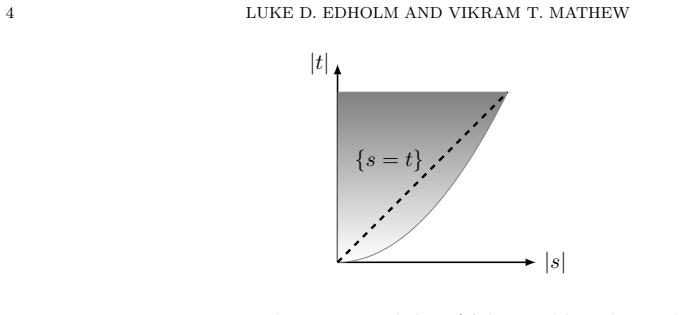
An effective formula for the Bergman kernel on $\mathbb{H}_{\gamma} = \{|z_1|^\gamma < |z_2| < 1 \}$ is obtained for rational $\gamma = \frac{m}{n} >1$. The formula depends on arithmetic properties of $\gamma$, which uncovers new symmetries and clarifies previous results. The formulas are then used to study the Lu Qi-Keng problem. We produce sequences of rationals $\gamma_j \searrow 1$, where each $\mathbb{H}_{\gamma_j}$ has a Bergman kernel with zeros (while $\mathbb{H}_1$ is known to have a zero-free kernel), resolving an open question on this domain class.
Editorial analysis
A structured set of objections, weighed in public.
Referee Report
Summary. The manuscript derives an effective formula for the Bergman kernel on the domains H_γ = {|z1|^γ < |z2| < 1} when γ = m/n is rational and greater than 1. The formula incorporates arithmetic properties (such as denominators and gcd data) of the rational γ. These formulas are applied to the Lu Qi-Keng problem by constructing sequences of rationals γ_j decreasing to 1, for which the Bergman kernel on each H_γj has zeros, while the kernel on H_1 is known to be zero-free. This is presented as resolving an open question for this class of quotient domains.
Significance. If the explicit formula is correctly derived and the zero detections are valid, the result is significant for the Lu Qi-Keng problem in several complex variables: it supplies explicit examples of domains whose Bergman kernels have zeros arbitrarily close to a zero-free case (γ=1). The arithmetic dependence of the formula is a strength, as it uncovers new symmetries and clarifies prior results on these domains. The provision of an effective, computable formula itself constitutes a concrete advance.
major comments (2)
- [§3, Theorem 3.4] §3, Theorem 3.4 (the effective formula for K_{H_γ} when γ=m/n): the derivation of the orthonormal basis via the quotient symmetry and the subsequent closed-form expression for the kernel must be verified to satisfy the reproducing property ∫_{H_γ} K(z,w) f(w) dV(w) = f(z) for holomorphic f; no direct check against the integral definition or against the known zero-free kernel at γ=1 is supplied, which is load-bearing for all subsequent zero claims.
- [§5, Proposition 5.3] §5, Proposition 5.3 (construction of γ_j ↘ 1 and zero locations): the explicit zeros are located using the arithmetic data (denominators/gcd) appearing in the kernel formula; if the formula contains an error in the handling of the symmetry or the basis completeness, the reported zeros for the sequence γ_j are not guaranteed to be actual zeros of the true Bergman kernel.
minor comments (1)
- [§2] The notation for the quotient action and the precise definition of the measure dV on H_γ should be recalled in §2 before the formula is stated, to improve readability for readers outside the immediate subfield.
Simulated Author's Rebuttal
We thank the referee for their thorough review and insightful comments on our manuscript. We address each major comment below and will make revisions to improve the clarity and rigor of the presentation.
read point-by-point responses
-
Referee: [§3, Theorem 3.4] §3, Theorem 3.4 (the effective formula for K_{H_γ} when γ=m/n): the derivation of the orthonormal basis via the quotient symmetry and the subsequent closed-form expression for the kernel must be verified to satisfy the reproducing property ∫_{H_γ} K(z,w) f(w) dV(w) = f(z) for holomorphic f; no direct check against the integral definition or against the known zero-free kernel at γ=1 is supplied, which is load-bearing for all subsequent zero claims.
Authors: The derivation proceeds by first identifying a complete orthonormal basis for the Bergman space on H_γ using the symmetry under the action of the finite group associated with the rational exponent γ = m/n. Specifically, the monomials z1^k z2^l are grouped according to the congruence conditions modulo n and m, incorporating the gcd data to determine the independent basis elements. The kernel is then expressed as a finite sum of geometric series, each corresponding to these arithmetic classes. The reproducing property holds by the standard construction of the Bergman kernel from a complete orthonormal basis. However, to address the referee's concern, we agree that an explicit verification would be beneficial. We will revise the manuscript to include a direct computation for a low-denominator example (e.g., γ=3/2) showing that the formula reproduces constants and linear functions, and we will add a note on the consistency with the γ=1 case by observing that as the denominator increases, the formula approaches the known integral expression for the zero-free kernel. revision: yes
-
Referee: [§5, Proposition 5.3] §5, Proposition 5.3 (construction of γ_j ↘ 1 and zero locations): the explicit zeros are located using the arithmetic data (denominators/gcd) appearing in the kernel formula; if the formula contains an error in the handling of the symmetry or the basis completeness, the reported zeros for the sequence γ_j are not guaranteed to be actual zeros of the true Bergman kernel.
Authors: We appreciate this cautionary note. The zeros are found by setting the kernel expression to zero at specific points (z,w) where the arithmetic conditions cause certain terms to cancel or vanish. Since the formula is derived from the basis, and the basis completeness is justified by the density of the monomials in the L2 space restricted to the domain (using the quotient to reduce to a fundamental domain), the zeros are indeed those of the Bergman kernel. To strengthen this, we will include in the revision a brief argument for the completeness of the basis and perhaps compute numerically for one γ_j the integral reproduction for a test function to confirm. This ensures the zero detections are reliable. revision: yes
Circularity Check
No circularity: formula derived independently then applied to zero detection
full rationale
The paper first obtains an effective formula for the Bergman kernel on H_γ for rational γ = m/n by standard orthonormal basis and reproducing kernel methods in several complex variables, with the formula explicitly incorporating arithmetic data such as denominators and gcd properties of m and n. This derivation is presented as self-contained and is then used to locate zeros for sequences γ_j ↘ 1. The zero-free property at γ = 1 is treated as previously established external knowledge rather than re-derived or fitted here. No step reduces the claimed zeros to a self-definition, a fitted parameter renamed as prediction, or a load-bearing self-citation chain; the central result remains an application of an independently derived expression.
Axiom & Free-Parameter Ledger
axioms (1)
- standard math Standard properties and existence of the Bergman kernel on Reinhardt or quotient domains in C^2
Lean theorems connected to this paper
-
IndisputableMonolith/Cost/FunctionalEquation.leanwashburn_uniqueness_aczel echoes?
echoesECHOES: this paper passage has the same mathematical shape or conceptual pattern as the Recognition theorem, but is not a direct formal dependency.
Qm,n(s) := s^{1-2n} P_{m,n}(s,s) ... Qm,n(s) = s^{2m-2n} Qm,n(s^{-1}) (Theorem 1.8, Prop. 3.22)
-
IndisputableMonolith/Foundation/ArithmeticFromLogic.leanLogicNat recovery unclear?
unclearRelation between the paper passage and the cited Recognition theorem.
L(j) = ceil((1 + n(j+1))/m), κ(j) = m + n -1 + nj - m L(j); modular arithmetic solves the index conditions (Prop. 3.4)
What do these tags mean?
- matches
- The paper's claim is directly supported by a theorem in the formal canon.
- supports
- The theorem supports part of the paper's argument, but the paper may add assumptions or extra steps.
- extends
- The paper goes beyond the formal theorem; the theorem is a base layer rather than the whole result.
- uses
- The paper appears to rely on the theorem as machinery.
- contradicts
- The paper's claim conflicts with a theorem or certificate in the canon.
- unclear
- Pith found a possible connection, but the passage is too broad, indirect, or ambiguous to say the theorem truly supports the claim.
Reference graph
Works this paper leans on
-
[1]
Bergman kernels of two dimensional monomial polyhedra
Almughrabi, R. Bergman kernels of two dimensional monomial polyhedra. Complex Anal. Oper. The- ory 17, 6 (2023), Paper No. 103, 21
work page 2023
-
[2]
Bell, S. R. The Bergman kernel function and proper holomorphic mappings. Trans. Amer. Math. Soc. 270, 2 (1982), 685–691. ARITHMETIC PROPERTIES AND ZEROS OF THE BERGMAN KERNEL 23
work page 1982
-
[3]
Lp-regularity of the Bergman projection on quotient domains
Bender, C., Chakrabarti, D., Edholm, L., and Mainkar, M. Lp-regularity of the Bergman projection on quotient domains. Canad. J. Math. 74 , 3 (2022), 732–772
work page 2022
-
[4]
The kernel function and conformal mapping , revised ed
Bergman, S. The kernel function and conformal mapping , revised ed. Mathematical Surveys, No. V. American Mathematical Society, Providence, R.I., 1970
work page 1970
-
[5]
Boas, H. P. Lu Qi-Keng’s problem. vol. 37. 2000, pp. 253–267. Several complex variables (Seoul, 1998)
work page 2000
-
[6]
Boas, H. P., Fu, S., and Straube, E. J. The Bergman kernel function: explicit formulas and zeroes. Proc. Amer. Math. Soc. 127 , 3 (1999), 805–811
work page 1999
-
[7]
Chakrabarti, D., and Edholm, L. D. Projections onto Lp-Bergman spaces of Reinhardt domains. Adv. Math. 451 (2024), Paper No. 109790, 46
work page 2024
-
[8]
Chakrabarti, D., Edholm, L. D., and McNeal, J. D. Duality and approximation of Bergman spaces. Adv. Math. 341 (2019), 616–656
work page 2019
-
[9]
Bergman kernels of elementary Reinhardt domains
Chakrabarti, D., Konkel, A., Mainkar, M., and Miller, E. Bergman kernels of elementary Reinhardt domains. Pacific J. Math. 306 , 1 (2020), 67–93
work page 2020
-
[10]
Chakrabarti, D., and Zeytuncu, Y. E. Lp mapping properties of the Bergman projection on the Hartogs triangle. Proc. Amer. Math. Soc. 144 , 4 (2016), 1643–1653
work page 2016
-
[11]
Christopherson, A. B., and Koenig, K. D. Weak-type regularity of the Bergman projection on rational Hartogs triangles. Proc. Amer. Math. Soc. 151 , 4 (2023), 1643–1653
work page 2023
-
[12]
S.Explicit construction of moduli space of bounded complete Reinhardt domains in Cn
Du, R., Gao, Y., and Yau, S. S.Explicit construction of moduli space of bounded complete Reinhardt domains in Cn. Comm. Anal. Geom. 18 , 3 (2010), 601–626
work page 2010
-
[13]
Du, R., and Yau, S. Higher order Bergman functions and explicit construction of moduli space for complete Reinhardt domains. J. Differential Geom. 82 , 3 (2009), 567–610
work page 2009
-
[14]
Dunnage, J. E. A. The number of real zeros of a random trigonometric polynomial. Proc. London Math. Soc. (3) 16 (1966), 53–84
work page 1966
-
[15]
Edholm, L. D. The Bergman kernel of fat Hartogs triangles . ProQuest LLC, Ann Arbor, MI, 2016. Thesis (Ph.D.)–The Ohio State University
work page 2016
-
[16]
Edholm, L. D. Bergman theory of certain generalized Hartogs triangles. Pacific J. Math. 284, 2 (2016), 327–342
work page 2016
-
[17]
Edholm, L. D., and McNeal, J. D. The Bergman projection on fat Hartogs triangles: Lp bounded- ness. Proc. Amer. Math. Soc. 144 , 5 (2016), 2185–2196
work page 2016
-
[18]
Edholm, L. D., and McNeal, J. D. Bergman subspaces and subkernels: degenerate Lp mapping and zeroes. J. Geom. Anal. 27 , 4 (2017), 2658–2683
work page 2017
-
[19]
Edholm, L. D., and McNeal, J. D. Sobolev mapping of some holomorphic projections. J. Geom. Anal. 30, 2 (2020), 1293–1311
work page 2020
-
[20]
Geometry of the symmetrized polydisc
Edigarian, A., and Zwonek, W. Geometry of the symmetrized polydisc. Arch. Math. (Basel) 84 , 4 (2005), 364–374
work page 2005
-
[21]
2-proper holomorphic images of classical cartan domains
Ghosh, G., and Zwonek, W. 2-proper holomorphic images of classical cartan domains. Indiana Univ. Math. J. (to appear) (2025)
work page 2025
-
[22]
Graham, R. L., Knuth, D. E., and Patashnik, O.Concrete mathematics, second ed. Addison-Wesley Publishing Company, Reading, MA, 1994. A foundation for computer science
work page 1994
-
[23]
Huo, Z., and Wick, B. D. Weak-type estimates for the Bergman projection on the polydisc and the Hartogs triangle. Bull. Lond. Math. Soc. 52 , 5 (2020), 891–906
work page 2020
-
[24]
Huo, Z., and Wick, B. D. Weighted estimates for the Bergman projection on the Hartogs triangle. J. Funct. Anal. 279 , 9 (2020), 108727, 34
work page 2020
-
[25]
First steps in several complex variables: Reinhardt domains
Jarnicki, M., and Pflug, P. First steps in several complex variables: Reinhardt domains . EMS Textbooks in Mathematics. European Mathematical Society (EMS), Z¨ urich, 2008
work page 2008
-
[26]
Khanh, T. V., Liu, J., and Thuc, P. T. Bergman-Toeplitz operators on fat Hartogs triangles. Proc. Amer. Math. Soc. 147 , 1 (2019), 327–338
work page 2019
-
[27]
Krantz, S. G. Function Theory of Several Complex Variables, 2nd Ed. Wadsworth & Brooks/Cole Mathematics Series. Wadsworth & Brooks/Cole, 1992
work page 1992
-
[28]
Krantz, S. G. A new proof and a generalization of Ramadanov’s theorem. Complex Var. Elliptic Equ. 51, 12 (2006), 1125–1128
work page 2006
-
[29]
Krantz, S. G. Geometric analysis of the Bergman kernel and metric , vol. 268 of Graduate Texts in Mathematics. Springer, New York, 2013
work page 2013
-
[30]
Kruzhilin, N. G. Holomorphic automorphisms of hyperbolic Reinhardt domains. Izv. Akad. Nauk SSSR Ser. Mat. 52 , 1 (1988), 16–40, 240
work page 1988
-
[31]
On Kaehler manifolds with constant curvature
Lu, Q.-K. On Kaehler manifolds with constant curvature. Acta Math. Sinica 16 (1966), 269–281
work page 1966
-
[32]
Nikolov, N., and Zwonek, W. o. The Bergman kernel of the symmetrized polydisc in higher dimen- sions has zeros. Arch. Math. (Basel) 87 , 5 (2006), 412–416
work page 2006
-
[33]
Rudin, W. Function theory in polydiscs . W. A. Benjamin, Inc., New York-Amsterdam, 1969. 24 LUKE D. EDHOLM AND VIKRAM T. MATHEW
work page 1969
-
[34]
Function theory in the unit ball of Cn
Rudin, W. Function theory in the unit ball of Cn. Classics in Mathematics. Springer-Verlag, Berlin,
-
[35]
Reprint of the 1980 edition
work page 1980
-
[36]
Automorphisms and equivalence of bounded Reinhardt domains not containing the origin
Shimizu, S. Automorphisms and equivalence of bounded Reinhardt domains not containing the origin. Tohoku Math. J. (2) 40 , 1 (1988), 119–152
work page 1988
-
[37]
Siu, Y. T. Pseudoconvexity and the problem of Levi. Bull. Amer. Math. Soc. 84 , 4 (1978), 481–512
work page 1978
-
[38]
Proper holomorphic mappings, Bell’s formula, and the Lu Qi-Keng problem on the tetrablock
Trybu la, M. Proper holomorphic mappings, Bell’s formula, and the Lu Qi-Keng problem on the tetrablock. Arch. Math. (Basel) 101 , 6 (2013), 549–558
work page 2013
-
[39]
Zapa lowski, P.Proper holomorphic mappings between generalized Hartogs triangles. Ann. Mat. Pura Appl. (4) 196 , 3 (2017), 1055–1071. Department of Mathematics, Universit¨at Wien, Vienna, Austria Email address: luke.david.edholm@univie.ac.at Department of Industrial Engineering and Operations Research, Columbia University, New York, New York Email address...
work page 2017
discussion (0)
Sign in with ORCID, Apple, or X to comment. Anyone can read and Pith papers without signing in.