REVIEW 3 major objections 6 minor 230 references
Imago Obscura: An Image Privacy AI Co-pilot to Enable Identification and Mitigation of Risks
T0 review · 3 major / 6 minor · reviewed 2026-08-07 · deepseek-v4-flash
Pith's one-line read Imago Obscura, an AI image-editing copilot, enables users to identify and mitigate privacy risks in images they intend to share.
desk verdict A well-crafted copilot prototype whose abstract overclaims: the evaluation is self-report only and cannot support the causal language used in the main claims. read the letter →
The pith
A machine-rendered reading of the paper's core claim, the machinery that carries it, and where it could break.
The reading
What carries the argument
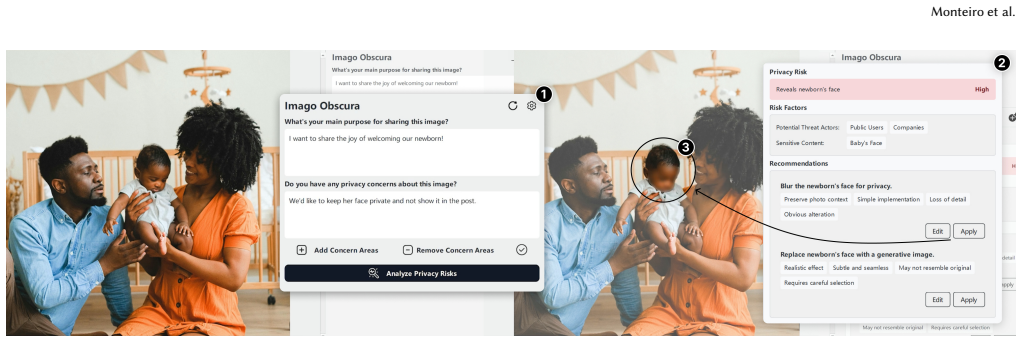
The load-bearing mechanism is an ensemble AI pipeline scaffolded by theory-grounded prompting. A vision model annotates objects with bounding boxes; a multimodal large language model, prompted with a curated taxonomy of sensitive elements and five risk categories plus the user's stated intent and concerns, returns structured risk assessments with severity and threat actors; a segmentation model turns bounding boxes into precise selections; and a latent diffusion image generator applies the chosen obfuscation, whether inpainting, generative replacement, blurring, or another technique. The prompting design uses set-of-mark visual prompting and chain-of-thought reasoning, which the paper argues constrains the model output and reduces ungrounded hallucinations. User control slots in at every stage: choose risks to address, choose a technique, refine the selection, and adjust intensity.
What would settle it
A randomized controlled experiment in which one group posts after using Imago Obscura and a control group posts after using a standard checklist, with actual posts coded for residual privacy-sensitive content, would settle whether the tool reduces real-world privacy risk; if no difference appears, the subjective gains do not translate into behavior.
Extended reading notes
Core claim
The paper's central claim is that a copilot can close the gap between academic knowledge about image privacy and what end-users actually do, by converting risk identification from a recall task into recognition and one-click action. It identifies five content-level risk categories—self-disclosure, identity exposure, confidential information leakage, location exposure, and bystander presence—and recommends from nine obfuscation techniques drawn from prior literature. The evaluation with 15 users found large drops in perceived privacy risk after using the tool, most pronounced for images users had withheld from sharing (mean change -2.26), while perceived ability to capture sharing intent did not significantly change. The paper concludes that Imago Obscura helps users balance privacy and publicity, including deciding knowingly to leave some risks unaddressed.
Load-bearing premise
The claim rests on the assumption that the 15 participants' self-reported survey and interview responses, without a control condition or observed sharing behavior, reflect real improvements in privacy awareness and protective behavior.
Editorial extensions
If this is right
- If the reported effects hold, users who currently self-censor or post without checking can instead edit out specific risks while keeping the photo shareable.
- Privacy risk identification stops being an expert skill: the taxonomy and explanations are surfaced in natural language with severity and threat actors.
- The copilot model implies that imperfect AI risk detection can still be useful when the human confirms selections and decides what to accept.
- The approach offers an alternative to blanket audience controls or full refusal to share, because users can address the specific risks they care about.
- The paper's own findings flag that heightened awareness can cut both ways: some users may over-rely on the tool and assume all risks are covered, so residual-risk communication matters.
Reading between the lines
- A fair next test would compare Imago Obscura against a static risk checklist or a generic photo editor with the same study protocol, since the current design does not isolate the copilot's interactive scaffolding as the cause of the gains.
- The tool's threat model excludes metadata, captions, and fully automated adversaries, so a malicious viewer with an analyst in the loop could still extract some information; this boundary is likely to shape any future deployment.
- The same pipeline could plausibly be adapted to screenshots, documents, or video frames where users must decide what to reveal, though the paper does not claim this.
- The reported accuracy numbers suggest user confirmation is not optional: at roughly 63% recall on sensitive objects, the system will miss risks, and the copilot's value depends on making misses visible and recoverable.
Editorial analysis
A structured set of objections, weighed in public.
Referee Report
Summary. This paper presents Imago Obscura, an AI-powered image privacy copilot integrated into the Krita editor, and reports its design and evaluation. The design is grounded in a formative study with seven image-editing experts, from which the authors derive five design requirements. The system lets users express sharing intent and privacy concerns in natural language or via visual annotations, uses an ensemble of Florence-2, GPT-4o, SAM, and Stable Diffusion to identify and explain privacy risks, and supports one-click application of nine obfuscation techniques. The evaluation includes an appendix technical evaluation on the DIPA2 dataset and a 15-participant lab study in which participants used the tool on their own images. The paper claims that the tool "greatly improved" users' awareness of image privacy risks, their ability to address those risks, and the informedness of their sharing decisions, based primarily on Likert-scale self-reports and semi-structured interviews.
Significance. The work addresses a real and timely problem, and its design process is a clear strength: the five design requirements are concretely tied to expert-interview findings and to specific system features, and the copilot framing is well motivated as an alternative to fully automated privacy protection. The implementation is substantial, and the qualitative findings about authenticity trade-offs, consent, and user agency are valuable for the usable-privacy community. The technical evaluation on an external dataset is a positive feature, as is the use of participants' own images. However, the central effectiveness claim rests on self-reported measures from a small, non-representative sample with no control condition and no behavioral outcome. As it stands, the contribution is best characterized as design requirements, system implementation, and qualitative insights; the stronger claim of demonstrated improvement in privacy decision-making is not yet established.
major comments (3)
- [8.2 and 8.3.2 / Fig. 14] The central claim of the abstract and conclusion—that Imago Obscura "greatly improved" users' awareness and ability and enabled "more informed sharing decisions"—is not supported by the reported study design. Section 8.2 states that participants were "not required to make any changes to their images," and the quantitative evidence in Fig. 14 is a pre/post change in self-reported perceived privacy risk (M = -1.20 overall; M = -2.27 for withheld images). Without a control condition, a behavioral outcome (e.g., actual mitigation quality or subsequent sharing behavior), or an objective measure of risk identification, a drop in perceived risk can be produced by the tool labeling content as risky, by demand characteristics, or by regression to the mean. The paper should either soften the causal claims to reflect that participants reported these effects, or add an experimental condition and outcome measures that directly test improved awareness and decision-making.
- [Appendix A.5, Table 2] The risk-identification performance is load-bearing for the awareness and informed-decision claims, but the reported numbers are weak on the dimensions that matter most for a copilot that surfaces overlooked risks: object-sensitivity recall is 53.22% and precision is 63.02%, and risk-category precision is 16.48%. This means that for a typical image, nearly half of sensitive objects and a large fraction of risk-category outputs may be missed or wrong. The text in §8 dismisses this evaluation as "peripheral," but if the tool systematically misses risks, user confidence in having "covered" an image—which participants expressed in §8.3.1—may be misplaced. The authors should either report a user-level analysis of missed risks in the study, temper the awareness and confidence claims, or provide evidence that the miss rate is acceptable for the copilot use case.
- [Appendix A.5.1 / §6.2] The technical evaluation has a circularity risk: the ground-truth risk categories in DIPA2 (personal information, location, preferences/pastimes, social circle, and others' confidential information) overlap with the risk taxonomy embedded in the MLLM prompt (§6.2 and Appendix A.6.1). The model is explicitly instructed to use this curated risk list, and the evaluation then measures agreement on the same or closely related categories. This makes the reported accuracy figures partially a measure of prompt-taxonomy alignment rather than generalizable risk-identification performance. A cleaner evaluation would use an independent annotation scheme or at least quantify the degree of label overlap between the prompt taxonomy and the evaluation dataset.
minor comments (6)
- [8.3.3] The SUS score of 70.1 should not be compared to standard SUS benchmarks because one item was omitted; the paper acknowledges this but still describes the score as indicating "good overall level of system usability." Since the benchmark comparison is invalid, present SUS only item-wise or recompute after estimating the omitted item.
- [6.3] There is a typo: "an explanation of of the source" should be "an explanation of the source."
- [Figure 10] The caption contains "A vatar replacement," which should read "Avatar replacement."
- [3.1] The reference "[49, 49, 76]" duplicates the [49] entry; please remove the duplicate.
- [A.4.1] Several post-task questions refer to "this modified image," even though participants were not required to modify their images; this wording may have confused participants' ratings and should be clarified.
- [7] The paper would benefit from a link to the plugin source code and the exact model configurations; no repository is provided.
Circularity Check
No significant circularity: the central claim is an empirical self-report result, and the technical evaluation uses an external dataset rather than a fitted input.
full rationale
Imago Obscura does not fit parameters to data and then present a transformed version of those data as a prediction. The technical evaluation in Appendix A.5 measures the risk-identification pipeline against the external DIPA2 dataset [68], which was annotated independently by Xu et al., and the paper explicitly calls this evaluation peripheral and model-agnostic. The user study's central claim ('greatly improved users' awareness ... ability') is supported by pre/post Likert ratings and interviews on participants' own images; whether self-report adequately supports a causal claim is a study-design and construct-validity issue, not a circular derivation. The one overlap worth noting is that the prompt taxonomy in Section 6.2 and Appendix A.6 is 'drawn from an analysis of prior art that includes taxonomies of sensitive content [42, 43, 68]' including DIPA2 [68], and the peripheral evaluation uses DIPA2 labels. However, the ground truth is external human annotation, the model is not fitted to that label set, and the paper's main contribution is the copilot workflow and qualitative evaluation, not an accuracy claim derived from the taxonomy. The SPAF self-citation ([9], Das et al.) frames the measurement but does not supply the outcome data, so it is not load-bearing. No circular step can be exhibited with a specific reduction, so the score is 0.
Assumptions & free parameters
assumptions (4)
- domain assumption The five-category risk taxonomy and the obfuscation-technique attribute table, derived from prior literature, are valid and sufficient for identifying and mitigating image privacy risks.
- domain assumption Third-party AI models (GPT-4o, Florence-2, SAM, Stable Diffusion) perform reliably enough for the copilot to support user decisions.
- domain assumption Self-reported Likert responses and interview statements are valid indicators of awareness, motivation, and ability to address privacy risks.
- domain assumption The adversary model (human analyst-in-the-loop, excluding contextual privacy and algorithmic adversaries) captures the privacy threats users care about.
Cite this review
Pith. "Pith review of Imago Obscura: An Image Privacy AI Co-pilot to Enable Identification and Mitigation of Risks." pith.science (2026). https://pith.science/paper/6R36EPKF
@misc{pith2026250520916,
  author       = {Pith},
  title        = {Pith review of: Imago Obscura: An Image Privacy AI Co-pilot to Enable Identification and Mitigation of Risks},
  year         = {2026},
  howpublished = {\url{https://pith.science/paper/6R36EPKF}},
  note         = {Machine review of arXiv:2505.20916}
}
read the original abstract
Users often struggle to navigate the privacy / publicity boundary in sharing images online: they may lack awareness of image privacy risks and/or the ability to apply effective mitigation strategies. To address this challenge, we introduce and evaluate Imago Obscura, an AI-powered, image-editing copilot that enables users to identify and mitigate privacy risks with images they intend to share. Driven by design requirements from a formative user study with 7 image-editing experts, Imago Obscura enables users to articulate their image-sharing intent and privacy concerns. The system uses these inputs to surface contextually pertinent privacy risks, and then recommends and facilitates application of a suite of obfuscation techniques found to be effective in prior literature -- e.g., inpainting, blurring, and generative content replacement. We evaluated Imago Obscura with 15 end-users in a lab study and found that it greatly improved users' awareness of image privacy risks and their ability to address those risks, allowing them to make more informed sharing decisions.
Figures


Figures from the paper (13 more)




Reference graph
Works this paper leans on
-
[1]
Adobe Inc. 2025. Adobe Photoshop. https://www.adobe.com/products/photoshop. html
2025
-
[2]
Shane Ahern, Dean Eckles, Nathaniel S Good, Simon King, Mor Naaman, and Rahul Nair. 2007. Over-exposed? Privacy patterns and considerations in online and mobile photo sharing. In Proceedings of the SIGCHI conference on Human factors in computing systems . 357–366
2007
-
[3]
Open AI. 2023. Gpt-4 technical report. arXiv preprint arXiv:2303.08774 (2023)
arXiv 2023
-
[4]
Tuomas Aura, Thomas A Kuhn, and Michael Roe. 2006. Scanning electronic documents for personally identifiable information. In Proceedings of the 5th ACM workshop on Privacy in electronic society . 41–50
2006
-
[5]
Virginia Braun and Victoria Clarke. 2006. Using thematic analysis in psychology. Qualitative research in psychology 3, 2 (2006), 77–101
2006
-
[6]
Matic Broz. 2024. How many pictures are there (2024): Statistics, trends, and forecasts. https://photutorial.com/photos-statistics/ Accessed: 2024-09-02
2024
-
[7]
Daniel Castro, Steven Hickson, Vinay Bettadapura, Edison Thomaz, Gregory Abowd, Henrik Christensen, and Irfan Essa. 2015. Predicting daily activities from egocentric images using deep learning. In proceedings of the 2015 ACM International symposium on Wearable Computers . 75–82
2015
-
[8]
Lorrie F Cranor. 2008. A framework for reasoning about the human in the loop. Conference on Usability, Psychology, and Security 1 (2008)
2008
Show all 230 references
-
[9]
Sauvik Das, Cori Faklaris, Jason I Hong, Laura A Dabbish, et al. 2022. The security & privacy acceptance framework (spaf). Foundations and Trends® in Privacy and Security 5, 1-2 (2022), 1–143
2022
-
[10]
Jelle Demanet, Kristof Dhont, Lies Notebaert, Sven Pattyn, and André Vandieren- donck. 2007. Pixelating familiar people in the media: Should masking be taken at face value? Psychologica belgica 47, 4 (2007), 261–276
2007
-
[11]
Early Moon, LLC. 2025. DAMA - Auto Redact Privacy. https://apps.apple.com/ us/app/dama-auto-redact-privacy/id1534690075
2025
-
[12]
W Keith Edwards, Erika Shehan Poole, and Jennifer Stoll. 2008. Security automa- tion considered harmful?. In Proceedings of the 2007 Workshop on New Security Paradigms. 33–42
2008
-
[13]
Michael Fire, Roy Goldschmidt, and Yuval Elovici. 2014. Online social networks: threats and solutions. IEEE Communications Surveys & Tutorials 16, 4 (2014), 2019–2036
2014
-
[14]
Ricard L Fogues, Jose M Such, Agustin Espinosa, and Ana Garcia-Fornes. 2017. Exploring the viability of tie strength and tags in access controls for photo sharing. In Proceedings of the Symposium on Applied Computing . 1082–1085
2017
-
[15]
Andrea Frome, German Cheung, Ahmad Abdulkader, Marco Zennaro, Bo Wu, Alessandro Bissacco, Hartwig Adam, Hartmut Neven, and Luc Vincent. 2009. Monteiro et al. Large-scale privacy protection in google street view. In 2009 IEEE 12th interna- tional conference on computer vision ....
2009
-
[16]
Guardian Project. 2025. ObscuraCam: The Privacy Camera. https:// guardianproject.info/apps/obscuracam/
2025
-
[17]
Maanak Gupta, CharanKumar Akiri, Kshitiz Aryal, Eli Parker, and Lopamudra Praharaj. 2023. From chatgpt to threatgpt: Impact of generative ai in cybersecurity and privacy. IEEE Access (2023)
2023
-
[18]
Rakibul Hasan, David Crandall, Mario Fritz, and Apu Kapadia. 2020. Auto- matically detecting bystanders in photos to reduce privacy risks. In 2020 IEEE Symposium on Security and Privacy (SP) . IEEE, 318–335
2020
-
[19]
Rakibul Hasan, Eman Hassan, Yifang Li, Kelly Caine, David J Crandall, Roberto Hoyle, and Apu Kapadia. 2018. Viewer experience of obscuring scene elements in photos to enhance privacy. In Proceedings of the 2018 CHI Conference on Human Factors in Computing Systems . 1–13
2018
-
[20]
Rakibul Hasan, Yifang Li, Eman Hassan, Kelly Caine, David J Crandall, Roberto Hoyle, and Apu Kapadia. 2019. Can privacy be satisfying? On improving viewer satisfaction for privacy-enhanced photos using aesthetic transforms. In Proceed- ings of the 2019 CHI conference on human ...
2019
-
[21]
Rakibul Hasan, Patrick Shaffer, David Crandall, Eman T Apu Kapadia, et al
-
[22]
Benjamin Henne and Matthew Smith. 2013. Awareness about photos on the web and how privacy-privacy-tradeoffs could help. In Financial Cryptography and Data Security: FC 2013 Workshops, USEC and W AHC 2013, Okinawa, Japan, April 1, 2013, Revised Selected Papers 17 . Springer, 131–148
2013
-
[23]
Roberto Hoyle, Robert Templeman, Denise Anthony, David Crandall, and Apu Kapadia. 2015. Sensitive lifelogs: A privacy analysis of photos from wearable cameras. In Proceedings of the 33rd Annual ACM conference on human factors in computing systems. 1645–1648
2015
-
[24]
Panagiotis Ilia, Iasonas Polakis, Elias Athanasopoulos, Federico Maggi, and Sotiris Ioannidis. 2015. Face/off: Preventing privacy leakage from photos in social networks. In Proceedings of the 22nd ACM SIGSAC Conference on computer and communications security. 781–792
2015
-
[25]
Yasha Iravantchi, Thomas Krolikowski, William Wang, Kang G Shin, and Alanson Sample. [n. d.]. PrivacyLens: On-Device PII Removal from RGB Images using Thermally-Enhanced Sensing. Proceedings on Privacy Enhancing Technologies YYYY (X) 1 ([n. d.]), 20
-
[26]
Adam Tauman Kalai and Santosh S Vempala. 2024. Calibrated language models must hallucinate. In Proceedings of the 56th Annual ACM Symposium on Theory of Computing. 160–171
2024
-
[27]
Vladimir Karpukhin, Barlas Oğuz, Sewon Min, Patrick Lewis, Ledell Wu, Sergey Edunov, Danqi Chen, and Wen-tau Yih. 2020. Dense passage retrieval for open- domain question answering. arXiv preprint arXiv:2004.04906 (2020)
2020 arXiv
-
[28]
Tero Karras, Miika Aittala, Janne Hellsten, Samuli Laine, Jaakko Lehtinen, and Timo Aila. 2020. Training generative adversarial networks with limited data. Advances in neural information processing systems 33 (2020), 12104–12114
2020
-
[29]
There will be less privacy, of course
Patrick Gage Kelley, Celestina Cornejo, Lisa Hayes, Ellie Shuo Jin, Aaron Sedley, Kurt Thomas, Yongwei Yang, and Allison Woodruff. 2023. " There will be less privacy, of course": How and why people in 10 countries expect{AI} will affect privacy in the future. In Nineteenth Sym...
2023
-
[30]
Mohamed Khamis, Habiba Farzand, Marija Mumm, and Karola Marky. 2022. DeepFakes for privacy: Investigating the effectiveness of state-of-the-art privacy- enhancing face obfuscation methods. In Proceedings of the 2022 International Conference on Advanced Visual Interfaces . 1–5
2022
-
[31]
Alexander Kirillov, Eric Mintun, Nikhila Ravi, Hanzi Mao, Chloe Rolland, Laura Gustafson, Tete Xiao, Spencer Whitehead, Alexander C Berg, Wan-Yen Lo, et al
-
[32]
Mohammed Korayem, Robert Templeman, Dennis Chen, David Crandall, and Apu Kapadia. 2016. Enhancing lifelogging privacy by detecting screens. In Proceedings of the 2016 CHI Conference on Human Factors in Computing Systems . 4309–4314
2016
-
[33]
Pavel Korshunov, Andrea Melle, Jean-Luc Dugelay, and Touradj Ebrahimi. 2013. Framework for objective evaluation of privacy filters. In Applications of Digital Image Processing XXXVI, Vol. 8856. SPIE, 265–276
2013
-
[34]
Open-source Krita Foundation. 2025. Krita: Free and open-source digital painting application. https://krita.org/en/
2025
-
[35]
Damera Vijay Kumar, P Satya Shekar Varma, and Shyam Sunder Pabboju. 2013. Security issues in social networking. International Journal of Computer Science and Network Security (IJCSNS) 13, 6 (2013), 120
2013
-
[36]
Karen Lander, Vicki Bruce, and Harry Hill. 2001. Evaluating the effectiveness of pixelation and blurring on masking the identity of familiar faces. Applied Cognitive Psychology: The Official Journal of the Society for Applied Research in Memory and Cognition 15, 1 (2001), 101–116
2001
-
[37]
Hao-Ping Lee, Yu-Ju Yang, Thomas Serban Von Davier, Jodi Forlizzi, and Sauvik Das. 2024. Deepfakes, Phrenology, Surveillance, and More! A Taxonomy of AI Privacy Risks. In Proceedings of the CHI Conference on Human Factors in Computing Systems. 1–19
2024
-
[38]
Patrick Lewis, Ethan Perez, Aleksandra Piktus, Fabio Petroni, Vladimir Karpukhin, Naman Goyal, Heinrich Küttler, Mike Lewis, Wen-tau Yih, Tim Rock- täschel, et al. 2020. Retrieval-augmented generation for knowledge-intensive nlp tasks. Advances in Neural Information Processing...
2020
-
[39]
Fenghua Li, Zhe Sun, Ang Li, Ben Niu, Hui Li, and Guohong Cao. 2019. Hideme: Privacy-preserving photo sharing on social networks. In IEEE INFOCOM 2019- IEEE Conference on Computer Communications . IEEE, 154–162
2019
-
[40]
Wenjie Li, Rongrong Ni, and Yao Zhao. 2017. JPEG photo privacy-preserving algorithm based on sparse representation and data hiding. InImage and Graphics: 9th International Conference, ICIG 2017, Shanghai, China, September 13-15, 2017, Revised Selected Papers, Part III 9 . Spri...
2017
-
[41]
Yifang Li and Kelly Caine. 2022. Obfuscation remedies harms arising from content flagging of photos. In Proceedings of the 2022 CHI Conference on Human Factors in Computing Systems . 1–25
2022
-
[42]
Yifang Li, Wyatt Troutman, Bart P Knijnenburg, and Kelly Caine. 2018. Human perceptions of sensitive content in photos. In Proceedings of the IEEE Conference on Computer Vision and Pattern Recognition Workshops . 1590–1596
2018
-
[43]
Yifang Li, Nishant Vishwamitra, Hongxin Hu, and Kelly Caine. 2020. Towards a taxonomy of content sensitivity and sharing preferences for photos. In Pro- ceedings of the 2020 CHI Conference on Human Factors in Computing Systems . 1–14
2020
-
[44]
Yifang Li, Nishant Vishwamitra, Bart P Knijnenburg, Hongxin Hu, and Kelly Caine. 2017. Effectiveness and users’ experience of obfuscation as a privacy- enhancing technology for sharing photos. Proceedings of the ACM on Human- Computer Interaction 1, CSCW (2017), 1–24
2017
-
[45]
Chi Liu, Tianqing Zhu, Jun Zhang, and Wanlei Zhou. 2022. Privacy intelligence: A survey on image privacy in online social networks. Comput. Surveys 55, 8 (2022), 1–35
2022
-
[46]
Virginia Mantouvalou. 2019. ‘I lost my job over a Facebook post: Was that fair?’Discipline and dismissal for social media activity. International Journal of Comparative Labour Law and Industrial Relations 35, 1 (2019)
2019
-
[47]
Gary Marcus. 2020. The next decade in AI: four steps towards robust artificial intelligence. arXiv preprint arXiv:2002.06177 (2020)
2020 arXiv
-
[48]
Phillip Nyoni and Mthulisi Velempini. 2018. Privacy and user awareness on Facebook. South African Journal of Science 114, 5-6 (2018), 1–5
2018
-
[49]
Tribhuvanesh Orekondy, Bernt Schiele, and Mario Fritz. 2017. Towards a vi- sual privacy advisor: Understanding and predicting privacy risks in images. In Proceedings of the IEEE international conference on computer vision . 3686–3695
2017
-
[50]
privacy
Leysia Palen and Paul Dourish. 2003. Unpacking" privacy" for a networked world. In Proceedings of the SIGCHI conference on Human factors in computing systems . 129–136
2003
-
[51]
Constantinos Patsakis, Athanasios Zigomitros, Achilleas Papageorgiou, and Agusti Solanas. 2015. Privacy and security for multimedia content shared on OSNs: issues and countermeasures. Comput. J. 58, 4 (2015), 518–535
2015
-
[52]
Alec Radford, Jong Wook Kim, Chris Hallacy, Aditya Ramesh, Gabriel Goh, Sand- hini Agarwal, Girish Sastry, Amanda Askell, Pamela Mishkin, Jack Clark, et al
-
[53]
You don’t want to be the next meme
Yasmeen Rashidi, Tousif Ahmed, Felicia Patel, Emily Fath, Apu Kapadia, Chris- tena Nippert-Eng, and Norman Makoto Su. 2018. " You don’t want to be the next meme": College Students’ Workarounds to Manage Privacy in the Era of Pervasive Photography. In Fourteenth Symposium on Us...
2018
-
[54]
Robin Rombach, Andreas Blattmann, Dominik Lorenz, Patrick Esser, and Björn Ommer. 2022. High-resolution image synthesis with latent diffusion models. In Proceedings of the IEEE/CVF conference on computer vision and pattern recognition . 10684–10695
2022
-
[55]
Shawn Shan, Jenna Cryan, Emily Wenger, Haitao Zheng, Rana Hanocka, and Ben Y Zhao. 2023. Glaze: Protecting artists from style mimicry by {Text-to- Image} models. In 32nd USENIX Security Symposium (USENIX Security 23) . 2187– 2204
2023
-
[56]
Shawn Shan, Wenxin Ding, Josephine Passananti, Haitao Zheng, and Ben Y Zhao
-
[57]
Shawn Shan, Emily Wenger, Jiayun Zhang, Huiying Li, Haitao Zheng, and Ben Y Zhao. 2020. Fawkes: Protecting privacy against unauthorized deep learning models. In 29th USENIX security symposium (USENIX Security 20) . 1589–1604
2020
-
[58]
Manya Sleeper, Rebecca Balebako, Sauvik Das, Amber Lynn McConahy, Ja- son Wiese, and Lorrie Faith Cranor. 2013. The post that wasn’t: exploring self-censorship on facebook. In Proceedings of the 2013 conference on Computer supported cooperative work. 793–802
2013
-
[59]
Eleftherios Spyromitros-Xioufis, Symeon Papadopoulos, Adrian Popescu, and Yiannis Kompatsiaris. 2016. Personalized privacy-aware image classification. In Proceedings of the 2016 ACM on international conference on multimedia retrieval . 71–78. Imago Obscura: An Image Privacy AI...
2016
-
[60]
arXiv preprint arXiv:2310.13828 (2023)
Prompt-specific poisoning attacks on text-to-image generative models. arXiv preprint arXiv:2310.13828 (2023)
2023 arXiv
-
[61]
Nishant Vishwamitra, Hongxin Hu, Feng Luo, and Long Cheng. 2021. Towards understanding and detecting cyberbullying in real-world images. In 2020 19th IEEE international conference on machine learning and applications (ICMLA)
2021
-
[62]
Nishant Vishwamitra, Yifang Li, Hongxin Hu, Kelly Caine, Long Cheng, Ziming Zhao, and Gail-Joon Ahn. 2022. Towards automated content-based photo privacy control in user-centered social networks. In Proceedings of the Twelfth ACM Conference on Data and Application Security and ...
2022
-
[63]
I regretted the minute I pressed share
Yang Wang, Gregory Norcie, Saranga Komanduri, Alessandro Acquisti, Pedro Gio- vanni Leon, and Lorrie Faith Cranor. 2011. " I regretted the minute I pressed share" a qualitative study of regrets on Facebook. In Proceedings of the seventh symposium on usable privacy and security . 1–16
2011
-
[64]
Nancy Van House, Marc Davis, Morgan Ames, Megan Finn, and Vijay Viswanathan. 2005. The uses of personal networked digital imaging: an empiri- cal study of cameraphone photos and sharing. In CHI’05 extended abstracts on Human factors in computing systems . 1853–1856
2005
-
[65]
Bin Xiao, Haiping Wu, Weijian Xu, Xiyang Dai, Houdong Hu, Yumao Lu, Michael Zeng, Ce Liu, and Lu Yuan. 2023. Florence-2: Advancing a Unified Representation for a Variety of Vision Tasks. arXiv:2311.06242 [cs.CV] https://arxiv.org/abs/ 2311.06242
2023 arXiv
-
[66]
Anran Xu, Shitao Fang, Huan Yang, Simo Hosio, and Koji Yatani. 2024. Exam- ining Human Perception of Generative Content Replacement in Image Privacy Protection. In Proceedings of the CHI Conference on Human Factors in Computing Systems. 1–16
2024
-
[67]
Anran Xu, Zhongyi Zhou, Kakeru Miyazaki, Ryo Yoshikawa, Simo Hosio, and Koji Yatani. 2023. DIPA: An Image Dataset with Cross-cultural Privacy Concern Annotations. In Companion Proceedings of the 28th International Conference on Intelligent User Interfaces. 259–266
2023
-
[68]
Jason Wei, Xuezhi Wang, Dale Schuurmans, Maarten Bosma, Fei Xia, Ed Chi, Quoc V Le, Denny Zhou, et al. 2022. Chain-of-thought prompting elicits reason- ing in large language models. Advances in neural information processing systems 35 (2022), 24824–24837
2022
-
[69]
Ziwei Xu, Sanjay Jain, and Mohan Kankanhalli. 2024. Hallucination is inevitable: An innate limitation of large language models. arXiv preprint arXiv:2401.11817 (2024)
2024 arXiv
-
[70]
Jianwei Yang, Hao Zhang, Feng Li, Xueyan Zou, Chunyuan Li, and Jianfeng Gao. 2023. Set-of-mark prompting unleashes extraordinary visual grounding in gpt-4v. arXiv preprint arXiv:2310.11441 (2023)
2023 arXiv
-
[71]
Jun Yu, Zhenzhong Kuang, Zhou Yu, Dan Lin, and Jianping Fan. 2017. Pri- vacy setting recommendation for image sharing. In 2017 16th IEEE International Conference on Machine Learning and Applications (ICMLA) . IEEE, 726–730
2017
-
[72]
Anran Xu, Zhongyi Zhou, Kakeru Miyazaki, Ryo Yoshikawa, Simo Hosio, and Koji Yatani. 2024. DIPA2: An Image Dataset with Cross-cultural Privacy Percep- tion Annotations. Proceedings of the ACM on Interactive, Mobile, Wearable and Ubiquitous Technologies 7, 4 (2024), 1–30
2024
-
[73]
Jun Yu, Baopeng Zhang, Zhengzhong Kuang, Dan Lin, and Jianping Fan. 2016. iPrivacy: image privacy protection by identifying sensitive objects via deep multi-task learning. IEEE Transactions on Information Forensics and Security 12, 5 (2016), 1005–1016
2016
-
[74]
Sergej Zerr, Stefan Siersdorfer, and Jonathon Hare. 2012. Picalert! a system for privacy-aware image classification and retrieval. In Proceedings of the 21st ACM international conference on Information and knowledge management . 2710–2712
2012
-
[75]
Sergej Zerr, Stefan Siersdorfer, Jonathon Hare, and Elena Demidova. 2012. Privacy-aware image classification and search. In Proceedings of the 35th in- ternational ACM SIGIR conference on Research and development in information retrieval. 35–44
2012
-
[76]
Jun Yu, Zhenzhong Kuang, Baopeng Zhang, Wei Zhang, Dan Lin, and Jianping Fan. 2018. Leveraging content sensitiveness and user trustworthiness to recom- mend fine-grained privacy settings for social image sharing. IEEE transactions on information forensics and security 13, 5 (2...
2018
-
[80]
Chenye Zhao, Jasmine Mangat, Sujay Koujalgi, Anna Squicciarini, and Cornelia Caragea. 2022. Privacyalert: A dataset for image privacy prediction. InProceedings of the International AAAI Conference on Web and Social Media, Vol. 16. 1352–1361. Monteiro et al. A APPENDIX A.1 Use ...
2022
-
[81]
Understand the context of the image * Examine the photo [ image ] * Consider the user ' s purpose for sharing , if provided [ text ] * Address user ' s privacy concerns , if any [ text , image with green annotations ]
-
[82]
Identify potential sensitive content * Refer to the Sensitive Content list [ text list ] * Analyze all objects in the photo [ text , annotated images , object list ]
-
[83]
Determine privacy risks based on steps 1 & 2 * Refer to common privacy risks in photo sharing [ text list ] * Identify user 's concern specific privacy risks , if any [ text ]
-
[84]
[ MATERIALS ] To achieve your goal , you have access to :
For each risk , categorize its severity and specify potential threat actors Your analysis will help you identify and communicate potential privacy risks to the user in a clear and actionable manner . [ MATERIALS ] To achieve your goal , you have access to :
-
[85]
Primary Image [ Original Image ] * The image the user wants to share
-
[86]
User - Provided Context ( optional ) * Sharing intent in the user ' s words [ User Input ] * Privacy concerns expressed by the user * Textual description in users words [ User Input ] * Annotated image with concerns marked in green by the user [ User Concern Region ]
-
[87]
Image Analysis [ Pre - Scan Data ] * Visually annotated photo with red boxes marking all objects * JSON dictionary of object annotations , including position , length , and width of bounding boxes
-
[88]
[ TASKS ] Please follow these tasks to analyze the image and provide necessary privacy risk assessments :
Reference Materials * Curated list of Potential Sensitive Elements * Curated list of Potential Risks in sharing images online Remember to prioritize user - provided privacy concerns when identifying risks and sensitive content . [ TASKS ] Please follow these tasks to analyze t...
-
[89]
Understand the Image Context :
-
[90]
analyze the image and the users sharing intent
-
[91]
Describe elements within green - bordered areas as user concerns ( if present )
-
[92]
analyze all user concern ( if provided )
-
[93]
license plate
Focus on specific elements , not general categories ( e . g . , " license plate " instead of " car ")
-
[94]
use concise phrases for each element
-
[95]
Identify Sensitive Elements
-
[96]
Reference the curated list of potential sensitive elements
-
[97]
Scan the entire image for sensitive elements
-
[98]
Scan the annotated image for sensitive elements
-
[99]
Scan the objects identified in the dictionary for potential sensitive elements
-
[100]
Include user - highlighted concerns as sensitive elements
-
[101]
Consider context - specific sensitive elements not in the curated list
-
[102]
When conducting analysis , first examine each object individually and assess it for sensitivity , and then analyze the relationships between objects in the image to identify potential sensitive information inferred in the image
-
[103]
person 1
Combine similar elements to avoid duplicates . For example , " person 1" , " person 2" , and " person 3" can be combined as " person "
-
[104]
Determine Privacy Risks
-
[105]
Identify potential privacy risks for each sensitive element
-
[106]
Refer to the curated list of potential privacy risks to identify risks present in the image that the user might have forgotten to consider
-
[107]
Combine the same risks which have different sensitive elements
-
[108]
Reveals personal information
Use clear , non - technical phrases ( max 5 words per risk ) Example : " Reveals personal information " instead of " Self Disclosure "
-
[109]
Assess Each Privacy Risk
-
[110]
If the risk contains elements marked by the user , prioritize those risks as high severity
Categorize severity : High , Medium , or Low . If the risk contains elements marked by the user , prioritize those risks as high severity
-
[111]
Specify potential threat actors ( e . g . , Public Users , Companies , Family / Friends )
-
[112]
List associated sensitive elements using concise phrases
-
[113]
Consider user intent and privacy concern : Ensure that the severity prediction accounts for the user ' s mentioned intent and specific privacy concerns
-
[115]
All risks should be identified
-
[116]
Measure Image Type Mean Change (SD) 𝛽 SE 𝑧 𝑝 Sig
Every sensitive element should have at least one associated privacy risk Monteiro et al. Measure Image Type Mean Change (SD) 𝛽 SE 𝑧 𝑝 Sig. Change in Expression Capture All images -0.116 (1.151) -0.235 0.364 -0.646 0.518 Previously Shared -0.333 (1.154) -0.427 0.556 -0.769 0.44...
-
[117]
All user concerns must be addressed in at least one privacy risk
-
[119]
Ensure clarity and consistency in assessments CURATED LIST OF POTENTIAL SENSITIVE ELEMENTS
-
[120]
Identity and Personal Information
-
[121]
Person : Faces and identities of individuals ( including photo owner , family members , children , friends , bystanders )
-
[122]
Identity : Personal documents ( e . g . , ID cards , passports , licenses ) , contact information ( e . g . , home address , phone numbers )
-
[123]
Place Identifier : Locations ( e . g . , home , workplace ) , scenery , or vacation spots that may be private
-
[124]
Vehicle Plate : Vehicle license plates and identifying markers
-
[125]
Nudity and Sexual Content
-
[126]
Full or partial nudity or semi - nudity
-
[127]
Sexual content , suggestive poses , or erotic imagery
-
[128]
Revealing , immodest , or inappropriate clothing ( e . g . , swimsuits , underwear )
-
[129]
Other People and Social Contexts
-
[130]
Person : Photos featuring others ( e . g . , family , friends , coworkers , bystanders )
-
[131]
Group events and social gatherings ( e . g . , parties , weddings )
-
[132]
Interactions with significant others or personal moments with others
-
[133]
Embarrassing or Unorganized Environments
-
[134]
Table : Messy , unorganized , or cluttered home spaces ( e . g . , kitchen , living room , bathroom )
-
[135]
Unflattering grooming or sleeping shots
-
[136]
Low - quality or outdated photos that do not reflect the current state
-
[137]
Violence and Criminal Activity
-
[138]
Weapon : Scenes depicting violence or harm ( e . g . , battlefield , firearms )
-
[139]
Criminal behavior or unlawful activities ( e . g . , drugs , vandalism , theft )
-
[140]
Dangerous objects ( e . g . , weapons , guns )
-
[141]
Medical and Health Conditions
-
[142]
Visible injuries , medical conditions , or medical treatments
-
[143]
Unflattering depictions of physical health ( e . g . , acne , wounds , bad teeth )
-
[144]
Photos taken during medical procedures or showing medical equipment
-
[145]
Alcohol , Drugs , and Partying
-
[146]
Cigarettes : Images showing drinking , smoking , or substance use
-
[147]
Social gatherings involving alcohol , drugs , or related paraphernalia
-
[148]
Partying or celebratory events with potentially controversial behaviors
-
[149]
Appearance , Grooming , and Physical Attributes
-
[150]
Cosmetics : Unflattering body features or grooming ( e . g . , messy hair , weight issues )
-
[151]
Clothing : Tattoos , piercings , or unusual fashion choices that may be controversial
-
[152]
Finger : Poses or expressions that reflect poorly on personal character
-
[153]
Religious and Cultural Sensitivity
-
[154]
Religious symbols , clothing , or practices that might be sensitive
-
[155]
Cultural references or behaviors that could be misinterpreted or offensive
-
[156]
LGBTQ + content that may be sensitive in certain contexts
-
[157]
Sensitive and Private Information
-
[158]
Screen : Screens displaying sensitive or personal information ( e . g . , emails , documents , monitor screens )
-
[159]
Printed Materials : Handwritten or printed details revealing personal or professional data
-
[160]
Unique or personal belongings that reveal too much about the owner
-
[161]
Illegal , Unlawful , or Copyrighted Content
-
[162]
Printed Materials : Images associated with illegal activities ( e . g . , drug use , piracy )
-
[163]
Content that might suggest unlawful behavior ( e . g . , trespassing , theft , vandalism )
-
[164]
Book : Copyrighted materials or unauthorized content ( e . g . , photos of artwork , copyrighted documents )
-
[165]
Politically and Socially Offensive Content
-
[166]
Printed Materials : Politically sensitive or controversial subjects ( e . g . , North Korean leader , racism memes )
-
[167]
Vulgar gestures , symbols , or language ( e . g . , middle finger , offensive memes )
-
[168]
Racism , hate speech , or other socially offensive materials
-
[169]
Personal Assets and Belongings
-
[170]
High - Value Assets : Cars , jewelry , antiques , art , and other valuable personal belongings
-
[171]
Pet : Photos of personal pets or animals that the individual owns
-
[172]
Electronic Devices : Personal electronics ( e . g . , laptops , phones )
-
[173]
Musical Instrument : Musical instruments and other personal items that might be sensitive to the owner
-
[174]
Factors Affecting Public Image and Reputation
-
[175]
Photo : Unflattering or embarrassing shots that may harm public perception ( e . g . , unflattering facial expressions , bad hair days )
-
[176]
Machine : Activities or settings that can be misinterpreted negatively ( e . g . , unorganized home , awkward social situations )
-
[177]
Old , poor - quality , or technically flawed photos that do not reflect current image
-
[178]
Food , Lifestyle , and Leisure
-
[179]
Food : Unhealthy or unappealing food ( e . g . , junk food , fast food )
-
[180]
Lifestyle : Overindulgence or gluttony in food or drink , smoking , cigars
-
[181]
Toy : Personal items such as toys that might reflect a certain lifestyle
-
[182]
No Need to Share or Irrelevant Content
-
[183]
Content irrelevant to the audience or context
-
[184]
Trivial or unnecessary details that don ' t add value to the viewer ( e . g . , insignificant events , mundane personal moments ) Although an object annotated image and an object dictionary is provided to help you identify sensitive elements , you should always add more sensit...
-
[185]
Self - Disclosure : Can we learn something personal or sensitive about the photo owner or subject from the content of the image ? Imago Obscura: An Image Privacy AI Co-pilot
-
[186]
Identity Disclosure : Can we learn something personal or sensitive about the photo owner or subject from the content of the image ?
-
[187]
Sensitive Information Leakage : Does the image reveal any unintended or unauthorized confidential data about the photo owner or subject ?
-
[188]
Location Exposure : Can the image provide insight into the movements or locations of the photo owner or subject , potentially exposing their location ?
-
[189]
Bystander Disclosure : Does the image inadvertently reveal personal information about third parties , such as bystanders , potentially violating their privacy ?
-
[190]
Acquaintance Disclosure : Does the image expose personal information about individuals familiar with the photo owner or subject , raising privacy concerns ?
-
[191]
Combine the same risks which have different sensitive elements
Any other privacy risks you can think of You can use these privacy risks as a reference to identify potential privacy risks . Combine the same risks which have different sensitive elements . Remember to use clear , easy to understand phrases ( max 5 words per risk ) , that is ...
-
[192]
Reveals personal details
Self - Disclosure Risk Examples : Risk : " Reveals personal details " Sensitive object : " Visible diary pages " Risk : " Shows private habits " Sensitive object : " Medication bottles "
-
[193]
Reveals who you are
Identity Exposure Risk Examples : Risk : " Reveals who you are " or " Reveals your identity " Sensitive object : " Face clearly visible " Risk : " Shows identifying marks " Sensitive object : " Unique tattoo visible "
-
[194]
Exposes private data
Confidential Information Leakage Risk Examples : Risk : " Exposes private data " Sensitive object : " Computer screen contents " Risk : " Reveals secret info " Sensitive object : " Visible document text "
-
[195]
Reveals where you are
Location Exposure Risk Examples : Risk : " Reveals where you are " Sensitive object : " Landmark in background " Risk : " Location can be inferred " Sensitive object : " Distinctive local architecture "
-
[196]
Shows others nearby
Bystander Risk Examples : Risk : " Shows others nearby " Sensitive object : " People in background " Risk : " Includes uninvolved persons " Sensitive object : " Stranger ' s face " IMPORTANT NOTE : Always try to understand the context of the image , and keep that in mind . If ...
-
[197]
Understand the context of the image
-
[198]
Examine the photo [ image ]
-
[199]
Consider the user 's purpose for sharing , if provided [ text ]
-
[200]
Consider the user 's privacy concerns , if any [ text , image with green annotations ]
-
[201]
Understand privacy risks & respective sensitive present in the image
-
[202]
Refer to the Privacy Risk identified in the image [ text list ]
-
[203]
Refer to the Sensitive Content Elements identified in the image [ text list ]
-
[204]
Analyze the available image obfuscation techniques and their advantages and disadvantages
-
[205]
Refer to the available image obfuscation techniques [ text list ] and their attributes [ text list ]
-
[206]
[ Materials ]: To help you better understand the image and privacy risks , you will receive :
Match it to the privacy risks based on your understanding of what is required by the image context and the identified privacy risks and sensitive elements [ text ] Your analysis will help you identify and recommend relevant image manipulation / obfuscation techniques and prese...
-
[207]
the original image [ Original Image ]
-
[208]
user ' s privacy concern , if provided any text description [ User Input ] or annotated image highlighting the areas of concern in green [ User Concern Region ]
-
[209]
a list of privacy risks and respective sensitive elements identified in the image [ Identification Result ]
-
[210]
Curated list of Available Image Obfuscation Technique
-
[211]
For each sensitive element of each privacy risk identified , provide specific image manipulation technique recommendations to mitigate the privacy risk
Curated list of Attributes of Each Image Obfuscation Technique [ Tasks ]: Please follow these tasks to provide the necessary recommendations for the image : Monteiro et al. For each sensitive element of each privacy risk identified , provide specific image manipulation techniq...
-
[212]
Understand the Image Context
-
[213]
Analyze the image , user ' s sharing intent , and user concerns
-
[214]
analyze the users sharing intent and user concern text and ( green ) annotated image ( if provided )
-
[215]
Determine Relevant Image Manipulation Techniques
-
[216]
For each sensitive element in an identified privacy risk refer to the curated list of image manipulation and the curated list of attributes
-
[217]
Generate Recommendations
-
[218]
List suitable recommendations for each sensitive element ( one manipulation type per recommendation )
-
[219]
Select up to 2 most appropriate recommendations per sensitive element
-
[220]
Provide 2 -6 recommendations per privacy risk ( mostly 2 x number of sensitive elements pointing to the privacy risk )
-
[221]
If the user has provided specific privacy concerns or preferences , you should ensure all user concerns have been addressed
-
[222]
Be creative and prioritize aesthetics - so consider the generative replacement , dot representation , avatar replacement , and removal techniques prior to other techniques
-
[223]
Present Recommendation
-
[224]
Use context - specific , user - friendly phrasing
-
[225]
Analyze and present attributes to help users make informed decisions
-
[226]
Include equal amounts of advantages and disadvantages
-
[227]
Explain attributes in context - specific , understandable terms
-
[228]
Ensure Comprehensive Coverage
-
[229]
Every sensitive element should have at least one recommended mitigation phrase suggesting an image manipulation technique
-
[230]
All user concerns must be addressed in at least 2 mitigation strategy recommendations
-
[231]
Verify all tasks are completed thoroughly
-
[232]
privacy_risk_id
Ensure clarity and consistency in assessments CURATED LIST OF AVAILABLE IMAGE MANIPULATION TECHNIQUE The obfuscation techniques can be in the types of : * Generative Replacement : replace the sensitive element with a generative image . * Removal : remove the sensitive element ...
-
[2017]
In Proceedings of the IEEE conference on computer vision and pattern recognition workshops
Cartooning for enhanced privacy in lifelogging and streaming videos. In Proceedings of the IEEE conference on computer vision and pattern recognition workshops. 29–38
-
[2021]
In International conference on machine learning
Learning transferable visual models from natural language supervision. In International conference on machine learning . PMLR, 8748–8763
-
[2023]
In Proceedings of the IEEE/CVF International Conference on Computer Vision
Segment anything. In Proceedings of the IEEE/CVF International Conference on Computer Vision. 4015–4026
Reviewed August 7, 2026 · model on record in the stance chip above.
Discussion (0). Sign in to comment.