REVIEW 3 major objections 3 minor 39 references
Progressively Projected Newton's Method
T0 review · 3 major / 3 minor · reviewed 2026-08-07 · deepseek-v4-flash
Pith's one-line read Selective, residual-guided projection secures Newton descent with 90% fewer Hessian projections.
desk verdict Useful empirical method with a real flaw: the descent guarantee is unsupported and the fallback claim doesn't hold. read the letter →
The pith
A machine-rendered reading of the paper's core claim, the machinery that carries it, and where it could break.
The reading
What carries the argument
The central mechanism is a residual-driven partition of element Hessians into an unprojected set $H_u$ and a projected set $H_p$, with an element moved into $H_p$ when $\|S_e g\|_\infty > \delta$, where $S_e$ selects the assembled degrees of freedom of element $e$ and $g$ is the current energy gradient. The adaptive tolerance $\delta$ — tightened by $\alpha = 0.5$ when indefiniteness is detected and relaxed by $\beta = 2$ after a successful Newton step — is what makes the projection progressive rather than fixed. Two engineering pieces carry the method: an SPD linear solver that exits early on indefiniteness (a negative pivot in LLT factorization, or a negative curvature direction in PCG), and incremental in-place assembly of the correction $\Delta H_e = \hat{H}_e - H_e$, which preserves sparsity and reuses existing assembly routines. Since the residual values are already computed by Newton's method, the heuristic adds no extra cost.
What would settle it
Construct a dynamic simulation in which the large-residual elements are all positive definite while the negative curvature resides in small-residual elements; if PPN then requires near-full projection to obtain a descent direction, the residual heuristic is refuted. The paper's own two-matrix example shows the phenomenon is possible in principle, so the test is concrete.
Extended reading notes
Core claim
The paper argues and demonstrates empirically that per-element Hessian projection is over-broad in two ways: it projects elements even when the assembled matrix is already positive definite, and it projects all elements even when only a sparse subset of them contributes the negative curvature. PPN instead starts each Newton iteration from the unmodified Hessian, has the linear solver signal indefiniteness, and projects only those element Hessians whose assembled residual exceeds an adaptive tolerance, expanding the projected set progressively until the solve succeeds. The tolerance is tightened by $\alpha = 0.5$ on failure and relaxed by $\beta = 2$ after a successful step, which keeps the global Hessian close to the true Hessian. The paper claims this preserves the descent-direction guarantee of PN while cutting element projections by an order of magnitude and, in most dynamic scenarios, also reducing Newton iterations by up to 50%.
Load-bearing premise
The load-bearing premise is that the elements with the largest assembled residual are the ones whose projection restores positive definiteness of the global Hessian; the paper offers empirical support but no proof of that correlation, and if it fails PPN can project the wrong elements without a guarantee of obtaining an SPD matrix.
Editorial extensions
If this is right
- In typical dynamic scenes with $\Delta t = 1/30$ s, substituting PPN for PN in an existing pipeline should reduce element Hessian projections by over 90% and cut Newton iterations by up to 50%.
- Because numerical eigendecompositions dominate projection cost, PPN narrows the performance gap between automatic-differentiation codebases and hand-tuned analytic-projection implementations.
- PPN reduces to plain Newton when the unmodified Hessian stays solvable, so it adds no overhead in contact-free or lightly stressed regimes.
- For very large time steps and quasistatic problems, the paper reports that PN remains preferable, so users in those regimes should not switch unconditionally.
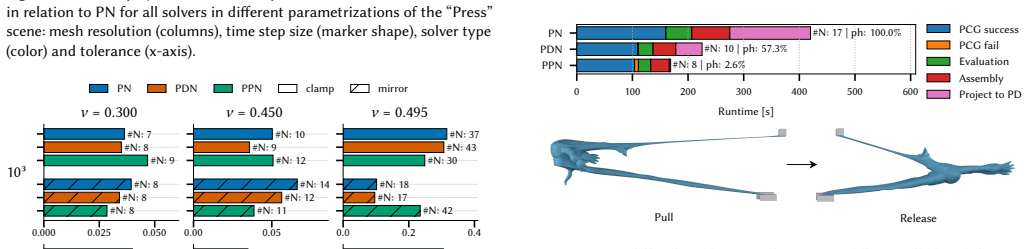
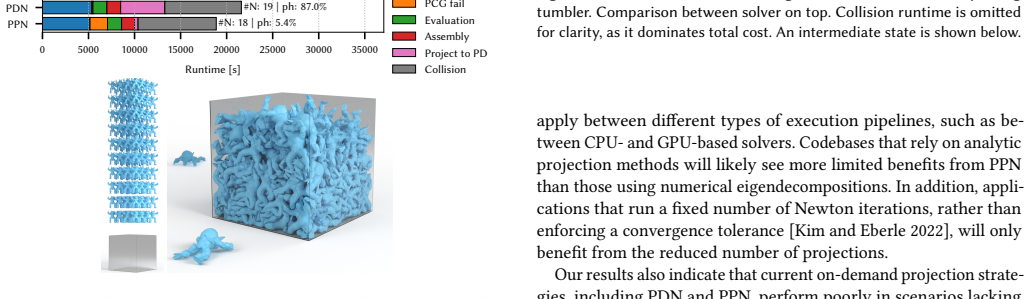
- The size of the speedup depends on the linear solver: PCG yields up to $\times 2.5$ over PN, while direct LLT factorization shows only modest gains because factorization dominates runtime.
Reading between the lines
- Beyond the paper: the residual-ranking heuristic could be replaced or augmented by a local curvature estimate, and the ablation suggests such a criterion might reduce failed linear solves at extreme settings even though $\alpha = 0.5, \beta = 2$ is not finely tuned.
- A further extension the authors do not pursue is a hybrid scheduler that projects unconditionally for the first iterations and switches to PPN once the residual concentrates, which could address the quasistatic weakness.
- The method's premise also applies outside time integration, to any second-order optimizer with element-wise assembled Hessians, such as shape optimization or material design, whenever global indefiniteness is localized.
- One could turn the heuristic into a certificate by computing, after the final projected set is chosen, whether any unprojected element still carries a negative eigenvalue; the paper offers no such check.
Editorial analysis
A structured set of objections, weighed in public.
Referee Report
Summary. The paper proposes Progressively Projected Newton (PPN), a Newton-type solver for optimization-based time integration. Instead of projecting every element Hessian before assembly as in Projected Newton (PN), PPN starts each Newton iteration with the unmodified Hessian and, whenever the linear solver reports indefiniteness, projects only those element Hessians whose assembled residual exceeds an adaptive threshold δ. The threshold is tightened after each failed solve and relaxed after a successful step. The method is evaluated on deformable solids, cloth, frictional contact, and rigid bodies, with PCG and direct Cholesky solvers, and is reported to use only a small fraction of the element projections of PN or Project-on-Demand Newton (PDN), often with fewer Newton iterations and lower runtime.
Significance. If the empirical claims hold, PPN is a practically valuable drop-in replacement for PN in dynamic simulation pipelines that rely on numerical eigendecompositions: it substantially reduces projection cost and keeps the global Hessian closer to the true Hessian, which plausibly explains the observed convergence benefits. The paper's strengths are its broad benchmark across contact-rich and contact-free scenes, resolutions, time steps, tolerances, and solvers; the ablation of the hyperparameters; and the explicit runtime breakdowns that identify eigenprojection as a dominant cost. The main weaknesses are the absence of a termination or descent guarantee for the residual-selection heuristic, the lack of the claimed full-projection fallback in Algorithm 1, and abstract/conclusion statements that overstate the consistency of the projection reductions.
major comments (3)
- [Section 4, Algorithm 1] The text states that PPN 'can fall back to full projection if necessary,' but Algorithm 1 contains no such fallback: the inner loop only tightens δ and never projects all elements. Consequently, the algorithm has no termination guarantee when indefiniteness is localized in an element whose assembled residual is zero or very small. Concretely, for Ψ(x,y) = −0.5 a x² + 0.5 k(x−y)² + 0.5 l(y−c)² at (0,0), with a > kl/(k+l), the global gradient is (0, −lc), the first element has residual 0 and Hessian −a, and the second element has a positive definite Hessian. Algorithm 1 never selects the indefinite first element, so every solve remains indefinite and δ decreases forever; full projection is never reached. Section 6 explicitly concedes that the heuristic is 'not tied to actual assembled indefiniteness.' Please either add a genuine full-projection fallback with a proof of finite termination, or substantially weaken the claims of guaranteed descent directions and robustness.
- [Abstract and §5.2 / Fig. 5] The abstract claims that PPN 'consistently performs fewer than 10% of the projections required by PN or PDN,' and the conclusion repeats that PPN 'consistently performs 90% fewer projections.' The paper's own results contradict the word 'consistently': §5.2 reports that across resolutions, time steps, and tolerances, PPN projects 'between 30% and 5%' of elements, and Fig. 5 shows cases above 10%, especially at Δt = 100 ms. The abstract should state the observed range and explicitly carry the caveat that PPN struggles for very large time steps and quasistatics, where PN remains preferable.
- [Section 4, Projection heuristic; Section 6] The paper presents the residual heuristic as the key mechanism for choosing projection subsets, but the only justification is the motivational observation that residual forces vanish at a stationary point. That observation does not imply that residual magnitude identifies elements whose contribution makes the assembled Hessian indefinite; a zero residual at a saddle point can coexist with an indefinite element Hessian. The paper acknowledges this gap in Section 6, yet the Introduction and Conclusion still claim that PPN 'guarantees descent directions' and that it is a 'direct replacement' for PN. Please present PPN's selection rule as an empirical heuristic with a clearly stated correctness caveat, or supply a proof under explicit assumptions.
minor comments (3)
- [Section 1 and Table 1] The time step is reported as 'Δt = 1/30 ms' in the text and as '1/30' under a column labeled 'Δt [ms]' in Table 1; the intended value is presumably 1/30 s (≈33.3 ms). Please correct the units consistently.
- [Algorithm 1, line 8] The notation 'partial_project_to_PD(H, g > δ)' is ambiguous; please define it explicitly, e.g. project all elements e for which ‖S_e g‖∞ > δ, using the selection matrix introduced in Section 4.
- [Section 5.1] The statement that a final fully projected Hessian solve is performed for verification but its cost is excluded from timing should be stated more prominently, since it affects the fairness of runtime comparisons for PN, which performs that projection at every iteration.
Circularity Check
PPN's residual heuristic is an empirical ansatz; its headline numbers are measured against independent baselines, so no circular reduction is present.
full rationale
The paper's central claim is that residual-driven selective projection is empirically faster and needs fewer projections. This is not derived from the tuned parameters: alpha and beta are chosen on the Press scene by ablation, then the same scene is used as one benchmark, but the headline claims are supported by a multi-scene comparison (Press, U-Turn, quasistatic, cloth, impacts) in which PPN, PN, and PDN are all executed under identical tolerances and time stepping. The residual heuristic itself is presented as a heuristic ('we define our heuristic: prioritize projecting element Hessians from regions ... with larger assembled residual'), and Section 6 explicitly concedes it is 'not tied to local assembled indefiniteness'; an unproven heuristic is a correctness/robustness limitation, not a circular definition. The PDN baseline comes from prior work by overlapping authors (Longva et al. 2023), but it is used as a compared baseline, not as the proof of PPN's guarantees, and its results are external published results rather than a premise smuggled into the derivation. The descent-direction 'guarantee' rests on the fallback-to-full-projection claim; the exact-zero residual counterexample shows that fallback can fail to trigger, which is a termination/robustness gap, not an equivalence between the input and the output. No equation in the paper defines the predicted quantity in terms of the fitted parameters or vice versa.
Assumptions & free parameters
free parameters (2)
- alpha (tightening factor) =
0.5
- beta (release factor) =
2.0
assumptions (4)
- ad hoc to paper Residual magnitude indicates local indefiniteness: elements with larger assembled residual are the ones whose projection restores positive definiteness of the global Hessian.
- standard math A successful PCG run (no negative curvature encountered) yields a descent direction even if the matrix is not SPD.
- domain assumption The assembled Hessian is the sum of element Hessians, and clamping eigenvalues of a subset can be updated incrementally without changing sparsity.
- domain assumption Early termination of LLT on a negative pivot and of PCG on a negative curvature direction reliably detects indefiniteness.
Cite this review
Pith. "Pith review of Progressively Projected Newton's Method." pith.science (2026). https://pith.science/paper/GWSG246C
@misc{pith2026250521013,
  author       = {Pith},
  title        = {Pith review of: Progressively Projected Newton's Method},
  year         = {2026},
  howpublished = {\url{https://pith.science/paper/GWSG246C}},
  note         = {Machine review of arXiv:2505.21013}
}
read the original abstract
Newton's Method is widely used to find the solution of complex non-linear simulation problems in Computer Graphics. To guarantee a descent direction, it is common practice to clamp the negative eigenvalues of each element Hessian prior to assembly - a strategy known as Projected Newton (PN) - but this perturbation often hinders convergence. In this work, we observe that projecting only a small subset of element Hessians is sufficient to secure a descent direction. Building on this insight, we introduce Progressively Projected Newton (PPN), a novel variant of Newton's Method that uses the current iterate residual to cheaply determine the subset of element Hessians to project. The global Hessian thus remains closer to its original form, reducing both the number of Newton iterations and the amount of required eigen-decompositions. We compare PPN with PN and Project-on-Demand Newton (PDN) in a comprehensive set of experiments covering contact-free and contact-rich deformables (including large stiffness and mass ratios), co-dimensional, and rigid-body simulations, and a range of time step sizes, tolerances and resolutions. PPN consistently performs fewer than 10% of the projections required by PN or PDN and, in the vast majority of cases, converges in fewer Newton iterations, which makes PPN the fastest solver in our benchmark. The most notable exceptions are simulations with very large time steps and quasistatics, where PN remains a better choice.
Figures


Figures from the paper (6 more)




Reference graph
Works this paper leans on
-
[6]
arXiv:2303.02156 arXiv Preprint
SymX: Energy-based Simulation from Symbolic Expressions. arXiv:2303.02156 arXiv Preprint. Xiao-Ming Fu and Yang Liu
-
[9]
ACM Transactions on Graphics 43, 6 (Nov
A Mesh-based Simulation Framework using Automatic Code Generation. ACM Transactions on Graphics 43, 6 (Nov. 2024), 1–17. https://doi.org/10.1145/3687986 Daniel Holz, Stefan Rhys Jeske, Fabian Löschner, Jan Bender, Yin Yang, and Sheldon Andrews
doi:10.1145/3687986 2024
-
[10]
Computer Graphics Forum (2025)
Multiphysics Simulation Methods in Computer Graphics. Computer Graphics Forum (2025). https://doi.org/10.1111/cgf.70082 Kemeng Huang, Floyd M. Chitalu, Huancheng Lin, and Taku Komura
-
[11]
ACM Transactions on Graphics 43, 2 (March 2024), 1–18
GIPC: Fast and Stable Gauss-Newton Optimization of IPC Barrier Energy. ACM Transactions on Graphics 43, 2 (March 2024), 1–18. https://doi.org/10.1145/3643028 L. Kharevych, Weiwei Yang, Y. Tong, E. Kanso, J. E. Marsden, P. Schröder, and M. Desbrun
doi:10.1145/3643028 2024
-
[16]
ACM Transactions on Graphics 41, 4 (July 2022), 67:1–67:14
Affine body dynamics: fast, stable and intersection-free simulation of stiff materials. ACM Transactions on Graphics 41, 4 (July 2022), 67:1–67:14. https://doi.org/10.1145/ 3528223.3530064 Minchen Li, Zachary Ferguson, Teseo Schneider, Timothy Langlois, Denis Zorin, Daniele Panozzo, Chenfanfu Jiang, and Danny M. Kaufman
arXiv 2022
-
[17]
ACM Trans- actions on Graphics 39, 4 (Aug
Incremental potential contact: intersection-and inversion-free, large-deformation dynamics. ACM Trans- actions on Graphics 39, 4 (Aug. 2020). https://doi.org/10.1145/3386569.3392425 Minchen Li, Danny M. Kaufman, and Chenfanfu Jiang
arXiv 2020
-
[18]
ACM Transactions on Graphics 40, 4 (July 2021), 1–24
Codimensional incremental potential contact. ACM Transactions on Graphics 40, 4 (July 2021), 1–24. https: //doi.org/10.1145/3450626.3459767 Xuan Li, Minchen Li, Xuchen Han, Huamin Wang, Yin Yang, and Chenfanfu Jiang
arXiv 2021
-
[19]
In ACM SIGGRAPH 2024 Conference Papers (SIGGRAPH ’24)
A Dynamic Duo of Finite Elements and Material Points. In ACM SIGGRAPH 2024 Conference Papers (SIGGRAPH ’24) . Association for Computing Machinery, Article 97, 11 pages. https://doi.org/10.1145/3641519.3657449 Huancheng Lin, Floyd M. Chitalu, and Taku Komura
arXiv 2024
Show all 39 references
-
[20]
ACM Transactions on Graphics 41, 6 (Nov
Isotropic ARAP Energy Using Cauchy-Green Invariants. ACM Transactions on Graphics 41, 6 (Nov. 2022), 1–14. https://doi.org/10.1145/3550454.3555507 Tiantian Liu, Adam W. Bargteil, James F. O’Brien, and Ladislav Kavan
2022
-
[23]
arXiv:2311.14526 arXiv Preprint
Pitfalls of Projection: A study of Newton-type solvers for incremental potentials. arXiv:2311.14526 arXiv Preprint. Fabian Löschner, José Antonio Fernández-Fernández, Stefan Rhys Jeske, Andreas Longva, and Jan Bender
-
[24]
Proceedings of the ACM on Computer Graphics and Interactive Techniques 6, 3, Article 46 (Aug
Micropolar Elasticity in Physically-Based Animation. Proceedings of the ACM on Computer Graphics and Interactive Techniques 6, 3, Article 46 (Aug. 2023), 24 pages. https://doi.org/10.1145/3606922 F. Löschner, J. A. Fernández-Fernández, S. R. Jeske, and J. Bender
2023 doi
-
[25]
Computer Graphics Forum 43, 8 (2024)
Curved Three- Director Cosserat Shells with Strong Coupling. Computer Graphics Forum 43, 8 (2024). https://doi.org/10.1111/cgf.15183 Miles Macklin, Kenny Erleben, Matthias Müller, Nuttapong Chentanez, Stefan Jeschke, and Tae-Yong Kim
2024 doi
-
[28]
Springer Science & Business Media
Numerical optimization. Springer Science & Business Media. https://doi.org/10.1007/978-0-387-40065-5 Matthew Overby, George E. Brown, Jie Li, and Rahul Narain
-
[29]
IEEE Transactions on Visualization and Computer Graphics 23, 10 (Oct 2017), 2222–2234
ADMM⊇ Projective Dynamics: Fast Simulation of Hyperelastic Models with Dynamic Constraints. IEEE Transactions on Visualization and Computer Graphics 23, 10 (Oct 2017), 2222–2234. https://doi.org/10.1109/TVCG.2017.2730875 R. Radovitzky and M. Ortiz
2017
-
[31]
Computer Graphics Forum 41, 5 (2022), 113–124
TinyAD: Automatic Differentiation in Geometry Processing Made Simple. Computer Graphics Forum 41, 5 (2022), 113–124. https://doi.org/10.1111/cgf.14607 Alvin Shi and Theodore Kim
2022 doi
-
[32]
Proceedings of the ACM on Computer Graphics and Interactive Techniques 6, 3 (Aug
A Unified Analysis of Penalty-Based Collision Energies. Proceedings of the ACM on Computer Graphics and Interactive Techniques 6, 3 (Aug. 2023), 1–19. https://doi.org/10.1145/3606934 Anna Shtengel, Roi Poranne, Olga Sorkine-Hornung, Shahar Z. Kovalsky, and Yaron Lip- man
2023 doi
-
[33]
ACM Transactions on Graphics 36, 4 (July 2017), 1–11
Geometric optimization via composite majorization. ACM Transactions on Graphics 36, 4 (July 2017), 1–11. https://doi.org/10.1145/3072959.3073618 Breannan Smith, Fernando De Goes, and Theodore Kim
2017
-
[35]
ACM Transactions on Graphics 38, 1 (Feb
Analytic Eigensystems for Isotropic Distortion Energies. ACM Transactions on Graphics 38, 1 (Feb. 2019), 1–15. https://doi.org/10.1145/3241041 Joseph Teran, Eftychios Sifakis, Geoffrey Irving, and Ronald Fedkiw
2019 doi
-
[37]
ACM Transactions on Graphics 35, 6, Article 212 (Dec
Descent Methods for Elastic Body Simulation on the GPU. ACM Transactions on Graphics 35, 6, Article 212 (Dec. 2016), 10 pages. https://doi.org/10.1145/2980179.2980236 Zhendong Wang, Yin Yang, and Huamin Wang
2016
-
[38]
ACM Transactions on Graphics 42, 6 (Dec
Stable Discrete Bending by Ana- lytic Eigensystem and Adaptive Orthotropic Geometric Stiffness. ACM Transactions on Graphics 42, 6 (Dec. 2023), 1–16. https://doi.org/10.1145/3618372 Haomiao Wu and Theodore Kim
2023 doi
-
[39]
https://doi.org/10.1111/cgf.14104 Sebastian Martin, Bernhard Thomaszewski, Eitan Grinspun, and Markus Gross
89–100. https://doi.org/10.1111/cgf.14104 Sebastian Martin, Bernhard Thomaszewski, Eitan Grinspun, and Markus Gross
-
[40]
Proceedings of the ACM on Computer Graphics and Interactive Techniques 6, 3 (Aug
An Eigenanalysis of Angle-Based Deformation Energies. Proceedings of the ACM on Computer Graphics and Interactive Techniques 6, 3 (Aug. 2023), 1–19. https://doi.org/10.1145/3606929 Tianyi Xie, Minchen Li, Yin Yang, and Chenfanfu Jiang
2023 doi
-
[41]
ACM Transactions on Graphics 42, 4 (July 2023), 122:1–122:14
A Contact Proxy Splitting Method for Lagrangian Solid-Fluid Coupling. ACM Transactions on Graphics 42, 4 (July 2023), 122:1–122:14. https://doi.org/10.1145/3592115
2023 doi
-
[1999]
Computer Methods in Applied Mechanics and Engineer- ing 172, 1–4 (April 1999), 203–240
Error estimation and adaptive meshing in strongly nonlinear dynamic problems. Computer Methods in Applied Mechanics and Engineer- ing 172, 1–4 (April 1999), 203–240. https://doi.org/10.1016/s0045-7825(98)00230-8 P. Schmidt, J. Born, D. Bommes, M. Campen, and L. Kobbelt
1999 doi
-
[2005]
Association for Computing Machinery, 181–190
Robust Qua- sistatic Finite Elements and Flesh Simulation (SCA ’05). Association for Computing Machinery, 181–190. https://doi.org/10.2312/SCA/SCA05/181-190 Huamin Wang and Yin Yang
-
[2006]
In Proceedings of the 2006 ACM SIGGRAPH/Eurographics Symposium on Computer Animation (SCA ’06)
Geometric, variational integrators for computer animation. In Proceedings of the 2006 ACM SIGGRAPH/Eurographics Symposium on Computer Animation (SCA ’06). 43–51. https://doi.org/10.2312/SCA/SCA06/043-051 Theodore Kim
2006 doi
-
[2011]
ACM Transactions on Graphics 30, 4 (July 2011), 1–8
Example-based elastic materials. ACM Transactions on Graphics 30, 4 (July 2011), 1–8. https://doi.org/10.1145/2010324.1964967 Progressively Projected Newton’s Method • 9 Jorge Nocedal and Stephen Wright
2011
-
[2013]
ACM Transactions on Graphics 32, 6 (Nov
Fast simulation of mass-spring systems. ACM Transactions on Graphics 32, 6 (Nov. 2013), 1–7. https://doi.org/10.1145/2508363.2508406 Tiantian Liu, Sofien Bouaziz, and Ladislav Kavan
2013
-
[2014]
ACM Trans- actions on Graphics 33, 4 (July 2014), 154:1–154:11
Projective dynamics: fusing constraint projections for fast simulation. ACM Trans- actions on Graphics 33, 4 (July 2014), 154:1–154:11. https://doi.org/10.1145/2601097. 2601116 Anka He Chen, Ziheng Liu, Yin Yang, and Cem Yuksel. 2024c. Vertex Block Descent. ACM Transactions on...
2014
-
[2015]
IEEE Transactions on Visualization and Computer Graphics 21, 10 (Oct
Optimization Integrator for Large Time Steps. IEEE Transactions on Visualization and Computer Graphics 21, 10 (Oct. 2015), 1103–1115. https: //doi.org/10.1109/tvcg.2015.2459687 Philipp Herholz, Tuur Stuyck, and Ladislav Kavan
2015
-
[2017]
ACM Transactions on Graphics 36, 4 (July 2017), 116a:1
Quasi-Newton Methods for Real-Time Simulation of Hyperelastic Materials. ACM Transactions on Graphics 36, 4 (July 2017), 116a:1. https://doi.org/10.1145/3072959.2990496 Andreas Longva, Fabian Löschner, José Antonio Fernández-Fernández, Egor Larionov, Uri M Ascher, and Jan Bender
2017
-
[2018]
ACM Transactions on Graphics 37, 2 (March 2018), 1–15
Stable Neo-Hookean Flesh Simulation. ACM Transactions on Graphics 37, 2 (March 2018), 1–15. https: //doi.org/10.1145/3180491 Breannan Smith, Fernando De Goes, and Theodore Kim
2018 doi
-
[2019]
ACM Transactions on Graphics 38, 4 (July 2019), 1–15
Anisotropic elasticity for inversion-safety and element rehabilitation. ACM Transactions on Graphics 38, 4 (July 2019), 1–15. https://doi.org/10.1145/3306346.3323014 Theodore Kim and David Eberle
2019
-
[2020]
Computer Graphics Forum 39, 8 (Nov
A Finite Element Formulation of Baraff-Witkin Cloth. Computer Graphics Forum 39, 8 (Nov. 2020), 171–179. https://doi.org/10.1111/cgf.14111 Theodore Kim, Fernando De Goes, and Hayley Iben
2020 doi
-
[2021]
ACM Transactions on Graphics 40, 4 (July 2021), 183:1–183:16
Intersection-free rigid body dynamics. ACM Transactions on Graphics 40, 4 (July 2021), 183:1–183:16. https://doi.org/10.1145/3450626.3459802 José Antonio Fernández-Fernández, Ralph Lange, Stefan Laible, Kai O. Arras, and Jan Bender
2021
-
[2022]
InACM SIGGRAPH 2022 Courses (SIGGRAPH ’22)
Dynamic deformables: implementation and pro- duction practicalities (now with code!). InACM SIGGRAPH 2022 Courses (SIGGRAPH ’22). ACM, 1–259. https://doi.org/10.1145/3532720.3535628 Lei Lan, Danny M. Kaufman, Minchen Li, Chenfanfu Jiang, and Yin Yang
2022
-
[2023]
In ACM SIGGRAPH 2023 Conference Proceedings (SIGGRAPH ’23)
Multi-Layer Thick Shells. In ACM SIGGRAPH 2023 Conference Proceedings (SIGGRAPH ’23) . Association for Computing Machinery, 1–9. https: //doi.org/10.1145/3588432.3591489 Yuan-Yuan Cheng, Ligang Liu, and Xiao-Ming Fu
2023
-
[2024]
In 2024 IEEE International Conference on Robotics and Automation (ICRA)
STARK: A Unified Framework for Strongly Coupled Simulation of Rigid and Deformable Bodies with Frictional Contact. In 2024 IEEE International Conference on Robotics and Automation (ICRA) . https://doi.org/10.1109/ICRA57147. 2024.10610574 José Antonio Fernández-Fernández, Fabia...
2024
-
[2025]
Computer Graphics Forum (April 2025)
Eigenvalue Blending for Projected Newton. Computer Graphics Forum (April 2025). https://doi.org/10.1111/ cgf.70027 Zachary Ferguson, Minchen Li, Teseo Schneider, Francisca Gil-Ureta, Timothy Langlois, Chenfanfu Jiang, Denis Zorin, Danny M. Kaufman, and Daniele Panozzo
2025
Reviewed August 7, 2026 · model on record in the stance chip above.
Discussion (0). Sign in to comment.