REVIEW 3 major objections 4 minor 23 references
Interference Detection in Spectrum-Blind Multi-User Optical Spectrum as a Service
T0 review · 3 major / 4 minor · reviewed 2026-08-07 · deepseek-v4-flash
Pith's one-line read A neural network can attribute optical interferences to a specific spectrum-sharing tenant using only operator-visible data.
desk verdict Solid experimental paper on a real OSaaS problem, but the random split without temporal grouping makes the headline accuracy untrustworthy as a measure of detecting unseen events. read the letter →
The pith
A machine-rendered reading of the paper's core claim, the machinery that carries it, and where it could break.
The reading
What carries the argument
The load-bearing object is a 1D-CNN applied to an $(m,n)$ measurement matrix whose rows are the operator channels ordered by frequency and whose columns are ordered optical performance monitoring parameters. Two parallel branches add sinusoidal positional encodings, one along the channel-frequency index and one along the component index, so the convolution keeps local interference patterns while retaining absolute position in the spectrum and along the lightpath. A padding of 40 after concatenation keeps the fully connected layer's input size fixed when more channels or components are added later. This combination is what lets a model attribute a shared-fiber impairment to a specific spectral window using only aggregate operator-side observables.
What would settle it
Train the model on the paper's ASE-based setup, then test it on a physically identical line in which each user's 400 GHz window is loaded with actual coherent transponders across all eight 50 GHz channels; if per-user F1 for add/drop or OOK attribution falls below 87%, the result is specific to the emulator rather than to OSaaS traffic in general.
Extended reading notes
Core claim
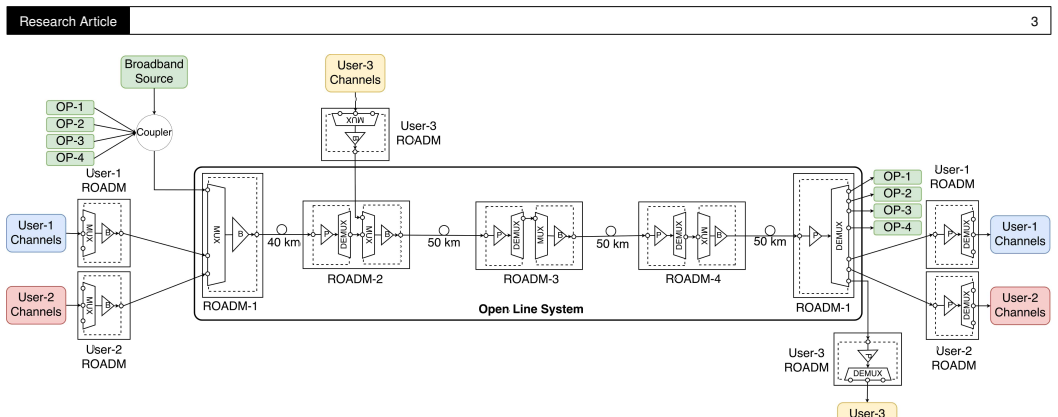
The central claim is that interference source attribution in a spectrum-blind OSaaS network is learnable from operator-visible data alone. The operator's own 400G 64-QAM channels act as guard probes interleaved between the spectral windows of three users; their per-channel OPM features (pre-FEC BER, Q-factor, OSNR, polarization and dispersion parameters) plus ROADM power readings form the only input. A 1D-CNN with sinusoidal positional encodings along the frequency axis and along the component axis classifies each measurement as no-interference, User-1, User-2, or User-3, reaching 90.31% test accuracy and a minimum 87% F1 across users and interference types. The same model outperforms a fully connected MLP baseline (82.53%), and it is most stressed by the OOK case, where fast polarization fluctuations are hardest to track.
Load-bearing premise
The threshold assumption is that user spectra loaded as shaped ASE noise behave, for interference purposes, like real OSaaS tenant transceivers; if real multi-wavelength coherent signals produce different monitoring signatures, the trained classifier may not transfer to production.
Editorial extensions
If this is right
- Operators can localize an interfering OSaaS tenant from their own transceiver telemetry and ROADM power monitors, without any visibility into tenant spectral loading.
- The three studied impairments—power-limit violation, channel add/drop under constant total power, and rogue OOK insertion—are all attributable to the right user at F1 above 87%.
- The architecture's fixed final-layer input, via padding, is designed to absorb additional operator channels or monitoring components without reinitializing the classifier.
- Adding new users changes the output space and requires fine-tuning of the final layer, and the authors point to existing service-installation windows as the opportunity to collect such data.
- The OOK case is the hardest; the paper attributes this to rapid polarization fluctuations from cross-polarization modulation in the intensity-modulated channel.
Reading between the lines
- Because each user's 400 GHz window was emulated with ASE-shaped noise plus a single Cassini transceiver at the window center, the learned signatures may not include the richer nonlinear interactions of a window fully loaded with coherent transponders; a model trained this way should be revalidated against real tenant traffic before deployment.
- The positional-encoding design suggests a testable generalization: a model trained on one spectral plan might transfer to other bandwidth allocations if the encoding is tied to physical frequency rather than channel index, but the paper does not test this.
- A natural extension is severity regression or multi-user attribution: instead of naming a single interferer, predict the launch-power offset of the rogue source, or detect two tenants interfering at once, since the measured telemetry encodes gradual power ramps.
Editorial analysis
A structured set of objections, weighed in public.
Referee Report
Summary. The paper addresses interference attribution in multi-user Optical Spectrum as a Service (OSaaS) networks. The authors propose a 1D-CNN architecture with sinusoidal positional encoding that, using only operator-visible optical performance monitoring (OPM) data from four probe channels and ROADM power telemetry, classifies the source of three types of interference (power increase, ADD/DROP, and rogue OOK) among three OSaaS users. Experimental data were collected on a 190 km Open Ireland testbed with commercial equipment. The model reports 90.31% classification accuracy and a minimum per-user F1-score of 87%, outperforming an MLP baseline at 82.53%.
Significance. If the reported results hold under a properly event-independent evaluation, the paper makes a useful contribution by showing that interference source attribution is possible from operator-visible data alone, without user spectrum visibility. The use of a real optical testbed with commercial transceivers, a well-defined service handover sheet, and a comparison against an MLP baseline are strengths. The F1-score analysis for an imbalanced multi-class problem is appropriate. The main caveat is that the headline accuracy has not yet been demonstrated to generalize to unseen interference events, which is the operational scenario claimed in the abstract.
major comments (3)
- [Sections 4 and 5 (Data Collection and Model Architecture)] The evaluation uses a random stratified 3:1 split without any grouping by time or by interference event. Because measurements are polled every 30 seconds (Section 4), successive samples recorded under the same configuration are near-duplicates; a random split will place these duplicates in both training and test sets. The reported 90.31% accuracy may therefore reflect memorization of specific experimental states rather than the ability to classify a genuinely new interference event, which is the operational scenario the abstract claims. Please re-evaluate using a split that groups samples by interference event or by contiguous time window (e.g., all polls of a given configuration in one partition), and report the resulting accuracy and F1 scores. Also report performance over multiple training seeds with means and standard deviations.
- [Section 5 (Model Architecture, hyperparameter search)] The text states that optimal hyperparameters "were identified via a randomized-grid search using stratified K-fold cross validation" immediately before stating that "data splitting for performance evaluation maintained a 3:1 training-to-test ratio." It is not clear whether the final test partition was kept separate from the data used for hyperparameter selection. If cross-validation included the test samples, the reported test accuracy is optimistic. Please clarify the order of operations, and if necessary re-run the experiment with a held-out test set that is not used for model selection.
- [Section 2.B (OSaaS Experimental Setup)] The user spectra are emulated by shaping ASE noise into 50 GHz channels, with only a single real coherent Cassini channel per user. Nonlinear crosstalk and XPM signatures from ASE-shaped "channels" are not necessarily representative of those generated by fully loaded coherent transponders, so the learned interference signatures may not transfer to real OSaaS users. The paper does not acknowledge this limitation in the conclusions, where it states the framework "can accurately locate the source of power/PSD violations and rogue OOK channels" in a general spectrum-blind scenario. Please add a careful discussion of this proxy and, ideally, a validation against a fully coherent multi-channel user setup, or soften the generalization claims accordingly.
minor comments (4)
- [Section 4 (Data Collection)] In the sentence "Firstly we aim to understand ... Secondly, the channel-related features ...", the second reason appears incomplete; please rephrase to clearly state why the aggregate OSaaS window power is unsuitable.
- [Section 5 (Model Architecture)] The padding value of 40 is introduced without explanation; please clarify the dimensionality of the concatenated feature representation and how the padding constant is derived.
- [Section 5 (Model Architecture)] The phrase "a decaying learning rate of 0.001" is ambiguous; please specify the initial learning rate and the schedule used during training.
- [Section 6 (Results)] In the text, "the F1-scores for each user was calculated" should be "were calculated."
Circularity Check
No significant circularity: the reported 90.31% accuracy is an empirical held-out measurement, not a derivation reducible to fitted parameters or self-citation.
full rationale
The paper's central claim is an experimentally measured classification accuracy on a held-out test split, not a quantity derived from its own inputs. The 1D-CNN architecture (Eqs. 1-7) maps operator-visible features to interference-source classes; no equation defines the class label in terms of the features, and no reported accuracy is obtained by renaming a fitted parameter. Hyperparameter selection used randomized-grid search with stratified K-fold cross-validation before the final 3:1 split, which can optimistically bias the reported accuracy, and the 30-second polling with random splitting may inflate scores due to temporal autocorrelation; these are evaluation-validity concerns, not circularity of the claimed derivation. Self-citations (Refs. 1, 2, 8, 10) include co-authors, but they are used for background, testbed description, preliminary analysis, and future transfer-learning plans; none provides a load-bearing uniqueness theorem, ansatz, or result that forces the classification outcome. The paper does not rename a known empirical pattern as unification, and no fitted input is presented as an independent prediction. The measured result is therefore self-contained as an experimental claim, and no circular step can be exhibited.
Assumptions & free parameters
free parameters (4)
- Q-factor drop threshold =
0.5
- Model hyperparameters (kernel size, layers, neurons, epochs, batch size, learning rate) =
3, 3, 100, 1200, 32, 0.001
- Positional encoding dimension and padding =
d_m=2, padding=40
- Classification probability threshold =
0.50
assumptions (4)
- domain assumption The operator is blind to users' internal spectrum details and only sees coarse powers and its own transceiver OPM.
- ad hoc to paper ASE-shaped noise slots emulate real user coherent channels for learning interference signatures.
- domain assumption Interference is a deterministic function of spectral adjacency and can be learned from operator channel probes.
- domain assumption XPM and EDFA crosstalk dominate the observed impairments.
Cite this review
Pith. "Pith review of Interference Detection in Spectrum-Blind Multi-User Optical Spectrum as a Service." pith.science (2026). https://pith.science/paper/4S6ZFF5E
@misc{pith2026250521018,
  author       = {Pith},
  title        = {Pith review of: Interference Detection in Spectrum-Blind Multi-User Optical Spectrum as a Service},
  year         = {2026},
  howpublished = {\url{https://pith.science/paper/4S6ZFF5E}},
  note         = {Machine review of arXiv:2505.21018}
}
read the original abstract
With the growing demand for high-bandwidth, low-latency applications, Optical Spectrum as a Service (OSaaS) is of interest for flexible bandwidth allocation within Elastic Optical Networks (EONs) and Open Line Systems (OLS). While OSaaS facilitates transparent connectivity and resource sharing among users, it raises concerns over potential network vulnerabilities due to shared fiber access and inter-channel interference, such as fiber non-linearity and amplifier based crosstalk. These challenges are exacerbated in multi-user environments, complicating the identification and localization of service interferences. To reduce system disruptions and system repair costs, it is beneficial to detect and identify such interferences timely. Addressing these challenges, this paper introduces a Machine Learning (ML) based architecture for network operators to detect and attribute interferences to specific OSaaS users while blind to the users' internal spectrum details. Our methodology leverages available coarse power measurements and operator channel performance data, bypassing the need for internal user information of wide-band shared spectra. Experimental studies conducted on a 190 km optical line system in the Open Ireland testbed, with three OSaaS users demonstrate the model's capability to accurately classify the source of interferences, achieving a classification accuracy of 90.3%.
Figures


Figures from the paper (8 more)


Reference graph
Works this paper leans on
-
[1]
Employing channel probing to derive end-of-life service margins for op- tical spectrum services,
K. Kaeval, F . Slyne, S. Troia, E. Kenny, K. Grobe, H. Griesser, D. C. Kilper, M. Ruffini, J.-J. Pedreno-Manresa, S. K. Patri, and G. Jervan, “Employing channel probing to derive end-of-life service margins for op- tical spectrum services,” J. Opt. Commun. Netw. 15, C63–C73 (2023)
work page 2023
-
[2]
Exploring service margins for optical spectrum services,
K. Kaeval, F . Slyne, S. Troia, E. Kenny, J.-J. Pedreño-Manresa, S. K. Patri, K. Grobe, D. C. Kilper, M. Ruffini, and G. Jervan, “Exploring service margins for optical spectrum services,” in European Conf. on Optical Communication (ECOC), (2022), pp. 1–4
work page 2022
-
[3]
Moldovan and Ukrainian R&E communities benefit from new ‘spectrum’ link with GEANT,
GEANT, “Moldovan and Ukrainian R&E communities benefit from new ‘spectrum’ link with GEANT,” Press. Release (2021)
work page 2021
-
[4]
Open RAN—Radio Access Network Evolution, Benefits and Market Trends,
D. Wypiór, M. Klinkowski, and I. Michalski, “Open RAN—Radio Access Network Evolution, Benefits and Market Trends,” Appl. Sci. 12, 408 (2022)
work page 2022
-
[5]
Design of Low-Margin Optical Networks,
Y . Pointurier, “Design of Low-Margin Optical Networks,” J. Opt. Com- mun. Netw. 9, A9 (2017)
work page 2017
-
[6]
Optical spectrum services in open disaggregated transport networks,
K. Kaeval, “Optical spectrum services in open disaggregated transport networks,” Phd thesis, Tallinn University of Technology (2023)
work page 2023
-
[7]
Machine Learn- ing enabled Fault-Detection Algorithms for Optical Spectrum-as-a- Service Users,
S. K. Patri, I. Dick, K. Kaeval, J. Muller, J.-J. Pedreno-Manresa, A. Aut- enrieth, J.-P . Elbers, M. Tikas, and C. Mas-Machuca, “Machine Learn- ing enabled Fault-Detection Algorithms for Optical Spectrum-as-a- Service Users,” Int. Conf. on Opt. Netw. Des. Model. (ONDM) (2023)
work page 2023
-
[8]
A. Raj, Z. Wang, F . Slyne, T. Chen, D. Kilper, and M. Ruffini, “In- terference identification in multi-user optical spectrum as a service using convolutional neural networks,” in European Conf. on Optical Communication (ECOC), (2024)
work page 2024
Show all 23 references
-
[9]
Openireland testbed, funded by science foundation ire- land,
CONNECT, “Openireland testbed, funded by science foundation ire- land,” (2022)
2022
-
[10]
Self- normalizing neural network, enabling one shot transfer learning for modeling edfa wavelength dependent gain
A. Raj, Z. Wang, F . Slyne, T. Chen, D. Kilper, and M. Ruffini, “Self- normalizing neural network, enabling one shot transfer learning for modeling edfa wavelength dependent gain.” in 2023 European Conf. on Optical Communication (ECOC), (2023), pp. 1–4
2023
-
[11]
Spectral grids for wdm applications: Dwdm frequency grid,
“Spectral grids for wdm applications: Dwdm frequency grid,” ITU-T Recomm. G.694.1 (2020). Research Article 10
2020
-
[12]
Fault and attack manage- ment in all-optical networks,
R. Rejeb, M. S. Leeson, and R. J. Green, “Fault and attack manage- ment in all-optical networks,” IEEE Commun. Mag. 44, 79–86 (2006)
2006
-
[13]
High- power jamming attack mitigation techniques in spectrally-spatially flexi- ble optical networks,
G. Savva, K. Manousakis, J. Rak, I. Tomkos, and G. Ellinas, “High- power jamming attack mitigation techniques in spectrally-spatially flexi- ble optical networks,” IEEE Access 9, 28558–28572 (2021)
2021
-
[14]
Nonlinear interference mitigation: Methods and potential gain,
R. Dar and P . J. Winzer, “Nonlinear interference mitigation: Methods and potential gain,” J. Light. Technol.35, 903–930 (2017)
2017
-
[15]
Cross-phase mod- ulation induced by ook channels on higher-rate dqpsk and coherent qpsk channels,
A. Bononi, M. Bertolini, P . Serena, and G. Bellotti, “Cross-phase mod- ulation induced by ook channels on higher-rate dqpsk and coherent qpsk channels,” J. Light. Technol.27, 3974–3983 (2009)
2009
-
[16]
Overlaying 10 gb/s legacy optical networks with 40 and 100 gb/s coherent terminals,
O. Bertran-Pardo, J. Renaudier, G. Charlet, H. Mardoyan, P . Tran, M. Salsi, and S. Bigo, “Overlaying 10 gb/s legacy optical networks with 40 and 100 gb/s coherent terminals,” J. Light. Technol.30, 2367–2375 (2012)
2012
-
[17]
Cross-polarization modulation: Theory and measurement in subcarrier-modulated wdm systems,
M. R. Phillips, S. L. Woodward, and R. L. Smith, “Cross-polarization modulation: Theory and measurement in subcarrier-modulated wdm systems,” J. Light. Technol.24, 4089–4099 (2006)
2006
-
[18]
Recent ad- vances in convolutional neural network acceleration,
Q. Zhang, M. Zhang, T. Chen, Z. Sun, Y . Ma, and B. Yu, “Recent ad- vances in convolutional neural network acceleration,” Neurocomputing. 323, 37–51 (2019)
2019
-
[19]
Convolutional deep belief networks for scalable unsupervised learning of hierarchical repre- sentations,
H. Lee, R. Grosse, R. Ranganath, and A. Y . Ng, “Convolutional deep belief networks for scalable unsupervised learning of hierarchical repre- sentations,” inProceedings of the 26th Annual International Conference on Machine Learning, (Association for Computing Machinery, New Y...
2009
-
[20]
Attention is All you Need,
A. Vaswani, N. Shazeer, N. Parmar, J. Uszkoreit, L. Jones, A. N. Gomez, L. Kaiser, and I. Polosukhin, “Attention is All you Need,” inAdv. Neural Inf. Process. Syst. , vol. 30 (Curran Associates, Inc., 2017)
2017
-
[21]
Position encoding based convolutional neural networks for machine remaining useful life prediction,
R. Jin, M. Wu, K. Wu, K. Gao, Z. Chen, and X. Li, “Position encoding based convolutional neural networks for machine remaining useful life prediction,” (2022)
2022
-
[22]
Self- normalizing neural networks,
G. Klambauer, T. Unterthiner, A. Mayr, and S. Hochreiter, “Self- normalizing neural networks,” (2017)
2017
-
[23]
Pytorch: An imperative style, high- performance deep learning library,
A. Paszke, S. Gross, F . Massa, A. Lerer, J. Bradbury, G. Chanan, T. Killeen, Z. Lin, N. Gimelshein, L. Antiga, A. Desmaison, A. Köpf, E. Y ang, Z. DeVito, M. Raison, A. Tejani, S. Chilamkurthy, B. Steiner, L. Fang, J. Bai, and S. Chintala, “Pytorch: An imperative style, high-...
2019
Reviewed August 7, 2026 · model on record in the stance chip above.
Discussion (0). Continue with ORCID to comment.