REVIEW 4 major objections 5 minor 1 cited by
Negative absolute temperature attractor in a dense photon gas
T0 review · 4 major / 5 minor · reviewed 2026-08-07 · deepseek-v4-flash
Pith's one-line read This paper claims that increasing input power in a few-mode step-index fiber inverts the mode population from the fundamental to the highest-order mode, which it interprets as the optical temperature passing through infinity to a negative…
desk verdict Solid experiments on modal inversion, but the negative-temperature attractor is not supported: the sign flip is forced by a fixed-U_L calibration and an unproved equation of state. read the letter →
The pith
A machine-rendered reading of the paper's core claim, the machinery that carries it, and where it could break.
The reading
What carries the argument
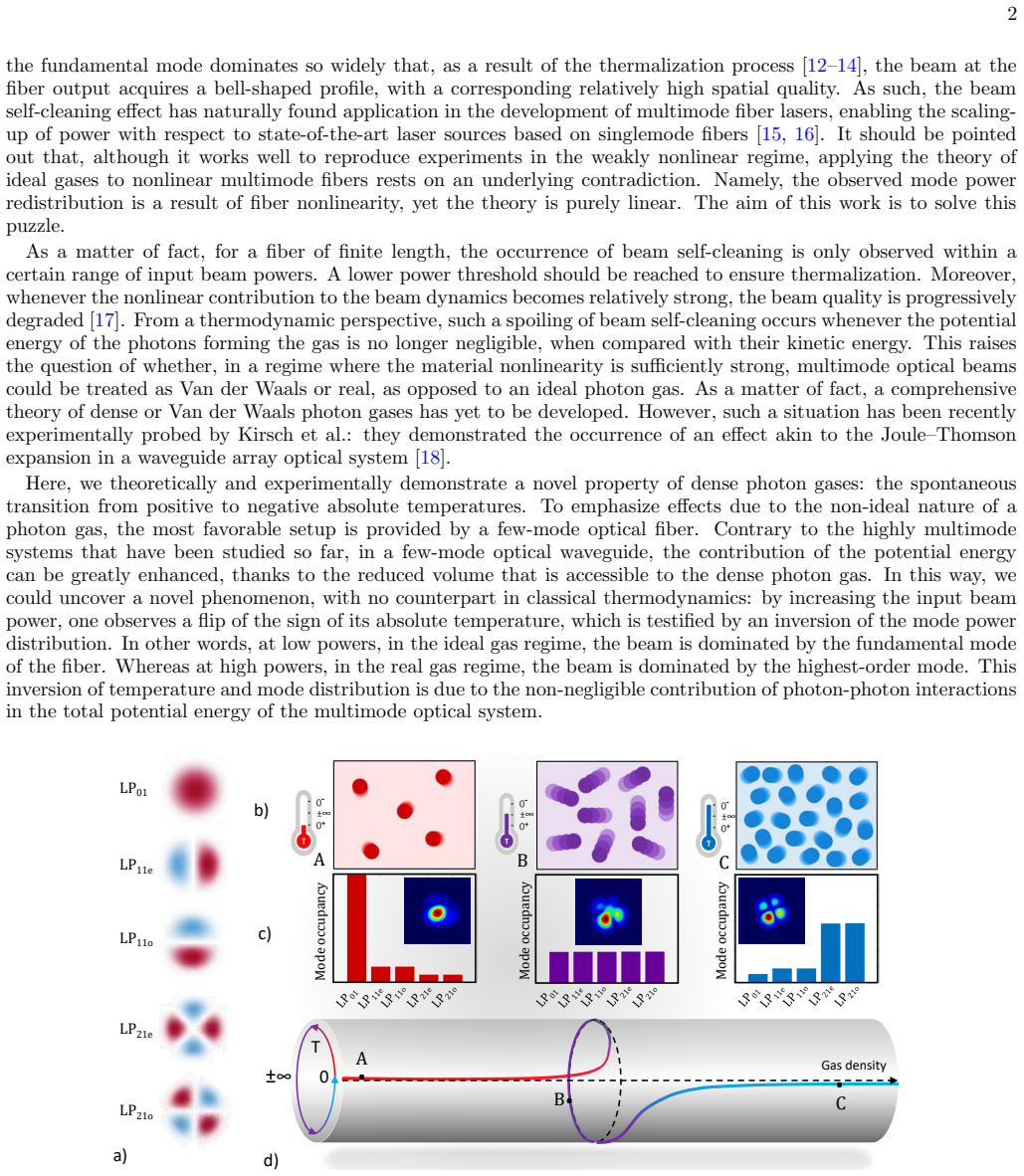
The carrying object is the modified equation of state $U_L + U_{NL} - \mu P = M T$, paired with the Rayleigh-Jeans mode distribution $|c_i|^2 = -T/(\mu + \beta_i)$, where $\beta_i$ are the propagation constants of the guided modes. The new term is the nonlinear potential energy $U_{NL} = \frac{\gamma}{2}\frac{P^2}{M}$, which is quadratic in total power and inversely proportional to the number of modes, so it acts like a density-dependent interaction energy of a Van der Waals gas. Holding $U_L$ fixed at its low-power value while solving the resulting equation for $T/P$ makes the temperature a nonlinear function of power: it rises, diverges at the equipartition condition, and then approaches $0^-$ as the highest-order mode becomes the only populated state. The sign flip at $T = \pm\infty$ is not a singularity of the model, because the Lagrange multiplier conjugate to momentum conservation is $1/T$.
What would settle it
Recompute the linear internal energy from the experimentally measured mode occupancies at each power level instead of carrying the lowest-power value through all powers, then solve the paper's Eq. (8) with that updated value; if the temperature no longer flips sign or the $T = 0^-$ branch disappears, the negative-temperature attractor would be an artifact of the fixed-energy assumption.
Extended reading notes
Core claim
The paper's central claim is that adding a Kerr-type potential energy to the equation of state of a photon gas in a few-mode fiber changes the power dependence of the optical temperature so drastically that the mode population spontaneously inverts. In the weakly nonlinear ideal-gas regime, the Rayleigh-Jeans distribution with conserved power and momentum gives an optical temperature whose sign is fixed by the linear internal energy; the paper's modified equation of state, $U_L + U_{NL} - \mu P = M T$, with $U_{NL} = \frac{\gamma}{2}\frac{P^2}{M}$, makes $T$ a nonlinear function of power. As power rises, $T$ increases, diverges at the equipartition point $U_L = U_{L,c}$, then returns from $T = 0^-$, which corresponds to the highest-order mode being the only populated state. In the experiment, the measured mode occupancy follows the Rayleigh-Jeans form at every power, with the highest-order guided modes carrying about 90% of the power at the highest input powers, and the same freezing is observed at other wavelengths where the number of guided modes differs.
Load-bearing premise
The whole temperature-versus-power curve is computed while holding the linear part of the internal energy fixed at its lowest-power value, even though the measured mode populations redistribute strongly with power; if that energy value actually changes, the inferred temperatures, the sign flip, and the negative-temperature branch would not follow.
Editorial extensions
If this is right
- At low power the output is dominated by the fundamental mode; above a threshold the same fiber outputs a beam dominated by the highest-order guided modes, so beam quality degradation appears as a predictable thermodynamic transition rather than an uncontrolled defect.
- The $T = 0^-$ state is stable: changing the launch offset, bending the fiber, or squeezing it does not change the final beam, which is what makes the effect usable as a form of spatial mode locking.
- Because freezing occurs at each wavelength slice of a spectrally broadened pulse, the mechanism extends to polychromatic beams, with the frozen mode being the highest-order mode guided at that wavelength.
- The inversion happens at power levels well below the self-focusing damage threshold, so it is accessible in ordinary step-index optical fibers.
- Regardless of whether the low-power gas starts with positive or negative temperature, raising the density always drives it toward $T = 0^-$ rather than away from it.
Reading between the lines
- The model's key quantitative step is to keep the linear internal energy $U_L$ fixed at its lowest-power value while solving for the temperature at every power; because the measured mode populations redistribute strongly with power, recomputing $U_L$ from the measured distribution at each power could shift or remove the sign flip.
- A testable extension is to check whether the critical power for the inversion scales as predicted with the mode count $M$, since the added potential energy is proportional to $P^2/M$; varying the fiber core or wavelength to change $M$ would directly probe the density mechanism.
- The attractor behavior may be a more general phenomenon than this specific fiber model: any nonlinearity that adds a positive, power-dependent term to the internal energy could push a Rayleigh-Jeans gas toward $T = 0^-$, so similar inversion should appear in other multimode nonlinear systems.
Editorial analysis
A structured set of objections, weighed in public.
Referee Report
Summary. The paper reports experiments in a few-mode step-index fiber (SMF-28 operated below cutoff) in which increasing input power causes the output mode occupancy to redistribute from the fundamental mode to the highest-order modes, with the highest-order LP21 modes carrying about 90% of the power at the largest powers. The authors interpret this redistribution thermodynamically: they retain the Rayleigh-Jeans distribution, add a Kerr-type potential energy U_NL = γP²/(2M), modify the equation of state to U_L + U_NL − μP = MT, and infer from this model that the optical temperature rises with power, diverges at an equipartition point, and then approaches zero from below, defining a negative-absolute-temperature attractor. Supporting experiments include cut-back tests for thermalization, power-conservation checks, offset-injection robustness measurements, and observations at several wavelengths.
Significance. If the thermodynamic interpretation is correct, the paper would be a notable experimental demonstration of a negative optical temperature in a multimode waveguide and of a robust, all-optically controlled modal inversion, with potential interest for beam shaping and high-power fiber lasers. The experimental core is valuable: the modal decomposition is state-of-the-art, the cut-back and power-conservation checks support the claim of a thermalized, lossless propagation, and the offset-injection data provide a convincing demonstration of the robustness of the high-order-mode dominance. However, the central quantitative claim—that the system reaches a negative temperature approaching zero from below—is not directly measured but is inferred from a model that contains an unproved equation of state and a questionable calibration procedure. Those issues are load-bearing and require substantial revision before the negative-absolute-temperature attractor claim can be accepted.
major comments (4)
- [Methods, 'Determination of thermodynamic parameters'] The procedure of computing U_L once from the lowest-power mode occupancy and then 'keeping it as a constant for all power levels' when solving Eq. (8) is inconsistent with the definition U_L = −Σβ_i|c_i|² in Eq. (2). The measured modal redistribution from LP01 to LP21 directly implies that U_L/P changes substantially with power; for an input profile that is simply rescaled in power, U_L/P should remain near −β_1, whereas fixing U_L drives U_L/P toward zero as P grows. This forced crossing of the critical value −Σβ_i/M in Eq. (5) is what produces the temperature divergence and the subsequent T→0⁻ branch in the authors' Fig. 2d and Fig. 3b. Since the central claim of a negative-absolute-temperature attractor depends on this branch, the authors must either recompute T using a power-dependent U_L(P) obtained from the measured occupancies or provide a physical justification for why U_L, as used in Eq. (8), should be the low-power linear energy rather than the instantaneous kinetic energy.
- [Main text, 'Real photon gas'] Equation (7), U_L + U_NL − μP = MT, is acknowledged in the manuscript to 'cannot be directly derived' from the Rayleigh-Jeans law and the conservation laws of P and U. This relation is not a minor technicality: it is the equation used to convert the measured mode occupancies into the optical temperature values plotted in Fig. 3b and to locate the T→0⁻ attractor. Because the equation of state is not derived, the quantitative temperature axis, the critical power at which T diverges, and the strength of the attractor are all model-dependent. The authors should either derive Eq. (7) from a controlled approximation of the nonlinear Hamiltonian or treat the model as a purely phenomenological fit and clearly separate the directly measurable quantities (mode occupancies, U_L) from the inferred thermodynamic parameters.
- [Fig. 3 and Methods, 'Determination of thermodynamic parameters'] The nonlinear coefficient γ is obtained by fitting Eq. (8) to the highest-power data point, and the same point is the one that most strongly determines the negative-temperature branch. Consequently, the agreement between the theoretical curve and the experimental occupancies at the highest power in Fig. 3a is not an independent validation of the model. The authors should provide a sensitivity analysis showing how the inferred temperatures and the predicted critical powers vary with γ and with the choice of the reference power used to fix U_L, including confidence intervals on γ from the fit.
- [Main text, 'Robustness of spatial beam freezing'] The statement that the negative-temperature attractor occurs 'no matter the sign of the temperature at low power' is supported experimentally by the offset-injection measurements in Fig. 4, but those measurements are shown at only two power levels and are compared with the model only qualitatively. The theoretical statement of a universal attractor to T→0⁻ in Fig. 2c,d is computed from the unproved equation of state (7) and the fixed-U_L procedure. To make the attractor claim quantitative, the authors should report for the offset data the model-inferred temperatures as a function of power and verify that they indeed converge to the same negative near-zero value regardless of the low-power sign of T.
minor comments (5)
- [Abstract and Main text] The paper uses 'demonstrate' for the negative absolute temperature regime, but T is always inferred from the model rather than directly measured. The wording should be softened, e.g., 'consistent with' or 'inferred from the thermodynamic model,' and the distinction between measured mode occupancies and inferred thermodynamic parameters should be made explicit in the abstract.
- [Fig. 2 caption / Fig. 3] The normalized nonlinear coefficient γ takes the value 0.05 in Fig. 2 but 2.04 in Fig. 3, with no statement of units or normalization. Please specify how γ is normalized, and report the fitted value with a confidence interval.
- [Methods, 'Experiments'] The manuscript reports average input powers (e.g., 0.1 mW, 3.3 mW, 4 mW) for femtosecond pulses at 100 kHz repetition rate, but the thermodynamic description and the nonlinear potential energy depend on the instantaneous power or pulse energy. The authors should report peak powers or pulse energies and justify using average power in the thermodynamic fits.
- [Eq. (8)] The sign conventions in the denominator of Eq. (8) are easy to misread; a short derivation in the Methods section showing how Eq. (8) follows from Eqs. (3) and (7) would improve clarity.
- [Main text, 'Real photon gas'] The text states that U_NL remains about two orders of magnitude lower than U_L while also describing the gas as 'dense.' This apparent tension should be clarified: the non-ideal nature of the gas is invoked through the equation of state even when the potential energy is small compared with the linear energy.
Circularity Check
The negative-temperature branch is calibrated, not predicted: γ is fitted to the highest-power point and U_L is held fixed, forcing the sign flip and the T→0− attractor.
-
fitted input called prediction
[Methods, 'Determination of thermodynamic parameters' (pages 8-9)]
"Specifically, we extracted the value of γ via nonlinear fit of eq. (8) at the highest input power. At this point, we fixed the value of γ and used eq. (8) to determine T corresponding to each input power. Within this procedure, the values of the thermodynamic parameters are determined by just two sets of experimental data, i.e., those at the highest and the lowest power."
The high-power negative-temperature state is not an independent prediction: the free parameter γ in the phenomenological potential (6) is fitted so that eq. (8) reproduces exactly the highest-power data point—the same point at which the highest-order modes dominate and the paper claims T→0−. The theoretical T(P) curve and the assignment of a negative, near-zero temperature to state E are therefore imposed by the fit rather than derived from the data. The intermediate-power agreement provides some independent support, but the existence of the negative-temperature branch at high power is calibrated in, not predicted.
-
self definitional
[Methods, 'Determination of thermodynamic parameters' (page 9)]
"At first, we computed UL by using eq. (2) from the data at the lowest power. Such a value of UL is kept as a constant for all power levels, when determining the thermodynamic parameters with eq. (8)."
Holding U_L fixed as a constant while P grows makes U_L/P decrease monotonically through the critical value U_L,c/P, which is precisely the mechanism that produces the temperature divergence and the subsequent T→0− branch. But the measured modal occupancies redistribute strongly with power, so the linear internal energy -Σβ_i|c_i|^2 computed from the measured occupancies is not constant. The sign flip and the negative-temperature attractor are thus a consequence of the definitional choice to treat U_L as a fixed parameter rather than as the measured power-dependent quantity, not a consequence of the data alone.
full rationale
The empirical phenomenon—a power-induced inversion from the fundamental to the highest-order mode—is real and independently observed, and the authors are transparent that eq. (7) 'cannot be directly derived' from the RJ law and the conservation laws. However, the central negative-absolute-temperature claim does not stand independently of the fitting procedure. U_L is fixed at the lowest-power value, so U_L/P decreases with P and forces a crossing of the critical value that drives the sign flip; γ is fitted to the highest-power point, exactly where the model is claimed to yield T→0−. Thus the high-power branch of the T(P) curve is determined by the two anchor points used for calibration. The intermediate-power data and the offset-injection robustness measurements do provide genuine, non-circular support, so the paper is only partially circular. The main unsupported step is the assumption that the Rayleigh-Jeans law and the modified equation of state (7) remain valid in the dense regime; that is a correctness risk more than a circularity, but it is compounded by the fit at the highest power.
Assumptions & free parameters
free parameters (1)
- gamma (normalized nonlinear coefficient) =
2.04 (units not stated; fitted via eq. (8) at the highest input power)
assumptions (5)
- ad hoc to paper The Rayleigh-Jeans distribution |c_i|^2 = -T/(mu + beta_i) remains valid in the strongly nonlinear regime.
- ad hoc to paper The modified equation of state U_L + U_NL - mu P = M T (eq. 7) holds.
- ad hoc to paper The potential energy takes the form U_NL = gamma P^2/(2M).
- domain assumption The photon gas reaches thermal equilibrium over the fiber length.
- domain assumption Power and the total Hamiltonian are conserved, with no losses or cladding leakage.
Cite this review
Pith. "Pith review of Negative absolute temperature attractor in a dense photon gas." pith.science (2026). https://pith.science/paper/VQKRMEFD
@misc{pith2026250521163,
  author       = {Pith},
  title        = {Pith review of: Negative absolute temperature attractor in a dense photon gas},
  year         = {2026},
  howpublished = {\url{https://pith.science/paper/VQKRMEFD}},
  note         = {Machine review of arXiv:2505.21163}
}
read the original abstract
Statistical mechanics permits to connect the macroscopic properties of matter with the laws governing the evolution of its microscopic constituents. Such an approach has been very successful for systems of particles governed by either classical or quantum mechanics. In a classical gas, different thermodynamic laws apply to the weakly or strongly interacting particles of an ideal or real gas, respectively. Here, we demonstrate that a similar situation occurs for a gas of photons, which is contained in a finite-dimensional box such as a multimode waveguide. We use a few-mode system provided by a standard step-index fiber operated below cutoff, which permits to prepare a high-density gas of photons. We show that, owing to the attractive potential energy contribution to the photon energy induced by the nonlinear Kerr effect, the mode population exhibits a spontaneous inversion from the fundamental to the highest-order mode, as the input laser beam power grows larger. This inversion of the mode power distribution leads to a stable attractor for the output beam, and is associated with a progressive increase of the optical temperature until a flip of its sign leads to a new regime of negative absolute temperatures. Our work demonstrates the ability to all-optically control the shape of laser beams, which is a prerequisite for applications in high-power laser sources, nonlinear imaging, and optical communication systems.
Figures


Figures from the paper (4 more)


Forward citations
Cited by 1 Pith paper
-
Spatio-temporal equilibrium thermodynamics of guided optical waves at positive and negative temperatures
Guided spatio-temporal light is predicted to undergo complete (2+1)D Bose–Einstein condensation at positive temperature (anomalous dispersion, lowest mode) and at negative temperature (normal dispersion, highest mode)...
Reference graph
Works this paper leans on
-
[1]
F. O. Wu, A. U. Hassan, and D. N. Christodoulides, Nature Photonics 13, 776 (2019)
work page 2019
-
[2]
L. Zanaglia, J. Garnier, S. Rica, R. Kaiser, S. Wabnitz, C. Michel, V. Doya, and A. Picozzi, Physical Review A 110, 063530 (2024)
work page 2024
-
[3]
M. Baldovin, S. Iubini, R. Livi, and A. Vulpiani, Physics Reports 923, 1 (2021)
work page 2021
-
[4]
E. M. Purcell and R. V. Pound, Phys. Rev. 81, 279 (1951)
1951
-
[5]
A. S. Oja and O. V. Lounasmaa, Rev. Mod. Phys. 69, 1 (1997)
work page 1997
- [6]
-
[7]
S. Braun, J. P. Ronzheimer, M. Schreiber, S. S. Hodgman, T. Rom, I. Bloch, and U. Schneider, Science 339, 52 (2013), https://www.science.org/doi/pdf/10.1126/science.1227831. 11
- [8]
Show all 24 references
-
[9]
A. L. M. Muniz, F. O. Wu, P. S. Jung, M. Khajavikhan, D. N. Christodoulides, and U. Peschel, Science 379, 1019 (2023), https://www.science.org/doi/pdf/10.1126/science.ade6523
2023 doi
-
[10]
Iubini and A
S. Iubini and A. Politi, Phys. Rev. Lett. 134, 097102 (2025)
2025
-
[11]
Krupa, A
K. Krupa, A. Tonello, B. M. Shalaby, M. Fabert, A. Barth´ el´ emy, G. Millot, S. Wabnitz, and V. Couderc, Nature Photonics 11, 237 (2017)
2017
-
[12]
Pourbeyram, P
H. Pourbeyram, P. Sidorenko, F. O. Wu, N. Bender, L. Wright, D. N. Christodoulides, and F. Wise, Nature Physics 18, 685 (2022)
2022
-
[13]
Baudin, J
K. Baudin, J. Garnier, A. Fusaro, C. Michel, K. Krupa, G. Millot, and A. Picozzi, Optics Communications 545, 129716 (2023)
2023
-
[14]
Ferraro, F
M. Ferraro, F. Mangini, M. Zitelli, and S. Wabnitz, Advances in Physics: X 8, 2228018 (2023)
2023
-
[15]
Te˘ gin, B
U. Te˘ gin, B. Rahmani, E. Kakkava, D. Psaltis, and C. Moser, Advanced Photonics 2, 056005 (2020)
2020
-
[16]
L. G. Wright, D. N. Christodoulides, and F. W. Wise, Science 358, 94 (2017)
2017
-
[17]
Mangini, M
F. Mangini, M. Ferraro, A. Tonello, V. Couderc, and S. Wabnitz, Optics Letters 48, 4741 (2023)
2023
-
[18]
M. S. Kirsch, G. G. Pyrialakos, R. Altenkirch, M. A. Selim, J. Beck, T. A. Wolterink, H. Ren, P. S. Jung, M. Khajavikhan, A. Szameit, et al. , Nature Physics 21, 214 (2025)
2025
-
[19]
K. G. Makris, F. O. Wu, P. S. Jung, and D. N. Christodoulides, Optics Letters 45, 1651 (2020)
2020
-
[20]
Eslami, L
Z. Eslami, L. Salmela, A. Filipkowski, D. Pysz, M. Klimczak, R. Buczynski, J. M. Dudley, and G. Genty, Nature Communications 13, 2126 (2022)
2022
-
[21]
Krupa, C
K. Krupa, C. Louot, V. Couderc, M. Fabert, R. Guenard, B. M. Shalaby, A. Tonello, D. Pagnoux, P. Leproux, A. Ben- dahmane, R. Dupiol, G. Millot, and S. Wabnitz, Optics Letters 41, 5785 (2016)
2016
-
[22]
Garnier, A
J. Garnier, A. Fusaro, K. Baudin, C. Michel, K. Krupa, G. Millot, and A. Picozzi, Phys. Rev. A 100, 053835 (2019)
2019
-
[23]
Mangini, M
F. Mangini, M. Ferraro, M. Zitelli, A. Niang, A. Tonello, V. Couderc, O. Sidelnikov, F. Frezza, and S. Wabnitz, Optics Express 29, 12625 (2021)
2021
-
[24]
Gervaziev, I
M. Gervaziev, I. Zhdanov, D. Kharenko, V. Gonta, V. Volosi, E. Podivilov, S. Babin, and S. Wabnitz, Laser Physics Letters 18, 015101 (2020)
2020
Reviewed August 7, 2026 · model on record in the stance chip above.
Discussion (0). Sign in to comment.