REVIEW 4 major objections 5 minor 20 references
Radionuclide Production for Dose Verification in VHEE FLASH Radiotherapy
T0 review · 4 major / 5 minor · reviewed 2026-08-07 · deepseek-v4-flash
Pith's one-line read Irradiating a plastic phantom with very high energy electrons produces measurable carbon-11 whose 20.9-minute decay half-life supports PET-style radionuclide detection as a dose-verification route for VHEE FLASH radiotherapy.
desk verdict The experiment is real and the 11C half-life measurement is clean, but the paper's own numbers contradict its 'clinically relevant quantities' claim, so the quantitative feasibility case needs a major rework before this can be relied on. read the letter →
The pith
A machine-rendered reading of the paper's core claim, the machinery that carries it, and where it could break.
The reading
What carries the argument
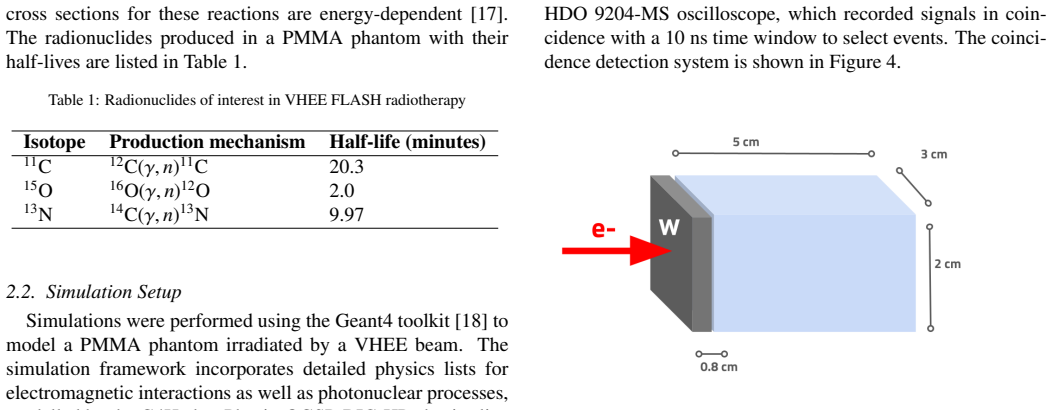
The mechanism that carries the argument is the photonuclear shower chain. VHEE electrons produce bremsstrahlung photons in an electromagnetic shower; photons above the reaction thresholds convert $^{12}\mathrm{C}$ to $^{11}\mathrm{C}$ by $^{12}\mathrm{C}(\gamma,n)^{11}\mathrm{C}$, $^{16}\mathrm{O}$ to $^{15}\mathrm{O}$, and $^{14}\mathrm{C}$ to $^{13}\mathrm{N}$. The detection chain is coincidence measurement of the two 511 keV annihilation photons from positron decay, with a 10 ns time window selecting valid events. The modeling chain is Geant4 with the QGSP_BIC_HP physics list, and the bridge quantity is the simulated yield per incident electron, which lets the authors scale predictions to FLASH pulse intensities and compare against measured coincidence counts.
What would settle it
Absolute-calibrate the coincidence detector and compare the measured count rate from the same PMMA-tungsten box setup against the Geant4 prediction computed from the measured electron spectrum. If the simulated absolute counts fall outside the measured rate plus systematic uncertainties, the quantitative yield prediction would be refuted even though the 11C half-life remains consistent.
Extended reading notes
Core claim
The central claim is that photonuclear production of positron emitters during VHEE irradiation is measurable and, with the right correlation model, usable for dose verification. In the full-size cylindrical PMMA phantom, simulations at 150 MeV give production yields per incident electron of $2\times10^{-6}$ for $^{11}\mathrm{C}$, $7\times10^{-7}$ for $^{13}\mathrm{N}$, and $5\times10^{-6}$ for $^{15}\mathrm{O}$. Scaled to a $10^{11}$-electron FLASH pulse, these yields translate into about $2\times10^5$, $7\times10^4$, and $5\times10^5$ nuclei per pulse, with total activity near $10^5~\mathrm{Bq}$. The experimental decay curve from the box phantom yields a half-life of $(20.9 \pm 0.2)$ minutes, consistent with $^{11}\mathrm{C}$. The paper also finds that the activity peak does not coincide with the dose peak, so the relationship between radionuclide density and dose must be established by further modeling rather than read directly.
Load-bearing premise
The paper's quantitative validation rests on an overall scaling between simulated and measured counts that is never described; if that scaling was tuned to make the curves agree, the experiment confirms only the 20.9-minute decay signature of 11C, not the simulated production rate.
Editorial extensions
If this is right
- If the central claim is correct, PET-style detection of $^{11}\mathrm{C}$, $^{15}\mathrm{O}$, and $^{13}\mathrm{N}$ can provide an in vivo dose-verification signal for VHEE FLASH without modifying the treatment beam.
- The $^{11}\mathrm{C}$ half-life of about 20 minutes gives a practical window for moving the patient or phantom to a PET scanner, while the roughly 2-minute half-life of $^{15}\mathrm{O}$ makes that isotope less useful for offline imaging.
- Because the radionuclide distribution peaks at a different depth than the dose, clinical dose verification will require a correlation model that accounts for shower-mediated photonuclear production.
- The predicted activity of about $10^5~\mathrm{Bq}$ per $10^{11}$-electron pulse is low relative to diagnostic PET injections but is claimed to be within the sensitivity of modern PET systems.
Reading between the lines
- A direct testable extension would be to fix the absolute detector normalization and use the simulated yield per electron to predict the absolute coincidence rate; a mismatch would point to missing systematic errors in the experimental setup.
- The spatial offset between radionuclide activity and dose could be turned into an inverse tool: measured PET activity may constrain the bremsstrahlung spectrum and thus the effective beam energy, which is relevant for range verification.
- Replacing the tungsten converter with tissue-equivalent material and testing an in-beam PET geometry would show whether the yields remain detectable under clinically realistic conditions.
Editorial analysis
A structured set of objections, weighed in public.
Referee Report
Summary. The paper investigates the production of positron-emitting radionuclides (11C, 13N, 15O) in a PMMA phantom irradiated by very high energy electron (VHEE) beams, with the goal of using PET-style detection of these radionuclides for dose verification in VHEE FLASH radiotherapy. Geant4 simulations predict yields and spatial distributions, and an experimental measurement using a laser-plasma accelerator confirms the production of 11C via a half-life measurement of (20.9 ± 0.2) minutes, consistent with the known value. The abstract and conclusions claim that the produced quantities are 'clinically relevant' and that the simulations are validated by the experiment. The core half-life measurement is clean, but the quantitative claims relating to activity and the simulation–experiment comparison are not adequately supported.
Significance. The paper provides the first experimental confirmation of 11C production in a PMMA phantom irradiated by a laser-plasma-accelerator VHEE beam, which is a useful proof-of-principle for the proposed dose-verification method. If the quantitative issues are resolved, the approach could offer a feasible in vivo dose verification technique for VHEE FLASH radiotherapy, where current monitoring methods are limited. The work leverages a straightforward physics mechanism (photonuclear reactions) and uses standard Geant4 simulation tools; the experimental half-life determination is a solid, externally validated result. However, the significance as a feasibility study depends on the quantitative consistency of the yield and activity claims, which currently contain an internal inconsistency and a missing normalization description.
major comments (4)
- [Section 3.1 and Table 2]
- [Figure 8]
- [Table 2]
- [Section 2.3 and Section 3.2]
minor comments (5)
- [Table 1]
- [Figure 6 caption]
- [Throughout]
- [Section 2.2]
- [Figure 8 and Section 3.2]
Circularity Check
No circularity: simulation predictions and experimental half-life validation are self-contained, with only a reproducibility gap in the Fig. 8 normalization.
full rationale
The central claim—that Geant4 photonuclear simulations predict 11C, 13N, and 15O production and that a measured half-life of (20.9 ± 0.2) minutes confirms 11C—does not reduce to its own inputs. The simulations use a standard physics list (G4HadronPhysicsQGSP_BIC_HP) plus an experimentally measured electron spectrum; no parameter is fitted to the coincidence data to produce the predicted yields. The half-life comparison is against an external, literature value rather than derived from the model, so the identification is independently anchored. The quantitative comparison in Figure 8 lacks a described absolute normalization (detector efficiency, solid angle, time window), which is a reproducibility gap, but it is not circular reasoning: the isotope identification rests on the decay constant, not on the arbitrary vertical scaling. The self-citations present (e.g., [15] for an in-beam PET system, [19] for the laser-plasma accelerator infrastructure) are contextual and not load-bearing for the radionuclide-production claim. An internal arithmetic concern exists in the reported activity (~10^5 Bq vs. ~3×10^3 Bq from Table 2 yields and Table 1 half-lives), but that is a numerical-correctness issue, not a circularity of derivation. Accordingly, no circular step is identified and the score is 0.
Assumptions & free parameters
assumptions (3)
- domain assumption Geant4 QGSP_BIC_HP physics list accurately simulates photonuclear reactions and electromagnetic showers for VHEE (150 MeV) electrons.
- domain assumption The energy spectrum of electrons produced by the laser-plasma accelerator, as measured by the magnetic spectrometer and shown in Figure 2, is a faithful representation of the beam used for irradiation.
- domain assumption The coincidence detection system has a known and uniform efficiency, or that the simulation-to-experiment normalization in Figure 8 is otherwise well-defined.
Cite this review
Pith. "Pith review of Radionuclide Production for Dose Verification in VHEE FLASH Radiotherapy." pith.science (2026). https://pith.science/paper/ZMP5XWXV
@misc{pith2026250521183,
  author       = {Pith},
  title        = {Pith review of: Radionuclide Production for Dose Verification in VHEE FLASH Radiotherapy},
  year         = {2026},
  howpublished = {\url{https://pith.science/paper/ZMP5XWXV}},
  note         = {Machine review of arXiv:2505.21183}
}
read the original abstract
This study explores the production of radionuclides in a PMMA (Polymethylmethacrylate) phantom irradiated with Very High Energy Electrons (VHEE) beams as a novel method for dose verification. In this work, Monte Carlo simulation studies using the Geant4 toolkit and experimental measurements with a VHEE beam produced by a laser-plasma accelerator were conducted. Specifically, the photonuclear production of 11C, 15O and 13N is examined, with a detailed analysis of their spatial distribution, production yields and decay time
Figures


Figures from the paper (4 more)


Reference graph
Works this paper leans on
-
[1]
Y . Lievens, J. M. Borras, C. Grau, Provision and use of radiotherapy in europe, Molecular oncology 14 (7) (2020) 1461–1469
work page 2020
-
[2]
J. M. Borras, Y . Lievens, M. Barton, J. Corral, J. Ferlay, F. Bray, C. Grau, How many new cancer patients in europe will require radiotherapy by 2025? an estro-hero analysis, Radiotherapy and Oncology 119 (1) (2016) 5–11
work page 2016
-
[3]
V . Favaudon, L. Caplier, V . Monceau, F. Pouzoulet, M. Sayarath, C. Fouil- lade, M.-F. Poupon, I. Brito, P. Hup ´e, J. Bourhis, et al., Ultrahigh dose- rate flash irradiation increases the di fferential response between normal and tumor tissue in mice, Science translational medicine 6 (245) (2014) 245ra93–245ra93
work page 2014
-
[4]
J. D. Wilson, E. M. Hammond, G. S. Higgins, K. Petersson, Ultra-high dose rate (flash) radiotherapy: Silver bullet or fool’s gold?, Frontiers in oncology 9 (2020) 1563
work page 2020
-
[5]
C. DesRosiers, V . Moskvin, A. F. Bielajew, L. Papiez, 150-250 mev elec- tron beams in radiation therapy, Physics in Medicine & Biology 45 (7) (2000) 1781
work page 2000
-
[6]
A. Lagzda, D. Angal-Kalinin, J. Jones, A. Aitkenhead, K. J. Kirkby, R. MacKay, M. Van Herk, W. Farabolini, S. Zeeshan, R. M. Jones, In- fluence of heterogeneous media on very high energy electron (vhee) dose penetration and a monte carlo-based comparison with existing radiother- apy modalities, Nuclear Instruments and Methods in Physics Research Section B...
work page 2020
-
[7]
M. G. Ronga, M. Cavallone, A. Patriarca, A. M. Leite, P. Loap, V . Favaudon, G. Cr´ehange, L. De Marzi, Back to the future: very high- energy electrons (vhees) and their potential application in radiation ther- apy, Cancers 13 (19) (2021) 4942
work page 2021
-
[8]
A. Sarti, P. De Maria, G. Battistoni, M. De Simoni, C. Di Felice, Y . Dong, M. Fischetti, G. Franciosini, M. Marafini, F. Marampon, et al., Deep seated tumour treatments with electrons of high energy delivered at flash rates: the example of prostate cancer, Frontiers in Oncology 11 (2021) 777852
work page 2021
Show all 20 references
-
[9]
Faillace, D
L. Faillace, D. Alesini, G. Bisogni, F. Bosco, M. Carillo, P. Cirrone, G. Cuttone, D. De Arcangelis, A. De Gregorio, F. Di Martino, et al., Per- spectives in linear accelerator for flash vhee: Study of a compact c-band system, Physica Medica 104 (2022) 149–159
2022
-
[10]
Clements, N
N. Clements, N. Esplen, J. Bateman, C. Robertson, M. Dosanjh, P. Ko- rysko, W. Farabolini, R. Corsini, M. Bazalova-Carter, Mini-grid radio- therapy on the clear very-high-energy electron beamline: collimator optimization, film dosimetry, and monte carlo simulations, Physics in...
2024
-
[11]
A. Hart, C. Gigu `ere, J. Bateman, P. Korysko, W. Farabolini, V . Rieker, N. Esplen, R. Corsini, M. Dosanjh, L. Beaulieu, et al., Plastic scintillator dosimetry of ultrahigh dose-rate 200 mev electrons at clear, IEEE Sensors Journal
-
[12]
Parodi, W
K. Parodi, W. Enghardt, Potential application of pet in quality assurance of protontherapy, Physics in Medicine & Biology 45 (11) (2000) N151
2000
-
[13]
Wro ´nska, et al., Prompt gamma imaging in proton therapy-status, chal- lenges and developments, in: Journal of Physics: Conference Series, V ol
A. Wro ´nska, et al., Prompt gamma imaging in proton therapy-status, chal- lenges and developments, in: Journal of Physics: Conference Series, V ol. 1561, IOP Publishing, 2020, p. 012021
2020
-
[14]
Paganetti (Ed.), Proton Therapy Physics, CRC Press, Boca Raton, FL, 2020
H. Paganetti (Ed.), Proton Therapy Physics, CRC Press, Boca Raton, FL, 2020
2020
-
[15]
M. G. Bisogni, A. Attili, G. Battistoni, N. Belcari, N. Camarlinghi, P. Cerello, S. Coli, A. Del Guerra, A. Ferrari, V . Ferrero, et al., Inside in-beam positron emission tomography system for particle range monitor- ing in hadrontherapy, Journal of medical imaging 4 (1) (2017...
2017
-
[16]
W. R. Leo, Techniques for nuclear and particle physics experiments, Springer, 1994
1994
-
[17]
Ishkhanov, V
B. Ishkhanov, V . Varlamov, Photonuclear reactions: Modern status of the data, Physics of Atomic Nuclei 67 (2004) 1664–1673
2004
-
[18]
S. Agostinelli, et al., Geant4: a simulation toolkit, Nuclear instruments and methods in physics research section A: Accelerators, Spectrometers, Detectors and Associated Equipment 506 (3) (2003) 250–303
2003
-
[19]
Labate, D
L. Labate, D. Palla, D. Panetta, F. Avella, F. Baffigi, F. Brandi, F. Di Mar- tino, L. Fulgentini, A. Giulietti, P. K ¨oster, et al., Toward an effective use of laser-driven very high energy electrons for radiotherapy: Feasibility assessment of multi-field and intensity modula...
2020
-
[20]
Singh, A review of digital pet-ct technology: comparing performance parameters in sipm integrated digital pet-ct systems, Radiography 30 (1) (2024) 13–20
M. Singh, A review of digital pet-ct technology: comparing performance parameters in sipm integrated digital pet-ct systems, Radiography 30 (1) (2024) 13–20. 5
2024
Reviewed August 7, 2026 · model on record in the stance chip above.
Discussion (0). Sign in to comment.