REVIEW 3 major objections 6 minor 41 references
A mathematical analysis of the discretized IPT-DMFT equations
T0 review · 3 major / 6 minor · reviewed 2026-08-07 · deepseek-v4-flash
Pith's one-line read The paper proves that the discretized IPT-DMFT equations admit physically admissible solutions for small hopping at any finite Matsubara cutoff, unique under a stronger smallness condition, with multiple admissible solutions possible for…
desk verdict Rigorous existence and uniqueness for the MaF-discretized IPT-DMFT equations, with a real but non-fatal gap: the algebraic reduction behind the Nω=1 solution counts is asserted, not proved. read the letter →
The pith
A machine-rendered reading of the paper's core claim, the machinery that carries it, and where it could break.
The reading
What carries the argument
The Matsubara-frequency (MaF) discretization: the unknown functions $\Delta$ and $\Sigma$, originally analytic on the upper half-plane, are represented by their values at the lowest $N_\omega+1$ imaginary Matsubara frequencies $i\omega_n$, $\omega_n=(2n+1)\pi/\beta$. The nonlocal IPT equation is replaced by the rational map $F_{N_\omega}$ defined by a convolution over triples of frequencies (equation (18)), and the full fixed-point map is $F^{\mathrm{DMFT}}_{N_\omega}(\Delta)_n = t^2 w^T (i(2n+1)\pi - t h^0_\perp - u^2[F_{N_\omega}(\Delta)]_n)^{-1} w$. Existence is proved by Brouwer's fixed-point theorem on the compact set $D_t^{N_\omega}=\{z: |z_n|\le t^2\deg(G_H)/((2n+1)\pi)\}$, while uniqueness and linear convergence follow from the contraction estimate of Lemma 3.6. For bipartite systems, the map preserves the imaginary axis, and in the variables $x_n=1/(1+y_n)$ the equations reduce to the sparse polynomial system (57), whose solution count is studied with symbolic and numerical algebraic geometry.
What would settle it
At a single parameter pair with $\alpha=U/T$ fixed just above $3\pi/2$ and $t$ large, solve the $N_\omega=0$ dimer equation (48) with arbitrary precision; Theorem 4.2 predicts exactly three admissible solutions, so any count other than three would falsify the characterization.
Extended reading notes
Core claim
The central claim is Theorem 3.1: for every Matsubara cutoff $N_\omega$ there is a positive constant $t_{N_\omega}$ such that, whenever $0\le t \le t_{N_\omega}/\sqrt{\deg(G_H)}$, equations (19)–(20) have a solution $(\Delta,\Sigma)$ with all components in the physically admissible cone $-C_+$. The obstruction this overcomes is that the discretized IPT map $F_{N_\omega}$ does not preserve $-C_+$ for $N_\omega>0$ (the counterexample is equation (23)); the proof uses Brouwer's fixed-point theorem on the compact set $D_t^{N_\omega}$. Theorem 3.5 shows uniqueness of that solution—and linear convergence of the simple fixed-point iteration (33)–(34)—under the additional smallness condition $t^2u^2\deg(G_H)<\eta_{N_\omega}$. For bipartite graphs, particle-hole symmetry forces solutions onto the imaginary axis and the discretized equations become a sparse polynomial system in variables $x_n\in(0,1]$; the paper completely solves the $N_\omega=0$ Hubbard dimer in the low-temperature limit, locating a transition in the count of admissible solutions at $\alpha=3\pi/2$, and reports that for $N_\omega=2$ and $5$ the converged numerical solution can have a negative Pick-matrix eigenvalue, meaning no Pick function interpolates the discrete Green's function. The paper conjectures (Remark 5.1) that as $N_\omega\to\infty$ the Pick-criterion violations disappear and the discrete solutions converge to the continuous ones.
Load-bearing premise
The physical reading of the theorems rests on the unproved assumption that solutions of the discretized equations converge to solutions of the continuous IPT-DMFT equations as the Matsubara cutoff $N_\omega$ grows; the paper only conjectures this in Remark 5.1.
Editorial extensions
If this is right
- For any finite Matsubara cutoff, the IPT-DMFT fixed-point loop has a guaranteed starting point in $D_t^{N_\omega}$ from which a physically admissible solution exists, as long as $t$ is below the graph-degree-adjusted bound.
- In the uniqueness regime $t^2u^2\deg(G_H)<\eta_{N_\omega}$, the simple fixed-point iteration converges linearly, with a rate controlled by the same constants used in the existence proof.
- For the Hubbard dimer at $N_\omega=0$ and low temperature, the number of admissible solutions changes at $\alpha=U/T=3\pi/2$: below this ratio only one solution exists (escaping to infinity with $t$), while above it two additional bounded solutions appear.
- Numerical simulations on the Hubbard dimer at $\beta=1$ show the spectral density at zero frequency $\rho(0)$ vanishing between $U\approx 6$ and $8$, identifying a conductor–insulator transition in the IPT-DMFT approximation.
- For $N_\omega=2$ and $5$, the converged discrete Green's function can have a negative Pick-matrix eigenvalue, proving that no Pick function interpolates the discrete data; the paper conjectures this artifact disappears as $N_\omega\to\infty$.
- The physical reading of the theorems rests on the unproved assumption that solutions of the discretized equations converge to solutions of the continuous IPT-DMFT equations as the Matsubara cutoff grows; the paper only conjectures this in Remark 5.1.
Reading between the lines
- Editorial inference: the sharp threshold $\alpha=3\pi/2$ at $N_\omega=0$, where the count of admissible solutions jumps from 1 to 3, is a plausible finite-cutoff precursor of the Mott transition; tracking how this threshold moves with $N_\omega$ would give a quantitative test of the paper's convergence conjecture.
- Editorial inference: the lowest eigenvalue of the Pick matrix computed from a converged discrete Green's function could serve as a practical a posteriori error indicator, telling a user how many Matsubara frequencies are needed before the discrete data become analytically continuable.
- Editorial inference: because the existence proof only covers small $t$, the strong-coupling regime where the numerics find insulator-like solutions may lie outside the range of guaranteed admissibility—an open question whether those solutions are physical or artifacts of the finite cutoff.
Editorial analysis
A structured set of objections, weighed in public.
Referee Report
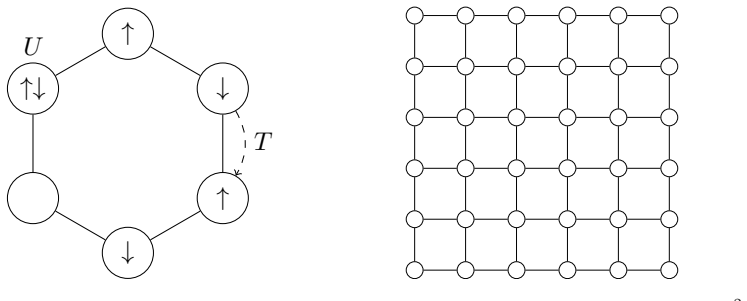
Summary. This paper studies the Matsubara-frequency (MaF) discretization of the IPT-DMFT equations for translation-invariant Hubbard models. In the dimensionless formulation (19)–(20), the authors prove via Brouwer's fixed-point theorem that for each cutoff N_ω there exists t_{N_ω} > 0 such that for 0 ≤ t ≤ t_{N_ω}/sqrt(deg(G_H)) the discretized equations admit a solution (Δ,Σ) with nonpositive imaginary parts (Theorem 3.1). Under the additional smallness condition t^2 u^2 deg(G_H) < η_{N_ω}, they prove uniqueness and linear convergence of the fixed-point iteration (Theorem 3.5). For bipartite graphs, particle-hole symmetry reduces the problem to a polynomial system in the variables x_n = 1/(1+y_n); the dimer case N_ω = 0 is fully characterized as a function of α = U/T (Theorem 4.2), and for N_ω = 1 numerical algebraic geometry suggests 16 complex solutions and 1–5 admissible solutions. The final section reports TRIQS and Julia simulations showing a conductor-to-insulator transition and cases where the converged values violate the Pick criterion.
Significance. These appear to be the first existence and uniqueness results for the discretized IPT-DMFT equations, and they are obtained from explicit fixed-point estimates rather than by fitting parameters. The N_ω = 0 dimer theorem is a complete, rigorous characterization of the admissible solutions in the low-temperature limit. The algebraic-geometry viewpoint in Section 4 is promising and, if fully justified, would give a systematic way to count and classify solutions for larger N_ω. The numerical experiments are clearly labelled as illustrations and include a careful high-precision check of the Pick criterion, which is a useful caution for practitioners of the MaF discretization. The main limitations are that the algebraic reduction in Section 4.2 is not proved in the manuscript, and the convergence of discretized solutions to the continuous IPT-DMFT solutions is only conjectured (Remark 5.1).
major comments (3)
- [Section 4.2, Eqs. (46) and (57)] The passage from the rational equations (19)–(20) to the polynomial system is asserted with 'it follows that' and no proof is given. This equivalence is load-bearing for the N_ω = 1 results in Section 4.3.2, because all solution counts are computed on the polynomial system (58)–(59), not on the original equations. A rigorous derivation must justify the change of variables x_n = 1/(1+y_n), the spectral decomposition of h_perp^0, and the clearing of denominators, and it must rule out spurious roots introduced by that clearing and the possible loss of boundary solutions (e.g., x_n = 1, i.e., y_n = 0). Please provide the full derivation in the text or in an appendix.
- [Proof of Theorem 3.5] The Lipschitz constant L_{N_ω} is defined as a supremum over D_t^{N_ω}, which depends on the parameter t. The subsequent identification η_{N_ω} = π^2/L_{N_ω} therefore makes η_{N_ω} depend on t, contrary to the theorem's statement that η_{N_ω} depends only on N_ω. The argument can be repaired by taking the supremum over the largest admissible set, D_{t_{N_ω}/sqrt(deg(G_H))}^{N_ω}, which depends only on N_ω, but as written the proof is incomplete.
- [Section 4.3.2, Eqs. (58)–(59)] The assertions that (58)–(59) have 16 complex solutions and that the number of admissible solutions ranges from 1 to 5 are obtained from HomotopyContinuation.jl, not from a proved theorem. Similarly, the separation line b = 3(1 + a/10)^3 is stated without computation. If these are numerical observations, the text should label them as such; if they are intended as rigorous 'some results for N_ω = 1', the manuscript must supply proofs or certificates. This matters because the abstract promises results for N_ω = 1.
minor comments (6)
- [Eq. (34)] The Matsubara frequency in the definition of F_DMFT_Nω is written 'i2(n+1)π' rather than 'i(2n+1)π'; this is inconsistent with all other occurrences and appears to be a typo.
- [Lemma 3.4] The statement says F_Nω(D_t^{Nω}) ⊂ −C_+ for all 0 ≤ t ≤ t_Nω, but because D_t^{Nω} = t^2 deg(G_H) C_Nω, the proof actually requires t ≤ t_Nω / sqrt(deg(G_H)); the statement and proof should be aligned.
- [Figure 2 caption] The caption writes 'ω_n = 2(n+1)π/β'; the correct Matsubara frequency is ω_n = (2n+1)π/β.
- [Theorem 4.2, first bullet] The bullet states that there is a unique solution 'in C+' with iΔ∞_{α,t} → +∞; for the admissible set −C_+ this should read 'in −C_+' so that the stated limit is consistent.
- [Proof of Lemma 3.4] The quantity φ(n,Nω) = π^3 Im(F_Nω(0)_n) is described as a 'positive rational number', but it is negative (for example φ(0,0) = −3); the word 'positive' should be removed or the sign convention explained.
- [Section 1, last paragraph] The phrase 'it is highlited' should be 'it is highlighted'.
Circularity Check
No significant circularity: the discretized existence/uniqueness proofs are self-contained fixed-point arguments, and self-citations to the prior continuous IPT-DMFT paper are background, not load-bearing reductions.
full rationale
This paper's central claims — existence (Theorem 3.1), uniqueness and linear convergence (Theorem 3.5), and the Nω=0 characterization (Theorem 4.2) — are proved by Brouwer/Picard fixed-point arguments on explicit parameter-dependent sets D_t^{Nω} and by an explicit quartic analysis; no fitted parameters are renamed as predictions. The discretized equations (19)-(20) are formulated independently of the results they are used to prove. The main self-citations to [5] are background: [5] supplies the continuous IPT construction, the sign of F_IPT(0) used in Lemma 3.4, and standard Nevanlinna-Pick facts, but the monotonicity in Nω, the invariant-set estimates, and the contraction estimates are derived here. Lemma 3.4 appeals to [5, Prop. 2.18] only to evaluate a fixed limit at zero hybridization; this is an independent quantitative fact, not a restatement of the discretized existence theorem. Section 4.2's algebraic reduction is compressed, and the homotopy-continuation counts of (58)-(59) are conditional on that reduction, but this is a derivation gap or numerical verification issue, not circularity: the variable change x_n=1/(1+y_n) is a bijection on the admissible domain and the polynomial system is an algebraic reformulation, not a fitted target. Section 5 numerical results are explicitly presented as simulations, and Remark 5.1 labels the Nω→∞ convergence as a conjecture, so the paper does not disguise an unproved link as a theorem. Overall, no step reduces by construction to its own input, and no load-bearing conclusion is forced by a self-citation chain.
Assumptions & free parameters
assumptions (7)
- standard math Brouwer fixed-point theorem
- standard math Picard fixed-point theorem (contraction mapping theorem)
- standard math Nevanlinna-Riesz representation and Pick function theory
- standard math Resolvent identities and Schur complement methods
- domain assumption IPT approximation is a valid impurity solver and the continuous IPT-DMFT equations from [5] are the correct starting point
- domain assumption Finite vertex-transitive Hubbard graph and paramagnetic single-site setting
- domain assumption For bipartite systems, half-filling and particle-hole symmetry
Cite this review
Pith. "Pith review of A mathematical analysis of the discretized IPT-DMFT equations." pith.science (2026). https://pith.science/paper/37GHNUQ7
@misc{pith2026250521287,
  author       = {Pith},
  title        = {Pith review of: A mathematical analysis of the discretized IPT-DMFT equations},
  year         = {2026},
  howpublished = {\url{https://pith.science/paper/37GHNUQ7}},
  note         = {Machine review of arXiv:2505.21287}
}
abstract
In a previous contribution (E. Canc\`es, A. Kirsch and S. Perrin--Roussel, arXiv:2406.03384), we have proven the existence of a solution to the Dynamical Mean-Field Theory (DMFT) equations under the Iterated Perturbation Theory (IPT-DMFT) approximation. In view of numerical simulations, these equations need to be discretized. In this article, we are interested in a discretization of the \acrshort{ipt}-\acrshort{dmft} functional equations, based on the restriction of the hybridization function and local self-energy to a finite number of points in the upper half-plane $\left(i\omega_n\right)_{n \in |[0,N_\omega]|}$, where $\omega_n=(2n+1)\pi / \beta$ is the $n$-th Matsubara frequency and $N_\omega \in \mathbb N$. We first prove the existence of solutions to the discretized equations in some parameter range depending on $N_\omega$. We then prove uniqueness for a smaller range of parameters. We also study more in depth the case of bipartite systems exhibiting particle-hole symmetry. In this case, the discretized IPT-DMFT equations have purely imaginary solutions, which can be obtained by solving a real algebraic system of $(N_\omega+1)$ equations with $(N_\omega+1)$ variables. We provide a complete characterization of the solutions for $N_\omega=0$ and some results for $N_\omega=1$ in the simple case of the Hubbard dimer. We finally present some numerical simulations on the Hubbard dimer.
Figures


Figures from the paper (4 more)


Reference graph
Works this paper leans on
-
[1]
Sergey Bravyi and David Gosset. Complexity of quantum impurity problems.Communications in Mathematical Physics, 356(2):451–500, December 2017. arXiv:1609.00735 [cond-mat, physics:math- ph, physics:quant-ph]
arXiv 2017
-
[2]
HomotopyContinuation.jl: A Package for Homotopy Continuation in Julia
Paul Breiding and Sascha Timme. HomotopyContinuation.jl: A Package for Homotopy Continuation in Julia. InInternational Congress on Mathematical Software, pages 458–465. Springer, 2018
work page 2018
-
[3]
Springer Science & Business Media, 2011
Andries E Brouwer and Willem H Haemers.Spectra of graphs. Springer Science & Business Media, 2011
2011
-
[4]
Eric Canc` es, David Gontier, and Gabriel Stoltz. A mathematical analysis of the GW0 method for computing electronic excited energies of molecules.Reviews in Mathematical Physics, 28(04):1650008, 2016
work page 2016
-
[5]
A mathematical analysis of IPT-DMFT, June
´Eric Canc` es, Alfred Kirsch, and Solal Perrin-Roussel. A mathematical analysis of IPT-DMFT, June
-
[6]
William F Donoghue and William F Donoghue. Interpolation by pick functions.Monotone Matrix Functions and Analytic Continuation, pages 117–127, 1974
work page 1974
-
[7]
Nevanlinna Analytical Continuation.Physical Review Letters, 126(5):056402, February 2021
Jiani Fei, Chia-Nan Yeh, and Emanuel Gull. Nevanlinna Analytical Continuation.Physical Review Letters, 126(5):056402, February 2021
work page 2021
-
[8]
Jiani Fei, Chia-Nan Yeh, Dominika Zgid, and Emanuel Gull. Analytical continuation of matrix- valued functions: Carath´ eodory formalism.Physical Review B, 104(16):165111, 2021
work page 2021
Show all 41 references
-
[9]
Hubbard model in infinite dimensions.Physical Review B, 45(12):6479–6483, March 1992
Antoine Georges and Gabriel Kotliar. Hubbard model in infinite dimensions.Physical Review B, 45(12):6479–6483, March 1992
1992
-
[10]
Rozenberg
Antoine Georges, Gabriel Kotliar, Werner Krauth, and Marcelo J. Rozenberg. Dynamical mean-field theory of strongly correlated fermion systems and the limit of infinite dimensions.Reviews of Modern Physics, 68(1):13–125, January 1996
1996
-
[11]
On Matrix–Valued Herglotz Functions.Mathematische Nachrichten, 218(1):61–138, 2000
Fritz Gesztesy and Eduard Tsekanovskii. On Matrix–Valued Herglotz Functions.Mathematische Nachrichten, 218(1):61–138, 2000
2000
-
[12]
Grayson and Michael E
Daniel R. Grayson and Michael E. Stillman. Macaulay2, a software system for research in algebraic geometry. Available athttp://www2.macaulay2.com
-
[13]
J. E. Gubernatis, Mark Jarrell, R. N. Silver, and D. S. Sivia. Quantum Monte Carlo simulations and maximum entropy: Dynamics from imaginary-time data.Physical Review B, 44(12):6011–6029, 1991
1991
-
[14]
Millis, Alexander I
Emanuel Gull, Andrew J. Millis, Alexander I. Lichtenstein, Alexey N. Rubtsov, Matthias Troyer, and Philipp Werner. Continuous-time Monte Carlo methods for quantum impurity models.Reviews of Modern Physics, 83(2):349–404, 2011
2011
-
[15]
Gutzwiller
Martin C. Gutzwiller. Effect of Correlation on the Ferromagnetism of Transition Metals.Physical Review Letters, 10(5):159–162, March 1963
1963
-
[16]
Mott-Hubbard Metal-Insulator Transition in Paramagnetic V$ 2$O$ 3$: An LDA+DMFT (QMC) Study.Physical review letters, 86(23):5345, 2001
Karsten Held, Georg Keller, Volker Eyert, Dieter Vollhardt, and Vladimir I Anisimov. Mott-Hubbard Metal-Insulator Transition in Paramagnetic V$ 2$O$ 3$: An LDA+DMFT (QMC) Study.Physical review letters, 86(23):5345, 2001. 26
2001
-
[17]
Robust analytic continuation of Green’s functions via projection, pole estimation, and semidefinite relaxation.Physical Review B, 107(7):075151, February
Zhen Huang, Emanuel Gull, and Lin Lin. Robust analytic continuation of Green’s functions via projection, pole estimation, and semidefinite relaxation.Physical Review B, 107(7):075151, February
-
[18]
Electron correlations in narrow energy bands.Proceedings of the Royal Society of London
John Hubbard. Electron correlations in narrow energy bands.Proceedings of the Royal Society of London. Series A. Mathematical and Physical Sciences, 276(1365):238–257, 1963
1963
-
[19]
Mark Jarrell and J. E. Gubernatis. Bayesian inference and the analytic continuation of imaginary- time quantum Monte Carlo data.Physics Reports, 269(3):133–195, May 1996
1996
-
[20]
Electron Correlation and Ferromagnetism of Transition Metals.Progress of Theoretical Physics, 30(3):275–289, 1963
Junjiro Kanamori. Electron Correlation and Ferromagnetism of Transition Metals.Progress of Theoretical Physics, 30(3):275–289, 1963
1963
-
[21]
Interaction-expansion inchworm Monte Carlo solver for lattice and impurity models.Physical Review B, 105(16):165133, 2022
Jia Li, Yang Yu, Emanuel Gull, and Guy Cohen. Interaction-expansion inchworm Monte Carlo solver for lattice and impurity models.Physical Review B, 105(16):165133, 2022
2022
-
[22]
Elliott H. Lieb. The Hubbard model: Some Rigorous Results and Open Problems. InCondensed Matter Physics and Exactly Soluble Models: Selecta of Elliott H. Lieb. Berlin, Heidelberg, 2004
2004
-
[23]
Sparsity Pattern of the Self-energy for Classical and Quantum Impurity Problems.Annales Henri Poincar´ e, 21(7):2219–2257, 2020
Lin Lin and Michael Lindsey. Sparsity Pattern of the Self-energy for Classical and Quantum Impurity Problems.Annales Henri Poincar´ e, 21(7):2219–2257, 2020
2020
-
[24]
Martin, Lucia Reining, and David M
Richard M. Martin, Lucia Reining, and David M. Ceperley.Interacting Electrons: Theory and Computational Approaches. Cambridge University Press, Cambridge, 2016
2016
-
[25]
Correlated Lattice Fermions in d =$\infty$Dimensions
Walter Metzner and Dieter Vollhardt. Correlated Lattice Fermions in d =$\infty$Dimensions. Physical Review Letters, 62(3):324–327, January 1989
1989
-
[26]
Uber beschrankte Funktionen, die in gegeben Punkten vorgeschrieben Werte an- nehmen.Ann
Rolf Nevanlinna. Uber beschrankte Funktionen, die in gegeben Punkten vorgeschrieben Werte an- nehmen.Ann. Acad. Sci. Fenn. Ser. A 1 Mat. Dissertationes, 1919
1919
-
[27]
Interpolating Blaschke products solving Pick-Nevanlinna problems.Journal d’Analyse Mathematique, 62(1):199–224, December 1994
Artur Nicolau. Interpolating Blaschke products solving Pick-Nevanlinna problems.Journal d’Analyse Mathematique, 62(1):199–224, December 1994
1994
-
[28]
The Nevanlinna-Pick Interpolation Problem
Artur Nicolau. The Nevanlinna-Pick Interpolation Problem. 2015
2015
-
[29]
TRIQS: A toolbox for research on interacting quantum systems.Computer Physics Communications, 196:398–415, 2015
Olivier Parcollet, Michel Ferrero, Thomas Ayral, Hartmut Hafermann, Igor Krivenko, Laura Messio, and Priyanka Seth. TRIQS: A toolbox for research on interacting quantum systems.Computer Physics Communications, 196:398–415, 2015
2015
-
[30]
Rudolph Pariser and Robert G. Parr. A Semi-Empirical Theory of the Electronic Spectra and Electronic Structure of Complex Unsaturated Molecules. II.The Journal of Chemical Physics, 21(5):767–776, 1953
1953
-
[31]
¨Uber die Beschr¨ ankungen analytischer Funktionen, welche durch vorgegebene Funk- tionswerte bewirkt werden.Mathematische Annalen, 77(1):7–23, March 1915
Georg Pick. ¨Uber die Beschr¨ ankungen analytischer Funktionen, welche durch vorgegebene Funk- tionswerte bewirkt werden.Mathematische Annalen, 77(1):7–23, March 1915
1915
-
[32]
John A. Pople. Electron interaction in unsaturated hydrocarbons.Transactions of the Faraday Society, 49(0):1375–1385, 1953
1953
-
[33]
A. N. Rubtsov, V. V. Savkin, and A. I. Lichtenstein. Continuous-time quantum Monte Carlo method for fermions.Physical Review B, 72(3):035122, July 2005
2005
-
[34]
TRIQS/CTHYB: A continuous- time quantum Monte Carlo hybridisation expansion solver for quantum impurity problems.Computer Physics Communications, 200:274–284, 2016
Priyanka Seth, Igor Krivenko, Michel Ferrero, and Olivier Parcollet. TRIQS/CTHYB: A continuous- time quantum Monte Carlo hybridisation expansion solver for quantum impurity problems.Computer Physics Communications, 200:274–284, 2016
2016
-
[35]
Shapiro.A Fixed-Point Farrago
Joel H. Shapiro.A Fixed-Point Farrago. Universitext. Springer International Publishing, Cham, 2016
2016
-
[36]
Extended dynamical mean-field theory and GW method.Physical Review B, 66(8):085120, 2002
Ping Sun and Gabriel Kotliar. Extended dynamical mean-field theory and GW method.Physical Review B, 66(8):085120, 2002
2002
-
[37]
Doping a Wigner- Mott insulator: Exotic charge orders in transition metal dichalcogenide moir´ e heterobilayers.Physical Review Research, 5(4):043190, 2023
Yuting Tan, Pak Ki Henry Tsang, Vladimir Dobrosavljevi´ c, and Louk Rademaker. Doping a Wigner- Mott insulator: Exotic charge orders in transition metal dichalcogenide moir´ e heterobilayers.Physical Review Research, 5(4):043190, 2023. 27
2023
-
[38]
Philipp Werner, Armin Comanac, Luca de’ Medici, Matthias Troyer, and Andrew J. Millis. Continuous-Time Solver for Quantum Impurity Models.Physical Review Letters, 97(7):076405, 2006
2006
-
[39]
Philipp Werner and Andrew J. Millis. Hybridization expansion impurity solver: General formulation and application to Kondo lattice and two-orbital models.Physical Review B, 74(15):155107, 2006
2006
-
[40]
X. Y. Zhang, M. J. Rozenberg, and G. Kotliar. Mott transition in the d =\infty Hubbard model at zero temperature.Physical Review Letters, 70(11):1666–1669, March 1993. 28
1993
-
[2023]
arXiv:2210.04187 [cond-mat, physics:physics]
Reviewed August 7, 2026 · model on record in the stance chip above.
Discussion (0). Sign in to comment.