Pair binding and Hund's rule breaking in high-symmetry fullerenes
Pith reviewed 2026-05-22 01:46 UTC · model grok-4.3
The pith
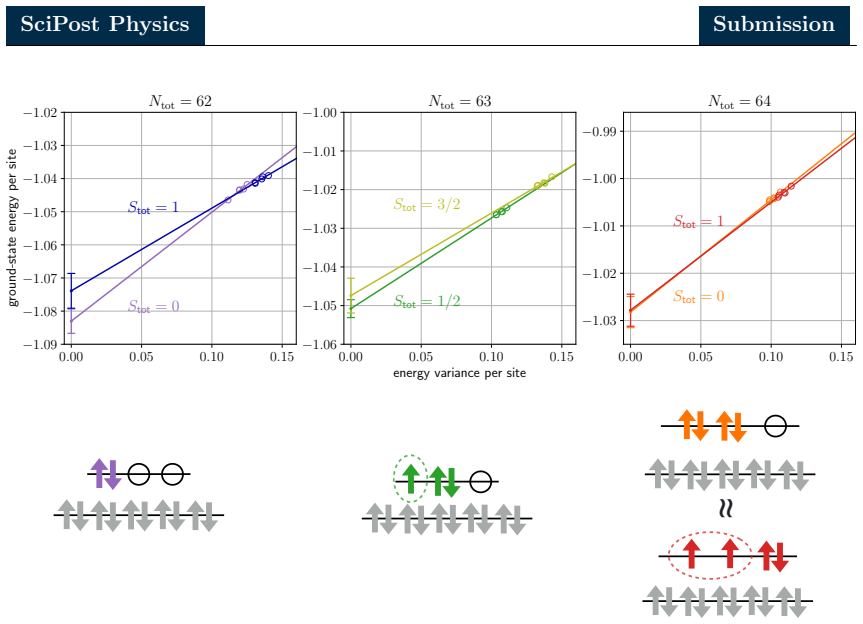
Hund's rule breaks in the ground states of C40 and C60 but holds in C28, with pair binding remaining repulsive overall in C20.
A machine-rendered reading of the paper's core claim, the machinery that carries it, and where it could break.
Core claim
Using the single-orbital Hubbard model, the authors find that Hund's rule is broken for C40 in the neutral singlet ground state but restored upon one-electron doping, while for C60 the rule is broken and doping with two or three electrons yields minimum-spin states; the pair-binding energy in C20 remains repulsive at all studied U, and the Mott transition occurs at U_c approximately 2.2t.
What carries the argument
Density-matrix renormalization group calculations on the Hubbard Hamiltonian that exploit SU(2) spin symmetry, U(1) charge symmetry, and Z(N) rotational symmetry to obtain ground-state spin and pair-binding energies for each fullerene.
If this is right
- C60 lattices can support superconductivity through an electronic mechanism once doped into the minimum-spin regime.
- Geometric frustration in smaller fullerenes suppresses pair binding and favors magnetic states up to higher interaction strengths.
- Hund's rule breaking signals a crossover from magnetic to paired behavior that depends on molecular size and symmetry.
- Mott transitions occur at molecule-specific values of U/t, with C20 crossing at a lower ratio than earlier estimates.
Where Pith is reading between the lines
- The same symmetry-adapted DMRG approach could be applied to other curved carbon structures to map how curvature and frustration trade off against pairing.
- If the minimum-spin states survive in extended lattices, they would provide a microscopic route to pairing that is independent of lattice phonons.
- Testing the model on fullerenes with reduced symmetry would isolate whether high symmetry itself is required for the observed Hund's rule breaking.
Load-bearing premise
The low-energy physics of these fullerenes is captured by a single-orbital Hubbard model containing only on-site repulsion and nearest-neighbor hopping.
What would settle it
A direct measurement or higher-precision calculation showing whether the pair-binding energy in C60 becomes negative at the doping levels where minimum-spin states appear.
Figures



read the original abstract
Highly-symmetric molecules often exhibit degenerate tight-binding states at the Fermi edge. This typically results in a magnetic ground state if small interactions are introduced in accordance with Hund's rule. In some cases, Hund's rule may be broken, which signals pair binding and goes hand-in-hand with an attractive pair-binding energy. We investigate pair binding and Hund's rule breaking for the Hubbard model on high-symmetry fullerenes C$_{20}$, C$_{28}$, C$_{40}$, and C$_{60}$ by using large-scale density-matrix renormalization group calculations. We exploit the SU(2) spin symmetry, the U(1) charge symmetry, and optionally the Z(N) spatial rotation symmetry of the problem. For C$_{20}$, our results agree well with available exact-diagonalization data, but our approach is numerically much cheaper. We find a Mott transition at $U_c\sim2.2t$, which is much smaller than the previously reported value of $U_c\sim4.1t$ that was extrapolated from a few datapoints. We compute the pair-binding energy for arbitrary values of $U$ and observe that it remains overall repulsive. For larger fullerenes, we are not able to evaluate the pair binding energy with sufficient precision, but we can still investigate Hund's rule breaking. For C$_{28}$, we find that Hund's rule is fulfilled with a magnetic spin-2 ground state that transitions to a spin-1 state at $U_{c,1}\sim5.4t$ before the eventual Mott transition to a spin singlet takes place at $U_{c,2}\sim 11.6t$. For C$_{40}$, Hund's rule is broken in the singlet ground state, but is restored if the system is doped with one electron. Hund's rule is also broken for C$_{60}$, and the doping with two or three electrons results in a minimum-spin state. Our results are consistent with an electronic mechanism of superconductivity for C$_{60}$ lattices. We speculate that the high geometric frustration of small fullerenes is detrimental to pair binding.
Editorial analysis
A structured set of objections, weighed in public.
Referee Report
Summary. The manuscript investigates the single-orbital Hubbard model on high-symmetry fullerenes C20, C28, C40, and C60 using large-scale DMRG calculations that exploit SU(2) spin, U(1) charge, and optional Z(N) rotational symmetries. For C20 the results reproduce exact-diagonalization benchmarks, locate a Mott transition at U_c ≈ 2.2t, and show that the pair-binding energy remains repulsive for all U. For the larger molecules, direct pair-binding energies cannot be obtained with sufficient precision, but the authors map Hund's-rule behavior: C28 obeys Hund's rule with a spin-2 ground state that crosses to spin-1 before the Mott transition; C40 breaks Hund's rule in the neutral singlet but restores it upon single-electron doping; C60 breaks Hund's rule and yields minimum-spin states upon two- or three-electron doping. The authors conclude that these findings are consistent with an electronic pairing mechanism for superconductivity in C60 lattices and speculate that geometric frustration suppresses pair binding in smaller fullerenes.
Significance. If the interpretation of Hund's-rule breaking as a proxy for attractive pair binding is valid, the work supplies concrete numerical evidence that interaction-driven pairing tendencies can survive in highly symmetric molecular Hubbard systems, supporting electronic mechanisms proposed for alkali-doped fullerene superconductors. The symmetry-adapted DMRG implementation and its agreement with exact results on C20 constitute clear technical strengths. The inability to compute pair-binding energies directly on C60, however, means the central consistency claim rests on an indirect indicator whose reliability in the relevant parameter window is not independently verified within the manuscript.
major comments (2)
- [Abstract] Abstract and concluding discussion: the claim that the C60 results are 'consistent with an electronic mechanism of superconductivity' is grounded in the observation of Hund's-rule breaking and minimum-spin doped states, yet the manuscript states that pair-binding energies cannot be evaluated with sufficient precision for C60 (and larger cages). Because the same DMRG framework finds a repulsive pair-binding energy for all U on C20, an explicit argument is required showing why Hund's-rule violation reliably signals attractive pair binding in the C60 regime; without it the consistency statement remains an untested extrapolation.
- [C20 results] C20 results section: the reported Mott transition at U_c ∼ 2.2t is lower than the previously extrapolated value of ∼4.1t. The manuscript indicates that the new value is obtained from finite-bond-dimension or finite-size DMRG data; the extrapolation procedure, bond-dimension scaling, and finite-size corrections used to locate the transition should be documented in detail so that the discrepancy with earlier work can be assessed.
minor comments (2)
- [Methods] Notation for the pair-binding energy Δ and the critical interaction strengths U_{c,1}, U_{c,2} should be defined once in the main text and used consistently; occasional redefinition in figure captions creates minor ambiguity.
- [Figures] Figure captions for the spin-gap and pair-binding plots should explicitly state the bond dimension and truncation error at which the data were obtained, allowing readers to judge convergence.
Simulated Author's Rebuttal
We thank the referee for their careful reading and constructive comments on our manuscript. We address the major comments point by point below.
read point-by-point responses
-
Referee: [Abstract] Abstract and concluding discussion: the claim that the C60 results are 'consistent with an electronic mechanism of superconductivity' is grounded in the observation of Hund's-rule breaking and minimum-spin doped states, yet the manuscript states that pair-binding energies cannot be evaluated with sufficient precision for C60 (and larger cages). Because the same DMRG framework finds a repulsive pair-binding energy for all U on C20, an explicit argument is required showing why Hund's-rule violation reliably signals attractive pair binding in the C60 regime; without it the consistency statement remains an untested extrapolation.
Authors: We agree that the connection merits explicit elaboration. The manuscript states that Hund's rule breaking signals pair binding and attractive pair-binding energy. For C20 the pair-binding energy is repulsive for all U, which we attribute to the high geometric frustration of the smallest fullerene as noted in the concluding discussion. For C60 the lower frustration permits Hund's rule breaking in the neutral singlet and minimum-spin states for two- and three-electron doping; this regime is the one relevant to the proposed electronic pairing mechanism in doped C60 solids. We have expanded the discussion section with a paragraph that makes this distinction and the resulting consistency argument explicit. revision: yes
-
Referee: [C20 results] C20 results section: the reported Mott transition at U_c ∼ 2.2t is lower than the previously extrapolated value of ∼4.1t. The manuscript indicates that the new value is obtained from finite-bond-dimension or finite-size DMRG data; the extrapolation procedure, bond-dimension scaling, and finite-size corrections used to locate the transition should be documented in detail so that the discrepancy with earlier work can be assessed.
Authors: We agree that a more detailed account of the extrapolation is needed. The lower U_c results from systematic scaling over a wider range of bond dimensions and system sizes than was available in prior work. We have revised the C20 results section to document the bond-dimension scaling of the charge gap, the extrapolation to infinite bond dimension, the finite-size corrections, and the procedure that yields U_c ≈ 2.2t, including additional figures that display the scaling data. revision: yes
Circularity Check
No significant circularity: results from direct DMRG on defined Hubbard model
full rationale
All reported quantities (Mott transitions, ground-state spins, pair-binding energies for C20, Hund's rule behavior) are obtained by explicit numerical diagonalization/DMRG of the single-orbital Hubbard Hamiltonian whose form is stated at the outset. No target observable is defined in terms of a fitted parameter that is subsequently re-derived from the same data. The abstract's general statement that Hund's rule breaking signals pair binding is presented as a known association rather than a self-referential derivation; for C60 the paper explicitly notes the inability to compute pair-binding energy directly and instead reports the observed minimum-spin states. No load-bearing self-citation chain or ansatz smuggling appears in the provided text. The derivation chain is therefore self-contained against the numerical benchmarks.
Axiom & Free-Parameter Ledger
free parameters (1)
- U/t ratio
axioms (1)
- domain assumption Low-energy physics of these fullerenes is captured by a single-band Hubbard model with nearest-neighbor hopping t and on-site repulsion U only.
Lean theorems connected to this paper
-
IndisputableMonolith/Cost/FunctionalEquation.leanwashburn_uniqueness_aczel unclear?
unclearRelation between the paper passage and the cited Recognition theorem.
The Hubbard Hamiltonian is given by H=−∑ijσ tij ci†σ cjσ + h.c. + U ∑i ni↑ ni↓ … We set it to be the unit of energy t=1 … We compute the pair-binding energy for arbitrary values of U and observe that it remains overall repulsive.
-
IndisputableMonolith/Foundation/AbsoluteFloorClosure.leanreality_from_one_distinction unclear?
unclearRelation between the paper passage and the cited Recognition theorem.
For C60 … Hund’s rule is also broken … doping with two or three electrons results in a minimum-spin state. Our results are consistent with an electronic mechanism of superconductivity for C60 lattices.
What do these tags mean?
- matches
- The paper's claim is directly supported by a theorem in the formal canon.
- supports
- The theorem supports part of the paper's argument, but the paper may add assumptions or extra steps.
- extends
- The paper goes beyond the formal theorem; the theorem is a base layer rather than the whole result.
- uses
- The paper appears to rely on the theorem as machinery.
- contradicts
- The paper's claim conflicts with a theorem or certificate in the canon.
- unclear
- Pith found a possible connection, but the passage is too broad, indirect, or ambiguous to say the theorem truly supports the claim.
Reference graph
Works this paper leans on
-
[1]
F. Hund,Zur Deutung verwickelter Spektren, insbesondere der Elemente Scandium bis Nickel, Zeitschrift für Physik33(1), 345 (1925), doi:10.1007/BF01328319
-
[2]
J. Katriel and R. Pauncz,Theoretical interpretation of Hund’s Rule, vol. 10 ofAdvances in Quantum Chemistry, pp. 143–185. Academic Press, doi:https://doi.org/10.1016/S0065-3276(08)60580-8 (1977)
-
[3]
R. A. Broglia and V. Zelevinsky,Fifty years of nuclear BCS: pairing in finite systems, World Scientific (2013)
work page 2013
-
[4]
V. Zelevinsky and A. Volya,Physics of Atomic Nuclei, John Wiley & Sons (2017)
work page 2017
-
[5]
S. R. White, S. Chakravarty, M. P. Gelfand and S. A. Kivelson,Pair binding in small Hubbard-model molecules, Phys. Rev. B45, 5062 (1992), doi:10.1103/PhysRevB.45.5062
-
[6]
T. Palstra, O. Zhou, Y. Iwasa, P. Sulewski, R. Fleming and B. Zegarski,Supercon- ductivity at 40K in cesium doped C60, Solid State Communications93(4), 327 (1995), doi:https://doi.org/10.1016/0038-1098(94)00787-X
-
[7]
Y. Takabayashi and K. Prassides,Unconventional high-Tc superconductivity in ful- lerides, Philosophical Transactions of the Royal Society A: Mathematical, Physical and Engineering Sciences374(2076), 20150320 (2016), doi:10.1098/rsta.2015.0320
-
[8]
S. Chakravarty and S. A. Kivelson,Electronic mechanism of superconductiv- ity in the cuprates,c 60,and polyacenes, Phys. Rev. B64, 064511 (2001), doi:10.1103/PhysRevB.64.064511
-
[9]
S. Chakravarty and S. Kivelson,Superconductivity of doped fullerenes, Europhysics Letters16(8), 751 (1991), doi:10.1209/0295-5075/16/8/008
-
[10]
S. Chakravarty, M. P. Gelfand and S. Kivelson,Electronic correlation ef- fects and superconductivity in doped fullerenes, Science254(5034), 970 (1991), doi:10.1126/science.254.5034.970
-
[11]
L. Bergomi, J. P. Blaizot, T. Jolicoeur and E. Dagotto,Generalized spin-density-wave state of the Hubbard model forc12 andc 60 clusters, Phys. Rev. B47, 5539 (1993), doi:10.1103/PhysRevB.47.5539
-
[12]
R. T. Scalettar, A. Moreo, E. Dagotto, L. Bergomi, T. Jolicoeur and H. Monien, Ground-state properties of the Hubbard model on ac60 cluster, Phys. Rev. B47, 12316 (1993), doi:10.1103/PhysRevB.47.12316
-
[13]
M. Lüders, A. Bordoni, N. Manini, A. D. Corso, M. Fabrizio and E. Tosatti, Coulomb couplings in positively charged fullerene, Philosophical Magazine B 82(15), 1611 (2002), doi:10.1080/13642810208220729,https://doi.org/10.1080/ 13642810208220729
-
[14]
F. Lin, J.Smakov, E. S. Sørensen, C. Kallin and A. J. Berlinsky,Quantum monte carlo calculation of the electronic binding energy in ac60 molecule, Phys. Rev. B71, 165436 (2005), doi:10.1103/PhysRevB.71.165436
-
[15]
Theoretical aspects of highly correlated fullerides: metal-insulator transition
N. Manini and E. Tosatti,Theoretical aspects of highly correlated fullerides: metal- insulator transition, arXiv preprint cond-mat/0602134 (2006). 23 SciPost Physics Submission
work page internal anchor Pith review Pith/arXiv arXiv 2006
-
[16]
F. Lin, E. S. Sørensen, C. Kallin and A. J. Berlinsky,Strong correlation effects in the fullerenec 20 studied using a one-band Hubbard model, Phys. Rev. B76, 033414 (2007), doi:10.1103/PhysRevB.76.033414
-
[17]
F. Lin, E. S. Sørensen, C. Kallin and A. J. Berlinsky,Single-particle excita- tion spectra ofc 60 molecules and monolayers, Phys. Rev. B75, 075112 (2007), doi:10.1103/PhysRevB.75.075112
-
[18]
F. Lin, E. S. Sørensen, C. Kallin and A. J. Berlinsky,Extended Hubbard model on a c20 molecule, Journal of Physics: Condensed Matter19(45), 456206 (2007), doi:10.1088/0953-8984/19/45/456206
-
[19]
H.-C. Jiang and S. Kivelson,Electronic pair binding and hund’s rule violations in doped c60, Phys. Rev. B93, 165406 (2016), doi:10.1103/PhysRevB.93.165406
-
[20]
U. Schollwöck,The density-matrix renormalization group in the age of matrix product states, Annals of Physics326(1), 96 (2011), doi:https://doi.org/10.1016/j.aop.2010.09.012, January 2011 Special Issue
-
[21]
M. Exler and J. Schnack,Evaluation of the low-lying energy spectrum of magnetic keplerate molecules using the density-matrix renormalization group technique, Phys. Rev. B67, 094440 (2003), doi:10.1103/PhysRevB.67.094440
-
[22]
R. Rausch, C. Plorin and M. Peschke,The antiferromagneticS= 1/2Heisen- berg model on the C 60 fullerene geometry, SciPost Phys.10, 087 (2021), doi:10.21468/SciPostPhys.10.4.087
-
[23]
R. Rausch, M. Peschke, C. Plorin and C. Karrasch,Magnetic properties of a capped kagome molecule with 60 quantum spins, SciPost Phys.12, 143 (2022), doi:10.21468/SciPostPhys.12.5.143
-
[24]
R. Rausch and C. Karrasch,The low-spin ground state of the giant Mn wheels(2024), 2401.07552
-
[25]
G. K.-L. Chan and S. Sharma,The density matrix renormalization group in quantum chemistry, Annual Review of Physical Chemistry62(1), 465 (2011), doi:10.1146/annurev-physchem-032210-103338, PMID: 21219144,https://doi.org/ 10.1146/annurev-physchem-032210-103338
-
[26]
R. Rausch, M. Peschke, C. Plorin, J. Schnack and C. Karrasch,Quantum spin spi- ral ground state of the ferrimagnetic sawtooth chain, SciPost Phys.14, 052 (2023), doi:10.21468/SciPostPhys.14.3.052
-
[27]
C. Hubig, I. P. McCulloch, U. Schollwöck and F. A. Wolf,Strictly single-site DMRG algorithm with subspace expansion, Phys. Rev. B91, 155115 (2015), doi:10.1103/PhysRevB.91.155115
-
[28]
G. K.-L. Chan and M. Head-Gordon,Highly correlated calculations with a polynomial cost algorithm: A study of the density matrix renormalization group, The Journal of Chemical Physics116(11), 4462 (2002), doi:10.1063/1.1449459,https://pubs.aip. org/aip/jcp/article-pdf/116/11/4462/19222618/4462_1_online.pdf
-
[29]
C. Hubig, I. P. McCulloch and U. Schollwöck,Generic construction of efficient matrix product operators, Phys. Rev. B95, 035129 (2017), doi:10.1103/PhysRevB.95.035129. 24 SciPost Physics Submission
-
[30]
I.P.McCullochandM.Gulácsi,The non-abelian density matrix renormalization group algorithm, Europhysics Letters57(6), 852 (2002), doi:10.1209/epl/i2002-00393-0
-
[31]
J. Motruk, M. P. Zaletel, R. S. K. Mong and F. Pollmann,Density matrix renor- malization group on a cylinder in mixed real and momentum space, Phys. Rev. B93, 155139 (2016), doi:10.1103/PhysRevB.93.155139
-
[32]
G. Ehlers, S. R. White and R. M. Noack,Hybrid-space density matrix renormalization group study of the doped two-dimensional Hubbard model, Phys. Rev. B95, 125125 (2017), doi:10.1103/PhysRevB.95.125125
-
[33]
A. Szasz, J. Motruk, M. P. Zaletel and J. E. Moore,Chiral spin liquid phase of the triangular lattice Hubbard model: A density matrix renormalization group study, Phys. Rev. X10, 021042 (2020), doi:10.1103/PhysRevX.10.021042
-
[34]
M. Feyereisen, M. Gutowski, J. Simons and J. Almlöf,Relative stabilities of fullerene, cumulene, and polyacetylene structures for Cn:n= 18˘60, The Journal of Chemical Physics96(4), 2926 (1992), doi:10.1063/1.461989
-
[35]
P. W. Fowler, S. J. Austin and J. P. B. Sandall,The tetravalence of C28, J. Chem. Soc., Perkin Trans. 2 pp. 795–797 (1993), doi:10.1039/P29930000795
-
[36]
G. Klimko, M. Mestechkin, G. Whyman and S. Khmelevsky,C 28 and c 48 fullerenes special properties, Journal of Molecular Structure480-481, 329 (1999), doi:https://doi.org/10.1016/S0022-2860(98)00815-1
-
[37]
P. W. Dunk, N. K. Kaiser, M. Mulet-Gas, A. Rodríguez-Fortea, J. M. Poblet, H. Shi- nohara, C. L. Hendrickson, A. G. Marshall and H. W. Kroto,The smallest stable fullerene, M@C28 (M = Ti, Zr, U): Stabilization and growth from carbon vapor, Jour- nal of the American Chemical Society134(22), 9380 (2012), doi:10.1021/ja302398h
-
[38]
A. V. Silant’ev,Energy spectrum and optical properties of fullerene C 28 within the Hubbard model, Physics of Metals and Metallography121(6), 501 (2020), doi:10.1134/S0031918X20060149
-
[39]
D. M. Bylander and L. Kleinman,Calculated properties of polybenzene and hyperdia- mond, Phys. Rev. B47, 10967 (1993), doi:10.1103/PhysRevB.47.10967
-
[40]
E. Kaxiras, L. M. Zeger, A. Antonelli and Y.-m. Juan,Electronic properties of a cluster-based solid form of carbon: C28 hyperdiamond, Phys. Rev. B49, 8446 (1994), doi:10.1103/PhysRevB.49.8446
-
[41]
E. Kaxiras,Atomic and electronic structure of solids, Cambridge University Press, ISBN 0521523397 (2003)
work page 2003
-
[42]
N. P. Konstantinidis,s= 1 2 antiferromagnetic Heisenberg model on fullerene-type symmetry clusters, Phys.Rev.B80, 134427(2009), doi:10.1103/PhysRevB.80.134427
-
[43]
R. Salcedo and L. Sansores,Electronic structure of C 40 possible struc- tures, Journal of Molecular Structure: THEOCHEM422(1), 245 (1998), doi:https://doi.org/10.1016/S0166-1280(97)00111-5
-
[44]
M. Cui, H. Zhang, M. Ge, J. Feng, W. Tian and C. Sun,An ab initio study of C40, C+ 40, C40h4, Nb+@C40, Nb+C39 and Nb+@C40h4 clusters, Chemical Physics Letters 309(5), 344 (1999), doi:https://doi.org/10.1016/S0009-2614(99)00716-2. 25 SciPost Physics Submission
-
[45]
X. Yang, G. Wang, Z. Shang, Y. Pan, Z. Cai and X. Zhao,A systematic investigation on the molecular behaviors of boron- or nitrogen-doped C40 cluster, Phys.Chem.Chem. Phys.4, 2546 (2002), doi:10.1039/B111443C
-
[46]
S. Qin, J. Lou, Z. Su and L. Yu,Strongly correlated complex systems, In I. Peschel, M. Kaulke, X. Wang and K. Hallberg, eds.,Density-Matrix Renormalization, pp. 271–
-
[47]
Springer Berlin Heidelberg, Berlin, Heidelberg, ISBN 978-3-540-48750-0 (1999)
work page 1999
-
[48]
A. Szabó, S. Capponi and F. Alet,Noncoplanar and chiral spin states on the way towards Néel ordering in fullerene Heisenberg models, Phys. Rev. B109, 054410 (2024), doi:10.1103/PhysRevB.109.054410
-
[49]
B. Ammon, M. Troyer and H. Tsunetsugu,Effect of the three-site hopping term on the t-J model, Phys. Rev. B52, 629 (1995), doi:10.1103/PhysRevB.52.629
-
[50]
L. N. Bulaevski˘ ı,Quasihomopolar electron levels in crystals and molecules, Soviet Journal of Experimental and Theoretical Physics24, 154 (1967)
work page 1967
-
[51]
T. O. Wehling, E. Şaşıoğlu, C. Friedrich, A. I. Lichtenstein, M. I. Katsnelson and S. Blügel,Strength of effective Coulomb interactions in graphene and graphite, Phys. Rev. Lett.106, 236805 (2011), doi:10.1103/PhysRevLett.106.236805
-
[52]
W. Barford,Electronic and Optical Properties of Conjugated Polymers, Oxford Uni- versity Press, ISBN 9780199677467, doi:10.1093/acprof:oso/9780199677467.001.0001 (2013)
work page doi:10.1093/acprof:oso/9780199677467.001.0001 2013
-
[53]
Y. Makurin, A. Sofronov, A. Gusev and A. Ivanovsky,Electronic structure and chemical stabilization of c 28 fullerene, Chemical Physics270(2), 293 (2001), doi:https://doi.org/10.1016/S0301-0104(01)00342-1
-
[54]
V. Guillerm, D. Kim, J. F. Eubank, R. Luebke, X. Liu, K. Adil, M. S. Lah and M. Eddaoudi,A supermolecular building approach for the design and construction of metal–organic frameworks, Chem. Soc. Rev.43, 6141 (2014), doi:10.1039/C4CS00135D
-
[55]
A. E. Thorarinsdottir and T. D. Harris,Metal–organic framework magnets, Chemical Reviews120(16), 8716 (2020), doi:10.1021/acs.chemrev.9b00666, PMID: 32045215, https://doi.org/10.1021/acs.chemrev.9b00666
-
[56]
S. Patra, S. S. Jahromi, S. Singh and R. Orús,Efficient tensor network simu- lation of IBM’s largest quantum processors, Phys. Rev. Res.6, 013326 (2024), doi:10.1103/PhysRevResearch.6.013326
-
[57]
J. Tindall, M. Fishman, E. M. Stoudenmire and D. Sels,Efficient tensor network simulation of IBM’s eagle kicked ising experiment, PRX Quantum5, 010308 (2024), doi:10.1103/PRXQuantum.5.010308
-
[58]
C. Krumnow, L. Veis, O. Legeza and J. Eisert,Fermionic orbital opti- mization in tensor network states, Phys. Rev. Lett.117, 210402 (2016), doi:10.1103/PhysRevLett.117.210402
-
[59]
S. Patra, S. Singh and R. Orús,Projected entangled pair states with flexible geometry, Phys. Rev. Res.7, L012002 (2025), doi:10.1103/PhysRevResearch.7.L012002
- [60]
-
[61]
D. Coffey and S. A. Trugman,Correlations for thes= 1/2antiferromagnet on a trun- cated tetrahedron, Phys. Rev. B46, 12717 (1992), doi:10.1103/PhysRevB.46.12717
-
[62]
N. P. Konstantinidis,Antiferromagnetic Heisenberg model on clusters with icosahedral symmetry, Phys. Rev. B72, 064453 (2005), doi:10.1103/PhysRevB.72.064453
-
[63]
F. H. Essler, H. Frahm, F. Göhmann, A. Klümper and V. E. Korepin,The one- dimensional Hubbard model, Cambridge University Press (2005)
work page 2005
-
[64]
S. Keller and M. Reiher,Spin-adapted matrix product states and operators, The Journal of Chemical Physics144(13), 134101 (2016), doi:10.1063/1.4944921. 27
discussion (0)
Sign in with ORCID, Apple, or X to comment. Anyone can read and Pith papers without signing in.