REVIEW 3 major objections 5 minor 28 references
Enhanced bandwidth in radiation sensors operating at the fundamental temperature fluctuation noise limit
T0 review · 3 major / 5 minor · reviewed 2026-08-07 · deepseek-v4-flash
Pith's one-line read Thermal sensors can break the thermal-time-constant bandwidth limit when they operate at the temperature-fluctuation noise floor, because the same thermal filter appears in both noise and responsivity and cancels out of the…
desk verdict Careful demonstration of 54 Hz temperature-fluctuation-limited bandwidth in a SiN resonator, but the flat-NEP claim rests on an assumption the authors' own data may violate. read the letter →
The pith
A machine-rendered reading of the paper's core claim, the machinery that carries it, and where it could break.
The reading
What carries the argument
The load-bearing mechanism is the cancellation of the thermal filter in the NEP ratio. NEP is the ratio $\sqrt{S_y}/R$, where $S_y$ is the fractional-frequency noise spectral density and $R$ is the thermal responsivity. For temperature-fluctuation noise, both quantities are proportional to the same effective thermal response $H_{\mathrm{th}}(\omega)$ (after the paper's assumption $H_{\mathrm{th,eff}}\approx H_{\mathrm{th}}$), so $H_{\mathrm{th}}$ cancels and NEP becomes the flat $\sqrt{4k_B T^2 G}/\gamma$. A second cancellation occurs in the closed-loop frequency-tracking scheme: the phase-locked-loop transfer function $H^{\mathrm{PLL}}_{\mathrm{mech}}(\omega)$ appears in both the filtered noise and the filtered responsivity, so the loop parameters drop out of NEP and $D^*$. The paper also derives approximate crossover frequencies $\omega_{c,\mathrm{tmech}}\simeq [2T\alpha^2 m_{\mathrm{eff}}\omega_r^3 Q A_{\mathrm{rss}}^2/(G\omega_{\mathrm{th}})]^{1/2}$ and $\omega_{c,\mathrm{read}}\simeq [2k_B T^2\omega_r^2\alpha^2 A_{\mathrm{rss}}^2/(S_x G)]^{1/4}\sqrt{\omega_{\mathrm{th}}}$, combined empirically as $\omega_c^{-3}\approx\omega_{c,\mathrm{read}}^{-3}+\omega_{c,\mathrm{tmech}}^{-3}$; these set the frequency where the flat-NEP regime ends.
What would settle it
A direct test: on the same resonator, measure the temperature-fluctuation noise spectral density $S_{y,T}$ and the thermal responsivity $R$ from 0.1 Hz to 100 Hz under conditions where readout and thermomechanical noise are negligible, then compute $\mathrm{NEP}=\sqrt{S_{y,T}}/R$. If the NEP rises before the predicted crossover frequency $\omega_c$, or if the high-frequency roll-off of $S_{y,T}$ is visibly shallower than $|H_{\mathrm{th}}(\omega)|^2$, the central assumption is false and the demonstrated enhancement is weaker than claimed.
Extended reading notes
Core claim
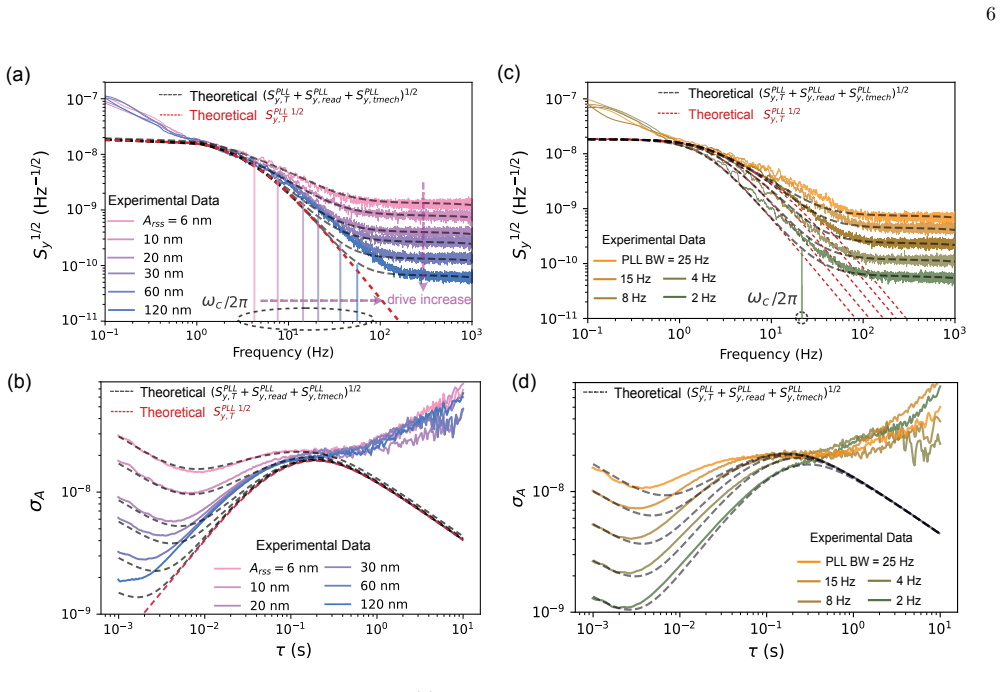
On the paper's own terms, the central claim is a cancellation: for a sensor whose only noise is temperature fluctuation, the noise spectral density is $S_{y,T}(\omega)=4k_B T^2 \alpha^2 |H_{\mathrm{th,eff}}(\omega)|^2/G$ and the thermal responsivity is $R(\omega)=\gamma\alpha |H_{\mathrm{th}}(\omega)|/G$. Assuming $H_{\mathrm{th,eff}}(\omega)\approx H_{\mathrm{th}}(\omega)$, the ratio $\mathrm{NEP}=\sqrt{S_{y,T}}/R$ becomes the frequency-independent $\sqrt{4k_B T^2 G}/\gamma$, so the thermal cutoff frequency $\omega_{\mathrm{th}}=1/\tau_{\mathrm{th}}$ no longer bounds the sensing bandwidth. The paper further shows, with a phase-locked-loop model, that the same loop filter multiplies both the temperature-fluctuation noise and the signal responsivity, so the tracking loop also cancels in NEP; the usable bandwidth is instead set by the intersection frequencies $\omega_{c,\mathrm{tmech}}$ and $\omega_{c,\mathrm{read}}$ where thermomechanical or readout noise begin to dominate. Experimentally, a 90-nm silicon-nitride membrane resonator with quality factor $Q\approx2.4\times10^6$ and thermal time constant $\tau_{\mathrm{th}}=90$ ms remains frequency-noise limited by temperature fluctuations up to about 54 Hz, and its measured NEP and $D^*$ follow flat theoretical curves until a corner at $\omega_c$ that matches the paper's Eq. 15, roughly 30 times $\omega_{\mathrm{th}}$.
Load-bearing premise
The load-bearing premise is that random internal temperature jitter produces frequency noise with exactly the same speed of response as the temperature change caused by uniform heating ($H_{\mathrm{th,eff}}\approx H_{\mathrm{th}}$); if those speeds differ at high frequencies, the noise and signal no longer cancel in the sensitivity ratio and the bandwidth gain shrinks.
Editorial extensions
If this is right
- Sensing bandwidth of a thermal detector at its temperature-fluctuation limit is set by the noise-crossover frequency, not by the thermal time constant; the same device can sense modulations well above its $\tau_{\mathrm{th}}$ without losing sensitivity.
- Phase-locked-loop settings (bandwidth, demodulation bandwidth) do not affect NEP or $D^*$, because the loop filters noise and signal identically; the tracking loop can be optimized for acquisition speed without sacrificing sensitivity.
- Drive amplitude becomes a bandwidth tuning knob: increasing the resonator vibration amplitude raises the crossover frequencies and widens the flat-NEP region, until Duffing nonlinearity sets an amplitude ceiling.
- With a broadband optical absorber added, such a resonator could approach the photon-fluctuation detectivity limit at room temperature while responding at frequencies well above the thermal cutoff.
- The corrected closed-loop model makes thermal-fluctuation-noise predictions reliable over a wider range of PLL parameters, which matters for designing sensor arrays.
Reading between the lines
- Beyond the paper, the same cancellation argument should apply to any thermal detector whose dominant noise is fundamental temperature fluctuation; in conventional bolometers and thermopiles the bottleneck would shift from the thermal time constant to electrical readout noise, so the bandwidth enhancement may transfer to those platforms.
- If the effective noise-averaging filter $H_{\mathrm{th,eff}}$ is broader than the uniform-heating response $H_{\mathrm{th}}$ (as the authors' high-frequency discrepancy hints), the flat-NEP region will end before the predicted $\omega_c$; quantifying this mismatch could also reveal whether engineering the spatial distribution of thermal fluctuations can push the crossover higher.
- A testable extension would be to repeat the measurement with a patterned absorber that guarantees spatially uniform heating, then compare the measured NEP roll-off with the predicted $\omega_c$; this would separate the assumption's failure from any genuine bandwidth limit.
Editorial analysis
A structured set of objections, weighed in public.
Referee Report
Summary. The paper proposes and experimentally demonstrates that a nanomechanical resonator-based thermal radiation sensor, when limited by fundamental temperature fluctuation noise, can maintain its noise equivalent power (NEP) and detectivity (D*) at frequencies well beyond the thermal cutoff frequency set by the thermal time constant. The authors derive expressions for the critical frequencies at which non-fundamental noise sources (thermomechanical and readout noise) begin to dominate over temperature fluctuation noise, and they validate these expressions with measurements on a silicon nitride membrane resonator. They report that the sensor operates within a factor of 3 of its peak detectivity (D_T^* = 7.4 × 10^9 cm·Hz^{1/2}·W^{-1}) up to 54 Hz, which is 30 times larger than the measured thermal cutoff frequency of 1.8 Hz, and they provide a closed-form approximation for the maximum achievable bandwidth enhancement in a closed-loop frequency-tracking scheme.
Significance. If the central claim holds, this result is important: it challenges the conventional assumption that the thermal time constant fundamentally limits the bandwidth of thermal radiation detectors, and it identifies the crossover frequencies of non-fundamental noise as the relevant bandwidth-limiting quantities. The paper's strengths include a mostly parameter-free noise model in which the input parameters (Q, τth, α, meff, Sx, G) are measured or simulated independently, a no-fitting-parameter comparison between predicted and measured frequency noise spectra (Fig. 4), explicit experimental validation of the PLL-filtered thermal responsivity (Fig. 5), and a falsifiable prediction that the critical frequency is independent of PLL bandwidth, which is confirmed in Fig. 6. The experimental demonstration of near-constant D* up to 54 Hz is compelling within the measured range, and the corrected treatment of temperature fluctuation noise in a closed-loop scheme (Eqs. 11–12) is a useful contribution.
major comments (3)
- [Section II, after Eq. (5); Fig. 4 discussion] The frequency independence of NEP_T (Eq. 6) relies on the exact cancellation of the thermal filter between the responsivity (Eq. 2) and the temperature-fluctuation noise (Eq. 5). The manuscript states 'We therefore assume Hth,eff(ω) ≈ Hth(ω)' after Eq. (5), but later, in the discussion of Fig. 4, it reports a discrepancy between theory and experiment in the Sy,T roll-off at ω > ωth and hypothesizes that Hth,eff(ω) > Hth(ω). If this hypothesis is correct, NEP_T(ω) scales as |Hth,eff(ω)|/|Hth(ω)|, which grows with frequency and eventually destroys the bandwidth advantage. The experimental demonstration of 'within a factor 3 up to 54 Hz' is then only evidence that the ratio |Hth,eff|/|Hth| remains below about 3 in the measured range, not that the bandwidth is unlimited. Please provide a direct measurement or a quantitative bound on Hth,eff(ω) (e.g., from the temperature-fluctuation-dominated noise spectrum), or revise the 'infinitely large bandwidth' claim to a finite bandwidth enhancement set by this ratio.
- [Section II, Eq. (15); Fig. 6] The overall critical frequency ωc is obtained from a phenomenological combination of ωc,read and ωc,tmech using an exponent N ≈ 3, introduced because 'this yields good results in the current work.' Since N is inferred from the same measurements whose corner frequency it is later used to predict, the agreement between the predicted and experimental corner frequencies in Fig. 6 is partly a self-consistency check rather than an independent prediction. Please derive Eq. (15) from the loop dynamics, provide a physical justification for N = 3, or at least show a sensitivity analysis demonstrating that the conclusions are robust for a reasonable range of N.
- [Section III, Figs. 4 and 6] The manuscript presents no error bars or repeated measurements for the noise spectra, Allan deviations, NEP, or D* traces. Given that the central quantitative claim is 'within a factor 3 from its peak detectivity up to 54 Hz,' the absence of uncertainty quantification makes it difficult to assess whether the factor-of-3 criterion is actually met with statistical confidence. Please provide estimates of statistical and systematic uncertainties (including calibration uncertainties in Sx, Arss, and G) for the NEP and D* traces, particularly in the frequency range near 54 Hz.
minor comments (5)
- [Section II, after Eq. (7)] The text gives 'D*_T,photon = 1.3 cm·Hz^{1/2}W^{-1}' for a two-side coupled sensor, but the Introduction quotes 'D*_T,photon ≈ 10^10 cm·Hz^{1/2}W^{-1}'. This is almost certainly a missing factor of 10^10; please correct.
- [Section III, paragraph on thermal conductance] The total thermal conductance is given as 'G = Grad/xrad = 7.4 × 10⁷ W/K', which should be 7.4 × 10^{-7} W/K (missing minus sign in the exponent). The numerical value used in the model implies the correct exponent.
- [Fig. 4 caption] The caption for panel (d) says 'Allan deviation σA at various Arss using the same data as in (c)', but panel (c) varies the PLL bandwidth at fixed Arss = 30 nm; the caption should say 'various PLL bandwidth'.
- [Fig. 2 caption] The phrase 'with at demodulation BW set at 5 kHz' should be 'with a demodulation bandwidth set to 5 kHz'.
- [Section II, after Eq. (12)] The sentence 'Note that Eq. 11–12 corrects our previous model' should be rephrased to 'Eqs. (11)–(12) correct our previous model' for grammatical agreement.
Circularity Check
Minor circularity: the corner-frequency prediction reuses the phenomenologically fitted exponent N≈3, while the central flat-NEP result is an exact consequence of the stated Hth,eff≈Hth assumption rather than a circular derivation.
-
fitted input called prediction
[Section II, Eq. (15); applied in Section III and Fig. 6]
"This is not straightforward analytically, and we instead provide a phenomenological approximation using the analytically obtained ωc,tmech and ωc,read: ω−N c ≈ ω−N c,read + ω−N c,tmech, (15) which yields good results in the current work for N ≈ 3, as illustrated in Fig. 2."
N ≈ 3 is a phenomenological fitting exponent, not derived from the underlying physics. The paper first chooses N ≈ 3 so that the theoretical intersection in Fig. 2 aligns with the expected noise crossover, and then, in the Results section, uses Eq. (15) with this same N to compute ωc values and states that they 'accurately predict the corner frequency at which experimental D∗ declines.' Because N was adjusted to match the crossover behavior being predicted, the corner-frequency prediction is partly a restatement of the fit rather than an independent test. The circularity is partial: ωc still depends on independently measured parameters (G, α, meff, Q, Arss, Sx), so the prediction is not fully forced by the fit.
full rationale
The central theoretical claim—that NEP and D* remain at their temperature-fluctuation-noise limits beyond the thermal cutoff—is not circular in the sense of an equation reducing to its own input. Equations (2) and (5) contain two different thermal filters, Hth(ω) and Hth,eff(ω), and the flat NEP in Eq. (6) is obtained only after explicitly assuming Hth,eff(ω) ≈ Hth(ω). That is a clear, stated physical assumption, and the cancellation is a legitimate mathematical consequence rather than a hidden identity. The paper even acknowledges the risk of this assumption in the Fig. 4 discussion, noting a high-frequency discrepancy in the Sy,T roll-off and hypothesizing Hth,eff(ω) > Hth(ω). That acknowledgment shows the limitation is disclosed rather than concealed, and it is a correctness/robustness concern, not a circularity. The one identifiable circular element is Eq. (15): the phenomenological exponent N ≈ 3 is selected to make the theoretical noise crossover match, and the same equation is then used to 'predict' the experimental corner frequency in Fig. 6. This is a mild fitted-input-called-prediction issue, but it does not invalidate the main result, because the bandwidth enhancement is experimentally visible directly in the noise spectra and in the NEP/D* curves regardless of the precise value of N. Self-citations are present (e.g., Ref. [18], corrected by Eqs. 11–12; Ref. [26] for material properties), but they are not load-bearing in a circular way: the corrected model is tested against new experimental data, and the Hth,eff ≈ Hth premise is attributed to external work [19]. Overall, the paper's core derivation is self-contained and the circularity score is low.
Assumptions & free parameters
free parameters (2)
- Phenomenological combination exponent N =
3
- Absorption coefficient gamma at 11 micrometers =
0.4
assumptions (4)
- domain assumption Effective thermal response for local temperature fluctuations equals thermal response under uniform illumination, Hth,eff(omega) approximately Hth(omega).
- domain assumption The PLL filters noise exactly as modeled by Demir and Hanay [14], with temperature fluctuation noise entering the loop like a step frequency change.
- domain assumption Radiative thermal conductance follows Stefan-Boltzmann with total hemispherical emissivity epsilon = 0.1 and a 65 percent radiative fraction from COMSOL.
- domain assumption SiN material properties (E = 300 GPa, alpha_T = 2.2 x 10^-6 K^-1, nu = 0.27, sigma = 70 MPa) and COMSOL mode shapes determine alpha and m_eff.
Cite this review
Pith. "Pith review of Enhanced bandwidth in radiation sensors operating at the fundamental temperature fluctuation noise limit." pith.science (2026). https://pith.science/paper/KQYYY225
@misc{pith2026250521678,
  author       = {Pith},
  title        = {Pith review of: Enhanced bandwidth in radiation sensors operating at the fundamental temperature fluctuation noise limit},
  year         = {2026},
  howpublished = {\url{https://pith.science/paper/KQYYY225}},
  note         = {Machine review of arXiv:2505.21678}
}
abstract
Temperature-based radiation detectors are an essential tool for long optical wavelengths detection even if they often suffer from important bandwidth limitations. Their responsivity, and hence their noise equivalent power (NEP), typically degrade at frequencies exceeding the cutoff set by their characteristic thermal response time ($\tau_\text{th}$), i.e., at $\omega > \tau_\text{th}^{-1}$. Here we show that this bandwidth limitation can be broken when a radiation sensor operates at its fundamental temperature fluctuation noise limit. The key enabler of this demonstration is a nanomechanical sensor in which frequency stability is limited by fundamental temperature fluctuations over an unprecedentedly large bandwidth of 54 $\text{Hz}$. In this range, the sensor performance remains within a factor 3 from its peak detectivity ($D_T^* = 7.4 \times 10^9~\mathrm{cm \cdot Hz^{1/2} W^{-1}}$) even though the thermal cutoff frequency is 30 times lower (i.e., $1/2\mathrm{\pi} \tau_\text{th} = 1.8~\text{Hz}$). We also derive and validate experimentally closed-form expression predicting maximum bandwidth enhancement in the context of nanomechanical resonators interfaced with a closed-loop frequency tracking scheme.
Figures


Figures from the paper (2 more)


Reference graph
Works this paper leans on
- [1]
-
[2]
L. Laurent, J.-J. Yon, J.-S. Moulet, M. Roukes, and L. Duraffourg, 12- µ m-pitch electromechanical resonator for thermal sensing, Physical Review Applied 9, 024016 (2018)
work page 2018
-
[3]
A. Blaikie, D. Miller, and B. J. Alem´ an, A fast and sensitive room-temperature graphene nanomechanical bolometer, Nature communications 10, 4726 (2019). 8
work page 2019
-
[4]
Y. Hui, J. S. Gomez-Diaz, Z. Qian, A. Alu, and M. Ri- naldi, Plasmonic piezoelectric nanomechanical resonator for spectrally selective infrared sensing, Nature commu- nications 7, 11249 (2016)
work page 2016
- [5]
- [6]
- [7]
-
[8]
L. Vicarelli, A. Tredicucci, and A. Pitanti, Micromechan- ical bolometers for subterahertz detection at room tem- perature, ACS Photonics 9, 360 (2022)
work page 2022
Show all 28 references
-
[9]
B. Wang, J. Lai, E. Zhao, H. Hu, Q. Liu, and S. Chen, Vanadium oxide microbolometer with gold black absorb- ing layer, Optical Engineering 51, 074003 (2012)
2012
-
[10]
Renoux, S
P. Renoux, S. Æ. J´ onsson, L. J. Klein, H. F. Hamann, and S. Ingvarsson, Sub-wavelength bolometers: Uncooled platinum wires as infrared sensors, Optics express 19, 8721 (2011)
2011
-
[11]
A. L. Hsu, P. K. Herring, N. M. Gabor, S. Ha, Y. C. Shin, Y. Song, M. Chin, M. Dubey, A. P. Chandrakasan, J. Kong, et al., Graphene-based thermopile for thermal imaging applications, Nano letters 15, 7211 (2015)
2015
-
[12]
B. C. St-Antoine, D. M´ enard, and R. Martel, Single- walled carbon nanotube thermopile for broadband light detection, Nano letters 11, 609 (2011)
2011
-
[13]
Rogalski, Infrared detectors(CRC press, 2000)
A. Rogalski, Infrared detectors(CRC press, 2000)
2000
-
[14]
Demir and M
A. Demir and M. S. Hanay, Fundamental sensitivity limitations of nanomechanical resonant sensors due to thermomechanical noise, IEEE Sensors Journal 20, 1947 (2019)
2019
-
[15]
Demir, Understanding fundamental trade-offs in nanomechanical resonant sensors, Journal of Applied Physics 129 (2021)
A. Demir, Understanding fundamental trade-offs in nanomechanical resonant sensors, Journal of Applied Physics 129 (2021)
2021
-
[16]
Sadeghi, A
P. Sadeghi, A. Demir, L. G. Villanueva, H. K¨ ahler, and S. Schmid, Frequency fluctuations in nanomechanical sil- icon nitride string resonators, Physical Review B 102, 214106 (2020)
2020
-
[17]
Beˇ si´ c, A
H. Beˇ si´ c, A. Demir, J. Steurer, N. Luhmann, and S. Schmid, Schemes for tracking resonance frequency for micro-and nanomechanical resonators, Physical Review Applied 20, 024023 (2023)
2023
-
[18]
Zhang and R
C. Zhang and R. St-Gelais, Demonstration of frequency stability limited by thermal fluctuation noise in silicon nitride nanomechanical resonators, Applied Physics Let- ters 122 (2023)
2023
-
[19]
Kanellopulos, F
K. Kanellopulos, F. Ladinig, S. Emminger, P. Martini, R. G. West, and S. Schmid, Comparative analysis of nanomechanical resonators: sensitivity, response time, and practical considerations in photothermal sensing, Mi- crosystems & Nanoengineering 11, 28 (2025)
2025
-
[20]
Demir, Understanding fundamental trade-offs in nanomechanical resonant sensors, J
A. Demir, Understanding fundamental trade-offs in nanomechanical resonant sensors, J. Appl. Phys. 129, 044503 (2021)
2021
-
[21]
Schmid, L
S. Schmid, L. G. Villanueva, and M. L. Roukes, Funda- mentals of nanomechanical resonators, Vol. 49 (Springer, 2016)
2016
-
[22]
Manzaneque, M
T. Manzaneque, M. K. Ghatkesar, F. Alijani, M. Xu, R. A. Norte, and P. G. Steeneken, Resolution limits of resonant sensors, Physical Review Applied 19, 054074 (2023)
2023
-
[23]
Postma, I
H. Postma, I. Kozinsky, A. Husain, and M. Roukes, Dy- namic range of nanotube-and nanowire-based electrome- chanical systems, Applied Physics Letters 86 (2005)
2005
-
[24]
X. Xie, R. Nikbakht, M. Couillard, R. St-Gelais, and A. Weck, Laser machining of free-standing silicon nitride membranes, Journal of Materials Processing Technology 318, 118001 (2023)
2023
-
[25]
Nikbakht, X
R. Nikbakht, X. Xie, A. Weck, and R. St-Gelais, High quality factor silicon nitride nanomechanical resonators fabricated by maskless femtosecond laser micromachin- ing, Journal of Vacuum Science & Technology B 41 (2023)
2023
-
[26]
Zhang, M
C. Zhang, M. Giroux, T. A. Nour, and R. St-Gelais, Ra- diative heat transfer in freestanding silicon nitride mem- branes, Physical Review Applied 14, 024072 (2020)
2020
-
[27]
Snell, C
N. Snell, C. Zhang, G. Mu, A. Bouchard, and R. St- Gelais, Heat transport in silicon nitride drum res- onators and its influence on thermal fluctuation-induced frequency noise, Physical Review Applied 17, 044019 (2022)
2022
-
[28]
Piller, P
M. Piller, P. Sadeghi, R. G. West, N. Luhmann, P. Mar- tini, O. Hansen, and S. Schmid, Thermal radiation dom- inated heat transfer in nanomechanical silicon nitride drum resonators, Applied Physics Letters 117 (2020). 9 S1. EXPRESSIONS FOR INTRINSIC THERMOMECHANICAL AND INSTRU...
2020
Reviewed August 7, 2026 · model on record in the stance chip above.
Discussion (0). Sign in to comment.