REVIEW 4 major objections 5 minor 132 references
Convergent Anthropocene Systems-of-Systems: Overcoming the Limitations of System Dynamics with Hetero-functional Graph Theory
T0 review · 4 major / 5 minor · reviewed 2026-08-07 · deepseek-v4-flash
Pith's one-line read SysML plus hetero-functional graph theory reproduces System Dynamics results for Mono Lake while adding structural expressiveness.
desk verdict A tidy translation of a two-stock SD model into HFGT, with an overreaching title: the equivalence is by construction, not a validation of general superiority. read the letter →
The pith
A machine-rendered reading of the paper's core claim, the machinery that carries it, and where it could break.
The reading
What carries the argument
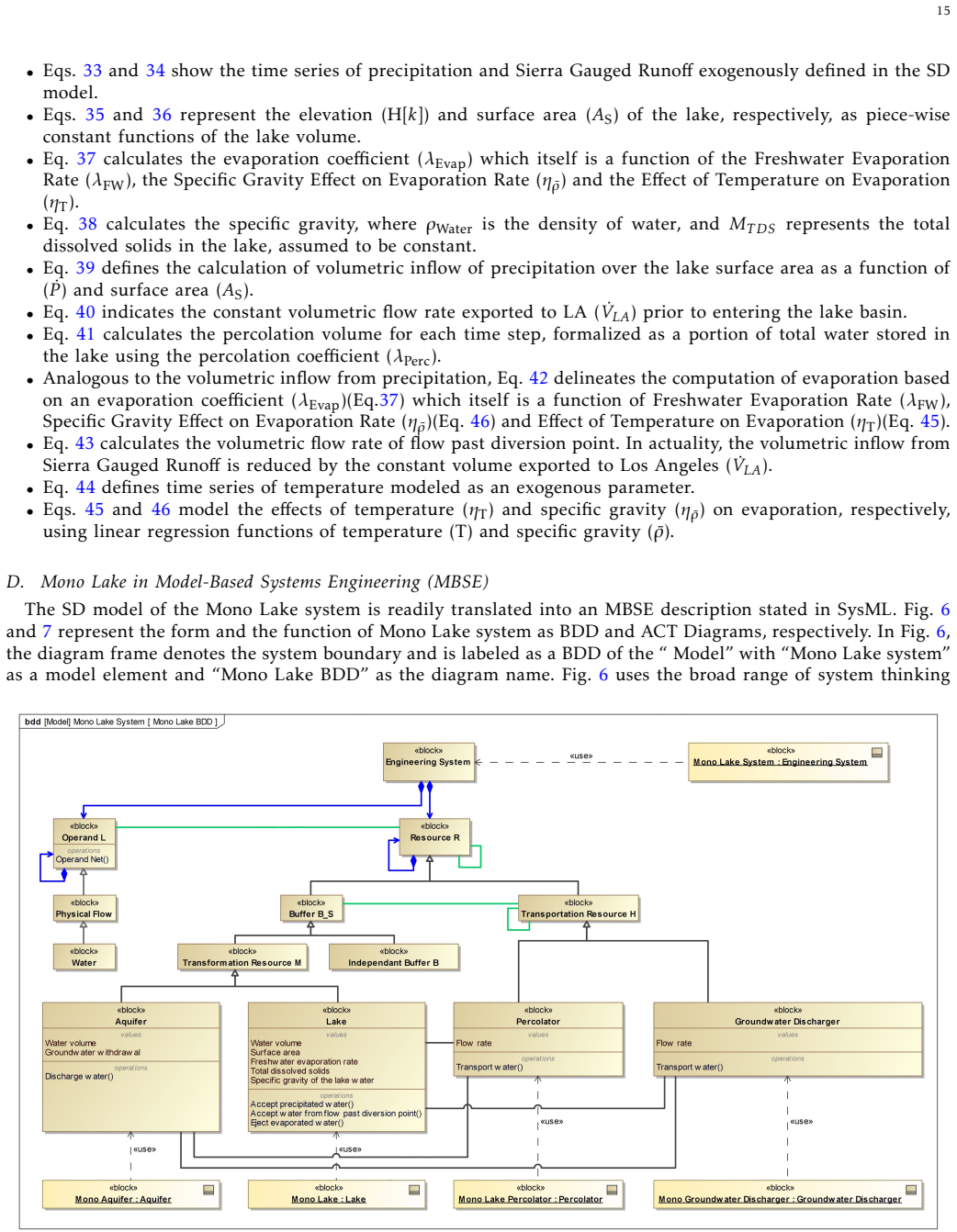
The carrying object is the hetero-functional graph, a Petri-net-like representation whose places are operand–buffer pairs and whose transitions are capabilities, where a capability is the sentence 'resource $r_v$ does process $p_w$.' The dynamics are governed by the engineering system net state transition function $Q[k+1] = \Phi(Q[k], U^-[k], U^+[k])$, with buffer markings updated as $Q_B[k+1] = Q_B[k] + M^+ U^+[k]\Delta T - M^- U^-[k]\Delta T$; the third-order hetero-functional incidence tensors $f^+$ and $f^-$ record which capabilities inject or pull each operand into each buffer and matricize into $M = M^+ - M^-$. The HFNMCF problem minimizes a convex time-separable cost subject to these state transitions together with synchronization, boundary, initial/final, capacity, and device-model constraints. For Mono Lake many constraints collapse as trivial because there is one operand with no state change and instantaneous transitions, leaving continuity equations plus the constitutive laws for evaporation, percolation, and surface area as device-model constraints.
What would settle it
Run the translation recipe on the food-energy-water Qazvin system shown in the paper as an SD example, which has multiple operands, nonlinear feedback, and sector couplings, and check whether the HFGT simulation reproduces the SD trajectories; if it diverges or cannot represent the feedback structure, the claimed equivalence and generality fail.
Extended reading notes
Core claim
The paper's central claim is the three-part statement that MBSE and HFGT '1) exhibit a broader set of systems thinking abstractions, 2) reproduce the analytical conclusions produced with an SD approach, and 3) ultimately overcome many of the methodological limitations' of SD for Anthropocene systems-of-systems. On the Mono Lake test case, the paper translates the two-stock SD model (lake volume and aquifer volume, with precipitation, runoff, evaporation, percolation, groundwater discharge, and withdrawal) into an HFGT model: a SysML Block Definition Diagram and Activity Diagram instantiate the HFGT meta-architecture, and the SD equations become the constraints of the HFNMCF problem with a zero objective. Simulated over 1990–2090 with identical exogenous inputs, the HFGT trajectories match the SD trajectories to within a normalized RMSE of about 0.15% for the lake and 0.000% for the aquifer. The paper therefore concludes that no analytical insight is lost by switching to MBSE-HFGT, and that the framework gives greater insight for the same example through its explicit system boundary, encapsulation of attributes in blocks, classification and instantiation relationships, and allocation of functions to resources.
Load-bearing premise
The load-bearing premise is that the two-stock, single-operand Mono Lake model is representative enough of Anthropocene systems-of-systems that a successful reproduction there demonstrates HFGT's general superiority over SD.
Editorial extensions
If this is right
- MBSE-HFGT preserves SD's analytical conclusions: on Mono Lake the simulated lake and aquifer volumes match the SD results with normalized RMSE of about 0.15% and 0.000%.
- Modelers gain an explicit system boundary with labeled input and output parameter nodes, so open-system assumptions, exogenous inputs, and conservation checks become visible by inspection rather than implicit.
- Separating system form (BDD) from system function (ACT), and using decomposition, classification, instantiation, and allocation, gives a way to structure large heterogeneous models that flat stock-flow diagrams do not provide.
- Because the HFGT formulation is built on Petri nets and an optimization problem, it can in principle represent discrete-time, discrete-event, and hybrid dynamics, and can carry policy objectives and constraints into the simulation.
Reading between the lines
- A decisive test beyond this paper would apply the same translation to a system whose SD model has strong nonlinear feedback and multiple interacting stocks, rather than the two-stock linearized Mono Lake case; the claimed advantages would be most convincing where SD is known to struggle.
- The equivalence result suggests a practical migration path: existing SD models can be converted to SysML and HFGT without re-deriving their behavior, which would let a research community keep its accumulated stock-flow knowledge while moving to a more expressive modeling language.
- The paper's own argument implies that the bottleneck for Anthropocene system-of-systems modeling then shifts from the mathematics to the SysML modeling effort and to the availability of automated HFGT tooling; whether that tooling scales to millions of places and transitions is a testable engineering question rather than a proven fact.
Editorial analysis
A structured set of objections, weighed in public.
Referee Report
Summary. The paper argues that Model-Based Systems Engineering (MBSE) expressed in SysML, together with Hetero-functional Graph Theory (HFGT), can serve as an alternative to System Dynamics (SD) for modeling Anthropocene systems-of-systems. It compares the two approaches in terms of systems thinking abstractions, translates a published SD model of Mono Lake, California, into an HFGT-based Hetero-functional Network Minimum Cost Flow (HFNMCF) formulation, and reports that the two simulations produce nearly identical results. The authors then claim that MBSE-HFGT offers a broader set of abstractions and overcomes methodological limitations of SD. The paper's central evidence is the Mono Lake equivalence, supported by conceptual arguments about system boundary, form, and function.
Significance. The paper addresses a timely and important problem: how to model interdependent human-natural systems with an approach that is expressive enough to capture heterogeneity, structure, and function. The conceptual comparison in Sections II and III is well organized and gives a clear, readable account of why SD's flat stock-and-flow primitives may be limiting. The worked translation of the Mono Lake SD model into HFNMCF constraints (Section V) is a useful pedagogical artifact: it shows step by step how an SD equation set maps onto HFGT incidence matrices and device-model constraints. However, the paper's load-bearing demonstration is constructed as a transcription rather than an independent test. The HFNMCF model is obtained by copying the SD equations as equality constraints, setting the objective to Z=0, and disabling or relaxing every HFGT-specific constraint. Consequently, the numerical agreement between the two models is a consistency check on the transcription, not evidence that HFGT can reproduce SD conclusions in general or that it can handle greater complexity.
major comments (4)
- [Sec. V-E, Eqs. 47-64] The HFGT model is constructed by rewriting the SD equations (27-46) as HFNMCF equality constraints (48-64), setting the objective to Z=0 (Eq. 47), and then declaring the HFGT-specific constraints trivial or eliminating them: Eqs. 9, 11-13 are collapsed, Eqs. 14-15 are called trivial, Eq. 19 is dropped, and Eq. 20 is relaxed to unbounded. The near-identical trajectories in Figs. 9-10 therefore only confirm that the transcription is internally consistent; they cannot establish the Sec. I-A claim that MBSE-HFGT 'reproduce[s] the analytical conclusions produced with an SD approach' in any non-tautological sense, nor the Sec. VI claim that HFGT 'offers a valuable tool for modeling systems with considerably greater complexity.' A supporting example that actually activates discrete-event, multiple-operand, or optimization features would be needed to support these claims.
- [Sec. V-C, Eq. 28] The printed aquifer balance equation is inconsistent. Eq. 28 reads VAqui[k+1] - VAqui[k] - (VPerc + VDis + VGWWith)ΔT = 0, which implies that groundwater discharge and withdrawal increase the aquifer volume. The surrounding text (and the physical description) treat percolation as inflow and discharge/withdrawal as outflows, and the corresponding HFGT row in Eq. 48 (second row: [0 0 0 -1 1 -1]) is physically correct. This is not a cosmetic typo: the paper explicitly claims a direct translation from SD equations to HFNMCF constraints (Sec. V-E), yet Eq. 48 is not the literal translation of Eq. 28. The authors should correct Eq. 28 or explain the intended sign convention.
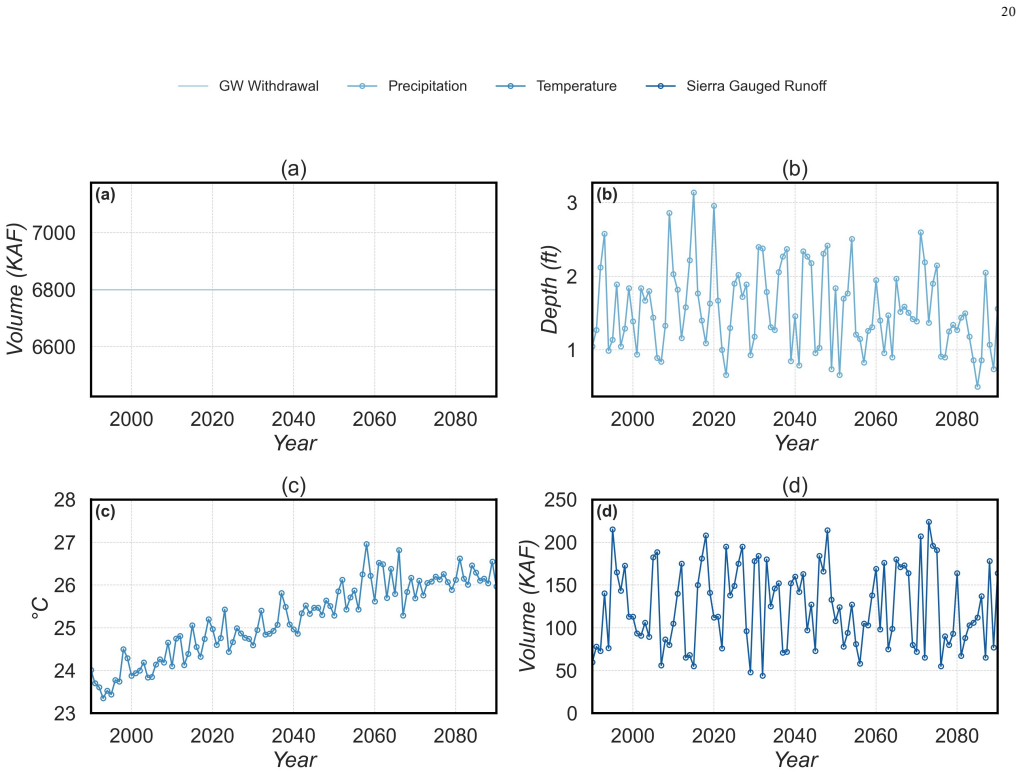
- [Sec. VI and Fig. 8] The central quantitative result is not reproducible as reported. The paper states that both models were calibrated and simulated over 1990-2090, but it does not provide numerical values for the percolation coefficient lambda_Perc, the freshwater evaporation rate lambda_FW, the elevation-volume and surface-area-volume linearization coefficients (Eqs. 53-54), the temperature and specific-gravity regression coefficients (Eqs. 62-63), the export withdrawal V_LA, the initial lake and aquifer volumes, the total dissolved solids mass, or the Markov-chain driver parameters for precipitation, temperature, and runoff. Without these values, a reader cannot reproduce Figs. 9-10 or verify the reported nRMSE values.
- [Sec. VI] The claimed advantages of MBSE-HFGT over SD are not demonstrated by the Mono Lake example. The system has a single operand, no state-changing transformations, no discrete events, no active objective function, and unbounded capacity constraints. All of the HFGT-specific machinery that would differentiate it from SD is disabled in the translation. The qualitative arguments in Sec. VI recapitulate the abstraction comparison from Sections II-III without providing any comparative experiment or case study. Thus the paper's broader claim that MBSE-HFGT 'overcome[s] many of the methodological limitations' of SD is unsupported by the evidence presented.
minor comments (5)
- [Sec. V-C, Eqs. 31-32] The initial conditions are written with a universal quantifier 'for all k in {0,...,K}', which is not meaningful for an initial condition; these equations should be stated for the single time index at which the volume is prescribed.
- [Sec. IV-B, Eqs. 25-26] The definitions of Q^-_SL and U^+_SL contain confusing notation and likely typos (e.g., 'U^-_{Sl|L|}' in Eq. 25). Please rewrite these concatenation definitions with consistent subscripts.
- [Sec. VI, first paragraph] The word 'Anthropoecene' is a typo for 'Anthropocene'.
- [Abstract and Sec. V-A] Mono Lake is described as being in Northern California; the lake is in eastern California (Mono County). Please correct the geographic description.
- [Global] The paper uses 'exogeneous' in several places (e.g., Fig. 8 caption, Sec. VI); the standard spelling is 'exogenous'.
Circularity Check
Mono Lake equivalence is constructed by transcription: the HFGT model is the SD equations re-expressed with Z=0 and HFGT-specific constraints disabled, so the match is forced by construction rather than independent confirmation.
-
self definitional
[Sec. V-E (Eqs. 47-48; bullets on Eqs. 9, 11-15, 19, 20)]
"Eq. 7 simplifies to Eq. 47 because there are no defined objectives ... Consequently, a dummy objective function (Z = 0) is defined. ... Eq. 8 simplifies to Eq. 48, which is a translation of Eq. 27 and 28 from SD model. ... Eqs. 9, 11, 12, and 13 collapse to triviality ... Eqs. 14 and 15 also collapse to triviality ... Eq. 19 is a final condition constraint and is eliminated ... Eq. 20 are eliminated by relaxation."
The HFGT simulation is built by copying every SD equation into HFNMCF equality constraints (48-64 correspond to 27-46), setting the objective to a dummy Z=0, and disabling the constraints that distinguish HFGT from SD (operand-net and synchronization constraints, final condition, capacity bounds). Consequently, any feasible trajectory of the HFGT model is, by construction, a trajectory of the SD model; the observed nRMSE of ~0.15% only verifies arithmetic transcription and solver numerics. The paper's headline claim that MBSE-HFGT 'reproduce[s] the analytical conclusions produced with an SD approach' (Sec. I-A) is therefore not an independent test of HFGT but a restatement of how the HFGT model was defined.
full rationale
The core quantitative exhibit is a translation, not an independent prediction. Because the HFGT model is assembled from the SD equations (with Z=0 and HFGT-specific constraints relaxed), the equality of trajectories is predetermined; this is the one place where the paper's central claim reduces by construction to its own input. The broader conceptual comparison of systems-thinking abstractions is not circular: it is an argument, grounded in the cited SysML/HFGT literature, that does not depend on the Mono Lake simulation. Nor is the heavy use of the authors' prior HFGT publications circular in itself, since HFGT is a published framework and no uniqueness theorem is being invoked to forbid alternatives. The sign inconsistency between Eq. 28 and Eq. 48 (percolation/withdrawal terms) is an internal-consistency typo rather than a circular step. Overall, partial circularity: the 'reproduces SD' claim is forced by construction, while the 'broader abstractions' claim retains independent content, so score 6 rather than 8-10.
Assumptions & free parameters
free parameters (9)
- Percolation coefficient lambda_Perc =
0.01 (per Eq. 58)
- Freshwater evaporation rate lambda_FW =
3.75 ft/yr (Eq. 55)
- Lake elevation-volume linearization coefficients =
slope 0.0265, intercept 6288.5 (Eq. 53)
- Surface area-volume linearization coefficients =
slope 0.008, intercept 15.44 (Eq. 54)
- Temperature effect regression coefficients =
0.06 and -0.08 (Eq. 62)
- Specific gravity effect regression coefficients =
-0.9 and 1.9 (Eq. 63)
- Export withdrawal to Los Angeles V_LA =
16 KAF/yr (Eq. 64)
- Initial lake and aquifer volumes =
not stated in text
- Markov-chain driver parameters for precipitation, temperature, runoff =
not specified
assumptions (3)
- domain assumption The systems-thinking abstractions from [89], [90] (boundary, form, function and their sub-types) provide a complete and valid basis for comparing modeling methods.
- domain assumption Mono Lake as modeled is representative of Anthropocene systems-of-systems complexities.
- ad hoc to paper Setting the HFNMCF objective to Z=0 and relaxing all bounds preserves the SD simulation semantics.
Cite this review
Pith. "Pith review of Convergent Anthropocene Systems-of-Systems: Overcoming the Limitations of System Dynamics with Hetero-functional Graph Theory." pith.science (2026). https://pith.science/paper/PUDMPYHO
@misc{pith2026250521793,
  author       = {Pith},
  title        = {Pith review of: Convergent Anthropocene Systems-of-Systems: Overcoming the Limitations of System Dynamics with Hetero-functional Graph Theory},
  year         = {2026},
  howpublished = {\url{https://pith.science/paper/PUDMPYHO}},
  note         = {Machine review of arXiv:2505.21793}
}
read the original abstract
Understanding the complexity and interdependence of systems in the Anthropocene is essential for making informed decisions about societal challenges spanning geophysical, biophysical, sociocultural, and sociotechnical domains. This paper explores the potential of Hetero-functional Graph Theory (HFGT) as a quantification tool for converting Model-based Systems Engineering (MBSE), stated in the Systems Modeling Language (SysML), into dynamic simulations-offering a comprehensive alternative to System Dynamics (SD) for representing interdependent systems of systems in the Anthropocene. The two approaches are compared in terms of systems thinking abstractions, methodological flexibility, and their ability to represent dynamic, multi-functional systems. Through a comparative study, the Mono Lake system is simulated in Northern California using both SD, and MBSE and HFGT, to highlight technical, conceptual and analytical differences. The simulations show equivalent results. However, MBSE and HFGT provide distinct advantages in capturing the nuances of the system through a broader set of systems thinking abstractions and in managing adaptive, multi-functional system interactions. These strengths position MBSE and HFGT as a powerful and flexible approach for representing, modeling, analyzing, and simulating heterogeneous and complex systems-of-systems in the Anthropocene.
Figures


Figures from the paper (7 more)





Reference graph
Works this paper leans on
-
[1]
Earth systems to anthropocene systems: An evolutionary, system-of-systems, convergence paradigm for interdependent societal challenges,
J. C. Little, R. O. Kaaronen, J. I. Hukkinen, S. Xiao, T. Sharpee, A. M. Farid, R. Nilchiani, and C. M. Barton, “Earth systems to anthropocene systems: An evolutionary, system-of-systems, convergence paradigm for interdependent societal challenges,” Environmental Science & Technology, vol. 57, no. 14, pp. 5504–5520, 2023
2023
-
[2]
Methods and approaches to modelling the anthropocene,
P . H. Verburg, J. A. Dearing, J. G. Dyke, S. Van Der Leeuw, S. Seitzinger, W. Steffen, and J. Syvitski, “Methods and approaches to modelling the anthropocene,” Global Environmental Change , vol. 39, pp. 328–340, 2016
2016
-
[3]
Trajectories of the earth system in the anthropocene,
W. Ste ffen, J. Rockstr¨om, K. Richardson, T. M. Lenton, C. Folke, D. Liverman, C. P . Summerhayes, A. D. Barnosky, S. E. Cornell, M. Crucifix et al., “Trajectories of the earth system in the anthropocene,”Proceedings of the National Academy of Sciences, vol. 115, no. 33, pp. 8252–8259, 2018
2018
-
[4]
The anthropocene,
J. Zalasiewicz, C. Waters, and M. Williams, “The anthropocene,” in Geologic time scale 2020 . Elsevier, 2020, pp. 1257–1280
2020
-
[5]
Coupled human and natural systems,
J. Liu, T. Dietz, S. R. Carpenter, C. Folke, M. Alberti, C. L. Redman, S. H. Schneider, E. Ostrom, A. N. Pell, J. Lubchenco et al., “Coupled human and natural systems,” AMBIO: a journal of the human environment , vol. 36, no. 8, pp. 639–649, 2007
2007
-
[6]
The anthropocene: are humans now overwhelming the great forces of nature,
W. Ste ffen, P . J. Crutzen, J. R. McNeillet al., “The anthropocene: are humans now overwhelming the great forces of nature,” Ambio-Journal of Human Environment Research and Management , vol. 36, no. 8, pp. 614–621, 2007
2007
-
[7]
A. S. Goudie, Human impact on the natural environment . John Wiley & Sons, 2018
2018
-
[8]
S. L. Lewis and M. A. Maslin, The human planet: How we created the Anthropocene . Yale University Press, 2018
2018
Show all 132 references
-
[9]
Challenges in natural resource management for ecological sustainability,
S. Mondal and D. Palit, “Challenges in natural resource management for ecological sustainability,” in Natural resources conservation and advances for sustainability . Elsevier, 2022, pp. 29–59
2022
-
[10]
Earth system law for the anthropocene,
L. J. Kotz ´e, “Earth system law for the anthropocene,” Sustainability, vol. 11, no. 23, p. 6796, 2019
2019
-
[11]
The post-anthropocene diet: navigating future diets for sustainable food systems,
R. Mazac and H. L. Tuomisto, “The post-anthropocene diet: navigating future diets for sustainable food systems,” Sustainability, vol. 12, no. 6, p. 2355, 2020
2020
-
[12]
Our future in the anthropocene biosphere,
C. Folke, S. Polasky, J. Rockstr ¨om, V. Galaz, F. Westley, M. Lamont, M. Sche ffer, H. ¨Osterblom, S. R. Carpenter, F. S. Chapin et al., “Our future in the anthropocene biosphere,” Ambio, vol. 50, pp. 834–869, 2021
2021
-
[13]
The anthropocene biosphere,
M. Williams, J. Zalasiewicz, P . K. Ha ff, C. Schw ¨agerl, A. D. Barnosky, and E. C. Ellis, “The anthropocene biosphere,” The Anthropocene Review, vol. 2, no. 3, pp. 196–219, 2015
2015
-
[14]
The concept of the anthropocene,
Y. Malhi, “The concept of the anthropocene,” Annual Review of Environment and Resources , vol. 42, no. 1, pp. 77–104, 2017
2017
-
[15]
The anthropocene: conceptual and historical perspectives,
W. Ste ffen, J. Grinevald, P . Crutzen, and J. McNeill, “The anthropocene: conceptual and historical perspectives,” Philosophical Transactions of the Royal Society A: Mathematical, Physical and Engineering Sciences , vol. 369, no. 1938, pp. 842–867, 2011
1938
-
[16]
Agent-based modeling in coupled human and natural systems (chans): lessons from a comparative analysis,
L. An, A. Zvole ff, J. Liu, and W. Axinn, “Agent-based modeling in coupled human and natural systems (chans): lessons from a comparative analysis,” Annals of the Association of American Geographers , vol. 104, no. 4, pp. 723–745, 2014
2014
-
[17]
Social-ecological systems insights for navigating the dynamics of the anthropocene,
B. Reyers, C. Folke, M.-L. Moore, R. Biggs, and V. Galaz, “Social-ecological systems insights for navigating the dynamics of the anthropocene,” Annual Review of Environment and Resources , vol. 43, no. 1, pp. 267–289, 2018
2018
-
[18]
Linking water research with the sustainability of the human–natural system,
F. Xiaoming, L. Qinglong, Y. Lichang, B. Fu, and C. Yongzhe, “Linking water research with the sustainability of the human–natural system,” Current Opinion in Environmental Sustainability , vol. 33, pp. 99–103, 2018
2018
-
[19]
Challenges and opportunities for modeling coupled human and natural systems,
Y. Li, S. Sang, S. Mote, J. Rivas, and E. Kalnay, “Challenges and opportunities for modeling coupled human and natural systems,” National Science Review, vol. 10, no. 7, p. nwad054, 2023
2023
-
[20]
Berkes, J
F. Berkes, J. Colding, and C. Folke, Navigating social-ecological systems: building resilience for complexity and change . Cambridge university press, 2008
2008
-
[21]
Modelling feedbacks between human and natural processes in the land system,
D. T. Robinson, A. Di Vittorio, P . Alexander, A. Arneth, C. M. Barton, D. G. Brown, A. Kettner, C. Lemmen, B. C. O’neill, M. Janssen et al., “Modelling feedbacks between human and natural processes in the land system,” Earth System Dynamics, vol. 9, no. 2, pp. 895–914, 2018
2018
-
[22]
Integrated assessment and modelling: overview and synthesis of salient dimensions,
S. H. Hamilton, S. ElSawah, J. H. Guillaume, A. J. Jakeman, and S. A. Pierce, “Integrated assessment and modelling: overview and synthesis of salient dimensions,” Environmental Modelling & Software , vol. 64, pp. 215–229, 2015
2015
-
[23]
Complexity of coupled human and natural systems,
J. Liu, T. Dietz, S. R. Carpenter, M. Alberti, C. Folke, E. Moran, A. N. Pell, P . Deadman, T. Kratz, J. Lubchenco et al. , “Complexity of coupled human and natural systems,” science, vol. 317, no. 5844, pp. 1513–1516, 2007
2007
-
[24]
Modeling human decisions in coupled human and natural systems: Review of agent-based models,
L. An, “Modeling human decisions in coupled human and natural systems: Review of agent-based models,” Ecological modelling, vol. 229, pp. 25–36, 2012
2012
-
[25]
Advancing integrated systems modelling framework for life cycle sustainability assessment,
A. Halog and Y. Manik, “Advancing integrated systems modelling framework for life cycle sustainability assessment,” Sustainability, vol. 3, no. 2, pp. 469–499, 2011
2011
-
[26]
Some contributions of integrated assessment models of global climate change,
J. Weyant, “Some contributions of integrated assessment models of global climate change,” Review of Environmental Economics and Policy , 2017
2017
-
[27]
Impacts of water and land resources exploitation on agricultural carbon emissions: The water-land-energy-carbon nexus,
R. Zhao, Y. Liu, M. Tian, M. Ding, L. Cao, Z. Zhang, X. Chuai, L. Xiao, and L. Yao, “Impacts of water and land resources exploitation on agricultural carbon emissions: The water-land-energy-carbon nexus,” Land Use Policy , vol. 72, pp. 480–492, 2018
2018
-
[28]
Impact of water utilization changes on the water-land-energy-carbon nexus in watersheds: A case study of yellow river basin, china,
Y. Feng, J. Wang, X. Ren, A. Zhu, K. Xia, H. Zhang, and H. Wang, “Impact of water utilization changes on the water-land-energy-carbon nexus in watersheds: A case study of yellow river basin, china,” Journal of Cleaner Production , vol. 443, p. 141148, 2024
2024
-
[29]
Spatio-temporal variation and influencing factors of industrial carbon emission e ffect in china based on water-land-energy-carbon nexus,
W. Jiang, Z. Zhang, J. Wen, L. Yin, and B. Song, “Spatio-temporal variation and influencing factors of industrial carbon emission e ffect in china based on water-land-energy-carbon nexus,” Ecological Indicators, vol. 152, p. 110307, 2023. 23
2023
-
[30]
System dynamics simulation of regional water supply and demand using a food-energy-water nexus approach: Application to qazvin plain, iran,
M. M. Naderi, A. Mirchi, A. R. M. Bavani, E. Goharian, and K. Madani, “System dynamics simulation of regional water supply and demand using a food-energy-water nexus approach: Application to qazvin plain, iran,” Journal of environmental management , vol. 280, p. 111843, 2021
2021
-
[31]
A systematic analysis of water-energy-food security nexus: A south asian case study,
M. P . I. F. Putra, P . Pradhan, and J. P . Kropp, “A systematic analysis of water-energy-food security nexus: A south asian case study,”Science of The Total Environment , vol. 728, p. 138451, 2020
2020
-
[32]
The water-food-energy nexus optimization approach to combat agricultural drought: a case study in the united states,
J. Zhang, P . E. Campana, T. Yao, Y. Zhang, A. Lundblad, F. Melton, and J. Yan, “The water-food-energy nexus optimization approach to combat agricultural drought: a case study in the united states,” Applied Energy, vol. 227, pp. 449–464, 2018
2018
-
[33]
System dynamics modelling to simulate regional water-energy-food nexus combined with the society- economy-environment system in hunan province, china,
X. Wang, Z. Dong, and J. Su ˇsnik, “System dynamics modelling to simulate regional water-energy-food nexus combined with the society- economy-environment system in hunan province, china,” Science of the Total Environment , vol. 863, p. 160993, 2023
2023
-
[34]
Sustainable resource optimization under water-energy-food-carbon nexus,
Z. Chamas, M. Abou Najm, M. Al-Hindi, A. Yassine, and R. Khattar, “Sustainable resource optimization under water-energy-food-carbon nexus,” Journal of Cleaner Production , vol. 278, p. 123894, 2021
2021
-
[35]
The food-energy-water-carbon nexus in a maize-maize-mustard cropping sequence of the indian himalayas: An impact of tillage-cum-live mulching,
G. S. Yadav, A. Das, B. Kandpal, S. Babu, R. Lal, M. Datta, B. Das, R. Singh, V. Singh, K. Mohapatra et al., “The food-energy-water-carbon nexus in a maize-maize-mustard cropping sequence of the indian himalayas: An impact of tillage-cum-live mulching,” Renewable and Sustainab...
2021
-
[36]
Impacts of irrigated agriculture on food–energy–water–co2 nexus across metacoupled systems,
Z. Xu, X. Chen, J. Liu, Y. Zhang, S. Chau, N. Bhattarai, Y. Wang, Y. Li, T. Connor, and Y. Li, “Impacts of irrigated agriculture on food–energy–water–co2 nexus across metacoupled systems,” Nature communications, vol. 11, no. 1, p. 5837, 2020
2020
-
[37]
A novel modelling toolkit for unpacking the water-energy-food-environment (wefe) nexus of agricultural development,
M. Correa-Cano, G. Salmoral, D. Rey, J. W. Knox, A. Graves, O. Melo, W. Foster, L. Naranjo, E. Zegarra, C. Johnsonet al., “A novel modelling toolkit for unpacking the water-energy-food-environment (wefe) nexus of agricultural development,” Renewable and Sustainable Energy Revi...
2022
-
[38]
Managing agricultural water-energy-food-environment nexus considering water footprint and carbon footprint under uncertainty,
Q. Yue and P . Guo, “Managing agricultural water-energy-food-environment nexus considering water footprint and carbon footprint under uncertainty,” Agricultural Water Management, vol. 252, p. 106899, 2021
2021
-
[39]
Integrating climate change adaptation into water-energy-food-environment nexus for sustainable development in east african community,
P . Mperejekumana, L. Shen, S. Zhong, F. Muhirwa, M. S. Gaballah, and J. M. V. Nsigayehe, “Integrating climate change adaptation into water-energy-food-environment nexus for sustainable development in east african community,” Journal of Cleaner Production , vol. 434, p. 140026, 2024
2024
-
[40]
Urban water-energy-food-climate nexus in integrated wastewater and reuse systems: Cyber-physical framework and innovations,
S. Radini, E. Marinelli, C ¸ . Akyol, A. L. Eusebi, V. Vasilaki, A. Mancini, E. Frontoni, G. B. Bischetti, C. Gandolfi, E. Katsou et al., “Urban water-energy-food-climate nexus in integrated wastewater and reuse systems: Cyber-physical framework and innovations,”Applied Energy...
2021
-
[41]
From state to system: Financialization and the water-energy-food-climate nexus,
J. J. Schmidt and N. Matthews, “From state to system: Financialization and the water-energy-food-climate nexus,” Geoforum, vol. 91, pp. 151–159, 2018
2018
-
[42]
Afkhami, A
S. Afkhami, A. R. M. Bavani, A. Gohari, M. M. Naderi, and T. Saadi, “Sustainability analysis of single vs. multiple adaptation strategies in tackling the adverse impacts of climate change on groundwater resources using water-food-energy nexus approach,” Journal of Cleaner Prod...
2024
-
[43]
A definition of systems thinking: A systems approach,
R. D. Arnold and J. P . Wade, “A definition of systems thinking: A systems approach,” Procedia computer science , vol. 44, pp. 669–678, 2015
2015
-
[44]
What is systems thinking?
D. Cabrera and L. Cabrera, “What is systems thinking?” in Learning, design, and technology: An international compendium of theory, research, practice, and policy . Springer, 2023, pp. 1495–1522
2023
-
[45]
An overview of the system dynamics process for integrated modelling of socio-ecological systems: Lessons on good modelling practice from five case studies,
S. Elsawah, S. A. Pierce, S. H. Hamilton, H. Van Delden, D. Haase, A. Elmahdi, and A. J. Jakeman, “An overview of the system dynamics process for integrated modelling of socio-ecological systems: Lessons on good modelling practice from five case studies,” Environmental Modelli...
2017
-
[46]
Understating complex interactions in socio-ecological systems using system dynamics: a case in the tropical andes,
L. Berrio-Giraldo, C. Villegas-Palacio, and S. Arango-Aramburo, “Understating complex interactions in socio-ecological systems using system dynamics: a case in the tropical andes,” Journal of Environmental Management , vol. 291, p. 112675, 2021
2021
-
[47]
Food-energy-water (few) nexus: Sustainable food production governance through system dynamics modeling,
´E. C. Francisco, P . S. de Arruda Ign ´acio, A. L. Piolli, and M. E. S. Dal Poz, “Food-energy-water (few) nexus: Sustainable food production governance through system dynamics modeling,” Journal of Cleaner Production , vol. 386, p. 135825, 2023
2023
-
[48]
Modeling of interconnected critical infrastructure systems using complex network theory,
J. V. Milanovi ´c and W. Zhu, “Modeling of interconnected critical infrastructure systems using complex network theory,” IEEE Transactions on Smart Grid , vol. 9, no. 5, pp. 4637–4648, 2017
2017
-
[49]
Network of interdependent networks: overview of theory and applications,
D. Y. Kenett, J. Gao, X. Huang, S. Shao, I. Vodenska, S. V. Buldyrev, G. Paul, H. E. Stanley, and S. Havlin, “Network of interdependent networks: overview of theory and applications,” Networks of Networks: The Last Frontier of Complexity , pp. 3–36, 2014
2014
-
[50]
Coupling the water-energy-food-ecology nexus into a bayesian network for water resources analysis and management in the syr darya river basin,
H. Shi, G. Luo, H. Zheng, C. Chen, J. Bai, T. Liu, F. U. Ochege, and P . De Maeyer, “Coupling the water-energy-food-ecology nexus into a bayesian network for water resources analysis and management in the syr darya river basin,” Journal of Hydrology , vol. 581, p. 124387, 2020
2020
-
[51]
Quantifying and predicting the water-energy-food-economy-society-environment nexus based on bayesian networks-a case study of china,
J. Chai, H. Shi, Q. Lu, and Y. Hu, “Quantifying and predicting the water-energy-food-economy-society-environment nexus based on bayesian networks-a case study of china,” Journal of Cleaner Production , vol. 256, p. 120266, 2020
2020
-
[52]
Coupled human and natural systems: A multi-agent-based approach,
M. Monticino, M. Acevedo, B. Callicott, T. Cogdill, and C. Lindquist, “Coupled human and natural systems: A multi-agent-based approach,” Environmental Modelling & Software , vol. 22, no. 5, pp. 656–663, 2007
2007
-
[53]
Integrating social science into empirical models of coupled human and natural systems,
J. D. Kline, E. M. White, A. P . Fischer, M. M. Steen-Adams, S. Charnley, C. S. Olsen, T. A. Spies, and J. D. Bailey, “Integrating social science into empirical models of coupled human and natural systems,” Ecology and Society , vol. 22, no. 3, 2017
2017
-
[54]
Synergy assessment and optimization for water-energy-food nexus: Modeling and application,
T. Zhang, Q. Tan, X. Yu, and S. Zhang, “Synergy assessment and optimization for water-energy-food nexus: Modeling and application,” Renewable and Sustainable Energy Reviews , vol. 134, p. 110059, 2020
2020
-
[55]
Stochastic multi-objective modeling for optimization of water-food-energy nexus of irrigated agriculture,
M. Li, Q. Fu, V. P . Singh, D. Liu, and T. Li, “Stochastic multi-objective modeling for optimization of water-food-energy nexus of irrigated agriculture,” Advances in water resources , vol. 127, pp. 209–224, 2019
2019
-
[56]
Exploratory modeling for analyzing coupled human-natural systems under uncertainty,
E. A. Moallemi, J. Kwakkel, F. J. de Haan, and B. A. Bryan, “Exploratory modeling for analyzing coupled human-natural systems under uncertainty,” Global Environmental Change , vol. 65, p. 102186, 2020
2020
-
[57]
A general framework for analyzing sustainability of social-ecological systems,
E. Ostrom, “A general framework for analyzing sustainability of social-ecological systems,” Science, vol. 325, no. 5939, pp. 419–422, 2009
2009
-
[58]
Norberg and G
J. Norberg and G. Cumming, Complexity theory for a sustainable future . Columbia University Press, 2008
2008
-
[59]
A social-ecological coupling model for evaluating the human-water relationship in basins within the budyko framework,
B. Wu, Q. Quan, S. Yang, and Y. Dong, “A social-ecological coupling model for evaluating the human-water relationship in basins within the budyko framework,” Journal of Hydrology , vol. 619, p. 129361, 2023
2023
-
[60]
Assessing coupling interactions in a safe and just operating space for regional sustainability,
D. Han, D. Yu, and J. Qiu, “Assessing coupling interactions in a safe and just operating space for regional sustainability,” Nature Communications, vol. 14, no. 1, p. 1369, 2023
2023
-
[61]
An integral approach to address socio-ecological systems sustainability and their uncertainties,
J. Martinez-Fernandez, I. Banos-Gonzalez, and M. A. Esteve-Selma, “An integral approach to address socio-ecological systems sustainability and their uncertainties,” Science of the Total Environment , vol. 762, p. 144457, 2021
2021
-
[62]
Linking sustainable business models to socio-ecological resilience through cross-sector partnerships: A complex adaptive systems view,
D. Dentoni, J. Pinkse, and R. Lubberink, “Linking sustainable business models to socio-ecological resilience through cross-sector partnerships: A complex adaptive systems view,” Business & Society , vol. 60, no. 5, pp. 1216–1252, 2021
2021
-
[63]
Agent-based modelling of socio-ecological systems: Models, projects and ontologies,
N. M. Gotts, G. A. van Voorn, J. G. Polhill, E. de Jong, B. Edmonds, G. J. Hofstede, and R. Meyer, “Agent-based modelling of socio-ecological systems: Models, projects and ontologies,” Ecological Complexity, vol. 40, p. 100728, 2019
2019
-
[64]
Towards the optimization of sustainable food-energy-water systems: A stochastic approach,
E. Karan, S. Asadi, R. Mohtar, and M. Baawain, “Towards the optimization of sustainable food-energy-water systems: A stochastic approach,” Journal of Cleaner Production , vol. 171, pp. 662–674, 2018. 24
2018
-
[65]
Socio-ecological systems modelling of coastal urban area under a changing climate–case study for ubatuba, brazil,
B. M. Oliveira, R. Boumans, B. D. Fath, and J. Harari, “Socio-ecological systems modelling of coastal urban area under a changing climate–case study for ubatuba, brazil,” Ecological Modelling, vol. 468, p. 109953, 2022
2022
-
[66]
A system dynamics model to simulate the water-energy-food nexus of resource-based regions: A case study in daqing city, china,
C. Wen, W. Dong, Q. Zhang, N. He, and T. Li, “A system dynamics model to simulate the water-energy-food nexus of resource-based regions: A case study in daqing city, china,” Science of the Total Environment , vol. 806, p. 150497, 2022
2022
-
[67]
Synthesis of system dynamics tools for holistic conceptualization of water resources problems,
A. Mirchi, K. Madani, D. Watkins, and S. Ahmad, “Synthesis of system dynamics tools for holistic conceptualization of water resources problems,” Water resources management, vol. 26, pp. 2421–2442, 2012
2012
-
[68]
The use of system dynamics simulation in water resources management,
I. Winz, G. Brierley, and S. Trowsdale, “The use of system dynamics simulation in water resources management,” Water resources management, vol. 23, pp. 1301–1323, 2009
2009
-
[69]
System dynamics and its contribution to economics and economic modeling,
M. J. Radzicki, “System dynamics and its contribution to economics and economic modeling,” System dynamics: Theory and applications , pp. 401–415, 2020
2020
-
[70]
System dynamics modelling to assess the impact of renewable energy systems and energy efficiency on the performance of the energy sector,
M. Laimon, T. Mai, S. Goh, and T. Yusaf, “System dynamics modelling to assess the impact of renewable energy systems and energy efficiency on the performance of the energy sector,” Renewable Energy, vol. 193, pp. 1041–1048, 2022
2022
-
[71]
Sustainable and renewable energy supply chain: A system dynamics overview,
C. H. d. O. Fontes, F. G. M. Freires et al., “Sustainable and renewable energy supply chain: A system dynamics overview,” Renewable and Sustainable Energy Reviews , vol. 82, pp. 247–259, 2018
2018
-
[72]
System dynamics modeling and simulation of a particular food supply chain,
S. Minegishi and D. Thiel, “System dynamics modeling and simulation of a particular food supply chain,” Simulation practice and theory , vol. 8, no. 5, pp. 321–339, 2000
2000
-
[73]
A system dynamics perspective of patient satisfaction in healthcare,
M. Faezipour and S. Ferreira, “A system dynamics perspective of patient satisfaction in healthcare,” Procedia computer science, vol. 16, pp. 148–156, 2013
2013
-
[74]
System dynamics: systems thinking and modeling for a complex world,
J. Sterman, “System dynamics: systems thinking and modeling for a complex world,” 2002
2002
-
[75]
Ogata, System dynamics, 2004
K. Ogata, System dynamics, 2004
2004
-
[76]
System dynamics as a useful technique for complex systems,
A. T. Azar, “System dynamics as a useful technique for complex systems,” International Journal of Industrial and Systems Engineering , vol. 10, no. 4, pp. 377–410, 2012
2012
-
[77]
System dynamics analysis for managing iran’s zayandeh-rud river basin,
K. Madani and M. A. Mari ˜no, “System dynamics analysis for managing iran’s zayandeh-rud river basin,” Water resources management , vol. 23, pp. 2163–2187, 2009
2009
-
[78]
Participatory system dynamics modeling for sustainable environmental management: Observations from four cases,
K. Stave, “Participatory system dynamics modeling for sustainable environmental management: Observations from four cases,” Sustain- ability, vol. 2, no. 9, pp. 2762–2784, 2010
2010
-
[79]
Tools and methods in participatory modeling: Selecting the right tool for the job,
A. Voinov, K. Jenni, S. Gray, N. Kolagani, P . D. Glynn, P . Bommel, C. Prell, M. Zellner, M. Paolisso, R. Jordan et al., “Tools and methods in participatory modeling: Selecting the right tool for the job,” Environmental Modelling & Software , vol. 109, pp. 232–255, 2018
2018
-
[80]
Loop polarity, loop dominance, and the concept of dominant polarity (1984),
G. P . Richardson, “Loop polarity, loop dominance, and the concept of dominant polarity (1984),” System dynamics review , vol. 11, no. 1, pp. 67–88, 1995
1984
-
[81]
Applying system dynamics modelling to strategic management: A literature review,
F. Cosenz and G. Noto, “Applying system dynamics modelling to strategic management: A literature review,” Systems Research and Behavioral Science, vol. 33, no. 6, pp. 703–741, 2016
2016
-
[82]
Towards the definition and use of a core set of archetypal structures in system dynamics,
E. F. Wolstenholme, “Towards the definition and use of a core set of archetypal structures in system dynamics,” System Dynamics Review, vol. 19, no. 1, pp. 7–26, 2003
2003
-
[83]
Introduction to system dynamics modeling with dynamo,
G. P . Richardson and A. L. Pugh III, “Introduction to system dynamics modeling with dynamo,” Journal of the Operational Research Society, vol. 48, no. 11, pp. 1146–1146, 1997
1997
-
[84]
Industrial dynamics,
J. W. Forrester, “Industrial dynamics,” Journal of the Operational Research Society , vol. 48, no. 10, pp. 1037–1041, 1997
1997
-
[85]
A system dynamics model to facilitate public understanding of water management options in las vegas, nevada,
K. A. Stave, “A system dynamics model to facilitate public understanding of water management options in las vegas, nevada,” Journal of Environmental Management, vol. 67, no. 4, pp. 303–313, 2003
2003
-
[86]
Spatial system dynamics: new approach for simulation of water resources systems,
S. Ahmad and S. P . Simonovic, “Spatial system dynamics: new approach for simulation of water resources systems,” Journal of Computing in Civil Engineering , vol. 18, no. 4, pp. 331–340, 2004
2004
-
[87]
The state-of-the-art system dynamics application in integrated water resources modeling,
M. Zomorodian, S. H. Lai, M. Homayounfar, S. Ibrahim, S. E. Fatemi, and A. El-Shafie, “The state-of-the-art system dynamics application in integrated water resources modeling,” Journal of environmental management , vol. 227, pp. 294–304, 2018
2018
-
[88]
Dictionary.com — meanings and definitions of words,
Dictionary.com, “Dictionary.com — meanings and definitions of words,” 2025, accessed: 29-Jan-2025. [Online]. Available: https://www.dictionary.com/
2025
-
[89]
Crawley, B
E. Crawley, B. Cameron, and D. Selva, System architecture: strategy and product development for complex systems . Prentice Hall Press, 2015
2015
-
[90]
Axiomatic design theory for systems,
N. P . Suh, “Axiomatic design theory for systems,” Research in engineering design , vol. 10, pp. 189–209, 1998
1998
-
[91]
An engineering systems introduction to axiomatic design,
A. M. Farid, “An engineering systems introduction to axiomatic design,” Axiomatic design in large systems: complex products, buildings and manufacturing systems, pp. 3–47, 2016
2016
-
[92]
The abcs of gis,
R. G. Congalton and K. Green, “The abcs of gis,” Journal of Forestry, vol. 90, no. 11, pp. 13–20, 1992
1992
-
[93]
Software systems as complex networks: Structure, function, and evolvability of software collaboration graphs,
C. R. Myers, “Software systems as complex networks: Structure, function, and evolvability of software collaboration graphs,” Physical review E, vol. 68, no. 4, p. 046116, 2003
2003
-
[94]
The gyrator, a new electric network element,
B. D. Tellegen, “The gyrator, a new electric network element,” Philips Res. Rep , vol. 3, no. 2, pp. 81–101, 1948
1948
-
[95]
An axiomatic design of a multiagent reconfigurable mechatronic system architecture,
A. M. Farid and L. Ribeiro, “An axiomatic design of a multiagent reconfigurable mechatronic system architecture,” IEEE Transactions on Industrial Informatics, vol. 11, no. 5, pp. 1142–1155, 2015
2015
-
[96]
D. P . Bertsekas, Constrained optimization and Lagrange multiplier methods . Academic press, 2014
2014
-
[97]
Leimkuhler and S
B. Leimkuhler and S. Reich, Simulating hamiltonian dynamics . Cambridge university press, 2004, no. 14
2004
-
[98]
Delligatti, SysML distilled: A brief guide to the systems modeling language
L. Delligatti, SysML distilled: A brief guide to the systems modeling language . Addison-Wesley, 2013
2013
-
[99]
W. C. Schoonenberg, I. S. Khayal, and A. M. Farid, A Hetero-functional graph theory for modeling interdependent smart City infrastructure . Springer, 2019
2019
-
[100]
Berlin, Heidelberg: Springer, 2019
——, A Hetero-functional Graph Theory for Modeling Interdependent Smart City Infrastructure . Berlin, Heidelberg: Springer, 2019. [Online]. Available: http://dx.doi.org/10.1007/978-3-319-99301-0
2019 doi
-
[101]
A Tensor-Based Formulation of Hetero-functional Graph Theory,
A. M. Farid, D. Thompson, and W. C. Schoonenberg, “A Tensor-Based Formulation of Hetero-functional Graph Theory,” Nature Scientific Reports, vol. 12, no. 18805, pp. 1–22, 2022. [Online]. Available: https://doi.org/10.1038/s41598-022-19333-y
2022 doi
-
[102]
An engineering systems introduction to axiomatic design,
A. M. Farid, “An engineering systems introduction to axiomatic design,” in Axiomatic Design in Large Systems: Complex Products, Buildings & Manufacturing Systems , A. M. Farid and N. P . Suh, Eds. Berlin, Heidelberg: Springer, 2016, ch. 1, pp. 1–47. [Online]. Available: http:/...
2016 doi
-
[103]
Multi-Agent System Design Principles for Resilient Coordination and Control of Future Power Systems,
——, “Multi-Agent System Design Principles for Resilient Coordination and Control of Future Power Systems,” Intelligent Industrial Systems, vol. 1, no. 3, pp. 255–269, 2015. [Online]. Available: http://dx.doi.org/10.1007/s40903-015-0013-x
2015 doi
-
[104]
A Hetero-functional Graph Resilience Analysis of the Future American Electric Power System,
D. Thompson, W. C. Schoonenberg, and A. M. Farid, “A Hetero-functional Graph Resilience Analysis of the Future American Electric Power System,” IEEE Access, vol. 9, pp. 68 837–68 848, 2021. [Online]. Available: https://doi.org/10.1109/ACCESS.2021.3077856
2021
-
[105]
Static Resilience of Large Flexible Engineering Systems: Axiomatic Design Model and Measures,
A. M. Farid, “Static Resilience of Large Flexible Engineering Systems: Axiomatic Design Model and Measures,” IEEE Systems Journal , vol. PP, no. 99, pp. 1–12, 2015. [Online]. Available: http://dx.doi.org/10.1109/JSYST.2015.2428284
2015
-
[106]
An Axiomatic Design Approach to Passenger Itinerary Enumeration in Reconfigurable Transportation Systems,
A. Viswanath, E. E. S. Baca, and A. M. Farid, “An Axiomatic Design Approach to Passenger Itinerary Enumeration in Reconfigurable Transportation Systems,” IEEE Transactions on Intelligent Transportation Systems , vol. 15, no. 3, pp. 915 – 924, 2014. [Online]. Available: http://...
2014
-
[107]
An Axiomatic Design of a Multi-Agent Reconfigurable Mechatronic System Architecture,
A. M. Farid and L. Ribeiro, “An Axiomatic Design of a Multi-Agent Reconfigurable Mechatronic System Architecture,” IEEE Transactions on Industrial Informatics , vol. 11, no. 5, pp. 1142–1155, 2015. [Online]. Available: http://dx.doi.org/10.1109/TII.2015.2470528
2015
-
[108]
Production degrees of freedom as manufacturing system reconfiguration potential measures,
A. M. Farid and D. C. McFarlane, “Production degrees of freedom as manufacturing system reconfiguration potential measures,” Proceedings of the Institution of Mechanical Engineers, Part B (Journal of Engineering Manufacture) – invited paper , vol. 222, no. B10, pp. 1301–1314, ...
2008 doi
-
[109]
Product Degrees of Freedom as Manufacturing System Reconfiguration Potential Measures,
A. M. Farid, “Product Degrees of Freedom as Manufacturing System Reconfiguration Potential Measures,” International Transactions on Systems Science and Applications – invited paper , vol. 4, no. 3, pp. 227–242, 2008. [Online]. Available: http://liines.net/resources/Journals/IE...
2008
-
[110]
Measures of Reconfigurability and Its Key Characteristics in Intelligent Manufacturing Systems,
——, “Measures of Reconfigurability and Its Key Characteristics in Intelligent Manufacturing Systems,” Journal of Intelligent Manufacturing, vol. 28, no. 2, pp. 353–369, 2017. [Online]. Available: http://dx.doi.org/10.1007/s10845-014-0983-7
2017 doi
-
[111]
A Hybrid Dynamic System Model for Multi-Modal Transportation Electrification,
——, “A Hybrid Dynamic System Model for Multi-Modal Transportation Electrification,” IEEE Transactions on Control System Technology, vol. PP, no. 99, pp. 1–12, 2016. [Online]. Available: http://dx.doi.org/10.1109/TCST.2016.2579602
2016
-
[112]
A hybrid dynamic system assessment methodology for multi-modal transportation-electrification,
T. J. van der Wardt and A. M. Farid, “A hybrid dynamic system assessment methodology for multi-modal transportation-electrification,” Energies, vol. 10, no. 5, p. 653, 2017. [Online]. Available: http://dx.doi.org/10.3390/en10050653
2017 doi
-
[113]
Electrified transportation system performance: Conventional vs. online electric vehicles,
A. M. Farid, “Electrified transportation system performance: Conventional vs. online electric vehicles,” in The On-line Electric Vehicle: Wireless Electric Ground Transportation Systems , N. P . Suh and D. H. Cho, Eds. Berlin, Heidelberg: Springer, 2017, ch. 20, pp. 279–313. [...
2017 doi
-
[114]
A Dynamic Model for the Energy Management of Microgrid-Enabled Production Systems,
W. C. Schoonenberg and A. M. Farid, “A Dynamic Model for the Energy Management of Microgrid-Enabled Production Systems,” Journal of Cleaner Production , vol. 1, no. 1, pp. 1–10, 2017. [Online]. Available: https://dx.doi.org/10.1016/j.jclepro.2017.06.119
2017 doi
-
[115]
Axiomatic Design Based Volatility Assessment of the Abu Dhabi Healthcare Labor Market,
I. S. Khayal and A. M. Farid, “Axiomatic Design Based Volatility Assessment of the Abu Dhabi Healthcare Labor Market,” Journal of Enterprise Transformation, vol. 5, no. 3, pp. 162–191, 2015. [Online]. Available: http://dx.doi.org/10.1080/19488289.2015.1056449
2015
-
[116]
Architecting a System Model for Personalized Healthcare Delivery and Managed Individual Health Outcomes,
——, “Architecting a System Model for Personalized Healthcare Delivery and Managed Individual Health Outcomes,” Complexity, vol. 1, no. 1, pp. 1–25, 2018. [Online]. Available: https://doi.org/10.1155/2018/8457231
2018 doi
-
[117]
A Dynamic System Model for Personalized Healthcare Delivery and Managed Individual Health Outcomes,
——, “A Dynamic System Model for Personalized Healthcare Delivery and Managed Individual Health Outcomes,” IEEE Access, vol. 9, pp. 138 267–138 282, 2021. [Online]. Available: https://dx.doi.org/10.1109/ACCESS.2021.3118010
2021
-
[118]
Hetero-functional Network Minimum Cost Flow Optimization,
W. C. Schoonenberg and A. M. Farid, “Hetero-functional Network Minimum Cost Flow Optimization,” Sustainable Energy Grids and Networks, vol. 31, no. 100749, pp. 1–18, 2022. [Online]. Available: https://doi.org/10.1016/j.segan.2022.100749
2022
-
[119]
A Hetero-functional Graph Resilience Analysis for Convergent Systems-of-Systems,
A. M. Farid, “A Hetero-functional Graph Resilience Analysis for Convergent Systems-of-Systems,” Available at: https://arxiv.org/abs/2409.04936, 2024. [Online]. Available: https://arxiv.org/abs/2409.04936
2024 arXiv
-
[120]
A hetero-functional graph structural analysis of the american multi-modal energy system,
D. Thompson and A. M. Farid, “A hetero-functional graph structural analysis of the american multi-modal energy system,” Sustainable Energy, Grids, and Networks , vol. 38, no. 1, pp. 101 254–101 269, 2024
2024
-
[121]
International Council on Systems Engineering (INCOSE), 2015
SE Handbook Working Group, Systems Engineering Handbook: A Guide for System Life Cycle Processes and Activities . International Council on Systems Engineering (INCOSE), 2015
2015
-
[122]
Hoyle, ISO 9000 pocket guide
D. Hoyle, ISO 9000 pocket guide . Oxford ; Boston: Butterworth-Heinemann, 1998. [Online]. Available: http://www.loc.gov/catdir/toc/ els033/99163006.html
1998
-
[123]
Microbial succession and dynamics in meromictic mono lake, california,
A. A. Phillips, D. R. Speth, L. G. Miller, X. T. Wang, F. Wu, P . M. Medeiros, D. R. Monteverde, M. R. Osburn, W. M. Berelson, H. L. Betts et al., “Microbial succession and dynamics in meromictic mono lake, california,” Geobiology, vol. 19, no. 4, pp. 376–393, 2021
2021
-
[124]
Ford, Modeling the environment
A. Ford, Modeling the environment . Island press Washington, DC, 2010, vol. 488
2010
-
[125]
Vensim dss software (on line),
V. Systems, “Vensim dss software (on line),” Ventana Systems, Inc., Harvard, Massachusetts, U.S.A., 2003, available from: http://www. vensim.com
2003
-
[126]
A hetero-functional graph structural analysis of the american multi-modal energy system,
D. J. Thompson and A. M. Farid, “A hetero-functional graph structural analysis of the american multi-modal energy system,” Sustainable Energy, Grids and Networks , vol. 38, p. 101254, 2024
2024
-
[127]
Salience, credibility and legitimacy in a rapidly shifting world of knowledge and action,
D. W. Cash and P . G. Belloy, “Salience, credibility and legitimacy in a rapidly shifting world of knowledge and action,” Sustainability, vol. 12, no. 18, p. 7376, 2020
2020
-
[128]
The hetero-functional graph theory toolbox,
D. Thompson, P . Hegde, W. C. Schoonenberg, I. Khayal, and A. M. Farid, “The hetero-functional graph theory toolbox,” arXiv preprint arXiv:2005.10006, 2020
2005 arXiv
-
[129]
The chesapeake bay program modeling system: Overview and recommendations for future development,
R. R. Hood, G. W. Shenk, R. L. Dixon, S. M. Smith, W. P . Ball, J. O. Bash, R. Batiuk, K. Boomer, D. C. Brady, C. Cerco et al. , “The chesapeake bay program modeling system: Overview and recommendations for future development,” Ecological modelling , vol. 456, p. 109635, 2021
2021
-
[130]
Elevating local knowledge through participatory modeling: active community engagement in restoration planning in coastal louisiana,
S. A. Hemmerling, M. Barra, H. C. Bienn, M. M. Baustian, H. Jung, E. Meselhe, Y. Wang, and E. White, “Elevating local knowledge through participatory modeling: active community engagement in restoration planning in coastal louisiana,”Journal of Geographical Systems, vol. 22, p...
2020
-
[131]
G. P . Podest´a, C. E. Natenzon, C. Hidalgo, and F. R. Toranzo, “Interdisciplinary production of knowledge with participation of stakeholders: A case study of a collaborative project on climate variability, human decisions and agricultural ecosystems in the argentine pampas,” ...
2013
-
[132]
Scoping river basin management issues with participatory modelling: the baixo guadiana experience,
N. Videira, P . Antunes, and R. Santos, “Scoping river basin management issues with participatory modelling: the baixo guadiana experience,” Ecological Economics, vol. 68, no. 4, pp. 965–978, 2009
2009
Reviewed August 7, 2026 · model on record in the stance chip above.
Discussion (0). Sign in to comment.