REVIEW 4 major objections 8 minor 31 references
Learning-Based Tracking Perimeter Control for Two-region Macroscopic Traffic Dynamics
T0 review · 4 major / 8 minor · reviewed 2026-08-07 · deepseek-v4-flash
Pith's one-line read This paper claims that an adaptive dynamic programming controller can solve optimal tracking perimeter control for a two-region macroscopic fundamental diagram network without knowing the system dynamics, and that in simulation this…
desk verdict A plausible extension of ADP to tracking perimeter control whose headline optimality and robustness claims rest on an under-specified reference trajectory. read the letter →
The pith
A machine-rendered reading of the paper's core claim, the machinery that carries it, and where it could break.
The reading
What carries the argument
The load-bearing object is the augmented system $N = \mathrm{col}(e_d, n_d)$ with dynamics $\dot{N} = F(N) + S(N)\mu$, together with the nonquadratic performance function whose tanh integrand enforces the actuator bound $|\mu_i| \le \lambda$. The tracking Hamilton-Jacobi-Bellman equation is solved iteratively through the integral reinforcement learning Bellman equation (21), which replaces $F(N)$ and $S(N)$ with an integral over data collected along the trajectory. Proposition III.1 proves that this data-driven update is equivalent to the model-based policy iteration, which is what lets the controller be model-free while still respecting input constraints and tracking a time-varying reference.
What would settle it
Run Example 2 again with several distinct four-dimensional reference trajectories that all reduce to the same aggregate accumulations $n_{d,1}$ and $n_{d,2}$ from (27), for example by reallocating the internal OD components. If the resulting tracking errors or cumulative trip completion differ appreciably, the claim that tracking (27) maximizes trip completion depends on reference components the paper never defines. A direct check is to compare the reported trip completion against a numerical search over admissible trajectories on the same demand pattern.
Extended reading notes
Core claim
The central claim is that the optimal tracking perimeter control problem for the two-region MFD system is solved by building an augmented system whose state combines the tracking error and the reference trajectory, then applying an integral reinforcement learning Bellman equation derived from a nonquadratic cost with tanh-saturated control. Proposition III.1 states that this IRL update is equivalent to model-based policy iteration, so the value function and control policy converge to the optimal tracking solution without knowledge of the drift and input dynamics. In the paper's simulations this yields 20.01% lower total time spent and 3.15% more cumulative trip completion than set-point perimeter control, and the controller keeps accumulation near a time-varying reference under demand noise. The paper also asserts that the reference trajectory used in Example 2 maximizes trip completion under the nominal demand pattern, so tracking it is presented as the practical traffic-management target.
Load-bearing premise
The Example 2 conclusions assume the reference trajectory (27) is fully specified and truly maximizes trip completion, but the paper defines it only for the two aggregate accumulations and does not prove the optimality claim.
Editorial extensions
If this is right
- Calibrated MFD dynamics become unnecessary: the IRL Bellman equation collects data along the actual trajectory, so the same algorithm can be applied when the drift and input dynamics are unknown or time-varying.
- Trajectory tracking changes the control objective from stabilizing one equilibrium to following a demand-fitted path, which the simulations show avoids unnecessary queueing when congestion is offset.
- The nonquadratic tanh cost keeps the feedback correction inside the actuator limits, so the learned policy respects $0 \le u_{ij} \le 1$ without post-hoc clipping.
- Because the policy is updated online from measured state and control data, the controller can compensate for demand disturbances that differ from the pattern used to design the reference.
Reading between the lines
- The paper leaves the design of the reference trajectory largely open; defining it from economic or OD-specific objectives would be a natural next step and would also make the trip-completion optimality claim checkable.
- The same augmented-system and IRL derivation does not use the two-region structure, so it should transfer to multi-region or trip-based MFD networks, though the convergence guarantee would need to be re-established.
- The chattering in the metering inputs under demand noise suggests the learned policy could benefit from a control-rate penalty or a filter on the demand estimate; the paper does not test these modifications.
Editorial analysis
A structured set of objections, weighed in public.
Referee Report
Summary. The paper extends set-point perimeter control for a two-region macroscopic fundamental diagram (MFD) traffic system to an optimal tracking perimeter control problem (OTPCP). The authors formulate an augmented system composed of the tracking error and the reference trajectory, introduce a nonquadratic cost to handle actuator constraints, and propose an adaptive dynamic programming (ADP) algorithm based on integral reinforcement learning (IRL) that is claimed to solve the OTPCP without knowledge of the system dynamics. Numerical experiments compare the proposed tracking perimeter control (TPC) with set-point perimeter control (SPC) in a time-varying demand scenario, reporting a 20.01% reduction in total time spent and a 3.15% improvement in cumulative trip completion, and a second example is intended to demonstrate robust tracking of a time-varying reference that is asserted to maximize trip completion.
Significance. If the claims are validated, the paper makes a useful contribution by generalizing MFD perimeter control from equilibrium stabilization to trajectory tracking, which is better suited to time-varying demand. The IRL derivation and the equivalence proof in Proposition III.1 follow standard policy-iteration arguments and are internally consistent apart from notation slips. The use of a nonquadratic performance function for constrained inputs is appropriate, and the numerical comparison in Example 1 gives a concrete performance improvement over SPC. The main advertised strengths are the model-free learning formulation and the ability to track a time-varying reference under demand disturbances. However, the strongest version of these claims, presented in Example 2, is not supported as written because the reference trajectory is incompletely specified and its optimality is asserted rather than proved; the 'model-free' label also requires qualification.
major comments (4)
- [Section IV-B, Eq. (27)] The command generator (27) defines differential equations only for nd,1 and nd,2, the regional accumulations, whereas the tracking error ed = n - nd in Eq. (5) is four-dimensional and nd(t) was defined in Section II-B as col(nd_11, nd_12, nd_21, nd_22). The OD-specific reference components nd_12 and nd_21 enter (27) as ratios, but their dynamics and initial conditions are never specified, so (27) is not a well-posed four-dimensional reference. Consequently, Example 2 cannot be implemented as stated and the claim that the controller regulates the four-dimensional accumulation state to the desired reference trajectory is not testable. The authors should either specify a complete four-dimensional command generator or reformulate the tracking problem in terms of the two regional accumulations n1 and n2 and correspondingly reduce the dimension of ed.
- [Section IV-B] It is asserted without proof or citation that tracking (27) 'maximizes trip completion.' The right-hand side of (27) is the free-running accumulation dynamics under a nominal demand pattern; no argument shows that this trajectory maximizes cumulative trip completion or the integral of the trip completion rates. In fact, a free-running trajectory generally settles at a demand-determined equilibrium rather than at the trip-completion-maximizing accumulation, which is typically near the critical accumulation of the MFD. Since the optimality of the tracked reference is load-bearing for the robust-optimality conclusion of Example 2, an explicit optimality argument or a precise definition of the trip-completion-maximizing reference is required.
- [Section II-B and Section III] The label 'model-free' overstates what Algorithm 1 actually achieves. The total perimeter control is u = us + µ, and the feedforward part us is computed from (6) or (7) using f(nd), s(nd), and θ(nd). If the system dynamics are unknown, us cannot be computed from these formulas. Furthermore, the policy improvement relation (17) still contains S(N); the text states that V(k+1) and D(k+1) are solved simultaneously from (21), but does not explain how S(N) is eliminated or approximated in the actor update. Please clarify the exact meaning of 'model-free' in this context and state which quantities are assumed known and which are learned from data.
- [Section III, Proposition III.1 and Algorithm 1] The paper states that the convergence of the policy iteration sequence (V(k), µ(k)) to (V*, µ*) 'has been checked by [21]', but no convergence theorem or sufficient conditions (initial admissibility, excitation condition, approximation error bounds) are provided in this manuscript. Because Algorithm 1's optimality claim is central, the authors should either state the relevant convergence result with assumptions or give a precise reference to a theorem in [21] that covers the constrained, augmented-system setting used here.
minor comments (8)
- [Eq. (20)] In the second-to-last line of (20), the term '−(∇V(k))^T S(µ(k)−µ)' should be '−(∇V(k+1))^T S(µ(k)−µ)' to be consistent with the preceding line; also, the notation tanh^{-T}(υ/λ) is unusual and should be defined.
- [Proposition III.1 proof] The proof divides (21) by Δt and takes the limit Δt → 0; this interchange requires differentiability of V(k+1) and continuity of the integrand. These regularity conditions are not stated.
- [Section II-A] Equation (7) requires s(nd)^T s(nd) to be invertible, i.e., s(nd) must have full column rank; this assumption should be stated explicitly.
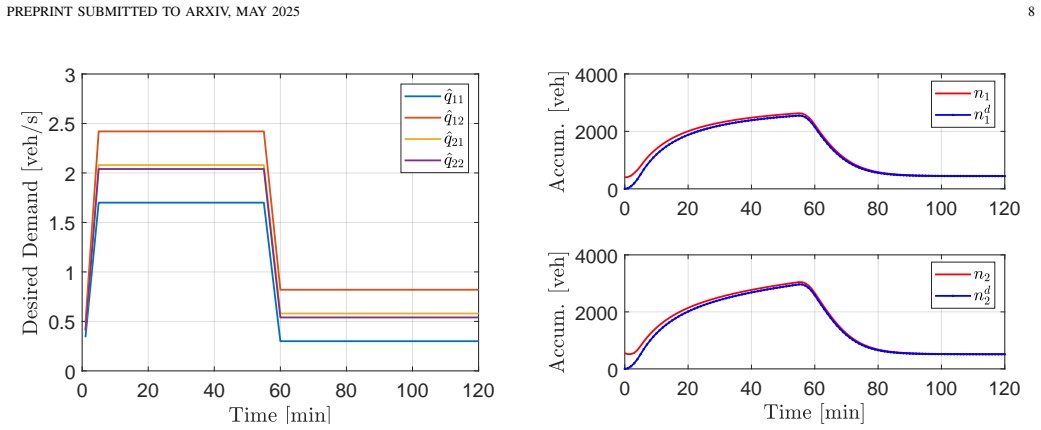
- [Figures 5 and 6] The legend labels in Figures 5 and 6 use abbreviated subscripts 'ntpc', 'nref', and 'nspc' that are not defined in the captions; please spell out the quantities being plotted.
- [Reference [31]] Reference [31] is a preprint under review, and it is used to motivate MFD uncertainty; please provide a published version or additional details so that the reader can verify the claim.
- [Eq. (27)] The notation nd,1 and nd,2 in (27) is inconsistent with the four-dimensional nd(t) defined earlier; clarify that nd,i = nd,i1 + nd,i2 and specify the relation between the regional reference accumulations and the OD-specific reference components.
- [Algorithm 1] The step 'According to the control policy D(k), D(k+1) and V(k+1) can be solved simultaneously' is presented as an equation, not as an implementable algorithm; please describe the function approximators and the least-squares or recursive least-squares procedure used to solve (21).
- [Abstract and Table II] The abstract reports a 20.01% TTS reduction and a 3.15% CTC improvement without stating that these numbers are for a single scenario (Example 1); please qualify them accordingly and, ideally, provide multiple simulation runs or error bars.
Circularity Check
The ADP derivation (Proposition III.1) is self-contained, but the convergence guarantee is imported from the authors' own [21] and Example 2's claim that tracking (27) maximizes trip completion is an unproven, under-specified assertion rather than a circular reduction.
-
self citation load bearing
[Section III, paragraph immediately after Eq. (17)]
"The convergence of sequence {(V (k), µ(k))} (i.e., {(V (k), D(k))}) to the optimal value and policy function (V ∗, µ∗) (i.e., (V ∗, D∗)) applying (16)-(17) has been checked by [21]."
[21] is the authors' own prior paper (Chen et al., Transportation Research Part C 2022). Algorithm 1's optimality claim depends on this convergence assertion, and the manuscript provides no independent proof of convergence here, nor does it reproduce or machine-check the cited result. The underlying policy-iteration convergence is also standard in the external ADP literature, so this is a load-bearing self-citation rather than a full circular collapse, but it is the kind of support that should ideally cite a non-overlapping source or give a self-contained theorem.
-
other
[Section IV-B, Eq. (27) and the paragraph following Fig. 10]
"The desired trajectory reference is given by ˙nd,1(t) = qˆ1(t) − G1(nd,1(t)) + nd,21(t)/nd,2(t) G2(nd,2(t)), ˙nd,2(t) = qˆ2(t) − G2(nd,2(t)) + nd,12(t)/nd,1(t) G1(nd,1(t)) ... and the trip completion of the system is thus maximized."
This is not an equation-level circular reduction, but it is a load-bearing asserted gap. The tracking error ed = n − nd in Eq. (5) is four-dimensional, while (27) defines only the two aggregate reference accumulations nd,1 and nd,2; the OD-specific components nd,12, nd,21, and nd,22 are never specified, so the controller is not shown to track a complete 4D reference trajectory. Moreover, no derivation or optimization shows that the uncontrolled aggregate dynamics (27) is the trajectory that maximizes trip completion; the statement that tracking it 'maximizes trip completion' is asserted without proof. Thus the Section IV-B conclusions on robust optimality are unsupported even if the ADP feedback loop itself is sound.
full rationale
The core of the paper, Proposition III.1, is a self-contained equivalence proof between the model-based policy iteration (16)-(17) and the model-free IRL Bellman equation (21); it follows from the Bellman optimality principle and standard ADP arguments, and it does not reduce to the paper's own inputs. The main circularity risk is the citation of the authors' own [21] for the convergence of the policy-iteration sequence underlying Algorithm 1. That citation is load-bearing because the optimality of the proposed controller requires convergence, but it is not the only possible support and the underlying result is standard in the external literature, so it counts as a minor self-citation concern rather than a demonstration that the algorithm is circular. A separate, non-circular but serious gap is Example 2: the reference trajectory (27) is under-specified (only two aggregate states are defined, while the tracking error is four-dimensional) and its claimed trip-completion-maximizing property is asserted, not derived. This makes the paper's headline robustness/optimality conclusion for Example 2 unsupported, but it is a correctness gap, not a self-referential reduction. Overall, no equation in the derivation is equivalent to its own output by construction, so the score is 3 rather than higher.
Assumptions & free parameters
free parameters (5)
- Q (tracking-error weight matrix) =
not reported
- R = diag(gamma1, gamma2) (control-effort weights) =
not reported
- lambda (actuator saturation bound) =
not reported
- Function-approximation architecture for V and D =
not reported
- Initial admissible policy mu(0) =
not reported
assumptions (6)
- domain assumption The two-region MFD dynamics are exactly affine (3) with the given f(n) and s(n), and the MFD (26) is well-calibrated and identical for both regions.
- domain assumption The reference trajectory nd is bounded and generated by a Lipschitz continuous command generator (4) with theta(0)=0.
- domain assumption s(nd)^T s(nd) is invertible, equivalently n12 and n21 are positive along the reference, so that us in (6)/(7) is well-defined.
- domain assumption The policy iteration (16)-(17) converges to the optimal solution of the tracking HJB equation (15).
- standard math The tracking HJB (15) has a smooth solution V* and the value function is continuously differentiable along closed-loop trajectories.
- ad hoc to paper The reference trajectory (27), defined as the free-running dynamics under a nominal demand pattern, maximizes trip completion.
Cite this review
Pith. "Pith review of Learning-Based Tracking Perimeter Control for Two-region Macroscopic Traffic Dynamics." pith.science (2026). https://pith.science/paper/JJNQOO55
@misc{pith2026250521818,
  author       = {Pith},
  title        = {Pith review of: Learning-Based Tracking Perimeter Control for Two-region Macroscopic Traffic Dynamics},
  year         = {2026},
  howpublished = {\url{https://pith.science/paper/JJNQOO55}},
  note         = {Machine review of arXiv:2505.21818}
}
read the original abstract
Leveraging the concept of the macroscopic fundamental diagram (MFD), perimeter control can alleviate network-level congestion by identifying critical intersections and regulating them effectively. Considering the time-varying nature of travel demand and the equilibrium of accumulation state, we extend the conventional set-point perimeter control (SPC) problem for the two-region MFD system as an optimal tracking perimeter control problem (OTPCP). Unlike the SPC schemes that stabilize the traffic dynamics to the desired equilibrium point, the proposed tracking perimeter control (TPC) scheme regulates the traffic dynamics to a desired trajectory in a differential framework. Due to the inherent network uncertainties, such as heterogeneity of traffic dynamics and demand disturbance, the system dynamics could be uncertain or even unknown. To address these issues, we propose an adaptive dynamic programming (ADP) approach to solving the OTPCP without utilizing the well-calibrated system dynamics. Numerical experiments demonstrate the effectiveness of the proposed ADP-based TPC. Compared with the SPC scheme, the proposed TPC scheme achieves a 20.01% reduction in total travel time and a 3.15% improvement in cumulative trip completion. Moreover, the proposed adaptive TPC approach can regulate the accumulation state under network uncertainties and demand disturbances to the desired time-varying equilibrium trajectory that aims to maximize the trip completion under a nominal demand pattern. These results validate the robustness of the adaptive TPC approach.
Figures


Figures from the paper (6 more)



Reference graph
Works this paper leans on
-
[21]
C. Chen, Y . Huang, W. Lam, T. Pan, S. Hsu, A. Sumalee, and R. Zhong, “Data efficient reinforcement learning and adaptive optimal perimeter control of network traffic dynamics,” Transportation Research Part C: Emerging Technologies, vol. 142, p. 103759, 2022
work page 2022
-
[1]
Y . Huang, J. Xiong, S.-C. Hsu, A. Sumalee, W. Lam, and R. Zhong, “A comparison of the accumulation-based, trip-based and time delay macroscopic fundamental diagram models,” Transportmetrica A: Trans- port Science , pp. 1–37, 2024
work page 2024
-
[2]
On the spatial partitioning of urban trans- portation networks,
Y . Ji and N. Geroliminis, “On the spatial partitioning of urban trans- portation networks,” Transportation Research Part B: Methodological , vol. 46, no. 10, pp. 1639–1656, 2012
work page 2012
-
[3]
Urban gridlock: Macroscopic modeling and mitigation approaches,
C. F. Daganzo, “Urban gridlock: Macroscopic modeling and mitigation approaches,” Transportation Research Part B: Methodological , vol. 41, no. 1, pp. 49–62, 2007. PREPRINT SUBMITTED TO ARXIV , MAY 2025 9
work page 2007
-
[4]
N. Geroliminis, J. Haddad, and M. Ramezani, “Optimal perimeter control for two urban regions with macroscopic fundamental diagrams: A model predictive approach,” IEEE Transactions on Intelligent Trans- portation Systems , vol. 14, no. 1, pp. 348–359, 2013
work page 2013
-
[5]
A. Aalipour, H. Kebriaei, and M. Ramezani, “Analytical optimal solution of perimeter traffic flow control based on mfd dynamics: A pontryagin’s maximum principle approach,” IEEE Transactions on Intelligent Trans- portation Systems , 2018
work page 2018
-
[6]
Perimeter and boundary flow control in multi-reservoir heterogeneous networks,
K. Aboudolas and N. Geroliminis, “Perimeter and boundary flow control in multi-reservoir heterogeneous networks,” Transportation Research Part B: Methodological , vol. 55, pp. 265–281, 2013
work page 2013
-
[7]
Multiple concentric gating traffic control in large-scale urban networks,
M. Keyvan-Ekbatani, M. Yildirimoglu, N. Geroliminis, and M. Papa- georgiou, “Multiple concentric gating traffic control in large-scale urban networks,” IEEE Transactions on Intelligent Transportation Systems , vol. 16, no. 4, pp. 2141–2154, 2015
work page 2015
Show all 31 references
-
[8]
Adaptive perimeter traffic control of urban road networks based on MFD model with time delays,
J. Haddad and B. Mirkin, “Adaptive perimeter traffic control of urban road networks based on MFD model with time delays,” International Journal of Robust and Nonlinear Control , vol. 26, no. 6, pp. 1267–1285, 2016
2016
-
[9]
Robust constrained control of uncertain macroscopic fun- damental diagram networks,
J. Haddad, “Robust constrained control of uncertain macroscopic fun- damental diagram networks,” Transportation Research Part C , no. 59, pp. 323–339, 2015
2015
-
[10]
Robust perimeter control for two urban regions with macroscopic fundamental diagrams: a control-lyapunov function approach,
R. Zhong, C. Chen, Y . Huang, A. Sumalee, W. Lam, and D. Xu, “Robust perimeter control for two urban regions with macroscopic fundamental diagrams: a control-lyapunov function approach,” Transportation Re- search Part B: Methodological , vol. 117, pp. 687–707, 2018
2018
-
[11]
Boundary conditions and behavior of the macroscopic fundamental diagram based network traffic dynamics: A control systems perspective,
R. Zhong, Y . Huang, C. Chen, W. Lam, D. Xu, and A. Sumalee, “Boundary conditions and behavior of the macroscopic fundamental diagram based network traffic dynamics: A control systems perspective,” Transportation Research Part B: Methodological , vol. 111, pp. 327 – 355, 2018
2018
-
[12]
Feedback perimeter control with online estimation of maximum throughput for an incident-affected road network,
J. Wang, X. He, S. Peeta, and X. Yang, “Feedback perimeter control with online estimation of maximum throughput for an incident-affected road network,” Journal of Intelligent Transportation Systems , vol. 26, no. 1, pp. 81–99, 2021
2021
-
[13]
H ∞ robust perimeter flow control in urban networks with partial information feedback,
R. Mohajerpoor, M. Saberi, H. L. Vu, T. M. Garoni, and M. Ramezani, “H ∞ robust perimeter flow control in urban networks with partial information feedback,” Transportation Research Part B: Methodological, vol. 137, pp. 47–73, 2020
2020
-
[14]
Enhancing model- based feedback perimeter control with data-driven online adaptive op- timization,
A. Kouvelas, M. Saeedmanesh, and N. Geroliminis, “Enhancing model- based feedback perimeter control with data-driven online adaptive op- timization,” Transportation Research Part B: Methodological , vol. 96, pp. 26–45, 2017
2017
-
[15]
Enhancing the performance of existing urban traffic light control through extremum-seeking,
R. Kutadinata, W. Moase, C. Manzie, L. Zhang, and T. Garoni, “Enhancing the performance of existing urban traffic light control through extremum-seeking,” Transportation Research Part C: Emerging Technologies, vol. 62, pp. 1–20, 2016
2016
-
[16]
Two-level hierarchical optimal control for urban traffic networks,
H. Yu and Z. Hou, “Two-level hierarchical optimal control for urban traffic networks,” Transportmetrica A: Transport Science , pp. 1–22, 2020
2020
-
[17]
Data driven model free adaptive iterative learning perimeter control for large-scale urban road networks,
Y . Ren, Z. Hou, I. I. Sirmatel, and N. Geroliminis, “Data driven model free adaptive iterative learning perimeter control for large-scale urban road networks,” Transportation Research Part C: Emerging Technolo- gies, vol. 115, p. 102618, 2020
2020
-
[18]
Distributed model-free adaptive predictive control for urban traffic networks,
D. Li and B. De Schutter, “Distributed model-free adaptive predictive control for urban traffic networks,” IEEE Transactions on Control Systems Technology, vol. 30, no. 1, pp. 180–192, 2022
2022
-
[19]
Model-free perimeter metering control for two-region urban networks using deep reinforcement learning,
D. Zhou and V . V . Gayah, “Model-free perimeter metering control for two-region urban networks using deep reinforcement learning,” Transportation Research Part C: Emerging Technologies , vol. 124, p. 102949, 2021
2021
-
[20]
Neuro-dynamic programming for optimal control of macroscopic fun- damental diagram systems,
Z. Su, A. H. Chow, N. Zheng, Y . Huang, E. Liang, and R. Zhong, “Neuro-dynamic programming for optimal control of macroscopic fun- damental diagram systems,” Transportation Research Part C: Emerging Technologies, vol. 116, p. 102628, 2020
2020
-
[22]
An iterative adaptive dynamic programming approach for macroscopic fundamental diagram-based perimeter control and route guidance,
C. Chen, N. Geroliminis, and R. Zhong, “An iterative adaptive dynamic programming approach for macroscopic fundamental diagram-based perimeter control and route guidance,” Transportation Science, vol. 58, no. 4, pp. 896–918, 2024
2024
-
[23]
Coordinated distributed adaptive perimeter control for large-scale urban road networks,
J. Haddad and B. Mirkin, “Coordinated distributed adaptive perimeter control for large-scale urban road networks,” Transportation Research Part C: Emerging Technologies , vol. 77, pp. 495–515, 2017
2017
-
[24]
Adaptive perimeter control for multi-region accumulation-based models with state delays,
J. Haddad and Z. Zheng, “Adaptive perimeter control for multi-region accumulation-based models with state delays,” Transportation Research Part B: Methodological , vol. 137, pp. 133–153, 2020
2020
-
[25]
Hierarchical control for stochastic network traffic with reinforcement learning,
Z. Su, A. H. Chow, C. Fang, E. Liang, and R. Zhong, “Hierarchical control for stochastic network traffic with reinforcement learning,” Transportation Research Part B: Methodological, vol. 167, pp. 196–216, 2023
2023
-
[26]
Two-layer adaptive sig- nal control framework for large-scale dynamically-congested networks: Combining efficient max pressure with perimeter control,
D. Tsitsokas, A. Kouvelas, and N. Geroliminis, “Two-layer adaptive sig- nal control framework for large-scale dynamically-congested networks: Combining efficient max pressure with perimeter control,” Transporta- tion Research Part C: Emerging Technologies, vol. 152, p. 104128, 2023
2023
-
[27]
Tracking control optimization scheme of continuous-time nonlinear system via online single network adaptive critic design method,
K. Zhang, H. Zhang, G. Xiao, and H. Su, “Tracking control optimization scheme of continuous-time nonlinear system via online single network adaptive critic design method,” Neurocomputing, vol. 251, pp. 127–135, 2017
2017
-
[28]
Near-optimal output tracking controller design for nonlinear systems using an event-driven adp approach,
K. Zhang, H. Zhang, H. Jiang, and Y . Wang, “Near-optimal output tracking controller design for nonlinear systems using an event-driven adp approach,” Neurocomputing, vol. 309, pp. 168–178, 2018
2018
-
[29]
Reinforcement learning and adaptive dynamic programming for feedback control,
F. L. Lewis and D. Vrabie, “Reinforcement learning and adaptive dynamic programming for feedback control,” IEEE Circuits and Systems Magazine, vol. 9, no. 3, pp. 32–50, 2009
2009
-
[30]
Cityflow: A multi-agent reinforcement learning environment for large scale city traffic scenario,
H. Zhang, S. Feng, C. Liu, Y . Ding, Y . Zhu, Z. Zhou, W. Zhang, Y . Yu, H. Jin, and Z. Li, “Cityflow: A multi-agent reinforcement learning environment for large scale city traffic scenario,” in The world wide web conference, 2019, pp. 3620–3624
2019
-
[31]
Calibration and uncertainty quantification of macroscopic fundamental diagrams,
W. Ma, Y . Huang, N. Zheng, T. Pan, and R. Zhong, “Calibration and uncertainty quantification of macroscopic fundamental diagrams,” Preprint under review , 2025
2025
Reviewed August 7, 2026 · model on record in the stance chip above.
Discussion (0). Sign in to comment.