REVIEW 2 major objections 5 minor 40 references
A Graph Completion Method that Jointly Predicts Geometry and Topology Enables Effective Molecule Assembly
T0 review · 2 major / 5 minor · reviewed 2026-08-07 · deepseek-v4-flash
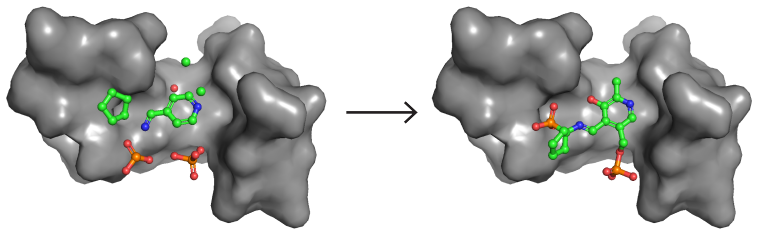
Pith's one-line read EdGr, a spatial graph diffusion model that couples bond prediction with atom movement, assembles drug fragments into complete molecules with 85% precision and 86% recall at 1Å noise, beating the next-best method by 15 points.
desk verdict A real architectural idea with strong results, but the underspecified diffusion/inference protocol is a load-bearing gap that needs fixing before the numbers can be taken at face value. read the letter →
The pith
A machine-rendered reading of the paper's core claim, the machinery that carries it, and where it could break.
The reading
What carries the argument
The load-bearing mechanism is a spatial graph diffusion model built from EGCL-style layers with two parallel edge-feature networks. One network passes messages along known bonds exactly as in an E(n)-equivariant graph neural network; the second computes embeddings for candidate inter-fragment edges and feeds them, through a learned scalar, directly into the atom-coordinate update. In the layer update, candidate edge embeddings are formed from atom embeddings, distances, predefined edge features, and the previous timestep's edge embeddings when self-conditioning applies; atom positions shift by a sum over neighbors of relative displacements weighted by both known-edge and candidate-edge scalars; and node embeddings aggregate both edge streams. During inference, Kabsch rigid-body alignment keeps each fragment rigid while the model denoises, and a final greedy pass selects the highest-weight chemically valid bonds that connect distinct fragments. This design is what lets connectivity cues guide spatial movement and spatial movement refine connectivity.
What would settle it
Compare EdGr's precision and recall when test fragments are jiggled according to exactly the same random pattern used in training, rather than the fixed 1–3Å translations and uniform rotations used in the paper. If the advantage over EDM shrinks to zero, the claim that coupling geometry and topology drives the result is not supported.
Extended reading notes
Core claim
On the paper's own terms, the discovery is that treating bond prediction and coordinate refinement as mutually informative, rather than as separate stages, is what makes molecule assembly work when fragment positions are noisy. EdGr maintains two message-passing streams: one for known intra-fragment edges and one for every candidate inter-fragment edge. The candidate-edge stream is trained with direct supervision, and its outputs enter the coordinate-update equation, so high-confidence bonds pull atoms into the positions those bonds require; the updated positions then change the distances and therefore the next round of edge scores. The paper reports that this coupling, rather than edge prediction alone, is responsible for most of the gain: removing the candidate-edge-to-node update drops precision from 85±1% to 63±1%, and full-molecule recovery from 64±2% to 26±1%. EdGr also improves on atom positions, with 1.09Å RMSD at 1Å noise versus 1.20Å for EDM.
Load-bearing premise
The result depends on the assumption that the random jitter used when testing the model matches the jitter pattern it was trained on; the paper does not report the training jitter pattern.
Editorial extensions
If this is right
- At 1Å noise, EdGr's 85±1% precision and 86±1% recall beat EDM's 70±1%; the margin persists at 3Å, where EdGr keeps 71±1% precision while EDM falls to 52±1%.
- The ablation shows the coupled update is the main driver: removing candidate-edge influence on node positions drops precision from 85±1% to 63±1% and full-molecule recovery from 64±2% to 26±1%.
- Self-conditioning adds a smaller but clear gain: without it, precision drops to 80±1% and recall to 79±1% at 1Å noise.
- Because EdGr treats fragments as rigid bodies and can handle single-atom fragments, the same pipeline covers a wide fragment library and can be adapted to the no-initial-coordinates setting by centering fragments and training with high noise.
- The coupled geometry–topology diffusion is proposed as a general spatial graph completion method, applicable to neural circuit reconstruction, 3D scene understanding, and sensor network design.
Reading between the lines
- A fair test of the method's claimed generality would be to apply the same two-stream coupling to a non-chemical spatial graph completion task, such as connecting neurons from noisy microscopy coordinates; none of EdGr's components is chemistry-specific except the final valence check.
- The paper does not state the forward diffusion noise schedule used in training, so it is an open question whether the reported numbers come from running the model in-distribution; evaluating under perturbations drawn from the exact training schedule would settle how much of the advantage is robust to distribution shift.
- EdGr currently predicts only single bonds and assumes rigid fragments, so flexible linkers, double bonds, and ring fusion remain out of reach; extending the edge stream to bond types is a concrete next step the architecture already supports.
- A scaling test of the bond-selection cutoff would clarify how much of the final accuracy comes from learned weights versus the geometric prior that connected atoms sit at characteristic distances.
Editorial analysis
A structured set of objections, weighed in public.
Referee Report
Summary. The paper introduces EdGr, a diffusion-style spatial graph completion model for the molecule assembly task, in which atomic coordinates and inter-fragment edge weights are refined jointly. Fragments are treated as rigid bodies; at each denoising step, candidate edge likelihoods contribute to node position updates, and updated positions feed back into subsequent edge predictions, with a Kabsch projection enforcing fragment rigidity. The method is evaluated on roughly 35,000 protein-ligand complexes split by protein sequence similarity, under 1, 2, and 3 Å translational fragment noise with uniform SO(3) rotations, against EDM, Equiformer, GCN, graph attention, and heuristic baselines, with precision, recall, full-molecule recovery, Tanimoto similarity, and RMSD as metrics. The paper reports consistently superior results for EdGr and provides two ablations, one removing self-conditioning and one removing the candidate-edge-to-node update.
Significance. If the reported results are reproducible, this is a useful contribution: it reframes molecule assembly as a joint geometry-topology completion problem and provides a concrete architecture in which edge predictions influence coordinate updates. The evaluation across three noise levels, the protein-similarity-based held-out split, and the two ablations are strengths. The main concern is that the inference protocol is not fully specified, which currently prevents verification that the method is a well-defined diffusion process or that the baseline comparison is fair; these issues are load-bearing for the central quantitative claim.
major comments (2)
- [§3.1, §3.3, Eqs. (1)–(9)] The forward noise schedule is unspecified, making the test-time denoising procedure ill-defined. Although Eq. (1) and the IGSO(3) density in Eq. (2) define families of distributions, the paper never specifies the schedules α_t, σ_t, and ε^2 as functions of t, nor the distribution over t used during training. In addition, none of the model equations (3)–(9) take t as an input, except through the recurrent n_{ij;t-1} term, so the model has no direct representation of the remaining noise level. Section 3.3 states only that inference follows the reverse diffusion process of Hoogeboom et al. with self-conditioning and a Kabsch projection; it does not state how the evaluation perturbation (σ = 1–3 Å translation and uniform SO(3) rotation, §4.1) is mapped to an initial diffusion step t_0, how many reverse steps are run, or how the forward schedule relates to the added perturbation. This leaves open the possibility that the reported performance gap over EDM depends on an arbitrary number of refinement steps or an off-distribution starting point. Please specify the full schedule, the training loss over t, any timestep conditioning, and the exact inference protocol; if the model is intentionally time-agnostic, explain why repeated application of a time-independent denoiser is well-posed and how training is consistent with that inference scheme.
- [§A.5, Tables 1–3] The Equiformer baseline is under-trained relative to EdGr and EDM. Appendix A.5 states that Equiformer was trained for roughly 80 epochs (about one week on an A100, with one epoch every two hours), while EdGr and EDM were trained for up to 300 epochs. An 80-epoch Equiformer may not have converged, and its near-chance performance (10% precision in Tables 1–3) could reflect incomplete training rather than an architectural limitation. Because the paper's central claim is that EdGr substantially outperforms prior methods, the Equiformer comparison should either be trained to convergence or accompanied by validation learning curves demonstrating that additional training would not change the conclusions.
minor comments (5)
- [§3.2, Eq. (5)] Equation (5) uses n_{ij;t-1} from the previous timestep, but the paper does not state how n_ij is initialized at the first denoising step; please specify the initial value.
- [§3.2, Eq. (3)] The self-conditioning threshold p is introduced in Eq. (3) but its value is never reported; please provide the value used in training and inference.
- [§3.3, Algorithm 1] The final bond selection procedure depends on a distance cutoff N for potential inter-fragment bonds, but the value of N is not given anywhere in the paper or appendix; please report this hyperparameter.
- [§4.2, Eq. (14)] The RMSD metric is computed directly from predicted and experimental coordinates, but the paper does not state whether any global alignment is applied before computing RMSD; please clarify the alignment protocol.
- [Throughout] There are several typographical errors, including 'to to other molecule assembly methods' in the captions of Tables 2 and 3, 'Nvidida A40' in Appendix A.4, and 'Tanimoto Similarity' where 'Tanimoto coefficient' would be more standard.
Circularity Check
No significant circularity: EdGr's predictions are held-out supervised outputs, and the central claim is an empirical comparison.
full rationale
The paper's central claim is that EdGr outperforms prior methods at molecule assembly, and this is supported by standard supervised training on ground-truth protein–ligand complexes followed by evaluation on held-out complexes. The predicted bonds and coordinates are genuine model outputs, not fitted constants renamed as predictions. The forward noising process (Eq. 1) and IGSO(3) rotational noise are standard diffusion ingredients, and the inference procedure is referenced to Hoogeboom et al. as an external method, not to the authors' own prior results. The paper does cite the authors' prior work (Powers et al. 2023, 2025) for the dataset and fragment library, but this is a data/benchmark source rather than a load-bearing analytical premise, and the underlying data come from the Protein Data Bank. The ablation study (removing candidate-edge-to-node updates) provides an independent control showing that the coupled update contributes to performance. Concerns about the unspecified forward noise schedule and missing timestep conditioning are correctness and reproducibility issues, not circularity: they do not show that any prediction is equivalent by construction to an input. No step in the derivation reduces to its own inputs via definition, fitted parameter renaming, or a self-citation chain.
Assumptions & free parameters
free parameters (1)
- bond distance cutoff N =
not specified
assumptions (4)
- domain assumption Fragments are rigid and contain no rotatable bonds.
- domain assumption Pocket atoms are static and serve only as context.
- ad hoc to paper The forward diffusion noise schedule matches the test-time fragment perturbations.
- standard math Kabsch algorithm provides the optimal rigid-body alignment.
Cite this review
Pith. "Pith review of A Graph Completion Method that Jointly Predicts Geometry and Topology Enables Effective Molecule Assembly." pith.science (2026). https://pith.science/paper/DQWPH4KI
@misc{pith2026250521833,
  author       = {Pith},
  title        = {Pith review of: A Graph Completion Method that Jointly Predicts Geometry and Topology Enables Effective Molecule Assembly},
  year         = {2026},
  howpublished = {\url{https://pith.science/paper/DQWPH4KI}},
  note         = {Machine review of arXiv:2505.21833}
}
read the original abstract
A common starting point for drug design is to find small chemical groups or "fragments" that form interactions with distinct subregions in a protein binding pocket. The subsequent challenge is to assemble these fragments into a molecule that has high affinity to the protein, by adding chemical bonds between atoms in different fragments. This "molecule assembly" task is particularly challenging because, initially, fragment positions are known only approximately. Prior methods for spatial graph completion-adding missing edges to a graph whose nodes have associated spatial coordinates-either treat node positions as fixed or adjust node positions before predicting edges. The fact that these methods treat geometry and topology prediction separately limits their ability to reconcile noisy geometries and plausible connectivities. To address this limitation, we introduce EdGr, a spatial graph diffusion model that reasons jointly over geometry and topology of molecules to simultaneously predict fragment positions and inter-fragment bonds. Importantly, predicted edge likelihoods directly influence node position updates during the diffusion denoising process, allowing connectivity cues to guide spatial movements, and vice versa. EdGr substantially outperforms previous methods on the molecule assembly task and maintains robust performance as noise levels increase. Beyond drug discovery, our approach of explicitly coupling geometry and topology prediction is broadly applicable to spatial graph completion problems, such as neural circuit reconstruction, 3D scene understanding, and sensor network design.
Figures


Reference graph
Works this paper leans on
-
[1]
Rational design of ligands with optimized residence time
Paolo Carloni, Giulia Rossetti, and Christa E M\"uller. Rational design of ligands with optimized residence time. ACS Pharmacology & Translational Science, 2025
work page 2025
-
[2]
Chaudhri, Naren Chittar, and Michael Genesereth
Vinay K. Chaudhri, Naren Chittar, and Michael Genesereth. An introduction to knowledge graphs. https://ai.stanford.edu/blog/introduction-to-knowledge-graphs/, May 2021. Stanford AI Lab Blog
work page 2021
-
[3]
Analog bits: Generating discrete data using diffusion models with self-conditioning, 2023
Ting Chen, Ruixiang Zhang, and Geoffrey Hinton. Analog bits: Generating discrete data using diffusion models with self-conditioning, 2023. URL https://arxiv.org/abs/2208.04202
arXiv 2023
-
[4]
Functional connectomics reveals general wiring rule in mouse visual cortex
Zhuokun Ding, Paul G Fahey, Stelios Papadopoulos, Eric Y Wang, Brendan Celii, Christos Papadopoulos, Andersen Chang, Alexander B Kunin, Dat Tran, Jiakun Fu, et al. Functional connectomics reveals general wiring rule in mouse visual cortex. Nature, 640 0 (8058): 0 459--469, 2025
work page 2025
-
[5]
Uncertainty modeling in wireless sensor networks
Gulustan Dogan and Ted Brown. Uncertainty modeling in wireless sensor networks. In Proceedings of the International Conference on Big Data and Internet of Thing, BDIOT '17, page 200–204, New York, NY, USA, 2017. Association for Computing Machinery. ISBN 9781450354301. doi:10.1145/3175684.3175692. URL https://doi.org/10.1145/3175684.3175692
-
[6]
Machine learning-aided generative molecular design
Yuanqi Du, Arian R Jamasb, Jeff Guo, Tianfan Fu, Charles Harris, Yingheng Wang, Chenru Duan, Pietro Li \`o , Philippe Schwaller, and Tom L Blundell. Machine learning-aided generative molecular design. Nature Machine Intelligence, 6 0 (6): 0 589--604, 2024
work page 2024
-
[7]
3d equivariant diffusion for target-aware molecule generation and affinity prediction
Jiaqi Guan, Wesley Wei Qian, Xingang Peng, Yufeng Su, Jian Peng, and Jianzhu Ma. 3d equivariant diffusion for target-aware molecule generation and affinity prediction. arXiv preprint arXiv:2303.03543, 2023
arXiv 2023
-
[8]
Decompdiff: diffusion models with decomposed priors for structure-based drug design
Jiaqi Guan, Xiangxin Zhou, Yuwei Yang, Yu Bao, Jian Peng, Jianzhu Ma, Qiang Liu, Liang Wang, and Quanquan Gu. Decompdiff: diffusion models with decomposed priors for structure-based drug design. arXiv preprint arXiv:2403.07902, 2024
arXiv 2024
Show all 40 references
-
[9]
Denoising diffusion probabilistic models, 2020
Jonathan Ho, Ajay Jain, and Pieter Abbeel. Denoising diffusion probabilistic models, 2020. URL https://arxiv.org/abs/2006.11239
2020 arXiv
-
[10]
Equivariant diffusion for molecule generation in 3d, 2022
Emiel Hoogeboom, Victor Garcia Satorras, Clément Vignac, and Max Welling. Equivariant diffusion for molecule generation in 3d, 2022. URL https://arxiv.org/abs/2203.17003
2022 arXiv
-
[11]
3dlinker: an e (3) equivariant variational autoencoder for molecular linker design
Yinan Huang, Xingang Peng, Jianzhu Ma, and Muhan Zhang. 3dlinker: an e (3) equivariant variational autoencoder for molecular linker design. arXiv preprint arXiv:2205.07309, 2022
2022 arXiv
-
[12]
Equivariant 3d-conditional diffusion model for molecular linker design
Ilia Igashov, Hannes St \"a rk, Cl \'e ment Vignac, Arne Schneuing, Victor Garcia Satorras, Pascal Frossard, Max Welling, Michael Bronstein, and Bruno Correia. Equivariant 3d-conditional diffusion model for molecular linker design. Nature Machine Intelligence, 6 0 (4): 0 417--...
2024
-
[13]
Deep generative models for 3d linker design
Fergus Imrie, Anthony R Bradley, Mihaela van der Schaar, and Charlotte M Deane. Deep generative models for 3d linker design. Journal of chemical information and modeling, 60 0 (4): 0 1983--1995, 2020
1983
-
[14]
Node deployment under position uncertainty for network localization
Mohammad Javad Khojasteh, Augustin A Saucan, Zhenyu Liu, Andrea Conti, and Moe Z Win. Node deployment under position uncertainty for network localization. In ICC 2022-IEEE International Conference on Communications, pages 889--894. IEEE, 2022
2022
-
[15]
Semi-supervised classification with graph convolutional networks
Thomas N Kipf and Max Welling. Semi-supervised classification with graph convolutional networks. arXiv preprint arXiv:1609.02907, 2016
2016 arXiv
-
[16]
Sgrec3d: Self-supervised 3d scene graph learning via object-level scene reconstruction
Sebastian Koch, Pedro Hermosilla, Narunas Vaskevicius, Mirco Colosi, and Timo Ropinski. Sgrec3d: Self-supervised 3d scene graph learning via object-level scene reconstruction. In Proceedings of the IEEE/CVF Winter Conference on Applications of Computer Vision, pages 3404--3414, 2024
2024
-
[17]
Current perspectives in fragment-based lead discovery (fbld)
Bas Lamoree and Roderick E Hubbard. Current perspectives in fragment-based lead discovery (fbld). Essays in biochemistry, 61 0 (5): 0 453--464, 2017
2017
-
[18]
Rdkit documentation
Greg Landrum. Rdkit documentation. Release, 1 0 (1-79): 0 4, 2013
2013
-
[19]
A purely algebraic justification of the kabsch-umeyama algorithm
Jim Lawrence, Javier Bernal, and Christoph Witzgall. A purely algebraic justification of the kabsch-umeyama algorithm. Journal of research of the National Institute of Standards and Technology, 124: 0 1, 2019
2019
-
[20]
Degiacomi, and Chris G
Adam Leach, Sebastian M Schmon, Matteo T. Degiacomi, and Chris G. Willcocks. Denoising diffusion probabilistic models on SO (3) for rotational alignment. In ICLR 2022 Workshop on Geometrical and Topological Representation Learning, 2022. URL https://openreview.net/forum?id=BY88eBbkpe5
2022
-
[21]
Evaluating graph neural networks for link prediction: Current pitfalls and new benchmarking
Juanhui Li, Harry Shomer, Haitao Mao, Shenglai Zeng, Yao Ma, Neil Shah, Jiliang Tang, and Dawei Yin. Evaluating graph neural networks for link prediction: Current pitfalls and new benchmarking. Advances in Neural Information Processing Systems, 36: 0 3853--3866, 2023
2023
-
[22]
Equiformer: Equivariant graph attention transformer for 3d atomistic graphs
Yi-Lun Liao and Tess Smidt. Equiformer: Equivariant graph attention transformer for 3d atomistic graphs. arXiv preprint arXiv:2206.11990, 2022
2022 arXiv
-
[23]
Revisiting link prediction: A data perspective
Haitao Mao, Juanhui Li, Harry Shomer, Bingheng Li, Wenqi Fan, Yao Ma, Tong Zhao, Neil Shah, and Jiliang Tang. Revisiting link prediction: A data perspective. arXiv preprint arXiv:2310.00793, 2023
2023 arXiv
-
[24]
Retinal connectomics: towards complete, accurate networks
Robert E Marc, Bryan W Jones, Carl B Watt, James R Anderson, Crystal Sigulinsky, and Scott Lauritzen. Retinal connectomics: towards complete, accurate networks. Progress in retinal and eye research, 37: 0 141--162, 2013
2013
-
[25]
Geometry-complete diffusion for 3d molecule generation and optimization
Alex Morehead and Jianlin Cheng. Geometry-complete diffusion for 3d molecule generation and optimization. Communications Chemistry, 7 0 (1): 0 150, 2024
2024
-
[26]
Bronstein, Philippe Schwaller, and Bruno Correia
Rebecca Manuela Neeser, Ilia Igashov, Arne Schneuing, Michael M. Bronstein, Philippe Schwaller, and Bruno Correia. Flow-based fragment identification via contrastive learning of binding site-specific latent representations. In AI for Accelerated Materials Design - ICLR 2025, 2...
2025
-
[27]
Clustering and preferential attachment in growing networks
Mark EJ Newman. Clustering and preferential attachment in growing networks. Physical review E, 64 0 (2): 0 025102, 2001
2001
-
[28]
Open babel: An open chemical toolbox
Noel M O'Boyle, Michael Banck, Craig A James, Chris Morley, Tim Vandermeersch, and Geoffrey R Hutchison. Open babel: An open chemical toolbox. Journal of cheminformatics, 3: 0 1--14, 2011
2011
-
[29]
Geometric deep learning for structure-based ligand design
Alexander S Powers, Helen H Yu, Patricia Suriana, Rohan V Koodli, Tianyu Lu, Joseph M Paggi, and Ron O Dror. Geometric deep learning for structure-based ligand design. ACS Central Science, 9 0 (12): 0 2257--2267, 2023
2023
-
[30]
MedSAGE : Bridging Generative AI and Medicinal Chemistry for Structure - Based Design of Small Molecule Drugs
Alexander S Powers, Tianyu Lu, Rohan V Koodli, Minkai Xu, Siyi Gu, Masha Karelina, and Ron O Dror. MedSAGE : Bridging Generative AI and Medicinal Chemistry for Structure - Based Design of Small Molecule Drugs . bioRxiv, 2025. doi:10.1101/2025.05.10.653107. URL https://www.bior...
2025 doi
-
[31]
Extended-connectivity fingerprints
David Rogers and Mathew Hahn. Extended-connectivity fingerprints. Journal of chemical information and modeling, 50 0 (5): 0 742--754, 2010
2010
-
[32]
E(n) equivariant graph neural networks, 2022
Victor Garcia Satorras, Emiel Hoogeboom, and Max Welling. E(n) equivariant graph neural networks, 2022. URL https://arxiv.org/abs/2102.09844
2022 arXiv
-
[33]
T. I. Savjolova. Preface to novye metody issledovanija tekstury polikristalliceskich materialov, 1985
1985
-
[34]
Structure-based drug design with equivariant diffusion models
Arne Schneuing, Charles Harris, Yuanqi Du, Kieran Didi, Arian Jamasb, Ilia Igashov, Weitao Du, Carla Gomes, Tom L Blundell, Pietro Lio, et al. Structure-based drug design with equivariant diffusion models. Nature Computational Science, 4 0 (12): 0 899--909, 2024
2024
-
[35]
Dobbelstein, Thomas Castiglione, Michael M
Arne Schneuing, Ilia Igashov, Adrian W. Dobbelstein, Thomas Castiglione, Michael M. Bronstein, and Bruno Correia. Multi-domain distribution learning for de novo drug design. In The Thirteenth International Conference on Learning Representations, 2025. URL https://openreview.ne...
2025
-
[36]
Fragment informatics and computational fragment-based drug design: an overview and update
Chunquan Sheng and Wannian Zhang. Fragment informatics and computational fragment-based drug design: an overview and update. Medicinal Research Reviews, 33 0 (3): 0 554--598, 2013
2013
-
[37]
Computational ligand-based rational design: role of conformational sampling and force fields in model development
Jihyun Shim and Alexander D MacKerell Jr. Computational ligand-based rational design: role of conformational sampling and force fields in model development. MedChemComm, 2 0 (5): 0 356--370, 2011
2011
-
[38]
Deep unsupervised learning using nonequilibrium thermodynamics
Jascha Sohl-Dickstein, Eric Weiss, Niru Maheswaranathan, and Surya Ganguli. Deep unsupervised learning using nonequilibrium thermodynamics. In International conference on machine learning, pages 2256--2265. pmlr, 2015
2015
-
[39]
Graph attention networks
Petar Veli c kovi \'c , Guillem Cucurull, Arantxa Casanova, Adriana Romero, Pietro Lio, and Yoshua Bengio. Graph attention networks. arXiv preprint arXiv:1710.10903, 2017
2017 arXiv
-
[40]
A review of knowledge graph completion
Mohamad Zamini, Hassan Reza, and Minou Rabiei. A review of knowledge graph completion. Information, 13 0 (8): 0 396, August 2022. ISSN 2078-2489. doi:10.3390/info13080396. URL http://dx.doi.org/10.3390/info13080396
2022 doi
Reviewed August 7, 2026 · model on record in the stance chip above.
Discussion (0). Sign in to comment.