REVIEW 2 major objections 6 minor 23 references
Polarization-Independent Zero Directional Scattering Without Geometric Symmetries
T0 review · 2 major / 6 minor · reviewed 2026-08-07 · deepseek-v4-flash
Pith's one-line read Polarization-independent zero directional scattering is possible without mirror or rotational symmetry, provided every excited quasi-normal mode either radiates zero along that direction or has radiation polarization opposite the…
desk verdict The first scenario for symmetry-free polarization-independent zero directional scattering is solid; the second rests on a geometric-phase relation that drops the QNM Lorentzian denominators, and that gap is load-bearing. read the letter →
The pith
A machine-rendered reading of the paper's core claim, the machinery that carries it, and where it could break.
The reading
What carries the argument
The central object is the quasi-normal-mode expansion of the scattered field, with the reciprocal excitation coefficient $\alpha_m = \cos(\tfrac12 IP_m)e^{i\varphi_m}$ and the geometric-phase relative phase $\varphi_{j,k} = \tfrac12 \Omega(\triangle IP_jP_k)$. These identities convert the polarization dependence of scattering into distances and areas on the Poincaré sphere: the cosine gives the excitation efficiency from polarization matching, and the triangle solid angle gives the relative phase. Together they make the cancellation condition factor out the incident polarization, so the zero survives arbitrary $I$ whenever the QNM radiation polarizations overlap and their radiations sum to zero.
What would settle it
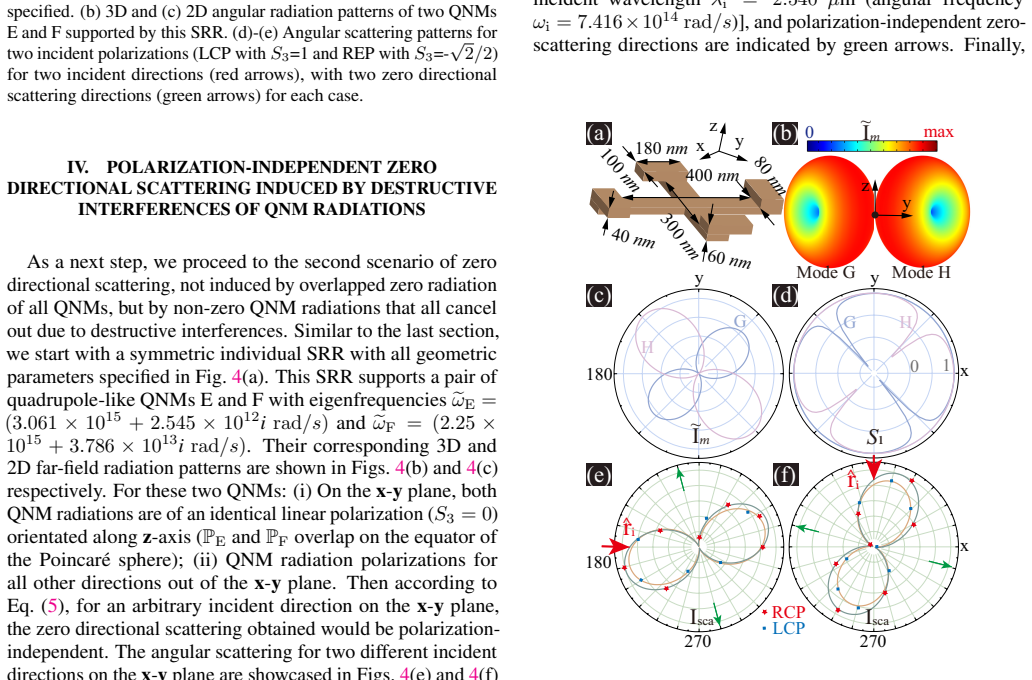
Run a full-wave simulation of the gold particle in Fig. 5(a), extract the complex excitation coefficients of the two quasi-normal modes for a fixed incident direction and polarization at several driving frequencies spanning both resonances, and compare the measured relative phase to the fixed geometric phase $\tfrac12 \Omega(\triangle IP_G P_H)$; if the relative phase changes with frequency while the Poincaré-sphere triangle is unchanged, the geometric-phase identity (3) fails and the polarization-independent zero would not survive detuning.
Extended reading notes
Core claim
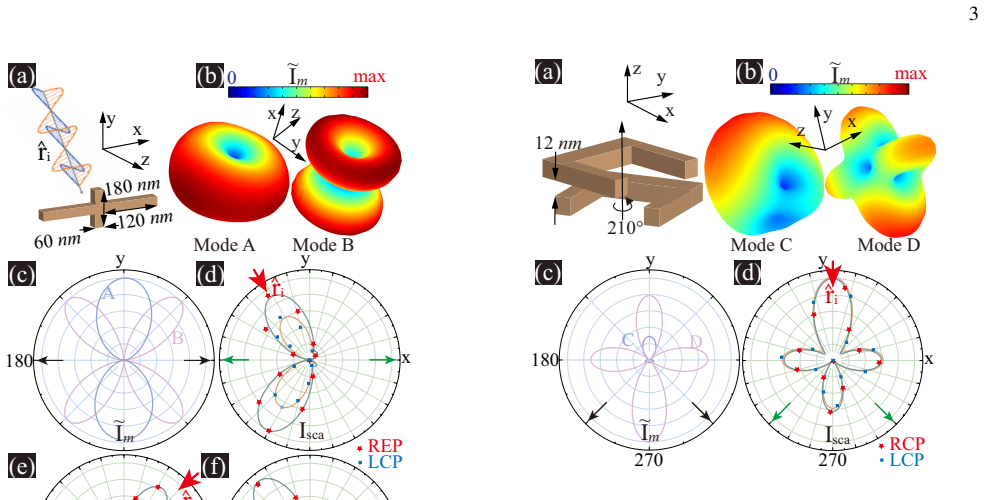
Starting from the quasi-normal-mode (QNM) expansion of the scattered field, the paper derives the condition for polarization-independent zero directional scattering along a direction $\hat{\mathbf r}_o$. For reciprocal scatterers the excitation coefficient of mode $m$ is $\alpha_m = \cos(\tfrac12 IP_m)\exp(i\varphi_m)$, where $I$ is the incident polarization and $P_m$ the radiation polarization of that mode opposite to the incidence direction on the Poincaré sphere. The relative phase between two modes is a pure geometric phase, $\varphi_{j,k} = \tfrac12 \Omega(\triangle IP_jP_k)$, the signed solid angle enclosed by the geodesic triangle. Polarization independence follows in two ways: all excited QNMs have $\tilde{\mathbf E}_m(\hat{\mathbf r}_o)=0$, or all $P_m$ coincide at $P_o$, which makes the cosine factor common and leaves ${\mathbf E}_{\rm sca}(\hat{\mathbf r}_o) = \cos(\tfrac12 IP_o)e^{i\varphi_o} \sum_m \tilde{\mathbf E}_m(\hat{\mathbf r}_o)$; the sum vanishing gives zero scattering for every $I$. Because the derivation uses only reciprocity and geometry on the Poincaré sphere, no mirror or rotational symmetry of the scatterer is required. The paper verifies both scenarios by full-wave simulations of symmetric and asymmetric gold structures.
Load-bearing premise
The load-bearing premise is that the phase difference between any two excited quasi-normal modes is set entirely by the geometric solid angle on the Poincaré sphere, with no extra phase coming from how far the driving frequency sits from each mode's resonance; the paper takes this relation from earlier work without deriving it here.
Editorial extensions
If this is right
- Designers no longer need mirror or rotational symmetry to make a scatterer's directional scattering vanish for every input polarization, so asymmetric plasmonic or dielectric particles can be used in sensors and antennas without symmetry constraints.
- Two concrete recipes follow: make every participating QNM have zero radiation along the target direction, or make their radiation polarizations opposite the incidence direction coincide while their far-field radiations sum to zero.
- The cancellation is protected by reciprocity, so once the QNM radiation polarizations overlap, the zero is invariant to the incident polarization and, in the symmetric example, to any incident direction on the relevant plane.
- The QNM-based picture makes the Kerker condition intrinsic and reference-frame independent, unlike multipole expansions whose coefficients shift with the chosen origin.
Reading between the lines
- In our reading, the same argument should produce polarization-independent zero directional scattering in acoustic, elastic, or matter-wave systems governed by reciprocal scattering, provided an analogue of QNM radiation polarizations can be defined.
- The factorization in Eq. (5) suggests a practical diagnostic: scanning the incident polarization over the Poincaré sphere and mapping where directional scattering stays zero identifies directions in which the QNM radiation polarizations overlap, which could serve as a near-field-free probe of QNM far-field properties.
- A natural test the paper does not carry out is a frequency sweep: if the pure-geometric-phase identity is modified by detuning-phase contributions away from the chosen wavelengths, the polarization-independent zero would be limited to isolated frequencies rather than a band, since the designs are verified at single wavelengths only.
- The twist-and-shift geometry of the coupled split-ring resonators provides a continuous tuning knob: varying the 210-degree twist or the 12 nm displacement should move the QNM radiation polarization points on the Poincaré sphere, so overlapping polarizations can be engineered rather than assumed.
Editorial analysis
A structured set of objections, weighed in public.
Referee Report
Summary. The manuscript claims that zero directional scattering can be made independent of incident polarization without mirror or rotational symmetry by using quasi-normal mode (QNM) interference and geometric phase. It presents two sufficient scenarios: (i) all excited QNMs have zero radiation along the selected direction, and (ii) all QNM radiation polarizations opposite the incident direction coincide, so that the relative geometric phases vanish and the scattered field factors into a common polarization-dependent factor times the sum of QNM radiation fields. The paper verifies scenario (i) with a symmetric particle and a coupled split-ring resonator pair, and scenario (ii) with a symmetric SRR and an asymmetric particle, using full-wave COMSOL simulations at specific wavelengths. The central theoretical step is Eq. (3), which asserts that the relative QNM excitation phase is a pure geometric phase without contributions from resonance detuning.
Significance. If correct, the paper would show a genuinely non-trivial relaxation of the usual symmetry requirements for polarization-independent directional scattering, and it would connect generalized Kerker effects to QNM and geometric-phase concepts in a useful way. The algebraic route from Eqs. (2)-(3) to Eqs. (4)-(5) is clean conditional on Eq. (3), and the COMSOL maps are visually consistent with the predicted dark directions. The paper also includes an instructive polarization sweep in Fig. 6 that contrasts overlapped and non-overlapped QNM polarization points. However, the central scenario-2 claim is not yet established because the paper does not derive or justify the neglect of the standard QNM Lorentzian denominators in the excitation coefficients, and the omitted dynamic phases are quantitatively large. Scenario 1 is not affected by this issue and is a solid contribution.
major comments (2)
- [Section II, Eqs. (3) and (5)] The claim that the relative QNM phase is purely geometric is load-bearing and is not justified in this manuscript. In the standard QNM expansion cited by the authors (refs. [18,19]), each excitation coefficient carries a Lorentzian denominator 1/(omega - omega_tilde_m), so the total relative phase of alpha_j and alpha_k includes arg[(omega - omega_tilde_k)/(omega - omega_tilde_j)] even if the numerator phases are geometric. Eq. (3) is quoted from ref. [21] without derivation and without any discussion of these denominators. This is not a minor gap: using the eigenfrequencies reported in Section IV, the omitted dynamic phase is about 171.5 degrees at lambda_i = 750 nm for the symmetric SRR and about 70.4 degrees at lambda_i = 2.540 micrometers for the asymmetric particle. Consequently, even when all P_m coincide, the common factor in Eq. (5) cannot be factored out of terms with unequal complex denominators. The correct zero condition would be sum_m tilde_E_m(r_o)/(omega - omega_tilde_m) = 0 (up to mode-dependent overlap factors), not sum_m tilde_E_m(r_o) = 0. The Section IV demonstrations therefore do not establish the geometric-phase mechanism for scenario 2; scenario 1 is unaffected.
- [Section II, Eq. (2)] The excitation coefficient alpha_m is stated without a mode-dependent amplitude. In the QNM expansion, alpha_m includes the overlap of the incident field with the adjoint mode and hence depends on the magnitude and phase of E_m(-r_i), not only on the Poincare-sphere distance IP_m. Unless the QNM eigenfields are normalized in a way that is not stated in the text, Eq. (2) is incomplete and the route to Eq. (4) is not self-contained. The manuscript should either derive Eq. (2) from reciprocity with the normalization made explicit, or show clearly that refs. [20,21] already contain that derivation.
minor comments (6)
- [Abstract] In the abstract, 'man other wave physics' should read 'many other wave physics'.
- [Fig. 1 caption] In the Fig. 1 caption, 'trhough' should read 'through'.
- [Introduction] In the Introduction, 'nanoantennnas' should read 'nanoantennas'.
- [Section IV and Fig. 4] The text refers to 'Figs. 4(e) and 4(f)' for the scattering patterns, but the figure caption labels panels (a)-(e); please reconcile the panel references.
- [Section IV] The sentence '(ii) QNM radiation polarizations for all other directions out of the x-y plane' is incomplete and should state the relevant property of those directions.
- [Notation] The notation IP_m is used both for points on the Poincare sphere and for the geodesic distance between them; a consistent notation would improve readability.
Circularity Check
No significant circularity: the QNM-based derivation is algebraic and the numerical checks are independent full-wave simulations rather than fits.
full rationale
The paper's derivation chain is: expand the scattered field in QNMs (Eq. 1), use reciprocity to write excitation coefficients as cos((1/2)IP_m) exp(i phi_m) (Eq. 2, cited to refs [20,21]), invoke the geometric-phase relation phi_jk = (1/2)Omega(triangle I P_j P_k) (Eq. 3, cited to ref [21]), and then manipulate the sum. The reduction from Eq. (4) to Eq. (5) under the condition that all P_m overlap is exact algebra, not a fit: the common factor cos((1/2)IP_o) exp(i phi_o) is factored out and the condition sum_m tilde E_m = 0 is verified by full-wave eigenmode simulations. The numerical demonstrations in Sections III and IV are independent COMSOL simulations: the QNM radiation patterns are computed first, the predicted zero-scattering directions are identified from those patterns, and the subsequent plane-wave scattering simulations confirm those directions. No fitted parameter is renamed as a prediction, and no quantity in the derivation is defined in terms of the target result. The self-citations [20,21] are to prior peer-reviewed theoretical results on reciprocity-based excitation amplitudes and geometric phase; these are parameter-free, externally falsifiable results, so under the stated rules they constitute independent support rather than circularity. The reader-flagged concern that Eq. (2) omits Lorentzian detuning factors 1/(omega - omega_tilde_m) is a validity challenge to the cited formula, not a circularity: if the formula is wrong, the conclusion would be unsupported, but the argument would still not be equivalent to its inputs by construction. Eq. (3) is indeed asserted without derivation in this paper, but an omitted derivation is not a circular step. No circular step can be exhibited from the text, so the score is 0.
Assumptions & free parameters
free parameters (4)
- Drude model plasma frequency =
1.37 x 10^16 rad/s
- Drude collision frequency =
8.17 x 10^13 rad/s
- Scatterer geometrical parameters =
e.g., 12 nm displacement, 210 degree twist, dimensions in Figs. 2-5
- Incident wavelengths =
1250 nm, 790 nm, 750 nm, 2.54 micrometers
assumptions (4)
- domain assumption QNM expansions converge and faithfully represent the scattered far field for lossy plasmonic structures.
- domain assumption The scatterers are reciprocal.
- domain assumption The relative phase between any pair of excited QNMs is purely the geometric phase of Eq. (3), with no additional spectral or detuning phase.
- standard math Far-field QNM radiations are transverse and can be represented by Jones vectors or Stokes parameters on the Poincare sphere.
Cite this review
Pith. "Pith review of Polarization-Independent Zero Directional Scattering Without Geometric Symmetries." pith.science (2026). https://pith.science/paper/YN3VBVZL
@misc{pith2026250521834,
  author       = {Pith},
  title        = {Pith review of: Polarization-Independent Zero Directional Scattering Without Geometric Symmetries},
  year         = {2026},
  howpublished = {\url{https://pith.science/paper/YN3VBVZL}},
  note         = {Machine review of arXiv:2505.21834}
}
read the original abstract
As the characteristic feature of generalized Kerker effect in Mie theory, directional scattering elimination has been playing a pivotal role in nanophotonics and many other photonic disciplines, such as singular optics and topological photonics. Generally, zero directional scattering can be obtained only for a specific incident polarization, and to make it fully independent of arbitrary polarizations would require scatterers that exhibit geometric (\textit{e.g.} mirror) symmetries. Here we revisit the generalized Kerker effect and directional scattering elimination from the perspective of not the conventional electromagnetic multipoles, but rather quasi-normal modes supported by non-Hermitian systems. We reveal how to obtain zero directional scattering that is independent of arbitrary incident polarizations, even for scattering structures that do not exhibit the required geometric symmetries. Such geometric symmetry-free and polarization-independent responses are made accessible through a synchronous exploitation of electromagnetic reciprocity and geometric phase. Our discovery can stimulate fundamental explorations and practical applications in not only photonics, but also many other wave physics branches where scattering and geometric phase are pervasive.
Figures


Figures from the paper (3 more)


Reference graph
Works this paper leans on
-
[21]
Geometric Phase-Driven Scat- tering Evolutions,
P. Wang, Y . Chen, and W. Liu, “Geometric Phase-Driven Scat- tering Evolutions,” Phys. Rev. Lett.133, 093801 (2024)
work page 2024
-
[1]
Electromagnetic scat- tering by magnetic spheres,
M. Kerker, D. S. Wang, and C. L. Giles, “Electromagnetic scat- tering by magnetic spheres,” J. Opt. Soc. Am.73, 765 (1983)
work page 1983
-
[2]
Generalized Kerker effects in nanophotonics and meta-optics [Invited],
W. Liu and Y . S. Kivshar, “Generalized Kerker effects in nanophotonics and meta-optics [Invited],” Opt. Express26, 13085–13105 (2018)
work page 2018
-
[3]
Y . Kivshar, “The Rise of Mie-tronics,” Nano Lett.22, 3513–3515 (2022)
work page 2022
-
[4]
V . E. Babicheva and A. B. Evlyukhin, “Mie-resonant metapho- tonics,” Adv. Opt. Photon., AOP16, 539–658 (2024)
work page 2024
-
[5]
X. Yin, R. Yang, G. Tan, and S. Fan, “Terrestrial radiative cool- ing: Using the cold universe as a renewable and sustainable energy source,” Science370(2020)
work page 2020
-
[6]
Topological polarization singularities in metaphotonics,
W. Liu, W. Liu, L. Shi, and Y . Kivshar, “Topological polarization singularities in metaphotonics,” Nanophotonics10, 1469–1486 (2021)
work page 2021
-
[7]
Exceptional points in optics and pho- tonics,
M.-A. Miri and A. Al`u, “Exceptional points in optics and pho- tonics,” Science363, eaar7709 (2019). 6
work page 2019
Show all 23 references
-
[8]
Meta-optics and bound states in the continuum,
K. Koshelev, A. Bogdanov, and Y . Kivshar, “Meta-optics and bound states in the continuum,” Science Bulletin64, 836–842 (2019)
2019
-
[9]
Applications of bound states in the continuum in photonics,
M. Kang, T. Liu, C. T. Chan, and M. Xiao, “Applications of bound states in the continuum in photonics,” Nat Rev Phys5, 659–678 (2023)
2023
-
[10]
Optical bound states in the continuum in periodic structures: Mechanisms, effects, and applications,
J. Wang, P. Li, X. Zhao, Z. Qian, X. Wang, F. Wang, X. Zhou, D. Han, C. Peng, L. Shi, and J. Zi, “Optical bound states in the continuum in periodic structures: Mechanisms, effects, and applications,” Photonics Insights3, R01 (2024)
2024
-
[11]
Arbitrary polarization- independent backscattering or reflection by rotationally symmet- ric reciprocal structures,
W. Chen, Q. Yang, Y . Chen, and W. Liu, “Arbitrary polarization- independent backscattering or reflection by rotationally symmet- ric reciprocal structures,” Phys. Rev. B103, 045422 (2021)
2021
-
[12]
Symmetry Protected Invariant Scattering Properties for Incident Plane Waves of Ar- bitrary Polarizations,
Q. Yang, W. Chen, Y . Chen, and W. Liu, “Symmetry Protected Invariant Scattering Properties for Incident Plane Waves of Ar- bitrary Polarizations,” Laser & Photonics Reviews15, 2000496 (2021)
2021
-
[13]
Ultra- directional forward scattering by individual core-shell nanoparti- cles,
W. Liu, J. Zhang, B. Lei, H. Ma, W. Xie, and H. Hu, “Ultra- directional forward scattering by individual core-shell nanoparti- cles,” Opt. Express22, 16178 (2014)
2014
-
[14]
Generalized magnetic mirrors,
W. Liu, “Generalized magnetic mirrors,” Phys. Rev. Lett.119, 123902 (2017)
2017
-
[15]
C. F. Bohren and D. R. Huffman,Absorption and Scattering of Light by Small Particles(Wiley, 1983)
1983
-
[16]
Doicu, T
A. Doicu, T. Wriedt, and Y . A. Eremin,Light Scattering by Systems of Particles: Null-Field Method with Discrete Sources: Theory and Programs, vol. 124 (Springer, 2006)
2006
-
[17]
J. D. Jackson,Classical Electrodynamics Third Edition(Wiley, New York, 1998), 3rd ed
1998
-
[18]
Light Interaction with Photonic and Plasmonic Resonances,
P. Lalanne, W. Yan, K. Vynck, C. Sauvan, and J.-P. Hugonin, “Light Interaction with Photonic and Plasmonic Resonances,” Laser Photonics Rev.12, 1700113 (2018)
2018
-
[19]
Modeling electromagnetic resonators using quasinormal modes,
P. T. Kristensen, K. Herrmann, F. Intravaia, and K. Busch, “Modeling electromagnetic resonators using quasinormal modes,” Adv. Opt. Photon., AOP12, 612–708 (2020)
2020
-
[20]
Extremize Optical Chiralities through Polarization Singularities,
W. Chen, Q. Yang, Y . Chen, and W. Liu, “Extremize Optical Chiralities through Polarization Singularities,” Phys. Rev. Lett. 126, 253901 (2021)
2021
-
[22]
Yariv and P
A. Yariv and P. Yeh,Photonics: Optical Electronics in Modern Communications(Oxford University Press, New York, 2006), 6th ed
2006
-
[23]
Optical constants of the noble metals,
P. B. Johnson and R. W. Christy, “Optical constants of the noble metals,” Phys. Rev. B6, 4370 (1972)
1972
Reviewed August 7, 2026 · model on record in the stance chip above.
Discussion (0). Sign in to comment.