REVIEW 3 major objections 5 minor 11 references
Regression Analysis of Ordinal Panel Count Data in Recurrent Medication Non-adherence
T0 review · 3 major / 5 minor · reviewed 2026-08-07 · deepseek-v4-flash
Pith's one-line read This paper argues that coarse recall categories for recurrent events—"never", "sometimes", "always"—can be analyzed as ordinal panel count data through a proportional intensity Poisson model estimated by spline-based sieve maximum…
desk verdict Fills a real gap with a convincing well-specified simulation study, but the pseudo-likelihood has an off-by-one error and the robustness claim is overstated. read the letter →
The pith
A machine-rendered reading of the paper's core claim, the machinery that carries it, and where it could break.
The reading
What carries the argument
The argument is carried by three ingredients working together. The first is the cumulative-probability link: with a Poisson process, the chance that an interval falls in ordinal level $k$ is $F_{\mu}(\gamma_k)-F_{\mu}(\gamma_{k-1})$, where $F_\mu$ is the Poisson CDF and $\mu$ is the interval mean implied by $\Lambda_0(t)\exp(\beta'Z_i)$. The second is the sieve approximation $\Lambda_0(t)\approx\sum_j \alpha_j I_j(t)$, where the $I_j$ are monotone I-spline basis functions with nonnegative coefficients; this turns a nonparametric baseline into a finite-dimensional constrained optimization. The third is the continuous pseudo-CDF $\tilde F_\mu(x)=\Gamma(x,\mu)/\Gamma(x)$ for $x>0$, which agrees with the Poisson CDF at integer $x$ and makes the likelihood a smooth function of unknown cut points, so a standard quasi-Newton optimizer can maximize the profile likelihood. The same machinery produces the sandwich covariance estimate via numerical derivatives of the profile likelihood.
What would settle it
Generate data from the same class of models but with the Poisson assumption violated—for example, Gamma frailty with variance 0.5 or a power transformation with shape 1.2—and fit the proposed estimator at $n=400$; if the 95% confidence intervals for covariate effects cover less than roughly 80% of the time, the method's finite-sample validity depends on the Poisson and proportional-intensity assumptions holding.
Extended reading notes
Core claim
The central claim is that ordinal panel count data can support efficient likelihood-based regression if the unobserved counting process is modeled as a nonhomogeneous Poisson process with proportional intensity $\lambda_0(t)\exp(\beta'Z_i)$. For an interval with mean count $\mu_{ij}=\int \exp(\beta'Z_i)\,d\Lambda_0(t)$, the probability of observing ordinal category $k$ is the Poisson CDF difference $F_{\mu_{ij}}(\gamma_k)-F_{\mu_{ij}}(\gamma_{k-1})$, so the observed ranks carry information about $\beta$ and $\Lambda_0$. The authors estimate these by maximizing a sieve likelihood over monotone I-spline coefficients for $\Lambda_0$, and when the cut points $\gamma$ are unknown they replace the Poisson CDF by its continuous incomplete-gamma extension to eliminate vanishing gradients. In their simulations the estimator has low bias and coverage near 95% for $n\ge200$ under the model assumptions; it outperforms the augmented estimating equations that treat ranks as counts and the cumulative-link mixed models that ignore the baseline intensity. In the STAR*D application, the estimated cumulative baseline intensity rises steeply to about day 120, and non-white, male, and younger patients show higher medication non-adherence risk.
Load-bearing premise
The load-bearing premise is that the unobserved event counts truly arrive as a Poisson process and that the timing of the check-up visits carries no extra information about how many events happened once the covariates are known.
Editorial extensions
If this is right
- Clinical and survey studies can regress covariates on recall categories directly, without forcing patients to give exact counts or exact event times.
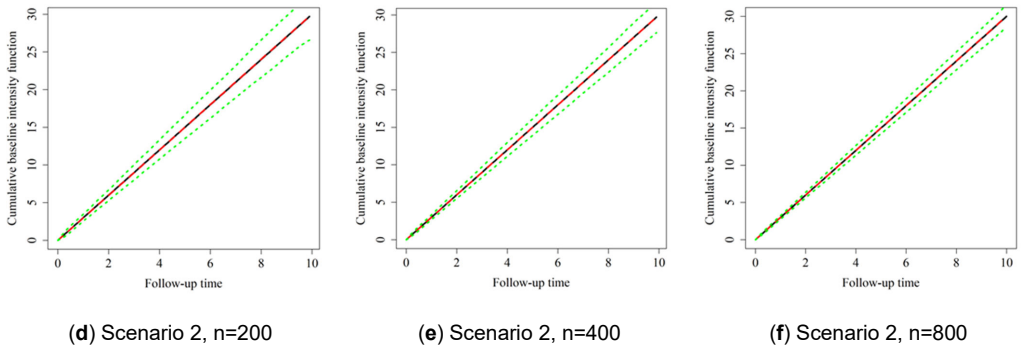
- At sample sizes around 200, the sieve maximum likelihood gives small bias and confidence intervals close to nominal for both covariate effects and baseline cumulative intensity under the model assumptions.
- When cut points are unknown, the continuous pseudo-likelihood estimates them along with the regression coefficients; baseline intensity estimation is accurate at larger sample sizes.
- The proposed estimator outperforms the two common shortcuts in the paper's comparisons: treating ordinal responses as true counts causes severe attenuation, and cumulative-link mixed models ignore the baseline intensity and give biased covariate effects.
- The estimation procedure is implemented in accompanying software, so it can be applied to other datasets of the same type.
Reading between the lines
- Beyond the paper, the same cumulative-probability link could be applied to other latent counting processes, such as negative binomial or zero-inflated models, whenever ordinal recall data are the only available outcome.
- The paper's discussion of informative follow-up times suggests a testable extension: combine the ordinal pseudo-likelihood with an augmented estimating-equation correction and check whether the robustness losses seen under misspecification shrink.
- In practice, analysts could apply a quick overdispersion screen—comparing observed category frequencies with fitted Poisson probabilities—before trusting the coverage of this estimator.
Editorial analysis
A structured set of objections, weighed in public.
Referee Report
Summary. The paper proposes a semiparametric proportional intensity model for ordinal panel count data, in which the latent recurrent event process is a nonhomogeneous Poisson process with cumulative intensity modeled by monotone I-splines. When the cut points defining the ordinal categories are known, estimation is by sieve maximum likelihood; when they are unknown, the authors introduce a continuous pseudo-likelihood based on an incomplete-gamma extension of the Poisson CDF to avoid discrete optimization. The method is evaluated in three simulation studies (including misspecification and comparisons with augmented estimating equations and cumulative link mixed models) and applied to medication non-adherence data from the STAR*D trial. An R package 'opr' is made publicly available.
Significance. If the method holds up, it addresses a real gap: ordinal panel count data arise frequently in clinical trials and surveys, yet dedicated regression methods are lacking. The paper's strengths include a clearly stated model-based derivation of the likelihood, extensive simulations (1,000 replicates, multiple sample sizes, known and unknown cut points), comparisons with two standard approaches, a real clinical application, and a publicly available R package for reproducibility. However, the significance is currently hampered by the absence of any asymptotic theory supporting the efficiency claim, a mathematical error in the stated identity for the continuous pseudo-likelihood, and an overstated robustness claim that is contradicted by the paper's own misspecification simulations.
major comments (3)
- [Section 2.2, Eq. (6)] The text states that when r is an integer, the continuous extension F̃_λ(r) ≡ F_λ(r), with F̃_λ(r) = Γ(r, λ)/Γ(r) and Γ(r, λ) = ∫_λ^∞ t^{r-1} e^{-t} dt. Under this upper incomplete gamma convention, for integer k one has Γ(k, λ)/Γ(k) = P(Poisson(λ) ≤ k−1), not P(Poisson(λ) ≤ k). Thus the pseudo-likelihood in Eq. (7) actually evaluates category probabilities using the shifted cut points r_j −1 rather than r_j. If the cut points are estimated as fully free parameters, the shift can be absorbed and the estimates of β and Λ0 may be unaffected, but the claimed equivalence in the text is false, and using the pseudo-likelihood with fixed cut points would be mis-specified. The authors should correct the identity, provide the correct relationship, and discuss whether the estimated cut points in Table 2 are systematically shifted by this artifact.
- [Section 2 and Abstract] The paper repeatedly describes the proposed sieve MLE as 'efficient' (Abstract, Section 1), but it provides no asymptotic theory: no regularity conditions, no consistency theorem, no rate of convergence, and no semiparametric efficiency bound. The sandwich covariance estimator in Eq. (4) relies on numerical derivatives of a profile log-likelihood with step h_n ~ n^{−1/2} without justification. Finite-sample simulation results cannot establish statistical efficiency. The authors should either add a theorem with verifiable conditions (or cite one that applies to this sieve setting) or explicitly temper the efficiency claim to 'good finite-sample performance' rather than efficiency.
- [Abstract and Section 3.2, Table 3] The abstract's claim that the method is 'relatively robust to model misspecification' is not supported by the paper's own Simulation 2. With a Gamma frailty of variance 0.1 (a modest departure from the Poisson assumption), coverage of 95% confidence intervals for regression coefficients falls to 68–78%; with a Box-Cox transformation of τ = 1.1, coverage falls to 61–85%. Such heterogeneity is plausible in recurrent medication non-adherence. The Discussion acknowledges the drop, but the abstract's statement is misleading. The authors should weaken the robustness claim to a quantitative statement, such as robustness only to very small frailty variance (e.g., 0.01) or minor transformations, and ideally add a simulation scenario that supports any retained robustness wording.
minor comments (5)
- [Section 4] The phrase 'Sequenced Treatment Alternatives to Relieve Depression the Sequenced Treatment Alternatives to Relieve Depression (STAR*D)' appears twice; the duplication should be removed.
- [Section 3] The choice of perturbation constant h_n = 3n^{−1/2} and convergence threshold 1×10^{−6} is stated without any rationale or sensitivity analysis; a brief justification or a small sensitivity check would improve reproducibility.
- [Section 2.1, Eq. (5)] The variance estimator for Λ̂0(t) is written as a sum of I_s(t)^2 Var(α_s), ignoring all covariances among the I-spline coefficients. Unless the sandwich covariance matrix is diagonal, the correct expression should include cross terms I_s(t) I_{s'}(t) Cov(α_s, α_{s'}). The simulations show acceptable coverage for the baseline at selected points, but the formula as stated is not generally valid, and the justification should be added.
- [Section 4] In the STAR*D application, the estimated cut points for the four-level ordinal outcome are not reported; these would be helpful for interpreting the model and for verifying that the continuous pseudo-likelihood does not produce implausible cut points.
- [Abstract] Minor grammatical issues appear throughout, e.g., 'there is lacking of standard and efficient methods' in the abstract; a careful proofread is recommended.
Circularity Check
No significant circularity: the proposed estimator is derived from a stated nonhomogeneous Poisson process model and evaluated on simulated data; no fitted quantity is reused as the estimand or as a prediction.
full rationale
The paper's derivation chain is self-contained. The likelihood in Section 2.1, Eq. (3), is constructed directly from the stated model assumptions: a nonhomogeneous Poisson process with intensity Lambda_0(t) exp(beta'X) and the ordinal observation mechanism in Eq. (2). The estimand, the regression parameter beta and baseline cumulative intensity Lambda_0, is not defined in terms of any fitted quantity; the sieve likelihood simply maximizes the implied multinomial cell probabilities P(Y_ij = k | X_i) = F_lambda(c_k) - F_lambda(c_{k-1}). The continuous pseudo-likelihood in Eq. (7) is introduced as an optimization device for unknown cut points, and the paper verifies in Simulation 1 that it recovers the true parameters and coverage probabilities. The misspecification study in Simulation 2 explicitly checks robustness and reports degraded coverage under Gamma frailty and Box-Cox transformations; this is an honest limitation, not a circular reuse of the model's assumptions. The simulations compare against AEE and CLMM as external benchmarks, and the STAR*D application is an independent real-data illustration. Self-citations to prior work by the authors, such as Liang et al. (2017), are used only to position the research gap and are not load-bearing for the proposed method's validity. There is no fitted parameter renamed as a prediction, no uniqueness theorem imported from the authors' prior work, and no ansatz smuggled in via citation. The central derivation is therefore independent of its inputs in the sense relevant to circularity.
Assumptions & free parameters
free parameters (4)
- Unknown cut points gamma =
estimated in the application after collapsing L1-MAQ to 4 levels
- I-spline coefficients alpha_i =
estimated as squared unconstrained parameters
- Spline tuning: number of knots and degree =
simulation: K_n=2, degree 3; application: K_n=3, degree 2 by BIC
- Perturbation constant h_n =
3 n^{-1/2}
assumptions (5)
- domain assumption The recurrent event process is a nonhomogeneous Poisson process with intensity lambda_i(t) = lambda_0(t) exp(beta' Z_i).
- domain assumption Visit times are conditionally independent of the event process given covariates.
- domain assumption The ordinal response is obtained by thresholding the underlying Poisson count with cut points c_1 < ... < c_{K-1}.
- standard math I-spline basis functions can approximate the baseline cumulative intensity Lambda_0 arbitrarily well with increasing knots.
- ad hoc to paper The continuous incomplete-gamma extension of the Poisson CDF equals the discrete CDF at integer arguments.
Cite this review
Pith. "Pith review of Regression Analysis of Ordinal Panel Count Data in Recurrent Medication Non-adherence." pith.science (2026). https://pith.science/paper/RAKOXRYB
@misc{pith2026250521858,
  author       = {Pith},
  title        = {Pith review of: Regression Analysis of Ordinal Panel Count Data in Recurrent Medication Non-adherence},
  year         = {2026},
  howpublished = {\url{https://pith.science/paper/RAKOXRYB}},
  note         = {Machine review of arXiv:2505.21858}
}
read the original abstract
Panel count data arise in clinical trials when patients are asked to report their occurrences of events of interest periodically but the exact event times are unknown, only the count of events between two successive examinations are observed. Ordinal panel count data goes even further as the exact event counts are not observed, the only information available is rank of event counts, for example, 'never', 'sometimes' and 'always'. Currently, there is lacking of standard and efficient methods for analyzing this type of data. In this paper, we proposed a semiparametric proportional intensity model to analyze such data. We developed a maximum sieve likelihood estimation using monotone spline under the nonhomogeneous Poisson process model assumption for statistical inference. Simulation studies show that our method performs well with finite sample sizes and is relatively robust to model misspecification. In addition, we compared the proposed method with other competitors and the proposed method outperforms in various settings. Finally, we investigated the recurrence of medication non-adherence in a clinical trial on non-psychotic major depressive disorder using the proposed method.
Figures

Reference graph
Works this paper leans on
-
[1]
Sequenced Treatment Alternatives to Relieve Depression (STAR*D): Rationale and Design
[1 ] Rush, A.J.; Fava, M.; Wisniewski, S.R.; Lavori, P.W.; Trivedi, M.H.; Sackeim, H.A.; Thase, M.E.; Nierenberg, A.A.; Quitkin, F.M.; Kashner, T.M.; et al. Sequenced Treatment Alternatives to Relieve Depression (STAR*D): Rationale and Design. Control Clin Trials 2004 , 25 , 119 – 142, doi:10.1016/s0197 - 2456(03)00112 -
-
[2]
Time - Varying Effect Models for Ordinal Responses with Applications in Substance Abuse Research
[ 2 ] Dziak, J.J.; Li, R.; Zimmerman, M.A.; Buu, A. Time - Varying Effect Models for Ordinal Responses with Applications in Substance Abuse Research. Stat Med 2014 , 33 , 5126 – 5137, doi:10.1002/sim.6303. [ 3 ] Gebski, V.; Byth, K.; Asher, R.; Marschner, I. Recurrent Time - to - Event Models with Ordinal Outcomes. Pharmaceutical Statistics 2021 , 20 , 77...
-
[3]
ed.; Chapman & Hall, CRC: Boca Raton, Fla., 2008 ; ISBN 978 - 1 - 58488 - 950 -
work page 2008
-
[4]
Inference of a Time - Varying Coefficient Regression Model for Multivariate Panel Count Data
[ 7 ] Guo, Y.; Sun, D.; Sun, J. Inference of a Time - Varying Coefficient Regression Model for Multivariate Panel Count Data. Journal of Multivariate Analysis 2022 , 192 , 105047, doi:10.1016/j.jmva.2022.105047. [ 8 ] Xu, Y.; Zeng, D.; Lin, D. - Y. Proportional Rates Models for Multivariate Panel Count Data. Biometrics 2024 , 80 , ujad011, doi:10.1093/bio...
arXiv 2022
-
[5]
Semiparametric Regression Analysis of Repeated Current Status Data
[ 18 ] Liang, B.; Tong, X.; Zeng, D.; Wang, Y. Semiparametric Regression Analysis of Repeated Current Status Data. Statistica Sinica 2017 , 27 , 1079 –
work page 2017
-
[6]
[ 14 ] Ge, L.; Hu, T.; Li, Y. Simultaneous Variable Selection and Estimation in Semiparametric Regression of Mixed Panel Count Data. Biometrics 2024 , 80 , ujad041, doi:10.1093/biomtc/ujad041. [ 15 ] Ge, L.; Liang, B.; Hu, T.; Sun, J.; Zhao, S.; Li, Y. Variable Selection for Mixed Panel Count Data under the Proportional Mean Model. Stat Methods Med Res 20...
-
[7]
[ 13 ] Zhu, L.; Choi, S.; Li, Y.; Huang, X.; Sun, J.; Robison, L.L. Statistical Analysis of Clustered Mixed Recurrent - Event Data with Application to a Cancer Survivor Study. Lifetime Data Anal 2020 , 26 , 820 – 832, doi:10.1007/s10985 - 020 - 09500 -
-
[20]
Monotone Regression Splines in Action
Ramsay, J.O. Monotone Regression Splines in Action. Statistical Science 1988 , 3 , 425 –
work page 1988
Show all 11 references
-
[381]
Semiparametric Regression of Multivariate Panel Count Data with Informative Observation Times
[ 11 ] Li, Y.; He, X.; Wang, H.; Zhang, B.; Sun, J. Semiparametric Regression of Multivariate Panel Count Data with Informative Observation Times. Journal of Multivariate Analysis 2015 , 140 , 209 – 219, doi:10.1016/j.jmva.2015.05.014. [ 12 ] Jiang, H.; Su, W.; Zhao, X. Robust...
2015 doi
-
[441]
(Roger) Practical Methods of Optimization ; Chichester; New York: Wiley, 1987 ; ISBN 978 - 0 - 471 - 49463 -
[ 2 1 ] Fletcher, R. (Roger) Practical Methods of Optimization ; Chichester; New York: Wiley, 1987 ; ISBN 978 - 0 - 471 - 49463 -
1987
-
[1100]
A Random - Effects Ordinal Regression Model for Multilevel Analysis
[ 19 ] Hedeker, D.; Gibbons, R.D. A Random - Effects Ordinal Regression Model for Multilevel Analysis. Biometrics 1994 , 50 , 933 – 944, doi:10.2307/2533433
1994 doi
Reviewed August 7, 2026 · model on record in the stance chip above.
Discussion (0). Sign in to comment.