REVIEW 2 major objections 5 minor 19 references
Examples of entire zero-mean curvature graphs of mixed-type in Lorentz-Minkowski space via Konderak's formulas
T0 review · 2 major / 5 minor · reviewed 2026-08-07 · deepseek-v4-flash
Pith's one-line read This paper constructs an explicit entire zero-mean curvature graph of mixed type, $t=\operatorname{arcsinh}(e^y\cos x)$, that is not a Kobayashi surface, answering an open question.
desk verdict A clean, narrowly scoped construction paper: it answers an open question with an explicit surface, and the only real flaw is an unproved 'no umbilics' sentence that a referee should ask them to expand. read the letter →
The pith
A machine-rendered reading of the paper's core claim, the machinery that carries it, and where it could break.
The reading
What carries the argument
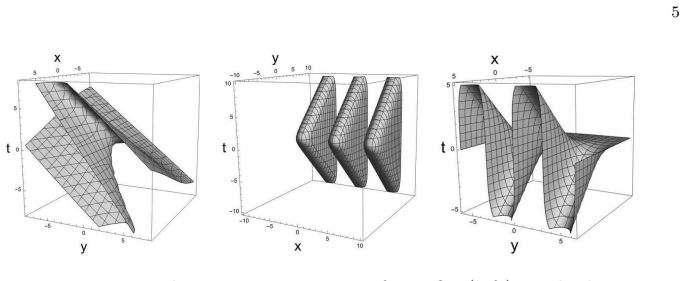
The carrying mechanism is the para-holomorphic (split-complex) Weierstrass-type representation, Konderak's four formulas. A para-holomorphic function $f(u+jv)=X+jY$ satisfies the para-Cauchy-Riemann equations $X_u=Y_v$ and $Y_u=X_v$, with $j^2=1$. Given para-holomorphic Weierstrass data $(g,\omega)$, the formulas $$F_1=\operatorname{Re}\int(-1-$g^{2}$,j(1-$g^{2}$),2g)\omega\,dz,\quad F_2=\operatorname{Im}\int\cdots$$ and $$F_3=\operatorname{Re}\int(-1-$g^{2}$,2jg,-1+$g^{2}$)\omega\,dz,\quad F_4=\operatorname{Im}\int\cdots$$ produce time-like zero-mean curvature surfaces. Feeding in the Scherk-surface data $g=-z$, $\omega=1/(z^4-1)$ and using para-holomorphic logarithms and arctangents gives $F_1+jF_2=\frac{1}{2}(\log A(z),-2j\arctan z,\log A(z^2))$ with $A(z)=(z+1)/(z-1)$; this yields the implicit surface $\sinh^2 t=e^{2y}\cos^2 x$, whose component $\sinh t=e^y\cos x$ is the graph $t=\operatorname{arcsinh}(e^y\cos x)$. For the light-like example, the Enneper data $g=z$, $\omega=1$ are substituted into the third and fourth formulas to produce $E_4$.
What would settle it
Evaluate the shape operator of $F(x,y)=(\operatorname{arcsinh}(e^y\cos x),x,y)$ at a space-like point such as $(x,y)=(0,0)$ and test whether the two principal curvatures coincide; equality at any space-like point would falsify the asserted absence of umbilics, and the proof that $F$ is not a Kobayashi surface would lose its stated support.
Extended reading notes
Core claim
The central claim is Theorem 1.1: the graph $F(x,y)=(\operatorname{arcsinh}(e^y\cos x),x,y)$ over $\mathbb{R}^2$ is an entire zero-mean curvature graph of mixed type whose space-like part is connected and whose time-like part has infinitely many connected components, and this surface is not a Kobayashi surface. The proof uses the structural constraints known for Kobayashi surfaces: a Kobayashi surface of order $n\ge 2$ has at least $2(n-2)$ umbilics on its space-like part, and one of order $2$ has at most four time-like components. Because the explicit $F$ has no umbilics, only order $n=2$ could be compatible, and the infinitude of time-like components contradicts the order-2 bound. The paper also proves Proposition 1.2: the surface $E_4=\{(t,x,y)\in\mathbb{R}^3_1: t-y=-(t+y)^3/6+x(t+y)\}$ is a mixed-type entire ZMC-graph over a light-like plane, and it is a Kobayashi surface. Together these results show that the causal character of the base plane (space-like versus light-like) does not by itself decide membership in the Kobayashi class.
Load-bearing premise
The load-bearing premise is the paper's unshown assertion that the explicit graph has no points with equal bending in all directions (no umbilic points); if such a point existed on the space-like part, the umbilic-count argument would not exclude the larger Kobayashi orders, and Theorem 1.1 would be unsupported.
Editorial extensions
If this is right
- The open problem posed in [5] — whether a mixed-type entire ZMC-graph of type S can be non-Kobayashi — is settled: the explicit graph $t=\operatorname{arcsinh}(e^y\cos x)$ is such an example.
- The class of entire mixed-type ZMC-graphs of type S is strictly larger than the class of Kobayashi surfaces; any classification must accommodate connected space-like parts with infinitely many time-like components.
- Konderak's four formulas applied to the Scherk data yield eight ZMC-surfaces $S_k$ and $S'_k$, of which $S'_1$ gives the new entire graph, showing that the representation formulas produce global implicit-form examples.
- There exists a mixed-type entire ZMC-graph of type L, $E_4$, and it is a Kobayashi surface, so the type L phenomenon is nonempty while the type S phenomenon extends beyond the known class.
- The new type S example is singly periodic, so periodic entire mixed-type ZMC-graphs of type S outside the Kobayashi class exist.
Reading between the lines
- An explicit shape-operator computation for $F$, printing the umbilic locus on the space-like set, would make the proof of Theorem 1.1 self-contained; the paper currently leaves this check as 'easily checked'.
- The same substitution strategy with other classical Weierstrass data — the paper's catenoid calculations already yield four non-congruent surfaces — suggests that a systematic catalogue of mixed-type entire ZMC-graphs from Euclidean minimal-surface data is feasible.
- The contrast between the non-Kobayashi type S example and the Kobayashi type L example suggests that membership in the Kobayashi class may depend on the causal character of the base plane; testing other type L candidates could clarify whether type L graphs are always Kobayashi.
Editorial analysis
A structured set of objections, weighed in public.
Referee Report
Summary. The paper constructs explicit entire zero-mean-curvature (ZMC) graphs in Lorentz-Minkowski 3-space using Konderak's para-complex representation formulas. The main result (Theorem 1.1) exhibits the mixed-type entire ZMC-graph F(x,y)=(arcsinh(e^y cos x), x, y) over a space-like plane and claims it is not a Kobayashi surface, thereby answering a question posed in [5]. The proof strategy is to rule out Kobayashi orders n >= 3 via the absence of space-like umbilics and then rule out order 2 by counting infinitely many time-like components against the known bound for order-2 Kobayashi surfaces. The paper also proves Proposition 1.2, showing that a known Enneper-type surface E4 is a mixed-type entire ZMC-graph of type L and a Kobayashi surface, and it derives a catalogue of Scherk-type surfaces S_k, S'_k from the four Konderak formulas.
Significance. If Theorem 1.1 is correct, it gives the first example of an entire mixed-type ZMC-graph of type S outside the Kobayashi surface class, resolving the third question of Akamine--Umehara--Yamada [5]. The construction is explicit and parameter-free, which is a genuine strength: the graph F is simple enough that all metric-type computations can be checked directly. The paper also provides a useful family of Scherk-type examples via the para-complex representation, and it clarifies the relationship between Kobayashi's and Konderak's formulas. The central idea is clear and the main computation identifying S'_1 is sound. However, the written proof of Theorem 1.1 contains two unproved assertions at load-bearing points: the claim that F has no umbilics, and the claim that the complement of the space-like region has infinitely many components. The first assertion is nontrivial and must be supplied; the second is evident but should be justified. The overall result is likely correct, but the proof needs completion.
major comments (2)
- [Section 3, Proof of Theorem 1.1] The sentence 'It can be easily checked that F has no umbilics' is stated without any computation. This assertion is load-bearing: together with [10, (3.6)] it is the only step that excludes Kobayashi surfaces of order n >= 3. Please provide the explicit computation of the shape operator for F and the resulting umbilic condition, and show that no space-like point satisfies it. Alternatively, it would suffice to prove the weaker statement that the space-like umbilic count is at most one. As printed, the proof of Theorem 1.1 is incomplete at this exact point.
- [Section 3, Proof of Theorem 1.1] The assertion that 'R^2 \ D consists of infinite number of time-like components' is used in the final contradiction with the 'at most four time-like components' bound for order-2 Kobayashi surfaces, but it is not justified. The components are not literally written down. A short verification would suffice: D contains the full vertical lines x = n pi, so the complement has one component in each strip (n pi, (n+1) pi) lying above the curve y = (1/2) log(2/(1 - cos 2x)), giving infinitely many components. Please add this or an equivalent argument.
minor comments (5)
- [Section 3, Proof of Theorem 1.1] In the formula for the metric type, '1 - f_x^2 - y_y^2' should read '1 - f_x^2 - f_y^2'.
- [Figure 2 caption] The caption says 'S2 (left) and S'2 (left)'; the second surface should presumably be on the right, matching the text.
- [Introduction] There are several typographical spacing issues, e.g. 'zero me an curvature' and 'a n entire'; a careful proofread is recommended.
- [Section 3, Remark 3.4] The remark states that if a real-analytic graph satisfies the ZMC equation on its time-like (or space-like) part, then it satisfies it everywhere. It would be helpful to spell out that this uses the identity theorem for real-analytic functions and that the equation (3.32) is polynomial in the partial derivatives, hence real-analytic wherever f is regular.
- [Section 3, Proof of Proposition 1.2] The assertion that the x-eta plane is light-like is correct but deserves a one-line explanation, since in the (x, eta, zeta) coordinates the metric takes the form dx^2 - d eta d zeta, making the plane zeta = 0 a degenerate plane.
Circularity Check
Derivation is self-contained; the one load-bearing use of prior work ([10]) is an independent theorem about Kobayashi surfaces, and the unproved "no umbilics" check is an omission, not a circular step.
full rationale
The construction of F(x,y) = arcsinh(e^y cos x) is explicit: it is produced from the Scherk Weierstrass data (3.7) under Konderak's first formula, and the identity sinh t = e^y cos x is derived by elementary para-holomorphic computations (3.8)-(3.16). No parameter is fitted, and no quantity later called a prediction is built from the same data. The only potentially load-bearing external input is the structural theory of Kobayashi surfaces from [10]: the lower bound 2(n-2) on space-like umbilics and the "at most four time-like components" bound for order 2. This is a self-citation, since Umehara is an author of both papers, but it is not circular: [10]'s assertions are parameter-free theorems about an entire class and do not include F as an assumption; they stand as independent published evidence. No uniqueness theorem or ansatz is imported from the authors' prior work to force the conclusion. The proof does contain a genuine omission: "It can be easily checked that F has no umbilics" in Section 3 is not shown. Recomputing the shape operator gives f_xx = -e^y c(1+e^{2y})/(1+e^{2y}c^2)^{3/2}, f_xy = -e^y s/(1+e^{2y}c^2)^{3/2}, f_yy = e^y c/(1+e^{2y}c^2)^{3/2}, which makes the umbilic proportionality equations inconsistent on the space-like region; the assertion is true, so the gap is an omitted verification rather than a circular derivation. The non-Kobayashi claim is therefore supported by the exhibited surface plus an externally grounded classification, and no part of the derivation reduces to its own inputs.
Assumptions & free parameters
assumptions (4)
- standard math Para-holomorphic calculus (Lemma A.1, Propositions A.2, A.3, A.7) including para-logarithm and para-arctangent.
- domain assumption Konderak's four representation formulas (2.6)-(2.9) produce time-like ZMC surfaces with the stated first fundamental forms.
- domain assumption Structural facts about Kobayashi surfaces: a Kobayashi surface of order n has at least 2(n-2) umbilics on its space-like part, and an order-2 surface has at most four time-like components.
- standard math A real analytic ZMC graph extends over the light-like locus, so surfaces defined implicitly by a real analytic equation are ZMC on both space-like and time-like parts when one part is ZMC.
Cite this review
Pith. "Pith review of Examples of entire zero-mean curvature graphs of mixed-type in Lorentz-Minkowski space via Konderak's formulas." pith.science (2026). https://pith.science/paper/UKWM6GPS
@misc{pith2026250521869,
  author       = {Pith},
  title        = {Pith review of: Examples of entire zero-mean curvature graphs of mixed-type in Lorentz-Minkowski space via Konderak's formulas},
  year         = {2026},
  howpublished = {\url{https://pith.science/paper/UKWM6GPS}},
  note         = {Machine review of arXiv:2505.21869}
}
read the original abstract
Using Konderak's representation formula, we construct an entire zero-mean curvature graph of mixed-type in Lorentz-Minkowski 3-space over a space-like plane, which does not belong to the class of "Kobayashi surfaces". We also point out the existence of an entire zero-mean curvature graph of mixed-type in Lorentz-Minkowski space over a light-like plane. These examples suggest that entire mixed-type zero-mean curvature graphs contain an unexpectedly large number of interesting examples.
Figures

Reference graph
Works this paper leans on
-
[10]
S. Fujimori, Y. Kawakami, M. Kokubu, W. Rossman, M. Umeh ara and K. Yamada, Entire zero-mean curvature graphs of mixed type in Lorentz-Minkowski 3-space, Quart. J. Math., 67 (2016), 801–837
work page 2016
-
[5]
S. Akamine, M. Umehara and K. Yamada, Improvement of the Bernstein-type theo- rem for space-like zero mean curvature graphs in Lorentz-Mi nkowski space using fluid mechanical duality, Proc. Amer. Math. Soc. Ser. B, 7 (2020), 17–27
work page 2020
-
[1]
S. Akamine and R. Lopez, The number of catenoids connecting two coaxial circles in Lorentz-Minkowski space J. Geom. and Phys. 121, (2017), 386-395
work page 2017
-
[2]
S. Akamine and R. K. Singh, Wick rotations of solutions to the minimal surface equation, the zero mean curvature equation and the Born-Inf eld equation Proc. Indian Acad. Sci. (Math.Sci.) (2019) 129:35
work page 2019
-
[3]
S. Akamine, A. Honda, M. Umehara and K. Yamada, Bernstein-type theorem for zero mean curvature hypersurfaces without time-like points in L orentz-Minkowski space, Bull. Braz. Math. Soc. (N.S.) 52 (2021), 175–181
work page 2021
-
[4]
S. Akamine, M. Umehara and K. Yamada, Space-like maximal surfaces containing entire null lines in Lorentz-Minkowski 3-space , Proc. Japan Acad., 95, Ser. A (2019) 97–102
work page 2019
-
[6]
Calabi, Examples of Bernstein problems for some nonlinear equation s, Proc
E. Calabi, Examples of Bernstein problems for some nonlinear equation s, Proc. Symp. Pure Math. 15 (1970), 223–230
work page 1970
-
[7]
S.Y. Cheng and S.T. Yau, Maximal space-like hypersurfaces in the Lorentz Minkowski spaces. Ann. Math. 104, 407–419 (1976)
work page 1976
Show all 19 references
-
[8]
Fujimori, K
S. Fujimori, K. Kim, S.-E.Koh, W. Rossman, H. Shin, H. Tak ahashi, M. Umehara, K. Yamada and S.-D. Yang, Zero mean curvature surfaces in L3 containing a light-like line, C.R. Acad. Sci. Paris, Ser. I, 350 (2012), 975–978. 20
2012
-
[9]
Fujimori, K
S. Fujimori, K. Kim, S.-E.Koh, W. Rossman, H.Shin, M. Ume hara, K. Yamada and S.-D. Yang, Zero mean curvature surfaces in Lorentz-Minkowski 3-space a nd 2-dimensional fluid mechanics , Math. J. Okayama Univ., 57 (2015), 173–200
2015
-
[11]
W. Goemans, Surfaces in three-dimensional Euclidean and Minkowski spa ce, in par- ticular a study of Weingarten surfaces , Arenberg Doctoral School of Science, Engi- neering and Technology Faculty of Science Department of Mat hematics, (2010), Ph. D. thesis
2010
-
[12]
Kaya and R
S. Kaya and R. Lopez, Classification of zero mean curvature surfaces of separable type in Lorentz-Minkowski space , Tohoku Math. J., 74 (2022), 263–286
2022
-
[13]
Kim and Y
D. Kim and Y. Ogata, Separable zero mean curvature surfaces in Minkowski 3-spac e preprint
-
[14]
Kim, S.-E.Koh, H.Shin and S.-D
K. Kim, S.-E.Koh, H.Shin and S.-D. Yang, Space-like maximal surfaces, time-like minimal surfaces, and Bjorling representation formulae , J. Korean Math. Soc. 48 (2011), 1083–1100
2011
-
[15]
Y. W. Kim, H. Y. Lee and S.-D. Yang, Minimal harmonic graphs and their Lorentzian cousins, J. Math. Anal. Appl. 353 (2009) 666–670
2009
-
[16]
Kobayashi, Maximal surfaces in the 3-dimensional Minkowski space L3, Tokyo J
O. Kobayashi, Maximal surfaces in the 3-dimensional Minkowski space L3, Tokyo J. Math. 6 (1983), 297–309
1983
-
[17]
J. J. Konderak, A Weierstrass representation theorem for Lorentz surface , Complex Variables. 50 (2005), 319–332
2005
-
[18]
M. A. Magid, The Bernstein problem for timelike surfaces , Yokohama Math. J., 37 (1989), 125–137
1989
-
[19]
Di Terlizzi, J
L. Di Terlizzi, J. J. Konderak and I. Lacirasella, On diff erentiable functions over Lorentz numbers and their geometric applications, Differ. G eom. Dyn. Syst. 16 (2014), 113–139. (Komatsu) Department of Mathematical and Computing Sciences, Instit ute of Science Tokyo, 2-12-1-W...
2014
Reviewed August 7, 2026 · model on record in the stance chip above.
Discussion (0). Sign in to comment.