REVIEW 4 major objections 4 minor 120 references
Broadening Our View: Assistive Technology for Cerebral Visual Impairment
T0 review · 4 major / 4 minor · reviewed 2026-08-07 · deepseek-v4-flash
Pith's one-line read This paper claims that vision-based assistive technology has almost completely overlooked cerebral visual impairment, a brain-based condition that is a leading cause of childhood visual impairment, and that the intersection contains only…
desk verdict The CVI gap is real but the exact numbers are fragile; a useful scoping review that needs abstract and search revisions. read the letter →
The pith
A machine-rendered reading of the paper's core claim, the machinery that carries it, and where it could break.
The reading
What carries the argument
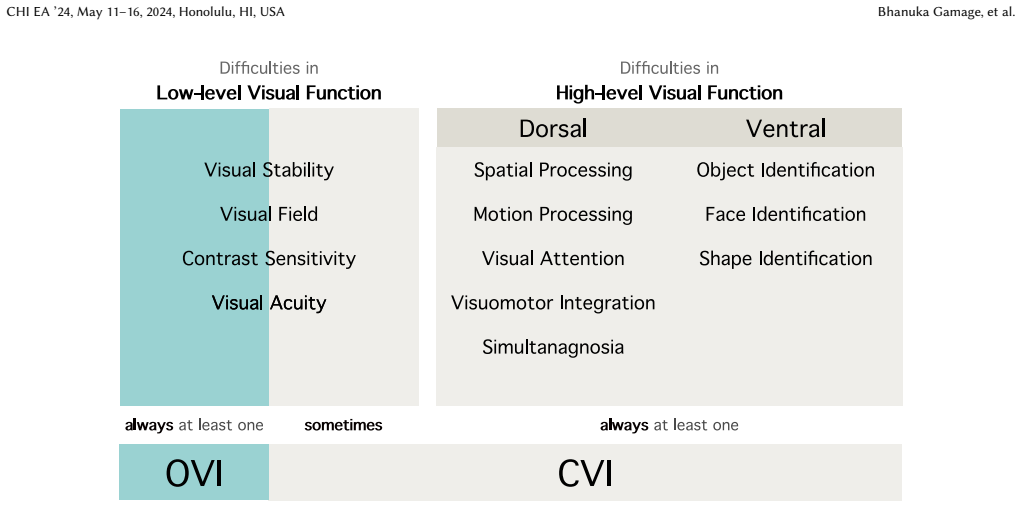
The machinery that carries the claim is a scoping review protocol: the authors combined CVI-related terms with a fixed set of vision-based assistive technology terms (computer vision, artificial intelligence, machine learning, image enhancement, augmented reality, virtual reality, mixed reality) using OR within each column and AND across columns, and searched Google Scholar, Scopus, Web of Science, and PubMed up to January 2, 2024. After title/abstract and full-text screening, the 14 included papers were classified by study type into diagnosis, understanding, simulation, assistance, and rehabilitation; the count of papers in the 'assistance' category is what directly yields the headline result of three. The supporting conceptual lens is the distinction between low-level functional vision (acuity, contrast, visual field) and high-level functional vision (recognition, comprehension, visual attention), grounded in the dorsal and ventral stream model, which explains why ocular low-vision assistance does not automatically meet CVI needs.
What would settle it
Run the same search with the exclusions relaxed (include theses and non-English papers) and with additional CVI-specific keywords such as 'visual crowding', 'simultagnosia', 'visual clutter reduction', 'environmental modification', and 'visual support', then count how many resulting papers describe assistive devices for people with CVI; if that count is substantially larger than three, the wide-gap claim would need revision.
Extended reading notes
Core claim
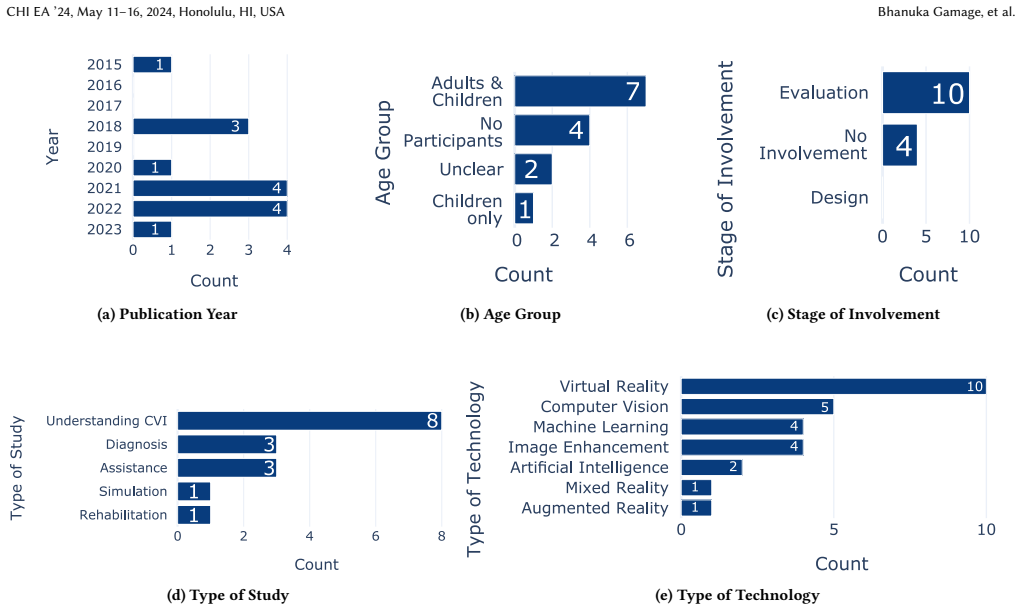
On the paper's own terms, the central discovery is a quantitative gap: the intersection of CVI with vision-based assistive technologies (VBAT) contains only 14 published papers, and only three of those describe assistive technologies. Only one of those three directly addresses CVI requirements, proposing high-contrast, low-spatial-frequency visual stimuli and real-time modification through augmented/virtual reality headsets to raise visual awareness, but the proposal was not implemented. The other two assistance papers were designed for broader populations; one included CVI participants but reported no CVI-specific findings. The paper also finds that none of the 14 studies involved people with CVI in design or requirement gathering, and that all eight papers concerned with understanding CVI came from one research group. This is presented as a call to action: the human-computer interaction and assistive technology communities should enter this domain.
Load-bearing premise
The conclusion that only three assistive-technology papers exist for CVI depends on the completeness of the literature search: if relevant studies are published under different terms, such as screen filters, environmental modifications, or non-vision aids, or in venues outside the four databases and language/type filters, the gap could be narrower than claimed.
Editorial extensions
If this is right
- Designers of assistive technology should treat CVI as a distinct user population from ocular low vision and not assume existing low-vision devices can be reused without adaptation.
- Building and evaluating a real-time visual-simplification system, such as an AR/VR headset that reduces visual clutter in crowded scenes, is a concrete next step because the only CVI-specific proposal in the literature was not implemented.
- Co-design with people with CVI is an open, low-competition area: none of the 14 reviewed studies involved CVI participants in design or requirement gathering.
- Because CVI is brain-based, assistive interventions could exploit neuroplasticity, but the paper cautions that long-term effects must be studied, so new devices should be evaluated over extended periods.
- The gap is likely to become more acute as the CVI population grows, since CVI is already the predominant cause of childhood vision impairment in developed nations and many adults live with undiagnosed CVI.
Reading between the lines
- If this review is accurate, the same technical building blocks used for ocular low-vision aids, such as saliency modulation, visual noise cancellation, and augmentation for attention guidance, could be redirected toward CVI-specific goals like real-time reduction of visual clutter, with the key difference that the target is the brain's interpretation rather than the eye's image.
- The finding that all eight 'understanding CVI' papers came from one group means the field's knowledge base is unusually concentrated; if that group's work stopped, progress on characterizing CVI for assistive-technology purposes would stall.
- A concrete test of the high-level functional vision hypothesis would be a controlled comparison in a crowded search task between an AR headset that fades background objects and a standard smartphone magnification tool, with CVI participants; the hypothesis predicts benefit only for the clutter-reducing condition.
- Because the review excluded non-English papers and theses, a multilingual or grey-literature search might uncover additional CVI-specific assistive aids such as apps or environmental modifications and would either confirm or refine the reported gap.
Editorial analysis
A structured set of objections, weighed in public.
Referee Report
Summary. This paper is a scoping review of research at the intersection of Cerebral Visual Impairment (CVI) and Vision-Based Assistive Technologies (VBAT). The authors define VBAT as devices incorporating machine learning, computer vision, image enhancement, or augmented/virtual reality. After searching four databases with a two-column keyword strategy, they identified 14 papers, of which they classify three as assistance-focused. The paper introduces CVI as a brain-based visual impairment distinct from ocular impairment, argues that mainstream assistive technology research has largely overlooked CVI, and proposes opportunities for HCI and assistive technology researchers. The central claim is that there is a wide research gap: very few assistive technologies have been designed specifically for people with CVI.
Significance. If the gap claim is accurate, the paper provides a useful service to the HCI and assistive-technology communities by defining an underserved demographic, distinguishing CVI from ocular visual impairment in ways that matter for design (e.g., complexity impact, neuroplasticity, multimodal overload), and cataloguing the small existing corpus. Strengths include a transparent and reproducible search protocol, a clearly presented data-extraction scheme, a full table of the 14 included papers, and an explicitly cautious interpretation of the small corpus. The paper also recognizes relevant prior work in OVI assistive technology and clearly separates diagnosis, understanding, simulation, rehabilitation, and assistance categories. However, the quantitative headline ('only three VBAT papers, with just one directly addressing CVI requirements') is currently stated more strongly in the abstract than in the body, and the completeness of the search—which the negative claim depends on—is not yet convincingly justified.
major comments (4)
- [Abstract vs. Section 4.2] The abstract states that 'only three papers described assistive technologies focused on people living with CVI,' but Section 4.2 says 'We found only three VBAT papers, with just one directly addressing CVI requirements' and goes on to explain that the other two were not specifically focused on CVI (Pitt and McCarthy's highlighting strategies were suggested as potentially applicable to CVI only in future directions; Lorenzini et al. included CVI participants but reported no CVI-specific findings). This is a direct overstatement of the body's own more careful conclusion. The abstract should be revised to say that only one paper directly addressed CVI needs, or the body should be the source of the stated claim.
- [Table 2a and Section 4.1 (search completeness)] The central negative claim—that only three VBAT papers exist at the CVI intersection—rests entirely on the completeness of the search. The keyword set in Table 2a is narrower than the definitions the paper itself uses. The technology column omits terms that are common in current VBAT literature, such as 'object recognition,' 'deep learning,' 'image processing,' 'contrast enhancement,' 'saliency,' 'vision augmentation,' 'head-mounted display,' and 'smart glasses.' Because the search uses AND across the two columns, a paper that describes, for example, a head-mounted aid for simplifying scenes for children with CVI but does not literally use the phrases 'computer vision' or 'augmented reality' would be excluded even if it is clearly inside the authors' own VBAT definition. Similarly, the CVI column omits synonyms acknowledged in Section 2, such as 'cerebral visual dysfunction,' 'perceptual visual impairment,' and the abbreviation 'CVI' itself. The authors should either expand the query, report a sensitivity analysis demonstrating that the additional terms do not retrieve substantially more relevant papers, or clearly bound the claim to the exact keyword set used and avoid the unqualified 'wide research gap' framing.
- [Section 4.1 (screening process)] The title and abstract screening was conducted by one researcher (with consultation), and only full-text review involved two researchers. In a scoping review whose primary output is a negative count (only three assistance papers), single-screener title/abstract screening is a material risk. Papers whose abstracts use non-obvious terminology for VBAT techniques (e.g., 'visual simplification,' 'scene reduction,' 'perceptual enhancement') could be missed at this stage. At minimum, this limitation should be explicitly acknowledged in Section 5; better, a second screener should be added or a sample should be dual-screened and reported.
- [Table 2b, Section 4.1 (exclusion criteria)] The exclusion of theses, non-English papers, and review papers, combined with the decision not to chase citations, is likely to remove exactly the venues where early assistive-technology prototypes and clinical reports often appear: doctoral theses, conference papers in other languages, and references cited within the 14 retrieved papers. This is a legitimate scoping decision, but it further undermines the quantitative strength of the 'only three papers' claim. The authors should either discuss these exclusions as a reason to treat the count as a lower bound rather than as evidence of a wide gap, or they should include theses and citation chasing in a sensitivity check.
minor comments (4)
- [Table 3 and reference list] The year for Pitt and McCarthy is listed as 2021 in Table 3 but as 2023 in the reference list ([72]). This discrepancy should be corrected.
- [Section 1 and title] The title contains an apparent typographical artifact: 'Cerebral Vis ual Impairment.' The final published version should use the correct spacing.
- [Figure 2c] The labels in Figure 2c (Stage of Involvement) are not defined in the caption; the reader must infer that 'Design' and 'Evaluation' refer to whether CVI participants were involved at those stages. A one-sentence caption explanation would improve clarity.
- [Section 4.2, Age Group paragraph] The sentence 'The focus on the pediatric and young adult population is understandable given the higher CVI prevalence in children' is slightly redundant with the age data just presented; consider restructuring to make the implications for future work the main point.
Circularity Check
No circularity: the review's gap claim is a transparent enumeration of its stated search protocol.
full rationale
This paper is a scoping review, not a derivation. The central claim—that only three VBAT papers exist at the intersection of CVI and VBAT, with only one directly addressing CVI requirements—is a direct summarization of the screening and classification process described in Section 4.1 and Table 3. The search protocol explicitly defines the keyword sets and inclusion/exclusion criteria, and the 'wide research gap' conclusion is a restatement of the enumerated 14 papers rather than an output forced by construction. No equations, fitted parameters, or statistical predictions appear anywhere in the paper, so no step reduces to its own inputs. The only self-citation, reference [27] (Gamage et al., ASSETS 2023), appears in Section 3 as an example of recent AI-driven assistive technology research for OVI; it is peripheral and does not support the gap analysis. A reader could question whether the keyword set in Table 2a fully operationalizes the paper's own VBAT definition, but that is a search-completeness and validity concern, not a circularity concern. The finding is self-contained against the stated methodology, so the appropriate circularity score is 0.
Assumptions & free parameters
assumptions (4)
- domain assumption CVI is a distinct visual impairment caused by damage to the brain's visual processing centres rather than the eye.
- domain assumption The two-stream (dorsal/ventral) model of visual processing adequately frames CVI visual difficulties.
- domain assumption The chosen search keywords and databases capture the relevant literature on CVI and vision-based assistive technologies.
- domain assumption Prevalence figures for CVI in children are accurate as cited.
Cite this review
Pith. "Pith review of Broadening Our View: Assistive Technology for Cerebral Visual Impairment." pith.science (2026). https://pith.science/paper/K73KOE5M
@misc{pith2026250521875,
  author       = {Pith},
  title        = {Pith review of: Broadening Our View: Assistive Technology for Cerebral Visual Impairment},
  year         = {2026},
  howpublished = {\url{https://pith.science/paper/K73KOE5M}},
  note         = {Machine review of arXiv:2505.21875}
}
read the original abstract
Over the past decade, considerable research has been directed towards assistive technologies to support people with vision impairments using machine learning, computer vision, image enhancement, and/or augmented/virtual reality. However, this has almost totally overlooked a growing demographic: people with Cerebral Visual Impairment (CVI). Unlike Ocular Vision Impairments (OVI), CVI arises from damage to the brain's visual processing centres. This paper introduces CVI and reveals a wide research gap in addressing the needs of this demographic. Through a scoping review, we identified 14 papers at the intersection of these technologies and CVI. Of these, only three papers described assistive technologies focused on people living with CVI, with the others focusing on diagnosis, understanding, simulation or rehabilitation. Our findings highlight the opportunity for the Human-Computer Interaction and Assistive Technologies research community to explore and address this underrepresented domain, thereby enhancing the quality of life for people with CVI.
Figures
Reference graph
Works this paper leans on
-
[1]
Meta Connect 2022: Meta Quest Pro, More Social VR and a Look Into the Future
2022. Meta Connect 2022: Meta Quest Pro, More Social VR and a Look Into the Future. https://about.fb.com/news/2022/10/meta-quest-pro-so cial-vr-connect-2022/
2022
-
[2]
Introducing Apple Vision Pro: Apple’s first spatia l computer
2023. Introducing Apple Vision Pro: Apple’s first spatia l computer. https://www.apple.com/au/newsroom/2023/06/introducing-apple-vision-pro/
2023
-
[3]
Meet Meta Quest 3, Our Mixed Reality Headset
2023. Meet Meta Quest 3, Our Mixed Reality Headset. https://about.fb.com/news/2023/09/meet-meta-quest-3 -mixed-reality-headset/
2023
-
[4]
Ali Abdolrahmani, Maya Howes Gupta, Mei-Lian Vader, Rav i Kuber, and Stacy Branham. 2021. Towards More Transactional Voice Assistant s: Investigating the Potential for a Multimodal Voice-Activated Indoor Navi gation Assistant for Blind and Sighted Travelers. In Proceedings of the 2021 CHI Conference on Human Factors in Computing Systems . 1–16
2021
-
[5]
Yahya Qasim I Al-Fadhili, Paul WH Chung, Baihua Li, and Ri chard Bowman
-
[6]
Susann Andersson, Eva-Karin Persson, Eva Aring, Barbro Lindquist, Gordon N Dutton, and Ann Hellström. 2006. Vision in children with hyd rocephalus. De- velopmental medicine and child neurology 48, 10 (2006), 836–841
2006
-
[7]
Adwitiya Arora, Atul Grover, Raksha Chugh, and S Sofana R eka. 2019. Real time multi object detection for blind using single shot multibox detector. Wireless Personal Communications 107 (2019), 651–661
2019
-
[8]
Melissa Bambery, Camille S Corre, Daniel Kelly, Amanda N agy, Catherine Becker, Claire Manley, Christopher Bennett, Lotfi B Merabet, and Florian Eichler
Show all 120 references
-
[9]
Fereshteh S Bashiri, Eric LaRose, Jonathan C Badger, Ros han M D’Souza, Zeyun Yu, and Peggy Peissig. 2018. Object detection to assist visu ally impaired peo- ple: A deep neural network adventure. In Advances in Visual Computing: 13th International Symposium, ISVC 2018, Las Veg...
2018
-
[10]
Christopher Bennett, Corinna Bauer, Peter Bex, Davide Bottari, and LOTFI MER- ABET. 2020. Alpha Oscillatory Activity Associated with Imp aired Visual Search in Cerebral Visual Impairment. (2020)
2020
-
[11]
Christopher R Bennett, Emma S Bailin, Timothy K Gottlie b, Corinna M Bauer, Peter J Bex, and Lotfi B Merabet. 2018. Assessing visual searc h performance in ocular compared to cerebral visual impairment using a vir tual reality simula- tion of human dynamic movement. In Proceedi...
2018
-
[12]
Christopher R Bennett, Emma S Bailin, Timothy K Gottlie b, Corinna M Bauer, Peter J Bex, and Lotfi B Merabet. 2018. Virtual reality based a ssessment of static object visual search in ocular compared to cerebral visual i mpairment. In Uni- versal Access in Human-Computer Intera...
2018
-
[13]
Christopher R Bennett, Corinna M Bauer, Emma S Bailin, a nd Lotfi B Merabet
-
[14]
Christopher R Bennett, Corinna M Bauer, Peter J Bex, Dav ide Bottari, and Lotfi B Merabet. 2021. Visual search performance in cerebral visua l impairment is asso- ciated with altered alpha band oscillations. Neuropsychologia 161 (2021), 108011
2021
-
[15]
Christopher R Bennett, Peter J Bex, Corinna M Bauer, and Lotfi B Merabet. 2019. The assessment of visual function and functional vision. In Seminars in pediatric neurology, Vol. 31. Elsevier, 30–40
2019
-
[16]
Jay S Bhatia, Nimit K Vasavat, Manali U Maniyar, Neha N Do shi, and Ruhina Karani. 2022. Audio-Based Staircase Navigation System for Visually Impaired. In Machine Learning and Autonomous Systems: Proceedings of ICM LAS 2021 . Springer, 411–424
2022
-
[17]
Faith A Birnbaum, Steven A Hackley, and Lenworth N Johns on. 2015. Enhanc- ing visual performance in individuals with cortical visual impairment (homony- mous hemianopsia): Tapping into blindsight. Journal of Medical Hypotheses and Ideas 9, 2 (2015), S8–S13
2015
-
[18]
Daniëlle GM Bosch, F Nienke Boonstra, Michèl AAP Willem sen, Frans PM Cre- mers, and Bert de Vries. 2014. Low vision due to cerebral visu al impairment: differentiating between acquired and genetic causes. BMC ophthalmology 14, 1 (2014), 1–9
2014
-
[19]
Diego Renan Bruno, Marcelo Henrique de Assis, and Ferna ndo Santos Osório
-
[20]
Arvind Chandna, Saeideh Ghahghaei, Susan Foster, and R am Kumar. 2021. Higher visual function deficits in children with cerebral vi sual impairment and good visual acuity. Frontiers in Human Neuroscience 15 (2021), 711873
2021
-
[21]
Ching-Han Chen and Ming-Fang Shiu. 2020. Smart guiding glasses with descrip- tive video service and spoken dialogue system for visually impaired. In 2020 IEEE International Conference on Consumer Electronics-Taiwan (ICCE-Taiwan). IEEE, 1–2
2020
-
[22]
GN Dutton. 2003. Cognitive vision, its disorders and di fferential diagnosis in adults and children: knowing where and what things are. Eye 17, 3 (2003), 289– 304
2003
-
[23]
Gordon N Dutton. 2011. Structured history taking to cha racterize visual dysfunc- tion and plan optimal habilitation for children with cerebr al visual impairment. Developmental Medicine & Child Neurology 53, 5 (2011), 390–390
2011
-
[24]
Gordon N Dutton, A Saaed, Badsha Fahad, Richie Fraser, G izelda McDaid, Jenny McDade, Anna Mackintosh, Talal Rane, and Katherine Spowart . 2004. Associa- tion of binocular lower visual field impairment, impaired si multaneous percep- tion, disordered visually guided motion and ...
2004
-
[25]
Alessandra Federici, Christopher R Bennett, Corinna M Bauer, Claire E Manley, Emiliano Ricciardi, Davide Bottari, and Lotfi B Merabet. 202 2. Altered Neural Oscillations Underlying Visuospatial Processing in Cereb ral Visual Impairment (CVI). medRxiv (2022), 2022–10
2022
-
[26]
Gordon N Dutton MD FRCOPHTH. 2009. ’Dorsal stream dysfu nction’and’dorsal stream dysfunction plus’: a potential classification for pe rceptual visual impair- ment in the context of cerebral visual impairment? Developmental medicine and child neurology 51, 3 (2009), 170
2009
-
[27]
Bhanuka Gamage, Thanh-Toan Do, Nicholas Seow Chiang Pr ice, Arthur Lowery, and Kim Marriott. 2023. What do Blind and Low-Vision People Really Want from Assistive Smart Devices? Comparison of the Literature with a Focus Study. In Proceedings of the 25th International ACM SIGACC...
2023
-
[28]
William V Good, James E Jan, Susan K Burden, Ann Skoczens ki, and Rowan Candy. 2001. Recent advances in cortical visual impairment . Developmental medicine and child neurology 43, 1 (2001), 56–60
2001
-
[29]
William V Good, James E Jan, Luis DeSa, A James Barkovich , Myryka Groenveld, et al. 1994. Cortical visual impairment in children. Survey of ophthalmology 38, 4 (1994), 351–364
1994
-
[30]
Melvyn A Goodale. 2013. Separate visual systems for per ception and action: a framework for understanding cortical visual impairment. Developmental Medicine & Child Neurology 55 (2013), 9–12
2013
-
[31]
Renan Guarese, Franklin Bastidas, João Becker, Marian e Giambastiani, Yhonatan Iquiapaza, Lennon Macedo, Luciana Nedel, Anderson Maciel, Fabio Zambetta, and Ron van Schyndel. 2021. Cooking in the Dark: Exploring Sp atial Audio as MR Assistive Technology for the Visually Impair...
2021
-
[32]
Deborah D Hatton, Eric Schwietz, Burt Boyer, and Paul Ry chwalski. 2007. Ba- bies Count: the national registry for children with visual i mpairments, birth to 3 years. Journal of American Association for Pediatric Ophthalmolog y and Stra- bismus 11, 4 (2007), 351–355
2007
-
[33]
James V Haxby, Cheryl L Grady, Barry Horwitz, Leslie G Un gerleider, Mortimer Mishkin, Richard E Carson, Peter Herscovitch, Mark B Schapi ro, and Stanley I Rapoport. 1991. Dissociation of object and spatial visual p rocessing pathways in human extrastriate cortex. Proceedings ...
1991
-
[34]
Bin Hong, Zhangxi Lin, Xin Chen, Jing Hou, Shunya Lv, and Zhendong Gao
-
[35]
Junlei Hong, Tobias Langlotz, Jonathan Sutton, and Hol ger Regenbrecht. 2023. Visual Noise Cancellation: Exploring Visual Discomfort an d Opportunities for Vision Augmentations. ACM Trans. Comput.-Hum. Interact. (dec 2023). https://doi.org/10.1145/3634699 Just Accepted
2023 doi
-
[36]
Mary Jane Houliston, Abdel H Taguri, Gordon N Dutton, Co nstantinos Haji- vassiliou, and Daniel G Young. 1999. Evidence of cognitive v isual problems in children with hydrocephalus: a structured clinical histor y-taking strategy. De- velopmental medicine and child neurology 41...
1999
-
[37]
Lea Hyvärinen. 1995. Considerations in evaluation and treatment of the child with low vision. The American Journal of Occupational Therapy 49, 9 (1995), 891–897
1995
-
[38]
MT Islam, MA Rashid, M Ahmad, A Kuwana, and H Kobayashi. 2 020. Design and Implementation of Smart Guided Glass for Visually Impai red People. Inter- national Journal of Electrical and Computer Engineering (I JECE) 9, 4 (2020)
2020
-
[39]
Robotics and Autonomous Systems (2022), 104104
Development and application of key technologies for G uide Dog Robot: A systematic literature review. Robotics and Autonomous Systems (2022), 104104
2022
-
[40]
Oliver Beren Kaul, Kersten Behrens, and Michael Rohs. 2021. Mobile Recognition and Tracking of Objects in the Environment through Augmented Reality and 3D Audio Cues for People with Visual Impairments. InExtended Abstracts of the 2021 CHI Conference on Human Factors in Computi...
2021
-
[41]
Akif Khan and Shah Khusro. 2021. An insight into smartph one-based assistive solutions for visually impaired and blind people: issues, c hallenges and oppor- tunities. Universal Access in the Information Society 20 (2021), 265–298
2021
-
[42]
N Kozeis. 2010. Brain visual impairment in childhood: m ini review. Hippokratia 14, 4 (2010), 249
2010
-
[43]
Barry S Kran, Linda Lawrence, D Luisa Mayer, and Gena Hei dary. 2019. Cere- bral/cortical visual impairment: a need to reassess curren t definitions of visual impairment and blindness. In Seminars in pediatric neurology , Vol. 31. Elsevier, 25–29
2019
-
[44]
Rakesh Chandra Joshi, Saumya Yadav, and Malay Kishore D utta. 2020. YOLO-v3 based currency detection and recognition system for visual ly impaired persons. In 2020 International Conference on Contemporary Computing a nd Applications (IC3A). IEEE, 280–285
2020
-
[45]
Fook Chang Lam, Fiona Lovett, and Gordon N Dutton. 2010. Cerebral visual impairment in children: a longitudinal case study of functional outcomes beyond the visual acuities. Journal of Visual Impairment & Blindness 104, 10 (2010), 625– 635
2010
-
[46]
Florian Lang, Albrecht Schmidt, and Tonja Machulla. 20 20. Augmented real- ity for people with low vision: symbolic and alphanumeric re presentation of information. In Computers Helping People with Special Needs: 17th Internati onal Conference, ICCHP 2020, Lecco, Italy, Septem...
2020
-
[47]
Tobias Langlotz, Jonathan Sutton, Stefanie Zollmann, Yuta Itoh, and Holger Re- genbrecht. 2018. ChromaGlasses: Computational Glasses fo r Compensating Colour Blindness. In Proceedings of the 2018 CHI Conference on Human Factors in Computing Systems (CHI ’18) . Association for ...
2018
-
[48]
Chan-Su Lee, Jae-Ik Lee, and Han Eol Seo. 2021. Deep Lear ning Based Mobile Assistive Device for Visually Impaired People. In 2021 IEEE International Confer- ence on Consumer Electronics-Asia (ICCE-Asia) . IEEE, 1–3
2021
-
[49]
Bineeth Kuriakose, Raju Shrestha, and Frode Eika Sandn es. 2020. Multimodal Navigation Systems for Users with Visual Impairments—A Review and Analysis. Multimodal Technologies and Interaction 4, 4 (2020), 73
2020
-
[50]
Yifan Li, Kangsoo Kim, Austin Erickson, Nahal Norouzi, Jonathan Jules, Gerd Bruder, and Gregory F Welch. 2022. A Scoping Review of Assist ance and Ther- apy with Head-Mounted Displays for People Who Are Visually I mpaired. ACM Transactions on Accessible Computing (TACCESS) (2022)
2022
-
[51]
Jyun-You Lin, Chi-Lin Chiang, Meng-Jin Wu, Chih-Chiun g Yao, and Ming-Chiao Chen. 2020. Smart Glasses Application System for Visually I mpaired People Based on Deep Learning. In 2020 Indo–Taiwan 2nd International Conference on Computing, Analytics and Networks (Indo-Taiwan ICA...
2020
-
[52]
Marie-Céline Lorenzini and Walter Wittich. 2021. Pers onalized telerehabilita- tion for a head-mounted low vision aid: a randomized feasibi lity study. Optom- etry and Vision Science 98, 6 (2021), 570
2021
-
[53]
Amanda Hall Lueck and Gordon Dutton. 2015. Vision and the brain: Understand- ing cerebral visual impairment in children . Vol. 2. AFB Press, American Founda- tion for the Blind Arlington, V A. CHI EA ’24, May 11–16, 2024, Honolulu, HI, USA Bhanuka Gamage, et al
2015
-
[54]
Manja Lehmann, Josephine Barnes, Gerard R Ridgway, Joh n Wattam-Bell, Eliz- abeth K Warrington, Nick C Fox, and Sebastian J Crutch. 2011. Basic visual function and cortical thickness patterns in posterior cort ical atrophy. Cerebral cortex 21, 9 (2011), 2122–2132
2011
-
[55]
Claire E Manley, Christopher R Bennett, and Lotfi B Merab et. 2022. Assessing Higher-Order Visual Processing in Cerebral Visual Impairm ent Using Naturalis- tic Virtual-Reality-Based Visual Search Tasks. Children 9, 8 (2022), 1114
2022
-
[56]
Maria BC Martín, Alejandro Santos-Lozano, Juan Martín -Hernández, Alberto López-Miguel, Miguel Maldonado, Carlos Baladrón, Corinna M Bauer, and Lotfi B Merabet. 2016. Cerebral versus ocular visual impairm ent: the impact on developmental neuroplasticity. Frontiers in psychology...
2016
-
[57]
Sina Masnadi, Brian Williamson, Andrés N Vargas Gonzál ez, and Joseph J LaVi- ola. 2020. Vriassist: An eye-tracked virtual reality low vi sion assistance tool. In 2020 IEEE Conference on Virtual Reality and 3D User Interfac es Abstracts and Workshops (VRW). IEEE, 808–809
2020
-
[58]
Carey A Matsuba and James E Jan. 2006. Long-term outcome of children with cortical visual impairment. Developmental medicine and child neurology 48, 6 (2006), 508–512
2006
-
[59]
Catriona Macintyre-Béon, Hussein Ibrahim, Isobel Hay , Debbie Cockburn, Julie Calvert, Gordon N Dutton, and Richard Bowman. 2010. Dorsal s tream dysfunc- tion in children. A review and an approach to diagnosis and ma nagement. Cur- rent Pediatric Reviews 6, 3 (2010), 166–182
2010
-
[60]
Nicola McDowell. 2022. Using digital technology to hel p identify children with brain based visual issues. Pacific Journal of Technology Enhanced Learning 4, 1 (2022), 36–37
2022
-
[61]
Nicola McDowell and Philippa Butler. 2023. Validation of the Austin Assessment: A screening tool for cerebral visual impairment related vis ual issues. Plos one 18, 11 (2023), e0293904
2023
-
[62]
Tram Thi Minh Tran, Shane Brown, Oliver Weidlich, Mark B illinghurst, and Callum Parker. 2023. Wearable Augmented Reality: Resea rch Trends and Future Directions from Three Major Venues. IEEE Transac- tions on Visualization and Computer Graphics 29, 11 (2023), 4782–4793. https...
2023
-
[63]
Mortimer Mishkin, Leslie G Ungerleider, and Kathleen A Macko. 1983. Object vision and spatial vision: two cortical pathways. Trends in neurosciences 6 (1983), 414–417
1983
-
[64]
Nicola McDowell. 2020. The CVI practice framework: an effective approach to supporting children with cerebral visual impairment (CVI) : a thesis presented in partial fulfilment of the requirements for the degree of Doct or of Philosophy in Education at Massey University, Manawat...
2020
-
[65]
Eduardo Gross Muñoz, Ramon Fabregat, Jorge Bacca-Acos ta, Néstor Duque- Méndez, and Cecilia Avila-Garzon. 2022. Augmented reality , virtual reality, and Game Technologies in ophthalmology training. Information 13, 5 (2022), 222
2022
-
[66]
American Conference on Pediatric Cortical Visual Impa irment. 2019. What is CVI? https://pcvis.vision/what-is-cvi/
2019
-
[67]
OpenAI. 2023. ChatGPT by OpenAI. https://chat.openai.com/ 12th April 2023
2023
-
[68]
Oihana Otaegui, J Seybold, J Spiller, A Marconi, R Olmed o, and M Dubielzig
-
[69]
Zachary Munn, Micah DJ Peters, Cindy Stern, Catalin Tuf anaru, Alexa McArthur, and Edoardo Aromataris. 2018. Systematic review or scoping review? Guidance for authors when choosing between a systematic or s coping review approach. BMC medical research methodology 18 (2018), 1–7
2018
-
[70]
Karan Patel and Bhavesh Parmar. 2020. Assistive device using computer vision and image processing for visually impaired; review and current status. Disability and Rehabilitation: Assistive Technology (2020), 1–8
2020
-
[71]
Swetha Sara Philip and Gordon N Dutton. 2014. Identifyi ng and characteris- ing cerebral visual impairment in children: a review. Clinical and Experimental Optometry 97, 3 (2014), 196–208
2014
-
[72]
Kevin M Pitt and John W McCarthy. 2023. Strategies for hi ghlighting items within visual scene displays to support augmentative and al ternative communi- cation access for those with physical impairments. Disability and Rehabilitation: Assistive Technology 18, 8 (2023), 1319–1329
2023
-
[73]
Fabiana Sofia Ricci, Alain Boldini, Xinda Ma, Mahya Behe shti, Duane R Ger- uschat, William H Seiple, John-Ross Rizzo, and Maurizio Por firi. 2023. Virtual reality as a means to explore assistive technologies for the visually impaired. PLOS Digital Health 2, 6 (2023), e0000275
2023
-
[74]
Christine Roman-Lantzy. 2007. Cortical visual impairment: An approach to as- sessment and intervention. American Foundation for the Blind
2007
-
[75]
Zahide Pamir, Corinna M Bauer, Christopher R Bennett, B arry S Kran, and Lotfi B Merabet. 2021. Visual perception supported by verbal mediation in an individual with cerebral visual impairment (CVI). Neuropsychologia 160 (2021), 107982
2021
-
[76]
Hanna EA Sakki, Naomi J Dale, Jenefer Sargent, Teresa Perez-Roche, and Richard Bowman. 2018. Is there consensus in defining childhood cereb ral visual impair- ment? A systematic review of terminology and definitions. British Journal of Ophthalmology 102, 4 (2018), 424–432
2018
-
[77]
Lisbeth Sandfeld Nielsen, Liselotte Skov, and Hanne Je nsen. 2007. Visual dys- functions and ocular disorders in children with developmen tal delay. I. preva- lence, diagnoses and aetiology of visual impairment.Acta Ophthalmologica Scan- dinavica 85, 2 (2007), 149–156
2007
-
[78]
Walter CSS Simões, Guido S Machado, André MA Sales, Mate us M de Lucena, Nasser Jazdi, and Vicente F de Lucena Jr. 2020. A review of tec hnologies and techniques for indoor navigation systems for the visually i mpaired. Sensors 20, 14 (2020), 3935
2020
-
[79]
Brijesh K Soni and Akhilesh A Waoo. 2023. Convolutional neural network model for identifying neurological visual disorder. In Artificial Intelligence for Neuro- logical Disorders. Elsevier, 61–75
2023
-
[80]
S Srija, P Kawya, T Akshara Reddy, and M Dhanalakshmi. 20 20. Raspberry Pi Based Wearable Reader For Visually Impaired People with Hap tic Feedback. In 2020 International Conference on Electronics and Sustaina ble Communication Sys- tems (ICESC). IEEE, 257–260
2020
-
[81]
Shohista Saidkasimova, David M Bennett, Sandra Butler , and Gordon N Dutton
-
[82]
Suzanne H Swift, Roseanna C Davidson, and Linda J Weems. 2008. Cortical Visual Impairment in Children: Presentation Intervention , and Prognosis in Ed- ucational Settings. Teaching exceptional children plus 4, 5 (2008), n5
2008
-
[83]
NM Taylor, LS Jakobson, D Maurer, and TL Lewis. 2009. Diff erential vulnerabil- ity of global motion, global form, and biological motion pro cessing in full-term and preterm children. Neuropsychologia 47, 13 (2009), 2766–2778
2009
-
[84]
Jonathan D Trobe. 2001. The neurology of vision . Oxford university press
2001
-
[85]
Mohammad Moeen Valipoor and Angélica de Antonio. 2022. Recent trends in computer vision-driven scene understanding for VI/blind u sers: a systematic mapping. Universal Access in the Information Society (2022), 1–23
2022
-
[86]
Ashish Vaswani, Noam Shazeer, Niki Parmar, Jakob Uszko reit, Llion Jones, Aidan N Gomez, Łukasz Kaiser, and Illia Polosukhin. 2017. At tention is all you need. Advances in neural information processing systems 30 (2017)
2017
-
[87]
Diego Villamarín and José Manuel Menéndez. 2021. Hapti c glove TV device for people with visual impairment. Sensors 21, 7 (2021), 2325
2021
-
[88]
Jonathan Sutton, Tobias Langlotz, Alexander Plopski, Stefanie Zollmann, Yuta Itoh, and Holger Regenbrecht. 2022. Look over there! Invest igating Saliency Modulation for Visual Guidance with Augmented Reality Glasses. In Proceedings of the 35th Annual ACM Symposium on User Inte...
2022
-
[89]
Cathy Williams, Anna Pease, Penny Warnes, Sean Harriso n, Florine Pilon, Lea Hyvarinen, Stephanie West, Jay Self, John Ferris, CVI Preva lence Study Group, et al. 2021. Cerebral visual impairment-related vision pro blems in primary school children: a cross-sectional survey. De...
2021
-
[90]
Hui-Yin Wu, Aurélie Calabrèse, and Pierre Kornprobst. 2021. Towards accessi- ble news reading design in virtual reality for low vision. Multimedia Tools and Applications 80, 18 (2021), 27259–27278
2021
-
[91]
Jiayang Wu, Wensheng Gan, Zefeng Chen, Shicheng Wan, an d Philip S Yu. 2023. Multimodal large language models: A survey. arXiv preprint arXiv:2311.13165 (2023)
2023 arXiv
-
[92]
Shamima Yasmin. 2020. Haptic Selfies: Bold and Beautifu l Living for the Blind and Visually Impaired. In Proceedings of the 26th ACM Symposium on Virtual Reality Software and Technology. 1–3
2020
-
[93]
Shukang Yin, Chaoyou Fu, Sirui Zhao, Ke Li, Xing Sun, Ton g Xu, and Enhong Chen. 2023. A Survey on Multimodal Large Language Models. arXiv preprint arXiv:2306.13549 (2023)
2023 arXiv
-
[94]
Xiaojun Zhang, Sachin Kedar, Michael J Lynn, Nancy J New man, and Valérie Biousse. 2006. Homonymous hemianopia in stroke. Journal of Neuro- ophthalmology 26, 3 (2006), 180–183
2006
-
[95]
Sharon Whiting, James E Jan, Peter KH Wong, Olof Flodmar k, Kevin Farrell, and Andrew Q McCormick. 1985. Permanent cortical visual impair ment in children. Developmental Medicine & Child Neurology 27, 6 (1985), 730–739
1985
-
[96]
Yuhang Zhao, Elizabeth Kupferstein, Brenda Veronica C astro, Steven Feiner, and Shiri Azenkot. 2019. Designing AR visualizations to facili tate stair navigation for people with low vision. In Proceedings of the 32nd annual ACM symposium on user interface software and technolog...
2019
-
[97]
Yuhang Zhao, Elizabeth Kupferstein, Hathaitorn Rojni run, Leah Findlater, and Shiri Azenkot. 2020. The effectiveness of visual and audio wa yfinding guidance on smartglasses for people with low vision. In Proceedings of the 2020 CHI con- ference on human factors in computing sys...
2020
-
[98]
Yuhang Zhao, Sarit Szpiro, and Shiri Azenkot. 2015. For esee: A customizable head-mounted vision enhancement system for people with low vision. In Pro- ceedings of the 17th international ACM SIGACCESS conferenc e on computers & Assistive Technology for CVI CHI EA ’24, May 11–1...
2015
-
[99]
Yuhang Zhao, Sarit Szpiro, Jonathan Knighten, and Shir i Azenkot. 2016. CueSee: exploring visual cues for people with low vision to facilita te a visual search task. In Proceedings of the 2016 ACM International Joint Conference o n Pervasive and Ubiquitous Computing. 73–84. A ...
2016
-
[102]
Xin Zhang, Claire E Manley, Serena Micheletti, Isidora Tesic, Christopher R Ben- nett, Elisa M Fazzi, and Lotfi B Merabet. 2022. Assessing visu ospatial processing in cerebral visual impairment using a novel and naturalisti c static visual search task. Research in Developmental...
2022
-
[107]
2015 N N A N Computer Vision, Image Enhancement, Augmented Reality, Mixed Reality
2015
-
[108]
2018 N 14- 28 U E Virtual Reality
2018
-
[109]
2018 N N S N Computer Vision, Artificial Intelligence, Machine Learning, Virtual Reality
2018
-
[110]
2018 B 14- 28 U E Virtual Reality
2018
-
[111]
2020 B 14- 25 U E Virtual Reality
2020
-
[112]
2021 ? ? A, R E Computer Vision, Image Enhancement, Machine Learning
2021
-
[113]
2021 C 17 U E Virtual Reality
2021
-
[114]
2021 N N A N Computer Vision, Image Enhancement, Machine Learning
2021
-
[115]
2021 B 15- 22 U E Virtual Reality
2021
-
[116]
2022 B 14- 21 U E Virtual Reality
2022
-
[117]
2022 ? ? U, D E Virtual Reality
2022
-
[118]
2022 B 7- 20 U E Virtual Reality
2022
-
[119]
2022 B 11- 20 D E Virtual Reality
2022
-
[120]
2023 N N D N Computer Vision, Artificial Intelligence, Image Enhancement, Machine Learning
2023
-
[2007]
Journal of American Association for Pediatric Ophthalmology and Strab ismus 11, 5 (2007), 426–430
Cognitive visual impairment with good visual acuity i n children with posterior periventricular white matter injury: a series of 7 cases. Journal of American Association for Pediatric Ophthalmology and Strab ismus 11, 5 (2007), 426–430
2007
-
[2013]
In Proceedings of the 26th International Technical Meeting of T he Satel- lite Division of the Institute of Navigation (ION GNSS+ 2013 )
ARGUS: Assisting peRsonal GUidance System for people with visual im- pairment. In Proceedings of the 26th International Technical Meeting of T he Satel- lite Division of the Institute of Navigation (ION GNSS+ 2013 ). 2276–2283
2013
-
[2018]
In Advances in Computational Intelligence Systems: Contribu tions Pre- sented at the 17th UK Workshop on Computational Intelligenc e, September 6-8, 2017, Cardiff, UK
3D simulation of navigation problem of people with cer ebral visual im- pairment. In Advances in Computational Intelligence Systems: Contribu tions Pre- sented at the 17th UK Workshop on Computational Intelligenc e, September 6-8, 2017, Cardiff, UK . Springer, 265–275
2017
-
[2019]
In 2019 Latin American Robotics Symposium (LARS), 2019 Brazilian Symposium on Robotics (SBR) and 2019 Worksho p on Robotics in Education (WRE)
Development of a mobile robot: Robotic guide dog for ai d of visual disabil- ities in urban environments. In 2019 Latin American Robotics Symposium (LARS), 2019 Brazilian Symposium on Robotics (SBR) and 2019 Worksho p on Robotics in Education (WRE). IEEE, 104–108
2019
-
[2020]
Neu- roscience & Biobehavioral Reviews 108 (2020), 171–181
Neuroplasticity in cerebral visual impairment (CVI) : assessing functional vision and the neurophysiological correlates of dorsal str eam dysfunction. Neu- roscience & Biobehavioral Reviews 108 (2020), 171–181
2020
-
[2022]
Virtual Reality Testing to Assess Cerebral Visual Imp airment in X-linked Adrenoleukodystrophy (P1-5.001)
Reviewed August 7, 2026 · model on record in the stance chip above.
Discussion (0). Sign in to comment.