REVIEW 4 major objections 4 minor 61 references
TIEboard: A Digital Educational Tool for Kids Geometric Learning
T0 review · 4 major / 4 minor · reviewed 2026-08-07 · deepseek-v4-flash
Pith's one-line read A screen-free board that guides children to lace glowing threads into shapes can teach basic geometry, creativity, and collaboration in children aged 5 to 9.
desk verdict TIEboard is a genuinely nice design contribution, but the paper's central 'effective learning' claim outruns the evidence by a wide margin. read the letter →
The pith
A machine-rendered reading of the paper's core claim, the machinery that carries it, and where it could break.
The reading
What carries the argument
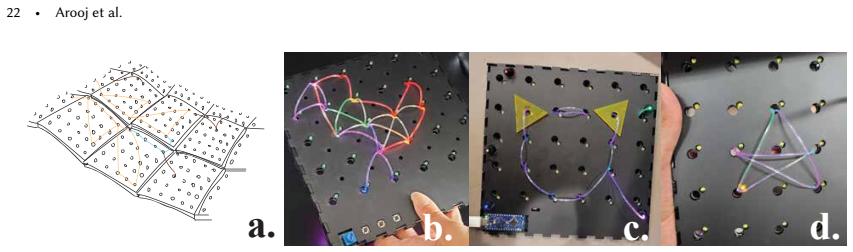
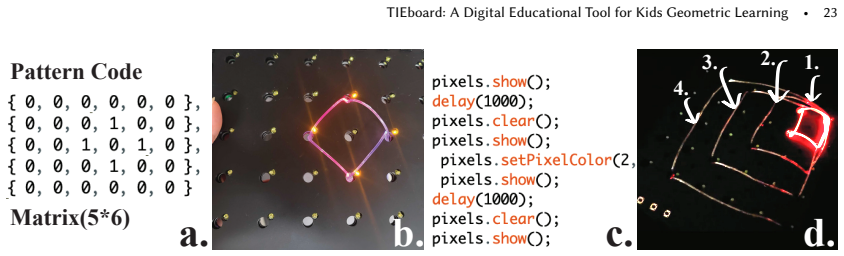
The load-bearing mechanism is the light-guided lacing loop. A 5 by 6 grid of holes, each ringed by LEDs and conductive material, turns the traditional geoboard into a self-instruction device: the LEDs show the next target vertex, the child laces a glowing optical fiber to it, and completing the outline makes the fiber light up, with a dial letting the child mix colors. This closes a feedback loop in the physical space of the task itself, which is what the paper uses to argue that scaffolding and immediate feedback can be delivered without a screen and with little teacher intervention. The same loop, extended by pairing boards and by free-play modes, is what the paper says supports collaboration and creative expression.
What would settle it
Give children aged 5 to 9 a test of shape recognition, composition, and symmetry before and after a fixed session, randomly assigning half to TIEboard and half to an ordinary geoboard with printouts of the same shapes; if the TIEboard group shows no greater improvement when scored by someone unaware of the condition, the central learning claim is undercut.
Extended reading notes
Core claim
The paper's central claim is that embedding computational guidance and immediate light feedback into a familiar physical form, a board you lace thread through, lets young children engage with abstract geometric ideas through their hands. Each of the board's holes is paired with an LED; a child presses a button to see which hole to lace next, and completed shapes light up in a color the child chooses with a dial. The six interaction levels advance from one-by-one shape construction, through same-shape-different-orientation and odd-one-out tasks, symmetry activities built from half-shapes, and composite figures made of simpler shapes, to collaborative two-board projects and open free play. The authors report that children completed all guided tasks with minimal intervention, became faster and more independent as they progressed, decomposed complex objects such as fish and butterflies into triangles and hexagons, and used color to mark symmetry lines and distinguish congruent parts. On this basis the paper claims TIEboard is an effective and engaging geometry learning tool for ages 5 to 9 that is easily adaptable and extensible.
Load-bearing premise
The load-bearing premise is that a child completing TIEboard's guided lacing tasks in the workshops, as coded by the researchers who designed the device, is evidence that geometric learning occurred; the workshops had no control group and no before-and-after measure of geometry knowledge.
Editorial extensions
If this is right
- If TIEboard works as claimed, early geometry instruction can move toward screen-free tangible tools that embed their own scaffolding, so children can practice shape recognition, composition, and symmetry outside formal lessons.
- The six-level progression gives a concrete path from recognizing a simple shape to decomposing a fish or apple into component shapes, which is the trajectory that guided instruction is meant to support.
- Because each board costs roughly 25 to 30 US dollars and runs on a microcontroller, the design is within reach of after-school programs and classrooms, and the guiding code can be re-edited to add new shapes or activities.
- Collaboration need not be limited to pairs: square boards can be tiled into larger patchworks, so the same device that teaches individual shape construction can support whole-class cooperative projects.
- Free play with colored and blinking light turns geometry practice into expressive design, which the paper claims sustains engagement and invites children to reuse learned shapes in their own creations.
Reading between the lines
- A natural next test would be a randomized comparison between TIEboard and an ordinary geoboard with identical shapes; if the learning gains are equal, the contribution lies in engagement and independence rather than in concept acquisition.
- The color-changing fiber is not just decoration: the paper's own observations show children using color to mark symmetry lines and distinguish congruent parts, so separating aesthetic appeal from pedagogical function in future designs could sharpen the scaffolding.
- Because the automatic lacing sensor was validated only in the lab and removed from the workshop device, an accurate sensing version could turn TIEboard into a data-logging instrument, giving researchers per-child completion traces instead of video-derived observations.
- The modular templates, including rectangular, circular, and isometric grids, suggest the same feedback circuit could be reused for other learning domains such as patterns, fractions, or introductory programming without redesigning the hardware.
Editorial analysis
A structured set of objections, weighed in public.
Referee Report
Summary. The paper introduces TIEboard, a screen-free tangible user interface for early geometry learning in children aged 5 to 9. The device combines a geoboard-like lacing surface with LED-guided step-by-step instructions, conductive-thread sensing for real-time feedback, customizable glowing optical fibers, and six interaction modes aligned with the Building Blocks curriculum. The authors report two workshops with 16 children, using video analysis, field notes, and structured ratings of collaboration (Meier et al. dimensions) and creativity (Guilford measures) for the four children in the second workshop. The paper claims that TIEboard is an effective and engaging tool for geometric learning, that it supports collaboration and creativity, and that it is adaptable to individual preferences and extensible to trans-disciplinary activities.
Significance. If the effectiveness claims were well supported, TIEboard would be a useful contribution to the limited body of screen-free tangible interfaces for early geometry education: it is low-cost (~25-30 USD), based on a recognized learning trajectory, and offers a novel combination of lacing, LED scaffolding, and color customization. The design rationale and detailed description of the six interaction modes are valuable for the IDC/TEI community, and the use of two independent coders for the collaboration and creativity ratings is a positive methodological step. However, the current evaluation cannot carry the stated conclusions about learning effectiveness, because the evidence consists of observed task completion in facilitated workshops without any direct measure of geometric knowledge gain, a control condition, or an independent assessor for the central learning outcome. The paper is best read as a design and feasibility study; the claims need to be scoped accordingly or the evidence base needs to be substantially strengthened.
major comments (4)
- [§5.1, §4.3, Conclusion] The central claim that TIEboard is 'an effective and engaging tool' for geometric learning is not supported by the presented data. Section 4.3 describes only video-based interaction analysis by the first author, with no pre/post measure of geometry knowledge, no control condition, and no independent assessor for the learning outcomes. Section 5.1 interprets successful lacing, verbal comments such as 'I can see a triangle in my butterfly,' and reduced facilitator intervention as evidence of concept acquisition, but these behaviors can equally reflect following LED instructions, facilitator scaffolding, or task practice. The Conclusion repeats the effectiveness claim without the qualifications that the evidence requires. I recommend either adding a direct measure of geometric learning (e.g., shape recognition or classification tasks before and after the workshop) or substantially reframing the claims to feasibility, engagement, and observed interaction patterns.
- [§3.2.3] The sensing mechanism, which the abstract presents as a key feature enabling real-time feedback, was disabled during the workshops because of concerns about misdetection. Section 3.2.3 states that 'we decided not to incorporate this function in the device used for the workshops.' Consequently, the evaluated device was button-controlled and did not automatically detect lacing errors; completion of the lacing tasks therefore demonstrates procedural following of lights and buttons rather than successful operation of the real-time feedback loop. This discrepancy should be acknowledged when reporting the findings, and the real-time feedback contribution should be described as a lab-tested prototype capability rather than a validated study result.
- [§5.2, §5.3, Figure 12] The collaboration and creativity findings rest on a very small and non-random sample: the second workshop included only four children, and the creativity scores in Figure 12 are based on qualitative observation of the designs produced by those four children. Although the authors used two independent coders, no inter-rater reliability statistic is reported for either the Meier et al. collaboration dimensions or the Guilford creativity measures, and the text in §5.3 notes that the assessment 'relied on qualitative observations rather than numerical scoring.' As reported, these results are illustrative case descriptions, not measured outcomes; the claims about promoting collaboration and creativity should be tempered accordingly or supplemented with reliability data and a larger sample.
- [§7 (Limitations) and §8 (Conclusion)] The Limitations section acknowledges confusion during instruction-format changes and the lab-only status of the sensing function, but it does not acknowledge the absence of a control condition, the lack of a direct learning measure, or the conflict-of-interest inherent in the first author facilitating the workshops and leading the video analysis. The Conclusion then asserts that 'our study has shown how TIEboard can represent an effective and engaging tool' without hedging. This mismatch between the stated limitations and the strength of the conclusion is a load-bearing issue. The manuscript should either add an explicit limitations paragraph covering the evaluation design or revise the conclusion to claim only that the workshops demonstrated feasibility, engagement, and promising interaction patterns.
minor comments (4)
- [Throughout] The manuscript contains several typos, OCR artifacts, and inconsistent placeholder details (e.g., 'e#ectiveness' for 'effectiveness', 'di"culty' for 'difficulty', and the ACM reference line reading 'May 2018' and '2018' in the copyright block despite the 2025 arXiv date). The authors should proofread the final version carefully.
- [§5.1] The report of completion times ('younger children took 7 to 8 minutes on average... older children finished in 5 minutes') is presented as a trend without descriptive statistics, individual data points, or any statistical analysis; it should be labeled as an anecdotal observation or supported with actual per-child data.
- [References] The reference list contains apparent citation inconsistencies, such as [15] being labeled Deiglmayr, Spada, and Rummel (2007) in the reference list while the text cites 'Meier et al.'; please verify that all citations match their reference entries.
- [Figure 12] The labels 'Highest Elaboration,' 'Highest Fluency,' 'Highest Originality,' and 'Highest Flexibility' in Figure 12 are not explained in the caption; please clarify which child received each attribution and how the qualitative judgment supports the label.
Circularity Check
Learning-effectiveness claim rests on task completion within the system's own scaffolded activities, without any independent geometry measure.
-
self definitional
[Section 5.1 (Findings: Engaging with TIEboard), design basis in Section 3.3.1; central claim in Section 8 (Conclusion)]
"Children’s acquisition of the various components of geometry as articulated in the Building Blocks framework could be observed from very early stages. When creating hexagons in the first interaction, several children were able to draw triangles inside the hexagon without assistance, indicating shape identification."
The paper's evidence for 'acquisition of geometric concepts' is children's successful completion of TIEboard lacing tasks, but TIEboard itself defines and scaffolds the tasks: Interaction 1 'displays the entire outline of the shape with guidance lights' and provides 'step-by-step instructions via LED guidance' (Section 3.3.1). There is no pre/post geometry-knowledge test, no control condition, and no independent assessor; the first author coded video data (Section 4.3). Thus the Conclusion's claim that TIEboard is 'an effective and engaging tool' for geometric learning reduces to the observation that children followed TIEboard's own instructions and completed its tasks, making the outcome measure self-referential.
full rationale
This is an empirical study rather than a formal derivation, so circularity appears in the evaluation design rather than in equations. The central learning claim is supported only by task performance on the very system being evaluated: completing LED-guided lacing activities is interpreted as geometric learning. No independent measurement of geometric understanding (e.g., shape knowledge, transfer, or pre/post assessment) is provided, so the conclusion that TIEboard is effective for geometric learning reduces to the operational definition of success as completing TIEboard activities. The paper does contain independent content for engagement, collaboration, and creativity: collaboration was scored with Meier et al.'s dimensions and free play with Guilford measures, though these were also coded by the researchers and reconciled by discussion. The co-authored citation [4] is present but not load-bearing for the main learning claim, so self-citation does not materially add to circularity. The central learning claim is therefore partially circular by construction, while feasibility and engagement evidence remain informative.
Assumptions & free parameters
assumptions (3)
- domain assumption Children's geometric understanding develops through the stage-like progression described by Piaget and van Hiele, so instruction should be aligned with developmental levels.
- domain assumption The Building Blocks curriculum's phases, including shape recognition, composition, congruence, construction, and patterning, form a valid ordering for early geometry learning.
- ad hoc to paper Qualitative observational coding by the researchers, supported by field notes and video, is sufficient to assess learning, collaboration, and creativity outcomes.
Cite this review
Pith. "Pith review of TIEboard: A Digital Educational Tool for Kids Geometric Learning." pith.science (2026). https://pith.science/paper/36J26ILE
@misc{pith2026250521891,
  author       = {Pith},
  title        = {Pith review of: TIEboard: A Digital Educational Tool for Kids Geometric Learning},
  year         = {2026},
  howpublished = {\url{https://pith.science/paper/36J26ILE}},
  note         = {Machine review of arXiv:2505.21891}
}
read the original abstract
Tangible User Interfaces have shown potential in supporting the acquisition of key concepts in computing and mathematics while fostering engagement in young learners, but these approaches are less commonly utilised in the context of geometry. In this paper we introduce TIEboard, an interactive device to promote early learning of basic geometry concepts. TIEboard draws inspiration from traditional geoboards and lacing toys to leverage children's familiarity with these traditional tools. It employs instructional lights to guide children in creating shapes using colourful threads of optical fiber. The use of conductive materials allows the system to detect lacing activity and provide feedback in real-time. TIEboard incorporates six interaction modes of varying difficulty based on an incremental learning framework. The study evaluated TIEboard's effectiveness in supporting early geometric learning, facilitating creativity and promoting collaboration among 16 children aged 5-9.
Figures


Figures from the paper (2 more)

Reference graph
Works this paper leans on
-
[2]
[66]Julie Sarama and Douglas H Clements
Emerald Group Publishing Limited, 271–295. [66]Julie Sarama and Douglas H Clements. 2009.Early childhood mathematics education research: Learning trajectories for young children. Routledge. [67]Hilary Scandrett
work page 2009
-
[4]
TIP-Toy: a tactile, open-source computational toolkit to support learning across visual abilities. InProceedings of the 22nd International ACM SIGACCESS Conference on Computers and Accessibility (Virtual Event, Greece)(ASSETS ’20). Association for Computing Machinery, New York, NY, USA, Article 21, 14 pages. https://doi.org/ 10.1145/3373625.3417005 [5]Law...
-
[11]
International Journal of Computer-Supported Collaborative Learning, 2(1), 63-86.I
A rating scheme for assessing the quality of computer-supported collaboration processes. International Journal of Computer-Supported Collaborative Learning, 2(1), 63-86.I. J. Computer-Supported Collaborative Learning2 (04 2007), 63–86. https://doi.org/10.1007/s11412-006-9005-x [16]Paul Dourish. 2001.Where the action is: the foundations of embodied interac...
-
[15]
[23]Danae Stanton Fraser et al
Taking shape: Supporting preschoolers’ acquisition of geometric knowledge through guided play.Child development84, 6 (2013), 1872–1878. [23]Danae Stanton Fraser et al
work page 2013
-
[16]
[24]Kaori Fujinami, Mami Kosaka, and Bipin Indurkhya
Literature review in learning with tangible technologies.NESTA futurelab report12 (2004). [24]Kaori Fujinami, Mami Kosaka, and Bipin Indurkhya
work page 2004
-
[17]
Painting an Apple with an Apple: A Tangible Tabletop Interface for Painting with Physical Objects.Proc. ACM Interact. Mob. Wearable Ubiquitous Technol.2, 4, Article 162 (Dec. 2018), 22 pages. https: //doi.org/10.1145/3287040 [25]Graciela Guerrero, Andrés Ayala, Juan Mateu, Laura Casades, and Xavier Alamán
-
[23]
Exploring the e#ects of ubiquitous geometry learning in real situations.Educational Technology Research and Development68 (2020), 1121–1147. [31]Hiroshi Ishii
work page 2020
-
[25]
The Tangible User Interface and Its Evolution.Commun. ACM51, 6 (jun 2008), 32–36. https://doi.org/10.1145/ 1349026.1349034 [33]Mohamad Gilar Jatisunda, Maria Hidayanti, Dede Salim Nahdi, Ujiati Cahyaningsih, Vici Suciawati, et al.2021. Mathematical knowledge for early childhood teaching: A deep insight on how pre-service teachers prepare mathematical acti...
Show all 61 references
-
[26]
Education Sciences10, 8 (2020),
Active learning augmented reality for STEAM education—A case study. Education Sciences10, 8 (2020),
2020
-
[28]
on Expressive Character of Interaction, 139–146
The reacTable: Exploring the Synergy between Live Music Performance and Tabletop Tangible Interfaces.Proc., ACM Conf. on Expressive Character of Interaction, 139–146. https: //doi.org/10.1145/1226969.1226998 [37]Hiroki Kaimoto, Kyzyl Monteiro, Mehrad Faridan, Jiatong Li, Samin...
-
[29]
In2007 Fourth International Conference on Networked Sensing Systems
A Tangible User Interface as Interaction and Presentation Device to a Social Learning Software. In2007 Fourth International Conference on Networked Sensing Systems. 114–117. https://doi.org/10.1109/INSS.2007.4297402 [41]Meng Liang, Yanhong Li, Thomas Weber, and Heinrich Hussmann
2007
-
[30]
InCreativity and Cognition(Virtual Event, Italy)(CC ’21)
Tangible Interaction for Children’s Creative Learning: A Review. InCreativity and Cognition(Virtual Event, Italy)(CC ’21). Association for Computing Machinery, New York, NY, USA, 14 pages. https://doi.org/10.1145/3450741.3465262 [42]Meng Liang, Yanhong Li, Thomas Weber, and He...
-
[33]
InProceedings of the 1st International Conference on Tangible and Embedded Interaction(Baton Rouge, Louisiana)(TEI ’07)
Do Tangible Interfaces Enhance Learning?. InProceedings of the 1st International Conference on Tangible and Embedded Interaction(Baton Rouge, Louisiana)(TEI ’07). Association for Computing Machinery, New York, NY, USA, 163–170. https: //doi.org/10.1145/1226969.1227004 [46]Tayl...
-
[34]
[47]Dalia Abdelwahad Mohamed and Mohamed Metwally Kandeel
Physically distributed learning: Adapting and reinterpreting physical environments in the development of fraction concepts.Cognitive science29, 4 (2005), 587–625. [47]Dalia Abdelwahad Mohamed and Mohamed Metwally Kandeel
2005
-
[35]
[48]Melisa Moore
Playful Learning: Teaching the Properties of Geometric Shapes through Pop-Up Mechanisms for Kindergarten.International Journal of Education in Mathematics, Science and Technology11, 1 (2023), 179–197. [48]Melisa Moore. 2011.Vygotsky’s Cognitive Development Theory. Springer US,...
2023 doi
-
[37]
[51]Jeanne Nakamura and Mihaly Csikszentmihalyi
Are we having fun yet? How teachers use manipulatives to teach mathematics.Educational Studies in mathematics 47, 2 (2001), 175–197. [51]Jeanne Nakamura and Mihaly Csikszentmihalyi
2001
-
[38]
Flow theory and research.Handbook of positive psychology195 (2009),
2009
-
[41]
[59]Hayes Solos Ra&e, Amanda J
Developing a conceptual model of STEAM teaching practices.School science and mathematics117, 1-2 (2017), 1–12. [59]Hayes Solos Ra&e, Amanda J. Parkes, and Hiroshi Ishii
2017
-
[42]
In Proceedings of the SIGCHI Conference on Human Factors in Computing Systems(Vienna, Austria)(CHI ’04)
Topobo: A Constructive Assembly System with Kinetic Memory. In Proceedings of the SIGCHI Conference on Human Factors in Computing Systems(Vienna, Austria)(CHI ’04). Association for Computing Machinery, New York, NY, USA, 647–654. https://doi.org/10.1145/985692.985774 [60]Mitch...
-
[44]
InProceedings of the SIGCHI Conference on Human Factors in Computing Systems(Los Angeles, California, USA)(CHI ’98)
Digital Manipulatives: New Toys to Think With. InProceedings of the SIGCHI Conference on Human Factors in Computing Systems(Los Angeles, California, USA)(CHI ’98). ACM Press/Addison-Wesley Publishing Co., USA, 281–287. https://doi.org/10.1145/274644.274684 [62]Mitchel Resnick ...
-
[45]
InProceedings of the 2005 conference on Interaction design and children
Some re$ections on designing construction kits for kids. InProceedings of the 2005 conference on Interaction design and children. 117–122. [63]Lea Duji% Rodi% and Andrina Grani%
2005
-
[46]
https://doi.org/10.1007/s00779-021-01556-x [64]Sameh Said-Metwaly, Christa L Taylor, Anaëlle Camarda, and Baptiste Barbot
Tangible Interfaces in Early Years’ Education: A Systematic Review.Personal Ubiquitous Comput.26, 1 (feb 2022), 39–77. https://doi.org/10.1007/s00779-021-01556-x [64]Sameh Said-Metwaly, Christa L Taylor, Anaëlle Camarda, and Baptiste Barbot
2022 doi
-
[47]
[65]Theodosios Sapounidis, Ioannis Stamelos, and Stavros Demetriadis
Divergent thinking and creative achievement—How strong is the link? An updated meta-analysis.Psychology of Aesthetics, Creativity, and the Arts(2022). [65]Theodosios Sapounidis, Ioannis Stamelos, and Stavros Demetriadis
2022
-
[49]
Using Geoboards in Primary Mathematics: Going... Going... Gone?Australian Primary Mathematics Classroom 13, 2 (2008), 29–32. [68]Lori L. Scarlatos, S. Landy, Julia Breban, Robert Horowitz, and C. Sandberg
2008
-
[51]
Page 26 of 1–27
2025-05-28 02:07. Page 26 of 1–27. Unpublished working draft.Not for distribution. TIEboard: A Digital Educational Tool for Kids Geometric Learning•27 [71]Ayelet Segal. 2011.Do gestural interfaces promote thinking? Embodied interaction: Congruent gestures and direct touch prom...
2025
-
[52]
[73]Nathalie Sinclair, Maria G Bartolini Bussi, Michael de Villiers, Keith Jones, Ulrich Kortenkamp, Allen Leung, and Kay Owens
Mathematics and virtual culture: An evolutionary perspective on technology and mathematics education.Educational studies in Mathematics37, 2 (1998), 97–119. [73]Nathalie Sinclair, Maria G Bartolini Bussi, Michael de Villiers, Keith Jones, Ulrich Kortenkamp, Allen Leung, and Kay Owens
1998
-
[53]
[75]Cristina Sylla, Pedro Branco, Clara Coutinho, and Eduarda Coquet
Design-based research on the use of a tangible user interface for geometry teaching in an inclusive classroom.British Journal of Educational Technology44, 5 (2013), 729–744. [75]Cristina Sylla, Pedro Branco, Clara Coutinho, and Eduarda Coquet
2013
-
[54]
GUIs: Comparing the learning potential with preschoolers.Personal and Ubiquitous Computing16 (04 2011), 421–432
TUIs vs. GUIs: Comparing the learning potential with preschoolers.Personal and Ubiquitous Computing16 (04 2011), 421–432. https://doi.org/10.1007/s00779-011-0407-z [76]Lucia Terrenghi, David Kirk, Hendrik Richter, Sebastian Krämer, Otmar Hilliges, and Andreas Butz
2011 doi
-
[55]
InProceedings of the Working Conference on Advanced Visual Interfaces(Napoli, Italy)(A VI ’08)
Physical Handles at the Interactive Surface: Exploring Tangibility and Its Bene!ts. InProceedings of the Working Conference on Advanced Visual Interfaces(Napoli, Italy)(A VI ’08). Association for Computing Machinery, New York, NY, USA, 138–145. https://doi.org/10.1145/1385569....
-
[57]
ACM Interact
AssessBlocks: Exploring Toy Block Play Features for Assessing Stress in Young Children after Natural Disasters.Proc. ACM Interact. Mob. Wearable Ubiquitous Technol.4, 1, Article 30 (March 2020), 29 pages. https://doi.org/10.1145/3381016 [82]Jenni Way
2020 doi
-
[58]
[83]Mark Weiser, Rich Gold, and John Seely Brown
Hot ideas: Polygons on the computer.Australian Primary Mathematics Classroom11, 2 (2006), 15–17. [83]Mark Weiser, Rich Gold, and John Seely Brown
2006
-
[59]
[84]Nesra Yannier, Scott E Hudson, and Kenneth R Koedinger
The origins of ubiquitous computing research at PARC in the late 1980s.IBM systems journal38, 4 (1999), 693–696. [84]Nesra Yannier, Scott E Hudson, and Kenneth R Koedinger
1999
-
[60]
[85]Yuxia Zhou and Minjuan Wang
Active learning is about more than hands-on: A mixed-reality AI system to support STEM education.International Journal of Arti#cial Intelligence in Education30 (2020), 74–96. [85]Yuxia Zhou and Minjuan Wang
2020
-
[63]
https://doi.org/10.1145/1054972.1055093 2025-05-28 02:07
Extending Tangible Interfaces for Education: Digital Montessori-Inspired Manipulatives.CHI 2005: Technology, Safety, Community: Conference Proceedings - Conference on Human Factors in Computing Systems. https://doi.org/10.1145/1054972.1055093 2025-05-28 02:07. Page 27 of 1–27....
2005
-
[1966]
[27]Pierre M van Hiele
Measurement and creativity.Theory into practice5, 4 (1966), 185–189. [27]Pierre M van Hiele
1966
-
[1986]
[28]Michael S Horn, R Jordan Crouser, and Marina U Bers
Structure and insight: A theory of mathematics education.(No Title)(1986). [28]Michael S Horn, R Jordan Crouser, and Marina U Bers
1986
-
[1995]
[36]Sergi Jordà, Gunter Geiger, Marcos Alonso, and Martin Kaltenbrunner
Interaction analysis: Foundations and practice.The journal of the learning sciences4, 1 (1995), 39–103. [36]Sergi Jordà, Gunter Geiger, Marcos Alonso, and Martin Kaltenbrunner
1995
-
[1998]
https://doi.org/10.1007/BF02299672 [61]Mitchel Resnick, Fred Martin, Robert Berg, Rick Borovoy, Vanessa Colella, Kwin Kramer, and Brian Silverman
Technologies for Lifelong Kindergarten.Educational Technology Research and Development46 (12 1998), 43–55. https://doi.org/10.1007/BF02299672 [61]Mitchel Resnick, Fred Martin, Robert Berg, Rick Borovoy, Vanessa Colella, Kwin Kramer, and Brian Silverman
1998 doi
-
[1999]
[81]Xiyue Wang, Kazuki Takashima, Tomoaki Adachi, Patrick Finn, Ehud Sharlin, and Yoshifumi Kitamura
Developing geometric thinking through activities that begin with play.Teaching children mathematics5, 6 (1999), 310–316. [81]Xiyue Wang, Kazuki Takashima, Tomoaki Adachi, Patrick Finn, Ehud Sharlin, and Yoshifumi Kitamura
1999
-
[2001]
(01 2001)
Virtual Manipulatives in the K-12 Classroom. (01 2001). [50]Patricia S Moyer
2001
-
[2003]
[19]Michael Eisenberg, Ann Nishioka, and ME Schreiner
Mindstu#: Educational technology beyond the computer.Convergence9, 2 (2003), 29–53. [19]Michael Eisenberg, Ann Nishioka, and ME Schreiner
2003
-
[2004]
Washington, DC: National Research Council
How People Learn. Washington, DC: National Research Council. [9]Gattegno Caleb. 1971.The common sense of teaching mathematics. Geoboard geometry. [S.l.]: Educational Solutions Worldwide Inc,
1971
-
[2005]
[6]Matthew Boggan, Sallie Harper, and Anna Whitmire
Situating abstract concepts.Grounding cognition: The role of perception and action in memory, language, and thought(2005), 129–163. [6]Matthew Boggan, Sallie Harper, and Anna Whitmire
2005
-
[2006]
Tangible math applications.See http://ms. cc. sunysb. edu/lscarlatos/TICLE/ticle. html(2006). [70]Bertrand Schneider and Paulo Blikstein
2006
-
[2007]
[14]Sanne Cools, Peter Conradie, Maria-Cristina Ciocci, and Jelle Saldien
E#ects of a preschool mathematics curriculum: Summative research on the Building Blocks project.Journal for research in Mathematics Education38, 2 (2007), 136–163. [14]Sanne Cools, Peter Conradie, Maria-Cristina Ciocci, and Jelle Saldien
2007
-
[2008]
InProceedings of the 2nd International Conference on Tangible and Embedded Interaction (Bonn, Germany)(TEI ’08)
Tangible Bits: Beyond Pixels. InProceedings of the 2nd International Conference on Tangible and Embedded Interaction (Bonn, Germany)(TEI ’08). Association for Computing Machinery, New York, NY, USA, xv–xxv. https://doi.org/10.1145/1347390.1347392 [32]Hiroshi Ishii
-
[2009]
In Proceedings of the 3rd International Conference on Tangible and Embedded Interaction(Cambridge, United Kingdom)(TEI ’09)
Physical Manipulation: Evaluating the Potential for Tangible Designs. In Proceedings of the 3rd International Conference on Tangible and Embedded Interaction(Cambridge, United Kingdom)(TEI ’09). Association for Computing Machinery, New York, NY, USA, 77–84. https://doi.org/10....
-
[2010]
[7]Esra Bozkurt Altan and Sema Tan
Using manipulatives to teach elementary mathematics.Journal of Instructional Pedagogies3 (01 2010). [7]Esra Bozkurt Altan and Sema Tan
2010
-
[2011]
In Proceedings of the 10th International Conference on Interaction Design and Children
Designing learning representations around physical manipulation: Hands and objects. In Proceedings of the 10th International Conference on Interaction Design and Children. 81–89. 2025-05-28 02:07. Page 25 of 1–27. , Vol. 1, No. 1, Article . Publication date: May
2025
-
[2012]
[29]Xincheng Huang, Keylonnie L
Tangible interaction and learning: the case for a hybrid approach.Personal and Ubiquitous Computing16 (2012), 379–389. [29]Xincheng Huang, Keylonnie L. Miller, Alanson P. Sample, and Nikola Banovic
2012
-
[2013]
[2]Jatin Arora, Kartik Mathur, Manvi Goel, Piyush Kumar, Abhijeet Mishra, and Aman Parnami
Getting down to details: Using theories of cognition and learning to inform tangible user interface design.Interacting with Computers25, 1 (2013), 1–20. [2]Jatin Arora, Kartik Mathur, Manvi Goel, Piyush Kumar, Abhijeet Mishra, and Aman Parnami
2013
-
[2014]
[56]Jean Piaget
Using representations in geometry: a model of students’ cognitive and a#ective performance.International Journal of Mathematical Education in Science and Technology45, 4 (2014), 498–511. [56]Jean Piaget. 2013.Child’s Conception of Space: Selected Works vol
2014
-
[2015]
https://doi.org/10.1016/B978-0-08-097086-8.92034-8 [86]Oren Zuckerman, Saeed Arida, and Mitchel Resnick
Tangible User Interfaces in Learning and Education.International Encyclopedia of the Social and Behavioral Sciences(12 2015). https://doi.org/10.1016/B978-0-08-097086-8.92034-8 [86]Oren Zuckerman, Saeed Arida, and Mitchel Resnick
2015 doi
-
[2016]
Integrating virtual worlds with tangible user interfaces for teaching mathematics: A pilot study.Sensors16, 11 (2016),
2016
-
[2017]
InProceedings of the 17th Koli Calling International Conference on Computing Education Research(Koli, Finland)(Koli Calling ’17)
The Nature of Physical Computing in Schools: Findings from Three Years of Practical Experience. InProceedings of the 17th Koli Calling International Conference on Computing Education Research(Koli, Finland)(Koli Calling ’17). Association for Computing Machinery, New York, NY, ...
-
[2018]
Page 24 of 1–27
2025-05-28 02:07. Page 24 of 1–27. Unpublished working draft.Not for distribution. TIEboard: A Digital Educational Tool for Kids Geometric Learning•25 [21]Joan Ferrini-Mundy
2025
-
[2019]
[4]Giulia Barbareschi, Enrico Costanza, and Catherine Holloway
E#ects of challenging games on manipulative motor skills of 4–6 years old children: an application of challenge point framework.Early Child Development and Care189, 5 (2019), 697–706. [4]Giulia Barbareschi, Enrico Costanza, and Catherine Holloway
2019
-
[2020]
ACM Interact
Design and Evaluation of DIO Construction Toolkit for Co-making Shared Constructions.Proc. ACM Interact. Mob. Wearable Ubiquitous Technol.3, 4, Article 127 (Sept. 2020), 25 pages. https://doi.org/10.1145/3369833 [3]Marzie Balali, Mohammad VaezMousavi, Abdollah Ghasemi, and Sha...
2020 doi
-
[2021]
[8]JD Bransford, AL Brown, and RR Cocking
Concepts of creativity in design based learning in STEM education.International Journal of Technology and Design Education31, 3 (2021), 503–529. [8]JD Bransford, AL Brown, and RR Cocking
2021
-
[2022]
InProceedings of the 21st Annual ACM Interaction Design and Children Conference(Braga, Portugal)(IDC ’22)
Grasping Derivatives: Teaching Mathematics through Embodied Interactions using Tablets and Virtual Reality. InProceedings of the 21st Annual ACM Interaction Design and Children Conference(Braga, Portugal)(IDC ’22). Association for Computing Machinery, New York, NY, USA, 98–108...
-
[2023]
ACM Interact
StructureSense: Inferring Constructive Assembly Structures from User Behaviors.Proc. ACM Interact. Mob. Wearable Ubiquitous Technol.6, 4, Article 204 (Jan. 2023), 25 pages. https: //doi.org/10.1145/3570343 [30]Wu-Yuin Hwang, Lixinin Zhao, Rustam Shadiev, Li-Kai Lin, Timothy K ...
2023 doi
Reviewed August 7, 2026 · model on record in the stance chip above.
Discussion (0). Sign in to comment.