REVIEW 3 major objections 4 minor 60 references
Exploring the Accretion disc/Corona Connection in NGC 6814: Insights from UV and X-ray spectral-timing studies
T0 review · 3 major / 4 minor · reviewed 2026-08-07 · deepseek-v4-flash
Pith's one-line read A compact X-ray corona illuminating the accretion disc can explain both the spectra and the time delays of NGC 6814.
desk verdict A careful, honest consistency test of lamp-post reprocessing in NGC 6814; the new lags and kynsed fits are real, but the strong conclusion depends on holding accretion rate fixed without testing that assumption. read the letter →
The pith
A machine-rendered reading of the paper's core claim, the machinery that carries it, and where it could break.
The reading
What carries the argument
The load-bearing tool is the kynsed model, a relativistic code that computes the broadband spectrum of a Novikov–Thorne disc illuminated by an isotropic X-ray source placed on the rotation axis (lamp-post geometry), including light bending, Doppler shifts, and thermalization of absorbed X-rays in the disc atmosphere. It is paired with the analytic disc response function of Kammoun et al. — updated to include the color-correction factor — which converts the best-fit physical parameters (black hole mass, accretion rate, corona height, luminosity) into predicted X-ray-to-UV time lags. The cross-correlation results (ICCF and DCF) provide the observed lags that the model must match.
What would settle it
Measure the 2910 Å lag with a longer, densely sampled simultaneous X-ray/UV campaign: if the observed lag consistently exceeds the model prediction for the adopted mass and corona height by more than the quoted uncertainties, or if segments of the UV light curve vary without a corresponding X-ray driver, the pure-reprocessing explanation fails. Alternatively, re-derive the host-galaxy subtracted UV fluxes with an independent imaging decomposition and check whether the best-fit disc parameters still yield the observed lags.
Extended reading notes
Core claim
The central claim is that X-ray illumination of an untruncated, standard accretion disc in a lamp-post geometry can simultaneously reproduce four broadband X-ray-to-UV spectral energy distributions of NGC 6814 and the measured X-ray/UV time delays. The authors find a best-fit disc inclination of 70°, black hole spin at or below 0.5, accretion rate about 10% of Eddington, corona height ranging from 7.5 to 35 gravitational radii, and a transfer of 10–20% of the accretion power to the corona. Using the same best-fit parameters, the predicted wavelength-dependent time lags agree with the observed delays of ~15 ks at 1541 Å and ~28 ks at 2910 Å. Within this framework, no outer or inner truncation of the disc is required, directly countering a recent suggestion of non-standard geometry from Swift monitoring.
Load-bearing premise
The analysis assumes that the observed UV variability is entirely X-ray reprocessing, with the accretion rate held fixed across all four spectra; if intrinsic accretion-rate fluctuations also drive the UV changes, the fitted parameters and lags would not uniquely support the lamp-post picture.
Editorial extensions
If this is right
- The observed X-ray/UV delays in NGC 6814 can be read as reprocessing lags: warmer, shorter-wavelength UV responds faster than cooler, longer-wavelength UV, as the 15 ks versus 28 ks delays show.
- A non-truncated disc with a compact, on-axis corona is sufficient for this source; future simultaneous X-ray/UV observations should not need to invoke an inner or outer truncation radius.
- The 10–20% transfer of accretion power to the corona and the corona height of 7.5–35 r_g give specific targets for physical models of how discs power coronae.
- Since the model predicts lags shorter than half a day at 2900 Å, the overprediction in the XMM-Newton UVW1 lag suggests either a lower black hole mass or simply that the ~1.5-day light curve is too short to measure the lag accurately.
Reading between the lines
- If the constant-accretion-rate assumption is relaxed, the distinctive prediction is that UV variations would show some component uncorrelated with X-rays and with zero lag; a dedicated high-cadence campaign could look for that.
- The same kynsed plus response-function pipeline could be applied to other Seyferts with simultaneous X-ray and UV data to see whether inferred corona heights cluster at a few tens of r_g, which would support a universal disc–corona geometry.
- The overprediction of the UVW1 lag, if confirmed with longer monitoring, would point toward either a black hole mass below the reverberation-mapped 1.09×10^7 M_sun or a contribution from diffuse broad-line-region emission.
- A testable extension: compare the host-galaxy subtraction from radial-profile decomposition against a fully independent method (e.g., high-resolution imaging) to check how much of the inferred disc parameters depends on that correction.
Editorial analysis
A structured set of objections, weighed in public.
Referee Report
Summary. The paper presents a combined spectral and timing analysis of NGC 6814 using AstroSat (2019) and XMM-Newton (2021) observations. The authors measure X-ray-to-UV lags of ~15 ks (FUV) and ~28 ks (UVW1) using both ICCF and DCF with bootstrap uncertainties, construct four time-resolved UV/X-ray SEDs, and fit them simultaneously with the kynsed lamp-post reprocessing model. They report that a constant accretion rate ~0.1 L_Edd, corona height 7.5-35 r_g, spin <=0.5, and inclination ~70 deg reproduces the SEDs, and that model time-lags computed with Kammoun et al. (2023) agree well with the observed FUV lag while overpredicting the UVW1 lag. The central claim is that the broadband spectra and timing data are both consistent with X-ray illumination of a standard, non-truncated accretion disc in a lamp-post geometry.
Significance. If the conclusion holds, the paper is a useful demonstration that a single lamp-post reprocessing model can jointly describe the broadband UV/X-ray SED and the X-ray/UV lags in a Seyfert galaxy, and the work provides a concrete application of the kynsed model. The timing analysis is solid in execution: two independent cross-correlation methods give consistent results, uncertainties are estimated with 5,000 bootstrap realizations, and the spectral fits have acceptable chi-square. The paper also includes careful treatment of aperture corrections, host-galaxy subtraction, and emission-line contamination, with the relevant details in appendices. The strength of the claim is limited, however, by the sparse UV sampling (one photometric point per SED) and by the fact that the constant-accretion-rate assumption is imposed a priori rather than tested against data.
major comments (3)
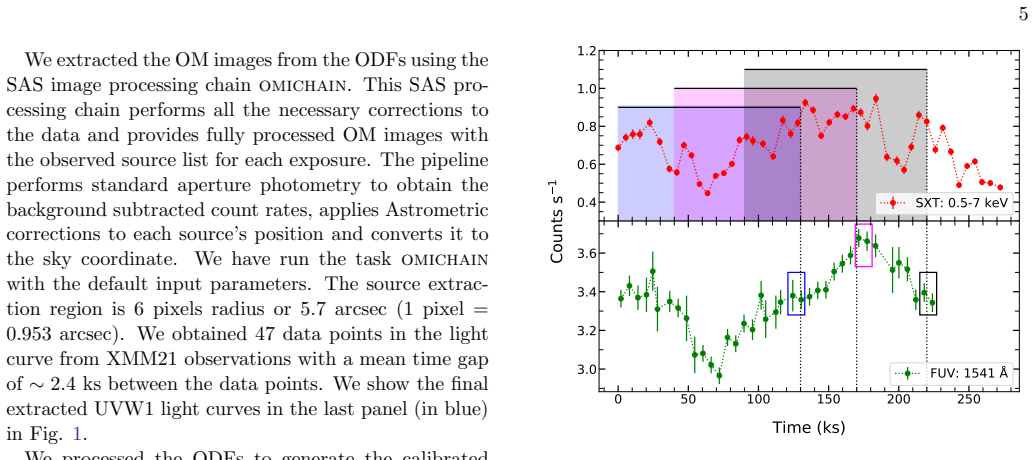
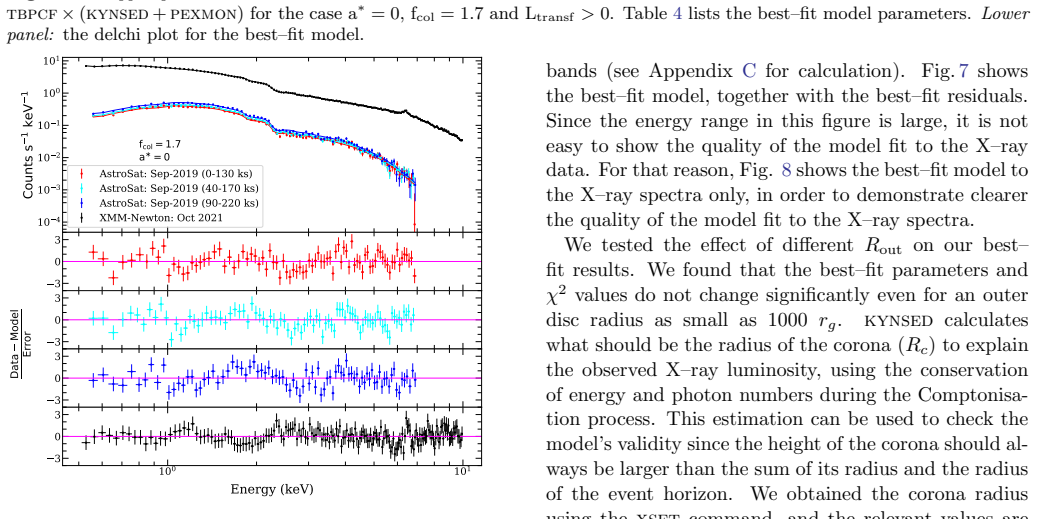
- [Section 4.1, Table 4] The accretion rate is fixed across all four SEDs by construction: 'we kept the accretion rate the same while fitting all four spectra.' Because each SED contains only one UV flux point (three FUV points from AstroSat and one UVW1 point from XMM21), the data have little power to distinguish a constant-mdot reprocessing model from one in which mdot varies intrinsically. The Section 6 statement that 'the observed variations are merely due to variations of Ltransf/Ldisc and/or variations of the X-ray source height' is therefore an input constraint, not an inference from the fits. Please fit the alternative with mdot free per epoch (or at least for AS2 versus AS1/AS3 and XMM21) and report whether the reprocessing model is actually preferred, and quantify whether the observed UV Fvar is consistent with the X-ray-driven response given the best-fit geometry.
- [Section 5, Fig. 9] The model time-lag overpredicts the EPIC-PN/UVW1 measurement: at 2910 Å the model lines shown for h_c = 30 r_g and L_X = 0.001 L_Edd lie near 0.4-0.45 days, while the observed lag is 0.32-0.33 days (28.9 +/- 4.6 ks). The manuscript attributes this to the short XMM21 light curve or an overestimated BH mass, but no quantitative test is provided. With only two lag anchors, this discrepancy is material to the claim that the model time-lags 'are aligned well' with the observed lags. Please provide a quantitative comparison (e.g., chi-square of the two lag measurements against the model, with propagated uncertainties on h_c, mdot, and M_BH), or fit the lags directly and show that the SED and timing constraints are mutually consistent within errors.
- [Appendices B and C, Table 4] The host-galaxy subtraction removes 12.2% (FUV) and 29.5% (UVW1) of the observed flux, and the emission-line correction removes an additional 16.7% and 21%, respectively. These corrections are derived from template and PSF fits that are assigned no uncertainties. Because the fitted disc parameters (arate, Ltransf, h_c) are directly determined by the four UV points, any error in these corrections propagates into all derived quantities and into the subsequent lag comparison. Please propagate the correction uncertainties (for example, by allowing the host-galaxy and line fractions to vary with priors, or by refitting after perturbing them by their estimated errors) and state how much the best-fit parameters and the model lag predictions shift.
minor comments (4)
- [Section 4.2, Table 4] The text describes an 'increasing trend' in corona height across AS1, AS2, and AS3, but the 90% error bars on h_c (9.09+2.53/-1.74, 12.58+5.63/-3.14, 23.78+12.33/-7.53) overlap substantially; the trend is not statistically significant and the wording should be softened.
- [Fig. 9 caption and text] The text says the dotted lines correspond to lags computed with the upper and lower limits on the black hole mass, but the figure caption and legend do not identify these dotted lines; please clarify the line styles in the caption.
- [Section 4.1, Eq. (2)] The model components 'redden', 'zredden', 'tbabs', 'tbpcf', and 'pexmon' are named without introducing them for readers not working in xspec; a short parenthetical definition of each would help.
- [Table 3] The 'evidence ratio' epsilon uses only the chi-square difference in Delta[AIC], which is appropriate only if all models have the same number of free parameters; this is true for the grid considered here, but the text should state this explicitly to avoid confusion.
Circularity Check
No significant circularity: the X-ray/UV lag comparison is a genuinely separate consistency check against SED-fitted parameters, and the constant-accretion-rate assumption is explicitly stated rather than smuggled in.
full rationale
The paper's derivation chain is: measure FUV/X-ray and UVW1/X-ray lags directly (Sec. 3, Table 2); fit four broadband SEDs with kynsed while keeping the accretion rate fixed (Sec. 4); then compute theoretical reprocessing lags from the SED best-fit parameters and compare them with the observed lags (Sec. 5, Fig. 9). The observed lag values were not used as inputs to the SED fits, so the timing comparison is not a fit renamed as a prediction; indeed the model overpredicts the UVW1 lag, which shows the comparison can fail. The kynsed and Kammoun et al. models are the authors' own, but they are used openly as physical hypotheses with stated assumptions, not as imported uniqueness theorems or forbidden alternatives; the lag check is externally falsifiable and is also compared with Swift lags from Troyer et al. (2016) and Gonzalez et al. (2024). The constant-arate constraint in Sec. 4.1 is explicitly labelled as an assumption: 'we kept the accretion rate the same while fitting all four spectra. This implies that we wish to investigate whether the observed UV variations are entirely due to the X-ray variations.' The later statement that the variations are 'merely due to variations of Ltransf/Ldisc and/or variations of the X-ray source height' restates that modelling assumption and is framed as possibility/consistency, not as a uniquely determined result. The Rout dependence was also tested (10^4 to 10^3 rg) with no significant change. No equation in the paper reduces to its inputs by construction, so the circularity score is low: only a minor self-citation/degenerate-assumption concern, not load-bearing circularity.
Assumptions & free parameters
free parameters (10)
- arate (mdot/mdot_Edd) =
0.1053
- Ltransf/Ldisc =
0.19 (AstroSat), 0.09 (XMM21)
- Corona height hc =
9.09, 12.58, 23.78, >=27.97 rg
- Photon index Gamma =
1.80 to 1.88
- fcol =
1.7 (fixed after grid scan)
- BH spin a* =
0 (fixed after grid scan)
- Inclination theta =
70 degrees (fixed after grid scan)
- tbpcf NH and fcov =
NH: 23.41e22 (AstroSat), 1.05e22 (XMM21); fcov: 0.24, 0.19
- zredden E(B-V)host =
0.24 (AstroSat), 0.35 (XMM21)
- pexmon normalization =
2.48e-3 (XMM21 only)
assumptions (6)
- domain assumption Novikov-Thorne thin disc with lamp-post X-ray illumination is the correct emission model.
- domain assumption The Kammoun et al. (2021a, 2023) response function and analytical lag prescription correctly describe time-dependent reprocessing.
- domain assumption BH mass 1.09e7 Msun and distance 21.65 Mpc are correct.
- domain assumption Composite quasar spectra and radial-profile decomposition give the correct line and host-galaxy corrections.
- ad hoc to paper arate is linked across all four SEDs and Ltransf across the three AstroSat SEDs.
- ad hoc to paper A 2% systematic is added to the model to achieve acceptable fits.
Cite this review
Pith. "Pith review of Exploring the Accretion disc/Corona Connection in NGC 6814: Insights from UV and X-ray spectral-timing studies." pith.science (2026). https://pith.science/paper/UUGL2ULD
@misc{pith2026250521953,
  author       = {Pith},
  title        = {Pith review of: Exploring the Accretion disc/Corona Connection in NGC 6814: Insights from UV and X-ray spectral-timing studies},
  year         = {2026},
  howpublished = {\url{https://pith.science/paper/UUGL2ULD}},
  note         = {Machine review of arXiv:2505.21953}
}
abstract
We conducted a comprehensive spectral and timing analysis of NGC 6814 using AstroSat's 2019 and XMM-Newton's 2021 observations. Cross-correlation analysis revealed a significant correlation between FUV (1541 \AA)/X-ray and UVW1 (2910 \AA)/X-ray variations, with delays of $\sim 15~\rm{ks}$ and $30~\rm{ks}$, respectively. We constructed four broadband SEDs after applying aperture correction (for the UVIT filter), subtracting host galaxy and emission line contributions from UV flux, and using mean X-ray spectra alongside selected UV data points. First, we fitted the SEDs with KYNSED model assuming various combinations of inclination, $\theta$, color correction factors, $f_{\rm col}$, and BH spins. Best-fit models were achieved for $\theta=70^{\circ}$ (consistent with past estimates for this source) and for spin $\leq 0.5$, while $f_{\rm col}$ is not constrained. KYNSED provided satisfactory fit to all SEDs in the case when the corona is powered by the accretion process, with $\sim 10-20$% of the accretion power transferred to the corona, $\dot{m}/\dot{m}_{\rm Edd}\sim 0.1$, corona radius of $\sim 6-10~r_g$, and height of $\sim7.5-35~r_g$. Model time-lags computed using the SED best-fit results are aligned well with the observed time-lags. Although some of the model parameters are not constrained, the important result of our work is that both the broadband X-ray/UV spectra and the X-ray/UV time-lags in NGC 6814 are consistent with the hypothesis of X-ray illumination of the disc in a lamp-post geometry framework. Within this model framework, we do not need to assume an outer or inner truncated disc.
Figures


Figures from the paper (4 more)



Reference graph
Works this paper leans on
-
[1]
Akaike, H. 1973, in Petrov B.N., Csaki F., eds, Second International Symposium on Information Theory, Akademiai Kiado, Budapest, p.267
work page 1973
-
[2]
Arnaud, K. A. 1996, in Astronomical Society of the Pacific Conference Series, Vol. 101, Astronomical Data Analysis Software and Systems V, ed. G. H. Jacoby & J. Barnes, 17 19 1500 2000 2500 3000 3500 4000 Wavelength (Å) 0 5 10 15 20 Relative F (arbitrary units) Continuum Composite spectrum 0.0 2.5 5.0 7.5 10.0 12.5 15.0 17.5 20.0 Eff. area (cm2) Eff. Area...
work page 2001
-
[3]
Bentz, M. C., Ferrarese, L., Onken, C. A., Peterson, B. M., & Valluri, M. 2019, ApJ, 885, 161, doi: 10.3847/1538-4357/ab48fb
-
[4]
Bentz, M. C., & Katz, S. 2015, PASP, 127, 67, doi: 10.1086/679601
doi:10.1086/679601 2015
-
[5]
Bentz, M. C., Walsh, J. L., Barth, A. J., et al. 2009, ApJ, 705, 199, doi: 10.1088/0004-637X/705/1/199
-
[6]
Bentz, M. C., Denney, K. D., Grier, C. J., et al. 2013, ApJ, 767, 149, doi: 10.1088/0004-637X/767/2/149
- [7]
-
[8]
M., Gelbord, J., Li, Y.-R., et al
Cackett, E. M., Gelbord, J., Li, Y.-R., et al. 2020, ApJ, 896, 1, doi: 10.3847/1538-4357/ab91b5
Show all 60 references
-
[9]
A., Clayton, G
Cardelli, J. A., Clayton, G. C., & Mathis, J. S. 1989, ApJ, 345, 245, doi: 10.1086/167900
1989 doi
-
[10]
W., & El-Abd, S
Davis, S. W., & El-Abd, S. 2019, ApJ, 874, 23, doi: 10.3847/1538-4357/ab05c5
2019 doi
-
[11]
Dewangan, G. C. 2021, Journal of Astrophysics and Astronomy, 42, 49, doi: 10.1007/s12036-021-09691-w
2021 doi
-
[12]
C., Tripathi, P., Papadakis, I
Dewangan, G. C., Tripathi, P., Papadakis, I. E., & Singh, K. P. 2021, MNRAS, 504, 4015, doi: 10.1093/mnras/stab1113
2021 doi
-
[13]
W., Jin, C., Blaes, O., & Ward, M
Done, C., Davis, S. W., Jin, C., Blaes, O., & Ward, M. 2012, MNRAS, 420, 1848, doi: 10.1111/j.1365-2966.2011.19779.x Dovˇ ciak, M., Papadakis, I. E., Kammoun, E. S., & Zhang, W. 2022, A&A, 661, A135, doi: 10.1051/0004-6361/202142358
2012
-
[14]
2020, A&A, 636, A73, doi: 10.1051/0004-6361/201936817
Duras, F., Bongiorno, A., Ricci, F., et al. 2020, A&A, 636, A73, doi: 10.1051/0004-6361/201936817
2020 doi
-
[15]
2017, ApJ, 840, 41, doi: 10.3847/1538-4357/aa6890 —
Edelson, R., Gelbord, J., Cackett, E., et al. 2017, ApJ, 840, 41, doi: 10.3847/1538-4357/aa6890 —. 2019, ApJ, 870, 123, doi: 10.3847/1538-4357/aaf3b4
2017 doi
- [16]
-
[17]
E., Epitropakis, A., et al
Emmanoulopoulos, D., Papadakis, I. E., Epitropakis, A., et al. 2016, MNRAS, 461, 1642, doi: 10.1093/mnras/stw1359
2016 doi
-
[18]
M., Denney, K
Fausnaugh, M. M., Denney, K. D., Barth, A. J., et al. 2016, ApJ, 821, 56, doi: 10.3847/0004-637X/821/1/56
2016 doi
-
[19]
2011, Sherpa: CIAO Modeling and Fitting Package, Astrophysics Source Code Library, record ascl:1107.005
Freeman, P., Nguyen, D., Doe, S., & Siemiginowska, A. 2011, Sherpa: CIAO Modeling and Fitting Package, Astrophysics Source Code Library, record ascl:1107.005
2011
-
[20]
C., Gonzalez, A
Gallo, L. C., Gonzalez, A. G., & Miller, J. M. 2021, ApJL, 908, L33, doi: 10.3847/2041-8213/abdcb5
2021 doi
-
[21]
G., Gallo, L
Gonzalez, A. G., Gallo, L. C., Miller, J. M., et al. 2024, MNRAS, 527, 5569, doi: 10.1093/mnras/stad3549 G¨ uver, T., &¨Ozel, F. 2009, MNRAS, 400, 2050, doi: 10.1111/j.1365-2966.2009.15598.x Hern´ andez Santisteban, J. V., Edelson, R., Horne, K., et al. 2020, MNRAS, 498, 5399,...
2024
-
[22]
2001, A&A, 365, L1, doi: 10.1051/0004-6361:20000036
Jansen, F., Lumb, D., Altieri, B., et al. 2001, A&A, 365, L1, doi: 10.1051/0004-6361:20000036
2001 doi
-
[23]
S., & Bleeker, J
Kaastra, J. S., & Bleeker, J. A. M. 2016, A&A, 587, A151, doi: 10.1051/0004-6361/201527395
2016 doi
-
[24]
S., Dovˇ ciak, M., Papadakis, I
Kammoun, E. S., Dovˇ ciak, M., Papadakis, I. E., Caballero-Garc ´ ıa, M. D., & Karas, V. 2021a, ApJ, 907, 20, doi: 10.3847/1538-4357/abcb93
-
[25]
S., Papadakis, I
Kammoun, E. S., Papadakis, I. E., & Dovˇ ciak, M. 2019, ApJL, 879, L24, doi: 10.3847/2041-8213/ab2a72 —. 2021b, MNRAS, 503, 4163, doi: 10.1093/mnras/stab725
2019 doi
-
[26]
S., Robin, L., Papadakis, I
Kammoun, E. S., Robin, L., Papadakis, I. E., Dovˇ ciak, M., & Panagiotou, C. 2023, MNRAS, 526, 138, doi: 10.1093/mnras/stad2701 20
2023 doi
-
[27]
2023, MNRAS, 525, 1941, doi: 10.1093/mnras/stad2364
Kang, J.-L., Wang, J.-X., & Fu, S.-Q. 2023, MNRAS, 525, 1941, doi: 10.1093/mnras/stad2364
2023 doi
-
[28]
A., et al
Kara, E., Mehdipour, M., Kriss, G. A., et al. 2021, ApJ, 922, 151, doi: 10.3847/1538-4357/ac2159
2021 doi
-
[29]
2018, MNRAS, 480, 1247, doi: 10.1093/mnras/sty1890
Kubota, A., & Done, C. 2018, MNRAS, 480, 1247, doi: 10.1093/mnras/sty1890
2018 doi
-
[30]
C., Gandhi, P., et al
Kumar, S., Dewangan, G. C., Gandhi, P., et al. 2024, ApJ, 975, 73, doi: 10.3847/1538-4357/ad77ca
2024 doi
-
[31]
C., Papadakis, I
Kumari, K., Dewangan, G. C., Papadakis, I. E., & Singh, K. P. 2024, MNRAS, 527, 5668, doi: 10.1093/mnras/stad3444
2024 doi
-
[32]
C., Papadakis, I
Kumari, K., Dewangan, G. C., Papadakis, I. E., et al. 2023, MNRAS, 521, 4109, doi: 10.1093/mnras/stad755
2023 doi
-
[33]
2014, ApJL, 782, L25, doi: 10.1088/2041-8205/782/2/L25
Malizia, A., Molina, M., Bassani, L., et al. 2014, ApJL, 782, L25, doi: 10.1088/2041-8205/782/2/L25
2014 doi
-
[34]
O., Breeveld, A., Much, R., et al
Mason, K. O., Breeveld, A., Much, R., et al. 2001, A&A, 365, L36, doi: 10.1051/0004-6361:20000044
2001 doi
-
[35]
M., Connolly, S
McHardy, I. M., Connolly, S. D., Horne, K., et al. 2018, MNRAS, 480, 2881, doi: 10.1093/mnras/sty1983
2018 doi
-
[36]
A., Cackett, E
Miller, J. A., Cackett, E. M., Goad, M. R., et al. 2023, ApJ, 953, 137, doi: 10.3847/1538-4357/ace342
2023 doi
-
[37]
2019, MNRAS, 484, 2735, doi: 10.1093/mnras/stz156
Molina, M., Malizia, A., Bassani, L., et al. 2019, MNRAS, 484, 2735, doi: 10.1093/mnras/stz156
2019 doi
-
[38]
A., et al
Nandra, K., Clavel, J., Edelson, R. A., et al. 1998, ApJ, 505, 594, doi: 10.1086/306181
1998 doi
-
[39]
M., George, I
Nandra, K., O’Neill, P. M., George, I. M., & Reeves, J. N. 2007, MNRAS, 382, 194, doi: 10.1111/j.1365-2966.2007.12331.x
2007
-
[40]
D., & Thorne, K
Novikov, I. D., & Thorne, K. S. 1973, in Black Holes (Les Astres Occlus), 343–450
1973
-
[41]
2022, ApJ, 941, 57, doi: 10.3847/1538-4357/aca2a4
Panagiotou, C., Kara, E., & Dovˇ ciak, M. 2022, ApJ, 941, 57, doi: 10.3847/1538-4357/aca2a4
2022 doi
-
[42]
J., Treu, T., et al
Pancoast, A., Brewer, B. J., Treu, T., et al. 2014, MNRAS, 445, 3073, doi: 10.1093/mnras/stu1419
2014 doi
-
[43]
M., Wanders, I., Horne, K., et al
Peterson, B. M., Wanders, I., Horne, K., et al. 1998, PASP, 110, 660, doi: 10.1086/316177
1998 doi
-
[44]
2007, ApJ, 663, 81, doi: 10.1086/518113
Polletta, M., Tajer, M., Maraschi, L., et al. 2007, ApJ, 663, 81, doi: 10.1086/518113
2007 doi
-
[45]
E., & Leahy, D
Postma, J. E., & Leahy, D. 2017, PASP, 129, 115002, doi: 10.1088/1538-3873/aa8800 Ramos Almeida, C., & Ricci, C. 2017, Nature Astronomy, 1, 679, doi: 10.1038/s41550-017-0232-z Ramos Almeida, C., Levenson, N. A., Alonso-Herrero, A., et al. 2011, ApJ, 731, 92, doi: 10.1088/0004-...
2017 doi
-
[46]
Readhead, A. C. S. 1994, ApJS, 93, 73, doi: 10.1086/192047 Schnorr-M¨ uller, A., Davies, R. I., Korista, K. T., et al. 2016, MNRAS, 462, 3570, doi: 10.1093/mnras/stw1865
1994 doi
-
[47]
P., Stewart, G
Singh, K. P., Stewart, G. C., Chandra, S., et al. 2016, in Society of Photo-Optical Instrumentation Engineers (SPIE) Conference Series, Vol. 9905, Space Telescopes and Instrumentation 2016: Ultraviolet to Gamma Ray, ed. J.-W. A. den Herder, T. Takahashi, & M. Bautz, 99051E, do...
2016 doi
-
[48]
P., Stewart, G
Singh, K. P., Stewart, G. C., Westergaard, N. J., et al. 2017, Journal of Astrophysics and Astronomy, 38, 29, doi: 10.1007/s12036-017-9448-7 Smithsonian Astrophysical Observatory. 2000, SAOImage DS9: A utility for displaying astronomical images in the X11 window environment, A...
2017 doi
-
[49]
M., et al
Starkey, D., Horne, K., Fausnaugh, M. M., et al. 2017, ApJ, 835, 65, doi: 10.3847/1538-4357/835/1/65
2017 doi
-
[50]
2003, A&A, 402, 477, doi: 10.1051/0004-6361:20030261 Str¨ uder, L., Briel, U., Dennerl, K., et al
Edelson, R. 2003, A&A, 402, 477, doi: 10.1051/0004-6361:20030261 Str¨ uder, L., Briel, U., Dennerl, K., et al. 2001, A&A, 365, L18, doi: 10.1051/0004-6361:20000066
2003 doi
-
[51]
J., & Peterson, B
Sun, M., Grier, C. J., & Peterson, B. M. 2018, PyCCF: Python Cross Correlation Function for reverberation mapping studies, Astrophysics Source Code Library, record ascl:1805.032. http://ascl.net/1805.032
2018
-
[52]
N., Subramaniam, A., Girish, V., et al
Tandon, S. N., Subramaniam, A., Girish, V., et al. 2017, AJ, 154, 128, doi: 10.3847/1538-3881/aa8451
2017 doi
-
[53]
N., Postma, J., Joseph, P., et al
Tandon, S. N., Postma, J., Joseph, P., et al. 2020, AJ, 159, 158, doi: 10.3847/1538-3881/ab72a3
2020 doi
-
[54]
Petrucci, P. O. 2018, A&A, 614, A37, doi: 10.1051/0004-6361/201732382
2018 doi
-
[55]
M., et al
Troyer, J., Starkey, D., Cackett, E. M., et al. 2016, MNRAS, 456, 4040, doi: 10.1093/mnras/stv2862 Vanden Berk, D. E., Richards, G. T., Bauer, A., et al. 2001, AJ, 122, 549, doi: 10.1086/321167
2016 doi
-
[56]
1991, Third Reference Catalogue of Bright Galaxies
Vaucouleurs, G., de Vaucouleurs, A., Corwin, Herold G., J., et al. 1991, Third Reference Catalogue of Bright Galaxies
1991
-
[57]
S., & Uttley, P
Vaughan, S., Edelson, R., Warwick, R. S., & Uttley, P. 2003, MNRAS, 345, 1271, doi: 10.1046/j.1365-2966.2003.07042.x
2003
-
[58]
J., Zoghbi, A., Cackett, E
Walton, D. J., Zoghbi, A., Cackett, E. M., et al. 2013, ApJL, 777, L23, doi: 10.1088/2041-8205/777/2/L23
2013 doi
-
[59]
1997, MNRAS, 292, 273, doi: 10.1093/mnras/292.2.273
Winkler, H. 1997, MNRAS, 292, 273, doi: 10.1093/mnras/292.2.273
1997 doi
-
[60]
2023, MNRAS, 519, 4951, doi: 10.1093/mnras/stac3625
Karas, V. 2023, MNRAS, 519, 4951, doi: 10.1093/mnras/stac3625
2023 doi
Reviewed August 7, 2026 · model on record in the stance chip above.
Discussion (0). Sign in to comment.