REVIEW 2 major objections 5 minor 35 references
Target Localization with Coprime Multistatic MIMO Radar via Coupled Canonical Polyadic Decomposition Based on Joint Eigenvalue Decomposition
T0 review · 2 major / 5 minor · reviewed 2026-08-07 · deepseek-v4-flash
Pith's one-line read Joint eigenvalue decomposition turns coprime-array MIMO target localization into a cheaper algebraic tensor problem.
desk verdict Solid algorithmic extension with a fixable but real gap between its stated working conditions and the J-EVD algorithm it actually runs. read the letter →
The pith
A machine-rendered reading of the paper's core claim, the machinery that carries it, and where it could break.
The reading
What carries the argument
The load-bearing object is the target matrix $G_v^{(m)} = B Z_v^{(m)} B^{-1}$, a similarity transform of the shared factor $B$ by a diagonal matrix of Vandermonde generators. It is constructed without knowing the waveforms: from the measured tensor of the $m$-th receive array, the paper extracts the subtensor belonging to one local sparse uniform linear subarray, picks two shifted blocks of its unfolding, and pseudo-inverts the first block to cancel the nuisance factors, leaving only $B$ and the generator diagonal. The same $B$ diagonalizes every $G_v^{(m)}$, so the coupled decomposition becomes a joint eigenvalue decomposition; solving it yields both the shared factor and the generators, and the paper does this by rewriting the J-EVD as a structured CPD with a biorthogonality constraint and solving it with a generalized eigenvalue decomposition plus a joint-diagonalization refinement.
What would settle it
A concrete numerical check: fix a coprime pair and subarray lengths satisfying the working conditions (13) or (26), generate noiseless C-CPD tensors (5) with many random full-rank factor matrices, and compute the rank of $M^{(m,1)}$ in (9) or (22); if any instance has rank below $R$ while the working conditions hold, the pseudo-inverse in (11)/(24) fails and the asserted generic equivalence in Remarks 1 and 5 is refuted for that configuration.
Extended reading notes
Core claim
For each receive array $m$, the pulse-indexed measurements stack into a third-order tensor $\mathcal{X}^{(m)} = [\![ A^{(m)}, B, C^{(m)} ]\!]_R$, with $B$ shared across arrays; the paper's central object is the collection of target matrices $G_v^{(m)} = B Z_v^{(m)} B^{-1}$ for $v=1,\dots,4$, obtained by exploiting the shift invariance of the Vandermonde steering submatrices $A_{x,1}^{(m)}, A_{x,2}^{(m)}, A_{y,1}^{(m)}, A_{y,2}^{(m)}$ that come from the two coprime-spaced subarrays on each axis. Concretely, selecting two shifted blocks of the mode-2 (CPLsA) or mode-3 (CPPA) unfolding of the subarray tensor gives matrices $M_{x,1}^{(m,1)}$ and $M_{x,1}^{(m,2)}$ whose Khatri-Rao structure satisfies $M^{(m,2)} = M^{(m,1)} Z_{x,1}^{(m)}$, so $G_1^{(m)} = (M_{x,1}^{(m,1)})^\dagger M_{x,1}^{(m,2)}$ equals $B Z_{x,1}^{(m)} B^{-1}$; repeating along both axes and both coprime spacings gives four such matrices per array. A joint eigenvalue decomposition of $\{G_v^{(m)}\}$, computed through an overdetermined structured CPD solved by a generalized eigenvalue decomposition followed by a joint-diagonalization refinement, recovers $B$ and all Vandermonde generators with automatic pairing. The paper then obtains $A^{(m)}$ and $C^{(m)}$ by rank-1 approximation, estimates DOAs from the steering factors via single-source multidimensional harmonic retrieval, and finds each target position as the point closest to the DOA lines from all receive arrays. The paper also states generic working conditions, $\min(T,J)\ge R$ and $(I'-1)K\ge R$ for CPLsA or $I''K\ge R$ for CPPA, under which at least one of the required matrices has linearly independent columns and the construction is identifiable.
Load-bearing premise
At least one of the extracted matrices $M^{(m,1)}$ must have linearly independent columns and the shared factor $B$ must be invertible after dimensionality reduction for the pseudo-inverse step to return $B$; the paper states this as generically equivalent to its working conditions without supplying a proof.
Editorial extensions
If this is right
- Target localization for both coprime L-shaped arrays and coprime planar arrays reduces to a J-EVD of $4M$ matrices of size $R\times R$, with target-matrix construction costing $O(12M(I'-1)KR^2)$ flops for CPLsA and $O(12M I'' K R^2)$ for CPPA, compared with $O(I^2K^2R^4)$-scale simultaneous diagonalization.
- The method works without knowing the transmitted probing waveforms, since only the receive-side tensors and their subarray structure are used to build the J-EVD.
- The working conditions allow single-side underdetermined scenarios: with $\min(T,J)\ge R$ and the relevant pulse-count condition, targets can outnumber receive-array sensors.
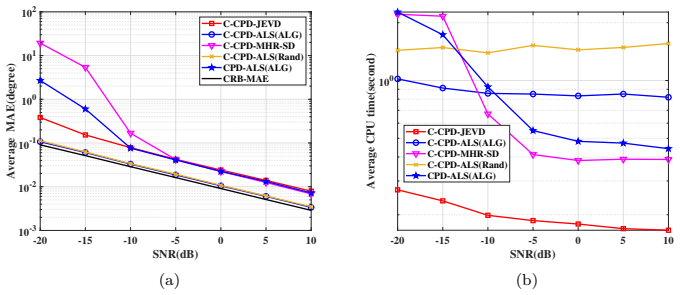
- Using the J-EVD result to initialize optimization-based C-CPD (alternating least squares or nonlinear least squares) improves accuracy and convergence relative to random initialization, as shown in the simulations.
- Fusing DOA lines from multiple receive arrays gives each target's position through a least-squares closest-point calculation.
Reading between the lines
- The same shift-invariance construction should transfer to other sparse geometries whose local subarrays are Vandermonde, such as nested or super-nested arrays, because the derivation uses only the rotational invariance of each subarray and not the specific coprime pair; the paper does not make this extension.
- The asserted generic equivalence between linear independence of $M^{(m,1)}$ and the working conditions (13)/(26) is unproven; a rank-deficient counterexample would not break the J-EVD idea but would force a sharper identifiability condition.
- Since $B$ carries transmit-pulse structure, the same decomposition could in principle yield direction-of-departure estimates from $B$ as well, enabling full bistatic localization from a single algebraic pass; the paper uses only DOA fusion.
- A testable practical prediction is that the method's advantage over virtual-array approaches grows as the number of pulses $K$ shrinks, because it never estimates second-order statistics; a benchmark with very small $K$ would make this explicit.
Editorial analysis
A structured set of objections, weighed in public.
Referee Report
Summary. The paper proposes tensor-based target localization for multistatic MIMO radar with two coprime array geometries: coprime L-shaped arrays (CPLsA) and coprime planar arrays (CPPA). The received data from multiple receive arrays are stacked into tensors that jointly admit a coupled canonical polyadic decomposition (C-CPD) model with a common factor matrix B. The authors exploit the Vandermonde structure of the local sparse uniform linear subarrays to construct four per-array 'target matrices' from shift-invariant submatrices, show that each target matrix equals B Z B^{-1} for a diagonal matrix Z of the corresponding Vandermonde generators, and then solve for B using a joint eigenvalue decomposition (J-EVD) implemented via GEVD/SGSD. The recovered factor matrices are used to estimate DOAs and fuse them into target locations. The paper also states working conditions for the algorithm (Remarks 1 and 5), analyzes computational complexity, and reports simulations comparing the proposed J-EVD-based C-CPD, ALS-refined versions, and existing tensor baselines in both overdetermined and underdetermined scenarios.
Significance. If the central claim holds, the paper contributes a low-complexity, semi-algebraic alternative to simultaneous-diagonalization-based C-CPD for multistatic MIMO radar with coprime arrays, with the attractive feature that it does not require prior knowledge of non-orthogonal probing waveforms. The complexity analysis and the simulations show a clear computational advantage for the J-EVD initialization, and the equal-length subarray configurations used in the experiments are the favorable case in which the algebraic construction is valid. However, because the general rank-condition issue affects the correctness of the target matrices for arbitrary coprime subarray lengths, the significance is conditional on a fix that either selects only valid target matrices or proves that all matrices passed to the J-EVD are of the claimed form.
major comments (2)
- [Section 3.1, Eqs. (9)-(12) and Remark 1; Section 3.2, Eqs. (22)-(25) and Remark 5] The derivation of G^(m)_v = B Z^(m)_v B^{-1} rests on the full-column-rank assumption of M^(m,1); when M^(m,1) is rank deficient, (M^(m,1))^† M^(m,1) is a non-identity projector and the equality in (11)/(24) no longer holds. Remark 1 (and Remark 5) require only that at least one of the four matrices per receive array have full column rank, but Algorithm 1 (and Algorithm 2) construct all four G^(m)_v and pass all of them to the J-EVD formulation (14)-(18), which models every slice as B diag(F'(w,:)) D^T. For a coprime array with unequal subarray lengths, condition (13) with I' equal to the maximum subarray length does not prevent a shorter subarray from having (I^(m)_x,2 - 1)K < R, in which case M^(m,1)_x,2 and the corresponding G^(m)_2 are invalid. The simulations use equal subarray lengths for which all four constructed matrices are valid, so the experiments do not exercise this failure mode. The central claim that the C-CPD is solved by J-EVD is therefore not established for the general configurations described in Section 2. Please modify the algorithm to select only target matrices known to be valid (e.g., by rank checking or by constructing only the largest subarray) and state the conditions under which that selection is possible, or prove that all four matrices are full rank under the stated working conditions.
- [Section 3.1, Remark 1, and Section 3.2, Remark 5] The statement that full column rank of at least one of the Khatri-Rao product matrices is 'generically equivalent' to conditions (13)/(26), and the claim that these are 'generic sufficient uniqueness conditions', are asserted without proof. The row-count conditions (I'-1)K >= R and I''K >= R are, at most, generic conditions for full column rank of the relevant Khatri-Rao product; they do not by themselves establish uniqueness of the C-CPD in (5), which requires additional conditions on the factor matrices. The equivalence of the full-column-rank event for one of the matrices and the stated inequalities should be proved, and the uniqueness claim should be either proved or replaced by a statement about algorithmic well-posedness.
minor comments (5)
- [Section 1, Notations] The definition of the matrices A^(1) and A^(1) (with the first/last row removed) is not typeset clearly; please use explicit overline/underline notation or A^+ and A^- to avoid ambiguity.
- [Section 3.1, Remark 3] The statement that setting eta = 1 'ensures the exactness of the constraint B·D^T = I' is not correct in general, because (16) is a regularized least-squares problem with a finite weight and the constraint is only approximately enforced; please clarify, e.g., that exact enforcement occurs only when the data residual can be driven to zero, or discuss how larger eta approximates the constraint.
- [Section 4] The text often refers to 'the proposed method' when the figures show that C-CPD-ALS(ALG) has the best MAE while C-CPD-JEVD is the fastest; please separate claims about the algebraic J-EVD method from claims about the full pipeline initialized by it.
- [Section 2] The symbol M is used both for the number of receive arrays and for the coprime integer M^(m)_x in the subarray spacing; this is confusing and should be disambiguated.
- [Throughout] The extracted text contains numerous typographical artifacts (e.g., 'Coprime' vs 'Coupled' in the keywords, garbled set definitions, unreadable bars on matrices); the final manuscript should be carefully proofread and the mathematical notation rendered cleanly.
Circularity Check
No circularity found: the J-EVD construction follows algebraically from the Vandermonde shift-invariance and the simulations use external baselines.
full rationale
The central derivation is self-contained and algebraic rather than circular. The key step constructs G_v^(m) = [(M^(m,1))^† M^(m,2)]^T and shows G_v^(m) = B Z_v^(m) B^(-1) using the Vandermonde shift-invariance A_down ⊙ C = (A_up ⊙ C) Z together with the full-column-rank assumption on M^(m,1). This is a direct matrix identity, not an input-output tautology: the target matrices are built from data, not from the factor matrix B being estimated. The subsequent J-EVD formulation (14)-(18) is a reformulation of that identity into a structured CPD, and no fitted parameter is later renamed as a prediction. The simulations compare against external baselines (C-CPD-MHR-SD from [22], Tensorlab-based ALS/SD methods, and CRB-MAE), so there is no fitting-to-prediction loop. Self-citations such as [6], [28], and [29] are used only for standard dimensionality reduction, optimization details, and DOA fusion; none of these citations predetermines the proposed J-EVD construction or its working conditions. The rank-condition concern raised in Remarks 1 and 5 (that only one M^(m,1) matrix is guaranteed to have full column rank while all four G_v are fed into J-EVD) is a correctness and robustness gap, not a circularity: it does not make the output equivalent to the input by construction. Therefore, the paper exhibits no significant circularity.
Assumptions & free parameters
free parameters (1)
- regularization coefficient eta =
1
assumptions (5)
- domain assumption A1-A6: far-field targets, narrowband signals, multiple pulses per CPI, Swerling II RCS, distinct DODs/DOAs per target, no angle ambiguity.
- domain assumption Factor matrix B = S T has full column rank and can be reduced to R x R by dimensionality reduction, requiring min(T, J) >= R.
- ad hoc to paper Generic full column rank of the Khatri-Rao product matrices M(m,1) is equivalent to the row-count working conditions (13) and (26).
- domain assumption The number of targets R is known and used as algorithm input.
- domain assumption The GEVD and SGSD routines from Tensorlab solve the structured CPD (14) correctly and provide the desired J-EVD.
Cite this review
Pith. "Pith review of Target Localization with Coprime Multistatic MIMO Radar via Coupled Canonical Polyadic Decomposition Based on Joint Eigenvalue Decomposition." pith.science (2026). https://pith.science/paper/JDJBTEWN
@misc{pith2026250521965,
  author       = {Pith},
  title        = {Pith review of: Target Localization with Coprime Multistatic MIMO Radar via Coupled Canonical Polyadic Decomposition Based on Joint Eigenvalue Decomposition},
  year         = {2026},
  howpublished = {\url{https://pith.science/paper/JDJBTEWN}},
  note         = {Machine review of arXiv:2505.21965}
}
read the original abstract
This paper investigates target localization using a multistatic multiple-input multiple-output (MIMO) radar system with two distinct coprime array configurations: coprime L-shaped arrays and coprime planar arrays. The observed signals are modeled as tensors that admit a coupled canonical polyadic decomposition (C-CPD) model. For each configuration, a C-CPD method is presented based on joint eigenvalue decomposition (J-EVD). This computational framework includes (semi-)algebraic and optimization-based C-CPD algorithms and target localization that fuses direction-of-arrivals (DOAs) information to calculate the optimal position of each target. Specifically, the proposed (semi-)algebraic methods exploit the rotational invariance of the Vandermonde structure in coprime arrays, similar to the multiple invariance property of \added{estimation of signal parameters via rotational invariance techniques} (ESPRIT), which transforms the model into a J-EVD problem and reduces computational complexity. The study also investigates the working conditions of the algorithm to understand model identifiability. Additionally, the proposed method does not rely on prior knowledge of non-orthogonal probing waveforms and is effective in challenging underdetermined scenarios. Experimental results demonstrate that our method outperforms existing tensor-based approaches in both accuracy and computational efficiency.
Figures


Figures from the paper (5 more)




Reference graph
Works this paper leans on
-
[1]
D. Nion, N. D. Sidiropoulos, Tensor algebra and multidimensional har- monic retrieval in signal processing for mimo radar, IEEE Trans. Signal Process. 58 (11) (2010) 5693–5705
work page 2010
-
[2]
H. Chen, F. Ahmad, S. Vorobyov, F. Porikli, Tensor decompositions in wireless communications and mimo radar, IEEE J. Sel. Top. Signal Process. 15 (3) (2021) 438–453
work page 2021
-
[3]
N. D. Sidiropoulos, L. D. Lathauwer, X. Fu, K. Huang, E. E. Papalex- akis, C. Faloutsos, Tensor decomposition for signal processing and ma- chine learning, IEEE Trans. Signal Process. 65 (13) (2017) 3551–3582
work page 2017
-
[4]
J. Liu, H. Li, B. Himed, Two target detection algorithms for passive multistatic radar, IEEE Trans. Signal Process. 62 (22) (2014) 5930– 5939
work page 2014
-
[5]
Chernyak, Multisite radar systems composed of mimo radars, IEEE Aerosp
V. Chernyak, Multisite radar systems composed of mimo radars, IEEE Aerosp. Electron. Syst. Mag. 29 (12) (2014) 28–37
work page 2014
-
[6]
X.-F. Gong, C.-Y. Xu, R.-X. Chen, Q.-H. Lin, Multistatic mimo radar target localization via coupled canonical polyadic decomposition, Signal Process. 201 (2022) 108716
work page 2022
-
[7]
W. Liu, M. Haardt, M. S. Greco, C. F. Mecklenbr¨ auker, P. Willett, Twenty-five years of sensor array and multichannel signal processing: a review of progress to date and potential research directions, IEEE Signal Process. Mag. 40 (4) (2024) 80–91
work page 2024
-
[8]
Y. Fang, S. Zhu, B. Liao, X. Li, G. Liao, Target localization with bistatic mimo and fda-mimo dual-mode radar, IEEE Trans. Aerosp. Electron. Syst. 60 (1) (2024) 952–964
work page 2024
Show all 35 references
-
[9]
Liao, X.-F
G.-Z. Liao, X.-F. Gong, Q.-H. Lin, Target localization based on multi- static mimo radar via double coupled canonical polyadic decomposition, in: Proc. IEEE Int. Conf. Acoust., Speech, Signal Process. (ICASSP), Seoul, Republic of Korea, 2024, pp. 6845–6849. 29
2024
-
[10]
P. P. Vaidyanathan, P. Pal, Sparse sensing with co-prime samplers and arrays, IEEE Trans. Signal Process. 59 (2) (2011) 573–586
2011
-
[11]
S. Qin, Y. D. Zhang, M. G. Amin, Generalized coprime array configu- rations for direction-of-arrival estimation, IEEE Trans. Signal Process. 63 (6) (2015) 1377–1390
2015
-
[12]
C.-L. Liu, P. P. Vaidyanathan, Super nested arrays: linear sparse ar- rays with reduced mutual coupling—part i: fundamentals, IEEE Trans. Signal Process. 64 (15) (2016) 3997–4012
2016
-
[13]
Q. Shen, W. Liu, W. Cui, S. Wu, Extension of co-prime arrays based on the fourth-order difference co-array concept, IEEE Signal Process. Lett. 23 (5) (2016) 615–619
2016
-
[14]
J. Shi, G. Hu, X. Zhang, F. Sun, H. Zhou, Sparsity-based two- dimensional doa estimation for coprime array: from sum–difference coar- ray viewpoint, IEEE Trans. Signal Process. 65 (21) (2017) 5591–5604
2017
-
[15]
Z. Shi, C. Zhou, Y. Gu, N. Goodman, F. Qu, Source estimation using coprime array: a sparse reconstruction perspective, IEEE Sens. J. 17 (3) (2017) 755–765
2017
-
[16]
C. Zhou, Y. Gu, X. Fan, Z. Shi, G. Mao, Y. D. Zhang, Direction-of- arrival estimation for coprime array via virtual array interpolation, IEEE Trans. Signal Process. 66 (22) (2018) 5956–5971
2018
-
[17]
Zheng, Z
H. Zheng, Z. Shi, C. Zhou, M. Haardt, J. Chen, Coupled coarray ten- sor cpd for doa estimation with coprime l-shaped array, IEEE Signal Process. Lett. 28 (2021) 1545–1549
2021
-
[18]
Zhang, Z
X. Zhang, Z. Zheng, W.-Q. Wang, H. C. So, Joint dod and doa esti- mation of coherent targets for coprime mimo radar, IEEE Trans. Signal Process. 71 (2023) 1408–1420
2023
-
[19]
F. Xu, H. Zheng, S. A. Vorobyov, Tensor-based 2-d doa estimation for l-shaped nested array, IEEE Trans. Aerosp. Electron. Syst. 60 (1) (2024) 604–618
2024
-
[20]
Sørensen, L
M. Sørensen, L. D. Lathauwer, Multiple invariance esprit for nonuniform linear arrays: a coupled canonical polyadic decomposition approach, IEEE Trans. Signal Process. 64 (14) (2016) 3693–3704
2016
-
[21]
Sørensen, L
M. Sørensen, L. D. Lathauwer, Multidimensional harmonic retrieval via coupled canonical polyadic decomposition—part i: Model and identifia- bility, IEEE Trans. Signal Process. 65 (2) (2017) 517–527
2017
-
[22]
Sørensen, L
M. Sørensen, L. D. Lathauwer, Multidimensional harmonic retrieval via coupled canonical polyadic decomposition—part ii: Algorithm and mul- tirate sampling, IEEE Trans. Signal Process. 65 (2) (2017) 528–539. 30
2017
-
[23]
Sørensen, I
M. Sørensen, I. Domanov, L. D. Lathauwer, Coupled canonical polyadic decompositions and multiple shift invariance in array processing, IEEE Trans. Signal Process. 66 (14) (2018) 3665–3680
2018
-
[24]
N. D. Sidiropoulos, R. Bro, G. B. Giannakis, Parallel factor analysis in sensor array processing, IEEE Trans. Signal Process. 48 (8) (2000) 2377–2388
2000
-
[25]
Haardt, J
M. Haardt, J. Nossek, Simultaneous schur decomposition of several non- symmetric matrices to achieve automatic pairing in multidimensional harmonic retrieval problems, IEEE Trans. Signal Process. 46 (1) (1998) 161–169
1998
-
[26]
Swindlehurst, B
A. Swindlehurst, B. Ottersten, R. Roy, T. Kailath, Multiple invariance esprit, IEEE Trans. Signal Process. 40 (4) (1992) 868–881
1992
-
[27]
Swerling, Probability of detection for fluctuating targets, IRE Trans
P. Swerling, Probability of detection for fluctuating targets, IRE Trans. Inf. Theory 6 (2) (1960) 269–308
1960
-
[28]
Gong, Q.-H
X.-F. Gong, Q.-H. Lin, F.-Y. Cong, L. D. Lathauwer, Double coupled canonical polyadic decomposition for joint blind source separation, IEEE Trans. Signal Process. 66 (13) (2018) 3475–3490
2018
-
[29]
Gong, Q.-H
X.-F. Gong, Q.-H. Lin, F.-Y. Cong, L. D. Lathauwer, Double coupled canonical polyadic decomposition of third-order tensors: algebraic algo- rithm and relaxed uniqueness conditions, Signal Process.: Image Com- mun. 73 (2019) 22–36
2019
-
[30]
Vervliet, O
N. Vervliet, O. Debals, L. Sorber, M. Van Barel, L. De Lathauwer, Tensorlab 3.0, available online. (Mar. 2016). URL https://www.tensorlab.net
2016
-
[31]
Sørensen, I
M. Sørensen, I. Domanov, L. D. Lathauwer, Coupled canonical polyadic decompositions and (coupled) decompositions in multilinear rank-(lr,n, lr,n, 1) terms—part ii: Algorithms, SIAM J. Matrix Anal. Appl. 36 (3) (2015) 1015–1045
2015
-
[32]
Sørensen, L
M. Sørensen, L. D. Lathauwer, Coupled canonical polyadic decompo- sitions and (coupled) decompositions in multilinear rank-(lr,n, lr,n, 1) terms—part i: Uniqueness, SIAM J. Matrix Anal. Appl. 36 (2) (2015) 496–522
2015
-
[33]
Sorber, M
L. Sorber, M. Van Barel, L. De Lathauwer, Structured data fusion, IEEE J. Sel. Top. Signal Process. 9 (4) (2015) 586–600
2015
-
[34]
Hendrikx, M
S. Hendrikx, M. Bouss´ e, N. Vervliet, M. Vandecappelle, R. Kenis, L. De Lathauwer, Tensorlab +, available online, Version of Dec 2022 downloaded from https://www.tensorlabplus.net
2022
-
[35]
L. D. Lathauwer, A link between the canonical decomposition in multi- 31 linear algebra and simultaneous matrix diagonalization, SIAM J. Matrix Anal. Appl. 28 (3) (2006) 642–666. 32
2006
Reviewed August 7, 2026 · model on record in the stance chip above.
Discussion (0). Sign in to comment.