REVIEW 5 major objections 5 minor 18 references
Enhanced SIRRT*: A Structure-Aware RRT* for 2D Path Planning with Hybrid Smoothing and Bidirectional Rewiring
T0 review · 5 major / 5 minor · reviewed 2026-08-07 · deepseek-v4-flash
Pith's one-line read E-SIRRT* claims faster, more stable 2D planning by spline-smoothing the skeleton path and rewiring the tree bidirectionally.
desk verdict A modest, clearly described extension of SIRRT* whose convergence-rate claim is confounded by an asymmetric iteration budget; worth revising rather than rejecting. read the letter →
The pith
A machine-rendered reading of the paper's core claim, the machinery that carries it, and where it could break.
The reading
What carries the argument
The central mechanism is a pipeline: morphological thinning extracts the medial-axis skeleton of the grid map; Harris corner detection identifies salient nodes; Prim's algorithm builds a minimum spanning tree over those nodes plus start and goal; and tracing the MST gives the initial path. Two refinements then carry the argument: hybrid path smoothing fits independent natural cubic splines to the x and y coordinates of the subsampled path (solved via a tridiagonal system with the Thomas algorithm) and replaces any spline segment that collides with an obstacle by the nearest feasible point from the original MST path; bidirectional rewiring then iterates over the smoothed path's points, in each neighborhood attempting forward rewiring (make the path point the parent of a cheaper neighbor) and reverse rewiring (make a neighbor the parent of the path point) whenever the edge is collision-free and lowers cost-to-come. These two steps are what convert an unrefined deterministic skeleton path into a high-quality initial solution for informed sampling.
What would settle it
Run IRRT* and E-SIRRT* with identical total iteration budgets (or equal wall-clock time) on the same two maps, and record final cost; if IRRT*'s average final cost matches or beats E-SIRRT* once its initial-discovery iterations are counted, the claimed convergence advantage would fail. A second check: compute the true optimal path cost in each map and compare how close each planner's deterministic initial cost comes to it, which would reveal whether skeleton-based initialization is actually a better heuristic.
Extended reading notes
Core claim
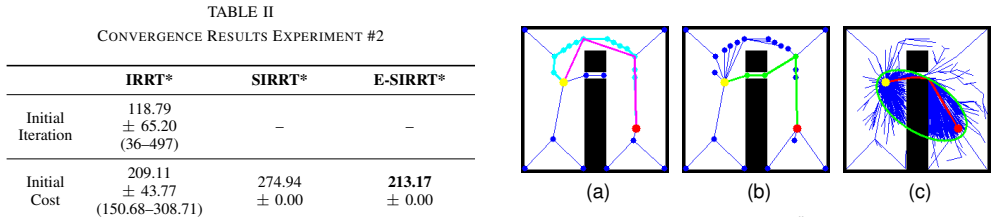
The central claim is that the quality of the initial path and tree, not the sampling strategy during optimization, is what limits RRT*-style planners in practice. E-SIRRT* therefore spends a deterministic preprocessing stage building a minimum spanning tree over skeleton corner points, extracting a path, and then applying hybrid path smoothing (cubic spline fitting followed by collision-aware correction) and bidirectional rewiring before any informed sampling begins. The paper argues that this yields a refined initial path embedded in a tree whose cost structure matches the smoothed geometry, so the subsequent ellipsoidal informed sampling starts from a better cost heuristic and propagates improvements more efficiently. Experimentally, E-SIRRT* achieves an initial cost of 1301.84 (Experiment #1) and 213.17 (Experiment #2), each with zero variance across 100 trials, compared with variable IRRT* initial costs averaging 1531.91 and 209.11, and final costs of 1276.05 and 145.23, the lowest or tied-lowest among the three planners.
Load-bearing premise
The comparison assumes that a fixed number of post-initial optimization iterations is a fair budget, even though IRRT* spends a highly variable number of iterations (356 to 7162 in one experiment) finding its first solution before that budget begins.
Editorial extensions
If this is right
- Initial solution cost becomes deterministic, so mission planners can predict path quality before optimization begins.
- Because the informed ellipsoid is defined by the initial cost, a cheaper smoothed initial path yields a tighter sampling region and faster convergence within a fixed iteration budget.
- The smoothing and rewiring steps are independent of the informed-sampling core and could be grafted onto any skeleton-based planner.
- Lower variance across trials makes the planner suitable for applications requiring repeatable behavior, such as benchmarking and safety certification.
- The approach inherits RRT*'s asymptotic optimality since the optimization phase is unchanged, with the enhancements only altering the starting tree.
Reading between the lines
- I infer that the fixed post-initial iteration budget comparison favors deterministic initialization: IRRT* spends on average 1922 (and up to 7162) iterations just to discover its first solution in Experiment #1, while E-SIRRT* starts optimization immediately, so a fairer test would equalize total computation or wall-clock time.
- The collision-aware correction may reinsert sharp corners exactly where the spline fails, so part of the smoothing benefit could be lost in cluttered environments; a metric separating spline-only length from post-correction length would test this.
- The method's advantage depends on the medial-axis skeleton being a meaningful guide; in maps where the skeleton misleads (e.g., wide-open spaces or a corridor off the optimal route), the deterministic initial path could be worse on average than a random one, and the reported gains may not transfer.
- A natural extension is to apply the same two-stage refinement to higher-dimensional skeletons or topological graphs, though the spline-correction step would then need a distance-aware fallback rather than a simple nearest-point search.
Editorial analysis
A structured set of objections, weighed in public.
Referee Report
Summary. The manuscript proposes Enhanced SIRRT* (E-SIRRT*), a structure-aware 2D path planner that builds on the authors' earlier SIRRT* method. It initializes a tree from the medial-axis skeleton via an MST, refines the extracted path with cubic-spline fitting plus collision-aware correction, and rewires the tree around the smoothed path in both directions before running informed RRT* optimization. Against IRRT* and SIRRT* over 100 trials in two grid maps, the paper claims consistently better initial path cost, faster convergence, and lower variance. The central evidence is Tables I-II and Figs. 5-6.
Significance. If the claims were supported, the paper would offer a practically useful recipe for combining deterministic structural initialization with geometric refinement, and the reported zero-variance initial cost would be a genuine repeatability advantage in planning systems. The algorithms are described in enough detail to be reimplemented, and the two environments include a narrow-passage test. However, the current experimental design does not establish the headline convergence-rate claim, no ablation isolates the two proposed mechanisms, and several free parameters are unreported, so the significance is contingent on the authors addressing these issues.
major comments (5)
- [V.A] The fixed post-initial iteration budget makes the convergence comparison unfair. In Tables I-II, IRRT* spends a mean of 1922.38 iterations (up to 7162) finding its first solution in Experiment #1 and 118.79 iterations in Experiment #2, while the SIRRT* and E-SIRRT* rows show no corresponding initial-iteration count; the deterministic skeletonization, MST construction, spline fitting, collision correction, and rewiring of E-SIRRT* are performed before the plotted optimization phase and are not charged to the iteration budget. The plotted metric is therefore cost level after a fixed number of optimization iterations from different starting points, not convergence rate. Please report total computation time or total iterations including initialization, and compare per-iteration cost slopes or time-to-reach fixed cost thresholds.
- [Tables I-II] The final-cost data do not support 'faster convergence.' In Experiment #1 the final costs are 1276.05 (E-SIRRT*), 1276.33 (IRRT*), and 1276.84 (SIRRT*), with overlapping standard deviations; in Experiment #2 they are 145.23, 145.25, and 145.37, also overlapping. After 20,000 iterations the remaining gap in Fig. 5 is essentially the initial-cost difference (1301.84 vs 1531.91/1484.38), not a demonstrated faster per-iteration improvement. The paper should report cost at several intermediate iteration budgets with confidence intervals and a paired significance test (e.g., Wilcoxon signed-rank), and should avoid claiming convergence-rate superiority from these data.
- [IV (Algorithms 1 and 4)] No ablation isolates the two proposed enhancements. The paper attributes its improvements to hybrid path smoothing (Algorithm 1) and bidirectional rewiring (Algorithm 4), but every experiment uses both together. Add SIRRT* + smoothing-only and SIRRT* + rewiring-only configurations; without these, it is impossible to tell whether the initial-cost gain comes from smoothing, rewiring, or the interaction. In addition, because Section II cites BIT* and ABIT* as state of the art, at least one such modern baseline should be included or the scope of the 'consistent outperformance' claim should be narrowed to IRRT* and SIRRT* only.
- [IV.A.2 (Eq. (2), Algorithm 2)] The cubic-spline system as written appears internally inconsistent. If M_i are the second derivatives at the knots, the standard continuity equation is h/6 M_{i-1} + 2h/3 M_i + h/6 M_{i+1} = (z_{i+1}-z_i)/h - (z_i-z_{i-1})/h, and in representation (1) the coefficient c_i should be M_i/2 to give s_i''(u_i)=M_i. Algorithm 2 instead sets A = (1/h) tridiag(1,4,1), b_i = 3[(z_{i+1}-z_i)/h - (z_i-z_{i-1})/h], and c_i = M_i, which is not the natural cubic spline stated. Please derive the system from the stated C2 conditions or correct the coefficients; as written, the smoothing stage cannot be reproduced from the description.
- [V.A and Algorithm inputs] Several free parameters needed to reproduce the experiments are not reported: the subsampling interval d and interpolation count N in Algorithm 1, the neighborhood radius in FIND NEIGHBORS in Algorithm 4, the Harris-corner and morphological-thinning parameters, and the collision-checking resolution. The paper also does not state the values used in Tables I-II or provide sensitivity analysis. Without these values, the numerical comparisons are not reproducible and the claimed 'consistent' behavior cannot be checked by other groups.
minor comments (5)
- [IV.A.1] There is an encoding artifact in the text: 'path?s suitability' should read 'path's suitability'.
- [Figs. 5-6] Figure 5 axis labels render the iteration multiplier as '104'; this should be formatted as 10^4, and Figure 6's horizontal axis begins at 200 rather than 0, making the two convergence plots visually inconsistent.
- [Algorithm 2] The line 'Compute Mi = s''_i(u_i)' refers to the spline coefficients before the representation is fully defined; state that M is the solution of the tridiagonal system before interpreting it as a second derivative.
- [Abstract and Section V.B] The abstract's 'consistently outperforms' should be explicitly scoped to the two tested grid maps and to the baselines IRRT* and SIRRT*, since no other environments or planners are tested.
- [Reproducibility] No code, parameter files, or data repository are provided; adding these would materially improve reproducibility, especially given the unreported parameter values noted in the major comments.
Circularity Check
Minor self-definitional robustness claim; central cost and convergence comparisons are not circular.
-
self definitional
[Section V.B (Quantitative Comparison), Tables I and II]
"In contrast, both SIRRT* and E-SIRRT* deterministically generate initial solutions from the grid map skeleton, resulting in zero variance."
Zero variance in the initial cost is a logical consequence of determinism: with the same map, start, and goal, the algorithm must produce the same initial path on every trial. Reporting this as an empirical robustness result restates the definition of the method rather than providing independent evidence. The same tautology appears in the abstract's claim that deterministic initialization yields 'repeatable and efficient performance.' This does not affect the measured cost reductions or the post-optimization comparisons, which are genuine experimental outputs, so the circularity is confined to the robustness framing.
full rationale
The core derivation of E-SIRRT* is not circular. Hybrid path smoothing and bidirectional rewiring are concrete algorithmic operations whose effects on path cost are measured directly in experiments, not predicted from fitted parameters. The final costs in Tables I and II are not obtained by fitting the method to match the baselines; they are reported trial outcomes on fixed environments. The comparison against SIRRT* does invoke the author's own prior work [5], but that self-citation is used as a baseline and a starting point, not as an unverified theorem that forces the result. No uniqueness theorem is imported, and no parameter is fitted to a subset of data and then renamed as a prediction. The only by-construction element is the zero-variance claim for deterministic initialization, which is a definitional consequence rather than an empirical finding. A more serious concern is that the convergence comparison uses a fixed post-initial iteration budget while excluding the uncounted preprocessing cost of SIRRT*/E-SIRRT* and including IRRT*'s initial exploration iterations; that is an experimental-design limitation affecting the fairness of the convergence-rate claim, but it is not circularity in the derivation chain. Overall, the paper's central cost comparisons have independent empirical content, warranting a low circularity score.
Assumptions & free parameters
free parameters (5)
- subsampling interval d =
not reported
- number of spline interpolation intervals N =
not reported
- rewiring radius for FIND NEIGHBORS =
not reported
- informed optimization iteration counts =
20,000 (Exp. 1), 2,000 (Exp. 2)
- skeletonization and Harris corner detection parameters =
not reported
assumptions (4)
- domain assumption The skeleton/MST-derived initial path is a reasonable basis for informed optimization in 2D grid maps.
- domain assumption The natural cubic spline with uniform parameterization preserves enough geometry of the original path after collision-aware correction.
- domain assumption Bidirectional rewiring around the smoothed path improves cost propagation without harming asymptotic optimality.
- domain assumption The two benchmark environments are representative of relevant planning scenarios.
invented entities (1)
-
E-SIRRT* (Enhanced SIRRT*)
Cite this review
Pith. "Pith review of Enhanced SIRRT*: A Structure-Aware RRT* for 2D Path Planning with Hybrid Smoothing and Bidirectional Rewiring." pith.science (2026). https://pith.science/paper/7H7QFRYP
@misc{pith2026250521968,
  author       = {Pith},
  title        = {Pith review of: Enhanced SIRRT*: A Structure-Aware RRT* for 2D Path Planning with Hybrid Smoothing and Bidirectional Rewiring},
  year         = {2026},
  howpublished = {\url{https://pith.science/paper/7H7QFRYP}},
  note         = {Machine review of arXiv:2505.21968}
}
read the original abstract
Sampling-based motion planners such as Rapidly-exploring Random Tree* (RRT*) and its informed variant IRRT* are widely used for optimal path planning in complex environments. However, these methods often suffer from slow convergence and high variance due to their reliance on random sampling, particularly when initial solution discovery is delayed. This paper presents Enhanced SIRRT* (E-SIRRT*), a structure-aware planner that improves upon the original SIRRT* framework by introducing two key enhancements: hybrid path smoothing and bidirectional rewiring. Hybrid path smoothing refines the initial path through spline fitting and collision-aware correction, while bidirectional rewiring locally optimizes tree connectivity around the smoothed path to improve cost propagation. Experimental results demonstrate that E-SIRRT* consistently outperforms IRRT* and SIRRT* in terms of initial path quality, convergence rate, and robustness across 100 trials. Unlike IRRT*, which exhibits high variability due to stochastic initialization, E-SIRRT* achieves repeatable and efficient performance through deterministic skeleton-based initialization and structural refinement.
Figures


Figures from the paper (3 more)


Reference graph
Works this paper leans on
-
[1]
Anytime motion planning using the rrt,
S. Karaman, M. R. Walter, A. Perez, E. Frazzoli, and S. Teller, “Anytime motion planning using the rrt,” in 2011 IEEE international conference on robotics and automation. IEEE, 2011, pp. 1478–1483. 0.5 1 1.5 2 Iteration (Post-Initial) 104 1250 1300 1350 1400 1450 1500Path Cost Best Path Cost IRRT* SIRRT* E-SIRRT* (a) 0.5 1 1.5 2 Iteration (Post-Initial) 1...
work page 2011
-
[2]
Rrt-connect: An efficient approach to single-query path planning,
J. J. Kuffner and S. M. LaValle, “Rrt-connect: An efficient approach to single-query path planning,” in Proceedings 2000 ICRA. Millennium conference. IEEE international conference on robotics and automa- tion. Symposia proceedings (Cat. No. 00CH37065) , vol. 2. IEEE, 2000, pp. 995–1001
work page 2000
-
[3]
Sampling-based algorithms for optimal motion planning,
S. Karaman and E. Frazzoli, “Sampling-based algorithms for optimal motion planning,” The international journal of robotics research , vol. 30, no. 7, pp. 846–894, 2011
2011
-
[4]
Asymptotically optimal sampling- based motion planning methods,
J. D. Gammell and M. P. Strub, “Asymptotically optimal sampling- based motion planning methods,” Annual Review of Control, Robotics, and Autonomous Systems , vol. 4, no. 1, pp. 295–318, 2021
work page 2021
-
[5]
Improved informed rrt* using gridmap skele- tonization for mobile robot path planning,
H. Ryu and Y . Park, “Improved informed rrt* using gridmap skele- tonization for mobile robot path planning,” International Journal of Precision Engineering and Manufacturing , vol. 20, no. 11, pp. 2033– 2039, 2019
work page 2019
-
[6]
J. D. Gammell, S. S. Srinivasa, and T. D. Barfoot, “Informed rrt*: Optimal sampling-based path planning focused via direct sampling of an admissible ellipsoidal heuristic,” in IEEE/RSJ International Conference on Intelligent Robots and Systems (IROS), 2014, pp. 2997– 3004
work page 2014
-
[7]
Informed rrt*-connect: An asymptotically optimal single-query path planning method,
R. Mashayekhi, M. Y . I. Idris, M. H. Anisi, I. Ahmedy, and I. Ali, “Informed rrt*-connect: An asymptotically optimal single-query path planning method,” IEEE Access, vol. 8, pp. 19 842–19 852, 2020
work page 2020
-
[8]
Rrt*-connect: Faster, asymptotically optimal motion planning,
S. Klemm, J. Oberl ¨ander, A. Hermann, A. Roennau, T. Schamm, J. M. Zollner, and R. Dillmann, “Rrt*-connect: Faster, asymptotically optimal motion planning,” in 2015 IEEE international conference on robotics and biomimetics (ROBIO) . IEEE, 2015, pp. 1670–1677
work page 2015
Show all 18 references
-
[9]
An improved informed rrt*-connect algorithm for uavs path planning,
Y . Wang, C. Liu, J. Li, Q. Tang, and Y . Yang, “An improved informed rrt*-connect algorithm for uavs path planning,” in IEEE International Conference on Unmanned Systems (ICUS) , 2024
2024
-
[10]
Neural informed rrt*: Learning-based path planning with point cloud state representations under admissible ellipsoidal constraints,
Z. Huang, H. Chen, J. Pohovey, and K. Driggs-Campbell, “Neural informed rrt*: Learning-based path planning with point cloud state representations under admissible ellipsoidal constraints,” in 2024 IEEE International Conference on Robotics and Automation (ICRA). IEEE, 2024, pp....
2024
-
[11]
Risk-informed-rrt*: A sampling-based human-friendly motion planning algorithm for mobile service robots in indoor environments,
W. Chi, J. Wang, and M. Q.-H. Meng, “Risk-informed-rrt*: A sampling-based human-friendly motion planning algorithm for mobile service robots in indoor environments,” in 2018 IEEE international conference on information and automation (ICIA) . IEEE, 2018, pp. 1101–1106
2018
-
[12]
Rbi-rrt*: Efficient sampling-based path planning for high-dimensional state space,
F. Chen, Y . Zheng, Z. Wang, W. Chi, and S. Liu, “Rbi-rrt*: Efficient sampling-based path planning for high-dimensional state space,” in 2024 IEEE International Conference on Robotics and Automation (ICRA). IEEE, 2024, pp. 8721–8727
2024
-
[13]
Am-rrt*: Informed sampling-based planning with assisting metric,
D. Armstrong and A. Jonasson, “Am-rrt*: Informed sampling-based planning with assisting metric,” in 2021 IEEE International Confer- ence on Robotics and Automation (ICRA) . IEEE, 2021, pp. 10 093– 10 099
2021
-
[14]
Batch informed trees (bit*): Informed asymptotically optimal anytime search,
J. D. Gammell, T. D. Barfoot, and S. S. Srinivasa, “Batch informed trees (bit*): Informed asymptotically optimal anytime search,” The International Journal of Robotics Research , vol. 39, no. 5, pp. 543– 567, 2020
2020
-
[15]
Advanced bit*(abit*): Sampling- based planning with advanced graph-search techniques,
M. P. Strub and J. D. Gammell, “Advanced bit*(abit*): Sampling- based planning with advanced graph-search techniques,” in 2020 IEEE International Conference on Robotics and Automation (ICRA). IEEE, 2020, pp. 130–136
2020
-
[16]
T. H. Cormen, C. E. Leiserson, R. L. Rivest, and C. Stein, Introduction to Algorithms, 3rd ed. MIT Press, 2009
2009
-
[17]
Quarteroni, F
A. Quarteroni, F. Saleri, and P. Gervasio, Scientific Computing with MATLAB and Octave , 3rd ed., ser. Texts in Computational Science and Engineering. Springer, 2007, vol. 2
2007
-
[18]
Freiburg-079 Building Corridor Dataset,
MRPT Project, “Freiburg-079 Building Corridor Dataset,” https:// www.mrpt.org/Dataset fr079, 2020, accessed: 2024-05-24
2020
Reviewed August 7, 2026 · model on record in the stance chip above.
Discussion (0). Sign in to comment.