REVIEW 4 major objections 6 minor 36 references
Trade Networks and the Rise of a Dominant Currency
T0 review · 4 major / 6 minor · reviewed 2026-08-07 · deepseek-v4-flash
Pith's one-line read The paper claims that a currency's fate is set by the network centrality of the users who prefer it, not by the issuer's trade volume, through an adoption–liquidity feedback loop.
desk verdict Solid theory paper on how trade network centrality, not trade volume, drives currency adoption; core mechanism is transparent, but proofs are sketched and the linear-quadratic cost is a real limitation. read the letter →
The pith
A machine-rendered reading of the paper's core claim, the machinery that carries it, and where it could break.
The reading
What carries the argument
The central object is the Katz-Bonacich centrality vector $\kappa = (I - \lambda w)^{-1}\mathbf{1}$, which counts all directed paths in the trade-payment network with decay factor $\lambda$; the paper's user equilibrium sets $\lambda = 1/\beta$ and replaces the vector of ones with the marginal-cost-difference vector $\gamma$, making usage differences an adjusted centrality. This linear resolvent identity converts network spillovers into a closed-form mapping from issuer commitments to currency shares, and the same identity, read through a Bellman equation, carries the two-currency result to a setting with finitely many currencies.
What would settle it
Compute each country's settlement-currency Gini coefficient and its Katz-Bonacich centrality in bilateral trade-payment data; if the relationship is flat, or if increasing network integration does not reduce the number of currencies used, the model's core prediction is falsified.
Extended reading notes
Core claim
On the paper's own terms, the equilibrium usage of currencies in a trade network is governed by a feedback loop between users and issuers, and the decisive variable is network position rather than aggregate trade volume. Formally, the usage difference $d_i = x_{ia} - x_{ib}$ satisfies $d = (I - \beta^{-1}w)^{-1}\gamma$, so each user's currency bias is an adjusted Katz-Bonacich centrality weighted by the marginal-cost advantage $\gamma_i = (f_{ia}(e_a) - f_{ib}(e_b))/\beta$. A more central user's choice reaches more trading partners, so that user concentrates on a single currency more strongly; the issuer whose currency it prefers therefore commits more liquidity and captures a larger market share. When users are symmetric, network integration amplifies the incumbent's commitment advantage and reduces the number of international currencies in equilibrium. The Gini coefficient of a user's currency allocation is a sum of adjusted Katz-Bonacich centralities, so central countries concentrate their settlement usage while peripheral countries diversify.
Load-bearing premise
The paper assumes users' cost functions are exactly quadratic (mean-variance preferences), which makes their best responses linear and turns currency concentration into a centrality transform; if actual settlement costs are not quadratic, the proportionality results can fail.
Editorial extensions
If this is right
- A country's settlement-currency concentration should track its Katz-Bonacich centrality in the trade-payment network, with the most central countries showing the most skewed currency portfolios.
- Two currencies can coexist when the cost of providing liquidity is low relative to total demand $M$, and even more so when exchange-rate risk $\beta$ is high, because users want to diversify.
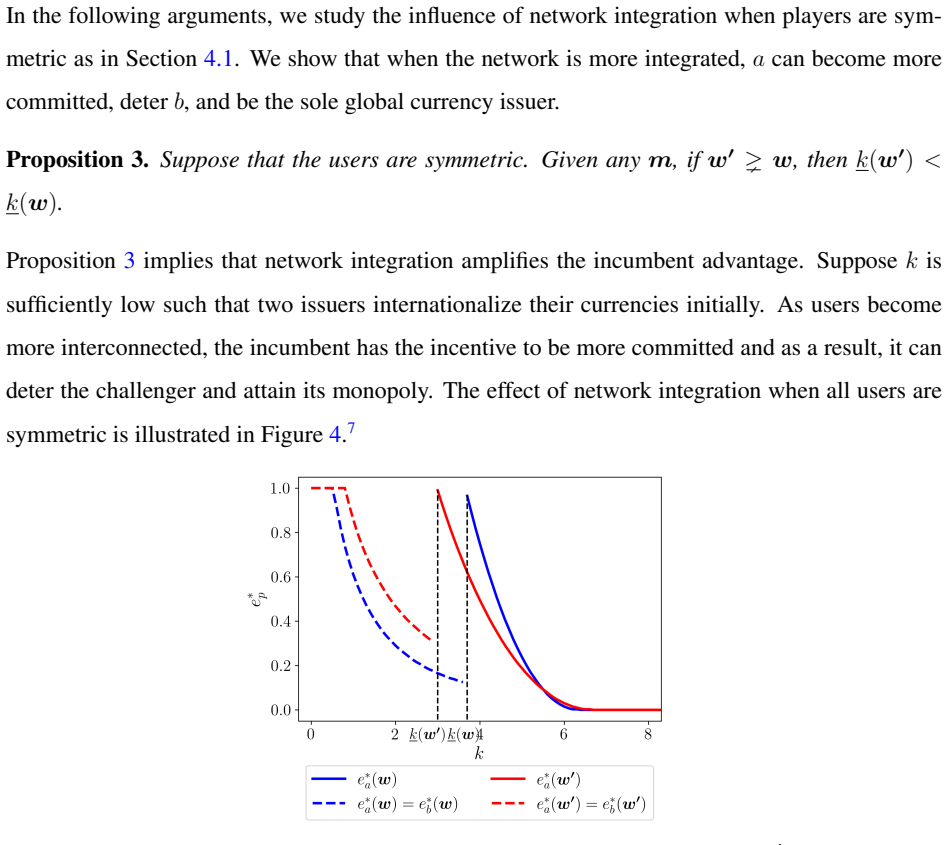
- Deepening trade integration lowers the threshold at which the incumbent deters entry, so a more connected world should see fewer settlement currencies.
- An emerging currency can overtake the incumbent only when network restructuring raises the centrality of a user that prefers it; otherwise the incumbent's first-mover liquidity commitment blocks entry.
- If capital-account openness is itself a commitment to liquidity, then a country's network position endogenously determines how open it will be, making aggregate trade dominance a poor predictor of currency internationalization.
Reading between the lines
- Beyond the paper, the Gini-centrality link suggests an immediate empirical design: compute each country's settlement-currency Gini coefficient from payments data and regress it on Katz-Bonacich centrality in bilateral trade-payment flows, expecting a positive cross-sectional slope.
- Beyond the paper, the model implies that capital-account liberalization is endogenous to network position, so cross-country studies of currency internationalization should treat liberalization as a strategic choice rather than an exogenous policy variable.
- Beyond the paper, the sequential timing is what selects the unique incumbent-deterrence outcome; under simultaneous entry the same model has multiple equilibria, so the theory does not by itself rule out a multipolar outcome under simultaneous competition.
Editorial analysis
A structured set of objections, weighed in public.
Referee Report
Summary. The paper develops a three-stage game in which two currency issuers sequentially choose commitment levels for liquidity provision, and users in a weighted directed trade network allocate a fixed import volume across currencies to minimize a mean-variance cost. The central result is that cross-currency usage differences equal a Katz-Bonacich centrality weighted by liquidity preferences (Lemma 1), leading to predictions: the issuer of the currency preferred by more central users commits more and obtains a larger market share (Proposition 2); network integration strengthens the incumbent's deterrence (Proposition 3); and more central users concentrate their currency holdings, as measured by a Gini coefficient (Proposition 4). The two-currency model is extended to T currencies via a dynamic programming argument.
Significance. If the results hold, the paper offers a tractable theory of how network position, rather than aggregate trade volume, determines international currency adoption, and it generates testable predictions linking centrality to currency concentration. Strengths include closed-form solutions, a clean link to a standard network measure, and an explicit model of issuer commitment. The significance is reduced by the reliance on a linear-quadratic cost structure; the core mechanism is a consequence of linear best responses, and the paper does not demonstrate robustness to non-quadratic costs. Nonetheless, the model is self-contained and the proofs are largely coherent conditional on this structure.
major comments (4)
- [Appendix, Proof of Lemma 3 and Proof of Proposition 1] The construction of the thresholds k and ¯k is not rigorous. The proof asserts monotonicity of ˆea(k) and that the two utility functions intersect at most twice, but no proof is given. The derivative expression for ∂[ua(ea,∅;k)−ua(˜ea,˜eb;k)]/∂k is not signed from the stated formula because ∂ea/∂k and ∂˜eb/∂k are unsigned. In the proof of Proposition 1, the threshold k appears before it is defined, and the comparative statics of k in β and M are argued using values that depend on the threshold itself. These gaps are load-bearing for Proposition 1, which is the paper's main characterization of the incumbent advantage.
- [Section 3.1 and Section 4.2, Eq. (7) and Eq. (17)] The central mechanism is derived from the quadratic cost function, which yields the linear best-response mapping d = (I − w/β)^{-1}γ. Footnote 3 concedes the restriction, but no robustness check shows that the results of Propositions 2 and 4 survive non-quadratic perturbations. For example, adding a small cubic term to the cost would break the linear resolvent representation, and it is not shown that the ranking in Proposition 2 is locally robust. Since the paper claims that network centrality, not trade volume, determines adoption as a general insight, the authors should either provide a perturbation argument or explicitly restrict the claims to the quadratic case.
- [Section 5.2, Proof of Proposition 4] The proof uses the identity x_iτ − x_i,τ+c = Σ d_it, but the subsequent reduction to a sum of t(T−t)|d_it| requires that all d_it have the same sign, i.e., that the currencies are ordered by decreasing usage. Without this ordering, the formula is false. For T=3 and allocations (0.2, 0.5, 0.3), Eq. (14) gives G_i=0.2, while the claimed sum gives 0.333. Because the Gini coefficient is invariant to reordering, the result can be repaired, but as written the statement and its proof are incorrect.
- [Section 5.1, dynamic programming extension] The condition guaranteeing interiority and order-independence of the T-currency solution is not proved. The condition mi,t ≥ sup{m ∈ (0, mi0]: C'_it(m) ≤ C'_{i,t+1}(0)} involves the endogenous state variable mi,t, and it is not shown that it holds for the β ≥ β region. The claim that low β makes the order of currencies matter conflicts with the convexity of the allocation problem, which should yield a unique optimum regardless of order. Since Corollary 1 and Proposition 4 rely on this solution, the T-currency extension is not yet fully rigorous.
minor comments (6)
- [Lemma 1] The term 'Kat-Bonacich' should be 'Katz-Bonacich'.
- [Section 5.1, Eq. (12)] The notation f_t as a vector difference is not defined, and the quantity γt is introduced as 1/β [ft − ft+1] but the subscript t is used both for currency and stage.
- [Proposition 2 proof, after Eq. (17)] The factor in the derivative after Eq. (17) appears to be off by a factor of 2; the correct expression should be (µ−1)(κi−κj) f'(e)/(2β). The conclusion is unaffected since the sign is correct.
- [References] The reference to Kikuchi et al. (2025) lists the university as 'Cornel University'; it should be 'Cornell University'.
- [Figures 2 and 4] The captions of Figures 2 and 4 do not explain what is plotted on the axes, beyond referring to commitment levels and k.
- [Section 2, cost notation] The symbol C_{ip} is used first for the unit cost and then for the total perceived cost; this should be clarified to avoid confusion.
Circularity Check
No significant circularity: all centrality results are derived from the stated quadratic payoff and backward induction, not fitted or assumed.
full rationale
The derivation chain is self-contained. Lemma 1 follows algebraically from the user's first-order condition (Eqs. 5-7): with the quadratic cost C_ip, the best response is linear, so the equilibrium usage difference d is exactly (I - w/β)^{-1}γ, which is the definition of (adjusted) Katz-Bonacich centrality; centrality is thus an output of the equilibrium, not an input. Propositions 1-3 and Corollary 1 are consequences of backward induction on issuer payoffs and the same linear response structure. Proposition 4 is an algebraic decomposition of the Gini coefficient into terms that equation (13) identifies with adjusted Katz-Bonacich centralities; because \tilde{\kappa}_{it} is defined from d_{it}, the equality is an identity, but the substantive link to network structure comes from (13) and is not assumed. The sole self-citation, Kikuchi et al. (2025), is a related-literature comparison and is not load-bearing. Footnote 3 concedes that the quadratic form is restrictive and defends it as a Taylor approximation; that is a robustness concern about the functional form, not circularity. No parameter is fitted to the target outcome, and no prediction is forced by construction.
Assumptions & free parameters
assumptions (6)
- domain assumption Users have mean-variance (quadratic) preferences over settlement costs, with risk parameter β.
- domain assumption Network externalities enter additively and linearly through the weighted sum of trade partners' usage.
- domain assumption The risk parameter β is sufficiently large: β ≥ β, where β is the threshold ensuring a unique, nonnegative, and order-independent solution.
- domain assumption The currency issuers move sequentially, with the incumbent a as first mover and the challenger b as second mover.
- ad hoc to paper Issuers only internationalize if they earn non-negative utility (Assumption (i)), and break payoff ties by choosing the higher commitment level (Assumption (ii)).
- domain assumption The trade network w and import volumes m are exogenous and do not respond to currency adoption decisions.
Cite this review
Pith. "Pith review of Trade Networks and the Rise of a Dominant Currency." pith.science (2026). https://pith.science/paper/J6C3PPQG
@misc{pith2026250522080,
  author       = {Pith},
  title        = {Pith review of: Trade Networks and the Rise of a Dominant Currency},
  year         = {2026},
  howpublished = {\url{https://pith.science/paper/J6C3PPQG}},
  note         = {Machine review of arXiv:2505.22080}
}
read the original abstract
We develop a model where currency issuers provide liquidity, while users in a trade network choose currency usage for trade settlement. We identify a feedback mechanism where a user's currency preference spillovers to others and increases the issuer's commitment to liquidity provision, which in turn increases the adoption of the currency. Our findings highlight not only the advantage of the incumbent issuer in maintaining dominance, but also the conditions that lead to the rise and fall of dominant currencies. Our framework offers testable implications for the share of global settlement currencies, the network structure, and the strategy of issuers.
Figures


Figures from the paper (4 more)


Reference graph
Works this paper leans on
-
[1]
Acemoglu, D., A. Ozdaglar, and A. Tahbaz-Salehi (2015): Networks, shocks, and systemic risk, Working Paper 20931, National Bureau of Economic Research
work page 2015
-
[2]
Calv \'o -Armengol, and Y
Ballester, C., A. Calv \'o -Armengol, and Y. Zenou (2006): Who's who in networks. Wanted: The key player, Econometrica, 74, 1403--1417
2006
-
[3]
Beck, T., A. Demirg \"u c -Kunt, and R. Levine (2003): Law and finance: why does legal origin matter? Journal of Comparative Economics, 31, 653--675
work page 2003
-
[4]
Belhaj, M. and F. Dero \" an (2014): Competing activities in social networks, The BE Journal of Economic Analysis & Policy, 14, 1431--1466
work page 2014
-
[5]
Bobba, M., A. Powell, and G. D. Corte (2007): On the determinants of international currency choice: Will the Euro dominate the world? IDB Working Paper 611, Inter-American Development Bank
work page 2007
-
[6]
(1987): Power and centrality: A family of measures, American Journal of Sociology, 92, 1170--1182
Bonacich, P. (1987): Power and centrality: A family of measures, American Journal of Sociology, 92, 1170--1182
work page 1987
-
[7]
Caballero, R. J., E. Farhi, and P.-O. Gourinchas (2008): An equilibrium model of “global imbalances” and low interest rates, American Economic Review, 98, 358--393
work page 2008
-
[8]
Chahrour, R. and R. Valchev (2020): International medium of exchange: Privilege and duty, Working paper, Boston College Department of Economics
work page 2020
Show all 36 references
-
[9]
Zenou, and J
Chen, Y.-J., Y. Zenou, and J. Zhou (2018): Multiple activities in networks, American Economic Journal: Microeconomics, 10, 34--85
2018
-
[10]
--- -.1pt --- -.1pt --- (2022): The impact of network topology and market structure on pricing, Journal of Economic Theory, 204, 105491
2022
-
[11]
Chinn, M. and J. A. Frankel (2008): Why the euro will rival the dollar, International Finance
2008
-
[12]
Eichengreen, and A
Chi t u, L., B. Eichengreen, and A. Mehl (2014): When did the dollar overtake sterling as the leading international currency? Evidence from the bond markets, Journal of Development Economics, 111, 225--245
2014
-
[13]
Dos Santos, M
Clayton, C., A. Dos Santos, M. Maggiori, and J. Schreger (2024): International currency competition, Working Paper 5067555, SSRN
2024
-
[14]
(2021): The Changing World Order: Why Nations Succeed or Fail, Simon and Schuster Limited
Dalio, R. (2021): The Changing World Order: Why Nations Succeed or Fail, Simon and Schuster Limited
2021
-
[15]
Dowd, K. and D. Greenaway (1993): Currency competition, network externalities and switching costs: Towards an alternative view of optimum currency areas, The Economic Journal, 103, 1180--1189
1993
-
[16]
(2011): The renminbi as an international currency, Journal of Policy Modeling, 33, 723--730
Eichengreen, B. (2011): The renminbi as an international currency, Journal of Policy Modeling, 33, 723--730
2011
-
[17]
Flandreau, M. and C. Jobst (2009): The empirics of international currencies: Network externalities, history and persistence, The Economic Journal, 119, 643--664
2009
-
[18]
(2012): Internationalization of the RMB and historical precedents, Journal of Economic Integration, 27, 329--365
Frankel, J. (2012): Internationalization of the RMB and historical precedents, Journal of Economic Integration, 27, 329--365
2012
-
[19]
(1912): Variabilit \`a e mutabilit \`a : contributo allo studio delle distribuzioni e delle relazioni statistiche.[Fasc
Gini, C. (1912): Variabilit \`a e mutabilit \`a : contributo allo studio delle distribuzioni e delle relazioni statistiche.[Fasc. I.] , Tipogr. di P. Cuppini
1912
-
[20]
Gopinath, G. and J. C. Stein (2018): Trade invoicing, bank funding, and central bank reserve holdings, AEA Papers and Proceedings, 108, 542--546
2018
-
[21]
--- -.1pt --- -.1pt --- (2021): Banking, trade, and the making of a dominant currency, The Quarterly Journal of Economics, 136, 783--830
2021
-
[22]
(1953): A new status index derived from sociometric analysis, Psychometrika, 18, 39--43
Katz, L. (1953): A new status index derived from sociometric analysis, Psychometrika, 18, 39--43
1953
-
[23]
Liu, and L
Kikuchi, T., S. Liu, and L. Pham (2025): Ideology and superpowers competing for a sphere of influence, arXiv 2209.10206, Cornel University
2025
-
[24]
Lagos, R. and R. Wright (2005): A unified framework for monetary theory and policy analysis, Journal of Political Economy, 113, 463--484
2005
-
[25]
(2014): Will the renminbi emerge as an international reserve currency? The World Economy, 37, 42--62
Lee, J.-W. (2014): Will the renminbi emerge as an international reserve currency? The World Economy, 37, 42--62
2014
-
[26]
Liu, Q. and S. Shi (2010): Currency areas and monetary coordination, International Economic Review, 51, 813--836
2010
-
[27]
Lu, and W
Liu, T., D. Lu, and W. T. Woo (2019): Trade, finance and international currency, Journal of Economic Behavior & Organization, 164, 374--413
2019
-
[28]
(2017): Financial intermediation, international risk sharing, and reserve currencies, American Economic Review, 107, 3038--3071
Maggiori, M. (2017): Financial intermediation, international risk sharing, and reserve currencies, American Economic Review, 107, 3038--3071
2017
-
[29]
(1952): Portfolio selection, The Journal of Finance, 7, 77--91
Markowitz, H. (1952): Portfolio selection, The Journal of Finance, 7, 77--91
1952
-
[30]
Kiyotaki, and A
Matsuyama, K., N. Kiyotaki, and A. Matsui (1993): Toward a theory of international currency, The Review of Economic Studies, 60, 283--307
1993
-
[31]
Porta, R. L., F. Lopez-de Silanes, A. Shleifer, and R. W. Vishny (1998): Law and finance, Journal of Political Economy, 106, 1113--1155
1998
-
[32]
Quinn, D. P. and C. Inclan (1997): The origins of financial openness: A study of current and capital account liberalization, American Journal of Political Science, 771--813
1997
-
[33]
Rajan, R. G. and L. Zingales (2003): The great reversals: the politics of financial development in the twentieth century, Journal of Financial Economics, 69, 5--50
2003
-
[34]
(2001): International trade and currency exchange, The Review of Economic Studies, 68, 443--464
Rey, H. (2001): International trade and currency exchange, The Review of Economic Studies, 68, 443--464
2001
-
[35]
Siranova, M. and M. D. Rocha (2020): Determinants shaping the international currency system: Where do currencies stand relative to their equilibria? The World Economy, 43, 458--483
2020
-
[36]
(1984): The government's money monopoly: Externalities or natural monopoly? Kyklos, 37, 27--58
Vaubel, R. (1984): The government's money monopoly: Externalities or natural monopoly? Kyklos, 37, 27--58
1984
Reviewed August 7, 2026 · model on record in the stance chip above.
Discussion (0). Continue with ORCID to comment.