REVIEW 3 major objections 6 minor 22 references
A simulation framework for autonomous lunar construction work
T0 review · 3 major / 6 minor · reviewed 2026-08-07 · deepseek-v4-flash
Pith's one-line read The paper presents a real-time physics-based simulation framework in which multiple autonomous machines—demonstrated with an excavator and a dump truck—execute lunar construction scenarios and report per-cycle work time, moved mass, and…
desk verdict A genuinely useful simulation framework; time results credible, energy results provisional until the unvalidated damping normalization is nailed down. read the letter →
The pith
A machine-rendered reading of the paper's core claim, the machinery that carries it, and where it could break.
The reading
What carries the argument
The load-bearing control structure is the behaviour tree, a rooted tree of sequence, selector, parallel, condition, and task nodes that return Success, Failure, or Running; this lets an entire multi-machine work plan be composed from smaller tasks and gives modular error handling via decorators such as FailureIsRunning. The load-bearing physical model is a multiscale terrain representation: rather than simulating all soil as particles, the model resolves only a localized active shear-failure zone into discrete particles whose size and mass adapt dynamically, with the remaining terrain treated as a bulk material, which is what keeps digging forces and soil flow real-time. Excavation trajectories are computed by inverse kinematics from the machine's own constraint frames, so the end-effector target is expressed as a position and digging angle and the solver returns joint values or a reachability error. The third component is the separation of high-level planning from low-level machine control, with the two connected over middleware so that the planner acts on observed telemetry rather than simulator ground truth.
What would settle it
Measure the actual drive-sprocket power of a comparable tracked excavator or dump truck working on lunar-like regolith (or a scaled Earth analogue) under the same flat-versus-sloped route plan, and compare the ratio of energy use with the framework's predicted 14 percent difference; if the correction changes the sign or magnitude of the terrain effect, the energy-analysis claim fails. A cheaper check is to rerun the paper's Scenario 1 with the no-load subtraction disabled and the efficiency factor set to one, and test whether the flat-versus-sloped ordering of energy use persists.
Extended reading notes
Core claim
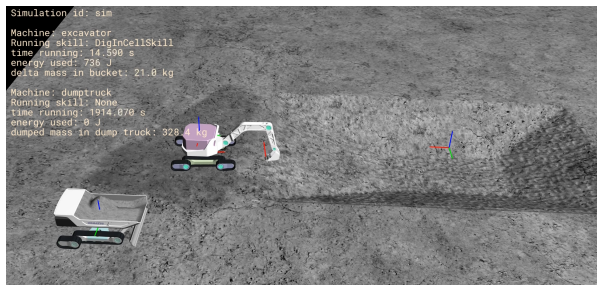
The central claim, stated in the paper's own terms, is that the framework supports modelling of construction scenarios and autonomy solutions, execution of the scenarios in simulation, and analysis of work time and energy consumption throughout the project. The architecture separates a behaviour-tree planner from a physics-based simulator, with the two communicating over middleware so that the planner never sees ground-truth world state, only machine observations. The simulator resolves contacting multibody dynamics with a deformable-terrain model that splits soil into particles only inside an active failure zone, and controls excavation through inverse kinematics and tracking controllers. Tested over 30 digging cycles, the framework quantifies that moving the dump site across a slope raises actuator work by about 14 percent relative to flat terrain, that 6–7 percent of bucket mass spills in turning, and that productivity and power drop when the excavator switches grid cells. These numbers are offered as evidence that the framework can support analysis of how environment, machine design, and autonomy choices affect time and energy in lunar construction.
Load-bearing premise
The energy numbers depend on a correction for energy dissipated by numerical stabilizers in the tracks: the authors measure power with the vehicle lifted off the ground, subtract that dissipation, and apply a constant efficiency factor, and they themselves state this procedure should be experimentally validated.
Editorial extensions
If this is right
- Mission planners could compare terrain slopes, dump-site locations, machine designs, and autonomy policies in simulation and obtain per-cycle time and energy estimates before any hardware is committed.
- The measured statistics—spill fraction, waiting time, and work per cycle—point directly to where an autonomy policy loses efficiency; the paper shows, for example, that productivity dips at grid-cell switches and that slope traversal raises energy use by 14 percent.
- Because the behaviour tree and machine skills are modular and connected through middleware, the same framework can accept new machines, new tasks, or a physical machine in place of a simulated one, an extension the architecture is designed to support.
- The simulator can generate long sequences of synthetic sensor and telemetry data at roughly real-time speed, which the paper identifies as useful for training learning-based perception and control models.
Reading between the lines
- Beyond the paper's own claims, the energy figures should be read as relative until the track-damping correction is validated; the framework's greatest value may be comparing the relative cost of design choices rather than predicting absolute Joules.
- A natural extension the authors do not implement is using the per-cycle energy telemetry as a reward signal for behaviour-tree or reinforcement-learning policies that adaptively choose dig sites, dump routes, or bucket trajectories to minimize energy per ton moved.
- The reported sensitivity of work to terrain shape suggests the same loop could be used to calibrate soil parameters against in-situ lunar measurements once they exist, tightening the model's quantitative predictions.
- The framework could serve as a data generator for excavator digging policies trained on varied regolith properties, since the underlying terrain model is already benchmarked against resolved DEM and field tests.
Editorial analysis
A structured set of objections, weighed in public.
Referee Report
Summary. The paper presents a simulation framework for autonomous multi-machine lunar construction, built on the AGX Dynamics physics engine with deformable terrain, behaviour trees for high-level planning, ROS2 for inter-process communication, and inverse-kinematics-based low-level control. The framework is demonstrated on two scenarios: repeated excavation, hauling, and dumping of lunar regolith on flat and sloped terrain, and the excavation and grading of a predefined habitat foundation. The authors report near-realtime execution at a 10 ms timestep, and they present quantitative results for the first scenario (cycle time, transported mass, and actuator work over 30 cycles) together with a qualitative evaluation of the second. The central claim is that the framework supports modelling, realtime execution, and analysis of work time and energy consumption for such construction projects.
Significance. If the framework performs as described, it addresses a genuine gap: related simulators either lack deformable-terrain excavation, lack multi-agent autonomy, or are too slow for realtime use. The modular separation of behaviour trees and low-level skills via ROS2 is a clean design, and the demonstration with actively articulated crawlers is a useful step. The paper is honest in flagging the unvalidated energy normalisation, which is a strength in reporting but also means that the quantitative energy analysis is not yet established. The video material and detailed descriptions are commendable. The significance of the work is currently conditional on resolving the energy-normalisation issue and on reporting the statistical uncertainty of the main comparison.
major comments (3)
- [Section 4.1 and Section 5] The energy results are a core output of the framework, but the normalisation procedure used to correct for numerical track damping is not validated. The paper states that 'strong numerical viscous damping' is added for stability and that the computed power is normalised by subtracting the dissipation measured with the vehicle elevated and introducing an efficiency factor. Because the elevated-vehicle baseline is not shown to equal the dissipation that occurs under load, and because the efficiency factor is a free constant, the work values in Table 1 and the flat-versus-sloped energy comparison rest on an untested calibration. The authors themselves write in Section 5 that the procedure 'should be experimentally validated to ensure that the energy computations are reliable.' I therefore regard the quantitative energy analysis as conditional. The paper should either provide such validation (for example, against measured actuator power or motor models) or explicitly present the energy numbers as qualitative indicators and remove the specific kJ values and the percentage comparison.
- [Section 4.2, Table 1] The claim that power consumption is 14% higher in the sloped case is not supported by the reported data. Table 1 gives work of 66 ± 16 kJ (flat) and 74 ± 24 kJ (sloped) per cycle over 30 cycles. The difference of 8 kJ is smaller than either standard deviation, and no significance test, confidence interval, or paired comparison is reported. In addition, 8/66 = 12%, not 14%, so the stated figure does not follow from the table. The large cycle-to-cycle variability visible in Figures 9-12 further emphasises the need for statistical treatment. I recommend either reporting per-cycle paired comparisons with confidence intervals or softening the claim to a qualitative observation.
- [Section 4.1] The paper does not report any numerical-convergence test for the quantities it analyses. The 10 ms timestep and the dynamically sized terrain particles are both likely to affect the computed actuator work, yet no study of timestep or particle-resolution dependence is presented. Without such a check, the reader cannot distinguish physical energy consumption from numerical artefacts. At minimum, the authors should demonstrate that the reported work values are insensitive to the timestep and to the particle-size threshold in the multiscale terrain model.
minor comments (6)
- [Figures 11 and 12] The captions label both panels '(a) flat' and '(b) flat'; panel (b) should presumably be 'sloped' in each figure. This makes it difficult to distinguish the two cases.
- [Section 3.1] The sentence 'a Python method thay returns a node or subtree' contains a typo; 'thay' should be 'that'.
- [Section 2.1] The sentence 'When the truckbed is raised and tilted to a critical angle, the the terrain starts avalanching' contains a duplicated 'the'.
- [Section 4.2] The sentence 'The power consumption is dominated by running the crawlers although it was rescaled for the excessive dissipation mechanism for numerical stabilization' is unclear; please rephrase to specify whether the reported values include or exclude the normalisation.
- [Section 4] The term 'realtime' is used without defining the realtime factor; please state the ratio of simulation time to wall-clock time for the reported runs.
- [Figure 2] The textual representation of the behaviour tree contains typographical spacing (for example, 'Se qu enc e' instead of 'Sequence'); please ensure the final formatting is clean.
Circularity Check
No significant circularity; the framework is demonstrated rather than derived from its own outputs, and the energy normalization is an acknowledged limitation, not a self-referential prediction.
full rationale
The paper's central claim is that the framework supports modelling, realtime execution, and analysis of work time and energy consumption, and it supports this by applying the framework in two construction scenarios rather than by deriving the claim from the claim itself. The load-bearing physics components are AGX Dynamics and the multiscale terrain model from prior work [17], with validation against DEM and full-scale field tests [2]; although these are partly self-citations, they are external evidence with independent content and do not make the current results true by construction. The energy calculation in Section 4.1 subtracts the dissipation measured with the vehicle elevated and applies an efficiency factor to compensate for numerical damping in the track joints. This is a calibration of the simulation, and the authors explicitly state in Section 5 that the normalization 'should be experimentally validated to ensure that the energy computations are reliable.' That is an admitted limitation on the quantitative energy claim, but it is not a circular step: the work values are not defined as the fitted normalization, and no equation is shown to be equivalent to the result by construction. No fitted parameter is relabelled as a prediction, and no load-bearing conclusion reduces to a self-citation chain. Accordingly, the derivation chain is self-contained for the claim of framework capability, and the energy caveat is a correctness risk rather than a circularity.
Assumptions & free parameters
free parameters (3)
- Track power normalisation efficiency factor =
not given
- Zero-load track dissipation baseline =
not given
- Lunar regolith bulk parameters =
friction angle 0.80 rad, cohesion 900 Pa, dilatancy 0.23 rad, density 1580 kg/m3 at packing 0.66, compression index 0.11
assumptions (3)
- domain assumption The AGX multiscale terrain model produces digging forces and soil displacements with 75-90 percent accuracy relative to resolved DEM and field tests.
- domain assumption The pre-calibration procedure makes DEM particles reproduce the assigned bulk soil behaviour.
- ad hoc to paper Strong numerical damping in the track model, compensated by the normalisation procedure, leaves the vehicle dynamics and the relative energy comparisons meaningful.
Cite this review
Pith. "Pith review of A simulation framework for autonomous lunar construction work." pith.science (2026). https://pith.science/paper/H5F4RP6X
@misc{pith2026250522091,
  author       = {Pith},
  title        = {Pith review of: A simulation framework for autonomous lunar construction work},
  year         = {2026},
  howpublished = {\url{https://pith.science/paper/H5F4RP6X}},
  note         = {Machine review of arXiv:2505.22091}
}
read the original abstract
We present a simulation framework for lunar construction work involving multiple autonomous machines. The framework supports modelling of construction scenarios and autonomy solutions, execution of the scenarios in simulation, and analysis of work time and energy consumption throughout the construction project. The simulations are based on physics-based models for contacting multibody dynamics and deformable terrain, including vehicle-soil interaction forces and soil flow in real time. A behaviour tree manages the operational logic and error handling, which enables the representation of complex behaviours through a discrete set of simpler tasks in a modular hierarchical structure. High-level decision-making is separated from lower-level control algorithms, with the two connected via ROS2. Excavation movements are controlled through inverse kinematics and tracking controllers. The framework is tested and demonstrated on two different lunar construction scenarios that involve an excavator and dump truck with actively controlled articulated crawlers.
Figures


Figures from the paper (13 more)



Reference graph
Works this paper leans on
- [1]
-
[2]
Examining the simulation-to-reality gap of a wheel loader digging in deformable terrain
Koji Aoshima and Martin Servin. “Examining the simulation-to-reality gap of a wheel loader digging in deformable terrain”. In:Multibody System Dynamics(2024), pp. 1–28
work page 2024
-
[3]
World Modeling for Autonomous Wheel Loaders
Koji Aoshima et al. “World Modeling for Autonomous Wheel Loaders”. In:Automation 5.3 (2024), pp. 259– 281
work page 2024
-
[4]
Continuous control of an underground loader using deep reinforcement learning
Sofi Backman et al. “Continuous control of an underground loader using deep reinforcement learning”. In: Machines 9.10 (2021), p. 216
work page 2021
-
[5]
A physics-based sensor simulation environment for lunar ground operations
Nevindu M Batagoda et al. “A physics-based sensor simulation environment for lunar ground operations”. In: arXiv preprint arXiv:2410.04371(2024)
work page Pith review arXiv 2024
-
[6]
Digital Lunar Exploration Sites Unreal Simulation Tool (DUST)
Lee Bingham et al. “Digital Lunar Exploration Sites Unreal Simulation Tool (DUST)”. In: 2023 IEEE Aerospace Conference. 2023, pp. 1–12
work page 2023
- [7]
-
[8]
N Abu El Samid, Jekanthan Thangavelautham, and G D’Eleuterio. “Infrastructure robotics: A technology enabler for lunar in-situ resource utilization, Habitat construction and maintenance”. In:Proceedings of International Astronautic Conference. 2008, pp. 2045–2058
work page 2008
Show all 22 references
-
[9]
A survey of Behavior Trees in robotics and AI
Matteo Iovino et al. “A survey of Behavior Trees in robotics and AI”. In:Robotics and Autonomous Systems 154 (2022), p. 104096
2022
-
[10]
Modeling of Terrain Deformation by a Grouser Wheel for Lunar Rover Simu- lation
Junnosuke Kamohara et al. “Modeling of Terrain Deformation by a Grouser Wheel for Lunar Rover Simu- lation”. In:arXiv preprint arXiv:2408.13468(2024)
2024 arXiv
-
[11]
Spook: a variational time-stepping scheme for rigid multibody systems subject to dry frictional contacts
Claude Lacoursiere and Mattias Linde. “Spook: a variational time-stepping scheme for rigid multibody systems subject to dry frictional contacts”. In:UMINF report11 (2011)
2011
-
[12]
Ghosts and machines: regularized variational methods for interactive simulations of multi- bodies with dry frictional contacts
C. Lacoursière. “Ghosts and machines: regularized variational methods for interactive simulations of multi- bodies with dry frictional contacts”. PhD thesis. SE-901 87 Umeå: Umeå University, June 2007
2007
-
[13]
Robot Operating System 2: Design, architecture, and uses in the wild
Steven Macenski et al. “Robot Operating System 2: Design, architecture, and uses in the wild”. In:Science Robotics 7.66 (2022), eabm6074
2022
-
[14]
ROS: an open-source Robot Operating System
Morgan Quigley et al. “ROS: an open-source Robot Operating System”. In:ICRA workshop on open source software. Vol. 3. 3.2. Kobe. 2009, p. 5
2009
-
[15]
OmniLRS: A photorealistic simulator for lunar robotics
Antoine Richard et al. “OmniLRS: A photorealistic simulator for lunar robotics”. In:2024 IEEE Interna- tional Conference on Robotics and Automation (ICRA). IEEE. 2024, pp. 16901–16907
2024
-
[16]
Exploratory study on time-delayed excavator teleoperation in virtual lunar construction simulation: Task performance and operator behavior
Miran Seo, Samraat Gupta, and Youngjib Ham. “Exploratory study on time-delayed excavator teleoperation in virtual lunar construction simulation: Task performance and operator behavior”. In: Automation in Construction 168 (2024), p. 105871
2024
-
[17]
A multiscale model of terrain dynamics for real- time earthmoving simulation
Martin Servin, Tomas Berglund, and Samuel Nystedt. “A multiscale model of terrain dynamics for real- time earthmoving simulation”. In:Advanced Modeling and Simulation in Engineering Sciences8.1 (2021), pp. 1–35
2021
-
[18]
Examining the smooth and nonsmooth discrete element approaches to granular mat- ter
Martin Servin et al. “Examining the smooth and nonsmooth discrete element approaches to granular mat- ter”. In:International Journal for Numerical Methods in Engineering97.12 (2014), pp. 878–902
2014
-
[19]
Development and Evaluation of Mobility and Excavation Rover Toward Lunar Base Construction
Masataku Sutoh. “Development and Evaluation of Mobility and Excavation Rover Toward Lunar Base Construction”. In:Journal of Robotics and Mechatronics36.2 (2024), pp. 334–342
2024
-
[20]
Autonomous multirobot excavation for lunar applications
Jekanthan Thangavelautham et al. “Autonomous multirobot excavation for lunar applications”. In:Robotica 35.12 (2017), pp. 2330–2362
2017
-
[21]
Control of rough terrain vehicles using deep reinforcement learning
Viktor Wiberg et al. “Control of rough terrain vehicles using deep reinforcement learning”. In:IEEE robotics and automation letters7.1 (2021), pp. 390–397
2021
-
[22]
Sim-to-real transfer of active suspension control using deep reinforcement learning
Viktor Wiberg et al. “Sim-to-real transfer of active suspension control using deep reinforcement learning”. In: Robotics and Autonomous Systems179 (2024), p. 104731. 13
2024
Reviewed August 7, 2026 · model on record in the stance chip above.
Discussion (0). Sign in to comment.