REVIEW 3 major objections 5 minor 4 cited by
The Kick Velocity Distribution of Isolated Neutron Stars
T0 review · 3 major / 5 minor · reviewed 2026-08-07 · deepseek-v4-flash
Pith's one-line read Neutron star natal kicks follow a single log-normal distribution peaking near 150-200 km/s, and the faster Maxwellian and claimed bimodality in the literature come from a missing Jacobian and small samples.
desk verdict Genuinely new Jacobian insight plus a broader sample, but the central likelihood looks like it is missing the per-pulsar prior division, so the headline log-normal parameters should be treated as provisional. read the letter →
The pith
A machine-rendered reading of the paper's core claim, the machinery that carries it, and where it could break.
The reading
What carries the argument
Three mechanisms carry the argument. The velocity reconstruction assumes the three-dimensional velocity vector is isotropic in each pulsar's local standard of rest, so the unmeasured radial component is drawn as $v_r = \|\vec{v}_t - \vec{v}_{\mathrm{LSR},t}\|\cot\theta + v_{\mathrm{LSR},r}$ from the observed transverse velocity. The statistical model is a log-normal distribution whose likelihood over each pulsar's sampled velocity draws includes a detection-probability correction and is renormalized to 0-1000 km/s. The literature reconciliation rests on the Jacobian identity $\mathrm{d}v/\mathrm{d}\log v \propto v$: a histogram of $\log v$ displays $v\,p(v)$, and fitting the linear-density Maxwellian $p(v)$ to it without the Jacobian pushes the fitted scale toward high speeds. For pulsars older than 10 Myr, kicks are inferred kinematically by tracing Galactic orbits in a Milky Way potential and inverting the simulated eccentricity-kick relation, which lets old pulsars, whose present-day velocities have relaxed, still constrain their birth kicks.
What would settle it
Measure the line-of-sight velocities of the young parallax pulsars, for example through high-precision timing or interstellar scintillation, and compare the distribution of measured $v_r$ with the LSR-isotropy prediction of Equation 4; a significant mismatch would bias the reconstructed speeds and shift the fitted $\mu$ and $\sigma$. A simpler check is to redo the Hobbs et al. (2005) histogram with the Jacobian correction and see whether a Maxwellian with $\sigma=265$ km/s still fits the corrected data.
Extended reading notes
Core claim
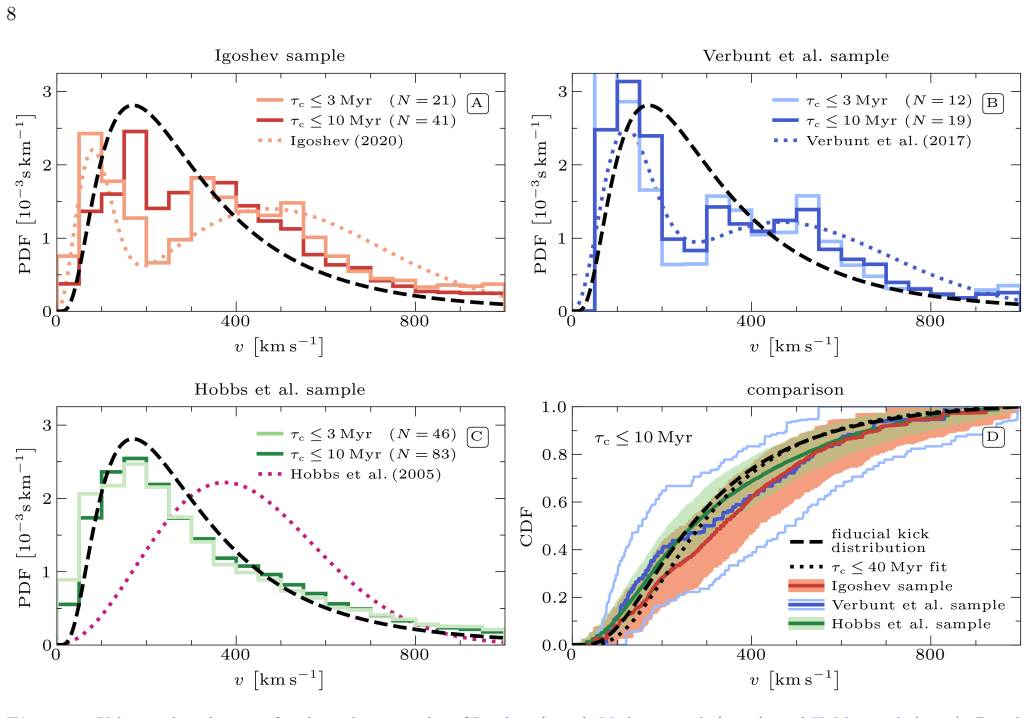
The paper's central claim is that the natal kick velocities of isolated neutron stars are well described by a log-normal distribution with $\mu=5.60\pm0.12$ and $\sigma=0.68\pm0.10$ fitted to the parallax-distance pulsars younger than 10 Myr, peaking at about 150-200 km/s; this is adopted as the fiducial kick distribution. The same distribution, the authors argue, describes the kinematically constrained kicks of pulsars aged 10-40 Myr, and combining the two age ranges yields $\mu=5.67\pm0.10$ and $\sigma=0.59\pm0.08$. Two apparent contradictions in the literature are explained rather than dismissed. First, the high-velocity Maxwellian of Hobbs et al. (2005) arises because that analysis fitted a probability density $p(v)$ to a histogram of log-velocity bins without the Jacobian $\mathrm{d}v/\mathrm{d}\log v \propto v$, so its $\sigma=265$ km/s overestimates the true kicks. Second, the bimodality found by Verbunt et al. (2017) and Igoshev (2020) falls within the fluctuations expected from small samples: about 10% of random draws of 21 pulsars from the fiducial distribution reproduce their two-peaked structure. On this view, the observed pulsar kick distribution is unimodal and log-normal, and the literature is reconciled once the histogram correction and finite-sample statistics are taken into account.
Load-bearing premise
The load-bearing assumption is that each pulsar's velocity vector is oriented isotropically in its local standard of rest, which lets the unmeasured radial velocity be reconstructed from the observed transverse velocity; if kick directions are systematically anisotropic, for instance through spin-kick alignment, the reconstructed three-dimensional speeds and the fitted log-normal parameters are biased.
Editorial extensions
If this is right
- Population-synthesis models that still adopt the Hobbs et al. (2005) Maxwellian with $\sigma=265$ km/s will overproduce fast neutron stars; the fiducial log-normal peaking near 150-200 km/s is the corrected empirical input for modeling neutron star populations and gravitational-wave sources.
- The fiducial distribution assigns only about 1% of neutron stars kicks below 50 km/s (up to roughly 10% within the 95% credible region), the fraction that would be retained in globular clusters or wide binaries.
- Kicks of pulsars aged 10-40 Myr, inferred from Galactic orbital eccentricities, are consistent with the young-pulsar log-normal, so a single kick distribution can be used across ages despite the relaxation of old pulsars' present-day velocities.
- The reported bimodality of Verbunt et al. (2017) and Igoshev (2020) is not statistically significant: about 10% of random 21-pulsar draws from the fiducial distribution reproduce their two-peaked structure, so larger parallax samples are needed to test true multimodality.
- Model comparison by BIC gives no strong preference for a Maxwellian, double-Maxwellian, or Weibull distribution over the log-normal, so the log-normal is an adequate unimodal description of the current data.
Reading between the lines
- If the spin-kick alignment bias cited in the paper is real, the true kick peak may sit about 15% below the quoted 150-200 km/s, and future fits of $\mu$ and $\sigma$ should marginalize over a direction-dependent detection model.
- The Jacobian critique is a checkable template that generalizes: any published pulsar-kick analysis that histograms log-velocity bins and fits a linear-scale model should be re-examined, and the same correction may affect kick distributions used in binary neutron star population synthesis.
- The LSR-isotropy assumption makes a direct prediction that surveys measuring line-of-sight velocities of young pulsars (for example through timing or interstellar scintillation) could test; detecting anisotropy in $v_r$ would reveal a systematic bias in all current reconstructions.
- Applying the eccentricity-based kinematic method to classes excluded from this sample, such as magnetars or X-ray-emitting isolated neutron stars, could test whether the same log-normal describes kicks across all neutron star formation channels.
Editorial analysis
A structured set of objections, weighed in public.
Referee Report
Summary. The paper compiles proper motions and distance estimates (parallax or dispersion measure) for isolated Galactic pulsars from the ATNF catalogue, constructs Monte Carlo samples of each pulsar's three-dimensional velocity relative to its local standard of rest under an assumed LSR isotropy, and fits a log-normal distribution to the inferred speeds of young pulsars. The fiducial result is a kick distribution with mu=5.60 +/- 0.12 and sigma=0.68 +/- 0.10 for pulsars with characteristic age below 10 Myr, peaking at roughly 150-200 km/s. The authors then use an eccentricity-kick relation from their earlier work to constrain kicks of older pulsars, argue that the Maxwellian of Hobbs et al. (2005) resulted from a missing Jacobian in logarithmic histogram binning, and claim that the previously reported bimodality is not statistically significant and that all existing samples are consistent with the proposed log-normal distribution.
Significance. If the quantitative result stands, the paper would provide a single empirical neutron-star kick distribution that reconciles several apparently conflicting analyses and is directly usable in binary population synthesis. The updated sample of 76 parallax pulsars is a useful resource, and the proposed explanation of the Hobbs et al. Maxwellian discrepancy via a missing Jacobian is a concrete, testable claim that could resolve a long-standing literature tension. However, the central hierarchical-likelihood estimator appears to be misspecified, so the quoted log-normal parameters and the model-comparison statements built on them are not yet established. The data compilation and qualitative conclusions are valuable, but the quantitative central claim requires recalibration before acceptance.
major comments (3)
- [Section 3, Eq. (6)] The population likelihood is printed as L = product over pulsars of (1/M) sum_i p_ln(v_{n,i}|mu,sigma) divided by the selection integral, where v_{n,i} are Monte Carlo draws from each pulsar's velocity posterior. These draws are generated under the distance prior of Eq. (1), Gaussian proper-motion uncertainties, and the LSR-isotropy radial sampling of Eq. (4). For posterior samples drawn from a per-pulsar prior pi_n(v), the correct hierarchical marginal likelihood contains a division by pi_n(v_{n,i}) in the sample average (Mandel et al. 2019). Equation (6) omits that inverse-prior weight. The induced prior is strongly non-uniform; for fixed transverse speed, the isotropic projection alone contributes a tail scaling roughly as v^{-3} before additional distance and proper-motion structure, so the unweighted average is not equivalent to the likelihood and can bias both mu and sigma. If the implementation does divide by the prior, Eq. (6) is misleading; if it does not, the fiducial parameters in Table 1 are not yet calibrated. Please recompute the fit with the proper inverse-prior weighting and report whether the quoted 68% intervals (mu=5.60+/-0.12, sigma=0.68+/-0.10) cover the corrected posterior. This check is load-bearing because the fiducial kick distribution is the paper's central claim.
- [Section 3, Table 1; Appendix E] The Bayesian information criterion comparison in Table E and the statement that the double-Maxwellian is not preferred (Delta BIC = -0.5) are computed from the same likelihood in Eq. (6). If Eq. (6) is biased, the BIC values and the conclusion that the data do not support bimodality are not reliable. Similarly, the bootstrap CDF comparisons in Figure 1 and the statement that the log-normal fit lies within the 95% intervals depend on the velocity samples being correctly incorporated into the likelihood. Please rerun the BIC comparison and the model-selection test after correcting the hierarchical likelihood, and state explicitly what prior is used when the samples are reweighted by the fiducial kick distribution in the histograms of Figure 1.
- [Section 2, Eq. (4); Section 6] The LSR-isotropy assumption is the only means of estimating the unmeasured radial velocity component, and the paper acknowledges that spin-kick alignment may overestimate velocities by about 15% (Mandel & Igoshev 2023). Because the fiducial log-normal parameters are fit to velocities constructed under this assumption, the paper should propagate this systematic into the quoted parameters, for example by fitting the distribution under a conservative anisotropic model or by reporting how mu and sigma shift under a +/-15% velocity correction. The current text lists the concern but does not connect it to the numerical central claim.
minor comments (5)
- [Section 6 (Conclusions)] The first bullet of the conclusions gives sigma=0.69 +/- 0.10, whereas the abstract, Table 1, and Section 3 all give sigma=0.68 +/- 0.10; this inconsistency should be corrected.
- [Section 3 and elsewhere] There are several formatting errors in the text: '10^3' is repeatedly printed as '103' (e.g., Section 3 near Eq. 6), and the caption of Figure 1 says 'Equations 5' where only Eq. (5) is meant.
- [Section 5] The sentence 'the PDF drops below 1.2 x 10^{-3} s km^{-1}' uses an incorrect unit; the probability density should have units of (km/s)^{-1}, not s km^{-1}.
- [Section 2] The description of the eccentricity-kick method for old pulsars would be clearer if the paper explicitly defined the time domain used for the Disberg et al. (2025) relation and how the flat prior on kick magnitude is implemented when sampling from the eccentricity-kick relation; these details currently appear only in a reference to the earlier paper.
- [General] Please include a data availability statement with the full list of the 197 selected pulsars, their parallaxes/proper motions/characteristic ages, and the Monte Carlo seeds or sampling code, so that the central fit can be reproduced.
Circularity Check
Central log-normal fit is independent; only a minor presentational circularity in the Figure 1 reweighted histogram and a self-cited (but independent) eccentricity method prevent a clean zero.
-
self definitional
[Section 3, Figure 1 (text preceding Figure 1)]
"In Figure 1 we show log-normal fits for the DM distances and the parallax distances, together with histograms of the most likely velocity values for each pulsar (after reweighting by our fiducial kick distribution as the prior)."
The histogram is presented as empirical evidence that the fiducial log-normal describes the velocities, but it is built by weighting each pulsar's velocity posterior with that same fiducial distribution as a prior. The apparent agreement between the histogram and the fitted curve is therefore partly by construction. This is not the source of the fitted parameters (mu=5.60, sigma=0.68 come from the Equation 6 likelihood on unweighted posterior samples), and the paper also shows bootstrapped CDFs that are independent, so this is a minor presentational circularity rather than a load-bearing derivation.
full rationale
The paper's central claim--that parallax-based velocities of pulsars younger than 10 Myr follow a log-normal with mu=5.60+/-0.12 and sigma=0.68+/-0.10--is an empirical maximum-likelihood fit to publicly available ATNF pulsar data. The velocity posterior samples are constructed from parallax/distance priors, proper-motion Gaussians, and an LSR-isotropy projection, none of which contain the target log-normal distribution; the fit does not reduce to those inputs by construction. The claimed reconciliation with Hobbs et al. (2005) is an independent reanalysis of logarithmic binning and the Jacobian, and the comparison with Verbunt/Igoshev samples is a direct reprocessing of their data. The old-pulsar consistency check does rely on the eccentricity-kick relation of the authors' own Disberg et al. (2025) simulation, but that relation is obtained from orbital dynamics in a Galactic potential, not from the fitted log-normal, so the consistency is not forced. The paper's self-acknowledged limitations (LSR isotropy, spin-kick alignment, binary selection) are systematic-error risks, not circular steps. A separate statistical concern is that Equation 6, as printed, appears to average the population log-normal over posterior samples without dividing by the per-pulsar sampling prior; if implemented literally this would bias the fit and its credible intervals, but this is a correctness/calibration issue rather than a circular equivalence. The only genuinely self-referential element is the Figure 1 histogram, which is reweighted by the fiducial fit and therefore cannot serve as an independent visual confirmation; because the parameter estimates themselves come from the unweighted likelihood and independent CDF checks are provided, this does not compromise the central derivation. Overall, no load-bearing circularity; score 2 reflects the one minor presentational circularity and the self-cited (though independent) eccentricity method.
Assumptions & free parameters
free parameters (2)
- log-normal μ =
5.60 ± 0.12
- log-normal σ =
0.68 ± 0.10
assumptions (7)
- domain assumption LSR isotropy of kick directions
- domain assumption Characteristic spin-down age τ_c approximates true pulsar age
- domain assumption For τ_c < 10 Myr, present-day velocity equals natal kick
- domain assumption Uniform detection probability for young pulsars
- domain assumption Parallax posterior prior of Equation 1
- domain assumption Static Milky Way potential (McMillan 2017)
- domain assumption Eccentricity-kick relation of Disberg et al. (2025)
Cite this review
Pith. "Pith review of The Kick Velocity Distribution of Isolated Neutron Stars." pith.science (2026). https://pith.science/paper/LTWOGC32
@misc{pith2026250522102,
  author       = {Pith},
  title        = {Pith review of: The Kick Velocity Distribution of Isolated Neutron Stars},
  year         = {2026},
  howpublished = {\url{https://pith.science/paper/LTWOGC32}},
  note         = {Machine review of arXiv:2505.22102}
}
abstract
Neutron stars (NSs) are thought to receive natal kicks at their formation in supernovae. In order to investigate the magnitude of these kicks, we analyze the proper motions and distance estimates -- either through parallax or dispersion measures -- of young isolated pulsars and infer their three-dimensional velocities relative to their local standard of rest. We find that the velocities based on parallax distances of pulsars younger than 10 Myr follow a log-normal distribution with $\mu=5.60\pm0.12$ and $\sigma=0.68\pm0.10$, peaking at ${\sim}$150--200 km/s, which we adopt as our fiducial kick distribution. Using a previously established method that infers kick magnitudes through the eccentricity of Galactic trajectories, we also estimate the kick velocities of older pulsars, which we find to be consistent with our fiducial kick distribution. A log-normal fit to all pulsars with ages below 40 Myr yields a more constraining (but possibly more prone to systematic errors) fit with $\mu=5.67\pm0.10$ and $\sigma=0.59\pm0.08$, respectively. Moreover, we (1) resolve the tension between our results and the Maxwellian distribution found by Hobbs et al. (2005), which has a ${\sim}50\%$ higher median velocity, by showing that their analysis is missing a Jacobian needed to correct for its logarithmic histogram bin sizes, and (2) argue that the bimodality found by others is not statistically significant and that previous results are consistent with our inferred kick distribution, effectively reconciling the literature on observed NS kicks.
Figures


Forward citations
Cited by 4 Pith papers
-
Pulsar Rockets and Gaia Neutron Star Binaries
The pulsar rocket force is exactly zero in ideal force-free electrodynamics, and Gaia neutron star eccentricities require rockets only for certain pre-supernova binary configurations.
-
Forming Double Neutron Stars using Detailed Binary Evolution Models with POSYDON: Comparison to the Galactic Systems
Double neutron stars form through two distinct common envelope subchannels, one with a helium-core donor that merges within a Hubble time and one with a carbon-oxygen core donor that does not, and matching the Galacti...
-
A Square Kilometre Array Pulsar Census
Composite SKA-Low + Mid Band 1/2 all-sky surveys with AA* yield ~10k slow pulsars and ~800 MSPs; AA4 yields ~20% more, rising to ~1300 MSPs if Mid coverage is broadened.
-
Rapid stellar and binary population synthesis with COMPAS: methods paper II
COMPAS v03.22.01 adds new prescriptions for stellar winds, rotation, supernovae, mass transfer, common envelopes, tides, and gravitational-wave radiation to the rapid binary population synthesis code.
Reference graph
Works this paper leans on
-
[1]
- [1] #1 = = ^ ^ ^ .\!\!^ d .\!\!^ h .\!\!^ m .\!\!^ s .\!\!^ @mss
thebibliography [1] 20pt to REFERENCES 6pt =0pt \@twocolumntrue 12pt -12pt 10pt plus 3pt =0pt =0pt =1pt plus 1pt =0pt =0pt -12pt =13pt plus 1pt =20pt =13pt plus 1pt \@M =10000 =-1.0em =0pt =0pt 0pt =0pt =1.0em @enumiv\@empty 10000 10000 `\.\@m \@noitemerr \@latex@warning Empty `thebibliography' environment \@ifnextchar \@reference \@latexerr Missing key o...
work page 2017
-
[2]
, " * write output.state after.block = add.period write newline
ENTRY address archivePrefix author booktitle chapter doi edition editor eprint howpublished institution journal key month number organization pages publisher school series title misctitle type volume year version url label extra.label sort.label short.list INTEGERS output.state before.all mid.sentence after.sentence after.block FUNCTION init.state.consts ...
-
[3]
write newline
" write newline "" before.all 'output.state := FUNCTION format.url url empty "" new.block "" url * "" * if FUNCTION format.eprint eprint empty "" archivePrefix empty "" archivePrefix "arXiv" = new.block " " eprint * " " * new.block " " eprint * " " * if if if FUNCTION format.doi doi empty "" " " doi * " " * if FUNCTION format.pid doi empty eprint empty ur...
-
[4]
, " * write output.state after.block = add.period write newline
ENTRY address archivePrefix author booktitle chapter doi edition editor eprint howpublished institution journal key month number organization pages publisher school series title misctitle type volume year version url label extra.label sort.label short.list INTEGERS output.state before.all mid.sentence after.sentence after.block FUNCTION init.state.consts ...
-
[5]
write newline
" write newline "" before.all 'output.state := FUNCTION format.url url empty "" new.block "" url * "" * if FUNCTION format.eprint eprint empty "" archivePrefix empty "" archivePrefix "arXiv" = new.block " " eprint * " " * new.block " " eprint * " " * if if if FUNCTION format.doi doi empty "" " " doi * " " * if FUNCTION format.pid doi empty eprint empty ur...
-
[6]
Arzoumanian , Z., Chernoff , D. F., & Cordes , J. M. 2002, , 568, 289, 10.1086/338805
doi:10.1086/338805 2002
-
[7]
2013, , 558, A33, 10.1051/0004-6361/201322068
Astropy Collaboration , et al. 2013, , 558, A33, 10.1051/0004-6361/201322068
-
[8]
2018, , 156, 123, 10.3847/1538-3881/aabc4f
---. 2018, , 156, 123, 10.3847/1538-3881/aabc4f
Show all 71 references
- [9]
-
[10]
Atri , P., Miller-Jones , J. C. A., Bahramian , A., et al. 2019, , 489, 3116, 10.1093/mnras/stz2335
2019 doi
-
[11]
2024, , 966, 17, 10.3847/1538-4357/ad32cd
Beniamini , P., & Piran , T. 2024, , 966, 17, 10.3847/1538-4357/ad32cd
2024 doi
-
[12]
S., & Istomin , A
Beskin , V. S., & Istomin , A. Y. 2022, , 516, 5084, 10.1093/mnras/stac2423
2022 doi
- [13]
-
[14]
2015, , 216, 29, 10.1088/0067-0049/216/2/29
Bovy , J. 2015, , 216, 29, 10.1088/0067-0049/216/2/29
2015 doi
-
[15]
F., Benson , J
Brisken , W. F., Benson , J. M., Goss , W. M., & Thorsett , S. E. 2002, , 571, 906, 10.1086/340098
2002 doi
-
[16]
F., Thorsett , S
Brisken , W. F., Thorsett , S. E., Golden , A., & Goss , W. M. 2003, , 593, L89, 10.1086/378184
2003 doi
-
[17]
K., Taylor , G
Bruzewski , S., Schinzel , F. K., Taylor , G. B., et al. 2023, , 958, 163, 10.3847/1538-4357/ad07e4
2023 doi
-
[18]
Burrows , A., Hayes , J., & Fryxell , B. A. 1995, , 450, 830, 10.1086/176188
1995 doi
-
[19]
Burrows , A., Wang , T., Vartanyan , D., & Coleman , M. S. B. 2024, , 963, 63, 10.3847/1538-4357/ad2353
2024 doi
-
[20]
M., Lazio , T
Chatterjee , S., Cordes , J. M., Lazio , T. J. W., et al. 2001, , 550, 287, 10.1086/319735
2001 doi
-
[21]
M., Vlemmings , W
Chatterjee , S., Cordes , J. M., Vlemmings , W. H. T., et al. 2004, , 604, 339, 10.1086/381748
2004 doi
-
[22]
F., Vlemmings , W
Chatterjee , S., Brisken , W. F., Vlemmings , W. H. T., et al. 2009, , 698, 250, 10.1088/0004-637X/698/1/250
2009 doi
- [23]
- [24]
-
[25]
T., Tingay , S
Deller , A. T., Tingay , S. J., Bailes , M., & Reynolds , J. E. 2009, , 701, 1243, 10.1088/0004-637X/701/2/1243
2009 doi
-
[26]
T., Goss , W
Deller , A. T., Goss , W. M., Brisken , W. F., et al. 2019, , 875, 100, 10.3847/1538-4357/ab11c7
2019 doi
-
[27]
T., Swiggum , J
Ding , H., Deller , A. T., Swiggum , J. K., et al. 2024, , 970, 90, 10.3847/1538-4357/ad4883
2024 doi
-
[28]
Disberg , P., Gaspari , N., & Levan , A. J. 2024 a , , 687, A272, 10.1051/0004-6361/202449996
2024 doi
-
[29]
2024 b , , 689, A348, 10.1051/0004-6361/202450790
---. 2024 b , , 689, A348, 10.1051/0004-6361/202450790
2024 doi
- [30]
-
[31]
Faucher-Gigu \`e re , C.-A., & Kaspi , V. M. 2006, , 643, 332, 10.1086/501516
2006 doi
-
[32]
2022, , 665, A31, 10.1051/0004-6361/202140853
Fortin , F., Garc \' a , F., Chaty , S., Chassande-Mottin , E., & Simaz Bunzel , A. 2022, , 665, A31, 10.1051/0004-6361/202140853
2022 doi
-
[33]
J., Chrimes , A
Gaspari , N., Levan , A. J., Chrimes , A. A., & Nelemans , G. 2024, , 527, 1101, 10.1093/mnras/stad3259
2024 doi
-
[34]
, Abuter , R., Amorim , A., et al
GRAVITY Collab. , Abuter , R., Amorim , A., et al. 2018, , 615, L15, 10.1051/0004-6361/201833718
2018 doi
- [35]
-
[36]
Hansen , B. M. S., & Phinney , E. S. 1997, , 291, 569, 10.1093/mnras/291.3.569
1997 doi
-
[37]
R., Millman , K
Harris , C. R., Millman , K. J., Van der Walt , S. J., et al. 2020, , 585, 357, 10.1038/s41586-020-2649-2
2020 doi
-
[38]
2024, , 972, L18, 10.3847/2041-8213/ad6e77
Hirai , R., Podsiadlowski , P., Heger , A., & Nagakura , H. 2024, , 972, L18, 10.3847/2041-8213/ad6e77
2024 doi
-
[39]
R., Lyne , A
Hobbs , G., Lorimer , D. R., Lyne , A. G., & Kramer , M. 2005, , 360, 974, 10.1111/j.1365-2966.2005.09087.x
2005
-
[40]
H \"o gbom , J. A. 1974, , 15, 417
1974
-
[41]
Hunter , J. D. 2007, Computing in Science and Engineering, 9, 90, 10.1109/MCSE.2007.55
2007 doi
-
[42]
Igoshev , A. P. 2019, , 482, 3415, 10.1093/mnras/sty2945
2019 doi
- [43]
-
[44]
P., Chruslinska , M., Dorozsmai , A., & Toonen , S
Igoshev , A. P., Chruslinska , M., Dorozsmai , A., & Toonen , S. 2021, , 508, 3345, 10.1093/mnras/stab2734
2021 doi
-
[45]
P., Verbunt , F., & Cator , E
Igoshev , A. P., Verbunt , F., & Cator , E. 2016, , 591, A123, 10.1051/0004-6361/201527471
2016 doi
-
[46]
T., & Müller , E
Janka , H. T., & Müller , E. 1994, , 290, 496
1994
-
[47]
2023, , 519, 5893, 10.1093/mnras/stad019
Kapil , V., Mandel , I., Berti , E., & M \"u ller , B. 2023, , 519, 5893, 10.1093/mnras/stad019
2023 doi
-
[48]
J., Johnston , S., Karastergiou , A., et al
Keith , M. J., Johnston , S., Karastergiou , A., et al. 2024, , 530, 1581, 10.1093/mnras/stae937
2024 doi
-
[49]
M., Kramer , M., & Chatterjee , S
Kirsten , F., Vlemmings , W., Campbell , R. M., Kramer , M., & Chatterjee , S. 2015, , 577, A111, 10.1051/0004-6361/201425562
2015 doi
-
[50]
G., Popov , S
Kuranov , A. G., Popov , S. B., & Postnov , K. A. 2009, , 395, 2087, 10.1111/j.1365-2966.2009.14595.x
2009
-
[51]
H., Kirsten , F., Pen , U.-L., & Deller , A
Lin , R., Van Kerkwijk , M. H., Kirsten , F., Pen , U.-L., & Deller , A. T. 2023, , 952, 161, 10.3847/1538-4357/acdc98
2023 doi
-
[52]
R., Faulkner , A
Lorimer , D. R., Faulkner , A. J., Lyne , A. G., et al. 2006, , 372, 777, 10.1111/j.1365-2966.2006.10887.x
2006
- [53]
-
[54]
G., Pritchard , R
Lyne , A. G., Pritchard , R. S., Graham-Smith , F., & Camilo , F. 1996, , 381, 497, 10.1038/381497a0
1996 doi
-
[55]
N., Hobbs , G
Manchester , R. N., Hobbs , G. B., Teoh , A., & Hobbs , M. 2005, , 129, 1993, 10.1086/428488
2005 doi
-
[56]
M., & Gair , J
Mandel , I., Farr , W. M., & Gair , J. R. 2019, , 486, 1086, 10.1093/mnras/stz896
2019 doi
-
[57]
Mandel , I., & Igoshev , A. P. 2023, , 944, 153, 10.3847/1538-4357/acb3c3
2023 doi
-
[58]
2025, , 982, 179, 10.3847/1538-4357/ada3bd
Maoz , D., & Nakar , E. 2025, , 982, 179, 10.3847/1538-4357/ada3bd
2025 doi
-
[59]
McMillan , P. J. 2017, , 465, 76, 10.1093/mnras/stw2759
2017 doi
-
[60]
W., Heger , A., Tauris , T
M \"u ller , B., Gay , D. W., Heger , A., Tauris , T. M., & Sim , S. A. 2018, , 479, 3675, 10.1093/mnras/sty1683
2018 doi
-
[61]
Noutsos , A., Schnitzeler , D. H. F. M., Keane , E. F., Kramer , M., & Johnston , S. 2013, , 430, 2281, 10.1093/mnras/stt047
2013 doi
-
[62]
Ofek , E. O. 2009, , 121, 814, 10.1086/605389
2009 doi
- [63]
-
[64]
Van den Heuvel , E. P. J., & Van Paradijs , J. 1997, , 483, 399, 10.1086/304249
1997 doi
-
[65]
Verbiest , J. P. W., Weisberg , J. M., Chael , A. A., Lee , K. J., & Lorimer , D. R. 2012, , 755, 39, 10.1088/0004-637X/755/1/39
2012 doi
-
[66]
2017, Journal of Astrophysics and Astronomy, 38, 40, 10.1007/s12036-017-9474-5
Verbunt , F., & Cator , E. 2017, Journal of Astrophysics and Astronomy, 38, 40, 10.1007/s12036-017-9474-5
2017 doi
-
[67]
2017, , 608, A57, 10.1051/0004-6361/201731518
Verbunt , F., Igoshev , A., & Cator , E. 2017, , 608, A57, 10.1051/0004-6361/201731518
2017 doi
-
[68]
E., et al
Virtanen , P., Gommers , R., Oliphant , T. E., et al. 2020, Nature Methods, 17, 261, 10.1038/s41592-019-0686-2
2020 doi
-
[69]
2021, , 920, L37, 10.3847/2041-8213/ac2cc8
Willcox , R., Mandel , I., Thrane , E., et al. 2021, , 920, L37, 10.3847/2041-8213/ac2cc8
2021 doi
-
[70]
M., Manchester , R
Yao , J. M., Manchester , R. N., & Wang , N. 2017, , 835, 29, 10.3847/1538-4357/835/1/29
2017 doi
-
[71]
2023, , 525, 1498, 10.1093/mnras/stad2226
Zhao , Y., Gandhi , P., Dashwood Brown , C., et al. 2023, , 525, 1498, 10.1093/mnras/stad2226
2023 doi
Reviewed August 7, 2026 · model on record in the stance chip above.
Discussion (0). Sign in to comment.