REVIEW 1 major objections 5 minor 45 references
Term Ordering Diagrams
T0 review · 1 major / 5 minor · reviewed 2026-08-07 · deepseek-v4-flash
Pith's one-line read Term ordering diagrams index repeated post-ordering checks so that equational provers reuse, rather than recompute, KBO and LPO comparisons.
desk verdict A solid, useful contribution on post-ordering checks in saturation provers; a real specification gap on positivity-check semantics needs closing. read the letter →
The pith
A machine-rendered reading of the paper's core claim, the machinery that carries it, and where it could break.
The reading
What carries the argument
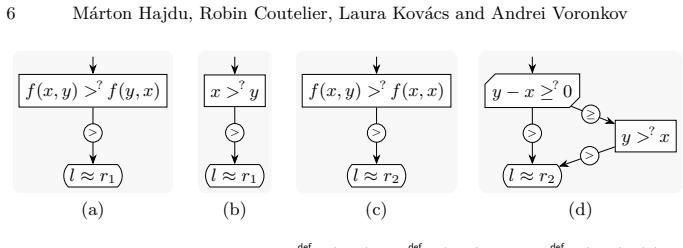
The central object is the term ordering diagram (TOD), a directed acyclic graph with a single root and a single exit. Each evaluation node carries either a term comparison $s>?t$ with outgoing edges labelled $>$, $=$, and $\ngeq$, or a KBO positivity check $e\geq?0$ with edges labelled $>$, $\geq$, and $\ngeq$; success nodes are labelled by equalities. The load-bearing mechanism is the set of node-local rewrite rules derived from the recursive clauses of KBO and LPO, together with a forcing rule: a node forces an edge label when every substitution that reaches the node must take that edge, and such nodes can be removed. Node replication guarantees that a visited node has a single incoming path, which is what makes the forcing analysis local and lets the paper state correctness as equivalence of success sets over all substitutions.
What would settle it
Run the retrieval algorithm on a small unit-equality problem whose weight difference is non-ground, such as $y-x$, and compare its answer with a brute-force post-ordering check that enumerates all grounding substitutions on a finite signature; any substitution for which the two answers differ falsifies the correctness claim.
Extended reading notes
Core claim
A post-ordering check does not have to be re-derived from scratch each time it is asked. The paper's claim is that the whole family of checks for one left-hand side can be organised as a term ordering diagram: a rooted DAG whose evaluation nodes are term comparisons $s>?t$ and, for KBO, weight-sign checks $e\geq?0$, and whose success nodes hold the equalities that may be retrieved. Traversing the diagram for a query substitution $\sigma$, following the edge selected by evaluating each node under $\sigma$, returns exactly the equalities with $l\sigma\succ r_i\sigma$. The retrieval algorithm rewrites the diagram on the fly: nodes that force an edge label are removed, nodes with several incoming paths are replicated, and a comparison of $f(\bar s)>?g(\bar t)$ is expanded according to the KBO or LPO clauses. The paper proves each rewrite preserves the success set for every substitution, and its experiments show that doing these rewrites lazily, only on nodes actually visited, makes checks cheaper over time, with the larger gains on LPO.
Load-bearing premise
The load-bearing premise is that the prover's sign test for a non-ground linear expression $e$ means exactly the paper's universal semantics: $e>0$ when $\sigma(e)>0$ for every grounding substitution, and $e\geq0$ when $\sigma(e)\geq0$ for every grounding substitution; if the implemented test uses a different convention, a transformed TOD could follow a branch that the correctness proof does not justify.
Editorial extensions
If this is right
- Lazy rewriting turns repeated post-ordering checks on the same left-hand side from full KBO or LPO re-evaluations into short traversals, so the cost of a check is amortised over many demodulation attempts.
- In the unit-equality regime with LPO, the post-ordering share of instructions drops from roughly $52\%$ to about $18\%$ with shared TODs, and more benchmark problems are solved within the same time limit.
- Because the transformations preserve the success set, equalities can be inserted into the index freely, and deletion is handled by marking clauses as deleted instead of restructuring the diagram.
- Sharing one TOD across all equalities with the same left-hand side is stronger than a per-equality TOD, because information learned while checking one equality immediately rules out or confirms others.
Reading between the lines
- The same node-local rewrite idea should transfer to other simplification orders whose definitions are a small set of recursive clauses; only the KBO/LPO-specific expansion rules would need to be replaced, for example for a weighted path order.
- Because the index is queried by substitution and rewritten lazily, TOD-style caching could also apply to other substitution-dependent side conditions in saturation, such as constrained superposition or ground-reducibility checks.
- The memory increase observed in some runs suggests a testable extension: a policy that bounds TOD size or forgets rarely visited branches could trade a little speed for much lower memory, a tradeoff the paper leaves implicit.
Editorial analysis
A structured set of objections, weighed in public.
Referee Report
Summary. The paper introduces term ordering diagrams (TODs), a DAG-based index for the post-ordering problem: given equalities l≈r1,...,l≈rn with a common left-hand side and a substitution σ, retrieve those with lσ≻riσ. TODs interleave term comparison nodes and, for KBO, positivity check nodes, and are modified lazily during traversal by equivalence-preserving transformations derived from the KBO/LPO definitions (Figures 4–5) plus generic node removal and replication (Figure 3). The authors prove termination and equivalence of the transformations (Theorem 1), give a retrieval algorithm with termination and correctness lemmas (Lemmas 1–4), implement the approach in Vampire, and report reduced instruction counts for post-ordering checks and forward demodulation, with the strongest gains in LPO/UEQ problems.
Significance. If correct, the TOD construction addresses a real bottleneck in saturation-based equational reasoning: the repeated checks of whether an unordered equality becomes orderable after substitution. The formal development is a genuine contribution: the transformations are derived from the KBO/LPO definitions rather than fitted to experimental data, the correctness proof for the transformations is a detailed case analysis (Appendix A), and the retrieval algorithm is accompanied by termination and equivalence lemmas. The experimental evaluation is thorough for the area, reporting problem counts, calibrated instruction counts, memory behavior, and per-problem distributions; the shared-TOD variant reduces the post-ordering instruction share in UEQ/LPO runs from about 52% to 18–24% (Table 3). The main caveat is that the soundness of the implemented variant rests on an unstated decision procedure for positivity checks on non-ground linear expressions.
major comments (1)
- [Section 2–3, Figure 4/10, Appendix A] The KBO branch condition e≥?0 is defined semantically: σ(e≥?0) is >, ≥, or ≱ according to whether the linear expression σ(e) is >0, ≳0, or neither, where >0 and ≳0 are universal over grounding substitutions. The KBO transformations branch on this check, and the proof of Theorem 1 (Appendix A, cases (1)–(5)) assumes the traversal follows the edge selected by this universal semantics. However, the manuscript never specifies how Vampire decides whether a non-ground linear expression such as 2x−y−1 is universally positive or non-negative over grounding substitutions, nor does it cite an external decision procedure for this subproblem. A syntactic sign test on the concrete substituted expression is not equivalent to the universal semantics, because the set of weights of ground terms is constrained by w0>0 and by the signature; for example, an expression with a negative variable coefficient can be non-negative on all ground terms, while a syntactically positive expression can fail to be universally positive. Remark 1 explicitly leaves positivity-check-derived term constraints out of the forcing function, so the forcing function cannot repair this gap. Please specify the implemented sign test (or the KBO constraint-solving algorithm from [8,9,19] used) and prove that it matches the Section 2 semantics; without this, Theorem 1 and Lemma 4 do not establish soundness of the implemented TOD retrieval.
minor comments (5)
- [Section 5, Figure 6] The insertion operation is described as inserting a node “just before the exit node,” but a general TOD can have many edges into the exit node; please state whether the new comparison node is spliced into every such edge or attached as a new shared predecessor, and how the single-incoming-edge invariant used in Lemma 1 is maintained.
- [Section 2–3] The symbol σ is used both for an arbitrary grounding substitution in the definitions of e>0 and e≳0 and for the query substitution in the definitions of Section 3; this double use makes the semantics of σ(e≥?0) harder to follow and should be renamed in one of the two places.
- [Definition 2 vs. Section 5, step 1] Definition 2 defines the success set as the labels of all success nodes on the traversal path, while the retrieval algorithm returns only non-deleted equalities; the definition of TOD equivalence should be stated with deletions in mind or the definition should be adjusted accordingly.
- [Figure 7, step 2 and Example 3] The example says a success node is “marked visited (step 3c)”, but step 3 in Figure 7 applies only to unvisited evaluation nodes; either mark success nodes visited explicitly in step 2 or omit this from the example.
- [Appendix D.2] The phrase “multiplied … by an order of 100” is imprecise; the described example increases the non-demodulation share by a factor of about 106, not 100.
Circularity Check
No significant circularity: TOD transformations are derived from KBO/LPO definitions and the speedups are externally measured; the positivity-check implementation gap is a soundness concern, not a circular derivation.
full rationale
The paper's derivation chain is self-contained. Theorem 1 is proved in Appendix A by case analysis directly from the KBO clauses (K1)-(K3) and LPO clauses (L1)-(L3): for instance, when sigma(|s|-|t|)>0, (K1) yields the original '>' edge and the replacement positivity node also leads to n1, and the remaining cases check the '>=' and 'not>=' paths. This is a soundness proof relative to the definitions of Sections 2-3, not a reuse of the target claim. The generic redundant-node-removal transformation is justified by Definition 2's 'forces' predicate: if every traversal reaching a node takes label l, bypassing the node cannot change the success set, so TOD equivalence follows semantically. The forcing function in Definition 4 has exactly the property used in Lemma 2, so it does not smuggle in the conclusion. The experimental claims (Tables 1-3) are direct measurements of externally supplied TPTP problems and instruction counters, with no parameter fitted to the reported post-ordering reductions. The only manuscript-internal concern is the unspecified computation of positivity checks for non-ground linear expressions: Section 2 defines e>0 universally over grounding substitutions, while Section 3's traversal semantics applies sigma(e>=?0) to a concrete query, so the paper does not state how Vampire decides the sign symbolically. This is a soundness/implementation gap, and Remark 1's limitation about term-constraint reasoning confirms the forcing function is an approximation, but neither makes any prediction equivalent to its input by construction. Self-citations [20,21] are contextual: they motivate runtime specialization, but the TOD correctness proof does not depend on them.
Assumptions & free parameters
assumptions (4)
- standard math KBO is a simplification ordering whenever w0>0 and every unary function symbol of weight 0 is minimal in the precedence.
- standard math LPO is a simplification ordering for any precedence.
- domain assumption The transitivity axioms (tr1)-(tr5) are valid for term constraints built from a simplification ordering and syntactic equality.
- domain assumption The post-ordering problem is restricted to equalities with a common left-hand side l.
Cite this review
Pith. "Pith review of Term Ordering Diagrams." pith.science (2026). https://pith.science/paper/KF5HXYNA
@misc{pith2026250522181,
  author       = {Pith},
  title        = {Pith review of: Term Ordering Diagrams},
  year         = {2026},
  howpublished = {\url{https://pith.science/paper/KF5HXYNA}},
  note         = {Machine review of arXiv:2505.22181}
}
read the original abstract
The superposition calculus for reasoning in first-order logic with equality relies on simplification orderings on terms. Modern saturation provers use the Knuth-Bendix order (KBO) and the lexicographic path order (LPO) for discovering redundant clauses and inferences. Implementing term orderings is however challenging. While KBO comparisons can be performed in linear time and LPO checks in quadratic time, using the best known algorithms for these orders is not enough. Indeed, our experiments show that for some examples term ordering checks may use about 98% of the overall proving time. The reason for this is that some equalities that cannot be ordered can become ordered after applying a substitution (post-ordered), and we have to check for post-ordering repeatedly for the same equalities. In this paper, we show how to improve post-ordering checks by introducing a new data structure called term ordering diagrams, in short TODs, which creates an index for these checks. We achieve efficiency by lazy modifications of the index and by storing and reusing information from previously performed checks to speed up subsequent checks. Our experiments demonstrate efficiency of TODs.
Figures


Figures from the paper (12 more)


Reference graph
Works this paper leans on
-
[1]
Comon, H., Narendran, P., Nieuwenhuis, R., Rusinowitch, M.: Deciding the confluence of ordered term rewrite systems. ACM TOCL (2003). https://doi.org/10.1145/601775.601777
arXiv 2003
-
[2]
Journal of Automated Reasoning (1997)
Denzinger, J., Kronenburg, M., Schulz, S.: DISCOUNT - A Distributed and Learning Equational Prover. Journal of Automated Reasoning (1997). https://doi.org/10.1023/A:1005879229581
-
[3]
Duarte, A., Korovin, K.: Ground Joinability and Connectedness in the Superposi- tion Calculus. In: IJCAR (2022). https://doi.org/10.1007/978-3-031-10769-6 11
-
[4]
Gleiss, B., Kov´ acs, L., Rath, J.: Subsumption Demodulation in First-Order Theo- rem Proving. In: IJCAR (2020). https://doi.org/10.1007/978-3-030-51074-9 17
-
[5]
Unpub- lished manuscript (1980)
Kamin, S., L´ evy, J.J.: Two generalizations of the recursive path ordering. Unpub- lished manuscript (1980)
work page 1980
-
[6]
Knuth, D.E., Bendix, P.B.: Simple Word Problems in Universal Algebras. In: Automation of Reasoning 2. Springer (1983). https://doi.org/10.1007/978-3-642- 81955-1 23
-
[7]
Korovin, K.: iProver — An Instantiation-Based Theorem Prover for First-Order Logic (System Description). In: IJCAR (2008). https://doi.org/10.1007/978-3-540- 71070-7 24
-
[8]
Korovin, K., Voronkov, A.: Knuth-Bendix Constraint Solving Is NP-Complete. In: ICALP (2001). https://doi.org/10.1007/3-540-48224-5 79
Show all 45 references
-
[9]
Information and Computation (2003)
Korovin, K., Voronkov, A.: Orienting rewrite rules with the Knuth–Bendix order. Information and Computation (2003). https://doi.org/10.1016/S0890- 5401(03)00021-X
2003 doi
-
[10]
Kov´ acs, L., Voronkov, A.: First-Order Theorem Proving and Vampire. In: CAV. pp. 1–35 (2013). https://doi.org/10.1007/978-3-642-39799-8 1
2013 doi
-
[12]
International Journal on Artificial Intelligence Tools (2006)
L¨ ochner, B.: Things To Know When Implementing LPO. International Journal on Artificial Intelligence Tools (2006). https://doi.org/10.1142/S0218213006002564
2006 doi
-
[13]
In: IWIL (2001), https://www.researchgate.net/publication/229079124
L¨ ochner, B., Schulz, S.: An Evaluation of Shared Rewriting. In: IWIL (2001), https://www.researchgate.net/publication/229079124
2001
-
[14]
Journal of Automated Reasoning (2006)
L¨ ochner, B.: Things to Know when Implementing KBO. Journal of Automated Reasoning (2006). https://doi.org/10.1007/s10817-006-9031-4
2006 doi
-
[15]
Journal of Automated Reasoning (1997)
McCune, W., Wos, L.: Otter - the CADE-13 competition incarnations. Journal of Automated Reasoning (1997). https://doi.org/10.1023/A:1005843632307
1997 doi
-
[16]
In: Hand- book of Automated Reasoning, chap
Nieuwenhuis, R., Rubio, A.: Paramodulation-Based Theorem Proving. In: Hand- book of Automated Reasoning, chap. 7. Elsevier and MIT Press (2001). https://doi.org/10.1016/B978-044450813-3/50009-6
2001 doi
-
[17]
Information Processing Letters (1993)
Nieuwenhuis, R.: Simple LPO constraint solving methods. Information Processing Letters (1993). https://doi.org/10.1016/0020-0190(93)90226-Y 18 M´ arton Hajdu, Robin Coutelier, Laura Kov´ acs and Andrei Voronkov
1993 doi
-
[18]
In: CADE (1999)
Nieuwenhuis, R.: Invited Talk: Rewrite-Based Deduction and Symbolic Con- straints. In: CADE (1999). https://doi.org/10.1007/3-540-48660-7 28
1999 doi
-
[19]
Information and Computation (2002)
Nieuwenhuis, R., Rivero, J.M.: Practical Algorithms for Deciding Path Ordering Constraint Satisfaction. Information and Computation (2002). https://doi.org/10.1006/inco.2002.3146
2002
-
[20]
In: JELIA (2000)
Riazanov, A., Voronkov, A.: Partially Adaptive Code Trees. In: JELIA (2000). https://doi.org/10.1007/3-540-40006-0 15
2000 doi
-
[21]
In: CADE (2004)
Riazanov, A., Voronkov, A.: Efficient Checking of Term Ordering Constraints. In: CADE (2004). https://doi.org/10.1007/978-3-540-25984-8 3
2004 doi
-
[22]
In: CADE (2019)
Schulz, S., Cruanes, S., Vukmirovi´ c, P.: Faster, Higher, Stronger: E 2.3. In: CADE (2019). https://doi.org/10.1007/978-3-030-29436-6 29
2019 doi
-
[23]
In: Handbook of Au- tomated Reasoning, chap
Sekar, R., Ramakrishnan, I., Voronkov, A.: Term Indexing. In: Handbook of Au- tomated Reasoning, chap. 26. MIT Press (2001). https://doi.org/10.1016/B978- 044450813-3/50028-X
2001 doi
-
[24]
AI Magazine (2016)
Sutcliffe, G.: The CADE ATP System Competition - CASC. AI Magazine (2016). https://doi.org/10.1609/aimag.v37i2.2620
2016 doi
-
[25]
In: IJCAR (2024)
Sutcliffe, G.: Stepping Stones in the TPTP World. In: IJCAR (2024). https://doi.org/10.1007/978-3-031-63498-7 3
2024 doi
-
[26]
Journal of Automated Reasoning (2022)
Vukmirovic, P., Bentkamp, A., Blanchette, J., Cruanes, S., Nummelin, V., Tourret, S.: Making Higher-Order Superposition Work. Journal of Automated Reasoning (2022). https://doi.org/10.1007/s10817-021-09613-z
2022 doi
-
[27]
Science of Computer Programming (2015)
Yamada, A., Kusakari, K., Sakabe, T.: A unified ordering for termination proving. Science of Computer Programming (2015). https://doi.org/10.1016/j.scico.2014.07.009 Appendix A Correctness of TOD Transformations In this section, we present a detailed proof of our main result. ...
2015 doi
-
[28]
x ⩾̸y due to x<f (x) and f(x) ⩾̸y, using axiom (tr5),
-
[29]
z >y due to y <g(y) and g(y) =z, using axiom (tr3),
-
[30]
Since x ⩾̸ z is implied by TR∧ F , we conclude that the node labeled x >? z forces label ≱
x ⩾̸z due to x ⩾̸y and y <z, using axiom (tr4). Since x ⩾̸ z is implied by TR∧ F , we conclude that the node labeled x >? z forces label ≱. ❏ 26 M´ arton Hajdu, Robin Coutelier, Laura Kov´ acs and Andrei Voronkov Remark 1. It is possible to further strengthen reasoning over te...
-
[31]
apply σ on s and θ on t, resulting in the terms s′ and t′, respectively,
-
[32]
We noted earlier that KBO and LPO can be implemented in linear, respectively quadratic time in the size of the compared terms [14,12]
compare s′ and t′ using≻, that is, determine whether s′≻ t′, s′ = t′ or s′≺t′ holds. We noted earlier that KBO and LPO can be implemented in linear, respectively quadratic time in the size of the compared terms [14,12]. However, we can still improve the above steps using the f...
-
[33]
traversing all non-variable subterms of s as if they were subterms of s′,
-
[34]
For this, we have to work on pairs of terms and substitutions, as defined below
applying the substitution only when reaching a variable x ins, in which case we continue traversal in xσ. For this, we have to work on pairs of terms and substitutions, as defined below. Definition 7 (Closure Term). Lets be a term and σ a substitution. We call the pair s·σ a c...
-
[35]
We get a·ε =a·θ, which is true by case (1) since a is ground
For x·σ =a·θ, case (2) applies. We get a·ε =a·θ, which is true by case (1) since a is ground
-
[36]
We get b·σ =b·ε, which is true by case (1) since b is ground
For b·σ =y·θ, case (3) applies. We get b·σ =b·ε, which is true by case (1) since b is ground. ❏ For KBO, we define linear expressions for closure terms as follows. 7 This is usually a pointer comparison taking constant time. Term Ordering Diagrams 29 Definition 9 (Linear Expre...
-
[37]
Finally,f(z,u )·ε≻lpo z·ε holds due to (L1) and f(z,u )≻lpo z
check x·σ≻lpo x·θ: (L2) applies, so we compare f(z,u )·ε and x·θ, then (L3) applies, so we compare f(z,u )·ε and z·ε. Finally,f(z,u )·ε≻lpo z·ε holds due to (L1) and f(z,u )≻lpo z. 30 M´ arton Hajdu, Robin Coutelier, Laura Kov´ acs and Andrei Voronkov
-
[38]
This holds by (L1) and f(z,u )≻lpo u
check f(x,y )·σ≻lpo y·θ: (L3) applies, so we comparef(x,y )·σ≻lpo f(u,z )·ε, then (L4) applies, so we perform the following subcomparisons: (a) check x·σ≻lpo u·ε, which by (L2) is equivalent to checkingf(z,u )·ε≻lpo u·ε. This holds by (L1) and f(z,u )≻lpo u. (b) check f(x,y )·...
-
[39]
We compute the linear expression |s|−| t|
-
[40]
If either (K1) or (K2) applies, we exit early with success
-
[41]
If none of (K1)–(K3) applies, we exit early with failure
-
[42]
for free
Otherwise, we check if (K3) applies recursively. This algorithm clearly takes quadratic time in the sizes of s and t. However, instead of always computing the linear expressions from scratch, we utilize term sharing to memoize the linear expressions for terms that we have alre...
-
[43]
baseline uses bidirectional comparison without closure terms,
-
[44]
conf1 uses bidirectional comparison with closure terms,
-
[45]
conf2 uses unidirectional comparison without closure terms,
-
[46]
queries” represent the number of retrievals for TODs, whereas “answers
conf3 uses unidirectional comparison with closure terms. Our experiments were run with a 60-second timeout. The results are shown in Tables 4 and 5. The tables show that both unidirectional comparisons and comparisons with closure terms improve the running times and also the n...
Reviewed August 7, 2026 · model on record in the stance chip above.
Discussion (0). Sign in to comment.