REVIEW 4 major objections 5 minor 15 references
A memristive model of spatio-temporal excitability
T0 review · 4 major / 5 minor · reviewed 2026-08-07 · deepseek-v4-flash
Pith's one-line read The same memristive mixed-feedback circuit that produces temporal spiking also produces spatial bumps in a neural field.
desk verdict A genuinely new unified memristive framework for temporal and spatial excitability, with a solid temporal analysis but an under-validated spatial branch that needs either an equivalence argument or systematic comparison to Amari. read the letter →
The pith
A machine-rendered reading of the paper's core claim, the machinery that carries it, and where it could break.
The reading
What carries the argument
The central object is the memductance: a conductance that obeys Ohm's law (current equals g times (v − E)) but whose value depends on the history of the entire neural field, so it carries memory. The paper models each memductance as a feedforward nonlinear convolution operator — a small CNN. The architecture is a nonlinear RC circuit with two such memductances, e and i: e is fast, inward, and positive-feedback; i is slow, outward, and negative-feedback. For spatial excitability, the e and i memductances are driven by two separate populations and convolved with exponential kernels of short and long range. All modeling complexity is concentrated in the memductances; the circuit skeleton stays fixed, which is what gives the model its cross-scale reach.
What would settle it
Simulate the two-population spatial memristive model and the original lateral-inhibition neural-field model side by side over a grid of input amplitudes, kernel widths, and thresholds; if there is any parameter region where the original model produces a localized persistent bump but the memristive model does not (or vice versa), the claimed spatial unification fails. A single matching example, as in the paper, is not enough.
Extended reading notes
Core claim
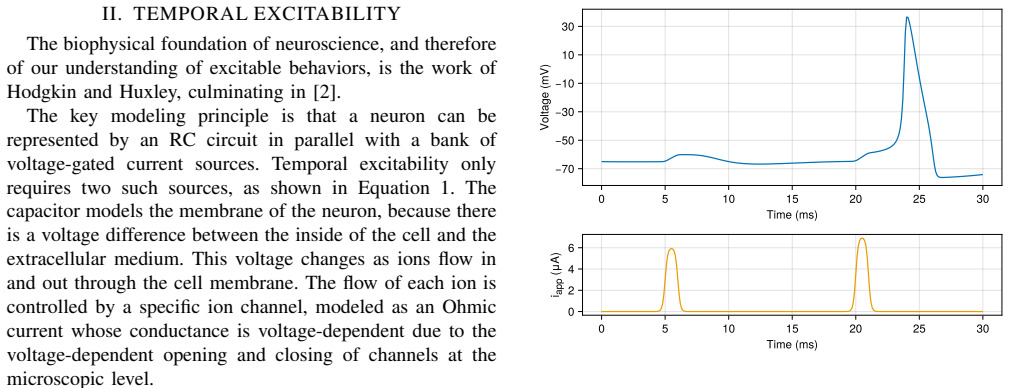
The central discovery claim is that temporal and spatial excitability share a single mechanism: a mixed-feedback loop where fast positive feedback provides the switch and slower negative feedback provides recovery and containment. In time, the positive feedback is a fast inward current and the negative feedback is a slower outward current; in space, the positive feedback is short-range excitation and the negative feedback is long-range inhibition. The paper's unified model encodes both in one RC circuit with two memristive currents, labeled e and i, whose memductances are nonlinear convolution operators (simple CNN models). A purely temporal instantiation of the memductances yields the canonical firing threshold, a spatial instantiation on separate excitatory and inhibitory populations yields the lateral-inhibition bump, and combining them yields both. The claim is that the mechanism of excitability is the mixed-feedback architecture itself, and that this mechanism is robust to the details of the memductance model.
Load-bearing premise
The claim rests on assuming that splitting Amari's signed spatial interaction kernel into two separate nonnegative excitatory and inhibitory memductance kernels reproduces the same spatial excitability; the paper shows one simulation with handpicked parameters rather than a proof or systematic comparison.
Editorial extensions
If this is right
- The same circuit model can reproduce both the temporal firing threshold of a biophysical neuron and the spatial bump of a lateral-inhibition neural field, by changing only the memductance maps.
- Because the fixed RC circuit is preserved across scales, temporal and spatial models become special cases of one architecture rather than two different modeling traditions.
- Excitability is robust to the details of the memductance model, so simplified memductance representations can be used for large-scale simulation without losing the fundamental behavior.
- The spatio-temporal model gives a single framework for studying how cellular-scale ion-channel properties shape population-scale activity.
- Temporal memductances map to ion channels and spatial memductances map to synaptic currents, preserving biophysical interpretability.
Reading between the lines
- If this unification holds, excitability may be a design principle rather than a material property: any system with fast positive and slow negative feedback could show the same threshold behavior, whether in neurons, populations, or engineered circuits.
- A natural testable extension is to use the CNN memductance representation to model traveling waves and oscillations in the neural field, which the paper mentions but does not demonstrate for the unified model.
- The two-population nonnegative memductance construction might also be applied to other signed-kernel neural-field models, potentially replacing signed interaction kernels with physiologically interpretable excitatory and inhibitory populations.
- The operator-theoretic fixed-point viewpoint suggested in the paper's future-work section could make the memristive model scalable to large networks, but that scalability remains to be demonstrated.
Editorial analysis
A structured set of objections, weighed in public.
Referee Report
Summary. The paper proposes a memristive model of spatio-temporal excitability that aims to unify Hodgkin-Huxley temporal excitability and Amari spatial excitability under a single mixed-feedback architecture. The authors revisit the HH and Amari models, represent their feedback structure as the difference of two currents, and introduce a conductance-based model in which temporal memductances (Section IV-A) and spatial memductances (Section IV-B) are implemented by simple CNN-type operators. Temporal excitability is characterized by explicit inequalities in Eqs. (7)-(8), and simulations in Figures 6, 8, and 9 illustrate temporal, spatial, and combined spatio-temporal responses. The central claim is that excitability at both scales is the result of one mechanism: fast/short-range positive feedback paired with slow/long-range negative feedback.
Significance. If fully substantiated, the proposed framework would offer a cross-scale modeling principle: the same RC-plus-memductance circuit structure would describe single-neuron and population excitability, with only the spatio-temporal kernel of the memductance changing. This is an attractive and potentially useful conceptual contribution for neuromorphic modeling and for linking cellular and population dynamics. The paper has notable strengths: the block-diagram analogy between HH and Amari is clearly drawn; the temporal model yields explicit, simple excitability conditions in Eqs. (7)-(8); and the parameter tables make the simulations reproducible in principle. However, the spatial branch, which is load-bearing for the unification claim, is validated only by a single handpicked simulation (Figure 8) with no equivalence proof, no quantitative comparison to Amari dynamics, and no sensitivity or stability analysis. The paper is therefore best read as a promising conceptual proposal rather than a demonstrated unification.
major comments (4)
- [Section IV-B, Eq. (10), Figure 8] The spatial branch of the model is not shown to reproduce Amari dynamics. Eq. (10) replaces the signed Mexican-hat kernel w(x)=e^{-|x|/sigma_E}-e^{-|x|/sigma_I} of Eq. (4) with two nonnegative memductance kernels acting on separate excitatory and inhibitory populations with voltages v_E and v_I. This is not a change of variables or a singular limit of Amari's equation: the convolution is applied to the filtered voltage v rather than to a saturating firing rate f(u), the nonlinearity in the current is quadratic in v through g(v)(v-E), and there is no sigmoid firing-rate function. The claim that this two-population conductance model preserves Amari's spatial excitability therefore requires either an equivalence proof or a systematic quantitative comparison (e.g., threshold amplitude, bump width, stability, and parameter sweeps against Eq. (4)). Figure 8 shows one simulation only, which is insufficient support for the spatial half of the unification.
- [Section IV-B, Eq. (10), Figures 8-9] The spatial model is underspecified. Eq. (10) defines the synaptic memductances g_syn through temporal filtering, spatial convolution, and a ReLU threshold, but the paper does not write the full coupled equations for the two populations v_E and v_I. The text says each population is connected to itself and to the other, but the exact right-hand sides of partial differential equations for both populations, the boundary conditions, the spatial domain, and the numerical discretization are not given. Without these details, the simulations in Figures 8 and 9 cannot be reproduced or independently checked. The authors should provide the complete PDE system and the numerical implementation details.
- [Section V, Eq. (11)] The unified spatio-temporal model is introduced by simply adding the temporal and spatial memductances in Eq. (11), but no analysis or systematic test shows that the combined system preserves both excitability types. In particular, it is not shown that a spatially superthreshold input produces the same localized bump in the presence of the temporal currents, nor that a temporally superthreshold input still produces an action-potential-like response in the presence of the spatial currents. Figure 9 is a single simulation and does not quantify threshold separation or the interaction between the two mechanisms. The authors should demonstrate both excitability types in the combined model, and ideally characterize how the temporal and spatial memductances interact.
- [Section IV-A, Eqs. (7)-(8)] The excitability conditions in Eqs. (7)-(8) are derived under the approximations v_e,m approximately v and v_i,m approximately 0, which are plausible for fast and slow time constants but are not rigorously justified. The paper states that the mechanism is 'robust to uncertainty in the parameter values' immediately after Eq. (8), yet no sensitivity analysis, parameter-space exploration, or basin/threshold study is provided. Since these conditions are central to the temporal excitability claim, the approximations and the robustness statement should be made precise, or at least supported by numerical experiments over the parameter ranges in Table III.
minor comments (5)
- [Section IV-B, text before Eq. (9)] Typo: 'obain' should be 'obtain'.
- [Table III caption] Typo: 'Whever applicable' should be 'Wherever applicable'.
- [Section VI-B] Typo: 'significant' is misspelled as 'sigificant'.
- [Tables III-IV and simulation section] The parameter tables give numerical values without units or a statement that the model is nondimensionalized; please clarify the units or state explicitly that all quantities are in arbitrary dimensionless units.
- [Section VII] The simulation details state when steady-state values are read off (e.g., t=205 and t=305 for Figure 4), but the total simulation time and the spatial domain size are not given; please specify these to ensure reproducibility.
Circularity Check
No circularity found: the model's feedback conditions and simulations are derived from its own stated equations; the lack of a quantitative Amari-equivalence proof is an evidential weakness, not circularity.
full rationale
The paper's central derivation chain is self-contained. The temporal excitability conditions in Equations (7)-(8) are derived directly from the proposed memristive current-balance model, not from the Hodgkin-Huxley equations it is meant to unify. The spatial model in Equations (9)-(10) explicitly introduces its own nonnegative memductance kernel and two-population architecture; the resulting figures are qualitative demonstrations, not fitted predictions relabeled as confirmations. No parameter is fitted to Amari or Hodgkin-Huxley data and then reported as a predicted observable. The self-citations ([10], [11], [13], [14], [15]) appear only as motivation or as future-work references and are not load-bearing for the paper's main claim. The absence of a formal equivalence proof or systematic comparison between Equation (10) and Amari's Equation (4) is a substantive validation gap, but it does not make the derivation circular: the conclusion that the proposed model exhibits spatio-temporal excitability is read off from its own simulated dynamics, not imported from the cited models or from the target conclusion itself.
Assumptions & free parameters
free parameters (19)
- leak conductance g_l =
0.1
- fast excitatory memductance time constant tau_e,m =
0.1
- max excitatory memductance g_e_bar =
1
- excitatory reversal potential E_e =
10
- excitatory memductance threshold vth_e,m =
1
- slow inhibitory memductance time constant tau_i,m =
10
- max inhibitory memductance g_i_bar =
10
- inhibitory reversal potential E_i =
-10
- inhibitory memductance threshold vth_i,m =
1
- excitatory spatial scale sigma_E =
0.5
- excitatory synaptic time constant tau_E_syn =
0.1
- excitatory synaptic threshold vth_E =
2
- max excitatory synaptic memductance g_E_syn_bar =
10
- excitatory synaptic reversal potential E_E_syn =
10
- inhibitory spatial scale sigma_I =
5
- inhibitory synaptic time constant tau_I_syn =
1
- inhibitory synaptic threshold vth_I =
2
- max inhibitory synaptic memductance g_I_syn_bar =
3
- inhibitory synaptic reversal potential E_I_syn =
-10
assumptions (6)
- domain assumption The mixed-feedback motif of fast positive feedback plus slower negative feedback fully captures Hodgkin-Huxley temporal excitability.
- domain assumption Amari's spatial excitability is fully captured by short-range excitation and long-range inhibition.
- domain assumption A neuron or neural population can be represented as an RC circuit with parallel Ohmic current sources whose conductances have memory.
- ad hoc to paper The memristive spatial kernel must be nonnegative, so excitation and inhibition must be modeled by separate populations.
- ad hoc to paper A simple CNN operator with one temporal or spatial convolution per current is sufficient to capture excitability.
- ad hoc to paper Temporal and spatial memductances can be combined additively in Equation 11 without losing either excitability type.
Cite this review
Pith. "Pith review of A memristive model of spatio-temporal excitability." pith.science (2026). https://pith.science/paper/DO7OZZNG
@misc{pith2026250522269,
  author       = {Pith},
  title        = {Pith review of: A memristive model of spatio-temporal excitability},
  year         = {2026},
  howpublished = {\url{https://pith.science/paper/DO7OZZNG}},
  note         = {Machine review of arXiv:2505.22269}
}
read the original abstract
This paper introduces a model of excitability that unifies the mechanism of an important neuronal property both in time and in space. As a starting point, we revisit both a key model of temporal excitability, proposed by Hodgkin and Huxley, and a key model of spatial excitability, proposed by Amari. We then propose a novel model that captures the temporal and spatial properties of both models. Our aim is to regard neuronal excitability as a property across scales, and to explore the benefits of modeling excitability with one and the same mechanism, whether at the cellular or the population level.
Figures


Figures from the paper (5 more)


Reference graph
Works this paper leans on
-
[1]
The Cognitive Correlates of Human Brain Oscilla- tions,
M. J. Kahana, “The Cognitive Correlates of Human Brain Oscilla- tions,”Journal of Neuroscience, vol. 26, pp. 1669–1672, Feb. 2006
work page 2006
-
[2]
A quantitative description of membrane current and its application to conduction and excitation in nerve,
A. L. Hodgkin and A. F. Huxley, “A quantitative description of membrane current and its application to conduction and excitation in nerve,”The Journal of Physiology, vol. 117, pp. 500–544, Aug. 1952
1952
-
[3]
Mathematical physiology 1: Cellular physi- ology,
J. Keener and J. Sneyd, “Mathematical physiology 1: Cellular physi- ology,” 2009
work page 2009
-
[4]
E. M. Izhikevich,Dynamical systems in neuroscience. MIT press, 2007
2007
-
[5]
B. Ermentrout and D. H. Terman,F oundations of mathematical neuroscience. Citeseer, 2010
work page 2010
-
[6]
Mathemat- ical model of an identified stomatogastric ganglion neuron,
F. Buchholtz, J. Golowasch, I. R. Epstein, and E. Marder, “Mathemat- ical model of an identified stomatogastric ganglion neuron,”Journal of neurophysiology, vol. 67, no. 2, pp. 332–340, 1992
work page 1992
-
[7]
Excitatory and Inhibitory Interactions in Localized Populations of Model Neurons,
H. R. Wilson and J. D. Cowan, “Excitatory and Inhibitory Interactions in Localized Populations of Model Neurons,”Biophysical Journal, vol. 12, pp. 1–24, Jan. 1972
work page 1972
-
[8]
Dynamics of pattern formation in lateral-inhibition type neural fields,
S.-i. Amari, “Dynamics of pattern formation in lateral-inhibition type neural fields,”Biological Cybernetics, vol. 27, pp. 77–87, June 1977
work page 1977
Show all 15 references
-
[9]
Next Generation Neural Mass Models,
S. Coombes and ´A. Byrne, “Next Generation Neural Mass Models,” in Nonlinear Dynamics in Computational Neuroscience(F. Corinto and A. Torcini, eds.), pp. 1–16, Cham: Springer International Publishing, 2019
2019
-
[10]
Switchable slow cellular conductances determine robustness and tunability of network states,
G. Drion, J. Dethier, A. Franci, and R. Sepulchre, “Switchable slow cellular conductances determine robustness and tunability of network states,”PLoS computational biology, vol. 14, no. 4, p. e1006125, 2018
2018
-
[11]
Burger,Oscillatory Spiking Circuits: A biologically plausible ar- chitecture for fast and reliable spiking computations
T. Burger,Oscillatory Spiking Circuits: A biologically plausible ar- chitecture for fast and reliable spiking computations. Ph.d. thesis, University of Cambridge, Cambridge, United Kingdom, 2023
2023
-
[12]
Memristive devices and systems,
L. Chua and S. M. Kang, “Memristive devices and systems,”Proceed- ings of the IEEE, vol. 64, pp. 209–223, Feb. 1976
1976
-
[13]
Neuromorphic control: Designing mul- tiscale mixed-feedback systems,
L. Ribar and R. Sepulchre, “Neuromorphic control: Designing mul- tiscale mixed-feedback systems,”IEEE Control Systems Magazine, vol. 41, no. 6, pp. 34–63, 2021
2021
-
[14]
Monotone one-port circuits,
T. Chaffey and R. Sepulchre, “Monotone one-port circuits,”IEEE Transactions on Automatic Control, vol. 69, no. 2, pp. 783–796, 2023
2023
-
[15]
An operator-theoretic framework to simulate neuromorphic circuits,
A. Shahhosseini, T. Chaffey, and R. Sepulchre, “An operator-theoretic framework to simulate neuromorphic circuits,” in2024 IEEE 63rd Conference on Decision and Control (CDC), pp. 6703–6708, IEEE, 2024
2024
Reviewed August 7, 2026 · model on record in the stance chip above.
Discussion (0). Continue with ORCID to comment.