A Hyperbolic Moment Based Shallow Water Model for Coupled Bedload Suspended Load Morphodynamics with Variable Density
Pith reviewed 2026-05-19 13:27 UTC · model grok-4.3
The pith
A derived hyperbolic shallow water moment model incorporates suspended sediment, bedload erosion and deposition, and variable density from the Navier-Stokes equations.
A machine-rendered reading of the paper's core claim, the machinery that carries it, and where it could break.
Core claim
Starting from the incompressible Navier-Stokes equations for a water-sediment mixture, we derive a coupled system consisting of the shallow water equations, moment equations for polynomial velocity coefficients, a depth-averaged suspended-sediment equation, and an Exner equation for bedload transport with erosion-deposition coupling. Although the transported scalar is depth-averaged, we reconstruct a low-order vertical concentration profile consistent with the moment representation of velocity, providing the near-bed concentration needed in the closure. We prove hyperbolicity through hyperbolic regularization and derive dissipative energy balance relations for lower-order models.
What carries the argument
The hyperbolic regularization of the moment-based shallow water system coupled with erosion-deposition source terms closed by a reconstructed vertical concentration profile.
If this is right
- The coupled system remains hyperbolic, allowing stable numerical solutions for morphodynamic problems.
- Variable mixture density affects both momentum and higher-order moment equations consistently.
- Dissipative energy relations hold for lower-order model truncations.
- Path-conservative schemes can simulate wet/dry fronts accurately in dam-break scenarios.
Where Pith is reading between the lines
- Similar moment reconstructions could improve closures in other multi-phase shallow flow models.
- The model framework may generalize to include additional transported scalars like temperature or pollutants.
- Validation against more field data could confirm its use for river engineering applications.
Load-bearing premise
Reconstructing a low-order vertical concentration profile from the velocity moments accurately captures the near-bed sediment concentration needed to close the erosion and deposition terms.
What would settle it
Direct measurement of near-bed sediment concentration in a controlled dam-break flume experiment that deviates substantially from the low-order reconstruction used to close the source terms would falsify the coupling.
Figures




read the original abstract
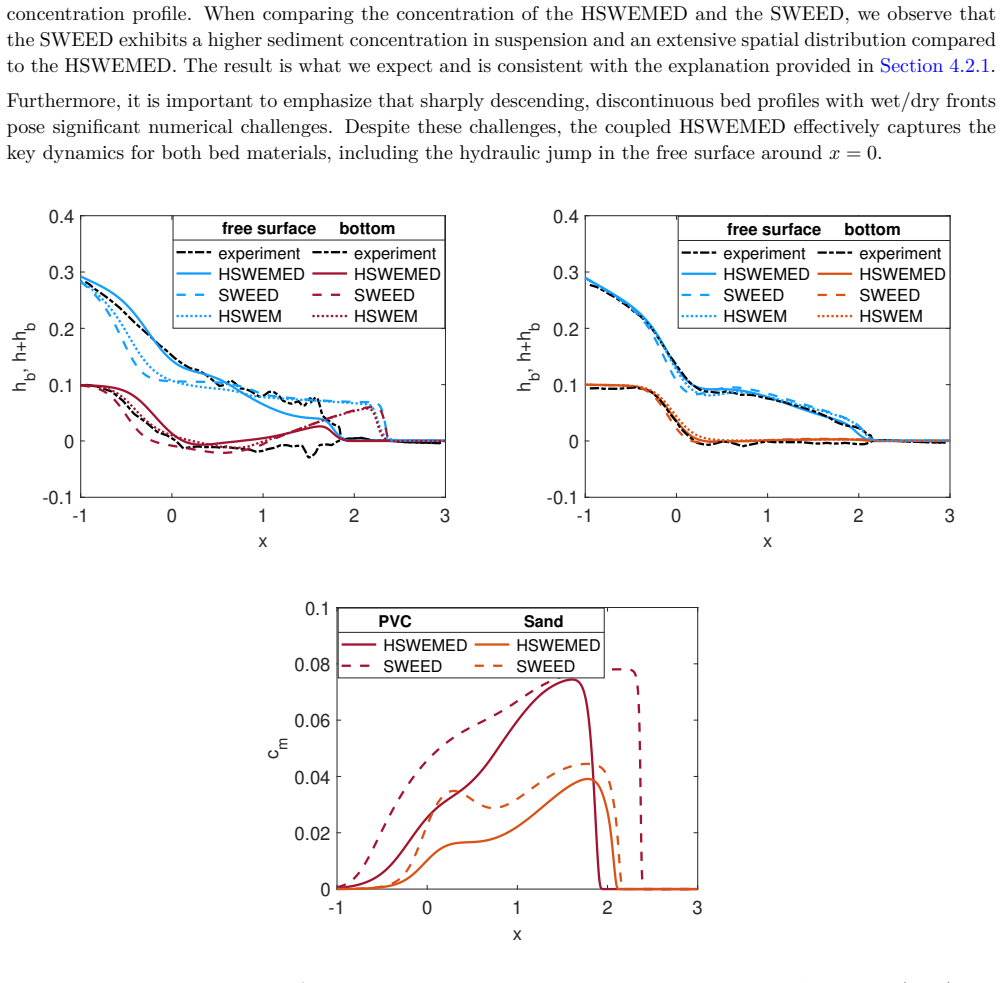
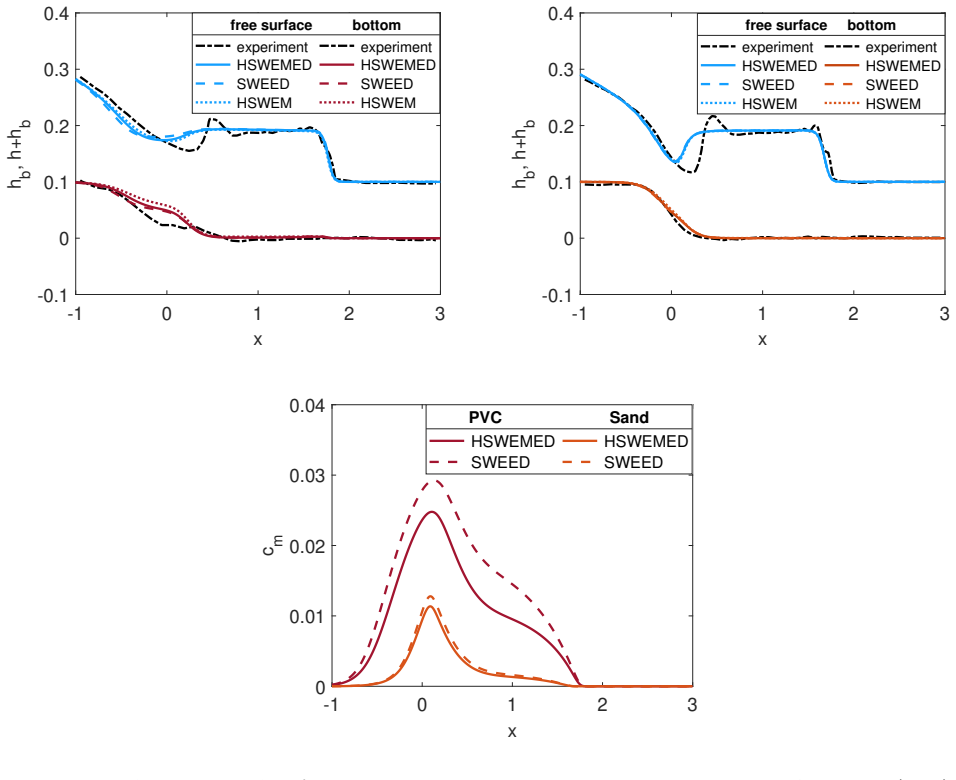
In this paper, we develop the Hyperbolic Shallow Water Exner Moment model with Erosion and Deposition (HSWEMED), extending the shallow water moment framework to capture coupled morphodynamics with erosion and deposition. HSWEMED introduces a suspended-sediment concentration equation, couples concentration-dependent mixture density with the momentum and higher-order moment equations, and includes source terms due to erosion and deposition. Starting from the incompressible Navier-Stokes equations for a water-sediment mixture, we derive a coupled system consisting of the shallow water equations, moment equations for polynomial velocity coefficients, a depth-averaged suspended-sediment equation, and an Exner equation for bedload transport with erosion-deposition coupling. Although the transported scalar is depth-averaged, we reconstruct a low-order vertical concentration profile consistent with the moment representation of velocity, providing the near-bed concentration needed in the closure. We prove hyperbolicity through hyperbolic regularization and derive dissipative energy balance relations for lower-order models. Numerical results are obtained with a path-conservative finite-volume scheme based on a Lax-Friedrichs-type flux. Several dam-break tests, including wet/dry front cases, are validated against laboratory experiments, showing improved accuracy over existing shallow water moment models. The proposed HSWEMED provides a mathematically well-posed and computationally efficient framework for morphodynamic simulations.
Editorial analysis
A structured set of objections, weighed in public.
Referee Report
Summary. The manuscript develops the Hyperbolic Shallow Water Exner Moment model with Erosion and Deposition (HSWEMED) by starting from the incompressible Navier-Stokes equations for a variable-density water-sediment mixture. It derives a coupled system consisting of the shallow water equations, moment equations for polynomial velocity profiles, a depth-averaged suspended-sediment concentration equation, and an Exner equation for bedload transport that incorporates erosion-deposition source terms. A low-order vertical concentration profile is reconstructed from the depth-averaged scalar to close the near-bed concentration in the source terms. Hyperbolicity is proved via regularization, dissipative energy balances are derived for lower-order models, and a path-conservative finite-volume scheme is applied to dam-break test cases (including wet/dry fronts) that are compared to laboratory experiments, with claims of improved accuracy over prior shallow-water moment models.
Significance. If the derivations remain valid after incorporation of the concentration closure, the paper supplies a first-principles derivation from the incompressible Navier-Stokes equations, a hyperbolicity proof, and an energy-dissipation identity together with direct validation against independent laboratory data. This yields a mathematically well-posed and computationally tractable framework for coupled suspended-load and bedload morphodynamics that extends existing moment-based shallow-water models while retaining variable density.
major comments (1)
- [derivation of dissipative energy balance relations for lower-order models] The dissipative energy balance relations derived for the lower-order models rely on exact cancellations that arise from the vertical integration procedure used to obtain the moment equations. However, the near-bed concentration that enters the erosion-deposition source terms is supplied by an assumed low-order vertical profile reconstruction rather than the same integration. It is not shown that the balance identity continues to hold once this reconstruction is substituted into the source terms; a direct verification (or counter-example) for the lowest-order case would be required to support the claim.
minor comments (2)
- [Abstract] The abstract states that numerical results show improved accuracy but supplies neither quantitative error norms, grid-convergence tables, nor any independent check on the reconstructed concentration profile.
- [model derivation] Notation for the polynomial coefficients in the velocity moments and for the reconstructed concentration profile should be introduced with explicit definitions before they appear in the source-term closures.
Simulated Author's Rebuttal
We thank the referee for the thorough review and constructive feedback on our manuscript. The observation concerning the dissipative energy balance relations is a valid point that requires clarification and explicit verification. We address it below and will revise the manuscript accordingly.
read point-by-point responses
-
Referee: [derivation of dissipative energy balance relations for lower-order models] The dissipative energy balance relations derived for the lower-order models rely on exact cancellations that arise from the vertical integration procedure used to obtain the moment equations. However, the near-bed concentration that enters the erosion-deposition source terms is supplied by an assumed low-order vertical profile reconstruction rather than the same integration. It is not shown that the balance identity continues to hold once this reconstruction is substituted into the source terms; a direct verification (or counter-example) for the lowest-order case would be required to support the claim.
Authors: We agree that the energy-dissipation identities were derived assuming all quantities, including concentration, arise from the same vertical integration procedure. The low-order reconstruction for near-bed concentration is chosen for consistency with the polynomial velocity representation, but we acknowledge that explicit substitution into the source terms has not been verified in the current manuscript. In the revised version we will add a direct algebraic check for the lowest-order (constant-velocity) case, confirming that the cancellations persist after inserting the reconstructed profile. If the identity holds only approximately, we will state the limitation clearly. revision: yes
Circularity Check
Derivation remains self-contained from NS equations with explicit closure assumption
full rationale
The paper starts from the incompressible Navier-Stokes equations for the water-sediment mixture and derives the shallow-water moment system, depth-averaged concentration equation, and Exner equation with erosion-deposition sources. The low-order vertical concentration profile is introduced as an explicit modeling choice to supply the near-bed value for the source-term closure; it is not obtained by re-deriving the moment equations themselves and does not redefine any target quantity in terms of itself. Hyperbolicity is established by regularization and dissipative energy balances are stated for the lower-order models. No fitted parameters are renamed as predictions, no uniqueness theorems are imported from the authors' prior work, and no self-citation chain is required to close the central derivation. External laboratory dam-break experiments supply independent validation, confirming that the claimed results are not tautological with the inputs.
Axiom & Free-Parameter Ledger
axioms (2)
- domain assumption Shallow-water and hydrostatic pressure assumptions hold for the water-sediment mixture
- domain assumption Polynomial moment representation of velocity is sufficient to capture the relevant vertical structure
Reference graph
Works this paper leans on
-
[1]
Determination of bed shear stress in gravel-bed rivers using boundary-layer parameters
H. Afzalimehr and C. Rennie. “Determination of bed shear stress in gravel-bed rivers using boundary-layer parameters” . In: Hydrological sciences journal 54.1 (2009), pp. 147–159. doi: 10.1623/hysj.54.1.147
-
[2]
Projective Integration for Hyperbolic Shallow Water Moment Equations
A. Amrita and J. Koellermeier. “Projective Integration for Hyperbolic Shallow Water Moment Equations” . In: Axioms 11.5 (2022), p. 235. doi: 10.3390/axioms11050235
-
[3]
A one-dimensional model for the transport of a sediment mixture in non- equilibrium conditions
A. Armanini and G. Di Silvio. “A one-dimensional model for the transport of a sediment mixture in non- equilibrium conditions” . In: Journal of Hydraulic Research 26.3 (1988), pp. 275–292
work page 1988
-
[4]
Asymptotic derivation and simulations of a non-local Exner model in large viscosity regime
E. Audusse, L. Boittin, and M. Parisot. “Asymptotic derivation and simulations of a non-local Exner model in large viscosity regime” . In: ESAIM: Mathematical Modelling and Numerical Analysis 55.4 (July 2021), pp. 1635–1668. doi: 10.1051/m2an/2021031
-
[5]
A Fast and Stable Well-Balanced Scheme with Hydrostatic Reconstruction for Shallow Water Flows
E. Audusse, F. Bouchut, M.-O. Bristeau, R. Klein, and B. Perthame. “A Fast and Stable Well-Balanced Scheme with Hydrostatic Reconstruction for Shallow Water Flows” . In: SIAM Journal on Scientific Com- puting 25.6 (2004), pp. 2050–2065. doi: 10.1137/S1064827503431090
-
[6]
E. Audusse, M.-O. Bristeau, B. Perthame, and J. Sainte-Marie. “A multilayer Saint-Venant system with mass exchanges for shallow water flows. Derivation and numerical validation” . In: ESAIM: Mathematical Modelling and Numerical Analysis 45.1 (2011), pp. 169–200. doi: 10.1051/m2an/2010036
-
[7]
L. Boittin. “Modeling, analysis and simulation of two geophysical flows. Sediment transport and variable density flows” . Theses. Sorbonne Université, Apr. 2019
work page 2019
-
[8]
L. Bonaventura, E. D. Fernández-Nieto, J. Garres-Díaz, and G. Narbona-Reina. “Multilayer shallow water models with locally variable number of layers and semi-implicit time discretization” . In: Journal of Compu- tational Physics 364 (2018), pp. 209–234. issn: 0021-9991. doi: 10.1016/j.jcp.2018.03.017
-
[9]
Hydrodynamics of Turbid Underflows. I: Formulation and Numerical Analysis
S. F. Bradford and N. D. Katopodes. “Hydrodynamics of Turbid Underflows. I: Formulation and Numerical Analysis” . In: Journal of Hydraulic Engineering 125.10 (1999), pp. 1006–1015. doi: 10.1061/(ASCE)0733- 9429(1999)125:10(1006)
-
[10]
R. Bürger, E. D. Fernández-Nieto, J. Garres-Díaz, and J. Moya. “Well-balanced physics-based finite volume schemes for Saint-Venant-Exner-type models of sediment transport” . In: Advances in Water Resources (2025), p. 105178
work page 2025
-
[11]
R. Bürger, E. D. Fernández-Nieto, and V. Osores. “A multilayer shallow water approach for polydisperse sedimentation with sediment compressibility and mixture viscosity” . In: Journal of Scientific Computing 85 (2020), pp. 1–40. doi: 10.1007/s10915-020-01334-6
-
[12]
On hyperbolicity of 13-moment system
Z. Cai, Y. Fan, and R. Li. “On hyperbolicity of 13-moment system” . In: Kinetic and Related Models 7.3 (2014), pp. 415–432. doi: 10.3934/krm.2014.7.415
-
[13]
Phase-lag effects in sheet flow transport
B. Camenen and M. Larson. “Phase-lag effects in sheet flow transport” . In: Coastal Engineering 53.5 (2006), pp. 531–542. issn: 0378-3839. doi: 10.1016/j.coastaleng.2005.12.003
-
[14]
Vertically-averaged and moment equations for flow and sediment transport
F. N. Cantero-Chinchilla, O. Castro-Orgaz, and A. A. Khan. “Vertically-averaged and moment equations for flow and sediment transport” . In: Advances in Water Resources 132 (2019), p. 103387. issn: 0309-1708. doi: 10.1016/j.advwatres.2019.103387
-
[15]
M. J. Castro Díaz, E. D. Fernández-Nieto, and A. M. Ferreiro. “Sediment transport models in shallow water equations and numerical approach by high order finite volume methods” . In: Computers and Fluids 37.3 (2008), pp. 299–316. issn: 0045-7930. doi: 10.1016/j.compfluid.2007.07.017
-
[16]
Bedload transport in shallow water models: Why splitting (may) fail, how hyperbolicity (can) help
S. Cordier, M. H. Le, and T. Morales de Luna. “Bedload transport in shallow water models: Why splitting (may) fail, how hyperbolicity (can) help” . In: Advances in Water Resources 34.8 (2011), pp. 980–989. issn: 0309-1708. doi: 10.1016/j.advwatres.2011.05.002. 33
-
[17]
Novel Numerical Approach for 1D Variable Density Shallow Flows over Uneven Rigid and Erodible Beds
L. Cozzolino, L. Cimorelli, C. Covelli, R. Della Morte, and D. Pianese. “Novel Numerical Approach for 1D Variable Density Shallow Flows over Uneven Rigid and Erodible Beds” . In: Journal of Hydraulic Engineering 140.3 (2014), pp. 254–268. doi: 10.1061/(ASCE)HY.1943-7900.0000821
-
[18]
A. Del Grosso, M. J. Castro Díaz, C. Chalons, and T. Morales de Luna. “On Lagrange-Projection Schemes for Shallow Water Flows over Movable Bottom with Suspended and Bedload Transport” . In: Numerical Mathematics: Theory, Methods and Applications 16.4 (2023), pp. 1087–1126. issn: 2079-7338. doi: 10.4208/ nmtma.OA-2023-0082
work page 2023
-
[19]
A Moment-Based Chezy Formula for Bed Shear Stress in Varied Flow
M. Elgamal. “A Moment-Based Chezy Formula for Bed Shear Stress in Varied Flow” . In: Water 13.9 (2021), p. 1254. doi: 10.3390/w13091254
-
[20]
Ernesto, C. Parés, M. J. Castro Díaz, and J. Koellermeier. “On the efficient implementation of PVM methods and simple Riemann solvers. Application to the Roe method for large hyperbolic systems” . In: Applied Mathematics and Computation 388 (2021), p. 125544. issn: 0096-3003. doi: 10.1016/j.amc.2020.125544
-
[21]
Formulas for Bed-Load Transport
M. P. Eugen and M. Robert. “Formulas for Bed-Load Transport” . In: Proceedings of the Second Meeting of the International Association for Hydraulic Structures Research . Delft, Netherlands, 1948, pp. 39–64
work page 1948
-
[22]
L. C. Evans. Partial Differential Equations . 2nd ed. Vol. 19. Graduate Studies in Mathematics. American Mathematical Society, 2010. isbn: 9780821849743
work page 2010
-
[23]
F. M. Exner Ewarten. “Zur Physik der Dünen” . In:Sitzungsberichte der Mathematisch-Naturwissenschaftlichen Klasse der Akademie der Wissenschaften in Wien 129 (1920), pp. 929–952
work page 1920
-
[24]
Über die Wechselwirkung zwischen Wasser und Geschiebe in Flüssen
F. M. Exner Ewarten. “Über die Wechselwirkung zwischen Wasser und Geschiebe in Flüssen” . In: Sitzungs- berichte der Akademie der Wissenschaften in Wien, Mathematisch-Naturwissenschaftliche Klasse 134.2a (1925), pp. 165–204
work page 1925
-
[25]
Erosion and transport of bed-load sediment
R. Fernandez Luque and R. Van Beek. “Erosion and transport of bed-load sediment” . In: Journal of Hydraulic Research 14.2 (1976), pp. 127–144. doi: 10.1080/00221687609499677
-
[26]
A depth-integrated model for suspended sediment transport
G. Galappatti and C. Vreugdenhil. “A depth-integrated model for suspended sediment transport” . In: Journal of Hydraulic Research 23.4 (1985), pp. 359–377
work page 1985
-
[27]
Experiments on the entrainment of sediment into suspension by a dense bottom current
M. H. Garcia and G. Parker. “Experiments on the entrainment of sediment into suspension by a dense bottom current” . In:Journal of Geophysical Research: Oceans 98.C3 (1993), pp. 4793–4807. doi: 10.1029/92JC02404
-
[28]
Shallow Water Moment Models for Bedload Transport Problems
J. Garres-Díaz, M. J. Castro Díaz, J. Koellermeier, and T. Morales de Luna. “Shallow Water Moment Models for Bedload Transport Problems” . In: Communications in Computational Physics 30.3 (2021), pp. 903–941. issn: 1991-7120. doi: 10.4208/cicp.OA-2020-0152
-
[29]
A General Vertical Decomposition of Euler Equations: Multilayer-Moment Models
J. Garres-Díaz, A. Escamilla-Sánchez, T. Morales de Luna, and M. J. Castro Díaz. “A General Vertical Decomposition of Euler Equations: Multilayer-Moment Models” . In: Applied Numerical Mathematics 183 (2023), pp. 236–262. doi: 10.1016/j.apnum.2022.09.004
-
[30]
J. C. González-Aguirre, M. J. Castro, and T. Morales de Luna. “A robust model for rapidly varying flows over movable bottom with suspended and bedload transport: Modelling and numerical approach” . In: Advances in Water Resources 140 (2020), p. 103575. doi: 10.1016/j.advwatres.2020.103575
-
[31]
J. C. González-Aguirre, J. A. González-Vázquez, J. Alavez-Ramírez, R. Silva, and M. E. Vázquez-Cendón. “Numerical simulation of bed load and suspended load sediment transport using well-balanced numerical schemes” . In: Communications on Applied Mathematics and Computation 5.2 (2023), pp. 885–922. doi: 10.1007/s42967-021-00162-1
-
[32]
Equilibrium Stability Analysis of Hyperbolic Shallow Water Moment Equations
Q. Huang, J. Koellermeier, and W.-A. Yong. “Equilibrium Stability Analysis of Hyperbolic Shallow Water Moment Equations” . In: Mathematical Methods in the Applied Sciences 45.10 (2022), pp. 6459–6480. doi: 10.1002/mma.8180
-
[33]
Applicability of Sediment Transport Capacity Formulas to Dam-Break Flows over Movable Beds
G. Kesserwani, S. Elghobashi, and A. Labeeb. “Applicability of Sediment Transport Capacity Formulas to Dam-Break Flows over Movable Beds” . In: Journal of Hydraulic Engineering 136.5 (2010), pp. 298–307. doi: 10.1061/(ASCE)HY.1943-7900.0000298
-
[34]
Derivation and Numerical Solution of Hyperbolic Moment Equations for Rarefied Gas Flows
J. Koellermeier. “Derivation and Numerical Solution of Hyperbolic Moment Equations for Rarefied Gas Flows” . PhD thesis. R WTH Aachen University, 2017. doi: 10.18154/RWTH-2017-07475
-
[35]
Steady States and Well-balanced Schemes for Shallow Water Moment Equations with Topography
J. Koellermeier and E. Pimentel-García. “Steady States and Well-balanced Schemes for Shallow Water Moment Equations with Topography” . In: Journal of Computational Physics 429 (2021), p. 109951. doi: 10.1016/j.jcp.2020.109951. 34
-
[36]
J. Koellermeier and M. Rominger. “Analysis and Numerical Simulation of Hyperbolic Shallow Water Moment Equations” . In:Communications in Computational Physics 28.3 (2020), pp. 1038–1084. doi: 10.4208/cicp. OA-2019-0065
-
[37]
Moment Approximations and Model Cascades for Shallow Flow
J. Kowalski and M. Torrilhon. “Moment Approximations and Model Cascades for Shallow Flow” . In: Com- munications in Computational Physics 25.3 (2019), pp. 669–702. issn: 1991-7120. doi: 10.4208/cicp.OA- 2017-0263
-
[38]
Laboratory experiments and numerical simulation of sediment-wave formation by turbidity currents
Y. Kubo and T. Nakajima. “Laboratory experiments and numerical simulation of sediment-wave formation by turbidity currents” . In: Marine Geology 192.1 (2002), pp. 105–121. issn: 0025-3227. doi: 10.1016/S0025- 3227(02)00551-0
-
[39]
Y. Kubo. “Experimental and numerical study of topographic effects on deposition from two-dimensional, particle-driven density currents” . In: Sedimentary Geology 164.3 (2004), pp. 311–326. issn: 0037-0738. doi: 10.1016/j.sedgeo.2003.11.002
-
[40]
A well-balanced central-upwind scheme for the thermal rotating shallow water equations
A. Kurganov, Y. Liu, and V. Zeitlin. “A well-balanced central-upwind scheme for the thermal rotating shallow water equations” . In: Journal of Computational Physics 411 (2020), p. 109414
work page 2020
-
[41]
Bed load transport in turbulent flow at the grain scale: Ex- periments and modeling
E. Lajeunesse, L. Malverti, and F. Charru. “Bed load transport in turbulent flow at the grain scale: Ex- periments and modeling” . In: Journal of Geophysical Research: Earth Surface 115.F4 (2010), F04001. doi: 10.1029/2009JF001628
-
[42]
X. Meng, T. T. P. Hoang, Z. Wang, and L. Ju. “Localized exponential time differencing method for shal- low water equations: Algorithms and numerical study” . In: Communications in Computational Physics 29.1 (2020), pp. 80–110. doi: 10.4208/cicp.OA-2019-0214
-
[43]
On a shallow water model for the simulation of turbidity currents
T. Morales de Luna, M. J. Castro Díaz, C. Parés Madroñal, and E. D. Fernández Nieto. “On a shallow water model for the simulation of turbidity currents” . In: Communications in Computational Physics 6.4 (2009), pp. 848–882. issn: 1991-7120. doi: https://doi.org/2009-CiCP-7709
work page 2009
-
[44]
Coastal bottom boundary layers and sediment transport
P. Nielsen. “Coastal bottom boundary layers and sediment transport” . In: World Sci., River Edge, NJ (1992)
work page 1992
-
[45]
Self-accelerating turbidity currents
G. Parker, Y. Fukushima, and H. M. Pantin. “Self-accelerating turbidity currents” . In: Journal of Fluid Mechanics 171 (1986), pp. 145–181. doi: 10.1017/S0022112086001404
-
[46]
Sediment transport in oscillatory boundary layers in cases of rippled beds and sheet flow
J. S. Ribberink and A. Al-Salem. “Sediment transport in oscillatory boundary layers in cases of rippled beds and sheet flow” . In: Journal of Geophysical Research 99.C6 (1994), pp. 12, 707–12, 727. doi: 10.1029/ 94JC00380
work page 1994
-
[47]
L. C. Rijn. Mathematical modelling of morphological processes in the case of suspended sediment transport . Delft, Netherlands, 1987
work page 1987
-
[48]
Efficient computational models for shallow water flows over multilayer erodible beds
T. Rowan and M. Seaid. “Efficient computational models for shallow water flows over multilayer erodible beds” . In: Engineering Computations 37.2 (2020), pp. 401–429
work page 2020
-
[49]
Dispersion in Shallow Moment Equations
U. Scholz, J. Kowalski, and M. Torrilhon. “Dispersion in Shallow Moment Equations” . In: Computational and Applied Mathematics 43.1 (2023), pp. 1–22. doi: 10.1007/s42967-023-00325-2
-
[50]
Small-scale laboratory dam-break waves on movable beds
B. Spinewine and Y. Zech. “Small-scale laboratory dam-break waves on movable beds” . In: Journal of Hy- draulic Research 45.sup1 (2007), pp. 73–86. doi: 10.1080/00221686.2007.9521834
-
[51]
Shallow Moments to Capture Vertical Structure in Open Curved Shallow Flow
I. Steldermann, M. Torrilhon, and J. Kowalski. “Shallow Moments to Capture Vertical Structure in Open Curved Shallow Flow” . In: Journal of Computational and Theoretical Transport 52.7 (2023), pp. 475–505. doi: 10.1080/23324309.2023.2284202
-
[52]
Fluvial Hydrodynamics: Hydrodynamic and Sediment Transport Phenomena
D. Subhasish. “Fluvial Hydrodynamics: Hydrodynamic and Sediment Transport Phenomena” . In: GeoPlanet: Earth and Planetary Sciences (2014)
work page 2014
-
[53]
R. Verbiest and J. Koellermeier. “Capturing Vertical Information in Radially Symmetric Flow Using Hy- perbolic Shallow Water Moment Equations” . In: Communications in Computational Physics 37.3 (2025), pp. 810–848. issn: 1991-7120. doi: 10.4208/cicp.OA-2024-0047
-
[54]
R. Zhang and J. Xie. Sedimentation research in China: Systematic selections . Beijing: China Water and Power Press, 1993. isbn: 9787120019433
work page 1993
-
[55]
J. Zhao, I. Özgen-Xian, D. Liang, and R. Hinkelmann. “Comparison of depth-averaged concentration and bed load flux sediment transport models of dam-break flow” . In: Water Science and Engineering 10.4 (2017), pp. 287–294. doi: 10.1016/j.wse.2017.12.006. 35
-
[56]
J. Zhao, I. Özgen-Xian, D. Liang, T. Wang, and R. Hinkelmann. “A depth-averaged non-cohesive sediment transport model with improved discretization of flux and source terms” . In: Journal of Hydrology 570 (2019), pp. 647–665. issn: 0022-1694. doi: 10.1016/j.jhydrol.2018.12.059
-
[57]
Entrainment, transport and deposition of sediment by saline gravity currents
J. Zordan, C. Juez, A. J. Schleiss, and M. J. Franca. “Entrainment, transport and deposition of sediment by saline gravity currents” . In: Advances in Water Resources 115 (2018), pp. 17–32. issn: 0309-1708. doi: 10.1016/j.advwatres.2018.02.017. Appendices A Derivation of the complete reference system A.1 Mapping of the mass balance From the divergence-fre...
-
[58]
(131) Adding ( K ′ u) and ( K ′ α,1) gives ∂tK1 + ∂x 1 2 hu3 m + gβ 2 h2cm um + α1 3 + 1 6 humα2 1 + gh um ∂x(h + hb) + um ∂x 1 3 hα2 1 + 1 3 hα2 1 ∂xum = gβ 2 cm ∂x h2 um + α1 3 − ϵ |um + α1| (um + α1)2 − 4ν h α2 1 + Sm 1 2 u2 m + umα1 + 1 2 α2 1 . (132) Finally, use the identity um ∂x 1 3 hα2 1 + 1 3 hα2 1 ∂xum + ∂x 1 6 humα2 1 = ∂x 1 2 humα2 1 , (133) ...
discussion (0)
Sign in with ORCID, Apple, or X to comment. Anyone can read and Pith papers without signing in.