REVIEW 3 major objections 5 minor 6 references
Network Model Averaging Prediction for Latent Space Models by K-Fold Edge Cross-Validation
T0 review · 3 major / 5 minor · reviewed 2026-08-07 · deepseek-v4-flash
Pith's one-line read Edge cross-validation weights make averaged latent-space link prediction asymptotically optimal, and often better than the true-dimension oracle.
desk verdict NetMA is a genuinely new model-averaging proposal for latent space link prediction, but the displayed CV formulas have a scaling mismatch (missing 1/p) that undermines the asymptotic optimality theorem as stated. read the letter →
The pith
A machine-rendered reading of the paper's core claim, the machinery that carries it, and where it could break.
The reading
What carries the argument
The load-bearing object is the K-fold edge cross-validation criterion. The method splits the set of node pairs symmetrically into a fitting part and a prediction part, fits each candidate model on the fitting part with a bias correction (dividing fitted probabilities by the inclusion probability p), then splits the fitting pairs into K folds. Each candidate is refit leaving one fold out, and the held-out fold is predicted through the adjusted link function f1(x) = K/{(1+$e^{{-x}}$)(K-1)} that compensates for the missing folds. The criterion CV(w) = (1/|Ψ1|) Σ_k ||A[k] − P̃[k](w)||$_F^{2}$ is a quadratic function of the weight vector w, so selecting weights reduces to a quadratic program over the unit simplex. All asymptotic optimality statements hinge on this criterion tracking the unobservable squared loss L(w) on the held-out pairs; the debiasing factors and the pair-splitting design are what make edge CV, rather than node CV, the appropriate loss estimator for network data.
What would settle it
Fit the candidate family to a network generated from the model with known P for increasing N, with the true dimension included among the candidates, and compute L(ŵ)/inf_w L(w) together with the weight assigned to the correct dimension: Theorem 1 predicts the ratio tends to 1 and Theorem 2 predicts all weight lands on the correct models, so a simulation where the ratio stays above 1 or the weight fails to concentrate would refute the claims. A sharper probe is a dense network where the minimal averaged loss does not grow with N, a setting the assumptions exclude; if the ratio still converges to 1 there, the conditions are stronger than needed, and if it does not, the stated boundary of the theory is confirmed.
Extended reading notes
Core claim
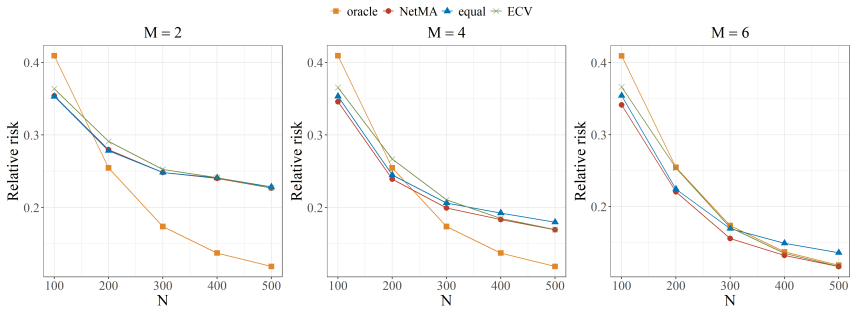
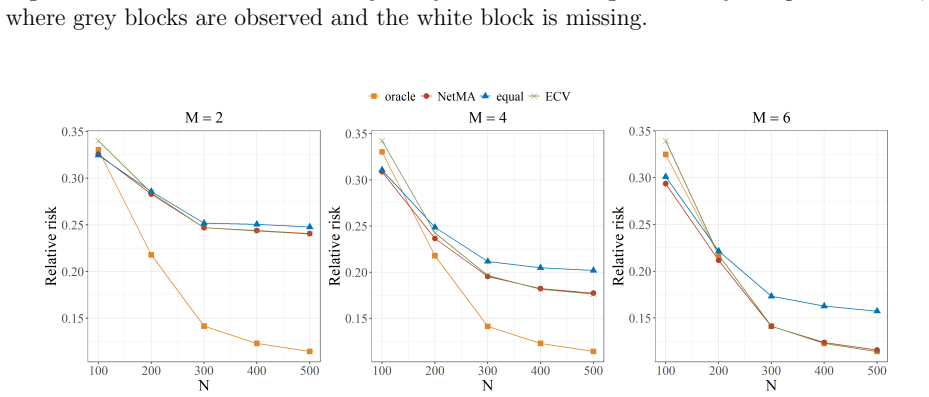
For an undirected network with connection probabilities logit(P_ij) = α_i + α_j + z_i^T z_j, averaging predictions across latent space models of dimensions 1 through M with weights from K-fold edge cross-validation is asymptotically no worse than the best possible weighted average of those models. Theorem 1 states that L(ŵ)/inf_w L(w) → 1 in probability under the stated assumptions, where L is the squared prediction loss on held-out node pairs; Theorem 2 states that when some candidate dimensions are at least the true dimension, the total weight on correct models tends to 1. The same pair of results holds for multi-layer networks (Theorems 4 and 5), and the empirical weight vector converges to the infeasible optimal weight vector at rate O_p($ξ^{{1/2}}$|Ψ1|^{-1/2+κ}) (Theorems 3 and 6). Simulations show the method outperforming the oracle when the true latent dimension is large relative to network size.
Load-bearing premise
The central guarantee rests on growth-rate conditions: the best possible squared prediction error from averaging must grow faster than the number of candidate models times the number of node pairs, and each fitted probability must converge to a fixed limit at that speed — conditions that are assumed rather than proven from the model, and that automatically fail when one candidate model is exactly correct.
Editorial extensions
If this is right
- Practitioners can include a range of candidate latent dimensions and let the edge-CV weights decide, removing the need to know or select the true dimension for link prediction.
- When the true dimension is among the candidates, the weights concentrate on it asymptotically, so averaging hedges against picking the wrong dimension in finite samples without sacrificing consistency.
- The multi-layer guarantee extends the method to networks sharing nodes across layers, with a common degree parameter and layer-specific latent positions.
- Averaging can beat the true-dimension oracle in small-N, large-d0 settings, making NetMA a credible default for link prediction on modest-sized networks.
- Because the criterion only uses fitted edge probabilities, the weighting scheme can be applied to other network estimators for undirected unweighted networks, not only latent space models.
Reading between the lines
- The oracle-beating phenomenon points to a regularization mechanism: averaging over misspecified low-dimensional fits trades a little bias for a large cut in estimation variance, and the paper does not formalize this bias-variance decomposition.
- Because NetMA only consumes fitted edge probabilities, it should transfer to block models, universal singular value thresholding, or other edge-probability estimators, with the bias-correction factors adjusted to each estimator's link function.
- A natural test is to apply the same edge-CV weighting to directed or dynamic latent space models, where estimation instability is even more pronounced, to see whether averaging helps there as it does here.
Editorial analysis
A structured set of objections, weighed in public.
Referee Report
Summary. This paper proposes a frequentist model averaging method (NetMA) for link prediction in single-layer and multi-layer latent space models with varying latent dimensions. The weights are selected by minimizing a K-fold edge cross-validation criterion, and the final prediction averages the debiased probability estimates from all candidate models. The paper claims three theoretical results: asymptotic optimality of the CV-selected weights relative to the infeasible best squared-error loss when all candidate models are misspecified, consistency of the weights toward correct models when such models are included, and a convergence rate of the CV weights to the infeasible optimal weight vector. These claims are stated for both single-layer and multi-layer networks. The paper also reports extensive simulations and two real-data link prediction applications.
Significance. If the theoretical results were correct, the paper would fill a genuine gap: it extends frequentist optimal model averaging from independent data to network data, where the dependence structure and one-realization setting make edge-based cross-validation natural. The computational proposal is simple (quadratic programming), and the simulations cover a useful range of settings, including covariates and egocentric missingness, with a transparent evaluation design. The empirical evaluation is a strength of the manuscript. However, the key theoretical claims are currently not supported because of an internal inconsistency in the CV correction factor (see Major Comment 1), and the proofs are not available in the posted version. The paper's significance is therefore conditional on repair of that factor and on provision of the supporting proofs.
major comments (3)
- [Section 2.2, Step 2(b); Section 3.2, Step 2(b)] The definition f1(x) = K/{(1+e^{-x})(K-1)} omits the factor 1/p. In fold k the fitting set is Ψ1 \ Gk, whose effective sampling proportion is q = p(K-1)/K; after fitting on A(Ψ1\Gk), the raw fitted probabilities σ(θ^[-k]) converge to qP*(m) under the paper's own debiasing logic, so eP[k](m) converges to [K/(K-1)] qP*(m) = pP*(m), not P*(m). The statement in Section 2.3 that bP(m),ij and eP[-k](m),ij have the same limiting values is therefore false for p < 1. Consequently CV(w) asymptotically minimizes a criterion proportional to ||P - pP*(w)||^2 on the held-out groups rather than L(w), and since the unit-simplex constraint is not invariant to scaling the candidate probabilities, the minimizer of CV(w) need not coincide with the minimizer of L(w). This invalidates the proof route of Theorem 1 and, by the same argument, Theorems 2 and 3; the identical missing factor in Section 3.2 undermines Theorems 4-6. The fix is to replace f1(x) by K/{p(1+e^{-x})(K-1)} and to re-derive the proofs with that correction.
- [Supplementary Material] Theorems 1-6 and the verification of Assumptions 1-3 are deferred to a supplementary file that is not included in the arXiv v1. Since the central contribution of the paper is these asymptotic results, the current version cannot be independently verified. Please include the proofs in the revised version or provide the supplement; this is a prerequisite for acceptance.
- [Section 2.3, Assumptions 1-2; Section 3.3, Assumptions 7-9] The assumptions are stated at a high level (existence of pseudo-true limits and growth-rate conditions on ξ* and ξ*†) without primitive conditions on the latent space model or the sampling scheme. The growth condition in Assumption 2 explicitly rules out the case where any candidate model is correct, so Theorem 1 does not cover the small-N large-d0 regime in which the simulations show the largest gains over the oracle. If the supplementary material verifies these assumptions from primitive conditions, please state that explicitly in the main text; otherwise the scope of the theoretical results should be narrowed accordingly.
minor comments (5)
- [Section 3.3] The definition of the squared risk R†(w) is missing the square: it should read R†(w) = Σ_t Σ_{(i,j)∈Ψ1} E( bP(t)ij(w) - P(t)ij)^2.
- [Section 5.1] The text refers to 'Table 6' for the ResearchGate link prediction results, but the table is labeled Table 4; please correct the cross-reference.
- [Throughout] There are minor typographical issues: 'matrics' should be 'matrices', and the reference to Roozbahani et al. contains 'reseachgate', which should be 'ResearchGate'.
- [Section 4.1] The term 'oracle' in the simulations denotes the estimator using the true latent dimension, not the infeasible optimal weight vector w0; the phrase 'outperforms the oracle' should be qualified to avoid confusion with the oracle averaging predictor used in the theory.
- [Section 2.2] The notation for the bias correction is applied inconsistently: the final estimator bP(m) divides by p, while the hold-out estimator eP[k](m) uses f1 without the p correction; even after the correction in Major Comment 1, please state explicitly that the same sampling fraction is used in both places.
Circularity Check
No material circularity: NetMA's weights are selected by K-fold edge CV on held-out edge groups, and the asymptotic results depend on external estimation-rate bounds rather than on the paper's own conclusions.
full rationale
The derivation chain is standard cross-validation-based model averaging. The final predictor bP_(m) is debiased by the known sampling fraction p (Section 2.2: 'we can remove the bias by setting bP(m) = bP0(m)/p to be the estimators of P'), and the CV weights minimize a criterion evaluated on fold-hold-out groups A[k] after fitting on the remaining edge groups; hence the selected weights are not fitted to the test edges they predict. The debiasing constants f1 and f2 depend only on the known fold count K and split sizes, not on data-fitting. The estimation-rate inputs (Assumptions 1 and 7) are imported from Ma et al. (2020) and Zhang et al. (2020), whose author sets do not overlap with the present authors; the self-citations (Yang 2001; Liao & Zou 2020; Liao et al. 2021) appear only in the literature review and are not load-bearing for Theorems 1-6. No displayed equation defines the claimed optimality into existence, and no parameter fitted to a subset of edges is renamed as a prediction. A separate technical concern about the f1 correction in the K-fold criterion omitting a 1/p factor, so eP^[k] may converge to pP* rather than P*, is a potential correctness flaw in the proof of Theorem 1, not a circularity, because it does not amount to assuming the conclusion. Overall the core claim has independent content.
Assumptions & free parameters
assumptions (8)
- domain assumption Model (1): A_ij | alpha,Z ~ Bernoulli(P_ij) with logit(P_ij)=alpha_i+alpha_j+z_i^T z_j, plus centering JZ=Z.
- domain assumption Edge-splitting missingness: unobserved pairs in Psi2 are set to zero, estimators from A(Psi1) are debiased by 1/p and clipped to [0,1].
- ad hoc to paper Assumption 1: for each candidate m there is a limiting pseudo-true P*_m with sum over Psi1 of (Phat_m,ij - P*_m,ij)^2 = O_p(N M) uniformly.
- ad hoc to paper Assumption 2: N M xi*^{-1}=o(1) and N max{D,log N} xi*^{-1}=O(1), where xi* is the minimum pseudo-true loss.
- ad hoc to paper Assumption 3: the same growth condition over the subset of misspecified weights W_s, used for Theorem 2.
- ad hoc to paper Assumptions 4-6: eigenvalue bounds on Lambda/|Psi1|, spectral bound on Omega/|Psi1|, and M=o(N^{1/2}), used for Theorem 3.
- ad hoc to paper Assumptions 7-9: multi-layer analogues of pseudo-true limits, T N^{-C0}=o(1), and N M T xi*_dag^{-1}=o(1).
- ad hoc to paper Assumptions 10-13: multi-layer separation, eigenvalue/spectral bounds, and M=o(N^{1/2}), used for Theorems 5-6.
Cite this review
Pith. "Pith review of Network Model Averaging Prediction for Latent Space Models by K-Fold Edge Cross-Validation." pith.science (2026). https://pith.science/paper/ZHACFZFQ
@misc{pith2026250522289,
  author       = {Pith},
  title        = {Pith review of: Network Model Averaging Prediction for Latent Space Models by K-Fold Edge Cross-Validation},
  year         = {2026},
  howpublished = {\url{https://pith.science/paper/ZHACFZFQ}},
  note         = {Machine review of arXiv:2505.22289}
}
read the original abstract
In complex systems, networks represent connectivity relationships between nodes through edges. Latent space models are crucial in analyzing network data for tasks like community detection and link prediction due to their interpretability and visualization capabilities. However, when the network size is relatively small, and the true latent space dimension is considerable, the parameters in latent space models may not be estimated very well. To address this issue, we propose a Network Model Averaging (NetMA) method tailored for latent space models with varying dimensions, specifically focusing on link prediction in networks. For both single-layer and multi-layer networks, we first establish the asymptotic optimality of the proposed averaging prediction in the sense of achieving the lowest possible prediction loss. Then we show that when the candidate models contain some correct models, our method assigns all weights to the correct models. Furthermore, we demonstrate the consistency of the NetMA-based weight estimator tending to the optimal weight vector. Extensive simulation studies show that NetMA performs better than simple averaging and model selection methods, and even outperforms the "oracle" method when the real latent space dimension is relatively large. Evaluation on collaboration and virtual event networks further emphasizes the competitiveness of NetMA in link prediction performance.
Figures


Figures from the paper (6 more)



Reference graph
Works this paper leans on
-
[1]
Airoldi, E. M., Blei, D. M., Fienberg, S. E. & Xing, E. P. (2008), ‘Mixed membership stochastic blockmodels’, Journal of Machine Learning Research 9(65), 1981–2014. Ando, T. & Li, K.-C. (2017), ‘A weight-relaxed model averaging approach for high- dimensional generalized linear models’, The Annals of Statistics 45(6), 2654 –
work page 2008
-
[29]
In press. Handcock, M. S., Raftery, A. E. & Tantrum, J. M. (2007), ‘Model-based clustering for social networks’, Journal of the Royal Statistical Society: Series A (Statistics in Society) 170(2), 301–354. Hansen, B. E. (2007), ‘Least squares model averaging’, Econometrica 75(4), 1175–1189. Hansen, B. E. & Racine, J. S. (2012), ‘Jackknife model averaging’,...
work page 2007
-
[105]
(2006), ‘Effects of missing data in social networks’, Social networks 28(3), 247–268
Kossinets, G. (2006), ‘Effects of missing data in social networks’, Social networks 28(3), 247–268. Kossinets, G. & Watts, D. J. (2009), ‘Origins of homophily in an evolving social network’, American Journal of Sociology 115(2), 405–450. Krivitsky, P. N., Handcock, M. S., Raftery, A. E. & Hoff, P. D. (2009), ‘Representing degree distributions, clustering,...
arXiv 2006
-
[221]
L¨ u, L. & Zhou, T. (2011), ‘Link prediction in complex networks: A survey’, Physica A: Statistical Mechanics and its Applications 390(6), 1150–1170. Lyu, Z., Xia, D. & Zhang, Y. (2023), ‘Latent space model for higher-order networks and generalized tensor decomposition’, Journal of Computational and Graphical Statistics 32(4), 1320–1336. Ma, Z., Ma, Z. & ...
work page 2011
-
[2679]
Buckland, S. T., Burnham, K. P. & Augustin, N. H. (1997), ‘Model selection: An integral part of inference’, Biometrics 53, 603–618. Chatterjee, S. (2012), ‘Matrix estimation by universal singular value thresholding’, The Annals of Statistics 43, 177–214. De Paula, ´A., Rasul, I. & Souza, P. C. L. (2024), ‘Identifying network ties from panel data: Theory a...
work page 1997
-
[8581]
Karrer, B. & Newman, M. E. (2011), ‘Stochastic blockmodels and community structure in networks’, Physical Review E 83(1), 016107. Kim, B., Lee, K. H., Xue, L. & Niu, X. (2018), ‘A review of dynamic network models with latent variables’, Statistics Surveys 12,
work page 2011
Reviewed August 7, 2026 · model on record in the stance chip above.
Discussion (0). Sign in to comment.