REVIEW 4 major objections 4 minor 25 references
Spiderwebs on the Sphere and an Isoperimetric Theorem
T0 review · 4 major / 4 minor · reviewed 2026-08-07 · deepseek-v4-flash
Pith's one-line read A convex polytope inscribed in a sphere is semi-globally rigid — only rotations are possible — provided each face contains its circumcenter.
desk verdict A plausible semi-global rigidity theorem for inscribed polytopes, but the proof skips the hard regularity step for arbitrary competitors. read the letter →
The pith
A machine-rendered reading of the paper's core claim, the machinery that carries it, and where it could break.
The reading
What carries the argument
The central object is the proper circumscribed geodesic spherical polygon, called a Dido polygon when the circumcenter sits at the midpoint of an edge. A proper polygon has each edge shorter than $\pi$, has no three vertices on a great circle, and has perimeter shorter than $2\pi$; it is internally circumscribed when its vertices lie on a circle whose center lies in the closed polygon. Corollary 3.2 is the load-bearing mechanism: under these hypotheses, the spherical area is strictly increased by lengthening any non-Dido edge and by shortening the Dido edge, so among all polygons with edge lengths no longer, the original is the unique area maximizer. The proof leans on the spherical isoperimetric theorem (Theorem 2.1), Lemma 3 transporting the fixed-edge-length planar isoperimetric fact to the sphere, and Lexell's theorem for spherical triangles.
What would settle it
Search numerically on the regular cube inscribed in the unit sphere for any degree-one realization $Q$ with all 12 edges at most the cube's edge length and all 8 vertices at distance at least 1 from the center, but not a rotation of the cube; if such a $Q$ exists, Theorem 4.1's conclusion fails, and if a proof can rule out all off-sphere competitors, the semi-global rigidity statement would extend beyond the paper's stated assumption.
Extended reading notes
Core claim
On its own terms, the paper establishes Theorem 4.1: let $P$ be a convex polytope inscribed in a sphere, with the circumcenter of every face lying inside or on that face. Then $P$ is semi-globally rigid with respect to its center: any realization $Q$ on the unit sphere with every edge geodesic length at most the corresponding edge of $P$ and with the same topological degree must be congruent to $P$ by rotation. The engine is Corollary 3.2, which says for a proper spherical geodesic polygon with its circumcenter inside or on the boundary, the area is uniquely maximized among all polygons with edge lengths no longer, and equality only when $Q$ is congruent. Because the total signed area of the face images covering the sphere is $4\pi$, each face of $Q$ must individually be at its maximum, so $Q$ is the same polytope rotated.
Load-bearing premise
The load-bearing premise is that every admissible competitor, including ones allowed by the strut inequalities to leave the sphere, can be treated as a union of proper simple spherical geodesic faces whose signed areas still sum to $4\pi$; the paper assumes the competitor's vertices stay on the unit sphere and does not prove that the constraints exclude folded, self-overlapping, or pinched faces.
Editorial extensions
If this is right
- For any inscribed polytope with face circumcenters inside or on the face, the sphere cannot 'slip off': the only allowed motions are rotations, so the spiderweb is locked in place.
- The result gives a global rigidity statement for a tensegrity where edges are cables (can only shorten) and radii from the center are bars or struts, a much stronger conclusion than the infinitesimal rigidity usually available.
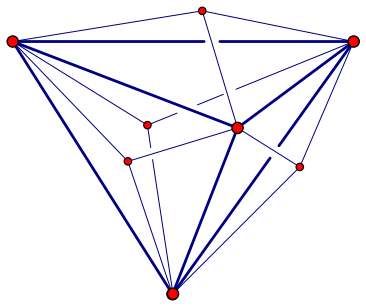
- It covers concrete examples such as the regular cube and the triakis tetrahedron, whose triangular face centers lie on the boundary, so these are semi-globally rigid.
- From the face-area equality, the paper derives quantitative rigidity: for a regular cube, if each vertex of a competitor lies within $\pi/4$ of the corresponding vertex on the sphere, the degree is forced to be one and congruence follows.
Reading between the lines
- A natural testable extension: the same face-counting argument should apply to any tight realization of a 3-connected planar graph on the sphere with positive equilibrium stress, giving uniqueness in the homotopy class up to rotation; this is close to Conjecture 4.2 and would generalize the theorem to configurations not arising as inscribed polytopes.
- The proof's dependence on face areas summing to $4\pi$ suggests the theorem is essentially two-dimensional; in higher dimensions the analogous statement would need a face-volume maximum principle, which the paper does not address.
- The paper assumes competitors stay on the unit sphere, but the definition of semi-global rigidity allows radii from the center to grow; a worthwhile check is whether an off-sphere degree-one competitor with all cables no longer exists for the cube, since the spherical face-area argument as written would not rule it out.
Editorial analysis
A structured set of objections, weighed in public.
Referee Report
Summary. The paper claims a semi-global rigidity theorem (Theorem 4.1) for convex polytopes inscribed in the unit sphere whose face circumcenters lie in the faces. The proof maps each planar face to a spherical geodesic polygon, uses a spherical isoperimetric theorem to show each face is area-maximal under cable constraints (Corollary 3.2), and then sums face areas to 4π to force every admissible competitor to be congruent. The paper also states a variational characterization of 'Dido polygons' (Theorem 3.1) and several conjectures about spiderwebs.
Significance. If the written proof were complete, this would be a valuable contribution to tensegrity and polytope rigidity: a global rigidity statement for a natural class of inscribed polytopes under one-sided edge constraints, complementing Winter's local rigidity result and Cauchy's rigidity theorem. The geometric idea, using spherical isoperimetry facewise, is elegant and likely to be of interest to the rigidity community. The paper has no machine-checked or code-verified part, so the assessment rests on the written argument; as written, the main theorem is conditional on substantial unproved ingredients.
major comments (4)
- [§4, proof of Theorem 4.1] The passage from facewise inequalities to congruence of Q is not justified for the class of admissible competitors. The definition of semi-global rigidity allows |q_i| ≥ 1 (strut lengths no shorter) and only requires the same homotopy class; it does not require q_i to lie on the unit sphere, nor that each face boundary of q be a proper simple spherical geodesic polygon as defined in Section 3. The same-homotopy condition gives a degree-one map S^2 → S^2, but a degree-one map can fold and overlap faces. Therefore the face areas used in Corollary 3.2 and the identity that the signed face areas sum to 4π are not established for arbitrary admissible q, and the equality case cannot be concluded. The sentence 'the topological degree of the possible realizations ... is well-defined by the length constraints' is asserted without proof and is not evident, since length bounds alone do not determine a map or an area decomposition.
- [§3, Corollary 3.2] The optimality proof contains a logical slip. In the sentence 'If any edge, not the Dido edge, is not strictly less than the corresponding edge of P, it can be increased to strictly increase the area of Q,' the edge is already at its upper bound when it is not strictly less, so it cannot be increased. If the intended hypothesis is 'strictly less,' the argument still does not prove that the Dido edge of Q must have the same length as the corresponding edge of P; the claimed equality case ('P and Q are congruent') is asserted rather than derived. The compactness argument also needs to rule out degenerations to polygons with zero-length edges or coincident vertices.
- [§3, Theorem 3.1] The proof for polygons with more than three sides is only a sketch. The paragraph beginning 'If a side c is to be increased...' does not define the configuration space of proper circumscribed geodesic polygons with one edge varying, does not treat all possible positions of the circumcenter relative to the varied edge, and does not prove that the described modification ('choose another point ... extend it to both sides') is compatible with the fixed other edge lengths and with Lemma 3. A complete proof is needed because Corollary 3.2 depends directly on this theorem.
- [§2, Theorem 2.1 and §3, Lemma 3] Theorem 2.1 is introduced with 'we assume' and is not proved or cited, although it is a classical result; its application in Lemma 3 is also under-explained. The proof of Lemma 3 asserts a 'fixed area difference' between a spherical polygon and the corresponding configuration of circular arcs, but for non-convex or self-intersecting polygonal curves this is not immediate. Since Lemma 3 underpins Corollary 3.2, the paper should either prove Theorem 2.1 or state it as a known theorem with a precise reference, and should give a complete proof of Lemma 3.
minor comments (4)
- [§4, Definition of semi-global rigidity] The definition says strut lengths are no shorter, while the preceding paragraph says all possible configurations have their vertices on the unit sphere; these two statements should be reconciled.
- [§4, proof of Theorem 4.1] The condition that the Euclidean circumcenter of a planar face lies in the face is used through Corollary 3.2, which is stated for spherical polygons; the equivalence between the Euclidean and spherical circumcenter conditions should be stated explicitly.
- [References and typos] Reference [Blrasjö(2005)] appears garbled; the author is Blåsjö. There are also typos such as 'origonal' in Conjecture 4.2 and 'decreas' in the caption of Figure 3.3.
- [§4, Lemma 5] The monotonicity argument for perimeters in the proof of Lemma 5 would benefit from a more formal treatment, since it is used to verify the hypotheses of Theorem 4.1.
Circularity Check
No circularity detected: Theorem 4.1 is derived from the classical spherical isoperimetric theorem and independent geometric lemmas, not from its own conclusion.
full rationale
Walking the derivation chain, Theorem 4.1 depends on Corollary 3.2, whose proof invokes Lemma 3, Theorem 2.1 (the classical spherical isoperimetric theorem), and Lexell's theorem; these are independent external results, not definitions of the conclusion. The facewise inequality area(Q_face) <= area(P_face) with equality only for congruent faces is then summed over the unit sphere, and the 4π sum forces each face equality. No parameter is fitted, no quantity is renamed, and no self-citation carries the argument: the authors' self-citations ([Connelly(1982)], [Connelly and Guest(2022)], [Connelly et al.(2024)], [Connelly and Gortler(2015)]) appear only for context, definitions, or examples, not as the engine of the proof. The assertion about topological degree and the facewise application to arbitrary admissible competitors may require additional argument, but any such gap is a completeness/correctness issue, not circularity. The explicit deferral of the proof of Theorem 2.1 ('we will leave that aside here') is an assumption of a classical theorem, not a circular reduction.
Assumptions & free parameters
assumptions (4)
- standard math Spherical isoperimetric theorem for closed curves of length ≤2π in S^2 (Theorem 2.1)
- standard math Lexell's theorem: with two spherical triangle sides fixed, the area function has critical points only at specific configurations
- domain assumption Projection of a convex polytope boundary from an interior point to S^2 is tight (Lemma 5), including the strict perimeter bound <2π
- domain assumption Every admissible competitor Q gives an embedded degree-one spherical map with simple facial geodesic polygons, allowing facewise application of Corollary 3.2
Cite this review
Pith. "Pith review of Spiderwebs on the Sphere and an Isoperimetric Theorem." pith.science (2026). https://pith.science/paper/QXA3GHFI
@misc{pith2026250522336,
  author       = {Pith},
  title        = {Pith review of: Spiderwebs on the Sphere and an Isoperimetric Theorem},
  year         = {2026},
  howpublished = {\url{https://pith.science/paper/QXA3GHFI}},
  note         = {Machine review of arXiv:2505.22336}
}
read the original abstract
Here we present a rigidity result in a global (semi-global, homotopy) setting for a restrictive class of polytopes, those that can be inscribed in a unit sphere, with some additional conditions. The proof of the rigidity result for cabled frameworks on the surface of the sphere uses classical isoperimetric ideas.
Figures


Figures from the paper (8 more)



Reference graph
Works this paper leans on
-
[1]
" write newline "" before.all 'output.state := FUNCTION n.dashify 't := "" t empty not t #1 #1 substring "-" = t #1 #2 substring "--" = not "--" * t #2 global.max substring 't := t #1 #1 substring "-" = "-" * t #2 global.max substring 't := while if t #1 #1 substring * t #2 global.max substring 't := if while FUNCTION format.date year duplicate empty "emp...
- [2]
-
[3]
A.-L. Cauchy. Recherche sur les polyèdres – premier mémoire. Journal de l'École Polytechnique, 9: 0 66--86, 1813
-
[4]
R. Connelly. Rigidity and energy. Invent. Math., 66 0 (1): 0 11--33, 1982. ISSN 0020-9910,1432-1297. doi:10.1007/BF01404753. URL https://doi.org/10.1007/BF01404753
-
[5]
R. Connelly and S. J. Gortler. Iterative universal rigidity. Discrete Comput. Geom., 53 0 (4): 0 847--877, 2015. ISSN 0179-5376,1432-0444. doi:10.1007/s00454-015-9670-5. URL https://doi.org/10.1007/s00454-015-9670-5
-
[6]
R. Connelly and S. D. Guest. Frameworks, tensegrities, and symmetry. Cambridge University Press, Cambridge, 2022. ISBN 978-0-521-87910-1. doi:10.1017/9780511843297. URL https://doi-org.proxy.library.cornell.edu/10.1017/9780511843297
-
[7]
R. Connelly, S. J. Gortler, L. Theran, and M. Winter. The stress-flex conjecture, 2024. URL https://arxiv.org/abs/2404.15590
work page Pith review arXiv 2024
-
[8]
J. Doolittle, J.-P. Labb\'e, C. E. M. C. Lange, R. Sinn, J. Spreer, and G. M. Ziegler. Combinatorial inscribability obstructions for higher dimensional polytopes. Mathematika, 66 0 (4): 0 927--953, 2020. ISSN 0025-5793,2041-7942. doi:10.1112/mtk.12051. URL https://doi.org/10.1112/mtk.12051
Show all 25 references
-
[9]
H. Gluck. Almost all simply connected closed surfaces are rigid. In Geometric topology ( P roc. C onf., P ark C ity, U tah, 1974) , volume Vol. 438 of Lecture Notes in Math., pages 225--239. Springer, Berlin-New York, 1975
1974
-
[10]
Ku, M.-C
H.-T. Ku, M.-C. Ku, and X.-M. Zhang. Isoperimetric inequalities on surfaces of constant curvature. Canad. J. Math., 49 0 (6): 0 1162--1187, 1997. ISSN 0008-414X,1496-4279. doi:10.4153/CJM-1997-057-x. URL https://doi.org/10.4153/CJM-1997-057-x
1997 doi
-
[11]
W. Y. Lam. Discrete harmonic maps between hyperbolic surfaces, 2024. URL https://arXiv:2405.02205
2024 arXiv
-
[12]
Lov\'asz
L. Lov\'asz. Steinitz representations of polyhedra and the C olin de V erdi\`ere number. J. Combin. Theory Ser. B, 82 0 (2): 0 223--236, 2001. ISSN 0095-8956,1096-0902. doi:10.1006/jctb.2000.2027. URL https://doi.org/10.1006/jctb.2000.2027
2001
-
[13]
Lov\'asz and A
L. Lov\'asz and A. Schrijver. On the null space of a C olin de V erdi\`ere matrix. Ann. Inst. Fourier (Grenoble), 49 0 (3): 0 1017--1026, 1999. ISSN 0373-0956,1777-5310. doi:10.5802/aif.1703. URL https://doi.org/10.5802/aif.1703. Symposium \`a la M\'emoire de Fran cois Jaeger ...
1999 doi
-
[14]
Maehara and H
H. Maehara and H. Martini. On C es\`aro triangles and spherical polygons. Aequationes Math., 96 0 (2): 0 361--379, 2022. ISSN 0001-9054,1420-8903. doi:10.1007/s00010-021-00820-y. URL https://doi.org/10.1007/s00010-021-00820-y
2022 doi
-
[15]
I. Niven. Maxima and minima without calculus, volume 6 of The Dolciani Mathematical Expositions. Mathematical Association of America, Washington, DC, 1981. ISBN 0-88385-306-X
1981
-
[16]
Padrol and G
A. Padrol and G. M. Ziegler. Six Topics on Inscribable Polytopes, pages 407--419. Springer Berlin Heidelberg, Berlin, Heidelberg, 2016. ISBN 978-3-662-50447-5. doi:10.1007/978-3-662-50447-5_13. URL https://doi.org/10.1007/978-3-662-50447-5_13
2016 doi
-
[17]
Lexell's theorem --- Wikipedia , the free encyclopedia, 2024
Wikipedia contributors . Lexell's theorem --- Wikipedia , the free encyclopedia, 2024. URL https://en.wikipedia.org/w/index.php?title=Lexell [Online; accessed 31-March-2025]
2024
-
[18]
M. Winter. Rigidity, tensegrity, and reconstruction of polytopes under metric constraints. Int. Math. Res. Not. IMRN, 2024 0 (9): 0 7721--7747, 2023. ISSN 1073-7928,1687-0247. doi:10.1093/imrn/rnad298. URL https://doi.org/10.1093/imrn/rnad298
2024 doi
-
[19]
Buchholz and James A
Ralph H. Buchholz and James A. MacDougall. Cyclic polygons with rational sides and area. J. Number Theory , 128(1):17--48, 2008
2008
-
[20]
Comments on generalized H eron polynomials and R obbins' conjectures
Robert Connelly. Comments on generalized H eron polynomials and R obbins' conjectures. Discrete Math. , 309(12):4192--4196, 2009
2009
-
[21]
Hubbard, Ilias Kastanas, and MMRS
Robert Connelly, John H. Hubbard, Ilias Kastanas, and MMRS. Problems and S olutions: S olutions: 10308. Amer. Math. Monthly , 103(5):430--431, 1996
1996
-
[22]
Old and new unsolved problems in plane geometry and number theory , volume 11 of The Dolciani Mathematical Expositions
Victor Klee and Stan Wagon. Old and new unsolved problems in plane geometry and number theory , volume 11 of The Dolciani Mathematical Expositions . Mathematical Association of America, Washington, DC, 1991
1991
-
[23]
Maxima and minima without calculus , volume 6 of The Dolciani Mathematical Expositions
Ivan Niven. Maxima and minima without calculus , volume 6 of The Dolciani Mathematical Expositions . Mathematical Association of America, Washington, D.C., 1981
1981
-
[24]
D. P. Robbins. Areas of polygons inscribed in a circle. Discrete Comput. Geom. , 12(2):223--236, 1994
1994
-
[25]
David P. Robbins. Areas of polygons inscribed in a circle. Amer. Math. Monthly , 102(6):523--530, 1995
1995
Reviewed August 7, 2026 · model on record in the stance chip above.
Discussion (0). Sign in to comment.