REVIEW 4 major objections 5 minor 79 references
Dynamics of thin film flows on a vertical fibre with vapor absorption
T0 review · 4 major / 5 minor · reviewed 2026-08-07 · deepseek-v4-flash
Pith's one-line read Vapor absorption can force film droplets on a vertical fibre to merge.
desk verdict A coherent new lubrication model for absorbing films on fibres; the droplet-coalescence phase diagram is plausible but rests on an unquantified absorption parameter and a nonphysical stability analysis. read the letter →
The pith
A machine-rendered reading of the paper's core claim, the machinery that carries it, and where it could break.
The reading
What carries the argument
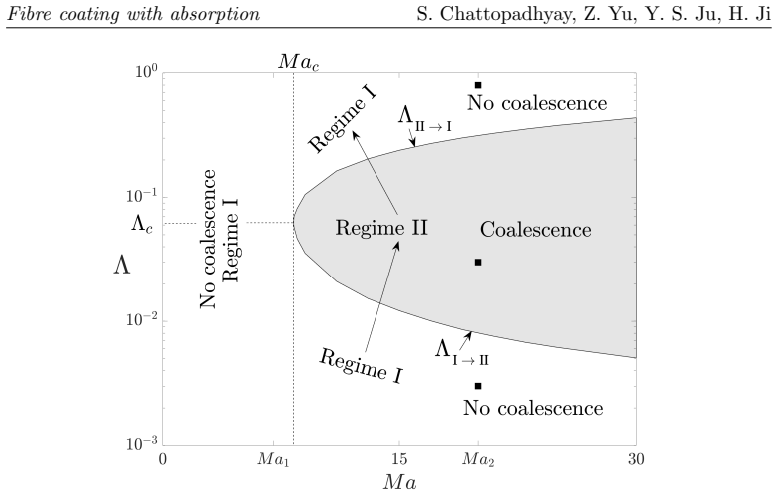
The carrying object is the coupled PDE system (3.9): a thickness equation with non-conservative source $\Lambda(1+\alpha h)(c-c_s)$, and a concentration equation of advection-diffusion form, linked by the flow rate $q$ that contains gravity, surface tension with destabilizing azimuthal curvature $\alpha/[\varsigma(1+\alpha h)]$ and stabilizing streamwise curvature $-h_{zz}$, and a Marangoni term proportional to $Ma\, h^2\psi(\alpha h)c_z$. The analytical workhorse is the effective linear growth rate (4.8) obtained by freezing a slowly absorbing base state: absorption adds a positive $\Lambda\Gamma$ term to the classical Rayleigh-Plateau growth rate and shifts the critical wavenumber. The regime boundaries are read off from this growth-rate structure and from the numerical phase diagram (Figure 12), where the two threshold curves $\Lambda_{I\to II}(Ma)$ and $\Lambda_{II\to I}(Ma)$ meet at $(Ma,\Lambda)\approx(8.28,0.063)$.
What would settle it
Run a controlled fibre experiment with a water-absorbing silicone oil at fixed fibre radius, flow rate, and inlet concentration, varying only the surrounding humidity (which sets the absorption parameter), and track droplet peak positions over time. The model predicts that at a Marangoni number of 20 the droplet train remains non-coalescing for absorption parameters below about 0.0083 and above about 0.32, but coalesces in between; observing no coalescence across a continuous humidity sweep, or coalescence at all humidities, would falsify the regime diagram. A direct check of the constitutive assumption is also possible: measure the absorption flux as a function of concentration difference for films of different thickness, since the predicted regime structure depends on the flux being linear.
Extended reading notes
Core claim
The paper's central discovery is a coupled system of two nonlinear fourth-order PDEs for film thickness $h(z,t)$ and silicone-oil concentration $c(z,t)$, equation (3.9), that extends the classical mass-conserving fibre-coating equation to include water vapor absorption through the flux $J(c)=c-c_s$ and Marangoni effects through the concentration gradient. For weak absorption, the paper derives a frozen-time linear stability result showing that absorption enlarges the unstable wavenumber band and raises the effective growth rate of interfacial perturbations. Numerical simulations with realistic inlet conditions then show that, for sufficiently strong Marangoni effects, increasing the absorption parameter moves the film from a non-coalescing Regime I into a coalescing Regime II, and back into Regime I at still larger values. The paper also derives a quasi-static logistic concentration profile and an approximate droplet-mass formula that captures the non-monotone dependence of total liquid mass on absorption rate.
Load-bearing premise
The model assumes the absorption rate into the film is simply proportional to how far the oil concentration is above its saturation value, with a fixed proportionality constant; if real sorption is slower, nonlinear, or depends on film thickness, the predicted coalescence window and regime boundaries change.
Editorial extensions
If this is right
- At fixed Marangoni number above the critical value, there is an intermediate absorption window in which droplet trains cannot remain in the non-coalescing regime; device operation would need to avoid or deliberately enter that window depending on the purpose.
- Stronger absorption within the coalescing regime moves the collision point upstream toward the nozzle, so the location of coalescence can be used as a readout of absorption rate.
- Below the critical Marangoni number (about 8.28), absorption alone is not enough to trigger coalescence; both concentration-gradient forcing and non-conservative growth are needed.
- The total liquid mass held in a fixed downstream window is non-monotone in the absorption rate, and the paper's parabolic droplet approximation gives a formula that reproduces this trend, connecting droplet spacing and height to mass capture.
- The quasi-static logistic concentration profile predicts where along the fibre saturation sets in and where droplet compression begins, so it furnishes a design relation between humidity, sorbent concentration, and droplet spacing.
Reading between the lines
- Beyond the paper: if the linear absorption law is replaced by a thickness-dependent or Langmuir-type kinetics, the predicted coalescence window would likely shift and could widen or close; measuring the absorption flux of the actual sorbent as a function of film thickness would tell which.
- Beyond the paper: because the regime transition is controlled by humidity through the absorption parameter, a fibre dehumidifier could in principle switch between coalescing and non-coalescing modes by adjusting ambient vapour pressure; the phase diagram gives the control margins.
- Beyond the paper: the prediction that no coalescence occurs for Marangoni numbers below about 8.28 suggests a simple experimental check: vary the initial oil concentration (which changes the surface-tension difference) at fixed humidity, and see whether coalescence turns on only above a threshold concentration difference.
- Beyond the paper: the same coupled thickness-concentration structure may apply to other non-conservative fibre coatings, such as reactive or evaporating films, where the source term in the thickness equation has a different functional form; the regime-boundary machinery is a testable generic prediction.
Editorial analysis
A structured set of objections, weighed in public.
Referee Report
Summary. The paper develops a one-sided lubrication model for a thin film of water-absorbing silicone oil flowing down a vertical cylindrical fibre. The model couples an evolution equation for the film thickness h with an advection-diffusion equation for the oil concentration c, and includes gravity, surface tension, Marangoni transport, and a non-mass-conserving absorption flux J(c)=c-cs. The authors perform a linear stability analysis of the coupled system around time-dependent base states using a frozen-time approximation, and then carry out extensive numerical simulations with Dirichlet inlet and Neumann outlet boundary conditions. The central results are the identification of two droplet regimes (Regime I: no coalescence; Regime II: coalescence) and a phase diagram in the (Ma, Λ) plane, with a critical Marangoni number Mac ≈ 8.28, together with an approximate mass-balance model that rationalizes the dependence of the averaged liquid mass on Λ.
Significance. If the model is faithful, it extends classical fibre-coating theory to a non-mass-conserving setting and proposes a concrete mechanism, vapor absorption, for triggering droplet coalescence and regime transitions. The derivation is coherent and reduces to known mass-conserving models in the limits Ma=Λ=0; the numerical exploration is systematic and the quasi-static concentration comparison in Figure 8b is a useful check. The paper provides testable predictions (the shape of the regime boundaries and the coalescence thresholds), although the primary axis of the phase diagram, Λ, is not calibrated to a measured mass-transfer coefficient. The presentation is generally clear, and the authors are candid about the uncertainty in the absorption scale.
major comments (4)
- [§3.2 and Figure 12] The regime-transition thresholds and the phase diagram in Figure 12 depend on Λ, yet §3.2 states that 'Λ is more difficult to estimate due to the uncertainty in the J0 scale' and the simulations simply set Λ ∈ [0,5]. Consequently, the reported values ΛI→II ≈ 0.0083 and ΛII→I ≈ 0.32 for Ma=20, and the shaded Regime II region in Figure 12, are not tied to the Dow XX-8810 system; an order-of-magnitude change in J0 would shift these thresholds correspondingly. The central quantitative claim should be reframed as a model prediction over a hypothesized Λ range, or supplemented by a sensitivity discussion of how the regime boundaries depend on J0 / Λ.
- [§4.2, Eqs. (4.8)-(4.9)] The linear stability analysis is deliberately performed with cs=0.2 while the PDE simulations in §5 use the estimated cs≈0.86, and the authors acknowledge this choice is made to make absorption persist. This changes the base-state dynamics in (4.5a): for cs≈0.86 the concentration decays much more slowly and the effective growth rate (4.8) and neutral curve (4.9) would differ. Since the stability results are invoked to interpret the regime transitions, the paper should either repeat the stability calculation at cs=0.86 or explicitly demonstrate (e.g., with a supplementary plot) that the conclusions about absorption-driven instability are insensitive to the choice of cs.
- [§4.2, Eqs. (4.5b)-(4.8)] The effective film-thickness growth rate (4.8) is obtained by dropping the Marangoni coupling term proportional to (bc/bh)exp(λc−λh) in (4.5b) and the corresponding exponential term in Γ, based on the assertion that λc,r<0. This is an uncontrolled truncation: it has not been tested against the full coupled linear system (4.5b)-(4.5c), and during the initial transient both exponents are small. The comparison in Figure 6b tests the final prediction but does not isolate the error introduced by this neglect. A direct comparison of (4.8) with numerical solutions of the coupled linearized equations for representative parameters is needed to validate the approximation.
- [§5.3, Eqs. (5.17)-(5.18)] The mass approximation (5.18) fixes hmin=0.455 'based on numerical observations' and then uses that same approximation to explain the trends in ⟨Ml⟩T. This is a post-hoc calibration, not a predictive derivation, so the sentence 'this figure concludes that the change in total mass can be estimated by equation (5.18)' overstates the closure. This issue does not affect the phase diagram, but the claim should be softened or an independent estimate of hmin should be provided.
minor comments (5)
- [§3 (before boundary conditions)] The text uses 'Raleigh-Plateau regime' but the correct spelling is 'Rayleigh-Plateau'; please correct this typo.
- [§4.2] In the sentence defining km, 'absoption parameter' should be 'absorption parameter'.
- [§4.2] The reference to 'Burelbachet al. 1988' in the frozen-time discussion is a typo and should read 'Burelbach et al. 1988'.
- [§5.2, Eq. (5.12) and Fig. 12] The classification of Regime I versus Regime II in Figure 12 appears to be based on visual inspection of coalescence events; the paper would benefit from stating an explicit quantitative criterion (e.g., a threshold in spacing variance or number of peak crossings) so that the phase boundaries are reproducible.
- [§5.3] The notation for time averages in (5.6) (⟨X⟩T) and spatiotemporal averages in (5.12) (⟨X⟩) is similar and could be confused; consider using a different symbol, such as an overbar or double bracket, for the double average.
Circularity Check
No significant circularity; the one fitted diagnostic in Section 5.3 is peripheral, and the central regime diagram is obtained by direct PDE simulation.
-
fitted input called prediction
[Section 5.3, Eq. (5.18) and Figure 13]
"In this approximation, we set the precursor layer thickness hmin = 0.455 based on numerical observations. ... This figure concludes that the change in total mass can be estimated by equation (5.18) in Regime I and the trend can be predicted by the average droplet height ⟨H⟩ and spacing ⟨∆Z⟩ curves in Figure 10."
Equation (5.18) is not an independent prediction of droplet mass: the precursor thickness hmin is fixed to 0.455 from the same PDE simulations, and the average height ⟨H⟩ and spacing ⟨∆Z⟩ entered through N = (z2−z1)/⟨∆Z⟩T are also extracted from those simulations. The agreement in Figure 13 therefore confirms the fitted formula and the simulation statistics, rather than independently predicting the mass trend. This is not load-bearing for the paper's central claim, because the Regime I/II phase diagram in Figure 12 is constructed by direct numerical observation of coalescence in the PDE system (3.9), not from Eq. (5.18).
full rationale
The derivation chain is essentially self-contained. The model is derived from the Navier–Stokes and advection–diffusion equations with stated boundary conditions and scalings, and it is checked in mass-conserving limits: for Ma = Λ = 0, Eq. (3.9a) reduces to the classical fibre-coating lubrication model (3.12), and the saturated-case dispersion relation (4.3) recovers Craster & Matar and Ji et al. results. The stability analysis in Section 4.2 uses the frozen-time approximation with explicitly stated quasi-static base states, and the dropping of terms proportional to exp(λc − λh) is justified by the sign of λc,r in (4.7). The regime diagram in Figure 12 is obtained by systematically simulating the PDE with cs = 0.86 and recording whether coalescence occurs, so it is not equivalent to a fitted parameter. The choice cs = 0.2 in Section 4.2 is a candid modelling choice to make absorption persist; it limits that stability calculation but does not force the central numerical claims, which revert to the estimated cs = 0.86. The admitted uncertainty in the scale J0 (and hence in Λ) is an input-parameter limitation, not circularity. The only reduction-by-construction content is the Section 5.3 mass approximation, whose hmin is calibrated from the simulations it is used to reproduce; this is peripheral and does not affect the main conclusions.
Assumptions & free parameters
free parameters (3)
- Saturated concentration cs in the linear stability analysis =
0.2
- Diffusion parameter delta =
0.01
- Precursor layer thickness hmin in the mass approximation =
0.455
assumptions (6)
- domain assumption Lubrication approximation with Re=O(1) and epsilon much less than 1, dropping inertial terms and O(epsilon^2) contributions.
- domain assumption Henry's law with constant Henry constant H, giving J = J0(eta_s - eta) = J0(c - cs).
- domain assumption Concentration decomposition c = c0(z,t) + epsilon^2 delta^{-1} c1(r,z,t) with zero cross-sectional mean, so radial concentration variations are small.
- domain assumption Frozen-time quasi-static base states for the linear stability analysis.
- ad hoc to paper Neglect of the Marangoni coupling term proportional to (bc/bh)exp(lambda_c - lambda_h) in the film-thickness growth rate.
- domain assumption Surface tension variation is neglected in the dynamic pressure term and retained only in the Marangoni term.
Cite this review
Pith. "Pith review of Dynamics of thin film flows on a vertical fibre with vapor absorption." pith.science (2026). https://pith.science/paper/BEWX4RE3
@misc{pith2026250522379,
  author       = {Pith},
  title        = {Pith review of: Dynamics of thin film flows on a vertical fibre with vapor absorption},
  year         = {2026},
  howpublished = {\url{https://pith.science/paper/BEWX4RE3}},
  note         = {Machine review of arXiv:2505.22379}
}
read the original abstract
Water vapor capture through free surface flows plays a crucial role in various industrial applications, such as liquid desiccant air conditioning systems, water harvesting, and dewatering. This paper studies the dynamics of a silicone liquid sorbent (also known as water-absorbing silicone oil) flowing down a vertical cylindrical fibre while absorbing water vapor. We propose a one-sided thin-film-type model for these dynamics, where the governing equations form a coupled system of nonlinear fourth-order partial differential equations for the liquid film thickness and oil concentration. The model incorporates gravity, surface tension, Marangoni effects induced by concentration gradients, and non-mass-conserving effects due to absorption flux. Interfacial instabilities, driven by the competition between mass-conserving and non-mass-conserving effects, are investigated via stability analysis. We numerically show that water absorption can lead to the formation of irregular wavy patterns and trigger droplet coalescence downstream. Systematic simulations further identify parameter ranges for the Marangoni number and absorption parameter that lead to the onset of droplet coalescence dynamics and regime transitions.
Figures


Figures from the paper (10 more)



Reference graph
Works this paper leans on
-
[1]
Ahn, Dongchan , Greiner, Aaron , Hrabal, James & Lichtor, Alexandra 2017 Method of separating a gas using at least one membrane in contact with an organosilicon fluid. US Patent 9,731,245
work page 2017
-
[2]
Journal of Fluid Mechanics 528 , 279--296
Ajaev, Vladimir S 2005 Spreading of thin volatile liquid droplets on uniformly heated surfaces . Journal of Fluid Mechanics 528 , 279--296
work page 2005
-
[3]
Advanced Materials 25 (31), 4335--4339
Binda, Maddalena , Natali, Dario , Iacchetti, Antonio & Sampietro, Marco 2013 Integration of an organic photodetector onto a plastic optical fiber by means of spray coating technique. Advanced Materials 25 (31), 4335--4339
work page 2013
-
[4]
Physica D: Nonlinear Phenomena 457 , 133942
Biswal, Shiba , Ji, Hangjie , Elamvazhuthi, Karthik & Bertozzi, Andrea L 2024 Optimal boundary control of a model thin-film fiber coating model . Physica D: Nonlinear Phenomena 457 , 133942
work page 2024
-
[5]
Bourges-Monnier, C & Shanahan, MER 1995 Influence of evaporation on contact angle . Langmuir 11 (7), 2820--2829
work page 1995
-
[6]
Journal of Fluid Mechanics 195 , 463--494
Burelbach, James P , Bankoff, Seymour G & Davis, Stephen H 1988 Nonlinear stability of evaporating/condensing liquid films . Journal of Fluid Mechanics 195 , 463--494
work page 1988
-
[7]
Journal of Fluid Mechanics 1001 , A14
Camassa, Roberto , Ogrosky, H Reed & Olander, Jeffrey 2024 A long-wave model for a falling upper convected maxwell film inside a tube . Journal of Fluid Mechanics 1001 , A14
work page 2024
-
[8]
Journal of Fluid Mechanics 380 , 233--255
Chang, Hsueh Chia & Demekhin, Evgeny A 1999 Mechanism for drop formation on a coated vertical fibre . Journal of Fluid Mechanics 380 , 233--255
work page 1999
Show all 79 references
-
[9]
International Journal of Heat and Mass Transfer 147 , 118942
Chao, Youchuang , Lu, Yongjie & Yuan, Hao 2020 On reactive thin liquid films falling down a vertical cylinder . International Journal of Heat and Mass Transfer 147 , 118942
2020
-
[10]
Physical Review Fluids 9 (9), 094001
Chao, Youchuang , Zhu, Lailai , Ding, Zijing , Kong, Tiantian , Chang, Juntao & Wang, Ziao 2024 Stability of gravity-driven viscous films flowing down a soft cylinder . Physical Review Fluids 9 (9), 094001
2024
-
[11]
International Journal of Heat and Mass Transfer 233 , 126027
Chattopadhyay, Souradip 2024 Thermocapillary thin films on rotating cylinders with wall slip and exothermic reactions . International Journal of Heat and Mass Transfer 233 , 126027
2024
-
[12]
International Journal of Heat and Mass Transfer 246 , 127033
Chattopadhyay, Souradip , Gaonkar, Amar K & Ji, Hangjie 2025 Thermocapillary instabilities in thin liquid films on a rotating cylinder . International Journal of Heat and Mass Transfer 246 , 127033
2025
-
[13]
Chemical Engineering Science 300 , 120551
Chattopadhyay, Souradip & Ji, Hangjie 2024 Modeling reactive film flows down a heated fiber . Chemical Engineering Science 300 , 120551
2024
-
[14]
Energy and Built Environment 1 (1), 106--130
Chen, Xiangjie , Riffat, Saffa , Bai, Hongyu , Zheng, Xiaofeng & Reay, David 2020 Recent progress in liquid desiccant dehumidification and air-conditioning: A review . Energy and Built Environment 1 (1), 106--130
2020
-
[15]
string-of-beads
Chinju, Hirofumi , Uchiyama, Kazunori & Mori, Yasuhiko H 2000 “string-of-beads” flow of liquids on vertical wires for gas absorption . AIChE journal 46 (5), 937--945
2000
-
[16]
Craster, R. V. & Matar, O. K. 2006 On viscous beads flowing down a vertical fibre . Journal of Fluid Mechanics 553 , 85--105
2006
-
[17]
International Journal of Non-Linear Mechanics 109 , 15--23
Davalos-Orozco, Luis Antonio 2019 Sideband thermocapillary instability of a thin film flowing down the outside of a thick walled cylinder with finite thermal conductivity . International Journal of Non-Linear Mechanics 109 , 15--23
2019
-
[18]
Physical Review E—Statistical, Nonlinear, and Soft Matter Physics 84 (4), 046307
Ding, Zijing & Liu, Qiusheng 2011 Stability of liquid films on a porous vertical cylinder . Physical Review E—Statistical, Nonlinear, and Soft Matter Physics 84 (4), 046307
2011
-
[19]
& Wong, T
Ding, Z. & Wong, T. N. 2017 Three-dimensional dynamics of thin liquid films on vertical cylinders with Marangoni effect . Physics of Fluids 29 (1), 011701
2017
-
[20]
Physical review letters 103 (23), 234501
Duprat, Camille , Giorgiutti-Dauphin \'e , Fr \'e d \'e rique , Tseluiko, Dmitri , Saprykin, Sergey & Kalliadasis, Serafim 2009 Liquid film coating a fiber as a model system for the formation of bound states in active dispersive-dissipative nonlinear media . Physical review le...
2009
-
[21]
Physical review letters 98 (24), 244502
Duprat, C , Ruyer-Quil, C , Kalliadasis, S & Giorgiutti-Dauphin \'e , F 2007 Absolute and convective instabilities of a viscous film flowing down a vertical fiber . Physical review letters 98 (24), 244502
2007
-
[22]
Journal of Fluid Mechanics 952 , A33
Eghbali, Shahab , Keiser, Ludovic , Boujo, Edouard & Gallaire, Francois 2022 Whirling instability of an eccentric coated fibre . Journal of Fluid Mechanics 952 , A33
2022
-
[23]
In AIP Conference Proceedings\/ , , vol
Fahlovi, Oldy , Putra, Nandy & Agustina, Dinni 2023 A review of recent advances in liquid desiccant dehumidification and air-conditioning. In AIP Conference Proceedings\/ , , vol. 2749 . AIP Publishing
2023
-
[24]
Europhysics Letters 18 (7), 583
Frenkel, AL 1992 Nonlinear theory of strongly undulating thin films flowing down vertical cylinders . Europhysics Letters 18 (7), 583
1992
-
[25]
Physical Review Fluids 6 (3), 034005
Gabbard, Chase T & Bostwick, Joshua B 2021 Asymmetric instability in thin-film flow down a fiber . Physical Review Fluids 6 (3), 034005
2021
-
[26]
Science 283 (5398), 46--49
Gau, Hartmut , Herminghaus, Stephan , Lenz, Peter & Lipowsky, Reinhard 1999 Liquid morphologies on structured surfaces: from microchannels to microchips . Science 283 (5398), 46--49
1999
-
[27]
Renewable and Sustainable Energy Reviews 57 , 929--944
Giwa, Adewale , Akther, Nawshad , Al Housani, Amna , Haris, Sabeera & Hasan, Shadi Wajih 2016 Recent advances in humidification dehumidification (hdh) desalination processes: Improved designs and productivity . Renewable and Sustainable Energy Reviews 57 , 929--944
2016
-
[28]
Glasner, K. B. & Witelski, T. P. 2003 Coarsening dynamics of dewetting films . Physical Review E 67 , 016302
2003
-
[29]
Applied Energy 254 , 113673
Gurubalan, A , Maiya, MP & Geoghegan, Patrick J 2019 A comprehensive review of liquid desiccant air conditioning system . Applied Energy 254 , 113673
2019
-
[30]
Energy Conversion and Management 240 , 114234
Gurubalan, A & Simonson, Carey J 2021 A comprehensive review of dehumidifiers and regenerators for liquid desiccant air conditioning system . Energy Conversion and Management 240 , 114234
2021
-
[31]
a umchen, Oliver , Salez, Thomas , Peters, Robert , McGraw, Joshua D , Jacobs, Karin , Rapha \
Haefner, Sabrina , Benzaquen, Michael , B \"a umchen, Oliver , Salez, Thomas , Peters, Robert , McGraw, Joshua D , Jacobs, Karin , Rapha \"e l, Elie & Dalnoki-Veress, Kari 2015 Influence of slip on the P lateau-- R ayleigh instability on a fibre . Nature communications 6 , 7409
2015
-
[32]
Journal of Fluid Mechanics 820 , 42--60
Halpern, David & Wei, Hsien-Hung 2017 Slip-enhanced drop formation in a liquid falling down a vertical fibre . Journal of Fluid Mechanics 820 , 42--60
2017
-
[33]
Journal of fluid Mechanics 137 , 363--384
Hammond, PS 1983 Nonlinear adjustment of a thin annular film of viscous fluid surrounding a thread of another within a circular cylindrical pipe . Journal of fluid Mechanics 137 , 363--384
1983
-
[34]
In Abstracts of the Papers Printed in the Philosophical Transactions of the Royal Society of London\/ , pp
Henry, William 1832 Experiments on the quantity of gases absorbed by water, at different temperatures, and under different pressures. In Abstracts of the Papers Printed in the Philosophical Transactions of the Royal Society of London\/ , pp. 103--104 . The Royal Society London
-
[35]
Physics of Fluids A: Fluid Dynamics 5 (1), 58--68
Jensen, OE & Grotberg, JB 1993 The spreading of heat or soluble surfactant along a thin liquid film . Physics of Fluids A: Fluid Dynamics 5 (1), 58--68
1993
-
[36]
, Falcon, C
Ji, H. , Falcon, C. , Sadeghpour, A. , Zeng, Z. , Ju, Y. S. & Bertozzi, A. L. 2019 Dynamics of thin liquid films on vertical cylindrical fibres . Journal of Fluid Mechanics 865 , 303--327
2019
-
[37]
Journal of Fluid Mechanics 916 , A19
Ji, Hangjie , Falcon, Claudia , Sedighi, Erfan , Sadeghpour, Abolfazl , Ju, Y Sungtaek & Bertozzi, Andrea L 2021 Thermally-driven coalescence in thin liquid film flowing down a fibre . Journal of Fluid Mechanics 916 , A19
2021
-
[38]
Journal of Fluid Mechanics 901
Ji, H , Sadeghpour, A , Ju, YS & Bertozzi, AL 2020 a\/ Modelling film flows down a fibre influenced by nozzle geometry . Journal of Fluid Mechanics 901
2020
-
[39]
Journal of Fluid Mechanics 901 , R6
Ji, Hangjie , Sadeghpour, Abolfazl , Ju, Y Sungtaek & Bertozzi, Andrea L 2020 b\/ Modelling film flows down a fibre influenced by nozzle geometry . Journal of Fluid Mechanics 901 , R6
2020
-
[40]
Physical Review Fluids 8 (6), 064302
Ji, Hangjie & Sanaei, Pejman 2023 Mathematical model for filtration and drying in filter membranes . Physical Review Fluids 8 (6), 064302
2023
-
[41]
European Journal of Applied Mathematics 33 (5), 864--893
Ji, Hangjie , Taranets, Roman & Chugunova, Marina 2022 On travelling wave solutions of a model of a liquid film flowing down a fibre . European Journal of Applied Mathematics 33 (5), 864--893
2022
-
[42]
Physical Review Fluids 3 (2), 024001
Ji, Hangjie & Witelski, Thomas P 2018 Instability and dynamics of volatile thin films . Physical Review Fluids 3 (2), 024001
2018
-
[43]
SIAM Journal on Applied Mathematics 84 (2), 362--386
Ji, Hangjie & Witelski, Thomas P 2024 Coarsening of thin films with weak condensation . SIAM Journal on Applied Mathematics 84 (2), 362--386
2024
-
[44]
Journal of Fluid Mechanics 261 , 135--168
Kalliadasis, Serafim & Chang, Hsueh-Chia 1994 Drop formation during coating of vertical fibres . Journal of Fluid Mechanics 261 , 135--168
1994
-
[45]
Langmuir 32 (27), 6871--6881
Karapetsas, George , Sahu, Kirti Chandra & Matar, Omar K 2016 Evaporation of sessile droplets laden with particles and insoluble surfactants . Langmuir 32 (27), 6871--6881
2016
-
[46]
Journal of Computational Physics 496 , 112560
Kim, Bohyun , Ji, Hangjie , Bertozzi, Andrea L , Sadeghpour, Abolfazl & Ju, Y Sungtaek 2024 A positivity-preserving numerical method for a thin liquid film on a vertical cylindrical fiber . Journal of Computational Physics 496 , 112560
2024
-
[47]
Kliakhandler, I. L. , Davis, S. H. & Bankoff, S. G. 2001 Viscous beads on vertical fibre . Journal of Fluid Mechanics 429 , 381--390
2001
-
[48]
Physical Review E 95 (5), 053101
Liu, Rong & Ding, Zijing 2017 Stability of viscous film flow coating the interior of a vertical tube with a porous wall . Physical Review E 95 (5), 053101
2017
-
[49]
Journal of Fluid Mechanics 899 , A14
Liu, Rong & Ding, Zijing 2020 Instabilities and bifurcations of liquid films flowing down a rotating fibre . Journal of Fluid Mechanics 899 , A14
2020
-
[50]
& Chen, X
Liu, Rong , Ding, Z. & Chen, X. 2018 The effect of thermocapillarity on the dynamics of an exterior coating film flow down a fibre subject to an axial temperature gradient . International Journal of Heat and Mass Transfer 123 , 718--727
2018
-
[51]
International Journal of Heat and Mass Transfer 112 , 918--925
Liu, Rong , Ding, Zijing & Zhu, Zhiqiang 2017 Thermocapillary effect on the absolute and convective instabilities of film flows down a fibre . International Journal of Heat and Mass Transfer 112 , 918--925
2017
-
[52]
Physical Review E 90 (3), 033005
Liu, Rong & Liu, Qiu Sheng 2014 Thermocapillary effect on the dynamics of viscous beads on vertical fiber . Physical Review E 90 (3), 033005
2014
-
[53]
Annual review of fluid mechanics 54 (1), 349--382
Lohse, Detlef 2022 Fundamental fluid dynamics challenges in inkjet printing . Annual review of fluid mechanics 54 (1), 349--382
2022
-
[54]
Journal of Evolution Equations 20 (4), 1227--1249
Marzuola, Jeremy L , Swygert, Sterling R & Taranets, Roman 2020 Nonnegative weak solutions of thin-film equations related to viscous flows in cylindrical geometries . Journal of Evolution Equations 20 (4), 1227--1249
2020
-
[55]
Textile Research Journal 29 (12), 931--939
Minor, Francis W , Schwartz, Anthony M , Wulkow, EA & Buckles, Lawrence C 1959 The migration of liquids in textile assemblies: Part ii: the wicking of liquids in yams . Textile Research Journal 29 (12), 931--939
1959
-
[56]
Nonlinear Dynamics 100 (2), 1143--1172
Mukhopadhyay, Anandamoy , Chattopadhyay, Souradip & Barua, Amlan K 2020 Stability of thin film flowing down the outer surface of a rotating non-uniformly heated vertical cylinder . Nonlinear Dynamics 100 (2), 1143--1172
2020
-
[57]
Physics of Fluids 21 (6)
Novbari, Elena & Oron, Alexander 2009 Energy integral method model for the nonlinear dynamics of an axisymmetric thin liquid film falling on a vertical cylinder . Physics of Fluids 21 (6)
2009
-
[58]
Chemical Engineering Science 23 (6), 525--536
Oliver, DR & Atherinos, TE 1968 Mass transfer to liquid films on an inclined plane . Chemical Engineering Science 23 (6), 525--536
1968
-
[59]
& Bankoff, S
Oron, A. & Bankoff, S. G. 1999 Dewetting of a heated surface by an evaporating liquid film under conjoining/disjoining pressures . Journal of colloid and interface science 218 (1), 152--166
1999
-
[60]
Physics of Fluids 13 (5), 1107--1117
Oron, Alexander & Bankoff, S George 2001 Dynamics of a condensing liquid film under conjoining/disjoining pressures . Physics of Fluids 13 (5), 1107--1117
2001
-
[61]
Textile Progress 38 (1), 1--105
Patnaik, Amalendu , Rengasamy, RS , Kothari, VK & Ghosh, A 2006 Wetting and wicking in fibrous materials . Textile Progress 38 (1), 1--105
2006
-
[62]
Europhysics Letters 13 (8), 721
Qu \'e r \'e , D 1990 Thin films flowing on vertical fibers . Europhysics Letters 13 (8), 721
1990
-
[63]
Annual Review of Fluid Mechanics 31 (1), 347--384
Qu \'e r \'e , David 1999 Fluid coating on a fiber . Annual Review of Fluid Mechanics 31 (1), 347--384
1999
-
[64]
Europhysics Letters 37 (4), 305
Qu \'e r \'e , D , De Ryck, A & Ramdane, O Ou 1997 Liquid coating from a surfactant solution . Europhysics Letters 37 (4), 305
1997
-
[65]
Journal of fluid mechanics 832 , 189--211
Rietz, Manuel , Scheid, Benoit , Gallaire, Fran c ois , Kofman, Nicolas , Kneer, Reinhold & Rohlfs, Wilko 2017 Dynamics of falling films on the outside of a vertical rotating cylinder: waves, rivulets and dripping transitions . Journal of fluid mechanics 832 , 189--211
2017
-
[66]
& Kalliadasis, S
Ruyer-Quil, C. & Kalliadasis, S. 2012 Wavy regimes of film flow down a fiber . Physical Review E 85 (4), 046302
2012
-
[67]
Journal of Fluid Mechanics 603 , 431--462
Ruyer-Quil, C , Treveleyan, P , Giorgiutti-Dauphin \'e , F , Duprat, C & Kalliadasis, S 2008 Modelling film flows down a fibre . Journal of Fluid Mechanics 603 , 431--462
2008
-
[68]
, Oroumiyeh, F
Sadeghpour, A. , Oroumiyeh, F. , Zhu, Y. , Ko, D. D. , Ji, H. , Bertozzi, A. L. & Ju, Y. S. 2021 Experimental study of a string-based counterflow wet electrostatic precipitator for collection of fine and ultrafine particles . Journal of the Air & Waste Management Association pp. 1--15
2021
-
[69]
Science advances 5 (4), eaav7662
Sadeghpour, A , Zeng, Z , Ji, H , Ebrahimi, N Dehdari , Bertozzi, AL & Ju, YS 2019 Water vapor capturing using an array of traveling liquid beads for desalination and water treatment . Science advances 5 (4), eaav7662
2019
-
[70]
, Zeng, Z
Sadeghpour, A. , Zeng, Z. & Ju, Y. S. 2017 Effects of nozzle geometry on the fluid dynamics of thin liquid films flowing down vertical strings in the Rayleigh - Plateau regime . Langmuir 33 , 6292--6299
2017
-
[71]
Journal of Fluid Mechanics 584 , 157--183
Shklyaev, Oleg E & Fried, Eliot 2007 Stability of an evaporating thin liquid film . Journal of Fluid Mechanics 584 , 157--183
2007
-
[72]
Sisoev, G. M. , Craster, R. V. , Matar, O. K. & Gerasimov, S. V. 2006 Film flow down a fibre at moderate flow rates . Chemical engineering science 61 (22), 7279--7298
2006
-
[73]
Discrete and Continuous Dynamical Systems-B pp
Taranets, Roman M , Ji, Hangjie & Chugunova, Marina 2024 On weak solutions of a control-volume model for liquid films flowing down a fibre . Discrete and Continuous Dynamical Systems-B pp. 0--0
2024
-
[74]
AIChE journal 38 (6), 821--834
Trifonov, Yu 1992 Steady-state traveling waves on the surface of a viscous liquid film falling down on vertical wires and tubes . AIChE journal 38 (6), 821--834
1992
-
[75]
Journal of fluid mechanics 735 , 427--456
Wray, AW , Papageorgiou, DT & Matar, OK 2013 a\/ Electrified coating flows on vertical fibres: enhancement or suppression of interfacial dynamics . Journal of fluid mechanics 735 , 427--456
2013
-
[76]
Journal of Fluid Mechanics 736 , R2
Wray, AW , Papageorgiou, DT & Matar, OK 2013 b\/ Electrostatically controlled large-amplitude, non-axisymmetric waves in thin film flows down a cylinder . Journal of Fluid Mechanics 736 , R2
2013
-
[77]
Applied Physics Letters 119 (20)
Xie, Qirui , Liu, Rong , Wang, Xun & Chen, Xue 2021 Investigation of flow dynamics of thin viscous films down differently shaped fibers . Applied Physics Letters 119 (20)
2021
-
[78]
, " * write output.state after.block = add.period write newline
ENTRY address author booktitle chapter edition editor howpublished institution journal key month note number organization pages publisher school series title type volume year eprint label extra.label sort.label short.list INTEGERS output.state before.all mid.sentence after.sen...
-
[79]
write newline
" write newline "" before.all 'output.state := FUNCTION n.dashify 't := "" t empty not t #1 #1 substring "-" = t #1 #2 substring "--" = not "--" * t #2 global.max substring 't := t #1 #1 substring "-" = "-" * t #2 global.max substring 't := while if t #1 #1 substring * t #2 gl...
Reviewed August 7, 2026 · model on record in the stance chip above.
Discussion (0). Sign in to comment.