REVIEW 4 major objections 5 minor 15 references
Toward Fully Neuromorphic Receivers for Ultra-Power Efficient Communications
T0 review · 4 major / 5 minor · reviewed 2026-08-07 · deepseek-v4-flash
Pith's one-line read Two leaky integrate-and-fire neurons can replace an ADC and digital logic to detect repetition-coded BPSK from spike counts alone, with lower bit-error rate and microwatt power.
desk verdict A genuinely new two-neuron analog spiking receiver idea, but the central BER claim rests on an unquantified spike-rate linearity assumption and an underspecified simulation. read the letter →
The pith
A machine-rendered reading of the paper's core claim, the machinery that carries it, and where it could break.
The reading
What carries the argument
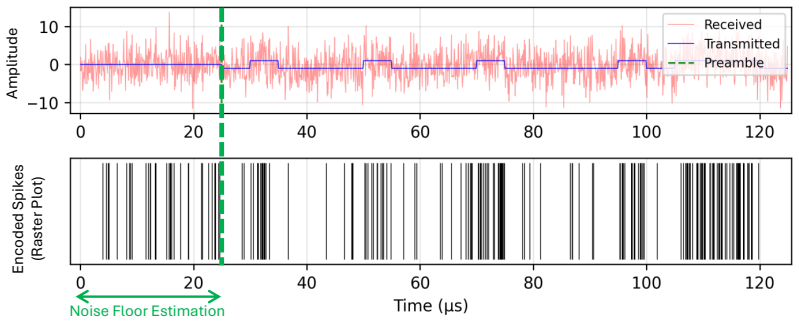
The key machinery is a two-neuron cascade of leaky integrate-and-fire circuits: a Spike Encoding LIF (SELIF) neuron that converts the analog baseband signal into spikes with count proportional to amplitude, and a Symbol Detection LIF (SDLIF) neuron that accumulates the spikes, with its threshold $\theta$ set so that firing means $\sum_i r_i > 0$. The decision rule is $\hat{s}_m = +1$ if $N_{\text{spikes}} \cdot dV_m \ge \theta$. The noise-tracking mechanism adds a second input path: during a silent preamble, noise-induced spikes raise the SDLIF threshold by $dV_n = n \cdot dV_m / n_{\text{symbols}}$, making the threshold proportional to the measured noise spike count rather than fixed.
What would settle it
Measure or simulate the actual SELIF transfer function $\rho(r)$ by driving one LIF neuron with the BPSK-plus-noise waveform and counting spikes per symbol; if, at the SNR points in Fig. 3, the spike count is not monotone in the average received amplitude, or if the decision rule $N_{\text{spikes}} \cdot dV_m \ge \theta$ disagrees with $\mathrm{sign}(\sum_i r_i)$ on enough symbols, the claimed equivalence to ML detection fails. A simpler check is to reproduce Fig. 3 using the full LIF differential equation (1) instead of the abstract spike-rate model and see whether the adaptive-threshold BER curve still crosses the 2-bit ADC curve.
Extended reading notes
Core claim
The central claim is that the maximum-likelihood sum $\sum_i r_i$ for repetition-coded BPSK can be realized physically as a spike count: a spike-encoding LIF neuron turns the analog received signal into a spike train whose rate is approximately proportional to instantaneous amplitude, and a symbol-detection LIF neuron integrates those spikes so that firing within the symbol window is equivalent to $\mathrm{sign}(\sum_i r_i)$. With this mapping, joint detection and decoding happen entirely in the spiking analog domain, with no ADC, no digital summation, and no reformulation of the problem into a form a spiking network can solve. The paper reports that with a 1/3 repetition code, the adaptive-threshold neuromorphic detector achieves lower BER than a 2-bit ADC digital detector at 64 samples per symbol, and that the advantage grows as the ADC sampling rate drops. Power is estimated at about 14 $\mu$W per LIF neuron at 200 kSymbols/s, compared with 0.5–1 mW for the 2-bit ADC alone, so the neuromorphic front end is claimed to be both lower-power and lower-error than the digital equivalent.
Load-bearing premise
The whole detector rests on the unquantified assumption that the encoding neuron's spike rate is a known, approximately linear function of the received amplitude at the operating point; if saturation or threshold dynamics make spike count a poor proxy for $\sum_i r_i$, the equivalence with the ML detector and the reported BER gains do not follow.
Editorial extensions
If this is right
- A BPSK receiver with repetition coding can drop its ADC and the digital detection/decoding logic entirely, replacing them with two analog neurons and a transmission gate.
- At 200 kSymbols/s the analog front end is estimated at roughly 14 $\mu$W per neuron, at least an order of magnitude below the 0.5–1 mW of the 2-bit ADC it replaces, and the comparison excludes the digital logic the ADC still needs.
- Adaptive thresholding via a short silence preamble recovers most of the low-SNR gain; performance saturates after about 50 preamble symbols, so the overhead can be kept small.
- The neuromorphic BER advantage becomes more pronounced as the comparison ADC's sampling rate is reduced from 64 to 8 samples per symbol, tying the benefit directly to the power-constrained regime.
Reading between the lines
- If the spike-count-to-amplitude linearity holds, the same architecture extends to soft information: the spike count is a natural log-likelihood metric, so cascading more integrate-and-fire stages could implement soft-decision decoding or iterative receivers without ever digitizing.
- The preamble-based noise tracking estimates the noise floor from spikes during silence; a testable extension is an online version that re-estimates the threshold continuously from decision-directed spikes, removing the preamble overhead.
- The paper's power comparison counts only the ADC, not the subsequent digital logic; a full system-level comparison including the SELIF driving circuitry, the threshold capacitor, and the transmission gate might shift the claimed margin, though femtojoule-per-spike LIF references suggest headroom.
Editorial analysis
A structured set of objections, weighed in public.
Referee Report
Summary. The paper proposes a fully analog neuromorphic receiver for repetition-coded BPSK. A first LIF neuron (SELIF) encodes the received analog signal into a spike train, and a second LIF neuron (SDLIF) accumulates spikes over the n repetitions and fires when a threshold is crossed, implementing a spike-domain approximation of the ML decision rule. A noise-adaptive threshold mechanism uses a silent preamble to estimate noise-induced spiking and adjusts the SDLIF threshold. Simulation results compare the neuromorphic detectors against a 2-bit ADC digital receiver with 64 samples per symbol, reporting BER gains with the adaptive threshold, and power estimates on the order of microwatts. The paper also discusses open challenges for higher-order modulation and higher-speed neuron implementations.
Significance. If the central claims are correct, the paper demonstrates a practically relevant architectural concept: an ADC-free, two-neuron analog front-end that jointly detects and decodes repetition-coded BPSK while preserving soft information in spike counts, with error-rate performance better than a 2-bit ADC digital receiver at microwatt power. This would be a genuinely novel contribution to neuromorphic physical-layer processing, and the ML derivation in Eqs. (2)-(5) is sound. The noise-tracking mechanism is a well-motivated contribution. However, the central performance claim rests on an unquantified linearity assumption between received amplitude and spike count, and the simulation description is too incomplete to establish the result as stated. The paper includes useful discussions of limitations, but the main load-bearing assumption is not subjected to sensitivity analysis.
major comments (4)
- [Section II.C, Eqs. (5)-(6)] The bridge from the ML decision rule in Eq. (5) to the spiking decision rule in Eq. (6)-(7) relies on the assumption, stated in Section II.C, that the SELIF neuron emits spikes at a rate ρ(r(t)) that is 'saturating, approximately linear'. This transfer function is never specified, and its operating point, slope, saturation levels, and low-SNR behavior are not quantified. For BPSK, a negative input drives the membrane potential downward and may produce few or no spikes, making the effective count map rectified near the −1 symbol and biased relative to the sum of received amplitudes. Equation (8) calibrates only the +1 high-SNR firing rate and gives no information about the −1 end or the low-SNR regime. Since the claimed BER advantage over the 2-bit ADC depends on the spike count preserving soft information, a nonlinear or rectified count map can shift the detection threshold and erase or invert the reported gains. The manuscript needs to provide the actual transfer function (or simulation-level neuron dynamics), the operating point, and a sensitivity analysis showing how deviations from linearity affect the BER.
- [Section IV, Figs. 3-4] The simulation setup is not described with enough specificity to be reproducible or to assess the validity of the BER comparison. Missing details include the exact numerical implementation of Eq. (1), the integration step, the reset mechanism, the value of dV_m, the static threshold value used in Fig. 3, the SDLIF parameter values, the noise model (e.g., whether the noise is band-limited and how it is generated), and the criterion for 'fires within T'. No error bars or confidence intervals are provided for the BER curves, even though the number of transmitted symbols is finite. The manuscript should add a complete simulation parameter table and, ideally, release the simulation code or provide the transfer function of the implemented SELIF, so that the central claim can be verified.
- [Section IV.A, power estimates] The power estimate of ~14 μW per LIF neuron depends on an assumed spike count of 14 spikes per symbol and a per-spike energy of 5 pJ, with the energy range 1–10 pJ cited from prior LIF implementations. However, this estimate does not include the energy consumed by the SDLIF neuron, the threshold-adjustment circuit, the transmission gate, leakage, or the noise-preamble processing. Since the abstract and conclusions claim power 'on the order of microwatts', the estimate should be presented with a clear breakdown of all components and with the uncertainty in per-spike energy translated into a range for the total power. As written, the comparison to a single low-resolution ADC is plausible but not fully established.
- [Section III, Eq. (9)-(10)] The adaptive threshold calibration in Eq. (9) is only stated symbolically. The relationship between N_noise, dV_n, and the threshold is not derived in terms of the actual noise statistics, and there is no analysis of how estimation error in N_noise (finite preamble length) affects the BER. The simulation results in Fig. 4 show that longer preambles improve performance, but the mechanism is not quantified. A short statistical model of the threshold estimation error and its impact on the decision boundary would make the adaptive mechanism more convincing.
minor comments (5)
- [Section I] The text contains typographical errors, including 'V on Neumann' and 'tranceivers', and the misspelling 'Finnaly' in Section V. These should be corrected.
- [Section II.C, Eq. (8)] Equation (8) uses V(t_spike)=v_th and gives t_spike = τ_m ln(1/(1-v_th)) ≈ 0.3465 μs, but the derivation of this formula from Eq. (1) is not shown and the definition of I(t) during the charging interval is omitted. The authors should clarify what input level is assumed for this nominal spike rate.
- [Section IV] The BER comparison in Fig. 3 uses a 2-bit ADC with 64 samples per symbol as the main digital baseline, but the sampling rates 8, 32, and 64 samples per symbol are only mentioned in the text and not all shown in the figure for the same operating conditions. Including the full set of curves with clear annotations would improve the presentation.
- [References] The novelty claim of being 'for the first time' a fully neuromorphic receiver should be supported by a more detailed comparison with the prior work discussed in reference [7], which is a review of spiking neuromorphic hardware communication systems. A clear statement of what distinguishes this work from existing spiking communication receivers is needed.
- [Section IV, Fig. 4] The preamble durations are listed as 5, 20, 50, and 300 symbols, but the text says 'preamble durations of 5, 20, 50, and 300 symbols' and then states 'beyond 50 symbols the gains become marginal'. The figure should be referenced with exact SNR values or a single representative SNR to make the observation reproducible.
Circularity Check
No significant circularity; the spiking decision rule is an explicit modeling approximation to the ML detector, and the thresholds are analytically derived rather than fitted to the BER results.
full rationale
The central derivation is self-contained: Eq. (5) is the standard ML decision rule for repetition-coded BPSK, reducing to the sign of the sum of received samples. The neuromorphic mapping in Section II.C is presented as an explicit modeling assumption — that the encoding LIF neuron emits spikes at a rate rho(r(t)) that is saturating and approximately linear, so that spike count N = rho(r) T preserves the soft information in the amplitude. This is an unverified and possibly fragile assumption, but it is not circular: it is not derived from the BER results, and it is not fitted to make the claimed gains appear. The static threshold theta is hand-computed from the theoretical interspike interval in Eq. (8) and the nominal high-SNR spike count, not optimized against the curves. The adaptive threshold in Eqs. (9)-(10) follows from the measured noise-preamble spike count and the defined per-spike increments; again, no parameter is fitted to the test outputs. The BER simulations therefore test the stated model rather than a prediction forced by construction. The paper's self-citations ([4], [5], [11]) provide background on prior neuromorphic MU-MIMO work and an ADC power-consumption figure; the ADC figure is externally falsifiable and is not a uniqueness theorem or an unverified premise that the detection derivation depends on. The main weakness — the unquantified linearity of the SELIF transfer function and the lack of a simulation-level description of the neuron implementation — is a correctness and validation risk, not a circularity. Nothing in the paper's own equations reduces the claimed result to its inputs by definition.
Assumptions & free parameters
free parameters (6)
- Membrane time constant tau_m =
0.5 microseconds
- Threshold voltage v_th =
0.5
- SDLIF voltage increment per spike dV_m =
not specified
- Static threshold factor =
7n times dV_m
- Energy per spike =
5 pJ (midpoint of cited 1-10 pJ)
- Preamble duration =
300 symbols (also 5, 20, 50 tested)
assumptions (6)
- standard math Leaky integrate-and-fire (LIF) neuron model as governed by Eq. (1)
- domain assumption SELIF firing rate is approximately linear in received amplitude
- domain assumption Noise statistics are stationary across the silent preamble and the data frame
- standard math AWGN channel model and equally likely symbols
- domain assumption The SDLIF threshold integration has no active leakage path, so the accumulated threshold stays constant
- domain assumption The 'conventional digital receiver' baseline is a 2-bit ADC with 8/32/64 samples per symbol
Cite this review
Pith. "Pith review of Toward Fully Neuromorphic Receivers for Ultra-Power Efficient Communications." pith.science (2026). https://pith.science/paper/SVE2XFVF
@misc{pith2026250522508,
  author       = {Pith},
  title        = {Pith review of: Toward Fully Neuromorphic Receivers for Ultra-Power Efficient Communications},
  year         = {2026},
  howpublished = {\url{https://pith.science/paper/SVE2XFVF}},
  note         = {Machine review of arXiv:2505.22508}
}
read the original abstract
Neuromorphic computing, inspired by biological neural systems, has emerged as a promising approach for ultra-energy-efficient data processing by leveraging analog neuron structures and spike-based computation. However, its application in communication systems remains largely unexplored, with existing efforts mainly focused on mapping isolated communication algorithms onto spiking networks, often accompanied by substantial, traditional computational overhead due to transformations required to adapt problems to the spiking paradigm. In this work, we take a fundamentally different route and, for the first time, propose a fully neuromorphic communication receiver by applying neuromorphic principles directly in the analog domain from the very start of the receiver processing chain. Specifically, we examine a simple transmission scenario: a BPSK receiver with repetition coding, and show that we can achieve joint detection and decoding entirely through spiking signals. Our approach demonstrates error-rate performance gains over conventional digital realizations with power consumption on the order of microwatts, comparable with a single very low-resolution Analog-to-Digital Converter (ADC) utilized in digital receivers. To maintain performance under varying noise conditions, we also introduce a novel noise-tracking mechanism that dynamically adjusts neural parameters during transmission. Finally, we discuss the key challenges and directions toward ultra-efficient neuromorphic transceivers.
Figures


Reference graph
Works this paper leans on
-
[1]
Opportunities for neuromorphic computing algorithms and applications,
C. D. Schuman, S. R. Kulkarni, M. Parsa, J. P. Mitchell, P. Date, and B. Kay, “Opportunities for neuromorphic computing algorithms and applications,”Nature Computational Science, vol. 2, no. 1, pp. 10–19,
-
[2]
A Survey of Neuromorphic Computing and Neural Networks in Hardware,
C. D. Schuman, T. E. Potok, R. M. Patton, J. D. Birdwell, M. E. Dean, G. S. Rose, and J. S. Plank, “A Survey of Neuromorphic Computing and Neural Networks in Hardware,”arXiv preprint arXiv:1705.06963, May 2017
arXiv 2017
-
[3]
Neuromorphic In-Context Learning for Energy-Efficient MIMO Symbol Detection,
Z. Song, O. Simeone, and B. Rajendran, “Neuromorphic In-Context Learning for Energy-Efficient MIMO Symbol Detection,” in2024 IEEE 25th International Workshop on Signal Processing Advances in Wireless Communications (SPA WC), pp. 1–5, Sept. 2024
work page 2024
-
[4]
G. N. Katsaros, J. C. D. L. Ducoing, and K. Nikitopoulos, “Neu- roMIMO: Employing the Neuromorphic Computing Principles to Achieve Power-Efficient MU-MIMO Detection,” inProceedings of the 23rd ACM Workshop on Hot Topics in Networks, HotNets ’24, (New York, NY , USA), pp. 368–375, Association for Computing Machinery, Nov. 2024
work page 2024
-
[5]
Towards Neuromorphic Processing for Next-Generation MU-MIMO Detection,
G. N. Katsaros, J. C. De Luna Ducoing, and K. Nikitopoulos, “Towards Neuromorphic Processing for Next-Generation MU-MIMO Detection,” in2024 IEEE 25th International Workshop on Signal Processing Ad- vances in Wireless Communications (SPA WC), pp. 581–585
-
[6]
TrueNorth: Design and tool flow of a 65 mW 1 mil- lion neuron programmable neurosynaptic chip,
F. Akopyan, J. Sawada, A. Cassidy, R. Alvarez-Icaza, J. Arthur, P. Merolla, N. Imam, Y . Nakamura, P. Datta, G.-J. Nam, B. Taba, M. Beakes, B. Brezzo, J. B. Kuang, R. Manohar, W. P. Risk, B. Jackson, and D. S. Modha, “TrueNorth: Design and tool flow of a 65 mW 1 mil- lion neuron programmable neurosynaptic chip,”IEEE Trans. Comput.- Aided Design Integr . C...
work page 2015
-
[7]
A review of spiking neuromorphic hardware communication systems,
A. R. Young, M. E. Dean, J. S. Plank, and G. S. Rose, “A review of spiking neuromorphic hardware communication systems,”IEEE Access, vol. 7, pp. 135606–135620, 2019
work page 2019
-
[8]
Loihi: A neuromorphic manycore processor with on-chip learning,
M. Davies, N. Srinivasa, T.-H. Lin, G. Chinya, Y . Cao, S. H. Choday, G. Dimou, P. Joshi, N. Imam, S. Jain, Y . Liao, C.-K. Lin, A. Lines, R. Liu, D. Mathaikutty, S. McCoy, A. Paul, J. Tse, G. Venkataramanan, Y .-H. Weng, A. Wild, Y . Yang, and H. Wang, “Loihi: A neuromorphic manycore processor with on-chip learning,”IEEE Micro, vol. 38, no. 1, pp. 82–99, 2018
2018
Show all 15 references
-
[9]
A biomimetic neural encoder for spiking neural network,
S. Subbulakshmi Radhakrishnan, A. Sebastian, A. Oberoi, S. Das, and S. Das, “A biomimetic neural encoder for spiking neural network,” Nature Communications, vol. 12, p. 2143, Apr. 2021
2021
-
[10]
An energy and area-efficient spike frequency adaptable LIF neuron for spiking neural networks,
U. Mushtaq, M. W. Akram, D. Prasad, and A. Islam, “An energy and area-efficient spike frequency adaptable LIF neuron for spiking neural networks,”Computers and Electrical Engineering, vol. 119, p. 109562
-
[11]
DigiLogue: Ultra-Fast and Ultra- Power-Efficient Signal Processing for Tbps Wireless Systems,
K. Nikitopoulos and M. M. Kiasaraei, “DigiLogue: Ultra-Fast and Ultra- Power-Efficient Signal Processing for Tbps Wireless Systems,” in2021 IEEE Globecom Workshops (GC Wkshps), pp. 1–6
-
[12]
A 4-fJ/Spike Artificial Neuron in 65 nm CMOS Technology,
I. Sourikopoulos, S. Hedayat, C. Loyez, F. Danneville, V . Hoel, E. Mercier, and A. Cappy, “A 4-fJ/Spike Artificial Neuron in 65 nm CMOS Technology,”Frontiers in Neuroscience, vol. 11, p. 123, Mar. 2017
2017
-
[13]
Optical synaptic devices with ultra-low power consumption for neuromorphic comput- ing,
C. Zhu, H. Liu, W. Wang, L. Xiang, J. Jiang, Q. Shuai, X. Yang, T. Zhang, B. Zheng, H. Wang, D. Li, and A. Pan, “Optical synaptic devices with ultra-low power consumption for neuromorphic comput- ing,”Light: Science & Applications, vol. 11, p. 337, Nov. 2022
2022
-
[14]
Photonic spiking neural networks with highly efficient training protocols for ul- trafast neuromorphic computing systems,
D. Owen-Newns, J. Robertson, M. Hejda, and A. Hurtado, “Photonic spiking neural networks with highly efficient training protocols for ul- trafast neuromorphic computing systems,”Intelligent Computing, vol. 2, p. 0031, 2023. Publisher: American Association for the Advancement o...
2023
-
[2022]
Number: 1 Publisher: Nature Publishing Group
Reviewed August 7, 2026 · model on record in the stance chip above.
Discussion (0). Sign in to comment.