REVIEW 2 major objections 5 minor 39 references
A recursive method for computing singular solutions in corners with homogeneous Dirichlet-Robin boundary condition with power-law coefficient variation
T0 review · 2 major / 5 minor · reviewed 2026-08-07 · deepseek-v4-flash
Pith's one-line read A recursive method builds the singular solutions of Laplace corner problems with a Dirichlet side and a power-law Robin side, for every real exponent and every corner angle, and classifies when the series terminates or acquires logarithms.
desk verdict Useful recursive construction for D-R corner singularities for all alpha, but the 'always convergent' claim needs a real coefficient bound. read the letter →
The pith
A machine-rendered reading of the paper's core claim, the machinery that carries it, and where it could break.
The reading
What carries the argument
The load-bearing mechanism is the recursive replacement of the Robin condition by boundary data from the previous shadow term: for $\alpha>-1$ the Robin condition is converted into a non-homogeneous Neumann condition, while for $\alpha<-1$ it is converted into a non-homogeneous Dirichlet condition. Each shadow term is then sought in the power-logarithmic basis $r^{\lambda_j \pm k(\alpha+1)}(\log r)^m$ times oscillatory angular functions, which reduces every step to an upper triangular linear system. The diagonal entries of these systems are $-\bigl(\lambda_j + k(\alpha+1)\bigr)\sin\bigl(\omega k(\alpha+1)\bigr)$ in the Dirichlet–Neumann case and $\sin\bigl(-k\omega(\alpha+1)\bigr)$ in the Dirichlet–Dirichlet case; when they vanish, the system is augmented by one degree of freedom, which is exactly when an additional power of $\log r$ enters the solution. The rationality of $\omega(\alpha+1)/\pi$ then decides, through the propositions of the paper, whether such augmentations ever occur and whether the right-hand side eventually vanishes, producing the finite/infinite and log/no-log classification summarized in the tables.
What would settle it
Take a case with $\omega(\alpha+1)/\pi$ irrational and $\alpha>-1$, compute the shadow coefficients recursively to, say, $k=20$, and test numerically whether the relative error $e_{DN}(r)$ tends to zero as $S_j \to \infty$ for a fixed small $r$; if the partial sums diverge, or if $\max_l |a^{(l)}_{j,k}|$ grows faster than exponentially in $k$, the uniform-convergence claim fails. The same check can be made for the D-D recursion with $\alpha<-1$.
Extended reading notes
Core claim
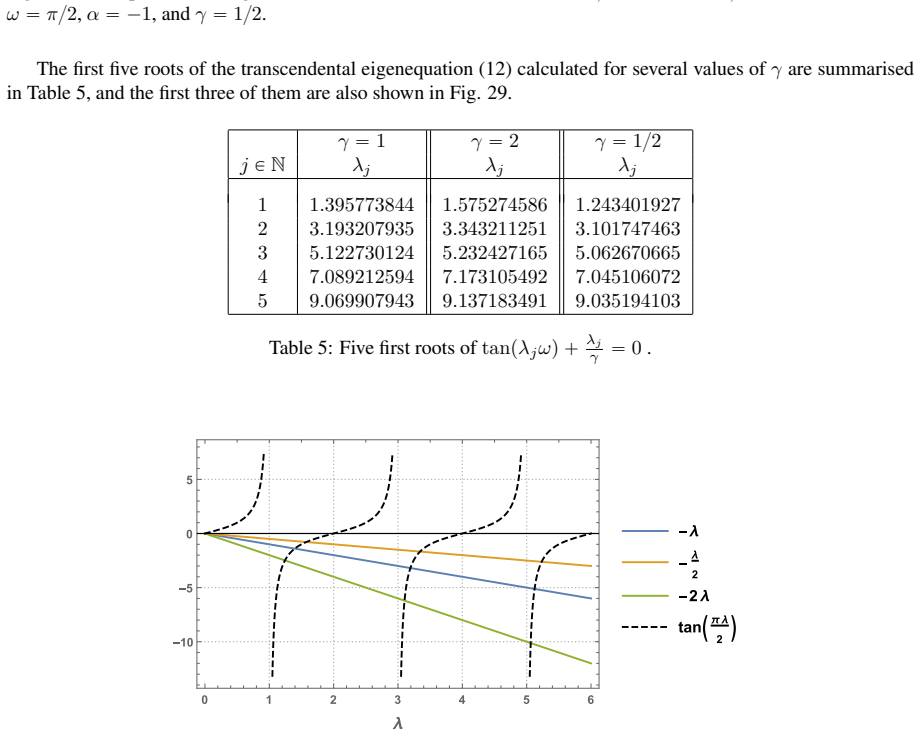
The central claim is that every singular eigensolution $u_j$ of the corner problem with $u=0$ on the ray $\theta=0$ and $(1/r)\,\partial u/\partial\theta + \gamma r^{\alpha} u = 0$ on the ray $\theta=\omega$ can be written as $u_j = u_j^{(0)} + \sum_{k=1}^{S_j} u_j^{(k)}$, where the main term $u_j^{(0)}$ solves a homogeneous Dirichlet–Neumann or Dirichlet–Dirichlet corner problem and each shadow term $u_j^{(k)}$ solves a recursive non-homogeneous version of the same problem. The shadow terms have the explicit harmonic form $r^{\lambda_j \pm k(\alpha+1)}$ times a polynomial in $\log r$ with angular factors built from sine and cosine of shifted arguments, and their coefficients solve upper triangular systems that grow by one row exactly when a resonance condition, a vanishing diagonal entry, occurs. The paper’s classification is that for $\omega(\alpha+1)/\pi$ irrational the series is infinite with no logarithmic terms; for $\omega(\alpha+1)/\pi = (2p-1)/(2q)$ the series stops after $q$ shadow terms and is exact with no logarithms (an apparent critical pair); and for $\omega(\alpha+1)/\pi = p/(2q-1)$ the series is infinite with logarithmic terms (an actual critical pair). For the critical exponent $\alpha=-1$ the series collapses to a single term $r^{\lambda_j}\sin(\lambda_j\theta)$ whose exponent solves $\tan(\lambda_j\omega)+\lambda_j/\gamma=0$. The same machinery yields a Mode III bridged-crack picture: $\alpha>-1$ gives the classical square-root stress singularity, $\alpha<-1$ gives continuous stresses with no singularity, and $\alpha=-1$ gives a weak singularity whose exponent lies between $1/2$ and $1$.
Load-bearing premise
The infinite-series convergence proof requires a bound on the recursively computed shadow coefficients $a^{(l)}_{j,k}$ that the paper only asserts as “suitable bounding conditions” in Section 3.6; if those coefficients grow too fast, the claimed always-convergent infinite series for $\alpha>-1$ or $\alpha<-1$ could diverge.
Editorial extensions
If this is right
- For any corner angle $\omega \in (0,2\pi]$ and any real exponent $\alpha$, a singular eigensolution can be written down algorithmically as a main term plus shadow terms, so no case requires a separate Mellin-transform derivation.
- When $\omega(\alpha+1)/\pi = (2p-1)/(2q)$, the recursive series terminates after $q$ shadow terms giving an exact solution with zero error on the Robin boundary, usable as a benchmark for numerical methods.
- When $\omega(\alpha+1)/\pi$ is irrational or equals $p/(2q-1)$, the series is infinite; in the latter case logarithmic terms must be included, and omitting them changes the asymptotic expansion qualitatively.
- For Mode III bridged cracks, the exponent $\alpha$ separates three regimes: $\alpha>-1$ reproduces the classical $r^{-1/2}$ stress singularity, $\alpha=-1$ produces a weak singularity with exponent $1-\lambda_1 \in (0,1/2)$ determined by the transcendental equation, and $\alpha<-1$ removes the singularity entirely.
- Because the recursion is triangular and each step only inverts a known upper triangular system, the method is directly implementable in computer algebra systems, making the long shadow-term expressions computable rather than formal.
Reading between the lines
- I would expect the same ratio-rationality classification to transfer to Neumann–Robin and Robin–Robin corner pairs, since the recursion only changes which side carries the homogeneous condition; if so, the table pattern is a general combinatorial law for power-logarithmic corner expansions.
- The recursion makes explicit, term by term, the resonance condition that in a Mellin-transform approach appears as poles of the Mellin symbol; a testable extension is to compare the exponents and log multiplicities produced here with those from a Mellin calculation for the same $(\omega,\alpha)$, which would confirm that no shadow term is missing.
- Fracture experiments on bridged cracks with tailored power-law springs could directly test the $\alpha=-1$ threshold: measuring the near-tip stress exponent for a family of exponents should show a transition from $1/2$ to $1$ exactly as $\alpha$ crosses $-1$, with the transcendental equation predicting the intermediate exponent.
- The proof of convergence of infinite shadow series leans on heuristic coefficient bounds; a natural next step, if the coefficient growth can be controlled, is to turn the recursion into a rigorous asymptotic expansion theorem in weighted Sobolev spaces.
Editorial analysis
A structured set of objections, weighed in public.
Referee Report
Summary. The manuscript studies the Laplace equation in an infinite angular sector with a homogeneous Dirichlet condition on one side and a Robin condition with power-law coefficient γ r^α on the other. It proposes two recursive procedures, a Dirichlet–Neumann (D-N) recursion for α > -1 and a Dirichlet–Dirichlet (D-D) recursion for α < -1, in which the Robin condition is converted into a sequence of nonhomogeneous Neumann or Dirichlet problems. The solution is written as a main term plus shadow terms of the form r^{λ_j ± k(α+1)} times polynomials in log r. The paper derives triangular systems for the shadow coefficients, classifies critical pairs (ω, α) into finite or infinite series with or without logarithmic terms, analyzes the boundary error and energy, presents several examples, and gives an application to Mode III bridged cracks.
Significance. If the convergence claims are established, the paper provides a systematic constructive method for singular eigensolutions across the full range α ∈ R and ω ∈ (0, 2π], extending earlier work in [10] from α = 0 and in [34] for α = -1. The explicit finite-series examples are checked in detail and achieve zero Robin-boundary error; the α = -1 eigenequation is standard; and the classification tables are useful for applications. The main weakness is that the paper's central 'always convergent' claim is not proved: the convergence argument in §3.6 reduces the problem to unproved coefficient bounds. This is a load-bearing issue, but it is potentially fixable either by supplying the missing bounds or by reframing the result as an asymptotic expansion rather than a convergent series.
major comments (2)
- [§3.6, Eq. (32); Proposition 5] The abstract and Remark 3.2 claim that the infinite shadow series always converge for α > -1 (D-N) and α < -1 (D-D). The proof in §3.6 does not establish this. Eq. (32) reduces the relative error to a ratio whose denominator is Σ_{k=0}^{S} r^{k(α+1)} v^{(k)}_j(r,ω), and the text states that 'under suitable bounding conditions for |a^{(l)}_{j,k} binom(l,m)ω^{l-m}|' this series converges absolutely, citing Proposition 5. Proposition 5 only proves convergence of Σ (r log r)^n for 0 < r < 1; it contains no estimate for the recursively determined coefficients a^{(l)}_{j,k}. These coefficients solve the triangular systems (19)/(24), whose diagonal entries sin(kω(α+1)) have no uniform lower bound when ω(α+1)/π is irrational, so coefficient blow-up is not excluded. Moreover, for actual critical pairs the degree L_{j,k} of the logarithmic polynomial grows with k, so a bound of the form |a^{(l)}_{j,k} binom(l,m)ω^{l-m}| ≤ C ρ^k would need to account for that growth as well. Without such a majorant, neither absolute convergence of the denominator in (32) nor vanishing of the absolute error (30)/(36) as S_j → ∞ is proved. The authors should either supply the missing coefficient bounds and a precise statement of the order of limits, or explicitly downgrade the claim to 'asymptotic expansion as r → 0 for fixed truncation S_j' and revise the abstract, Remark 3.2 and Remark 3.3 accordingly.
- [§3.7.3] The criterion for the series to be finite or infinite is stated as 'the recursive procedure stops if and only if the right-hand side ... is null', and the subsequent analysis in cases (a)–(c) treats only L_{j,c} ∈ {0, 1}. The sentence 'In general, the vectors g_{j,c-1} at least contain a subvector of the form shown in (57); therefore these last three cases are sufficient' is not a proof for L > 1. A simple downward induction using the top component g^{(L)}_{j,c-1} (which equals -γ a^{(L)}_{j,c-1} cos((c-1)ω(α+1)) up to the D-D prefactor) would settle the claim, but the manuscript does not present it. Since the finite/infinite classification in Tables 1–4 is a central result, this gap should be filled rather than left to the reader.
minor comments (5)
- [§4.2] In the D-D examples, the text refers to 'E_DN and e_DN' (e.g., in the paragraph around Fig. 25); these should be E_DD and e_DD.
- [Tables 1–4] The symbol '8' in the S_j and L_{j,k} columns is presumably meant to be infinity; please use ∞ in the final version to avoid confusion.
- [§3.5] The sentence explaining the Sans-serif typography is a typesetting instruction; please ensure the D-D coefficients are actually distinguished typographically in the published version.
- [§5, Fig. 31] The horizontal axis in Fig. 31 appears to be labeled 'a' but should be 'α'.
- [§3.7.3] The phrase 'a_{j,c-1}≠0 or a_{j,c-1}≠0' contains a duplicated symbol; it should refer separately to the D-N and D-D coefficients.
Circularity Check
No significant circularity: shadow coefficients are solved from the recursive BVP, not fitted to the target error; the convergence gap in §3.6 is an unproved premise, not a circular reduction.
full rationale
The derivation chain is self-contained in the sense relevant to circularity. The proposed shadow-term ansatz (14) is an assumed functional form, but every coefficient is determined by solving the recursive non-homogeneous D-N or D-D BVPs (8)/(10) through the triangular systems (19)/(24); no coefficient is fitted to the error or to a target eigensolution. The finite-versus-infinite classification in Tables 1-4 follows from the algebraic conditions (20)-(26) derived from those systems, not from assuming the answer. For the critical case α=-1, the eigenvalue equation (12), tan(λ_j ω)+λ_j/γ=0, is obtained by imposing the Robin condition on the harmonic function r^{λ_j} sin(λ_j θ), so it is derived rather than postulated. The only self-citation that might be questioned is [10], used in §3.3 to borrow the shadow-term structure for α=0 and later to validate the α=0 case; this is a template and a check, not an unverified uniqueness theorem, and it is not load-bearing for the α∈R generalization. The one genuine support gap is in §3.6, Eq. (32): the relative-error convergence is conditioned on 'suitable bounding conditions for |a^{(l)}_{j,k} binom(l,m) ω^{l-m}|', while Proposition 5 only proves absolute convergence of ∑(r log r)^n for 0<r<1 and supplies no bound on the recursively defined coefficients. This gap directly affects the abstract's 'always convergent' claim, but it is a missing proof of a coefficient estimate, not a circular definition or a fitted input disguised as a prediction: the coefficients are not chosen to make the error vanish, and the convergence claim is not equivalent to an input by construction. I therefore find no circular step requiring a reduction; the score 1 reflects the minor self-citation and the unproved convergence premise, the latter being a correctness risk rather than circularity.
Assumptions & free parameters
assumptions (4)
- ad hoc to paper The shadow terms admit the ansatz u_j^{(k)} = sum [a Im{z^{lambda_j +/- k(alpha+1)} log^l z} + b Re{z^{lambda_j +/- k(alpha+1)} log^l z}].
- standard math Kondratiev and Costabel-Dauge theory ensures that near a corner, solutions of elliptic BVPs split into finite singular parts plus regular parts, and that singular eigensolutions are harmonic.
- domain assumption The recursive non-homogeneous D-N problem (8) and D-D problem (10) have unique harmonic solutions, and the triangular systems (19) and (24) determine all coefficients when diagonal entries are nonzero; when a diagonal entry vanishes the augmented system remains consistent.
- standard math For alpha = -1, the complete finite-energy eigensolutions are exactly r^lambda sin(lambda theta) with lambda roots of tan(lambda omega) + lambda/gamma = 0.
Cite this review
Pith. "Pith review of A recursive method for computing singular solutions in corners with homogeneous Dirichlet-Robin boundary condition with power-law coefficient variation." pith.science (2026). https://pith.science/paper/EIUJ72XI
@misc{pith2026250522585,
  author       = {Pith},
  title        = {Pith review of: A recursive method for computing singular solutions in corners with homogeneous Dirichlet-Robin boundary condition with power-law coefficient variation},
  year         = {2026},
  howpublished = {\url{https://pith.science/paper/EIUJ72XI}},
  note         = {Machine review of arXiv:2505.22585}
}
abstract
This study introduces a recursive method for computing asymptotic solutions of the Laplace equation in corner domains with the homogeneous Dirichlet boundary condition on one side and the Robin boundary condition with a power-law coefficient variation with exponent $\alpha\in \mathbb{R}$ on the other side (D-R corner problem). An asymptotic solution of this D-R corner problem is given as the sum of a main term, the solution of either a homogeneous Dirichlet-Neumann (D-N) or Dirichlet-Dirichlet (D-D) corner problem, and a finite or infinite series of the associated higher-order shadow terms by using harmonic basis functions with power-logarithmic terms. To determine this series of shadow terms, it is shown that the recursive procedures based on recursive non-homogeneous D-N or D-D corner problems are always convergent for $\alpha > -1$ or $\alpha < -1$, respectively. For the critical case $\alpha=-1$, the closed form expression of the asymptotic solution is given. Asymptotic solutions for several relevant D-R corner problems are derived and analysed. Two of these examples are applied to the problem of bridged cracks in antiplane Mode III in linear elastic fracture mechanics. The results presented can be applied to many other physical and engineering applications, such as heat transfer with the thermal resistance condition, acoustics and electrostatics with the impedance condition, and elasticity and structural analysis with the Winkler spring boundary condition.
Figures


Figures from the paper (28 more)




Reference graph
Works this paper leans on
-
[10]
S. Jiménez-Alfaro, V . Villalba, and V . Mantiˇc. Singular elastic solutions in corners with spring boundary conditions under anti-plane shear.International Journal of Fracture, 223:197–220, 2020
work page 2020
-
[34]
S. Ueda et al. On the stiffness of spring model for closed crack.International Journal of Engineering Science, 44:874–888, 2006
work page 2006
-
[1]
Y . Antipov et al. Mathematical model of delamination cracks on imperfect interfaces.International Journal of Solids and Structures, 38:6665–6697, 2001
work page 2001
-
[2]
I. Babuška. Finite element method for domains with corners.Computing, 6:264–273, 1970
work page 1970
-
[3]
S. C. Brenner and C. Carstensen. Finite element methods (ch. 4). In E. Stein, R. de Borst, and T. J. R. Hughes, editors,Encyclopedia of Computational Mechanics, Volume 1: Fundamentals, pages 73–114. Wiley, 2004
work page 2004
-
[4]
M. Costabel and M. Dauge. Construction of corner singularities for agmon-douglis-nirenberg elliptic systems. Mathematische Nachrichten, 162:209–237, 1993
work page 1993
-
[5]
M. Costabel and M. Dauge. A singularly mixed boundary value problem.Communications in Partial Differ- ential Equations, 21:1919–1949, 1996
work page 1919
-
[6]
Dauge.Elliptic Boundary Value Problems on Corner Domains
M. Dauge.Elliptic Boundary Value Problems on Corner Domains. Springer, Berlin, Heidelberg, 1988
work page 1988
Show all 39 references
-
[7]
Grisvard.Elliptic problems in nonsmooth domains
P. Grisvard.Elliptic problems in nonsmooth domains. Pitman Advanced Publishing Program, Boston, Lon- don, Melbourne, 1985. 39
1985
-
[8]
Grisvard.Singularities in boundary value problems
P. Grisvard.Singularities in boundary value problems. Masson and Springer-Verlag, Paris, 1992
1992
-
[9]
Jiménez-Alfaro and V
S. Jiménez-Alfaro and V . Manti ˇc. Crack tip solution for mode iii cracks in spring interfaces.Engineering Fracture Mechanics, 288:109293, 2023
2023
-
[11]
V . A. Kondratiev. Boundary value problems for elliptic equations in domains with conical or angular points. Trans. Moscow Math. Soc., 16:227–313, 1967
1967
-
[12]
V . A. Kozlov, V . G. Maz’ya, and J. Rossmann.Elliptic Boundary Value Problems in Domains with Point Singularities. American Mathematical Society, Providence, Rhode Island, 1997
1997
-
[13]
V . A. Kozlov, V . G. Maz’ya, and J. Rossmann.Spectral Problems Associated with Corner Singularities of Solutions of Elliptic Equations. American Mathematical Society, Providence, Rhode Island, 2001
2001
-
[14]
Kufner and A.-M
A. Kufner and A.-M. Sändig.Some Applications of Weighted Sobolev Spaces. Teubner Verlag, Wiesbaden, 1987
1987
-
[15]
Leguillon and E
D. Leguillon and E. Sanchez-Palencia.Computation of singular solutions in elliptic problems and elasticity. Masson, Paris, 1987
1987
-
[16]
S. Lenci. Analysis of a crack at a weak interface.International Journal of Fracture, 108:275–290, 2001
2001
-
[17]
Mantiˇc et al
V . Mantiˇc et al. A new crack-tip element for the logarithmic stress-singularity of mode-iii cracks in spring interfaces.Computational Mechanics, 74:641–660, 2024
2024
-
[18]
Maz’ya and J
V . Maz’ya and J. Rossmann. On a problem of babuška (stable asymptotics of the solution to the dirichlet problem for elliptic equations of second order in domains with angular points).Mathematische Nachrichten, 155:199–220, 1992
1992
-
[19]
Medková.The Laplace Equation
D. Medková.The Laplace Equation. Boundary Value Problems on Bounded and Unbounded Lipschitz Do- mains. Springer, Cham, Switzerland, 2018
2018
-
[20]
Z. Mghazli. Regularity of an elliptic problem with mixed dirichlet-robin boundary conditions in a polygonal domain.CALCOLO, 29:241–267, 1992
1992
-
[21]
Mishuris
G. Mishuris. Interface crack and nonideal interface concept (mode iii).International Journal of Fracture, 107, 2001
2001
-
[22]
G. S. Mishuris. Stress singularity at a crack tip for various intermediate zones in bimaterial structures (mode iii).International Journal of Solids and Structures, 36:999–1015, 1999
1999
-
[23]
G. S. Mishuris and G. Kuhn. Asymptotic behaviour of the elastic solution near the tip of a crack situated at a nonideal interface.ZAMM Zeitschrift für Angewandte Mathematik und Mechanik, 81, 2001
2001
-
[24]
Nazarov and B
S. Nazarov and B. Plamenevsky.Elliptic Problems in Domains with Piecewise Smooth Boundaries. Walter de Gruyter, Berlin, 1994
1994
-
[25]
Nicaise.Polygonal Interface Problems
S. Nicaise.Polygonal Interface Problems. Peter Lang, 1993
1993
-
[26]
Sayas, T
F. Sayas, T. Brown, and M. Hassell.Variational Techniques for Elliptic Partial Differential Equations: Theoretical Tools and Advanced Applications. CRC Press, 2019
2019
-
[27]
G. B. Sinclair. On the influence of cohesive stress-separation laws on elastic stress singularities.Journal of Elasticity, 44, 1996
1996
-
[28]
G. B. Sinclair. A note on the removal of further breakdowns in classical solutions of laplace’s equation on sectorial regions.Journal of Elasticity, 56:247–252, 1999
1999
-
[29]
G. B. Sinclair. Stress singularities in classical elasticity-i: Removal, interpretation, and analysis.Applied Mechanics Reviews, 57:251–298, 2004
2004
-
[30]
G. B. Sinclair. A note on the influence of cohesive stress-separation laws on elastic stress singularities in antiplane shear.Journal of Elasticity, 94:87–93, 2009. 40
2009
-
[31]
G. B. Sinclair. On the influence of adhesive stress-separation laws on elastic stress singularities.Journal of Elasticity, 118:187–206, 2015
2015
-
[32]
Strang and G
G. Strang and G. J. Fix.An analysis of the finite element method. Prentice-Hall, Inc., Englewood Cliffs, NJ, 1973
1973
-
[33]
Szabó and I
B. Szabó and I. Babuška.Finite Element Analysis. Wiley, New York, 1991
1991
-
[35]
Watanabe et al
K. Watanabe et al. Closed interface crack with singular spring stiffness model.International Journal of Engineering Science, 45:210–226, 2007
2007
-
[36]
M. L. Williams. Stress singularities resulting from various boundary conditions in angular corners of plates in extension.Journal of Applied Mechanics, 19:526–528, 1952
1952
-
[37]
Wolfram.Mathematica: A system for doing mathematics by computer
S. Wolfram.Mathematica: A system for doing mathematics by computer. Addison-Wesley, Redwood City, CA, 2 edition, 1991
1991
-
[38]
J. Wu, L. Zhang, and L. Wan. A mode-iii crack under adhesion studied by non-uniform linear spring models. Acta Mechanica, 228:1621–1629, 2017
2017
-
[39]
Yosibash.Singularities in elliptic boundary value problems and elasticity and their connection with failure initiation
Z. Yosibash.Singularities in elliptic boundary value problems and elasticity and their connection with failure initiation. Springer, New York, 2012. 41
2012
Reviewed August 7, 2026 · model on record in the stance chip above.
Discussion (0). Sign in to comment.