REVIEW 2 major objections 3 minor 1 cited by
Towards the Efficient Inference by Incorporating Automated Computational Phenotypes under Covariate Shift
T0 review · 2 major / 3 minor · reviewed 2026-08-07 · deepseek-v4-flash
Pith's one-line read This paper shows that automated computational phenotypes can be incorporated into semi-supervised inference under covariate shift to yield doubly robust, semiparametrically efficient estimators, and that the efficiency gains come entirely…
desk verdict Solid PPI extension under covariate shift with a correctable overstatement about when ACPs yield zero efficiency gain. read the letter →
The pith
A machine-rendered reading of the paper's core claim, the machinery that carries it, and where it could break.
The reading
What carries the argument
The argument rides on the semiparametric tangent-space decomposition for the combined labeled/unlabeled likelihood, which yields the efficient influence function. The load-bearing objects are the density ratio $w_0(x)=q(x)/p(x)$, the conditional score $m_0(x)=E\{s(Y,X;\beta_0)\mid x\}$, and its ACP-augmented counterpart $\tilde m_0(x,\tilde y)=E\{s(Y,X;\beta_0)\mid x,\tilde y\}$; the EIF (4) reweights these by the selection indicator $R$. Cross-fitting with $K$ folds and product-rate conditions $a_{1M}a_{2M}=o(M^{-1/2})$, $a_{1M}a_{3M}=o(M^{-1/2})$ lets the estimator tolerate nuisance estimates converging slower than $M^{-1/4}$ and avoids Donsker restrictions. The efficiency-gain formula comes from subtracting the two closed-form variance expressions, which isolates the term depending only on unlabeled ACPs.
What would settle it
Run the paper's synthetic experiment with the same ACP generation but set the unlabeled outcome to $q(y\mid x)\neq p(y\mid x)$, for example by shifting the intercept by a nonzero constant; if the proposed estimator's bias does not vanish as $n,N\to\infty$ and its nominal 95% confidence intervals undercover, that confirms the transportability assumption is load-bearing. A direct check in an applied dataset is to label a random hold-out subset of the unlabeled cohort and test equality of $p(y\mid x)$ and $q(y\mid x)$; rejection would invalidate the identification of $\beta$.
Extended reading notes
Core claim
On the paper's own terms, the central discovery is that the efficiency bound and the efficient influence function for a parameter $\beta$ defined by $E_q\{s(Y,X;\beta)\}=0$ take an explicit form under covariate shift, and that the bound with ACPs is strictly smaller than the bound without ACPs except in the degenerate case where $\tilde Y$ is a function of $X$. Proposition 3.1 gives the EIF $\Omega\phi_w$ with $\phi_w$ as in equation (4); Proposition 3.3 shows the variance gap equals $\frac{1}{(1-\pi)^2}\Omega E[\{1-\pi_0(X)\}^3/\pi_0(X)\{\tilde m_0(X,\tilde Y)-m_0(X)\}^{\otimes2}]\Omega$, which is positive semidefinite. Theorem 5.5 proves that the cross-fitted estimator solving equation (5) is asymptotically normal with covariance $\Omega V_w\Omega$, exactly the semiparametric efficiency bound, under the product-rate conditions. Theorem 5.3 establishes double robustness, and Proposition 3.5 shows that ACPs available only for labeled data leave the bound unchanged, so the gain is attributable to unlabeled ACPs.
Load-bearing premise
The load-bearing premise is that the outcome distribution transports from the labeled to the unlabeled population, $p(y\mid x)=q(y\mid x)$ (and the same conditional stability holds for the ACP); because $Y$ is unobserved in the unlabeled data, this equality cannot be tested in the semi-supervised setting the paper targets.
Editorial extensions
If this is right
- ACP-augmented inference never increases asymptotic variance; it strictly reduces it whenever $\tilde Y$ is not a function of $X$ and is predictive given $X$.
- The entire efficiency gain is driven by ACPs attached to unlabeled observations, so ACP collection effort should be directed to the unlabeled cohort.
- The estimator remains consistent if either the density-ratio model or the pair of outcome regressions is correctly specified (double robustness).
- Under the product-rate conditions, nuisance functions can be estimated by flexible machine learning without Donsker-type entropy restrictions and the estimator still reaches the semiparametric bound.
- Confidence intervals based on equation (8) have nominal asymptotic coverage and their lengths are asymptotically no larger than intervals from any estimator that ignores ACPs.
Reading between the lines
- A design corollary the paper leaves implicit: an ACP algorithm should be encouraged to consume auxiliary variables beyond the model's feature set; an ACP built only from $X$ is informationally useless for this estimator.
- The theorem also suggests a resource-allocation rule for EHR studies: spend ACP generation on the unlabeled majority rather than on chart-reviewed patients, since labeled ACPs contribute no asymptotic gain.
- Because the efficiency bound is conditional on transportability, a natural extension is a sensitivity analysis that reports how much bias in $\hat\beta$ could arise from a given divergence between $p(y\mid x)$ and $q(y\mid x)$; the paper does not provide such a bound.
- The product-rate double robustness might be exploited in practice by pairing a fast, parametric density-ratio estimator with flexible machine-learned outcome regressions, relaxing the requirement that every nuisance converge quickly.
Editorial analysis
A structured set of objections, weighed in public.
Referee Report
Summary. The paper studies semi-supervised estimation of parameters defined by estimating equations for the unlabeled population under covariate shift, when automated computational phenotypes (ACPs) are available for both labeled and unlabeled observations. It derives the semiparametric efficient influence function with and without ACPs (Propositions 3.1 and 3.2), gives a closed-form positive-semidefinite efficiency gain from incorporating ACPs (Proposition 3.3), and argues that only unlabeled ACPs, not labeled ACPs, produce the gain (Proposition 3.5). It then proposes a cross-fitted doubly robust estimator for the target parameter, establishes double robustness (Theorem 5.3), asymptotic normality at the semiparametric efficiency bound (Theorem 5.5), and valid confidence intervals (Theorem 5.8), with supporting simulations and real-data analyses.
Significance. The core derivation is self-contained and largely standard semiparametric theory: the EIF is obtained from a tangent-space decomposition and the efficiency comparison is given in closed form. If the results hold, the paper makes a useful contribution to the prediction-powered inference and surrogate-outcome literature by allowing flexible covariate shift, black-box ACPs, and doubly robust efficient estimation. The explicit formula for the efficiency gain and the identification of unlabeled ACPs as the source of the gain are potentially valuable for practitioners. The paper also ships reproducible code and compares with PPI/PPI++/RePPI on several data sets. The main mathematical claims appear sound, but a key interpretive claim about when the gain vanishes is overstated and needs correction, and one headline proposition is stated without proof.
major comments (2)
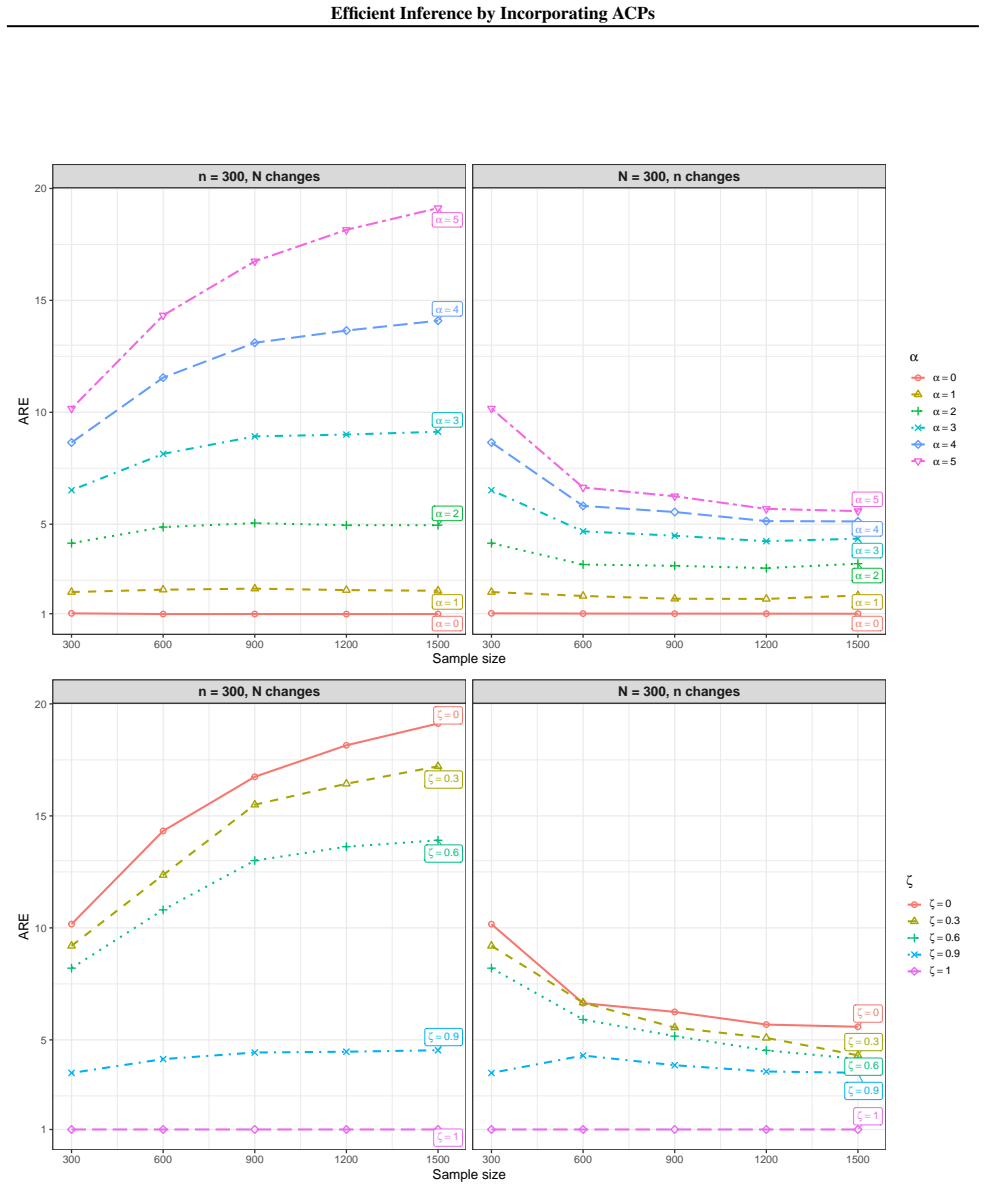
- [§1.2 and Remark 3.4] The claim that 'the only scenario with no efficiency gain occurs when the generation of ACPs depends solely on the available feature X' is not supported by the paper's own Proposition 3.3. The gain matrix is proportional to E[ (1−π0(X))^3/π0(X) {em0(X,bY)−m0(X)}^⊗2 ], so the gain vanishes if and only if em0(X,bY)=m0(X) almost surely, i.e., E[s(Y,X;β0)|X,bY]=E[s(Y,X;β0)|X]. This condition holds whenever bY is conditionally independent of Y given X, including the case where bY=f(X,Z) with Z independent of Y given X, or bY is pure noise independent of (X,Y). These cases are not covered by the 'bY is a function of X' characterization. The paper's own simulation discussion in §6.1 implicitly acknowledges this: ARE equals 1 when the ACP is not predictive of the outcome (α=0), even though bY is generated from an additional covariate Z. The instructions in Remark 3.4 should be revised to state the correct zero-gain condition, and the corresponding sentences in §1.2 should be corrected so that practitioners are not told that any ACP depending on variables beyond X automatically improves efficiency.
- [Proposition 3.5 and Remark 3.6] The claim that ACPs in the labeled data contribute no efficiency gain is a headline result of the paper, but Proposition 3.5 is stated without proof, with only 'proof similar to Proposition 3.1 so omitted.' Because this proposition underlies the abstract's assertion that unlabeled ACPs drive the efficiency gain, the appendix should contain the derivation, or at least a detailed proof sketch that specifies the tangent spaces for the intermediate scenario in Table 2 and verifies that the resulting efficiency bound equals that of Proposition 3.2. Without this, a load-bearing claim is left unverified.
minor comments (3)
- [Proposition 3.3 and Appendix A] The unsubscripted expectation E in the gain formula is not explicitly defined. In the proof of Proposition 3.3 the notation alternates among E, E_p, and E_q, and the final coefficient (1−π0(X))^3/π0(X) is only correct when E is interpreted as the expectation over the combined covariate distribution with density proportional to π p(x)+(1−π)q(x). Please define this expectation explicitly in the main text.
- [Throughout the paper] There are several typographical errors that should be fixed: 'combind' in Appendix B, 'propoesd' in Table 14, and 'identify' where 'identity' is meant in §6.1. These are minor but interrupt reading.
- [Section 3.1] The RAL estimator definition is written for a sample of size n, while the data consist of M=n+N observations. The notation should be harmonized so that the total sample size M is used consistently before Remark 5.7 introduces the π→0 scaling.
Circularity Check
No circularity: the efficiency-bound derivation is self-contained; the 'only scenario' wording in Section 1.2 overreaches its own formula but that is a correctness issue, not a circular one.
full rationale
The derivation chain is self-contained. Proposition 3.1 obtains the efficient influence function from the factored likelihood p(y|x,bY)p(bY|x)p(x)^r q(x)^{1-r} and orthogonal tangent-space calculations, and the efficiency bound is computed in closed form. Proposition 3.3 is an algebraic subtraction of V_wo and V_w, and Theorem 5.5 proves that the cross-fitted estimator solving equation (5) is asymptotically normal with variance equal to that bound through the standard sample-splitting, bias, and CLT decomposition under product rate conditions. No fitted parameter is relabeled as a prediction: the target beta is defined by Eq{s(Y,X;beta)}=0, the nuisance functions are estimated but must converge to their true limits, and the reported efficiency gain is a function of the true nuisance functions. Self-citations (e.g., Miao et al. 2023/2024; Deng et al. 2024; Tian et al. 2023; Kim et al. 2024; Lee et al. 2025) appear only as related work and do not supply a load-bearing premise; the semiparametric machinery is cited to Bickel et al. (1993), Tsiatis (2006), and Chernozhukov et al. (2018). I do flag two non-circular concerns. First, Section 1.2 states "The only scenario with no efficiency gain occurs when the generation of ACPs depends solely on the available feature X," but Proposition 3.3's own zero-gain condition is em0(X,bY)=m0(X), which also holds for ACPs that are independent of Y given X even if generated using additional variables; this is an internal-consistency and correctness issue, not circularity. Second, Proposition 3.5's proof is "similar to Proposition 3.1 so omitted," and Remark 2.1 candidly labels p(y|x,bY)=q(y|x,bY) untestable; both are completeness and identification limitations rather than circular reductions. Therefore the circularity score is 0.
Assumptions & free parameters
free parameters (3)
- pi(x) propensity model =
estimated from data via SuperLearner
- w(x) density ratio =
estimated from data via SuperLearner
- m(x) and em(x,by) regression functions =
estimated from data via SuperLearner
assumptions (5)
- domain assumption p(y | x) = q(y | x), the conditional outcome distribution is transportable across labeled and unlabeled populations.
- domain assumption pr(R=1 | Y, X) = pr(R=1 | X), i.e., labeling is ignorable given X.
- standard math Nuisance estimators converge at product rates a1M*a2M = o(M^{-1/2}) and a1M*a3M = o(M^{-1/2}).
- standard math E_q{ds(Y,X;beta)/dbeta^T} is invertible at beta0.
- domain assumption The ACP by generation does not depend on R given (X,Y), i.e., p(by|x,y) = q(by|x,y).
Cite this review
Pith. "Pith review of Towards the Efficient Inference by Incorporating Automated Computational Phenotypes under Covariate Shift." pith.science (2026). https://pith.science/paper/47JT4GBT
@misc{pith2026250522632,
  author       = {Pith},
  title        = {Pith review of: Towards the Efficient Inference by Incorporating Automated Computational Phenotypes under Covariate Shift},
  year         = {2026},
  howpublished = {\url{https://pith.science/paper/47JT4GBT}},
  note         = {Machine review of arXiv:2505.22632}
}
read the original abstract
Collecting gold-standard phenotype data via manual extraction is typically labor-intensive and slow, whereas automated computational phenotypes (ACPs) offer a systematic and much faster alternative. However, simply replacing the gold-standard with ACPs, without acknowledging their differences, could lead to biased results and misleading conclusions. Motivated by the complexity of incorporating ACPs while maintaining the validity of downstream analyses, in this paper, we consider a semi-supervised learning setting that consists of both labeled data (with gold-standard) and unlabeled data (without gold-standard), under the covariate shift framework. We develop doubly robust and semiparametrically efficient estimators that leverage ACPs for general target parameters in the unlabeled and combined populations. In addition, we carefully analyze the efficiency gains achieved by incorporating ACPs, comparing scenarios with and without their inclusion. Notably, we identify that ACPs for the unlabeled data, instead of for the labeled data, drive the enhanced efficiency gains. To validate our theoretical findings, we conduct comprehensive synthetic experiments and apply our method to multiple real-world datasets, confirming the practical advantages of our approach. \hfill{\texttt{Code}: \href{https://github.com/brucejunjin/ICML2025-ACPCS}{\faGithub}}
Figures


Figures from the paper (4 more)


Forward citations
Cited by 1 Pith paper
-
Towards Efficient Inference under Nonmonotone Missingness with General Imputation
The RAY decomposition approximates the semiparametrically efficient estimator under blockwise missingness, yielding AI-powered estimators that are unbiased, asymptotically normal, and adaptively no worse than complete...
Reference graph
Works this paper leans on
-
[1]
write newline
" write newline "" before.all 'output.state := FUNCTION n.dashify 't := "" t empty not t #1 #1 substring "-" = t #1 #2 substring "--" = not "--" * t #2 global.max substring 't := t #1 #1 substring "-" = "-" * t #2 global.max substring 't := while if t #1 #1 substring * t #2 global.max substring 't := if while FUNCTION format.date year duplicate empty "emp...
-
[2]
M., Toni, L., and Rodrigues, M
Aminian, G., Abroshan, M., Khalili, M. M., Toni, L., and Rodrigues, M. An information-theoretical approach to semi-supervised learning under covariate-shift. In International Conference on Artificial Intelligence and Statistics, pp.\ 7433--7449. PMLR, 2022
2022
-
[3]
N., Bates, S., Fannjiang, C., Jordan, M
Angelopoulos, A. N., Bates, S., Fannjiang, C., Jordan, M. I., and Zrnic, T. Prediction-powered inference. Science, 382 0 (6671): 0 669--674, 2023 a
2023
-
[4]
Angelopoulos, A. N., Duchi, J. C., and Zrnic, T. Ppi++: Efficient prediction-powered inference. arXiv preprint arXiv:2311.01453, 2023 b
arXiv 2023
-
[5]
W., and Kang, H
Athey, S., Chetty, R., Imbens, G. W., and Kang, H. The surrogate index: Combining short-term proxies to estimate long-term treatment effects more rapidly and precisely. Technical report, National Bureau of Economic Research, 2019
2019
-
[6]
Combining experimental and observational data to estimate treatment effects on long term outcomes
Athey, S., Chetty, R., and Imbens, G. Combining experimental and observational data to estimate treatment effects on long term outcomes. arXiv preprint arXiv:2006.09676, 2020
arXiv 2006
-
[7]
D., Sklar, M., Berk, R., Buja, A., and Zhao, L
Azriel, D., Brown, L. D., Sklar, M., Berk, R., Buja, A., and Zhao, L. Semi-supervised linear regression. Journal of the American Statistical Association, 117 0 (540): 0 2238--2251, 2022
2022
-
[8]
Berk, R., Buja, A., Brown, L., George, E., Kuchibhotla, A., Su, W., and Zhao, L. Assumption lean regression. The American Statistician, pp.\ 1--23, 2019. doi:10.1080/00031305.2019.1592781
arXiv 2019
Show all 86 references
-
[9]
J., Klaassen, J., Ritov, Y., and Wellner, J
Bickel, P. J., Klaassen, J., Ritov, Y., and Wellner, J. A. Efficient and Adaptive Estimation for Semiparametric Models. Johns Hopkins University Press Baltimore, 1993
1993
-
[10]
Models as approximations i: consequences illustrated with linear regression
Buja, A., Brown, L., Berk, R., George, E., Pitkin, E., Traskin, M., Zhang, K., and Zhao, L. Models as approximations i: consequences illustrated with linear regression. Statistical Science, 34 0 (4): 0 523--544, 2019
2019
-
[11]
Buonaccorsi, J. P. Measurement Error: Models, Methods, and Applications. Chapman and Hall/CRC, 2010
2010
-
[12]
and Guo, Z
Cai, T. and Guo, Z. Semisupervised inference for explained variance in high dimensional linear regression and its applications. Journal of the Royal Statistical Society: Series B (Statistical Methodology), 82 0 (2): 0 391--419, 2020
2020
-
[13]
J., Ruppert, D., Stefanski, L
Carroll, R. J., Ruppert, D., Stefanski, L. A., and Crainiceanu, C. M. Measurement Error in Nonlinear Models: A Modern Perspective. Chapman and Hall/CRC, 2006
2006
-
[14]
and Cai, T
Chakrabortty, A. and Cai, T. Efficient and adaptive linear regression in semi-supervised settings. Ann. Statist., 46 0 (4): 0 1541--1572, 2018. doi:10.1214/17-AOS1594
2018 doi
-
[15]
Semi-supervised learning
Chapelle, O., Scholkopf, B., and Zien, A. Semi-supervised learning. IEEE Transactions on Neural Networks, 20 0 (3): 0 542--542, 2009
2009
-
[16]
and White, H
Chen, X. and White, H. Improved rates and asymptotic normality for nonparametric neural network estimators. IEEE Transactions on Information Theory, 45 0 (2): 0 682--691, 1999
1999
-
[17]
N., and Cai, T
Cheng, D., Ananthakrishnan, A. N., and Cai, T. Robust and efficient semi-supervised estimation of average treatment effects with application to electronic health records data. Biometrics, 77 0 (2): 0 413--423, 2021
2021
-
[18]
Double/debiased machine learning for treatment and structural parameters: Double/debiased machine learning
Chernozhukov, V., Chetverikov, D., Demirer, M., Duflo, E., Hansen, C., Newey, W., and Robins, J. Double/debiased machine learning for treatment and structural parameters: Double/debiased machine learning. The Econometrics Journal, 21 0 (1), 2018
2018
-
[19]
Applied causal inference powered by ml and ai
Chernozhukov, V., Hansen, C., Kallus, N., Spindler, M., and Syrgkanis, V. Applied causal inference powered by ml and ai. arXiv preprint arXiv:2403.02467, 2024
2024 arXiv
-
[20]
A computational approach to politeness with application to social factors
Danescu-Niculescu-Mizil, C., Sudhof, M., Jurafsky, D., Leskovec, J., and Potts, C. A computational approach to politeness with application to social factors. arXiv preprint arXiv:1306.6078, 2013
2013 arXiv
-
[21]
Optimal and safe estimation for high-dimensional semi-supervised learning
Deng, S., Ning, Y., Zhao, J., and Zhang, H. Optimal and safe estimation for high-dimensional semi-supervised learning. Journal of the American Statistical Association, 119 0 (548): 0 2748--2759, 2024
2024
-
[22]
Du Plessis, M. C. and Sugiyama, M. Semi-supervised learning of class balance under class-prior change by distribution matching. Neural Networks, 50: 0 110--119, 2014
2014
-
[23]
Elliott, M. R. Surrogate endpoints in clinical trials. Annual Review of Statistics and its Application, 10 0 (1): 0 75--96, 2023
2023
-
[24]
and Kennedy, E
Fisher, A. and Kennedy, E. H. Visually communicating and teaching intuition for influence functions. The American Statistician, 75 0 (2): 0 162--172, 2021
2021
-
[25]
B., and Han, L
Gao, C., Gilbert, P. B., and Han, L. On the role of surrogates in conformal inference of individual causal effects. arXiv preprint arXiv:2412.12365, 2024
2024 arXiv
-
[26]
A unified view of label shift estimation
Garg, S., Wu, Y., Balakrishnan, S., and Lipton, Z. A unified view of label shift estimation. Advances in Neural Information Processing Systems, 33: 0 3290--3300, 2020
2020
-
[27]
J., and Jurafsky, D
Gligori \'c , K., Zrnic, T., Lee, C., Cand \`e s, E. J., and Jurafsky, D. Can unconfident llm annotations be used for confident conclusions? arXiv preprint arXiv:2408.15204, 2024
2024 arXiv
-
[28]
Covariate shift by kernel mean matching
Gretton, A., Smola, A., Huang, J., Schmittfull, M., Borgwardt, K., and Sch \"o lkopf, B. Covariate shift by kernel mean matching. Dataset Shift in Machine Learning, 3 0 (4): 0 5, 2009
2009
-
[29]
R., and Cheng, D
Gronsbell, J., Gao, J., Shi, Y., McCaw, Z. R., and Cheng, D. Another look at inference after prediction. arXiv preprint arXiv:2411.19908, 2024
2024
-
[30]
Label correction of crowdsourced noisy annotations with an instance-dependent noise transition model
Guo, H., Wang, B., and Yi, G. Label correction of crowdsourced noisy annotations with an instance-dependent noise transition model. In Advances in Neural Information Processing Systems, 2024
2024
-
[31]
Top challenges from the first practical online controlled experiments summit
Gupta, S., Kohavi, R., Tang, D., Xu, Y., Andersen, R., Bakshy, E., Cardin, N., Chandran, S., Chen, N., Coey, D., et al. Top challenges from the first practical online controlled experiments summit. ACM SIGKDD Explorations Newsletter, 21 0 (1): 0 20--35, 2019
2019
-
[32]
Demystifying statistical learning based on efficient influence functions
Hines, O., Dukes, O., Diaz-Ordaz, K., and Vansteelandt, S. Demystifying statistical learning based on efficient influence functions. The American Statistician, 76 0 (3): 0 292--304, 2022
2022
-
[33]
Surrogate assisted semi-supervised inference for high dimensional risk prediction
Hou, J., Guo, Z., and Cai, T. Surrogate assisted semi-supervised inference for high dimensional risk prediction. Journal of Machine Learning Research, 24 0 (265): 0 1--58, 2023
2023
-
[34]
Correcting sample selection bias by unlabeled data
Huang, J., Gretton, A., Borgwardt, K., Sch \"o lkopf, B., and Smola, A. Correcting sample selection bias by unlabeled data. Advances in Neural Information Processing Systems, 19, 2006
2006
-
[35]
and Newey, W
Ichimura, H. and Newey, W. K. The influence function of semiparametric estimators. Quantitative Economics, 13 0 (1): 0 29--61, 2022
2022
-
[36]
Long-term causal inference under persistent confounding via data combination
Imbens, G., Kallus, N., Mao, X., and Wang, Y. Long-term causal inference under persistent confounding via data combination. Journal of the Royal Statistical Society Series B: Statistical Methodology, pp.\ qkae095, 2024
2024
-
[37]
Maximum mean discrepancy for class ratio estimation: Convergence bounds and kernel selection
Iyer, A., Nath, S., and Sarawagi, S. Maximum mean discrepancy for class ratio estimation: Convergence bounds and kernel selection. In International Conference on Machine Learning, pp.\ 530--538. PMLR, 2014
2014
-
[38]
Predictions as surrogates: Revisiting surrogate outcomes in the age of ai
Ji, W., Lei, L., and Zrnic, T. Predictions as surrogates: Revisiting surrogate outcomes in the age of ai. arXiv preprint arXiv:2501.09731, 2025
2025 arXiv
-
[39]
and Mao, X
Kallus, N. and Mao, X. On the role of surrogates in the efficient estimation of treatment effects with limited outcome data. Journal of the Royal Statistical Society Series B: Statistical Methodology, pp.\ qkae099, 2024
2024
-
[40]
Kelly, S. J. and Ismail, M. Stress and type 2 diabetes: a review of how stress contributes to the development of type 2 diabetes. Annual Review of Public Health, 36 0 (1): 0 441--462, 2015
2015
-
[41]
Kennedy, E. H. Semiparametric doubly robust targeted double machine learning: a review. Handbook of Statistical Methods for Precision Medicine, pp.\ 207--236, 2024
2024
-
[42]
Retasa: A nonparametric functional estimation approach for addressing continuous target shift
Kim, H., Zhang, X., Zhao, J., and Tian, Q. Retasa: A nonparametric functional estimation approach for addressing continuous target shift. In The Twelfth International Conference on Learning Representations, 2024
2024
-
[43]
Semi-supervised regression: A recent review
Kostopoulos, G., Karlos, S., Kotsiantis, S., and Ragos, O. Semi-supervised regression: A recent review. Journal of Intelligent & Fuzzy Systems, 35 0 (2): 0 1483--1500, 2018
2018
-
[44]
Kouw, W. M. and Loog, M. A review of domain adaptation without target labels. IEEE Transactions on Pattern Analysis and Machine Intelligence, 43 0 (3): 0 766--785, 2021. doi:10.1109/TPAMI.2019.2945942
2021
-
[45]
and Martinet, G
Kpotufe, S. and Martinet, G. Marginal singularity and the benefits of labels in covariate-shift. The Annals of Statistics, 49 0 (6): 0 3299--3323, 2021
2021
-
[46]
and Sch \"o lkopf, B
Lawrence, N. and Sch \"o lkopf, B. Estimating a kernel Fisher discriminant in the presence of label noise. In International Conference on Machine Learning, 2001
2001
-
[47]
Doubly flexible estimation under label shift
Lee, S.-h., Ma, Y., and Zhao, J. Doubly flexible estimation under label shift. Journal of the American Statistical Association, 120 0 (549): 0 278--290, 2025
2025
-
[48]
T., Bost, S., Lyu, T., Wu, Y., Hogan, W., Prosperi, M., et al
Li, P., Spector, E., Alkhuzam, K., Patel, R., Donahoo, W. T., Bost, S., Lyu, T., Wu, Y., Hogan, W., Prosperi, M., et al. Developing an automated algorithm for identification of children and adolescents with diabetes using electronic health records from the oneflorida+ clinical...
2025
-
[49]
Provably end-to-end label-noise learning without anchor points
Li, X., Liu, T., Han, B., Niu, G., and Sugiyama, M. Provably end-to-end label-noise learning without anchor points. In International Conference on Machine Learning, 2021
2021
-
[50]
Detecting and correcting for label shift with black box predictors
Lipton, Z., Wang, Y.-X., and Smola, A. Detecting and correcting for label shift with black box predictors. In International Conference on Machine Learning, pp.\ 3122--3130. PMLR, 2018
2018
-
[51]
Identifiability of label noise transition matrix
Liu, Y., Cheng, H., and Zhang, K. Identifiability of label noise transition matrix. In International Conference on Machine Learning, 2023
2023
-
[52]
Improved estimators for semi-supervised high-dimensional regression model
Livne, I., Azriel, D., and Goldberg, Y. Improved estimators for semi-supervised high-dimensional regression model. Electronic Journal of Statistics, 16 0 (2): 0 5437--5487, 2022
2022
-
[53]
Assumption-lean and data-adaptive post-prediction inference
Miao, J., Miao, X., Wu, Y., Zhao, J., and Lu, Q. Assumption-lean and data-adaptive post-prediction inference. arXiv preprint arXiv:2311.14220, 2023
2023 arXiv
-
[54]
Valid inference for machine learning-assisted genome-wide association studies
Miao, J., Wu, Y., Sun, Z., Miao, X., Lu, T., Zhao, J., and Lu, Q. Valid inference for machine learning-assisted genome-wide association studies. Nature Genetics, 56 0 (11): 0 2361--2369, 2024
2024
-
[55]
and Witten, D
Motwani, K. and Witten, D. Revisiting inference after prediction. Journal of Machine Learning Research, 24 0 (394): 0 1--18, 2023
2023
-
[56]
D., Christoffel, M., and Sugiyama, M
Nguyen, T. D., Christoffel, M., and Sugiyama, M. Continuous target shift adaptation in supervised learning. In Asian Conference on Machine Learning, pp.\ 285--300. PMLR, 2016
2016
-
[57]
Prentice, R. L. Surrogate endpoints in clinical trials: definition and operational criteria. Statistics in Medicine, 8 0 (4): 0 431--440, 1989
1989
-
[58]
Quinonero-Candela, J., Sugiyama, M., Schwaighofer, A., and Lawrence, N. D. Dataset Shift in Machine Learning. MIT Press, 2008
2008
-
[59]
Generalization error bounds in semi-supervised classification under the cluster assumption
Rigollet, P. Generalization error bounds in semi-supervised classification under the cluster assumption. Journal of Machine Learning Research, 8, 05 2006
2006
-
[60]
In all likelihoods: Robust selection of pseudo-labeled data
Rodemann, J., Jansen, C., Schollmeyer, G., and Augustin, T. In all likelihoods: Robust selection of pseudo-labeled data. In International Symposium on Imprecise Probability: Theories and Applications, pp.\ 412--425. PMLR, 2023
2023
-
[61]
On causal and anticausal learning
Sch \"o lkopf, B., Janzing, D., Peters, J., Sgouritsa, E., Zhang, K., and Mooij, J. On causal and anticausal learning. In 29th International Conference on Machine Learning (ICML 2012), pp.\ 1255--1262. Omnipress, 2012
2012
-
[62]
A rate of convergence for mixture proportion estimation, with application to learning from noisy labels
Scott, C. A rate of convergence for mixture proportion estimation, with application to learning from noisy labels . In International Conference on Artificial Intelligence and Statistics, 2015
2015
-
[63]
Improving predictive inference under covariate shift by weighting the log-likelihood function
Shimodaira, H. Improving predictive inference under covariate shift by weighting the log-likelihood function. Journal of Statistical Planning and Inference, 90 0 (2): 0 227--244, 2000
2000
-
[64]
A general m-estimation theory in semi-supervised framework
Song, S., Lin, Y., and Zhou, Y. A general m-estimation theory in semi-supervised framework. Journal of the American Statistical Association, pp.\ 1--11, 2023
2023
-
[65]
and Cowie, C
Stark Casagrande, S. and Cowie, C. C. Health insurance coverage among people with and without diabetes in the us adult population. Diabetes Care, 35 0 (11): 0 2243--2249, 2012
2012
-
[66]
When training and test sets are different: characterizing learning transfer
Storkey, A. When training and test sets are different: characterizing learning transfer. Dataset Shift in Machine Learning, 30: 0 3--28, 2009
2009
-
[67]
and Kawanabe, M
Sugiyama, M. and Kawanabe, M. Machine Learning in Non-Stationary Environments: Introduction to Covariate Shift Adaptation. MIT press, 2012
2012
-
[68]
Direct importance estimation for covariate shift adaptation
Sugiyama, M., Suzuki, T., Nakajima, S., Kashima, H., von B \"u nau, P., and Kawanabe, M. Direct importance estimation for covariate shift adaptation. Annals of the Institute of Statistical Mathematics, 60 0 (4): 0 699--746, 2008
2008
-
[69]
Fisher consistency for prior probability shift
Tasche, D. Fisher consistency for prior probability shift. The Journal of Machine Learning Research, 18 0 (1): 0 3338--3369, 2017
2017
-
[70]
Elsa: Efficient label shift adaptation through the lens of semiparametric models
Tian, Q., Zhang, X., and Zhao, J. Elsa: Efficient label shift adaptation through the lens of semiparametric models. In International Conference on Machine Learning, pp.\ 34120--34142. PMLR, 2023
2023
-
[71]
Inferring the long-term causal effects of long-term treatments from short-term experiments
Tran, A., Bibaut, A., and Kallus, N. Inferring the long-term causal effects of long-term treatments from short-term experiments. arXiv preprint arXiv:2311.08527, 2023
2023 arXiv
-
[72]
Tsiatis, A. A. Semiparametric Theory and Missing Data. New York: Springer, 2006
2006
-
[73]
Van der Laan, M. J. and Rose, S. Targeted Learning: Causal Inference for Observational and Experimental Data, volume 4. Springer, 2011
2011
-
[74]
J., Polley, E
Van der Laan, M. J., Polley, E. C., and Hubbard, A. E. Super learner. Statistical Applications in Genetics and Molecular Biology, 6 0 (1), 2007
2007
-
[75]
van der Vaart, A. W. Asymptotic Statistics. Cambridge University Press, 1998
1998
-
[76]
and Walther, G
Wager, S. and Walther, G. Adaptive concentration of regression trees, with application to random forests. arXiv preprint arXiv:1503.06388, 2015
2015 arXiv
-
[77]
H., and Leek, J
Wang, S., McCormick, T. H., and Leek, J. T. Methods for correcting inference based on outcomes predicted by machine learning. Proceedings of the National Academy of Sciences, 117 0 (48): 0 30266--30275, 2020
2020
-
[78]
Usb: A unified semi-supervised learning benchmark for classification
Wang, Y., Chen, H., Fan, Y., Sun, W., Tao, R., Hou, W., Wang, R., Yang, L., Zhou, Z., Guo, L.-Z., et al. Usb: A unified semi-supervised learning benchmark for classification. Advances in Neural Information Processing Systems, 35: 0 3938--3961, 2022
2022
-
[79]
and Lafferty, J
Wasserman, L. and Lafferty, J. D. Statistical analysis of semi-supervised regression. In Platt, J. C., Koller, D., Singer, Y., and Roweis, S. T. (eds.), Advances in Neural Information Processing Systems 20, pp.\ 801--808. Curran Associates, Inc., 2008
2008
-
[80]
Yi, G. Y. Statistical Analysis with Measurement Error or Misclassification: Strategy, Method and Application. Springer, 2017
2017
-
[81]
Yi, G. Y. Likelihood methods with measurement error and misclassification. In Handbook of measurement error models, pp.\ 99--126. Chapman and Hall/CRC, 2021
2021
-
[82]
D., and Cai, T
Zhang, A., Brown, L. D., and Cai, T. T. Semi-supervised inference: General theory and estimation of means. Ann. Statist., 47 0 (5): 0 2538--2566, 10 2019. doi:10.1214/18-AOS1756
2019 doi
-
[83]
Domain adaptation under target and conditional shift
Zhang, K., Sch \"o lkopf, B., Muandet, K., and Wang, Z. Domain adaptation under target and conditional shift. In International Conference on Machine Learning, pp.\ 819--827. PMLR, 2013
2013
-
[84]
Evaluating the surrogate index as a decision-making tool using 200 a/b tests at netflix
Zhang, V., Zhao, M., Le, A., and Kallus, N. Evaluating the surrogate index as a decision-making tool using 200 a/b tests at netflix. arXiv preprint arXiv:2311.11922, 2023
2023 arXiv
-
[85]
and Bradic, J
Zhang, Y. and Bradic, J. High-dimensional semi-supervised learning: in search of optimal inference of the mean. Biometrika, 109 0 (2): 0 387--403, 2022
2022
-
[86]
Zhu, X. J. Semi-supervised learning literature survey. Technical report, University of Wisconsin-Madison Department of Computer Sciences, 2005
2005
Reviewed August 7, 2026 · model on record in the stance chip above.
Discussion (0). Sign in to comment.