REVIEW 3 major objections 4 minor 90 references
The Co-Evolution of Stellar Wind-blown Bubbles and Photoionized Gas I: Physical Principles and a Semi-Analytic Model
T0 review · 3 major / 4 minor · reviewed 2026-08-07 · deepseek-v4-flash
Pith's one-line read This paper argues that stellar winds and ionizing light act as coupled feedback, with the ratio ζ = Req/RSt deciding which mechanism dominates and whether the two must be modeled together.
desk verdict A genuinely useful zeta diagnostic and a careful coupled WBB/PIR model, but the headline quantitative claims lean on an instantaneous equilibrium switch that the authors themselves flag as suspect. read the letter →
The pith
A machine-rendered reading of the paper's core claim, the machinery that carries it, and where it could break.
The reading
What carries the argument
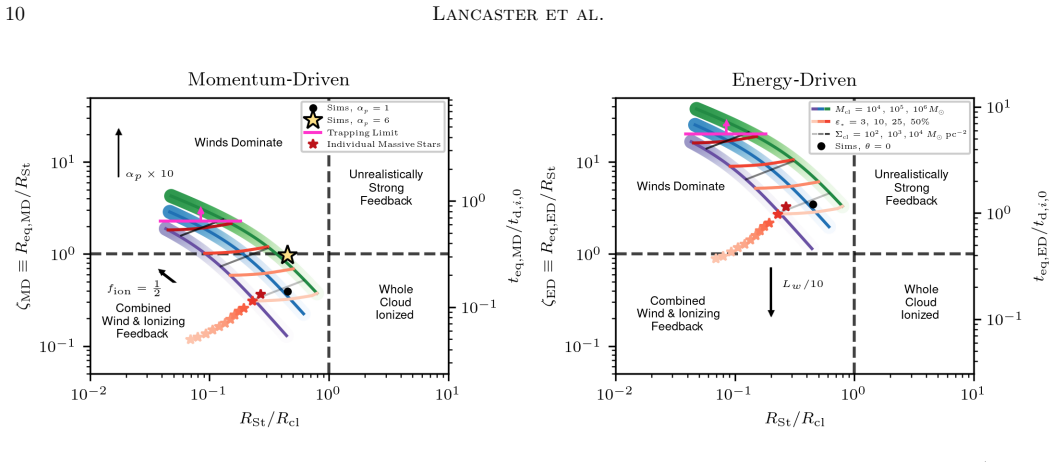
The load-bearing object is the dimensionless ratio $\zeta \equiv R_{\rm eq}/R_{\rm St}$, with $R_{\rm eq} = \sqrt{\alpha_p \dot{p}_w/(4\pi \bar{\rho} c_i^2)}$ for momentum-driven winds and $R_{\rm St} = (3Q_0/(4\pi \alpha_B n_{\rm H}^2))^{1/3}$ the Strömgren radius; it classifies every environment, since $\zeta > 1$ means the wind bubble overruns the Strömgren sphere, $\zeta \ll 1$ means the ionized gas confines a weak wind, and $0.1 \lesssim \zeta \lesssim 1$ is the co-evolution strip. The coupled phase is carried by a thin-shell momentum equation for the ionization front, $\frac{d}{dt}\left(\tfrac{4\pi}{3}\bar{\rho} R_i^3 \dot{R}_i\right) = \alpha_p \dot{p}_w (R_i/R_w)^2$, closed by force balance $\rho_i c_i^2 = \alpha_p \dot{p}_w/(4\pi R_w^2)$ and a modified ionization-recombination equilibrium $\tfrac{4\pi}{3}(R_i^3 - R_w^3)\alpha_B n_{{\rm H},i}^2 = Q_0$ that accounts for the volume the wind bubble occupies inside the ionized gas; together these give $R_i = R_w(1 + R_w/R_{\rm ch})^{1/3}$ with $R_{\rm ch} = R_{\rm eq}^4/R_{\rm St}^3$ the radius at which the two forces would balance at a single location. An energy-driven branch replaces the WBB pressure with a hot-gas energy equation $dE_w/dt = (1-\theta)L_w - P_{\rm hot}\,dV_w/dt$, where $\theta$ is the fraction of wind energy lost to cooling. In dimensionless form the system reduces to a one-parameter family of solutions labelled by $\zeta$.
What would settle it
A numerical experiment that would settle the matter: in three-dimensional radiation-hydrodynamic simulations with turbulent clouds, record the time at which the wind bubble first reaches $R_{\rm eq}$ and the time at which the ionized-gas density profile actually becomes uniform; a lag of several sound-crossing times, which the paper's Appendix B says may occur, would falsify the instantaneous-equilibrium switch and require the CEM's radii, momenta, and pressures to be revised. On the observational side, measuring the radii of wind bubbles around isolated OB stars in the $\zeta \ll 1$ regime and comparing with free-expansion expectations would test the predicted factor-of-two-or-more suppression of $R_w$.
Extended reading notes
Core claim
The central claim is that the joint feedback bubble driven by a massive star or cluster passes through two phases: an early phase in which the wind-blown bubble (WBB) and the photoionized region (PIR) expand independently, and a co-evolution phase in which the two are in pressure equilibrium and move together, with the switch between them governed by $\zeta = R_{\rm eq}/R_{\rm St}$. For momentum-driven winds, realistic star-forming environments with $\zeta$ between roughly 0.1 and 1 sit in the regime where this co-evolution phase is dynamically important. In that regime, the WBB compresses the PIR, raising its density and recombination rate and shrinking the ionized region, while the already-ionized volume inside the WBB frees Lyman-continuum photons to ionize gas further out, and these two effects nearly cancel in the total momentum. Compared with naive predictions that simply add the independent solutions, the Co-Evolution Model shifts the total feedback-bubble momentum by up to 25 percent in the $\zeta < 1$ regime and changes WBB properties by factors of roughly two or more in the weak-wind limit $\zeta \ll 1$, while the PIR radius stays within about 20 percent of the classical Spitzer expansion.
Load-bearing premise
The load-bearing assumption is that at the switch time $t_{\rm switch}$ the wind bubble and the ionized region are already in pressure equilibrium, with the ionized gas at uniform density and in ionization-recombination equilibrium, and that this state is reached effectively instantly; the paper itself notes that the equilibrium may instead require several sound-crossing times to establish, in which case the quantitative predictions would shift.
Editorial extensions
If this is right
- Feedback prescriptions that keep only one mechanism, or collapse both into a single thin shell, will misstate the momentum delivered to the cloud in the $\zeta \lesssim 1$ regime; near $R \sim R_{\rm ch}$ the naive sum of the two forces overestimates the coupled force by roughly 35 percent.
- In the weak-wind limit relevant to individual OB stars and low-mass clusters, the photoionized region's radius stays within about 20 percent of the classical Spitzer solution, so HII region sizes remain a reliable probe even where winds are dynamically suppressed.
- The wind bubble is the sensitive partner: in the $\zeta \ll 1$ regime its radius is reduced by up to a factor of about three relative to free expansion, so observable WBB structure around single stars is a direct diagnostic of co-evolution.
- Because the dimensionless equations form a one-parameter family in $\zeta$, the model results scale to other densities, wind momenta, and ionizing luminosities without re-solving the system, which makes the Co-Evolution Model convenient as a subgrid or comparison module for larger simulations.
- Whether co-evolution matters at all rests on winds being momentum-driven: if shocked wind gas retained most of its energy with $1 - \theta \sim 1$, the energy-driven branch would make winds dominant in essentially all environments, so the $\zeta \approx 0.1$ to $1$ strip is itself a sign of strong interface cooling.
Reading between the lines
- A corollary the paper leaves implicit: in the co-evolution strip the WBB interior pressure is pinned to the ionized-gas pressure, so observations of electron-pressure-sensitive line ratios in HII regions around clusters should track the wind momentum input rate $\alpha_p \dot{p}_w$ as much as the ionizing luminosity.
- The same two-region, force-balance construction should transfer to radiation pressure: substituting the combined wind-plus-trapped-infrared momentum rate into $R_{\rm eq}$ would extend the $\zeta$ classification to the densest, highest star-formation-efficiency clouds where the paper's own parameter map still leaves a gap.
- The instantaneous switch with a discontinuous jump in $R_i$ is the most fragile part of the construction; if the companion simulations confirm a finite equilibration time, a natural repair is to replace the switch with a smooth relaxation term on the sound-crossing timescale, which would change the transient but not the asymptotic scalings.
Editorial analysis
A structured set of objections, weighed in public.
Referee Report
Summary. This paper proposes a framework for treating stellar wind-blown bubbles (WBBs) and photoionized regions (PIRs) as coupled feedback agents rather than as independent or single-shell mechanisms. The key diagnostic is ζ = Req/RSt, the ratio of the radius at which the WBB and PIR pressures balance to the Strömgren radius. The authors survey ζ for Milky Way-like GMCs, massive OB stars, and low-metallicity dense environments, finding 0.1 ≲ ζ ≲ 1 for momentum-driven winds, and then derive two semi-analytic Co-Evolution Models (CEMs), one momentum-driven (Section 3.5) and one energy-driven (Section 3.6). Each model has an early independent-evolution phase and a later co-evolution phase with pressure equilibrium and ionization-recombination equilibrium. The dimensionless equations reduce each model to a one-parameter family parameterized by ζ. The models are used to claim up to 25% changes in total feedback-bubble momentum relative to the naive sum of idealized solutions in the ζ < 1 regime, and factors ≳ 2 changes in WBB properties in the weak-wind limit. A companion paper is said to compare the models with 3D simulations.
Significance. If the central claims hold, this paper provides a useful criterion for when stellar winds and photoionization must be modeled jointly and a compact one-parameter family of solutions for their co-evolution. The dimensionless formulation is a genuine strength, as is the explicit separation of force application locations and the back-reactions between the two phases. The paper is also honest about its assumptions, and the public code release will make the model easy to test. The headline quantitative claims (25% momentum difference and factor-of-2 changes in weak-wind WBB properties) are falsifiable and will be directly checked against the simulations of Paper II.
major comments (3)
- [Section 3.5, Eq. (28), initial conditions after Eq. (37); Appendix B after Eq. (B27)] The co-evolution phase assumes that at t_switch the WBB and PIR are in instantaneous pressure equilibrium and remain so, with the PIR at uniform density. Appendix B explicitly states that establishing this equilibrium requires several sound-crossing times and that 'this may not be the case, as we see in Paper II.' This assumption is load-bearing: Eq. (28) is the momentum equation during the phase that produces the paper's headline 25% and factor-of-2 quantitative results. If equilibrium is delayed, the bubble radii, pressures, and momenta during the co-evolution phase will differ, and the model as written has no mechanism to capture that delay. I ask the authors to either (i) quantify the sensitivity of their results to a finite equilibration timescale, for example by comparing with a model that keeps the early-phase dynamics for several sound-crossing times before switching, or (ii) explicitly soften the quantitative claims in the abstract and Section 4 and defer their validation to Paper II. As written, the manuscript flags a correctness risk in the very assumption on which its central numerical claims rest.
- [Equation (42)] Equation (42) defines ζ_ED for the energy-driven CEM using (α_p ẋ_w)^(1/2) and c_i^-1, which is the functional form of ζ_MD in Eq. (38), not the energy-driven equilibrium radius in Eq. (23). The dimensionless parameter in Appendix D, Eq. (D46), correctly uses [(1-θ)L_w]^(1/2) and c_i^(-3/2). Since ζ parameterizes the entire one-parameter family of energy-driven solutions and is used to locate the model in Figures 1-2, this inconsistency must be fixed in the main text. If the printed Eq. (42) is what was used in the numerical solutions, then the labeling of the ED-CEM solutions in Figures 5-6 should be re-examined.
- [Section 4, Figure 6 right panels; Appendix A, Eqs. (A13)-(A14)] The abstract and Section 4 state that the weak-wind limit with factors ≳ 2 differences in WBB properties is applicable to individual OB stars. However, the single-star models in Figure 6 assume a uniform background and explicitly ignore LyC radiation trapping, while Appendix A argues that trapping is important precisely for individual massive stars expanding into steep density profiles. The breakout time and radius in Eqs. (A13)-(A14) suggest that an individual star's PIR is initially confined by the WBB shell, which is a different dynamical regime from the uniform-density co-evolution modeled here. The factor-of-2 claim should be restricted to low-density or nearly uniform environments, or the authors should justify why the trapping physics does not alter the back-reaction on the WBB in the weak-wind limit.
minor comments (4)
- [Section 3.6] The text contains 'For for ζ_ED < 1' in the paragraph describing initial conditions; remove the duplicated word.
- [Section 3.4] The phrase 'nearly adiabtically' should read 'nearly adiabatically.'
- [Figure 1 caption] The caption says 'The position of the simulations presented in this work are indicated' but these simulations are in Paper II; revise to avoid confusion about which paper presents the simulations.
- [References] The manuscript refers repeatedly to 'Paper II' without a bibliographic entry; please add a reference or a footnote identifying the companion paper.
Circularity Check
No significant circularity: the CEM is derived from conservation equations with explicit, stated inputs, and the headline numerical differences are model outputs rather than fitted constants.
full rationale
The paper's central derivation is self-contained in the sense required by the circularity pass. The momentum-driven CEM is obtained by starting from the Spitzer momentum equation (Eq. 14) and substituting the force-balance condition Pi = alpha_p pdot_w/(4 pi R_w^2), giving Eq. 28; this is combined with ionization-recombination equilibrium in the region between R_w and R_i (Eq. 30), yielding the closure relation Eq. 32 and the characteristic scale R_ch (Eq. 33). The energy-driven CEM similarly solves a coupled energy equation (Eqs. 39-40) with the same ionization-equilibrium closure. The quantities alpha_p and theta are explicit inputs chosen from prior work, not parameters fitted to the outputs being predicted; the model is solved for arbitrary alpha_p (e.g., alpha_p = 6.25 in Figure 6) and for the energy-driven alternative, so the central derivation does not reduce to a self-citation. The 25% total-momentum difference and the factor-of-2 WBB suppression in the weak-wind limit are obtained by numerically solving these ODEs and comparing them to the classical solutions; they are not imposed by an initial condition that already contains the answer. The initial condition Eq. 37 sets the co-evolution momentum equal to the sum of the idealized momenta at t_switch, but the subsequent evolution is governed by the force equation, so the eventual difference is a model output. The zeta parameter is a comparison of independently defined radii (R_eq and R_St), not a fitted quantity. Self-citations do appear in the justification for adopting alpha_p ~ 1 from Lancaster et al. (2021b, 2024), but the paper presents this as a stated assumption, includes an energy-driven alternative, and explicitly notes that the dynamical importance of winds hinges on this input; this is a caveat or correctness risk rather than a circular reduction. Appendix B flags the instantaneous-equilibrium assumption: after Eq. B27 the text says 'our model assumes that the equilibrium is set up relatively quickly, and this may not be the case, as we see in Paper II.' This is an honest limitation on the validity of the co-evolution phase, not a step that equates the prediction to the input. No fitted input is renamed as a prediction, no uniqueness theorem is imported from the authors' prior work, and no known result is merely relabeled; the framework's quantitative claims are derived from stated conservation laws and equilibrium closures.
Assumptions & free parameters
free parameters (2)
- alpha_p (momentum enhancement factor) =
chosen values: 1 (fiducial zeta survey), 6.25 (Figure 6 cluster CEM)
- theta (energy loss fraction) =
chosen values: 0 (fiducial), 0.92 and 0.98 (Figure 6)
assumptions (5)
- domain assumption Spherically symmetric expansion into a uniform background density with thin-shell mass M_sh = 4 pi R^3 rho_bar / 3.
- domain assumption The photoionized region is always in ionization-recombination equilibrium with constant density and Case B recombination coefficient alpha_B.
- domain assumption At t_switch the WBB and PIR are in pressure equilibrium, and this equilibrium is maintained during the co-evolution phase.
- domain assumption The WBB is either momentum-driven with constant alpha_p or energy-driven with constant theta.
- domain assumption Radiation trapping by the WBB shell is negligible except at extremely high densities.
Cite this review
Pith. "Pith review of The Co-Evolution of Stellar Wind-blown Bubbles and Photoionized Gas I: Physical Principles and a Semi-Analytic Model." pith.science (2026). https://pith.science/paper/3TP2BUWF
@misc{pith2026250522730,
  author       = {Pith},
  title        = {Pith review of: The Co-Evolution of Stellar Wind-blown Bubbles and Photoionized Gas I: Physical Principles and a Semi-Analytic Model},
  year         = {2026},
  howpublished = {\url{https://pith.science/paper/3TP2BUWF}},
  note         = {Machine review of arXiv:2505.22730}
}
abstract
We propose a new framework for the simultaneous feedback of stellar winds and photo-ionizing radiation from massive stars, distinguishing the locations where forces are applied, and consequences for internal spatio-temporal evolution of the whole feedback bubble (FB). We quantify the relative dynamical importance of wind-blown bubbles (WBB) versus the photoionized region (PIR) by the ratio of the radius at which the WBB is in pressure equilibrium with the PIR, $R_{\rm eq}$, to the Str\"{o}mgren radius, $R_{\rm St}$. $\zeta \equiv R_{\rm eq}/R_{\rm St}$ quantifies the dynamical dominance of WBBs ($\zeta > 1$) or the PIR ($\zeta < 1$). We calculate $\zeta$ and find that, for momentum-driven winds, $0.1 \lesssim \zeta \lesssim 1$ for the star-forming regions in (i) typical Milky Way-like giant molecular clouds (GMCs), (ii) the most massive of individual OB stars, and (iii) dense, low-metallicity environments, relevant in the early universe. In this regime, both WBBs and the PIR are dynamically important to the expansion of the FB. We develop a semi-analytic Co-Evolution Model (CEM) that takes into account the spatial distribution of forces and the back reactions of both the WBB and PIR. In the $\zeta <1$ regime where the CEM is most relevant, the model differs in the total FB momentum by up to 25% compared to naive predictions. In the weak-wind limit of $\zeta \ll 1$, applicable to individual OB stars or low-mass clusters, the CEM has factors $\gtrsim 2$ differences in WBB properties. In a companion paper we compare these models to three-dimensional, turbulent hydro-dynamical simulations.
Figures


Figures from the paper (3 more)


Reference graph
Works this paper leans on
-
[1]
Abel, N. P., Ferland, G. J., Shaw, G., & van Hoof, P. A. M. 2005, ApJS, 161, 65, doi: 10.1086/432913
doi:10.1086/432913 2005
-
[2]
Adamo, A., Bradley, L. D., Vanzella, E., et al. 2024, arXiv e-prints, arXiv:2401.03224, doi: 10.48550/arXiv.2401.03224
-
[3]
Blinnikov, S. I. 2016, MNRAS, 459, 2188, doi: 10.1093/mnras/stw790
-
[4]
2022, A&A, 659, A26, doi: 10.1051/0004-6361/202141859
Belfiore, F., Santoro, F., Groves, B., et al. 2022, A&A, 659, A26, doi: 10.1051/0004-6361/202141859
-
[5]
Binder, B. A., & Povich, M. S. 2018, ApJ, 864, 136, doi: 10.3847/1538-4357/aad7b2
-
[6]
Capriotti, E. R., & Kozminski, J. F. 2001, PASP, 113, 677, doi: 10.1086/320809
-
[7]
Castor, J. I., Abbott, D. C., & Klein, R. I. 1975, ApJ, 195, 157, doi: 10.1086/153315
doi:10.1086/153315 1975
-
[8]
R., McLeod, A
Chevance, M., Krumholz, M. R., McLeod, A. F., et al. 2023, in Astronomical Society of the Pacific Conference
2023
Show all 90 references
- [9]
-
[10]
Chevance, M., Kruijssen, J. M. D., Hygate, A. P. S., et al. 2020, MNRAS, 493, 2872, doi: 10.1093/mnras/stz3525
2020 doi
-
[11]
Chevance, M., Kruijssen, J. M. D., Krumholz, M. R., et al. 2022, MNRAS, 509, 272, doi: 10.1093/mnras/stab2938
2022 doi
-
[12]
Dale, J. E. 2015, NewAR, 68, 1, doi: 10.1016/j.newar.2015.06.001
2015 doi
-
[13]
E., Ngoumou, J., Ercolano, B., & Bonnell, I
Dale, J. E., Ngoumou, J., Ercolano, B., & Bonnell, I. A. 2014, MNRAS, 442, 694, doi: 10.1093/mnras/stu816 Dav´ e, R., Finlator, K., & Oppenheimer, B. D. 2012, MNRAS, 421, 98, doi: 10.1111/j.1365-2966.2011.20148.x
2014
-
[14]
Draine, B. T. 2011a, Physics of the Interstellar and Intergalactic Medium —. 2011b, ApJ, 732, 100, doi: 10.1088/0004-637X/732/2/100
-
[15]
A., Kreckel, K., et al
Drory, N., Blanc, G. A., Kreckel, K., et al. 2024, AJ, 168, 198, doi: 10.3847/1538-3881/ad6de9
2024 doi
-
[16]
Weisz, D. R. 2019, MNRAS, 490, 1961, doi: 10.1093/mnras/stz2773
2019 doi
-
[17]
L., Bolatto, A
Emig, K. L., Bolatto, A. D., Leroy, A. K., et al. 2020, ApJ, 903, 50, doi: 10.3847/1538-4357/abb67d Faucher-Gigu` ere, C.-A., Quataert, E., & Hopkins, P. F. 2013, MNRAS, 433, 1970, doi: 10.1093/mnras/stt866
2020 doi
-
[18]
2018, MNRAS, 481, 3325, doi: 10.1093/mnras/sty2466 32 Lancaster et al
Fielding, D., Quataert, E., & Martizzi, D. 2018, MNRAS, 481, 3325, doi: 10.1093/mnras/sty2466 32 Lancaster et al
2018 doi
-
[19]
2006, A&A, 459, 1, doi: 10.1051/0004-6361:20053898
Folini, D., & Walder, R. 2006, A&A, 459, 1, doi: 10.1051/0004-6361:20053898
2006 doi
-
[20]
1990, ApJ, 349, 126, doi: 10.1086/168300
Franco, J., Tenorio-Tagle, G., & Bodenheimer, P. 1990, ApJ, 349, 126, doi: 10.1086/168300
1990 doi
-
[21]
2023, MNRAS, 526, 1832, doi: 10.1093/mnras/stad2667
Geen, S., Bieri, R., de Koter, A., Kimm, T., & Rosdahl, J. 2023, MNRAS, 526, 1832, doi: 10.1093/mnras/stad2667
2023 doi
-
[22]
2021, MNRAS, 501, 1352, doi: 10.1093/mnras/staa3705
Geen, S., Bieri, R., Rosdahl, J., & de Koter, A. 2021, MNRAS, 501, 1352, doi: 10.1093/mnras/staa3705
2021 doi
-
[23]
2022, MNRAS, 509, 4498, doi: 10.1093/mnras/stab3245
Geen, S., & de Koter, A. 2022, MNRAS, 509, 4498, doi: 10.1093/mnras/stab3245
2022 doi
-
[24]
2020, MNRAS, 492, 915, doi: 10.1093/mnras/stz3491
Geen, S., Pellegrini, E., Bieri, R., & Klessen, R. 2020, MNRAS, 492, 915, doi: 10.1093/mnras/stz3491
2020 doi
-
[25]
Klessen, R. S. 2010, MNRAS, 404, 2, doi: 10.1111/j.1365-2966.2009.15718.x Grudi´ c, M. Y., Guszejnov, D., Hopkins, P. F., Offner, S. S. R., & Faucher-Gigu` ere, C.-A. 2021, MNRAS, 506, 2199, doi: 10.1093/mnras/stab1347 Grudi´ c, M. Y., Hopkins, P. F., Faucher-Gigu` ere, C.-A.,...
2010
-
[26]
2018, MNRAS, 478, 4799, doi: 10.1093/mnras/sty1315
Haid, S., Walch, S., Seifried, D., et al. 2018, MNRAS, 478, 4799, doi: 10.1093/mnras/sty1315
2018 doi
-
[27]
2009, ApJ, 693, 1696, doi: 10.1088/0004-637X/693/2/1696
Harper-Clark, E., & Murray, N. 2009, ApJ, 693, 1696, doi: 10.1088/0004-637X/693/2/1696
2009 doi
-
[28]
R., Jarrod Millman, K., van der Walt, S
Harris, C. R., Jarrod Millman, K., van der Walt, S. J., et al. 2020, arXiv e-prints, arXiv:2006.10256. https://arxiv.org/abs/2006.10256
2020 arXiv
-
[29]
2006, ApJ, 646, 240, doi: 10.1086/504789
Hosokawa, T., & Inutsuka, S.-i. 2006, ApJ, 646, 240, doi: 10.1086/504789
2006 doi
-
[30]
Hunter, J. D. 2007, Computing in Science and Engineering, 9, 90, doi: 10.1109/MCSE.2007.55
2007 doi
-
[31]
U., Baes, M., van der Wel, A., et al
Kapoor, A. U., Baes, M., van der Wel, A., et al. 2023, MNRAS, 526, 3871, doi: 10.1093/mnras/stad2977
2023 doi
-
[32]
C., Fielding, D
Kim, C.-G., Ostriker, E. C., Fielding, D. B., et al. 2020, ApJL, 903, L34, doi: 10.3847/2041-8213/abc252
2020 doi
-
[33]
Kim, J.-G., Kim, W.-T., & Ostriker, E. C. 2016, ApJ, 819, 137, doi: 10.3847/0004-637X/819/2/137 —. 2018, ApJ, 859, 68, doi: 10.3847/1538-4357/aabe27
2016 doi
-
[34]
C., & Filippova, N
Kim, J.-G., Ostriker, E. C., & Filippova, N. 2021, ApJ, 911, 128, doi: 10.3847/1538-4357/abe934
2021 doi
-
[35]
Koo, B.-C., & McKee, C. F. 1992a, ApJ, 388, 93, doi: 10.1086/171132 —. 1992b, ApJ, 388, 103, doi: 10.1086/171133
-
[36]
V., Egorova, E., et al
Kreckel, K., Egorov, O. V., Egorova, E., et al. 2024, A&A, 689, A352, doi: 10.1051/0004-6361/202449943
2024 doi
-
[37]
Kruijssen, J. M. D., Schruba, A., Chevance, M., et al. 2019, Nature, 569, 519, doi: 10.1038/s41586-019-1194-3
2019 doi
-
[38]
R., Burkhart, B., Forbes, J
Krumholz, M. R., Burkhart, B., Forbes, J. C., & Crocker, R. M. 2018, MNRAS, 477, 2716, doi: 10.1093/mnras/sty852
2018 doi
-
[39]
R., & Matzner, C
Krumholz, M. R., & Matzner, C. D. 2009, ApJ, 703, 1352, doi: 10.1088/0004-637X/703/2/1352
2009 doi
-
[40]
R., McKee, C
Krumholz, M. R., McKee, C. F., & Bland -Hawthorn, J. 2019, ARA&A, 57, 227, doi: 10.1146/annurev-astro-091918-104430
2019 doi
- [41]
-
[42]
R., Bate, M
Krumholz, M. R., Bate, M. R., Arce, H. G., et al. 2014, in Protostars and Planets VI, ed. H. Beuther, R. S. Klessen, C. P. Dullemond, & T. Henning, 243–266, doi: 10.2458/azu uapress 9780816531240-ch011
2014 doi
- [43]
-
[44]
C., Kim, J.-G., & Kim, C.-G
Lancaster, L., Ostriker, E. C., Kim, J.-G., & Kim, C.-G. 2021a, ApJL, 922, L3, doi: 10.3847/2041-8213/ac3333 —. 2021b, ApJ, 914, 89, doi: 10.3847/1538-4357/abf8ab —. 2021c, ApJ, 914, 90, doi: 10.3847/1538-4357/abf8ac
-
[45]
2018, A&A, 611, A88, doi: 10.1051/0004-6361/201731522
Lee, Y.-N., & Hennebelle, P. 2018, A&A, 611, A88, doi: 10.1051/0004-6361/201731522
2018 doi
-
[46]
1992, ApJ, 401, 596, doi: 10.1086/172089
Leitherer, C., Robert, C., & Drissen, L. 1992, ApJ, 401, 596, doi: 10.1086/172089
1992 doi
-
[47]
D., et al
Leitherer, C., Schaerer, D., Goldader, J. D., et al. 1999, ApJS, 123, 3, doi: 10.1086/313233
1999 doi
-
[48]
K., Schinnerer, E., Hughes, A., et al
Leroy, A. K., Schinnerer, E., Hughes, A., et al. 2017, ApJ, 846, 71, doi: 10.3847/1538-4357/aa7fef
2017 doi
-
[49]
C., Bolatto, A
Levy, R. C., Bolatto, A. D., Leroy, A. K., et al. 2021, ApJ, 912, 4, doi: 10.3847/1538-4357/abec84
2021 doi
- [50]
-
[51]
A., Krumholz, M
Lopez, L. A., Krumholz, M. R., Bolatto, A. D., Prochaska, J. X., & Ramirez-Ruiz, E. 2011, ApJ, 731, 91, doi: 10.1088/0004-637X/731/2/91
2011 doi
-
[52]
A., Krumholz, M
Lopez, L. A., Krumholz, M. R., Bolatto, A. D., et al. 2014, ApJ, 795, 121, doi: 10.1088/0004-637X/795/2/121 Mac Low, M.-M., & McCray, R. 1988, ApJ, 324, 776, doi: 10.1086/165936
2014 doi
-
[53]
F., van Buren, D., & Lazareff, B
McKee, C. F., van Buren, D., & Lazareff, B. 1984, ApJL, 278, L115, doi: 10.1086/184237 M´ endez-Delgado, J. E., Skillman, E. D., Aver, E., et al. 2024, arXiv e-prints, arXiv:2410.17381, doi: 10.48550/arXiv.2410.17381 Co-Evolution of Winds and Photoionized Gas I 33
- [54]
-
[55]
H., Federrath, C., & Krumholz, M
Menon, S. H., Federrath, C., & Krumholz, M. R. 2022, MNRAS, 517, 1313, doi: 10.1093/mnras/stac2702 —. 2023, MNRAS, 521, 5160, doi: 10.1093/mnras/stad856
2022 doi
-
[56]
H., Lancaster, L., Burkhart, B., et al
Menon, S. H., Lancaster, L., Burkhart, B., et al. 2024b, ApJL, 967, L28, doi: 10.3847/2041-8213/ad462d
-
[57]
Murray, N., Quataert, E., & Thompson, T. A. 2010, ApJ, 709, 191, doi: 10.1088/0004-637X/709/1/191
2010 doi
-
[58]
F., Klein, R
Nakamura, F., McKee, C. F., Klein, R. I., & Fisher, R. T. 2006, ApJS, 164, 477, doi: 10.1086/501530
2006 doi
-
[59]
E., & Burkert, A
Ngoumou, J., Hubber, D., Dale, J. E., & Burkert, A. 2015, ApJ, 798, 32, doi: 10.1088/0004-637X/798/1/32
2015 doi
-
[60]
2011, ApJ, 731, 13, doi: 10.1088/0004-637X/731/1/13
Ntormousi, E., Burkert, A., Fierlinger, K., & Heitsch, F. 2011, ApJ, 731, 13, doi: 10.1088/0004-637X/731/1/13
2011 doi
-
[61]
C., & Kim, C.-G
Ostriker, E. C., & Kim, C.-G. 2022, ApJ, 936, 137, doi: 10.3847/1538-4357/ac7de2
2022 doi
-
[62]
C., McKee, C
Ostriker, E. C., McKee, C. F., & Leroy, A. K. 2010, ApJ, 721, 975, doi: 10.1088/0004-637X/721/2/975
2010 doi
-
[63]
C., & Shetty, R
Ostriker, E. C., & Shetty, R. 2011, ApJ, 731, 41, doi: 10.1088/0004-637X/731/1/41
2011 doi
-
[64]
S., Angl´ es-Alc´ azar, D., et al
Pandya, V., Somerville, R. S., Angl´ es-Alc´ azar, D., et al. 2020, ApJ, 905, 4, doi: 10.3847/1538-4357/abc3c1
2020 doi
-
[65]
B., Bryan, G
Pandya, V., Fielding, D. B., Bryan, G. L., et al. 2023, ApJ, 956, 118, doi: 10.3847/1538-4357/acf3ea
2023 doi
-
[66]
F., & Tsang, B
Pascale, M., Dai, L., McKee, C. F., & Tsang, B. T. H. 2023, ApJ, 957, 77, doi: 10.3847/1538-4357/acf75c
2023 doi
-
[67]
W., Baldwin, J
Pellegrini, E. W., Baldwin, J. A., & Ferland, G. J. 2011, ApJ, 738, 34, doi: 10.1088/0004-637X/738/1/34
2011 doi
-
[68]
W., Baldwin, J
Pellegrini, E. W., Baldwin, J. A., Brogan, C. L., et al. 2007, ApJ, 658, 1119, doi: 10.1086/511258
2007 doi
-
[69]
Pittard, J. M. 2013, MNRAS, 435, 3600, doi: 10.1093/mnras/stt1552
2013 doi
-
[70]
M., Kupilas, M
Pittard, J. M., Kupilas, M. M., & Wareing, C. J. 2022, MNRAS, 510, 2797, doi: 10.1093/mnras/stab3707
2022 doi
-
[71]
W., Glover, S
Rahner, D., Pellegrini, E. W., Glover, S. C. O., & Klessen, R. S. 2017, MNRAS, 470, 4453, doi: 10.1093/mnras/stx1532 —. 2019, MNRAS, 483, 2547, doi: 10.1093/mnras/sty3295
2017 doi
-
[72]
2014, MNRAS, 442, 2701, doi: 10.1093/mnras/stu1037
Ramirez-Ruiz, E. 2014, MNRAS, 442, 2701, doi: 10.1093/mnras/stu1037
2014 doi
-
[73]
P., Robert, C., et al
Rousseau-Nepton, L., Martin, R. P., Robert, C., et al. 2019, MNRAS, 489, 5530, doi: 10.1093/mnras/stz2455
2019 doi
-
[74]
2020, PASP, 132, 104301, doi: 10.1088/1538-3873/aba840
Schneider, N., Simon, R., Guevara, C., et al. 2020, PASP, 132, 104301, doi: 10.1088/1538-3873/aba840
2020 doi
-
[75]
2013, ApJ, 765, 43, doi: 10.1088/0004-637X/765/1/43
Silich, S., & Tenorio-Tagle, G. 2013, ApJ, 765, 43, doi: 10.1088/0004-637X/765/1/43
2013 doi
-
[76]
A., & Ostriker, E
Skinner, M. A., & Ostriker, E. C. 2015, ApJ, 809, 187, doi: 10.1088/0004-637X/809/2/187
2015 doi
-
[77]
S., & Dav´ e, R
Somerville, R. S., & Dav´ e, R. 2015, ARA&A, 53, 51, doi: 10.1146/annurev-astro-082812-140951
2015 doi
-
[78]
1978, Physical processes in the interstellar medium, doi: 10.1002/9783527617722
Spitzer, L. 1978, Physical processes in the interstellar medium, doi: 10.1002/9783527617722
1978 doi
-
[79]
A., & Williams, R
Steigman, G., Strittmatter, P. A., & Williams, R. E. 1975, ApJ, 198, 575, doi: 10.1086/153636 Str¨ omgren, B. 1939, ApJ, 89, 526, doi: 10.1086/144074
1975 doi
-
[80]
K., Rosolowsky, E., et al
Sun, J., Leroy, A. K., Rosolowsky, E., et al. 2022, AJ, 164, 43, doi: 10.3847/1538-3881/ac74bd
2022 doi
-
[81]
2024, ApJ, 967, 133, doi: 10.3847/1538-4357/ad3de6
Sun, J., He, H., Batschkun, K., et al. 2024, ApJ, 967, 133, doi: 10.3847/1538-4357/ad3de6
2024 doi
-
[82]
1979, A&A, 71, 59
Tenorio-Tagle, G. 1979, A&A, 71, 59
1979
-
[83]
S., de Koter, A., & Lamers, H
Vink, J. S., de Koter, A., & Lamers, H. J. G. L. M. 2001, A&A, 369, 574, doi: 10.1051/0004-6361:20010127
2001 doi
-
[84]
S., & Sander, A
Vink, J. S., & Sander, A. A. C. 2021, MNRAS, 504, 2051, doi: 10.1093/mnras/stab902
2021 doi
-
[85]
E., et al
Virtanen, P., Gommers, R., Oliphant, T. E., et al. 2020, Nature Methods, 17, 261, doi: 10.1038/s41592-019-0686-2
2020 doi
-
[86]
Vishniac, E. T. 1983, ApJ, 274, 152, doi: 10.1086/161433 —. 1994, ApJ, 428, 186, doi: 10.1086/174231
1983 doi
- [87]
-
[88]
M., Carr, C., Fielding, D
Voit, G. M., Carr, C., Fielding, D. B., et al. 2024a, ApJ, 976, 151, doi: 10.3847/1538-4357/ad81d5
-
[89]
M., Pandya, V., Fielding, D
Voit, G. M., Pandya, V., Fielding, D. B., et al. 2024b, ApJ, 976, 150, doi: 10.3847/1538-4357/ad81d6
-
[90]
1977, ApJ, 218, 377, doi: 10.1086/155692
Weaver, R., McCray, R., Castor, J., Shapiro, P., & Moore, R. 1977, ApJ, 218, 377, doi: 10.1086/155692
1977 doi
Reviewed August 7, 2026 · model on record in the stance chip above.
Discussion (0). Sign in to comment.