REVIEW 5 major objections 6 minor 32 references
2-Segal sets and pseudomonoids in the bicategory of spans
T0 review · 5 major / 6 minor · reviewed 2026-08-07 · deepseek-v4-flash
Pith's one-line read 2-Segal sets are in one-to-one correspondence with pseudomonoids in the bicategory of spans, and this paper proves both directions.
desk verdict Useful expository paper on 2-Segal sets and pseudomonoids in Span, with a genuine gap: the inverse construction is never verified, so the stated one-to-one correspondence is not proven. read the letter →
The pith
A machine-rendered reading of the paper's core claim, the machinery that carries it, and where it could break.
The reading
What carries the argument
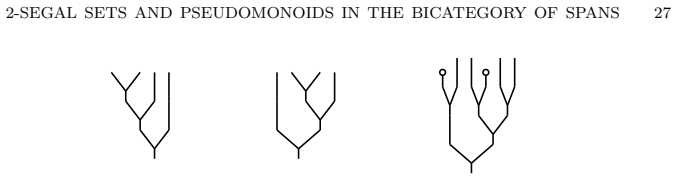
The load-bearing tool is a graphical calculus that represents an n-simplex of a 2-Segal set as a subdivided (n+1)-gon. A subdivision of the polygon into two polygons corresponds to the pullback expressing X_n as a fiber product of smaller X_k over X_1, and the 2-Segal condition says that any two subdivisions of the same polygon give canonically isomorphic sets. The dual graph of the triangulated polygon is then a string diagram for the n-fold multiplication span µ_n, which turns the polygon-subdivision isomorphisms into the associator and unitors of a pseudomonoid. In the reverse direction, the same dual-graph correspondence lets the coherence theorem for pseudomonoids produce the face, degeneracy, and 2-Segal structure maps of a simplicial set from any pseudomonoid.
What would settle it
The theorem would be overturned by any 2-Segal set for which the diagram in Remark 3.3 is not a pullback—that is, any 2-Segal set that is not unital—since the definition of the unitors in Section 5.1 depends on this. A direct check is also possible: take a concrete 2-Segal set, such as the nerve of a partial monoid, write out the associator and unitors the construction gives, and verify the pentagon and triangle identities in Span; a mismatch would show the correspondence is not as stated.
Extended reading notes
Core claim
The central claim, Theorem 5.1, is that there is a one-to-one correspondence, up to isomorphism, between 2-Segal sets and pseudomonoids in Span. Given a 2-Segal set X•, the paper builds a pseudomonoid whose underlying object is the set X1 of 1-simplices; the unit is the span η: {•} ← X0 → X1 given by s0, and the multiplication is the span µ: X1 × X1 ← X2 → X1 given by (d2,d0) and d1. The 2-Segal isomorphisms from subdivisions of the (n+1)-gon provide the associator, and the remaining coherence data comes from the unitality of 2-Segal sets. In the other direction, a pseudomonoid (X, µ, η) yields a simplicial set whose n-simplices are the apexes of the n-fold multiplication spans µn: X^n ← X_n → X, with face and degeneracy maps defined by the canonical 2-isomorphisms that the coherence theorem for pseudomonoids provides. The paper shows these two constructions are inverse up to isomorphism, and that the whole correspondence can be read as a categorification of associative algebras.
Load-bearing premise
The proof relies on the fact, imported from [12], that every 2-Segal set is unital: a degenerate 1-simplex is exactly s0(x) for some vertex x, and this is what makes the unit and the unitors of the pseudomonoid constructible. If unitality ever failed, the construction of a pseudomonoid from a 2-Segal set would not go through.
Editorial extensions
If this is right
- The Hall algebra and the incidence (co)algebra constructions from a 2-Segal set are direct consequences: applying the pullback-pushforward functor to the pseudomonoid's spans yields an associative algebra with unit.
- Every Segal set is 2-Segal, so every nerve of a category carries the pseudomonoid structure; the theorem thus covers classical category nerves as a special case.
- The correspondence is an elementary, set-level shadow of Stern's ∞-categorical equivalence, so it can serve as a bridge for readers who want the 2-Segal viewpoint without ∞-category theory.
- The graphical calculus becomes a proof technique: any identity that holds for all subdivisions of a polygon corresponds to a coherence identity for the associated pseudomonoid, so the pentagon and triangle equations can be read directly from pictures.
- Because pseudomonoids are the objects of a known theory, results about pseudomonoids (such as the coherence theorem) can be imported to produce structure on 2-Segal sets, e.g., the use of the coherence theorem to construct face and degeneracy maps in the reverse direction.
Reading between the lines
- The same polygon-dual-graph dictionary should work for 2-Segal objects in any category with finite limits, not only Set, because the proof uses only universal properties of pullbacks and the unitality theorem is known to hold for 2-Segal spaces.
- If unitality is dropped, the correspondence likely restricts to nonunital pseudomonoids ('pseudo-semigroups') in Span, so the unit is the only place where the external unitality theorem is essential.
- The correspondence suggests that computing the Hall algebra of a 2-Segal set is equivalent to computing the decategorified monoid of a pseudomonoid, which may yield new examples by starting with any span-wise monoid structure and checking the coherence identities.
- A fully functorial version would identify morphisms of 2-Segal sets with oplax morphisms of pseudomonoids, as Stern observed; spelling this out at the set level would give a clean statement of the correspondence as an equivalence of categories rather than a bijection of objects.
Editorial analysis
A structured set of objections, weighed in public.
Referee Report
Summary. The paper surveys 2-Segal sets and their graphical calculus, and then proves Theorem 5.1: a one-to-one correspondence (up to isomorphism) between 2-Segal sets and pseudomonoids in the bicategory Span of sets and spans. The forward direction (Section 5.1) constructs the multiplication span, associator, and unitors from the 2-Segal isomorphisms, following the approach of [8]. The backward direction (Section 5.2) starts from a pseudomonoid, defines X_n as the apex of the n-fold multiplication span, and defines face and degeneracy maps via coherence 2-isomorphisms and projections. The paper also discusses partial categories, several concrete examples, and Hall and incidence algebra constructions.
Significance. The main theorem is a known special case of Stern's infinity-categorical correspondence, but the paper aims to give an elementary and widely accessible proof, with a graphical calculus for 2-Segal sets and spans. The dual-graph interpretation in Section 5.1 is a useful contribution, and the examples in Sections 3 and 6 make the paper valuable as an introduction. The exposition is generally clear and the Hall/incidence algebra section connects the categorical framework to classical combinatorics. However, as detailed below, the proof of the main theorem is not complete as written: several load-bearing verifications are deferred or omitted.
major comments (5)
- [§5.2 and Theorem 5.1] The theorem is not established because the two constructions are never shown to be inverse up to isomorphism. Section 5.2 ends by asserting that the constructed simplicial set is 2-Segal, but it does not prove that applying the construction of Section 5.1 to this simplicial set recovers the original pseudomonoid, nor that applying Section 5.2 to the pseudomonoid produced in Section 5.1 recovers the original 2-Segal set. For example, for a 2-Segal set X, the 3-simplices of the reconstructed simplicial set are the apex of μ∘(μ×id), canonically identified with X_2 ×_{X_1} X_2 via T_13; one must check that the face maps defined in Section 5.2 agree with the original face maps under this identification, but no such check appears.
- [§5.1, paragraph after Eq. (3.8)] The pentagon equation for the associator a = T_02 ∘ (T_13)^{-1} is left as 'a nice exercise for the reader', and the triangle identity is asserted as 'immediate'. These are central coherence conditions for the pseudomonoid structure, not optional details. A complete proof of Theorem 5.1 must include an explicit verification that a satisfies the pentagon equation using the 2-Segal functor for n=3, and that ℓ and r satisfy the triangle identity.
- [§5.2, definitions of face and degeneracy maps] The simplicial identities and the 2-Segal conditions for the constructed simplicial set are claimed to follow from the graphical calculus, but no rigorous verification is supplied. The face and degeneracy maps are defined by choosing canonical 2-isomorphisms and then projecting; compatibility of these choices is needed for the simplicial identities. The statement that the string diagrams 'correspond precisely' to the graphical calculus of Section 3.4 is not a substitute for checking the identities directly, especially because the backward construction has not been shown to satisfy the same graphical rules as the forward direction.
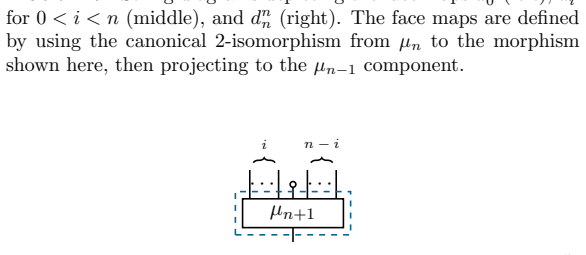
- [§5.2, degeneracy maps] The displayed canonical 2-isomorphism used to define degeneracies appears to have the wrong type. If μ is the multiplication morphism with two inputs, then μ_{n+1} ∘ (id^i × μ × id^{n-i}) is a span from X^{n+2} to X, not from X^n to X. The formula as written therefore cannot define a map from X_n to X_{n+1}. If the intended morphism is the unit η rather than μ, the formula should be corrected; otherwise, the construction must be explained more carefully.
- [Statement of Theorem 5.1] The theorem is stated as a 'one-to-one correspondence (up to isomorphism)' without specifying the categories or bicategories involved and without discussing morphisms between 2-Segal sets or between pseudomonoids. If the intended statement is an equivalence of categories, as in Stern's result, the paper needs to define the relevant functors and natural transformations, or at least state clearly that only isomorphism classes of objects are being compared. If only a bijection of isomorphism classes is claimed, the missing round-trip verification in Section 5.2 is still required.
minor comments (6)
- [Title] The title contains a typo: 'BICA TEGOR Y' should be 'BICATEGORY'.
- [§4.5] The string diagrams for η and μ appear to be missing from the text between 'We represent η and μ, respectively, by the following string diagrams:' and 'Note that'.
- [Throughout] There are several typos: 'Propositiion' before Corollary 3.7, 'amd' in Section 3.2, 'the the Hall algebra' in Section 6.2, and an extra parenthesis in 'Figure 11))' in Section 5.1.
- [§3.1, Proposition 3.1] The proof of Proposition 3.1 is said to be similar to that of Proposition 2.1, but since the equivalence of the three 2-Segal conditions is used throughout the graphical calculus, a detailed proof or a precise reference would improve self-containedness.
- [§3.2, Proposition 3.8] The proof of Proposition 3.8 is left as an exercise. If this characterization is intended to be used in later sections, at least a sketch of the proof should be included.
- [§5.2] The paper relies on the coherence theorem for pseudomonoids to obtain canonical 2-isomorphisms to μ_n, but the choices of these isomorphisms are not specified. Since the face and degeneracy maps are defined through these choices, a precise statement of which coherence isomorphism is used in each case would make the construction checkable.
Circularity Check
No circularity: the two directions are constructed from independent inputs, and the only self-citation supplies technique rather than the theorem.
full rationale
The derivation is not circular. Section 5.1 constructs a pseudomonoid from a 2-Segal set by setting eta = s0, mu = (d2,d0; d1), a = T02 ∘ T13^{-1}, and unitors via the unitality theorem; the unitality input is cited from the independent source [12] (Feller-Garner-Kock-Proulx-Weber), and the pentagon/triangle checks are justified by the 2-Segal functor Proposition 3.15, not assumed. Section 5.2 constructs a simplicial set from a pseudomonoid by taking X_n as the apex of the left-associated n-fold multiplication and defining face and degeneracy maps via canonical pseudomonoid coherences; it invokes the independent coherence theorem [21,32] to conclude that the 2-Segal maps are isomorphisms. This is a deduction from the pseudomonoid axioms, not a restatement of the target theorem. The only self-citation, [8] (Contreras-Mehta-Stern), supplies the graphical calculus and the approach for the forward direction, but the paper reproduces the relevant graphical facts and states Proposition 3.15 rather than deferring the theorem to [8]; hence it is not load-bearing. One genuine proof gap is that the round-trip inverse verification (Psi∘Phi ≅ id and Phi∘Psi ≅ id) is never explicitly checked in Section 5.2, so Theorem 5.1 is not fully established as a one-to-one correspondence; however, an omitted verification is a correctness concern, not a circular reduction, and it does not raise the circularity score.
Assumptions & free parameters
assumptions (4)
- standard math The category of sets has finite limits, so pullbacks exist and are used to compose spans.
- domain assumption Every 2-Segal set is unital: the diagram (3.6) is a pullback.
- domain assumption Coherence theorem for monoidal bicategories and pseudomonoids.
- domain assumption Planar binary rooted trees are the dual graphs of triangulated polygons.
Cite this review
Pith. "Pith review of 2-Segal sets and pseudomonoids in the bicategory of spans." pith.science (2026). https://pith.science/paper/NN4H7YLD
@misc{pith2026250522832,
  author       = {Pith},
  title        = {Pith review of: 2-Segal sets and pseudomonoids in the bicategory of spans},
  year         = {2026},
  howpublished = {\url{https://pith.science/paper/NN4H7YLD}},
  note         = {Machine review of arXiv:2505.22832}
}
read the original abstract
In this survey article, we give an introduction to the notion of a 2-Segal set and prove that 2-Segal sets are equivalent to pseudomonoids in the bicategory of spans. The proof utilizes graphical techniques for 2-Segal sets and spans that should be useful in more general settings. There are procedures for obtaining an associative algebra from a 2-Segal set (satisfying finiteness conditions). We describe these procedures and give several examples of algebras arising from 2-Segal sets. Wherever possible, we avoid higher category theory so as to make the paper accessible to a wide audience.
Figures


Figures from the paper (15 more)




Reference graph
Works this paper leans on
-
[8]
Stern,Frobenius and commutative pseudomonoids in the bicategory of spans, J
Ivan Contreras, Rajan Amit Mehta, and Walker H. Stern,Frobenius and commutative pseudomonoids in the bicategory of spans, J. Geom. Phys.207(2025), Paper No. 105309, 31
work page 2025
-
[1]
John C. Baez and James Dolan,From finite sets to Feynman diagrams, Mathematics unlimited—2001 and beyond, 2001, pp. 29–50
work page 2001
-
[2]
John C. Baez, Alexander E. Hoffnung, and Christopher D. Walker,Higher dimen- sional algebra VII: Groupoidification, Theory Appl. Categ.24(2010), No. 18, 489– 553
work page 2010
-
[3]
Combinatorial examples and applications of 2-Segal sets
Julia E Bergner,Combinatorial examples and applications of 2-Segal sets, arXiv preprint arXiv:2411.18544 (2024). 32 SOPHIA E MARX AND RAJAN AMIT MEHTA
work page Pith review arXiv 2024
-
[4]
Julia E. Bergner, Ang´ elica M. Osorno, Viktoriya Ozornova, Martina Rovelli, and Claudia I. Scheimbauer,2-Segal sets and the Waldhausen construction, Topology Appl.235(2018), 445–484
work page 2018
-
[5]
A. Carboni, G. M. Kelly, R. F. C. Walters, and R. J. Wood,Cartesian bicategories II, Theory Appl. Categ.19(2007), 93–124
work page 2007
-
[6]
Mireille Content, Fran¸ cois Lemay, and Pierre Leroux,Cat´ egories de M¨ obius et fonc- torialit´ es: un cadre g´ en´ eral pour l’inversion de M¨ obius, J. Combin. Theory Ser. A28 (1980), no. 2, 169–190
work page 1980
-
[7]
Ivan Contreras, Molly Keller, and Rajan Amit Mehta,Frobenius objects in the cate- gory of spans, Rev. Math. Phys.34(2022), no. 10, Paper No. 2250036, 34
work page 2022
Show all 32 references
-
[9]
Benjamin Cooper and Matthew B Young,Hall algebras via 2-Segal spaces, arXiv preprint arXiv:2409.19384 (2024)
2024 arXiv
-
[10]
Brian Day and Ross Street,Monoidal bicategories and Hopf algebroids, Adv. Math. 129(1997), no. 1, 99–157
1997
-
[11]
2244, Springer, Cham, 2019
Tobias Dyckerhoff and Mikhail Kapranov,Higher Segal spaces, Lecture Notes in Mathematics, vol. 2244, Springer, Cham, 2019
2019
-
[12]
Proulx, and Mark Weber, Every 2-Segal space is unital, Commun
Matthew Feller, Richard Garner, Joachim Kock, May U. Proulx, and Mark Weber, Every 2-Segal space is unital, Commun. Contemp. Math.23(2021), no. 2, Paper No. 2050055, 6
2021
-
[13]
Imma G´ alvez-Carrillo, Joachim Kock, and Andrew Tonks,Decomposition spaces in combinatorics, arXiv preprint arXiv:1612.09225 (2016)
2016 arXiv
-
[14]
Math.331(2018), 952–1015
,Decomposition spaces, incidence algebras and M¨ obius inversion I: Basic the- ory, Adv. Math.331(2018), 952–1015
2018
-
[15]
Goerss and John F
Paul G. Goerss and John F. Jardine,Simplicial homotopy theory, Progress in Math- ematics, vol. 174, Birkh¨ auser Verlag, Basel, 1999
1999
-
[16]
Alexander Grothendieck,Techniques de construction et th´ eor` emes d’existence en g´ eom´ etrie alg´ ebrique. III. Pr´ eschemas quotients, S´ eminaire Bourbaki, Vol. 6, 1995, pp. Exp. No. 212, 99–118
1995
-
[17]
201, Cambridge University Press, Cambridge, 2013
Nick Gurski,Coherence in three-dimensional category theory, Cambridge Tracts in Mathematics, vol. 201, Cambridge University Press, Cambridge, 2013
2013
-
[18]
Claudio Hermida and Paulo Mateus,Paracategories. I. Internal paracategories and saturated partial algebras, Theoret. Comput. Sci.309(2003), no. 1-3, 125–156
2003
-
[19]
,Paracategories. II. Adjunctions, fibrations and examples from probabilistic automata theory, Theoret. Comput. Sci.311(2004), no. 1-3, 71–103
2004
-
[20]
Andr´ e Joyal and Ross Street,The geometry of tensor calculus. I, Adv. Math.88 (1991), no. 1, 55–112
1991
-
[21]
Math.152(2000), no
Stephen Lack,A coherent approach to pseudomonads, Adv. Math.152(2000), no. 2, 179–202
2000
-
[22]
Tom Leinster,Notions of M¨ obius inversion, Bull. Belg. Math. Soc. Simon Stevin19 (2012), no. 5, 911–935
2012
-
[23]
In progress
Sophia E Marx and Rajan Amit Mehta,Cosymmetric sets and categorified 2- dimensional topological quantum field theories. In progress
-
[24]
Paper No
Paulo Mateus, Am ´ ılcar Sernadas, and Cristina Sernadas,Precategories for combining probabilistic automata, CTCS ’99: Conference on Category Theory and Computer Science (Edinburgh), 1999, pp. Paper No. 29016, 18
1999
-
[25]
Charles Rezk,A model for the homotopy theory of homotopy theory, Trans. Amer. Math. Soc.353(2001), no. 3, 973–1007
2001
-
[26]
Gian-Carlo Rota,On the foundations of combinatorial theory. I. Theory of M¨ obius functions, Z. Wahrscheinlichkeitstheorie und Verw. Gebiete2(1964), 340–368. 2-SEGAL SETS AND PSEUDOMONOIDS IN THE BICATEGORY OF SPANS 33
1964
-
[27]
Hautes ´Etudes Sci
Graeme Segal,Classifying spaces and spectral sequences, Inst. Hautes ´Etudes Sci. Publ. Math.34(1968), 105–112
1968
-
[28]
Math.21(1973), 213– 221
,Configuration-spaces and iterated loop-spaces, Invent. Math.21(1973), 213– 221
1973
-
[29]
Categ.31(2016), Paper No
Michael Stay,Compact closed bicategories, Theory Appl. Categ.31(2016), Paper No. 26, 755–798
2016
-
[30]
Stern,2-Segal objects and algebras in spans, J
Walker H. Stern,2-Segal objects and algebras in spans, J. Homotopy Relat. Struct. 16(2021), no. 2, 297–361
2021
-
[31]
,Perspectives on the 2-Segal conditions(2024)
2024
-
[32]
Dominic Verdon,Coherence for braided and symmetric pseudomonoids, arXiv preprint arXiv:1705.09354 (2017). Department of Mathematics, University of Massachusetts, Amherst, MA Email address:semarx@umass.edu Department of Mathematical Sciences, Smith College, 44 College Lane, Nor...
2017 arXiv
Reviewed August 7, 2026 · model on record in the stance chip above.
Discussion (0). Sign in to comment.