REVIEW 3 major objections 4 minor 11 references
Separating dots with circles
T0 review · 3 major / 4 minor · reviewed 2026-08-07 · deepseek-v4-flash
Pith's one-line read The paper proves that separating-circle counts for point configurations are universal, and that the associated cluster algebra depends only on the number of dots and the order of the Voronoi decomposition.
desk verdict A clean spherical-Voronoi proof of known counting formulas plus a genuinely new local-moves theorem, but the key lemma is asserted from figures rather than proved. read the letter →
The pith
A machine-rendered reading of the paper's core claim, the machinery that carries it, and where it could break.
The reading
What carries the argument
The $k$th order Voronoi decomposition of the sphere: a partition of the sphere into regions, edges, and vertices according to which $k$-element subset of the dots is closest to each point. Its vertices are left centers of oriented incident circles and are colored white or black according to whether the circle has $k-2$ or $k-1$ dots on its left side; the strata form a 3-regular bicolored graph. Euler characteristic then converts a count of vertices into a count of regions, and the bijection between regions and equivalence classes of oriented avoidant circles yields the circle-partition formula. The local-move mechanism is Lemma 20, which asserts that crossing a single cocircularity changes the graph only by the moves shown in Figure 2.
What would settle it
Take a configuration of six dots, $k=2$, and a path through configuration space that crosses exactly one cocircularity wall. Compute the bicolored Voronoi graphs immediately before and after the crossing; if the two graphs differ by a move not appearing in Figure 2, or if the change occurs outside the two neighborhoods around the centers of the common circle, then Lemma 20 and Theorem C are false.
Extended reading notes
Core claim
The paper's central claim is that, for $0<k<n$ and $n>3$, the $k$th order Voronoi decomposition of the sphere determined by $n$ dots is, up to a small explicit list of local moves, independent of the dots' positions. Concretely, the decomposition is a 3-regular bicolored graph whose numbers of white vertices, black vertices, edges, and regions are fixed by $k$ and $n$; counting incident circles is the same as counting vertices by color, and counting avoidant circles is the same as counting regions. When four dots become cocircular during a deformation, the decomposition changes only in two small neighborhoods, and the change is one of three local moves (or an antipodal pair), so any two configurations are connected by a sequence of such moves. Since each move induces an isomorphism of the associated cluster algebra, the isomorphism class of that cluster algebra depends only on $k$ and $n$.
Load-bearing premise
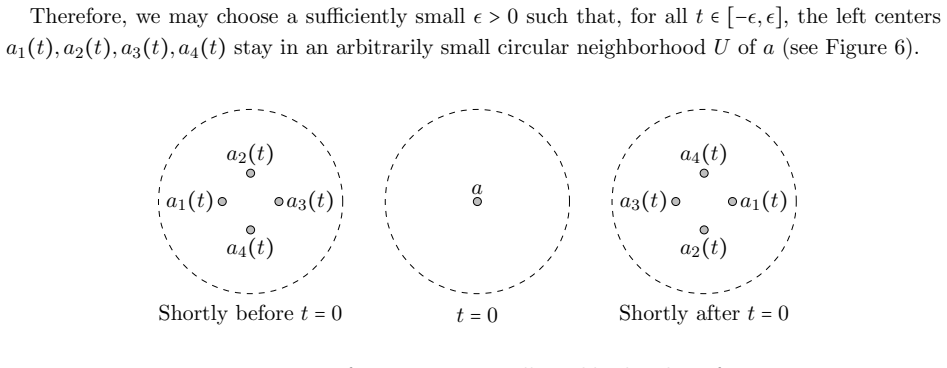
The argument depends on Lemma 20's local picture: when four dots pass through cocircularity, the Voronoi decomposition is assumed to change only in two small neighborhoods, and the change is assumed to be exactly one of the moves in Figures 7 and 8; if that locality or the exhaustiveness of those pictures fails, Theorem C and the cluster algebra invariance collapse.
Editorial extensions
If this is right
- For any $n$ dots in general position in the plane or sphere, the number of incident circles separating the dots into parts of sizes $k$ and $\ell$ is $2(k+1)(\ell+1)$ when $k\neq\ell$, and $(k+1)^2$ when $k=\ell$.
- The number of partitions of $n$ dots into non-empty parts of sizes $k$ and $\ell$ that can be separated by an avoidant circle is $2k\ell-k-\ell+2$ when $k\neq\ell$, and $k^2-k+1$ when $k=\ell$.
- The isomorphism class of the cluster algebra associated to the $k$th order Voronoi decomposition depends only on $k$ and $n$, not on the configuration of dots.
- For four dots and $k=2$, the resulting cluster algebra is the Markov cluster algebra; for six dots and $k=3$, it is the $X_7$ cluster algebra.
- The local moves preserve the numbers of white vertices, black vertices, edges, and regions, providing a second proof that these stratum counts depend only on $k$ and $n$.
Reading between the lines
- If the locality principle behind Lemma 20 holds in other settings, the same argument could yield configuration-independent cluster algebras for Voronoi-type decompositions on other surfaces or in other metric spaces.
- A concrete testable extension is to explore, for small $n$ and $k$, whether the isomorphism class of the cluster algebra distinguishes configurations that are not connected by a sequence of allowed moves; the paper's Warning 23 indicates such obstructions can exist.
- The paper's suggestion to derive planar counting formulas from spherical ones reverses the direction of earlier proofs, which could make future enumeration arguments shorter by working entirely on the sphere.
Editorial analysis
A structured set of objections, weighed in public.
Referee Report
Summary. The paper studies circles that separate a finite set of n points ('dots') in general position on the sphere or plane. It proves two counting results: Theorem A gives the number of incident circles (through three dots) that separate the remaining dots into subsets of sizes k and l, and Theorem B gives the number of equivalence classes of avoidant circles (through no dots) that induce a partition of sizes k and l; both formulas are configuration-independent. The proofs use a double-counting induction for incident circles (Proposition 7) and, for avoidant circles, the kth-order Voronoi decomposition of the sphere, whose vertices and regions are counted via a convex-hull argument and Euler's formula (Theorems 13). The paper also studies continuous deformations of configurations, claiming in Lemma 20 that crossing a single cocircularity wall changes the kth-order Voronoi decomposition by one of three local moves (or an antipodal pair), and in Theorem C that any two decompositions are related by a sequence of such moves. This implies, via known cluster-algebra results, that the associated cluster algebra depends only on k and n (Proposition 24). The paper is clearly written and well motivated, and it includes helpful remarks and a discussion of the relation between spherical and planar Voronoi decompositions.
Significance. If the results hold, the paper gives clean, explicit formulas for two natural counting problems and, more importantly, establishes a structural connection between spherical higher-order Voronoi decompositions and Postnikov's local moves for bicolored graphs. This has attractive consequences, including the configuration-independence of the associated cluster algebra and explicit identifications with the Markov and X7 cluster algebras. The counting proofs are elegant and self-contained: Proposition 7 is a sound double-counting induction, Proposition 6 is a clean convex-hull argument, and Theorem 13 correctly combines vertex counts with the Euler characteristic. The paper is also commendably honest about where its arguments are informal, such as Warning 23 on the limitations of the move realization. However, the main structural theorem (Theorem C) rests entirely on Lemma 20, whose proof relies on an unproved local model. Because Theorem C and Proposition 24 are the paper's most significant advertised contributions, this gap is load-bearing and needs to be addressed.
major comments (3)
- [Section 7, Lemma 20] The proof asserts that, in the two bullet cases, 'the restriction to the neighborhood U will be equivalent to one of the pictures in Figures 7 and 8.' This assertion is not derived. The proof does not explicitly rule out the existence of additional vertices of the kth-order Voronoi decomposition inside U that are not among the four a_i(t) (e.g., from incident circles that do not correspond to the four triples of {d1,d2,d3,d4} but whose centers might approach a); it does not justify that the three cases |D−|=k−3,k−2,k−1 are the only possible ones; and it does not verify that the incidence pattern of edges and regions near a matches the figures. Since Lemma 20 is the only step that connects a semigeneral wall-crossing to the moves in Figure 2, Theorem C and Proposition 24 inherit this gap. The authors should either provide a rigorous local model, for instance by writing down the positions of the four centers relative to a and deriving the Voronoi regions explicitly, or give a formal continuity argument that no other vertices/edges can enter U and that the local graph is exactly one of the depicted ones.
- [Section 7, Lemma 20, final paragraph] The statement 'For any triple of dots besides the four triples in {d1,d2,d3,d4}, the corresponding incident circle does not cross a dot, and therefore has the same set of dots on either side for all t. As a consequence, the corresponding vertices in the kth order Voronoi decomposition and their adjacencies to other vertices do not change as t varies' is not fully justified. The constancy of the sets of dots on either side is true by continuity (since no other quadruple is cocircular at t=0), but the vertices themselves are centers of circles that move with t. The proof must also ensure that, for sufficiently small epsilon, none of these moving vertices collides with another vertex, lies on an edge, or crosses the boundary of U. This can likely be achieved by choosing epsilon small enough, since all such coincidences would require a cocircularity not present at t=0, but the argument is omitted. The authors should spell out this stability argument explicitly.
- [Section 7, Lemma 20, bullet cases] The two bullet cases assume that once the sign of d1(t) relative to C1(t) is fixed, the signs of d2(t), d3(t), d4(t) relative to C2(t), C3(t), C4(t) are forced (alternating). This is a standard property of four points on an oriented circle, but it is not proved in the paper. Since the orientation of C is chosen 'so that it passes through the dots in that order,' the authors should include a short proof or a reference establishing that the four points appear in the stated alternating order on the circles C_i(t). Without this, the exhaustiveness of the case split in Figures 7 and 8 is not fully transparent.
minor comments (4)
- [Throughout] The notation '0<k<n>3' is confusing; it should be written as 'n>3 and 0<k<n' (or simply '3<n and 0<k<n') in Theorem C, Definition 10, Proposition 11, and elsewhere.
- [Section 7, Lemma 20, proof] In the paragraph beginning 'Next, let Ci(t) denote the orientation-reversal of C_i(t)', the text lists 'σ(a1(p)), σ(a1(p)), σ(a1(p)), σ(a1(p))' with a repeated index; it should read 'σ(a1(t)), σ(a2(t)), σ(a3(t)), σ(a4(t))'.
- [Proposition 19, proof] The sentence 'By deforming D(t) in a tubular neighborhood of W_I, we may assume that the set of intersections is discrete' is vague; a brief explanation (e.g., a transversality argument) would make the proof more transparent.
- [Section 6, Lemma 18] The proof of Lemma 18 is clear, but the phrase 'this consists of disjoint open intervals, which are submanifolds of dimension 1' could be simplified to 'this is a one-dimensional submanifold' for readability.
Circularity Check
No circularity: the counting formulas are derived from convex hull, induction, and Euler characteristic; Theorem C rests on a geometric case analysis rather than on its conclusion.
full rationale
The paper's derivation chain is self-contained and does not reduce to its own conclusions. Theorem A is proved by induction on k, with the base case (Proposition 6) derived from convex hull faces and Euler characteristic; the induction (Proposition 7) is a double-counting argument with no fitted parameters. The counts of incident circles are then used, via Propositions 12 and 13, to count Voronoi vertices, edges, and regions by Euler characteristic, yielding the avoidant circle counts in Theorem B. This is a standard geometric derivation, not a renaming or a fit. Theorem C and Proposition 24 rely on Lemma 20's local analysis of a semigeneral wall crossing, which is asserted informally ('equivalent to one of the pictures in Figures 7 and 8') but is not circular: the local pictures are derived from the positions of the four moving left centers and the value of |D^-|, not from the conclusion that only Postnikov moves occur. The cited results [Pos06] and [FWZ25, Proposition 7.2.2] are external sources for the cluster algebra isomorphism under those moves, and the authors do not invoke their own prior work as a load-bearing premise. The only notable weakness is the informality of Lemma 20's case analysis, which is a correctness gap rather than a circularity; the paper's claims are not equivalent to its assumptions by construction.
Assumptions & free parameters
assumptions (4)
- standard math Euler characteristic of the sphere is 2
- standard math Stereographic projection maps circles not through the pole to circles and preserves incidence and separation of dots
- domain assumption Postnikov moves between bicolored graphs induce isomorphic cluster algebras
- standard math The complement of codimension-2 submanifolds in a connected manifold of dimension at least 3 is path-connected
Cite this review
Pith. "Pith review of Separating dots with circles." pith.science (2026). https://pith.science/paper/QHNGB3VG
@misc{pith2026250522851,
  author       = {Pith},
  title        = {Pith review of: Separating dots with circles},
  year         = {2026},
  howpublished = {\url{https://pith.science/paper/QHNGB3VG}},
  note         = {Machine review of arXiv:2505.22851}
}
read the original abstract
Given a finite set of points in general position in the plane or sphere, we count the number of ways to separate those points using two types of circles: circles through three of the points, and circles through none of the points (up to an equivalence). In each case, we show the number of circles which separate the points into subsets of size k and l is independent of the configuration of points, and we provide an explicit formula in each case. We also consider how the circles change as the configuration of dots varies continuously. We show that an associated higher order Voronoi decomposition of the sphere changes by a sequence of local `moves'. As a consequence, an associated cluster algebra is independent of the configuration of dots, and only depends on the number of dots and the order of the Voronoi decomposition.
Figures


Figures from the paper (5 more)




Reference graph
Works this paper leans on
-
[1]
Federico Ardila. The number of halving circles. Amer. Math. Monthly , 111(7):586--591, 2004
work page 2004
-
[2]
Arkady Berenstein, Sergey Fomin, and Andrei Zelevinsky. Cluster algebras. III . U pper bounds and double B ruhat cells. Duke Math. J. , 126(1):1--52, 2005
work page 2005
-
[3]
Kevin Q. Brown. Voronoi diagrams from convex hulls. Information Processing Letters , 9(5):223--228, 1979
work page 1979
-
[4]
Properties for Voronoi diagrams of arbitrary order on the sphere
Merc \`e Claverol Aguas, Andrea de la Heras Parilla, and Clemens Huemer. Properties for Voronoi diagrams of arbitrary order on the sphere. In The 38th European Workshop on Computational Geometry , pages 210--217, 2022
work page 2022
-
[5]
New graphs of finite mutation type
Harm Derksen and Theodore Owen. New graphs of finite mutation type. Electron. J. Combin. , 15(1):Research Paper 139, 15, 2008
work page 2008
-
[6]
G. Dupont. An approach to non-simply laced cluster algebras. J. Algebra , 320(4):1626--1661, 2008
work page 2008
-
[7]
Algorithms in combinatorial geometry , volume 10 of EATCS Monographs on Theoretical Computer Science
Herbert Edelsbrunner. Algorithms in combinatorial geometry , volume 10 of EATCS Monographs on Theoretical Computer Science . Springer-Verlag, Berlin, 1987
work page 1987
-
[8]
Introduction to Cluster Algebras
Sergey Fomin, Lauren Williams, and Andrei Zelevinsky. Introduction to Cluster Algebras . Chapter 7, March 2025. arXiv:2106.02160
arXiv 2025
Show all 11 references
-
[9]
A V oronoi poset
Roderik Lindenbergh. A V oronoi poset. J. Geom. Graph. , 7(1):41--52, 2003
2003
-
[10]
Voronoi diagrams on the sphere
Hyeon-Suk Na, Chung-Nim Lee, and Otfried Cheong. Voronoi diagrams on the sphere. Computational Geometry , 23(2):183--194, 2002
2002
-
[11]
Total positivity, G rassmannians, and networks
Alexander Postnikov. Total positivity, G rassmannians, and networks. preprint , September 2006. arXiv:math/0609764
2006 arXiv
Reviewed August 7, 2026 · model on record in the stance chip above.
Discussion (0). Sign in to comment.