REVIEW 3 major objections 4 minor 77 references
Effect of positronium on the $\gamma$-ray spectra and energy deposition in Type Ia supernovae
T0 review · 3 major / 4 minor · reviewed 2026-08-07 · deepseek-v4-flash
Pith's one-line read Positronium formation can cut the 511 keV line flux of Type Ia supernovae by about 70 percent around 100 days after explosion.
desk verdict TARDIS-HE is a genuinely useful new gamma-ray transport tool and the positronium study deserves a serious referee, but the 3γ continuum sampling is biased soft and the 2% deposition number needs a recheck before anyone quotes it. read the letter →
The pith
A machine-rendered reading of the paper's core claim, the machinery that carries it, and where it could break.
The reading
What carries the argument
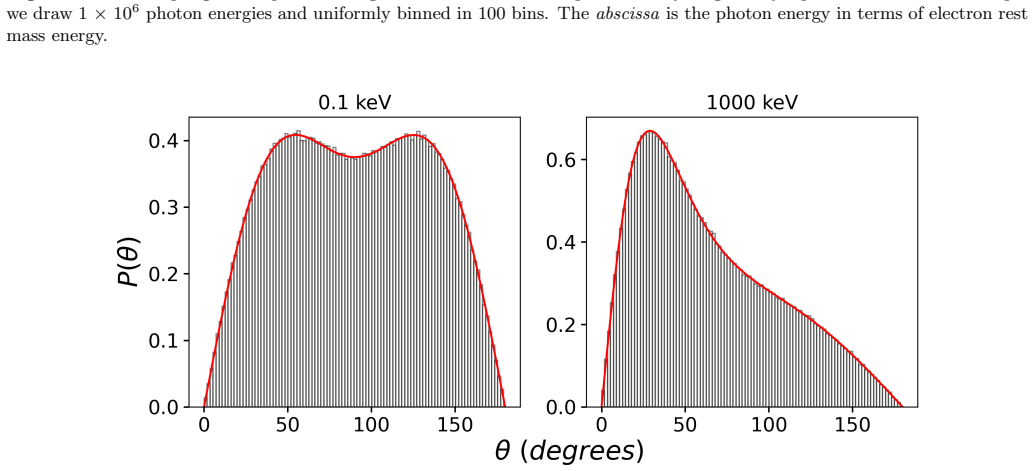
The central machinery is the indivisible energy-packet Monte Carlo transport in TARDIS-HE: gamma-ray packets representing radioactive decay radiation are moved through spherical, homologously expanding ejecta shells and interact through Compton scattering, pair production, and photoabsorption. The positronium channel is handled separately: a chosen positronium fraction $f_p$ diverts that share of annihilation packets into positronium, and 75 percent of those decay through the three-photon ortho-positronium channel, with photon energies sampled from the Ore–Powell distribution. That branching is what moves flux out of the 511 keV line into the continuum below it and shifts energy deposition.
What would settle it
Measure the 511 keV line and the continuum shape of a nearby Type Ia supernova around 100 days after explosion with a high-resolution gamma-ray spectrometer: if the line flux matches the no-positronium prediction or no ortho-positronium continuum appears, the assumed full positronium formation and fixed 75 percent three-photon branching are not realized in real ejecta.
Extended reading notes
Core claim
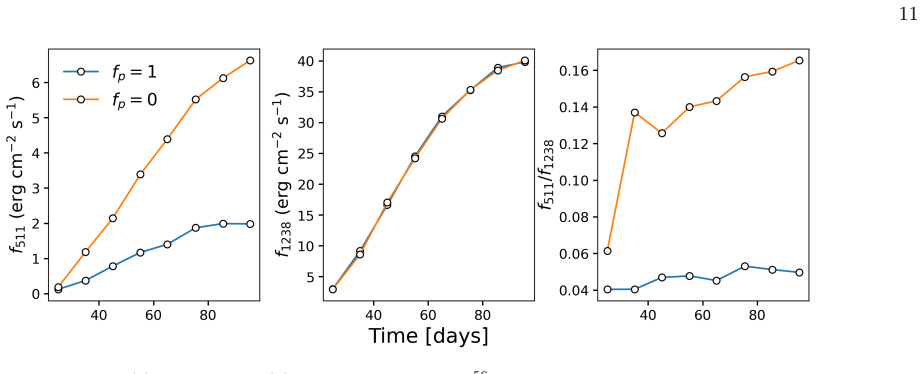
The central discovery is that including positronium formation in gamma-ray transport changes predicted observables in a specific, quantifiable way. With a positronium fraction of unity and 75 percent of positronium decaying through the three-photon channel, the 511 keV line flux falls by roughly 70 percent at about 95 days in the delayed-detonation model, while the continuum below 511 keV brightens; energy deposition rises by up to 2 percent at late times because the softer three-photon continuum is more likely to be photoabsorbed. The paper also reports that the 511 keV to 1238 keV line ratio decreases in all four explosion models considered when positronium forms, and that low-energy 56Ni lines at 158 and 270 keV can distinguish explosion scenarios, disappearing into the continuum for the violent merger geometry.
Load-bearing premise
The calculation assumes a fixed fraction of positron annihilations goes through positronium and that 75 percent of those positronium atoms decay into three photons, but in a real supernova both numbers depend on local density, temperature, and ionization, so the 70 percent line reduction is tied to those assumed values.
Editorial extensions
If this is right
- The 511 keV line is not a clean measure of the 56Co positron yield; interpreting its flux without correcting for positronium redistribution would bias estimates of the radioactive mass.
- The 511 keV to 1238 keV line ratio decreases with positronium formation in all four explosion models studied, offering an observational diagnostic for the positronium fraction that is less sensitive to absolute flux calibration.
- Low-energy 56Ni lines at 158 and 270 keV survive in delayed-detonation, deflagration, and double-detonation models but are lost in the continuum for the violent merger model, so gamma-ray spectra can discriminate between explosion scenarios.
- Energy deposition rises by up to 2 percent near 100 days, which feeds into late-time bolometric light curves and the UV-optical-IR emission powered by radioactive decay.
- Future observations of late-phase spectra of a nearby Type Ia supernova could detect the ortho-positronium continuum and constrain the positronium fraction, refining models of radioactive energy transport.
- If the claims hold, gamma-ray line-flux measurements used as explosion diagnostics must account for positronium formation even when the effect is not the dominant shaping process.
Reading between the lines
- The 70 percent line reduction is an upper-end scenario attached to the paper's assumed 100 percent positronium formation and fixed 75 percent three-photon branching; a self-consistent model with a time- and density-dependent positronium fraction will likely place the effect somewhere between the paper's 0 and 70 percent endpoints.
- The same line-versus-continuum redistribution should apply to other positron-producing transients, such as ejecta powered by 44Ti or 57Ni decay, where the neglected positronium channel would alter gamma-ray diagnostics similarly.
- Because the ortho-positronium continuum is independent of ejecta composition while the Compton-scattered continuum is not, separating these two components in an observed spectrum could isolate the positronium contribution without requiring detailed abundance information.
- A direct extension would replace the fixed 75 percent three-photon branch with a density- and temperature-dependent ortho-para conversion treatment and test whether the energy-deposition excess grows or shrinks at late times.
Editorial analysis
A structured set of objections, weighed in public.
Referee Report
Summary. This paper presents TARDIS-HE, a new time-dependent Monte Carlo transport module for gamma rays built on the TARDIS radiative-transfer framework. The code uses indivisible energy packets, homologous expansion, and three opacity channels (Compton scattering, pair production, photoabsorption), and it reads decay chains and transition data from ENSDF to produce spectra and deposition curves. Positronium formation is included in a parameterized way: a fraction f_p of annihilation packets is assumed to form positronium, and 75% of those are assumed to decay through the three-photon channel. The authors validate the spectra against Summa et al. (2013) and the deposition against several published codes, then apply the code to four SN Ia models. The central quantitative result is that for f_p = 1 and a 75% three-photon branching, the 511 keV line flux is reduced by approximately 70% at around 95-100 days and the energy deposition is increased by up to 2%, compared with models without positronium.
Significance. If the implementation is correct, TARDIS-HE would be a useful open-source addition to the SN Ia gamma-ray modeling toolkit, and the paper gives a transparent parameter study of positronium's effect on line and continuum observables, including a discussion of COSI detectability. The code description is detailed enough that the emission and opacity treatments can be checked, and the comparison against multiple deposition codes is a strength. However, the headline numbers are directly tied to the assumed constant values of f_p and the three-gamma branching, and the three-gamma sampling appears inconsistent with the equal-energy indivisible-packet scheme, so the claimed 2% deposition enhancement is not yet established. The spectral validation is also weakened by a model-mass mismatch. These issues are fixable with a corrected sampling scheme and a same-model comparison, but they must be addressed before the quantitative conclusions can be accepted.
major comments (3)
- [Appendix A; §2.2–2.3, Eq. (7)] The three-gamma continuum sampling is inconsistent with the equal-energy indivisible-packet scheme. Equation (7) fixes every packet's rest-frame energy to E_tot/N_packet, so in such a scheme the emission frequency must be drawn from the source's energy spectrum. For positronium three-gamma decay, the Ore-Powell function F(x) in Eq. (A1) is the number distribution of photon energies; the physical continuum energy spectrum is proportional to xF(x). Sampling x from F(x) instead produces an emergent energy spectrum proportional to F(x), which is biased toward low photon energies. Because §4.1 attributes the 2% deposition increase to low-energy continuum photons being more readily photoabsorbed, this bias likely inflates that number, and it also shifts the continuum level subtracted under the 511 keV line. In addition, the manuscript does not state how many packets are created per three-gamma decay; since a three-photon decay has total energy 2 m_e c^2 while each equal-energy packet has energy E_tot/N_packet, the energy bookkeeping for this channel must be specified explicitly. The authors should sample from the energy-weighted distribution (or assign variable packet energies) and rerun the positronium cases.
- [§3.1, Fig. 3] The spectral comparison against Summa et al. (2013) is not a clean validation because the two runs use different 56Ni masses: the text states that the ddt N100 model has 0.6 M_sun of 56Ni in Summa et al., while TARDIS-HE is run with 0.67 M_sun after normalization, and the late-phase flux difference is attributed to this mass difference. This means the comparison does not test whether the code reproduces the published absolute line and continuum fluxes. The authors should run the same 56Ni mass (or explicitly rescale the comparison) and quantify the residual difference.
- [§4.1, Fig. 5] The central quantitative claims — approximately 70% reduction in the 511 keV line flux and up to 2% increase in energy deposition — are reported without statistical or systematic uncertainties. With a finite packet count, the line and continuum fluxes carry Monte Carlo Poisson errors, and the specutils Gaussian-fit plus continuum-subtraction procedure adds a systematic component. The authors should report these uncertainties or, at minimum, demonstrate convergence with respect to packet number and show that the line-measurement method does not drive the quoted values.
minor comments (4)
- [§2.3] The text says positronium decays by two-gamma or three-gamma emission 'in the ratio of 1:4.5', which is inconsistent with the 75% three-gamma branching used throughout the paper; the statistical ratio from the 1:3 singlet-to-triplet spin weights is 1:3, and the lifetime ratio for ortho- to para-positronium is much larger than 4.5. Please check and correct this statement.
- [Abstract and §5] The phrase 'We find that full positronium formation can reduce the 511 keV line flux by approximately 70%' should be framed as conditional on the assumed input f_p = 1 and the assumed 75% three-gamma branching, since these quantities are not derived in this work; the current wording could be read as a prediction rather than a parameter-study result.
- [Throughout] There are several typos and formatting inconsistencies, including 'radiaoctive' (Introduction), 'desposition' (§2.6 and Fig. 1), 'contin num opacity' (§4.1), and inconsistent rendering of 'tardis-he' (sometimes italic, sometimes roman). A careful copy edit is needed.
- [§4.2, last paragraph] The statement that 'the ortho-Ps continuum is independent of the composition of the ejecta' is true only for the intrinsic emission spectrum; after transport through the ejecta the observed continuum is modulated by Compton scattering and photoabsorption, so the sentence should be qualified.
Circularity Check
Headline 511 keV line reduction (~70%) is nearly the complement of the assumed 75% 3γ branching at f_p=1; the code transport itself is externally benchmarked and the deposition/line-ratio results are genuinely transport-dependent.
-
self definitional
[Section 2.3 (positronium treatment) and Section 4.1 (Positronium contribution)]
"For those that form positronium, 75 % decays to 3γ to form a continuum. [§2.3] … There is a decrease in flux in the 511 keV line by ∼70 % at around 95 days for a positronium fraction of 1. [§4.1]"
With f_p=1 all annihilation packets form positronium, so by construction only the 25% para-Ps (2γ) branch can still put flux in the 511 keV line; the retained line flux is pinned near 25% of the no-positronium value plus 3γ contamination near the 511 keV endpoint. The reported ~70% reduction (Section 4.1) is therefore almost exactly the complement of the assumed 75% 3γ branching: the headline number is set by the input, and radiative transfer moves it by only ~5 points. Unlike the 2% deposition enhancement, which is genuinely transport-dependent, the 70% line reduction is an input echo dressed as a finding; the abstract itself juxtaposes the assumed 75% with the derived ~70% without noting that the second is nearly forced by the first.
full rationale
The new transport code is not circular: at f_p=0 the paper validates TARDIS-HE against externally published spectra (Summa et al. 2013, Figure 3) and a multi-code deposition comparison (Blondin et al. 2022, Figure 4), so the transport chain has independent support. There is no load-bearing self-citation: some benchmark-model papers list co-author S. Sim, but the compared outputs are external published results, not premises of this paper's positronium argument, and the Ps branching is cited to Ore & Powell (1949), Crannell et al. (1976), Leising & Clayton (1987), and Milne et al. (2004), none of which are the present authors. The paper also concedes in Section 5 that the positronium fraction and the 2γ/3γ ratio depend on density, temperature, and collisions, i.e., the inputs are honestly labeled as parameters. The one by-construction element is the headline 511 keV claim: with f_p=1 all annihilations form positronium and 75% of them are diverted to the 3γ continuum (Section 2.3), so the 511 keV line is reduced to about 25% plus small contamination before any transport; the reported ~70% reduction (Section 4.1) is thus nearly the complement of the assumed branching, echoing the input. The +2% deposition enhancement and the inter-model line-ratio comparisons are genuine transport outputs and are not circular. The Ore-Powell sampling issue raised in review (Appendix A samples equal-energy packet energies from the photon-number distribution F(x) instead of the energy distribution xF(x), biasing the continuum soft and plausibly inflating the deposition enhancement) is a distinct correctness concern, not a circularity, and is left out of the score.
Assumptions & free parameters
free parameters (1)
- Positronium fraction f_p =
0, 0.5, 1 (scanned, not fitted)
assumptions (7)
- ad hoc to paper Positronium fraction f_p and the 3γ decay branching ratio are constant over time and uniform across the ejecta.
- domain assumption Positrons deposit their kinetic energy in the shell where they are created; positron transport is neglected.
- domain assumption The kinetic energy of β+ decay channels is deposited immediately as thermal energy.
- domain assumption Photoabsorption deposits all packet energy in-situ and instantaneously.
- domain assumption Pair production opacity depends only on Si and Fe-group mass fractions, using a simplified formula.
- domain assumption All electrons, bound and free, participate in Compton scattering with the Klein-Nishina cross-section.
- domain assumption The ejecta undergoes homologous expansion, and the 1D spherical models from HESMA represent the ejecta structure.
Cite this review
Pith. "Pith review of Effect of positronium on the $\gamma$-ray spectra and energy deposition in Type Ia supernovae." pith.science (2026). https://pith.science/paper/7XY6SSPI
@misc{pith2026250522992,
  author       = {Pith},
  title        = {Pith review of: Effect of positronium on the $\gamma$-ray spectra and energy deposition in Type Ia supernovae},
  year         = {2026},
  howpublished = {\url{https://pith.science/paper/7XY6SSPI}},
  note         = {Machine review of arXiv:2505.22992}
}
abstract
Type Ia supernovae (SNe Ia) are powered by the radioactive decay of isotopes such as $^{56}$Ni and $^{56}$Co, making their $\gamma$-ray spectra useful probes of the explosion mechanism and ejecta structure. Accurate interpretation of $\gamma$-ray observables, including line ratios and continuum fluxes, requires a detailed understanding of the microphysical processes that shape the spectra. One such process is positronium formation during electron-positron annihilation, which can redistribute flux from the 511 keV line into the surrounding continuum. To assess the impact of positronium on the emergent spectra, we developed a new open-source module TARDIS-HE, for time-dependent three-dimensional $\gamma$-ray transport, integrated into the radiative transfer code TARDIS. The code simulates $\gamma$-ray spectra and light curves from one-dimensional supernova ejecta models and allows for flexible incorporation of decay chains and opacity treatments. Using TARDIS-HE, we explore the effect of positronium formation by varying the positronium fraction from 0 % to 100 %, and assuming an extreme case where 75 % of positronium decays result in three-photon emission. We find that full positronium formation can reduce the 511 keV line flux by approximately 70 % and modestly enhance energy deposition by up to 2 % at around 100 days post-explosion, compared to models without positronium. These results demonstrate that while the effect is not dominant, positronium formation introduces measurable changes to $\gamma$-ray observables. Future observations with missions such as the Compton Spectrometer and Imager (COSI) may offer constraints on positronium formation in SNe Ia and help refine models of their radioactive energy transport.
Figures


Figures from the paper (6 more)




Reference graph
Works this paper leans on
-
[1]
1988, ApJ, 325, 820, doi: 10.1086/166052 Astropy Collaboration, Robitaille, T
Ambwani, K., & Sutherland, P. 1988, ApJ, 325, 820, doi: 10.1086/166052 Astropy Collaboration, Robitaille, T. P., Tollerud, E. J., et al. 2013, A&A, 558, A33, doi: 10.1051/0004-6361/201322068 Astropy Collaboration, Price-Whelan, A. M., Sip˝ ocz, B. M., et al. 2018, AJ, 156, 123, doi: 10.3847/1538-3881/aabc4f Astropy Collaboration, Price-Whelan, A. M., Lim,...
-
[2]
I., & Bartunov, O
Blinnikov, S. I., & Bartunov, O. S. 1993, A&A, 273, 106
1993
-
[3]
Blondin, S., Blinnikov, S., Callan, F. P., et al. 2022, A&A, 668, A163, doi: 10.1051/0004-6361/202244134
-
[4]
Brown, B. L., & Leventhal, M. 1987, ApJ, 319, 637, doi: 10.1086/165484
-
[5]
1990, ApJ, 360, 626, doi: 10.1086/169150
Burrows, A., & The, L.-S. 1990, ApJ, 360, 626, doi: 10.1086/169150
-
[6]
Carter, L. L., & Cashwell, E. D. 1975, 22, doi: 10.2172/4167844
-
[7]
Castor, J. I. 1972, ApJ, 178, 779, doi: 10.1086/151834
doi:10.1086/151834 1972
-
[8]
2014, Nature, 512, 406, doi: 10.1038/nature13672 —
Churazov, E., Sunyaev, R., Isern, J., et al. 2014, Nature, 512, 406, doi: 10.1038/nature13672 —. 2015, ApJ, 812, 62, doi: 10.1088/0004-637X/812/1/62
Show all 77 references
- [9]
-
[10]
J., Joyce, G., Ramaty, R., & Werntz, C
Crannell, C. J., Joyce, G., Ramaty, R., & Werntz, C. 1976, ApJ, 210, 582, doi: 10.1086/154863
1976 doi
-
[11]
J., Blondin, S., & Khokhlov, A
Dessart, L., Hillier, D. J., Blondin, S., & Khokhlov, A. 2014, MNRAS, 441, 3249, doi: 10.1093/mnras/stu789 16
2014 doi
-
[12]
2014, Science, 345, 1162, doi: 10.1126/science.1254738
Diehl, R., Siegert, T., Hillebrandt, W., et al. 2014, Science, 345, 1162, doi: 10.1126/science.1254738
2014 doi
-
[13]
K., Anupama, G
Dutta, A., Sahu, D. K., Anupama, G. C., et al. 2022, ApJ, 925, 217, doi: 10.3847/1538-4357/ac366f
2022 doi
-
[14]
2024, astropy/specutils: v1.19.0, v1.19.0, Zenodo, doi: 10.5281/zenodo.14042033
Earl, N., Tollerud, E., O’Steen, R., et al. 2024, astropy/specutils: v1.19.0, v1.19.0, Zenodo, doi: 10.5281/zenodo.14042033
2024 doi
-
[15]
2022, URILIGHT: Time-dependent Monte-Carlo radiative-transfer, Astrophysics Source Code Library, record ascl:2209.012
Elbaz, Y. 2022, URILIGHT: Time-dependent Monte-Carlo radiative-transfer, Astrophysics Source Code Library, record ascl:2209.012
2022
-
[16]
R., et al
Fink, M., Kromer, M., Seitenzahl, I. R., et al. 2014, MNRAS, 438, 1762, doi: 10.1093/mnras/stt2315
2014 doi
-
[17]
J., Challis, P
Foley, R. J., Challis, P. J., Chornock, R., et al. 2013, ApJ, 767, 57, doi: 10.1088/0004-637X/767/1/57
2013 doi
-
[18]
1998, MNRAS, 296, 913, doi: 10.1046/j.1365-8711.1998.01421.x G´ omez-Gomar, J., Isern, J., & Jean, P
Gomez-Gomar, J., Hernanz, M., Jose, J., & Isern, J. 1998, MNRAS, 296, 913, doi: 10.1046/j.1365-8711.1998.01421.x G´ omez-Gomar, J., Isern, J., & Jean, P. 1998, MNRAS, 295, 1, doi: 10.1046/j.1365-8711.1998.29511115.x
1998
-
[19]
M., et al
Graur, O., Zurek, D., Shara, M. M., et al. 2016, ApJ, 819, 31, doi: 10.3847/0004-637X/819/1/31
2016 doi
-
[20]
T., et al
Gronow, S., Collins, C., Ohlmann, S. T., et al. 2020, A&A, 635, A169, doi: 10.1051/0004-6361/201936494
2020 doi
-
[21]
R., Millman, K
Harris, C. R., Millman, K. J., van der Walt, S. J., et al. 2020, Nature, 585, 357, doi: 10.1038/s41586-020-2649-2
2020 doi
-
[22]
J., & Dessart, L
Hillier, D. J., & Dessart, L. 2012, MNRAS, 424, 252, doi: 10.1111/j.1365-2966.2012.21192.x
2012
- [23]
-
[24]
M., & Wheeler, J
Hoeflich, P., Khokhlov, A. M., & Wheeler, J. C. 1995, ApJ, 444, 831, doi: 10.1086/175656 H¨ oflich, P., Wheeler, J. C., & Khokhlov, A. 1998, ApJ, 492, 228, doi: 10.1086/305018
1995 doi
-
[25]
J., & Caplan, M
Horowitz, C. J., & Caplan, M. E. 2021, PhRvL, 126, 131101, doi: 10.1103/PhysRevLett.126.131101
2021 doi
-
[26]
1969, National Bureau of Standards Report NSRDS-NBS29, Washington DC
Hubbell, J. 1969, National Bureau of Standards Report NSRDS-NBS29, Washington DC
1969
-
[27]
Hunter, J. D. 2007, Computing in Science & Engineering, 9, 90, doi: 10.1109/MCSE.2007.55
2007 doi
-
[28]
2011, A&A, 530, A45, doi: 10.1051/0004-6361/201015937
Jerkstrand, A., Fransson, C., & Kozma, C. 2011, A&A, 530, A45, doi: 10.1051/0004-6361/201015937
2011 doi
-
[29]
2012, A&A, 546, A28, doi: 10.1051/0004-6361/201219528
Jerkstrand, A., Fransson, C., Maguire, K., et al. 2012, A&A, 546, A28, doi: 10.1051/0004-6361/201219528
2012 doi
-
[30]
2006, AJ, 132, 189, doi: 10.1086/504599
Jha, S., Branch, D., Chornock, R., et al. 2006, AJ, 132, 189, doi: 10.1086/504599
2006 doi
-
[31]
W., Maguire, K., & Sullivan, M
Jha, S. W., Maguire, K., & Sullivan, M. 2019, Nature Astronomy, 3, 706, doi: 10.1038/s41550-019-0858-0
2019 doi
-
[32]
2011, Nuclear Data Sheets, 112, 1513, doi: 10.1016/j.nds.2011.04.004
Junde, H., Su, H., & Dong, Y. 2011, Nuclear Data Sheets, 112, 1513, doi: 10.1016/j.nds.2011.04.004
2011 doi
-
[33]
Karshenboim, S. G. 2004, International Journal of Modern Physics A, 19, 3879, doi: 10.1142/S0217751X04020142
2004 doi
-
[34]
C., & Nugent, P
Kasen, D., Thomas, R. C., & Nugent, P. 2006, ApJ, 651, 366, doi: 10.1086/506190
2006 doi
-
[35]
E., & Sim, S
Kerzendorf, W. E., & Sim, S. A. 2014, MNRAS, 440, 387, doi: 10.1093/mnras/stu055
2014 doi
-
[36]
Khokhlov, A. M. 1991, A&A, 245, 114
1991
-
[37]
I., & Lugaro, M
Kobayashi, C., Karakas, A. I., & Lugaro, M. 2020, ApJ, 900, 179, doi: 10.3847/1538-4357/abae65
2020 doi
- [38]
-
[39]
Kromer, M., & Sim, S. A. 2009, MNRAS, 398, 1809, doi: 10.1111/j.1365-2966.2009.15256.x
2009
- [40]
-
[41]
V., Chornock, R., et al
Li, W., Filippenko, A. V., Chornock, R., et al. 2003, PASP, 115, 453, doi: 10.1086/374200
2003 doi
-
[42]
2018, PhR, 736, 1, doi: 10.1016/j.physrep.2018.02.002
Livio, M., & Mazzali, P. 2018, PhR, 736, 1, doi: 10.1016/j.physrep.2018.02.002
2018 doi
-
[43]
1995, ApJ, 452, 62, doi: 10.1086/176279
Livne, E., & Arnett, D. 1995, ApJ, 452, 62, doi: 10.1086/176279
1995 doi
-
[44]
Lucy, L. B. 2005, A&A, 429, 19, doi: 10.1051/0004-6361:20041656
2005 doi
-
[45]
R., & Maguire, K
Magee, M. R., & Maguire, K. 2020, A&A, 642, A189, doi: 10.1051/0004-6361/202037870
2020 doi
-
[46]
R., Maguire, K., Kotak, R., & Sim, S
Magee, M. R., Maguire, K., Kotak, R., & Sim, S. A. 2021, MNRAS, 502, 3533, doi: 10.1093/mnras/stab201
2021 doi
-
[47]
2022, Journal of Open Source Software, 7, 3318, doi: 10.21105/joss.03318
Malins, A., & Lemoine, T. 2022, Journal of Open Source Software, 7, 3318, doi: 10.21105/joss.03318
2022 doi
-
[48]
A., The, L
Milne, P. A., The, L. S., & Leising, M. D. 1999, ApJS, 124, 503, doi: 10.1086/313262
1999 doi
-
[49]
A., Hungerford, A
Milne, P. A., Hungerford, A. L., Fryer, C. L., et al. 2004, ApJ, 613, 1101, doi: 10.1086/423235 Mohoroviˇ ci´ c, S. 1934, Astronomische Nachrichten, 253, 93, doi: https://doi.org/10.1002/asna.19342530402
2004 doi
-
[50]
Nadyozhin, D. K. 1994, ApJS, 92, 527, doi: 10.1086/192008
1994 doi
-
[51]
M., Kromer, M., Taubenberger, S., et al
Noebauer, U. M., Kromer, M., Taubenberger, S., et al. 2017, MNRAS, 472, 2787, doi: 10.1093/mnras/stx2093 O’Brien, J. T., Kerzendorf, W. E., Fullard, A., et al. 2024, The Astrophysical Journal, 964, 137, doi: 10.3847/1538-4357/ad2358
2017 doi
-
[52]
Ore, A., & Powell, J. L. 1949, Physical Review, 75, 1696, doi: 10.1103/PhysRev.75.1696
1949 doi
-
[53]
K., et al
Pakmor, R., Kromer, M., R¨ opke, F. K., et al. 2010, Nature, 463, 61, doi: 10.1038/nature08642
2010 doi
-
[54]
2012, ApJL, 747, L10, doi: 10.1088/2041-8205/747/1/L10 pandas development team, T
Pakmor, R., Kromer, M., Taubenberger, S., et al. 2012, ApJL, 747, L10, doi: 10.1088/2041-8205/747/1/L10 pandas development team, T. 2020, pandas-dev/pandas: Pandas, latest, Zenodo, doi: 10.5281/zenodo.3509134
2012 doi
-
[55]
1962, PhD thesis, Howard University, Washington DC 17
Pankey, Titus, J. 1962, PhD thesis, Howard University, Washington DC 17
1962
-
[56]
Phillips, M. M. 1993, ApJL, 413, L105, doi: 10.1086/186970
1993 doi
-
[57]
A., Sobol, I
Pozdnyakov, L. A., Sobol, I. M., & Syunyaev, R. A. 1983, Astrophys. Space Phys. Res., 2, 189
1983
-
[58]
M., et al
Prantzos, N., Boehm, C., Bykov, A. M., et al. 2011, Reviews of Modern Physics, 83, 1001, doi: 10.1103/RevModPhys.83.1001
2011 doi
-
[59]
Pskovskii, I. P. 1977, Soviet Ast., 21, 675 R¨ opke, F. K., Kromer, M., Seitenzahl, I. R., et al. 2012, ApJL, 750, L19, doi: 10.1088/2041-8205/750/1/L19
1977 doi
-
[60]
J., & Seitenzahl, I
Ruiter, A. J., & Seitenzahl, I. R. 2025, A&A Rv, 33, 1, doi: 10.1007/s00159-024-00158-9
2025 doi
-
[61]
B., & Lightman, A
Rybicki, G. B., & Lightman, A. P. 1979, Radiative processes in astrophysics
1979
-
[62]
R., Ciaraldi-Schoolmann, F., R¨ opke, F
Seitenzahl, I. R., Ciaraldi-Schoolmann, F., R¨ opke, F. K., et al. 2013, MNRAS, 429, 1156, doi: 10.1093/mnras/sts402
2013 doi
-
[63]
2020, MNRAS, 496, 4517, doi: 10.1093/mnras/staa1745 —
Sharon, A., & Kushnir, D. 2020, MNRAS, 496, 4517, doi: 10.1093/mnras/staa1745 —. 2023, MNRAS, 522, 6264, doi: 10.1093/mnras/stad1227
2020 doi
-
[64]
2024, MNRAS, 535, 924, doi: 10.1093/mnras/stae2378
Sharon, A., Kushnir, D., & Schinasi-Lemberg, E. 2024, MNRAS, 535, 924, doi: 10.1093/mnras/stae2378
2024 doi
-
[65]
Sim, S. A. 2007, MNRAS, 375, 154, doi: 10.1111/j.1365-2966.2006.11271.x
2007
-
[66]
A., & Mazzali, P
Sim, S. A., & Mazzali, P. A. 2008, MNRAS, 385, 1681, doi: 10.1111/j.1365-2966.2008.12600.x
2008
-
[67]
2013, A&A, 554, A67, doi: 10.1051/0004-6361/201220972
Summa, A., Ulyanov, A., Kromer, M., et al. 2013, A&A, 554, A67, doi: 10.1051/0004-6361/201220972
2013 doi
-
[68]
A., Sutherland, P
Swartz, D. A., Sutherland, P. G., & Harkness, R. P. 1995, ApJ, 446, 766, doi: 10.1086/175834
1995 doi
-
[69]
Utrobin, V. P. 2004, Astronomy Letters, 30, 293, doi: 10.1134/1.1738152
2004 doi
-
[70]
Veigele, W. J. 1973, Atomic Data, 5, 51, doi: 10.1016/S0092-640X(73)80015-4
1973 doi
-
[71]
A., Zimmerman, G
Weaver, T. A., Zimmerman, G. B., & Woosley, S. E. 1978, ApJ, 225, 1021, doi: 10.1086/156569
1978 doi
-
[72]
Webbink, R. F. 1984, ApJ, 277, 355, doi: 10.1086/161701
1984 doi
-
[73]
1995, The Quantum Theory of Fields Wes McKinney
Weinberg, S. 1995, The Quantum Theory of Fields Wes McKinney. 2010, in Proceedings of the 9th Python in Science Conference, ed. St´ efan van der Walt & Jarrod Millman, 56 – 61, doi: 10.25080/Majora-92bf1922-00a
1995 doi
-
[74]
T., & van Rossum, D
Wollaeger, R. T., & van Rossum, D. R. 2014, ApJS, 214, 28, doi: 10.1088/0067-0049/214/2/28
2014 doi
-
[75]
T., van Rossum, D
Wollaeger, R. T., van Rossum, D. R., Graziani, C., et al. 2013, ApJS, 209, 36, doi: 10.1088/0067-0049/209/2/36
2013 doi
- [76]
-
[77]
2019a, MNRAS, 484, 3941, doi: 10.1093/mnras/stz145 —
Wygoda, N., Elbaz, Y., & Katz, B. 2019a, MNRAS, 484, 3941, doi: 10.1093/mnras/stz145 —. 2019b, MNRAS, 484, 3951, doi: 10.1093/mnras/stz146
Reviewed August 7, 2026 · model on record in the stance chip above.
Discussion (0). Sign in to comment.