REVIEW 4 major objections 6 minor 5 references
Learning to Regulate: A New Event-Level Dataset of Capital Control Measures
T0 review · 4 major / 6 minor · reviewed 2026-08-07 · deepseek-v4-flash
Pith's one-line read Capital controls become event-level data: 5,198 dated measures with 27 attributes, and an event study shows restrictive inward rules cut fund inflows within a month.
desk verdict A genuinely useful event-level dataset idea built on LLM extraction, but the core fields lack human validation and the event study is oversold; fixable and worth refereeing. read the letter →
The pith
A machine-rendered reading of the paper's core claim, the machinery that carries it, and where it could break.
The reading
What carries the argument
The load-bearing mechanism is a two-step prompting pipeline for the commercial model GPT-4.1, followed by a fine-tuned open-source classifier called CCM-Llama. The first prompt teaches the model the layout of the AREAER reports and grounds it with definitions from the capital-flow-management literature and the Global Trade Alert's three-tier intervention taxonomy; the second prompt asks for a fixed JSON schema: one of ten action verbs, one of four intensity labels, one of four direction labels, plus instrument, actor, condition, beneficiary, target country, target industry, and three binary flags for trade, sanctions, and national security, each field accompanied by the source sentence from the report text. CCM-Llama, a fine-tuned version of the Llama 3.1-8B model trained on 29,012 pairs that align change texts with their affected category and next-year status, is what makes the method fast enough to apply to external sources. The empirical claim rides on an event-study regression with fund fixed effects and global month fixed effects, tracing average fund-flow responses from month $t = -6$ to $t = +6$ around each event, split by restrictive/conditional versus liberalizing intensity.
What would settle it
Hand-code a random sample of roughly 300 of the 5,198 events (or a fresh draw from the underlying AREAER change logs) for action intensity and action direction, and measure agreement with the GPT-4.1 outputs; if agreement on these two fields is substantially below the 99.55% accuracy the paper reports for binary status, the event-study treatment assignments are not reliable. A cheaper complementary check: re-estimate the China event study using only events whose cited LLM reasoning contains an explicit verb such as 'prohibit,' 'suspend,' 'remove,' or 'permit,' and see whether the roughly 8% cumulative decline in fund inflows within three months survives.
Extended reading notes
Core claim
On its own terms, the paper's claim is that the narrative change descriptions in the AREAER reports can be converted into a reliable event-level record of capital control policy. Where existing indices read only the annual binary status column—restriction present or not—this dataset treats each recorded change as an event with a date, a direction (inward, outward, or both), an intensity (restrictive, conditional, liberalizing, or neutral), and one of ten action verbs (prohibit, limit, suspend, require approval, subject to quota, permit, remove, ease, amend, clarify). The authors report that the model GPT-4.1, prompted with report examples and classification definitions at temperature 0, extracted 5,198 such events with 27 fields each plus the model's cited reasoning, and that their fine-tuned open-source model CCM-Llama reproduces the status classification at 99.55% binary accuracy and 90.09% in category classification. The empirical demonstration is an event study of China, Australia, and the United States in which restrictive and conditional inward measures are followed by a significant decline in fund inflows within one month—for China, roughly an 8% cumulative drop within three months—while liberalizing measures show weaker, shorter-lived effects.
Load-bearing premise
The 27 attributes extracted by GPT-4.1, in particular action intensity and action direction, are treated as accurate without any human-coded validation having been reported; since those two fields define the treatment in the event study, systematic mislabeling would compromise the paper's empirical conclusions.
Editorial extensions
If this is right
- Researchers can now align capital control interventions with daily or monthly outcome data instead of annual index snapshots, opening this policy area to event-study methods.
- The case-study results imply that restrictive and conditional inward measures reduce fund inflows within a month, that liberalizing measures are comparatively weak, and that this asymmetry can now be tested across all 196 countries.
- The reported 99.55% binary and 90.09% category accuracies indicate that status and category coding of AREAER text can be automated, removing the manual-labeling bottleneck in dataset construction.
- The action-type and intensity fields permit dynamic capital-control indices that track the frequency and depth of intervention rather than a static presence-absence status.
- Because the fine-tuned model accepts arbitrary policy text, the same pipeline can classify capital control events from news and central-bank announcements in near real time.
Reading between the lines
- If the extraction accuracy transfers to new documents, the same two-step prompt plus fine-tuning recipe could convert other narrative regulatory corpora—trade measures, sanctions lists, macroprudential actions—into event-level datasets at low marginal cost, since the design is domain-generic by construction.
- The conditional intensity label offers a testable operationalization of the 'gates versus walls' idea in the capital-controls literature: approval- and quota-based measures behave like gates, prohibitions and suspensions like walls, and the dataset allows comparing their flow effects directly.
- Because the paper reports no human-coded validation of the 27 extracted fields, the first independent check should be a hand-coded gold sample; the event-study conclusions cannot be separated from the accuracy of the intensity and direction labels.
- The asymmetric response—tightening moves flows quickly, loosening does not pull them back—suggests a ratchet-like dynamic in capital flows that weekly fund-flow data could test, since monthly aggregation may mask the true response timing.
Editorial analysis
A structured set of objections, weighed in public.
Referee Report
Summary. This paper introduces the Capital Control Measures (CCM) dataset, an event-level dataset of 5,198 capital control interventions in 196 countries over 1999–2023, constructed by using GPT-4.1 with a two-step prompting approach to extract 27 structured fields from IMF AREAER narrative records. The authors also fine-tune Llama 3.1-8B (CCM-Llama) on 29,012 AREAER-derived examples to classify policy texts into IMF categories and statuses, reporting 99.55% binary accuracy and up to 90.09% hierarchical accuracy. As an application, an event study for China, Australia, and the US uses the extracted Action Direction and Action Intensity fields and finds that inward restrictive/conditional measures reduce fund inflows (e.g., about 8% cumulative decline for China), with heterogeneous effects across countries.
Significance. If validated, the CCM dataset would be a substantial contribution: it moves from annual binary indices to daily, attribute-rich policy events, and the CCM-Llama pipeline offers a reproducible, open-source route for extending classification to new sources. The inclusion of source-sentence citations for every extracted field is a genuine transparency feature that makes auditing feasible, and the fine-tuning evaluation against strong baselines is clearly described. However, the paper's value hinges on the accuracy of the GPT-4.1-extracted fields, and the manuscript currently provides no quantitative validation of those fields; the empirical application rests directly on this unvalidated output. With a human-coded validation study and clarification of a few internal inconsistencies, the contribution would be publishable and useful to the international macro-finance and dataset-construction communities.
major comments (4)
- [§2.2, §4.2] The 27 structured fields produced by GPT-4.1, and in particular Action Intensity and Action Direction, are validated only by temperature-zero setting and a qualitative consistency check against GPT-3.5; no precision, recall, or agreement statistics against human-coded labels are reported anywhere. Section 4.2 constructs its treatment variable by selecting events with Action Direction == 'Inward' and splitting them by Action Intensity (restrictive/conditional vs. liberalizing), so errors in these two fields are directly load-bearing for the headline estimates, such as the roughly 8% cumulative inflow decline for China. The authors should provide a human-coded gold-standard evaluation of the extraction for at least the fields used in the application, with per-field agreement, precision, and recall; the existence of source-sentence citations is useful for audit but does not by itself establish validity.
- [§2.1, footnote 8; Table 1; §2.3] The manuscript states in Section 2.1 and footnote 8 that the 2023 AREAER final report had not yet been released and that the fine-tuning data cover 1999–2022, yet Table 1 Panel B lists 343 yearly-change events for 2023 and Section 2.3 describes the dataset as covering 1999–2023. This is an internal inconsistency in a central coverage claim. Clarify the provenance of the 2023 events (for example, whether the 'yearly changes' component is available separately from the final report), and make the coverage statement consistent throughout.
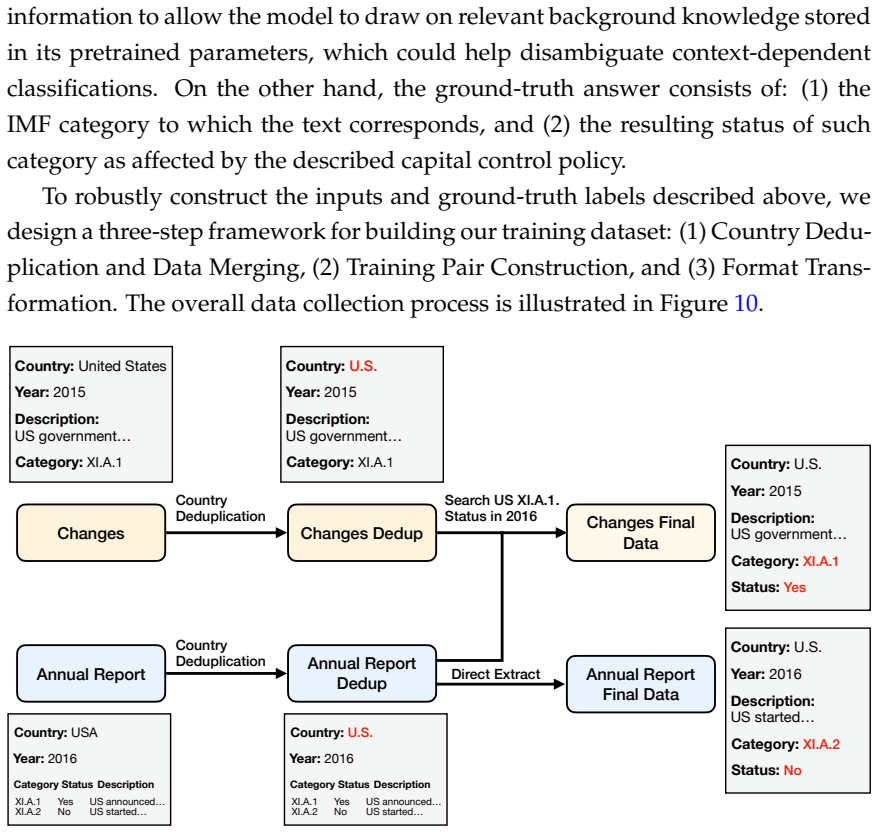
- [§3.2, Step 2] The fine-tuning labels are constructed by taking the status in the year y+1 final report as the outcome caused by each policy change recorded in year y. This is valid only when there is a single change affecting a given category in a given year and when a 'Yes' status reflects that specific change rather than pre-existing restrictions; the paper does not discuss or test these conditions. If multiple changes occur in one year, or if restrictive measures are layered without altering the binary status, the assigned labels are not uniquely attributable to the described change, and the reported CCM-Llama accuracy figures may overstate the model's true performance. At minimum, the authors should quantify how often multiple changes map to one category-year cell and provide a robustness check restricting to unambiguous cells.
- [§4.2, Eq. (4)] Equation (4) contains no control variables, although Section 4.1 describes global push and domestic pull controls; it also does not define an explicit baseline event time or the treatment assignment rule for events outside the [-6,+6] window. The text says standard errors are clustered 'at the fund or country level' without specifying which, and no pre-trend test is reported. Because this application is presented as preliminary, this is not a fatal flaw, but the specification should be completed or explicitly labeled as descriptive before the estimates are interpreted causally.
minor comments (6)
- [Abstract; §3.4] The abstract and Section 3.4 refer to '99.55% in status prediction,' but Table 5's Binary Acc measures whether the policy is a capital control at all, not whether the status is Yes or No; rename the metric to avoid confusion.
- [Table 3] Table 3 lists 'Target Industry' twice; remove the duplicate row.
- [§2.3 vs §2.2] Section 2.3 says the dataset provides 'nine categories of action types,' while the prompt in Section 2.2 defines ten action types; correct the count.
- [Footnote 9] Footnote 9 contains an incomplete citation 'Fernández et al. (citation)'; add the full reference.
- [§2.2, Condition field] The Condition field description ('without - with (e.g., only on request,subject to approval)') is grammatically incomplete and should be rewritten to specify the coding scheme clearly.
- [Data availability] The paper does not state where the CCM dataset, prompts, or fine-tuning code will be made available; for a dataset paper this should be explicit.
Circularity Check
No significant circularity: CCM-Llama is validated on AREAER-derived ground truth, the event study uses LLM-annotated treatments against external EPFR outcomes, and the only self-citation is not load-bearing.
full rationale
Verdict: no significant circularity. Each claimed result rests on external inputs rather than on its own outputs. (1) CCM dataset construction (Section 2.2): the 27 annotated fields are GPT-4.1 extractions from AREAER policy text using author-defined prompts; none of these fields is constructed from the EPFR fund-flow outcomes used later, so the dataset is an independent encoding of policy text, not a fit to the outcome. (2) CCM-Llama evaluation (Section 3): ground-truth category and status labels come directly from the AREAER final reports and yearly changes (Section 3.2: "we retrieve the status of the affected category from the final report for country n in year y+1"), not from GPT-4.1 and not from the model itself; the 500-example test split is benchmarked against external baselines (GPT-4o, GPT-4.1, Llama 3.1-8B) in Table 5, so the reported 99.55% and 90.09% accuracies are measured against AREAER and external models, not against the model's own training targets. (3) Event study (Section 4.2, Equation 4): the treatments (Action Direction = 'Inward'; Action Intensity restrictive/conditional vs. liberalizing) are extracted from policy text, while Flowpct comes from EPFR Global fund-flow data, a separate external source; the beta coefficients are freely estimated, and nothing in the annotation schema mechanically determines their sign or size, so the China ~8% cumulative inflow decline is an empirical estimate, not a fitted parameter renamed as a prediction. Self-citation check: the only author-overlapping reference is Liu et al. (2024), cited once in Section 3.2 for the tangential claim that enriched context improves LLM classification; the finetuning claim is independently demonstrated in Table 5, so the citation is not load-bearing. Two flagged concerns are correctness risks, not circularity: the 27 GPT-4.1-extracted fields (especially Action Intensity and Action Direction) have no reported human-coded precision/recall, a validity threat to the event study (which the paper itself calls preliminary in footnote 12); and footnote 8 states the 2023 AREAER report was not yet released while Table 1 and Figure 5 include 343 events for 2023, an unexplained data-consistency issue. Neither concern exhibits a reduction of a result to its own inputs.
Assumptions & free parameters
assumptions (5)
- domain assumption AREAER reports contain a complete and accurate narrative of capital control measures, including effective dates.
- domain assumption GPT-4.1's extraction of the 27 fields is unbiased and accurate enough for downstream analysis.
- ad hoc to paper The status recorded in the year y+1 final report is the correct label for a policy change in year y.
- domain assumption Fund fixed effects and global month fixed effects in the event study specification (Equation 4) control for confounding factors.
- domain assumption The test set of 500 examples is representative of new capital control texts.
Cite this review
Pith. "Pith review of Learning to Regulate: A New Event-Level Dataset of Capital Control Measures." pith.science (2026). https://pith.science/paper/YO57CVF4
@misc{pith2026250523025,
  author       = {Pith},
  title        = {Pith review of: Learning to Regulate: A New Event-Level Dataset of Capital Control Measures},
  year         = {2026},
  howpublished = {\url{https://pith.science/paper/YO57CVF4}},
  note         = {Machine review of arXiv:2505.23025}
}
read the original abstract
We construct a novel event-level Capital Control Measures (CCM) dataset covering 196 countries from 1999 to 2023 by leveraging prompt-based large language models (LLMs). The dataset enables event study analysis and cross-country comparisons based on rich policy attributes, including action type, intensity, direction, implementing entity, and other multidimensional characteristics. Using a two-step prompt framework with GPT-4.1, we extract structured information from the IMF's Annual Report on Exchange Arrangements and Exchange Restrictions (AREAER), resulting in 5,198 capital control events with 27 annotated fields and corresponding model reasoning. Secondly, to facilitate real-time classification and extension to external sources, we fine-tune an open-source Meta Llama 3.1-8B model, named CCM-Llama, trained on AREAER change logs and final status reports. The model achieves 90.09\% accuracy in category classification and 99.55\% in status prediction. Finally, we apply the CCM dataset in an empirical application: an event study on China, Australia, and the US. The results show that inward capital control measures significantly reduce fund inflows within one month, and restrictive policies tend to have stronger effects than liberalizing ones, with notable heterogeneity across countries. Our work contributes to the growing literature on the use of LLMs in economics by providing both a novel high-frequency policy dataset and a replicable framework for automated classification of capital control events from diverse and evolving information sources.
Figures


Figures from the paper (13 more)





Reference graph
Works this paper leans on
-
[1]
Capital flows to emerging market economies: A brave new world?,
Ahmed, Shaghil and Andrei Zlate, “Capital flows to emerging market economies: A brave new world?,”Journal of International Money and Finance, 2014,48(PB), 221–248. Bergant, Katharina, Francesco Grigoli, Niels-Jakob Hansen, and Damiano San- dri, “Dampening global financial shocks: can macroprudential regulation help (more than capital controls)?,”Journal o...
work page 2014
-
[1993]
Measuring Financial Integration: A New Data Set,
Schindler, Martin, “Measuring Financial Integration: A New Data Set,”IMF Staff Papers, April 2009,56(1), 222–238. Tille, Cedric and Eric Van Wincoop, “International capital flows,”Journal of inter- national Economics, 2010,80(2), 157–175. Zhao, Wayne Xin, Kun Zhou, Junyi Li, Tianyi Tang, Xiaolei Wang, Yupeng Hou, Yingqian Min, Beichen Zhang, Junjie Zhang,...
arXiv 2009
-
[2005]
Capital controls: The- ory and evidence,
Erten, Bilge, Anton Korinek, and Jos´ e Antonio Ocampo, “Capital controls: The- ory and evidence,”Journal of Economic Literature, 2021,59(1), 45–89. Evenett, Simon J., “Global Trade Alert: Motivation and Launch,”World Trade Re- view, October 2009,8(4), 607–609. Fernandez, Andres, Michael W. Klein, Alessandro Rebucci, Martin Schindler, and Martin Uribe, “C...
arXiv 2021
-
[2012]
What drives capital to green companies in emerging markets: Evidence from investment funds,
42 Lepers, Etienne and Annamaria De Crescenzio, “What drives capital to green companies in emerging markets: Evidence from investment funds,” OECD Working Papers on International Investment 2024/02, OECD Publishing Decem- ber
work page 2024
-
[2024]
Beyond Text: Unveiling Multimodal Proficiency of Large Language Models with MultiAPI Benchmark,
Liu, Xiao, Jianfeng Lin, and Jiawei Zhang, “Beyond Text: Unveiling Multimodal Proficiency of Large Language Models with MultiAPI Benchmark,” in Sha Li, Manling Li, Michael JQ Zhang, Eunsol Choi, Mor Geva, Peter Hase, and Heng Ji, eds.,Proceedings of the 1st Workshop on Towards Knowledgeable Language Models (KnowLLM 2024), Association for Computational Lin...
work page 2024
Reviewed August 7, 2026 · model on record in the stance chip above.
Discussion (0). Sign in to comment.