REVIEW 3 major objections 5 minor 26 references
Measurements of Fusion Yield on the Centrifugal Mirror Fusion Experiment
T0 review · 3 major / 5 minor · reviewed 2026-08-07 · deepseek-v4-flash
Pith's one-line read The Centrifugal Mirror Fusion Experiment has produced its first absolutely calibrated measurement of fusion neutrons, with a peak D-D emission rate of $8.4\times 10^{6} \pm 7.0\times 10^{5}$ neutrons/s and a modeled triple product of…
desk verdict First credible fusion yield measurement on a centrifugal mirror; the raw yield stands while the model-inferred triple product needs a sensitivity analysis. read the letter →
The pith
A machine-rendered reading of the paper's core claim, the machinery that carries it, and where it could break.
The reading
What carries the argument
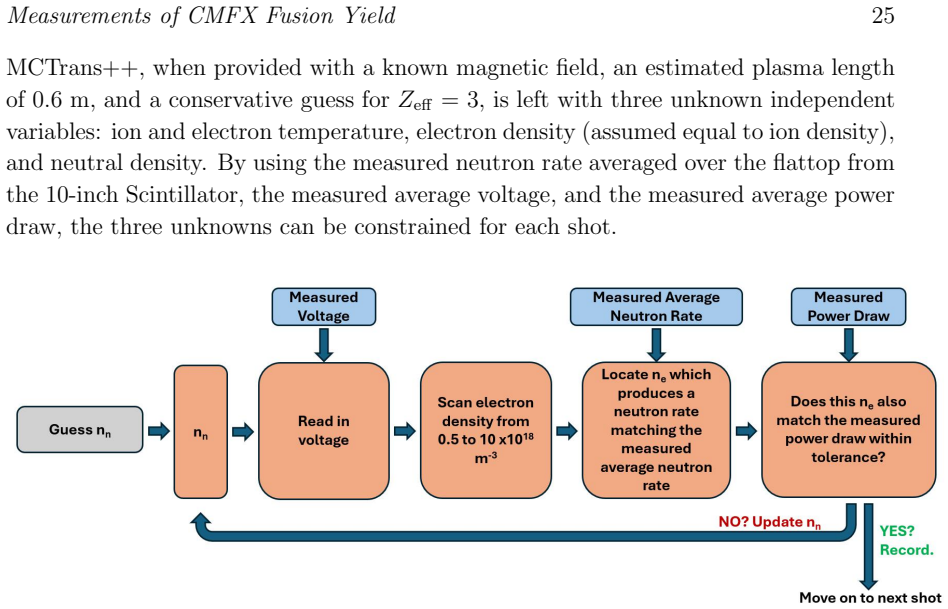
The load-bearing object is the calibrated counting chain $\dot{M} = \epsilon \dot{Y}_n$, where the measured neutron count rate $\dot{M}$ is converted to total yield $\dot{Y}_n$ by an efficiency $\epsilon$ factored into a zero-threshold transport efficiency $G$ (computed with OpenMC) and a finite-threshold response efficiency $T$ (computed with Geant4 response matrices plus measured light-output functions). A 10-inch EJ301 scintillator is cross-calibrated against the absolutely calibrated 2-inch detectors so that low yields and time evolution can be resolved, while a permanent $^3$He tube calibrated in situ by a Cf-252 source on an image-ring path provides an independent check. On the interpretation side, MCTrans++ --- a 0D centrifugal-mirror code solving particle, energy, and angular-momentum balance with classical transport under strong flow shear --- is iterated shot by shot: a Newton scheme adjusts the assumed neutral density until the modeled power draw matches measurement, leaving the measured neutron rate to fix density and temperature, and hence the triple product.
What would settle it
Measure the ion temperature independently (e.g., via Doppler broadening of a spectral impurity line or charge-exchange recombination spectroscopy) on the same 65 kV discharge conditions; a material deviation from the ~720 eV inferred by MCTrans++ would invalidate the triple product and the 100 kV projection, while leaving the raw $8.4\times 10^{6} \pm 7.0\times 10^{5}$ n/s neutron-rate measurement intact.
Extended reading notes
Core claim
The central claim is that CMFX now produces measurable, absolutely calibrated D-D fusion neutrons: a peak average emission rate of $8.4\times 10^{6} \pm 7.0\times 10^{5}$ n/s during flat-top operation at a set voltage of 65 kV. Two independent calibration routes agree with each other --- an in silico chain (OpenMC transport plus Geant4-based response matrices) applied to 2-inch EJ301/EJ301D scintillators and a 10-inch cross-calibrated detector, and an in situ Cf-252 calibration of a permanent $^3$He tube --- with a linear-fit slope of $0.981 \pm 0.024$ and intercept below 2% of the maximum yield. The 0D model MCTrans++, iterated against measured neutron rate, voltage, and power draw, infers ion temperatures up to ~720 eV and a peak triple product of $1.9\times 10^{17}\,\mathrm{m^{-3}\,keV\,s}$, which the paper places alongside other compact confinement devices. The measured yield also grows approximately exponentially with set voltage, consistent with ion temperature rising linearly with voltage.
Load-bearing premise
The inferred temperature, density, and triple product rest on MCTrans++ inputs that the paper concedes were chosen conservatively but not measured or calculated: $Z_{\mathrm{eff}} = 3.0$, a plasma length of 0.6 m, $n_e = n_i$, and parabolic radial profiles.
Editorial extensions
If this is right
- CMFX has crossed a diagnostic threshold: D-D fusion neutrons are now measured rather than modeled, with a validated absolute calibration.
- The agreement between the in silico and in situ calibrations (slope $0.981 \pm 0.024$) means the yield numbers do not depend on a single detector model.
- The exponential yield-versus-voltage trend implies ion temperature grows roughly linearly with set voltage, a simple scaling law for planning future experiments.
- MCTrans++ projects triple products near $1\times 10^{18}\,\mathrm{m^{-3}\,keV\,s}$ at 100 kV, positioning stable 100 kV operation as the next concrete milestone for CMFX.
- The double-puff fueling scheme produced the highest neutron rates while injecting half the gas of a single long puff, identifying fueling schedule as a performance lever.
Reading between the lines
- If the 100 kV scaling holds, CMFX would offer a comparatively inexpensive testbed for shear-flow confinement at projected triple products near $1\times 10^{18}\,\mathrm{m^{-3}\,keV\,s}$; a direct test would be to measure ion temperature spectroscopically across the 65--100 kV range rather than infer it from the 0D model.
- The success of the in silico scintillator calibration, given a faithful transport model, suggests the same workflow could be ported to other compact fusion devices that lack a removable in situ calibration source.
- The strong correlation between instantaneous input power and neutron rate during the double-puff discharge, which the paper notes but does not regress, points to a testable extension: a shot-resolved power-versus-neutron-rate model that might separate density evolution from temperature evolution during transients.
Editorial analysis
A structured set of objections, weighed in public.
Referee Report
Summary. This paper reports the first measurements of fusion neutron yield on the Centrifugal Mirror Fusion Experiment (CMFX). The authors use three detection systems: two 2-inch liquid scintillators calibrated with an in silico OpenMC/Geant4 method, a larger 10-inch scintillator cross-calibrated against the two smaller detectors, and a permanently installed 3He proportional counter calibrated in situ with a Cf-252 source. The two absolute calibration chains agree to within a regression slope of 0.981 +/- 0.024 with R^2 = 0.978 over 42 discharges. The paper reports a peak average neutron emission rate of 8.4e6 +/- 7.0e5 neutrons/s at 65 kV and an exponential scaling of yield with applied voltage. An interpretive 0D MCTrans++ framework is then used to infer ion and electron temperatures, densities, neutral density, and the fusion triple product from measured voltage, input power, and neutron rate, yielding a peak inferred triple product of 1.9e17 m^-3 keV s. The paper also projects, using the same model, that operation at 100 kV could reach triple products near 1e18 m^-3 keV s.
Significance. If the absolute yield measurement stands, this is a significant milestone for centrifugal mirror research: CMFX is producing measurable D-D fusion neutrons, and the two independent absolute calibrations are a genuine methodological strength. The in silico scintillator calibration, supported by synthetic-versus-experimental pulse-height agreement and by agreement with the Cf-252-calibrated 3He detector, is a valuable contribution that could be reused on other compact fusion devices. The paper also demonstrates useful experimental findings on shot repeatability and fueling schemes. However, the headline triple product and the 100 kV projection are entirely outputs of the MCTrans++ 0D model with several unmeasured and unvaried inputs. Those interpretive claims therefore carry substantial unquantified systematic uncertainty and are the main factor limiting the paper's conclusiveness. The measured neutron rate, by contrast, is well supported and should be regarded as the paper's central robust result.
major comments (3)
- [Sec. 4.3, Fig. 18d] The inferred triple product, ion/electron temperatures, densities, and confinement times are all outputs of MCTrans++ with fixed inputs Zeff = 3.0, plasma length 0.6 m, ne = ni, and parabolic radial profiles. The paper's own limitation statement at the start of Sec. 4.3 acknowledges that Zeff and plasma length were 'chosen with values that are conservative but not measured or calculated.' These choices directly enter the power balance, plasma volume, and volume-integrated reactivity, so they can shift the inferred Ti, ne, and triple product substantially. No sensitivity analysis is reported, and Fig. 18d shows the triple product without error bars. I request a systematic sensitivity study varying Zeff, plasma length, ne/ni ratio, radial profile shape, and neutral density, with the resulting ranges propagated to the inferred quantities and to the 100 kV projection in Fig. 15.
- [Sec. 4.2, iterative solve] The iterative solve uses three measured constraints (voltage, power, neutron rate) to determine three model unknowns, but the assumed inputs are not independently constrained by CMFX diagnostics. In particular, the electron density is assumed equal to the ion density, and the interferometer that would provide a direct density constraint was unavailable during these experiments. As a result, the inferred electron density of about 2.8e18 m^-3 is a model output, not a measurement, and the same is true of the inferred confinement time and triple product. The paper should state this distinction explicitly throughout Sec. 4 and should provide a quantitative uncertainty budget for the inference, including the effect of relaxing the ne = ni assumption.
- [Sec. 2.3, Eq. (11), and Fig. 10] Both absolute calibration methods rely on an assumed spatial distribution of the neutron emissivity: the 3He calibration uses a midplane ring source at radius R0, and the OpenMC model uses a prescribed centrifugal-mirror plasma source. The excellent agreement between the two methods validates the consistency of the two calibration chains but does not by itself validate the source geometry, because both methods share the same class of source assumptions. If the true fusion emissivity has significant axial extent or a different radial weighting, both efficiencies could be biased in the same direction. I ask the authors to add a sensitivity scan of the inferred detector efficiencies to the source profile parameters (ring radius, radial width, axial extent, and potentially a volumetric source) and to include this contribution in the systematic uncertainty of the absolute yield measurement.
minor comments (5)
- [Sec. 2.2, text after Eq. (4)] The cross-calibration factor is given as m_XC = (2.822 +/- 189) x 10^3 neutrons/count, which as written has an uncertainty roughly 67 times the central value. This appears to be a typographical error, likely (2.822 +/- 0.189) x 10^3; please correct the value and verify that the quoted uncertainty is consistent with Fig. 8.
- [Abstract and Sec. 5] The abstract reports '8.4e6 +/- 7.0e5' without units; the units neutrons/s appear in the body text but should also appear in the abstract for clarity.
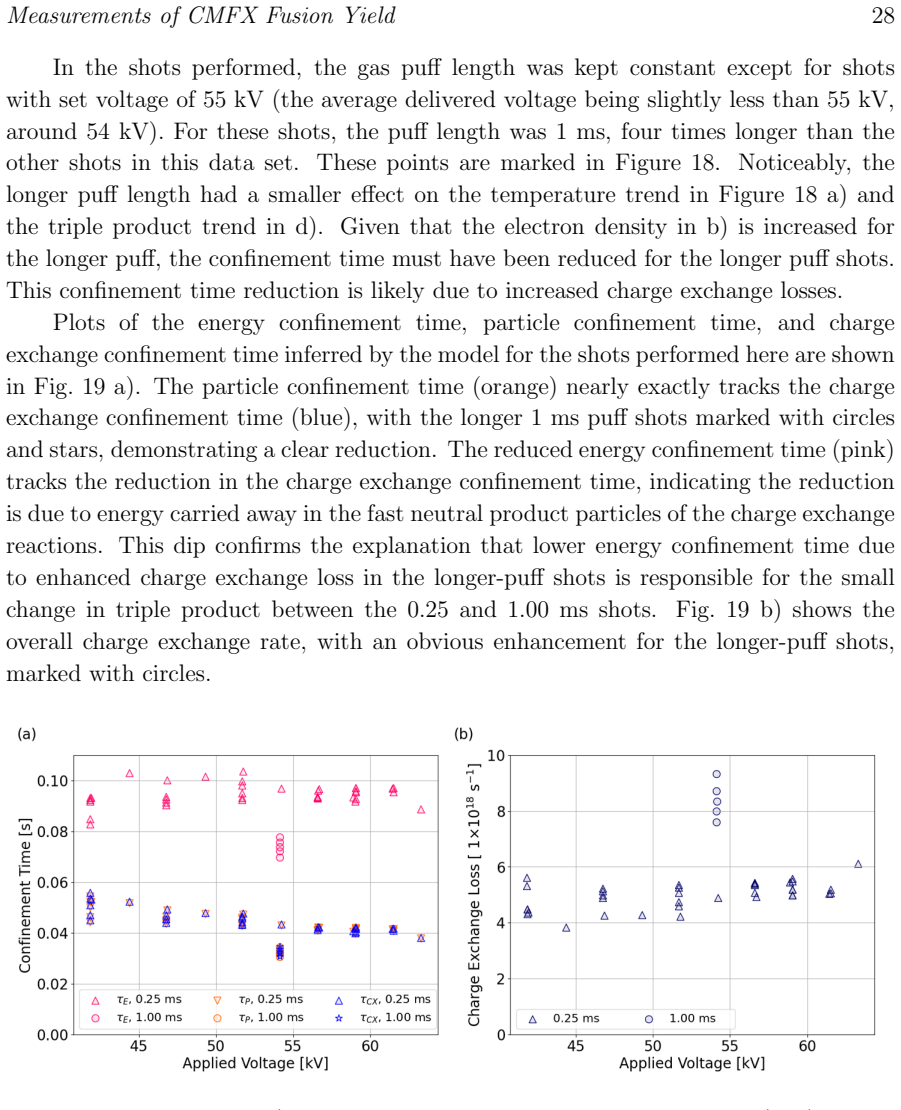
- [Fig. 15, Sec. 4.1] The POPCON projection uses a constant neutral density of 2.4e14 m^-3, while the iterative inference in Fig. 18c finds that neutral density increases with voltage. The paper notes that neutral density is not expected to remain constant, but this inconsistency is not quantified; please state its effect on the 100 kV triple-product projection.
- [Fig. 15 caption] The caption states that error bars are excluded for clarity on the experimental red points. Since Fig. 15 supports the 100 kV projection, please include representative error bars in a version of the figure or state their size in the text.
- [References] Reference [26] cites 'Physics of Plasma' but the journal name should be 'Physics of Plasmas'; please correct this and any similar typographical errors in the bibliography.
Circularity Check
No significant circularity: the neutron yield measurement is independently calibrated and cross-validated; the MCTrans++ interpretive layer is transparently model-based rather than a prediction disguised as measurement.
full rationale
The central measured claim, a peak neutron rate of 8.4e6 +/- 7.0e5 n/s, is supported by two independent calibration chains: the in silico OpenMC/Geant4 calibration of the 2-inch liquid scintillators, validated by synthetic-versus-experimental pulse-height agreement, and the in situ Cf-252 calibration of the 3He tube. These methods agree with a slope of 0.981 +/- 0.024 over 42 discharges (Sec. 2.3, Fig. 10), so the measured yield does not reduce to an assumed input. The interpretive MCTrans++ inference (Sec. 4.2) uses measured voltage, power, and neutron rate as constraints and explicitly labels all other inputs as conservative assumptions: 'Zeff and plasma length were chosen with values that are conservative but not measured or calculated,' and radial profiles were assumed to be parabolic (Sec. 4.3). This is an inverse/fitting exercise, not a tautology: the inferred temperatures, densities, and triple product are model outputs, not restatements of the measurements. The paper does not present these as independent predictions, and no uniqueness theorem or circular definition forces the result. The only notable self-citation, MCTrans++ [24], is used for the interpretive layer; it is load-bearing for the inferred triple product and the 100 kV extrapolation, but those claims are clearly labeled as modeling rather than measurement, and the raw yield measurement stands independently. Hence no step reduces by construction to its own input.
Assumptions & free parameters
free parameters (6)
- Cross-calibration factor m_XC for 10-inch scintillator =
2822 +/- 189 neutrons/count
- Exponential fit parameters A, B, C for yield vs voltage =
A = 26.0 n/s, B = 0.133 kV^-1, C = -29.9 kV
- Neutral density n0 in MCTrans++ iterative solve =
About 2.4e14 m^-3 across shots (e.g., 2.35e14 m^-3 for shot 2071)
- Electron density n_e (assumed equal to ion density) in MCTrans++ =
About 2.8e18 m^-3
- Effective charge Zeff =
3.0
- Plasma length L =
0.6 m
assumptions (7)
- standard math Neutron rate is proportional to total yield via detector efficiency M = epsilon * Yn (Eq. 1).
- ad hoc to paper The 3He calibration ring-source model: neutron emissivity is azimuthally symmetric and localized to a ring at midplane radius R0; up-down symmetry holds; vacuum vessel attenuation is negligible for the calibration geometry.
- domain assumption Regarding 252Cf as spectrally equivalent to DD fusion neutrons for the 3He detector response.
- domain assumption MCTrans++ 0D centrifugal mirror transport equations are valid for CMFX parameter space.
- ad hoc to paper Radial profiles of density and temperature follow a parabolic form; ion temperature is a flux function; electron density equals ion density.
- domain assumption Neutral density is spatially uniform in the POPCON and per-shot solves.
- domain assumption The OpenMC CMFX geometry and source model are adequate representations of the machine and neutron source distribution.
Cite this review
Pith. "Pith review of Measurements of Fusion Yield on the Centrifugal Mirror Fusion Experiment." pith.science (2026). https://pith.science/paper/4MBRFYNV
@misc{pith2026250523047,
  author       = {Pith},
  title        = {Pith review of: Measurements of Fusion Yield on the Centrifugal Mirror Fusion Experiment},
  year         = {2026},
  howpublished = {\url{https://pith.science/paper/4MBRFYNV}},
  note         = {Machine review of arXiv:2505.23047}
}
abstract
The Centrifugal Mirror Fusion Experiment (CMFX) at the University of Maryland, College Park is a rotating mirror device that utilizes a central cathode to generate a radial electric field which induces a strongly sheared azimuthal $E\times B$ flow to improve plasma confinement and stability. The fusion yield of CMFX plasmas is assessed by diagnosis of neutron emission for the first time. The total neutron yield is measured with two xylene (EJ-301) and deuterated-xylene (EJ-301D) liquid scintillator detectors absolutely calibrated with an in silico method. A larger xylene scintillator was cross-calibrated and used to measure the time dynamics of the fusion rate under various experimental conditions. A permanently installed $^3$He gas tube detector was independently calibrated with a Cf-252 neutron source to make total yield measurements and provide an independent validation of the scintillator calibration. An interpretive modeling framework was developed using the 0D code MCTrans++ (Schwartz et al 2024 JPP) to infer undiagnosed plasma parameters such as density, temperature, and confinement time. A peak neutron emission rate of 8.4$\times 10^{6}$ $\pm$ 7.0$\times 10^{5}$ was measured (neglecting modeling uncertainties), with an inferred triple product of 1.9~$\times~10^{17}$ $\mathrm{m^{-3}}$ keV s from 0D modeling.
Figures


Figures from the paper (17 more)




Reference graph
Works this paper leans on
-
[1]
Steady supersonically rotating plasmas in the maryland centrifugal experimenta),
R. F. Ellis, A. Case, R. Elton, J. Ghosh, H. Griem, A. Hassam, R. Lunsford, S. Messer, and C. Teodorescu, “Steady supersonically rotating plasmas in the maryland centrifugal experimenta),”Physics of Plasmas, vol. 12, p. 055704, 05 2005
work page 2005
-
[2]
An experiment to test centrifugal confinement for fusion,
R. F. Ellis, A. B. Hassam, S. Messer, and B. R. Osborn, “An experiment to test centrifugal confinement for fusion,”Physics of Plasmas, vol. 8, pp. 2057–2065, 05 2001
work page 2001
-
[3]
Rotating plasma experiments. i. hydromagnetic properties,
D. A. Baker, J. E. Hammel, and F. L. Ribe, “Rotating plasma experiments. i. hydromagnetic properties,”The Physics of Fluids, vol. 4, pp. 1534–1548, 12 1961
work page 1961
-
[4]
Mhd stability of a hot rotating plasma: A brief review of psp-2 experiments,
V. Volosov, “Mhd stability of a hot rotating plasma: A brief review of psp-2 experiments,”Plasma Physics Reports, vol. 35, pp. 719–733, 2009
work page 2009
-
[5]
Charge and mass considerations for plasma velocity measurements in rotating plasmas,
C. Romero-Talam´ as, R. C. Elton, W. C. Young, R. Reid, R. F. Ellis, and A. B. Hassam, “Charge and mass considerations for plasma velocity measurements in rotating plasmas,”Journal of Fusion Energy, vol. 29, pp. 543–547, 2010
work page 2010
-
[6]
C. Teodorescu, W. C. Young, G. W. S. Swan, R. F. Ellis, A. B. Hassam, and C. A. Romero-TalamasPhys. Rev. Lett., vol. 105, p. 085003, 2010. REFERENCES31
work page 2010
-
[7]
Uzun-Kaymak, P. N. Guzdar, R. Clary, R. F. Ellis, A. B. Hassam, and C. Teodorescu, “Analysis and modeling of edge fluctuations and transport mechanism in the maryland centrifugal experiment,”Physics of Plasmas, vol. 15, 2008
work page 2008
-
[8]
M. S´ anchez and J. S´ anchez, “Thermo-optical effect in zinc selenide windows for two-color interferometer for fusion plasma diagnostics,”Review of Scientific Instruments, vol. 76, p. 046104, 03 2005
work page 2005
Show all 26 references
-
[9]
Convenient computational forms for Maxwellian reactivities,
L. M. Hively, “Convenient computational forms for Maxwellian reactivities,” Nuclear Fusion, vol. 17, 1977
1977
-
[10]
I. H. Hutchinson,Principles of Plasma Diagnostics. Cambridge University Press, 2 ed., 2002
2002
-
[11]
Deuterated-xylene (xylene-d10; ej301d): A new, improved deuterated liquid scintillator for neutron energy measurements without time- of-flight,
F. Becchettiet al., “Deuterated-xylene (xylene-d10; ej301d): A new, improved deuterated liquid scintillator for neutron energy measurements without time- of-flight,”Nuclear Instruments and Methods in Physics Research Section A: Accelerators, Spectrometers, Detectors and Associ...
2016
-
[12]
Evaluating deuterated-xylene for use as a fusion neutron spectrometer,
J. L. Ball, E. Panontin, S. Mackie, R. A. Tinguely, and P. Raj, “Evaluating deuterated-xylene for use as a fusion neutron spectrometer,”Review of Scientific Instruments, vol. 95, p. 123514, 12 2024
2024
-
[13]
Gamma-calibration of ne 213 scintillation counters,
G. Dietze and H. Klein, “Gamma-calibration of ne 213 scintillation counters,” Nuclear Instruments and Methods in Physics Research, vol. 193, no. 3, pp. 549– 556, 1982
1982
-
[14]
Openmc: A state-of-the-art monte carlo code for research and development,
P. K. Romano, N. E. Horelik, B. R. Herman, A. G. Nelson, B. Forget, and K. Smith, “Openmc: A state-of-the-art monte carlo code for research and development,” Annals of Nuclear Energy, vol. 82, pp. 90–97, 2015. Joint International Conference on Supercomputing in Nuclear Applica...
2015
-
[15]
Geant4—a simulation toolkit,
S. Agostinelli, J. Allison, K. Amako, J. Apostolakis, H. Araujo, P. Arce, M. Asai, D. Axen, S. Banerjee, G. Barrand, F. Behner, L. Bellagamba, J. Boudreau, L. Broglia, A. Brunengo, H. Burkhardt, S. Chauvie, J. Chuma, R. Chytracek, G. Cooperman, G. Cosmo, P. Degtyarenko, A. Del...
2003
-
[16]
N. R. Schwartz,Insulating Materials for an Extreme Environment in a Supersonically Rotating Fusion Plasma. PhD thesis, University of Maryland, College Park, Maryland, 2024
2024
-
[17]
Grasshopper, a geant4 front end: Validation and benchmarking,
A. Danagoulianet al., “Grasshopper, a geant4 front end: Validation and benchmarking,” in2021 IEEE Nuclear Science Symposium and Medical Imaging Conference (NSS/MIC), pp. 1–7, 2021
2021
-
[18]
Openmc interpretation of fns sinbad shielding benchmark experiments,
B. Ebiwonjumi, S. Segantin, and E. Peterson, “Openmc interpretation of fns sinbad shielding benchmark experiments,”Fusion Science and Technology, vol. 81, no. 1, pp. 18–31, 2025
2025
-
[19]
Validation of the openmc code for fusion applications: The fng-streaming benchmark case,
S. Segantin, B. Ebiwonjumi, and E. Peterson, “Validation of the openmc code for fusion applications: The fng-streaming benchmark case,”Fusion Science and Technology, vol. 0, no. 0, pp. 1–11, 2024
2024
-
[20]
Arc reactor neutronics multi-code validation*,
J. W. Bae, E. Peterson, and J. Shimwell, “Arc reactor neutronics multi-code validation*,”Nuclear Fusion, vol. 62, p. 066016, apr 2022
2022
-
[21]
Recent developments in geant4,
J. Allison, K. Amako, J. Apostolakis, P. Arce, M. Asai, T. Aso, E. Bagli, A. Bagulya, S. Banerjee, G. Barrand, B. Beck, A. Bogdanov, D. Brandt, J. Brown, H. Burkhardt, P. Canal, D. Cano-Ott, S. Chauvie, K. Cho, G. Cirrone, G. Cooperman, M. Cort´ es-Giraldo, G. Cosmo, G. Cutton...
2016
-
[22]
Simulating response functions and pulse shape discrimination for organic scintillation detectors with geant4,
Z. S. Hartwig and P. Gumplinger, “Simulating response functions and pulse shape discrimination for organic scintillation detectors with geant4,”Nuclear Instruments and Methods in Physics Research Section A: Accelerators, Spectrometers, Detectors and Associated Equipment, vol. ...
2014
-
[23]
D. C. Henzlova, M. P. Baker, K. Bartlett, A. Favalli, M. Iliev, M. A. Root, S. Sarnoski, T. Shin, and M. T. Swinhoe,Neutron Detectors, pp. 325–358. Cham: Springer Nature Switzerland, 2024
2024
-
[24]
Mctrans++: a 0-D model for centrifugal mirrors,
N. R. Schwartz, I. G. Abel,et al., “Mctrans++: a 0-D model for centrifugal mirrors,”Journal of Plasma Physics, vol. 90, no. 905900217, 2024
2024
-
[25]
Contour analysis of fusion reactor plasma performance,
W. Houlberget al., “Contour analysis of fusion reactor plasma performance,” Nuclear Fusion, vol. 22, 1982
1982
-
[26]
Progress toward fusion energy breakeven and gain as measured against the Lawson criterion,
S. E. Wurzel and S. C. Hsu, “Progress toward fusion energy breakeven and gain as measured against the Lawson criterion,”Physics of Plasma, vol. 29, 2022
2022
Reviewed August 7, 2026 · model on record in the stance chip above.
Discussion (0). Sign in to comment.