REVIEW 2 major objections 6 minor 16 references
Conductive homogeneity of locally symmetric polygon-based self-similar sets
T0 review · 2 major / 6 minor · reviewed 2026-08-07 · deepseek-v4-flash
Pith's one-line read Locally symmetric polygon-based self-similar sets are $p$-conductively homogeneous for every $p$ above the Ahlfors regular conformal dimension, so they carry Sobolev-type spaces and, at $p=2$, Brownian motion with a continuous heat kernel.
desk verdict Real new examples and a useful reduction to finite combinatorics, but the proof of the second backbone theorem leaves an unhandled case that the later sufficient conditions depend on. read the letter →
The pith
A machine-rendered reading of the paper's core claim, the machinery that carries it, and where it could break.
The reading
What carries the argument
The argument is carried by conductance constants $E_{M,p,m}(w)$ and neighbour disparity constants $\sigma_{p,m,n}$; $p$-conductive homogeneity means the product $\sup_w E_{M,p,m}(w)\, \sup_n \sigma_{p,m,n}$ stays bounded, which Theorem 5.6 rephrases as geometric two-sided scaling of both quantities, and Theorem 5.9 reduces the condition to the 'knight move' bound $E_{M,p,m}(z)\le c(k) E_{p,m}(u,v,T_k)$. The paper's new work is to verify that bound from geometry: essential boundary segments $(Z_J)_e$, which record which sides of the polygon actually appear as shared sides of cells; a no-isolated-contact-point condition that lets star-paths $E^*_n$ be replaced by edge-paths $E^{\ell}_n$ with bounded modulus loss; and, for low-symmetry cases, a boundary-correspondence map $F_{\partial}$ and a folding map that transfer paths between levels.
What would settle it
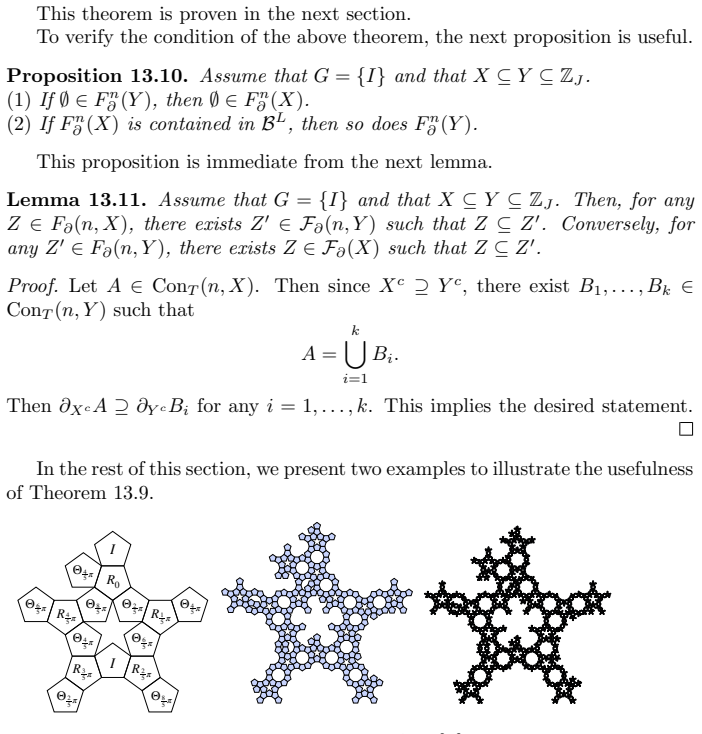
Directly test the equivalent knight-move condition on a concrete low-symmetry candidate, for instance the trivial-$G$ pentagon configuration of Example 13.12: compute $E_{M,p,m}(z)$ for a central cell $z$ and $E_{p,m}(u,v,T_k)$ for pairs far apart, and look for an unbounded ratio as $m$ grows for some $p>\dim_{\mathrm{AR}}(K,d^*)$; an unbounded ratio would disprove $p$-conductive homogeneity for that example.
Extended reading notes
Core claim
For a $G$-symmetric $J$-gon-based self-similar system satisfying one of the paper's sufficient conditions --- $J=3$ with no further assumptions, $G$ acting transitively on the full boundary index set $Z_J$, essential boundary segments $(Z_J)_e$ transitive when isolated contact points are absent, certain even-$J$ cases with $G=D_q$ or $G=\mathrm{Rot}_q$ governed by boundary-correspondence data, or the trivial-$G$ case governed by iterating a finite map $F_{\partial}$ on subsets of boundary segments --- the associated self-similar set $(K,d^*)$ is $p$-conductively homogeneous for every $p>\dim_{\mathrm{AR}}(K,d^*)$. A direct corollary is existence of Banach spaces $W_p$ that mimic $(1,p)$-Sobolev spaces, including density in continuous functions, Markov property, self-similar energy identity, and Hölder-type bounds. In the case $p=2$, $(\widehat{E}_2,W_2)$ is a strongly local regular Dirichlet form and the associated diffusion has a continuous heat kernel satisfying two-sided sub-Gaussian estimates; this gives Brownian motions on infinitely ramified self-similar sets whose global symmetry group can be trivial.
Load-bearing premise
The load-bearing assumption is that cells have no isolated contact points---single vertex intersections that disconnect the union of neighbouring cells---because that is what allows $E^*_n$-paths to be replaced by $E^{\ell}_n$-paths with only a bounded modulus loss, and without it the combinatorial route to the knight-move condition is not established.
Editorial extensions
If this is right
- Every $(J,G)$-s.s. system with $J=3$ is $p$-conductively homogeneous for $p>\dim_{\mathrm{AR}}(K,d^*)$, regardless of global symmetry, so the triangle-based family yields Sobolev spaces and diffusions without any symmetry assumptions.
- At $p=2$, conductive homogeneity produces a strongly local regular Dirichlet form with continuous heat kernel and two-sided estimates, giving Brownian motions on infinitely ramified polygon-based fractals whose isometry group may be trivial.
- The construction yields $W_p$ spaces with Markov property, density in $C(K)$, self-similar energy identity, and Hölder-type bounds, extending Sobolev-theoretic tools to fractals where upper-gradient methods fail.
- For even $J$, the boundary-correspondence conditions give a checkable finite criterion: whether certain subsets of boundary indices appear as $F_{\partial}$-images decides conductive homogeneity for $G=D_q$ or $G=\mathrm{Rot}_q$ systems without isolated contacts.
- For trivial $G$, the finite iteration of $F_{\partial}$ gives an algorithmic criterion (the three equivalent conditions $F_{\partial}1$--$F_{\partial}3$) that certifies $p$-conductive homogeneity for all $p>\dim_{\mathrm{AR}}(K,d^*)$.
Reading between the lines
- The paper leaves open whether the no-isolated-contact-point hypothesis in Theorem 6.11 is removable; since Theorems 6.3 and 6.11 are otherwise identical, the technical gap suggests testing transitivity of $(Z_J)_e$ on systems with vertex-only cell intersections.
- The $F_{\partial}$-iteration criterion in the trivial-$G$ case is effectively a finite-state automaton on subsets of $Z_J$; one could implement it as a combinatorial pre-screening for conductive homogeneity of a given polygon configuration.
- The existence of examples with trivial isometry group suggests conductive homogeneity is a local ratio property rather than a global symmetry property; a natural extension would be non-self-similar locally symmetric tilings obtained by varying contraction ratios cell by cell.
- For $p=2$, the two-sided heat kernel estimates contain an exponent $\beta_*$; computing $\beta_*$ numerically for the new examples would connect the construction to the spectral dimension and walk dimension of these diffusions.
Editorial analysis
A structured set of objections, weighed in public.
Referee Report
Summary. The paper introduces a class of self-similar sets called G-symmetric J-gon-based self-similar systems and gives sufficient conditions, in terms of the group G and the essential boundary segments (Z_J)_e, for the associated self-similar set (K,d*) to be p-conductively homogeneous for every p > dim_AR(K,d*). Conductive homogeneity is a sufficient condition, developed by the first author in [13], for constructing Sobolev-type spaces W_p and, when p=2, a strongly local regular Dirichlet form with continuous heat kernel and two-sided estimates, hence a Brownian motion. The main theorems are Theorem 6.1 (J=3, no extra condition), Theorem 6.3 (G-transitive action on Z_J), Theorem 6.11 (G-transitive action on (Z_J)_e, no isolated contact points), Theorem 10.2 (even J, G=Rot_q or D_q, a contrapositive condition in terms of boundary components), and Theorem 13.9 (G={I}, no isolated contact points, a condition on iterations of the boundary map F_∂). The proofs reduce conductive homogeneity to the knight-move condition of Theorem 5.9 through two backbone theorems, Theorems 7.2 and 8.8, which assert the existence of connected sets with sufficiently large essential boundary in certain unions of paths.
Significance. If correct, the paper substantially enlarges the class of infinitely ramified self-similar sets known to admit Brownian motions and p-energy Sobolev spaces, and it does so in a direction that is novel: the examples may have trivial global isometry group, in contrast to the Sierpinski carpet, unconstrained carpets, and the Octa-carpet. The sufficient conditions are expressed in finite combinatorial data (the action of G on Z_J and the iterates of F_∂), making them checkable for concrete configurations, as demonstrated in Examples 10.3–10.5 and 13.12–13.13. The paper builds on the published theory of [13] rather than re-deriving it, and the overall proof architecture via conductance constants, neighbor disparity constants, and the knight-move condition is clear and well organized. However, the central combinatorial backbone theorem, Theorem 8.8, contains a proof gap (see Major Comment 1), and a load-bearing existence assertion for J=5 rests on a private communication (see Major Comment 2); these issues must be resolved before the results can be considered established.
major comments (2)
- [Section 8, proof of Theorem 8.8] In the proof of Theorem 8.8, the 'general case' after Lemma 8.9 is only carried out under the supposition that every (T_m,E*_m)-connected subset A of the union in (8.2) has #(A)≤2; this is exactly the hypothesis of Lemma 8.10, which then reduces [γ]_n to an E^ℓ_n-path. The complementary case, where some connected A has #(A)≥3, is not treated. The theorem's conclusion requires a specific boundary condition (#(∂A)≥3 or ∂A={i,i+J/2}), and a connected set of three or more cells can have as few as two boundary segments (for example, a linear chain ending on one boundary segment). Consequently, the general case of Theorem 8.8 is not established as written. Since Theorem 8.8 is invoked in the proofs of Theorems 6.1, 6.3, 6.11, 10.2, and 13.9, the central sufficient conditions for conductive homogeneity are not fully supported.
- [Section 13, paragraph before Proposition 13.2] The assertion that 'there always exists a folding map for J=5' is attributed to [15], a private communication by K. Sasaya. This assertion is used to claim that one may assume G={I} without loss of generality if J=5. A private communication is not a citable proof for a mathematical existence statement. The authors should either prove this assertion, replace it with a public reference, or explicitly state that the paper's J=5 results do not depend on it; as written, the claim of generality for the J=5 case rests on unverifiable grounds.
minor comments (6)
- [Section 8, proof of Theorem 8.8] The expression '#((∂σF_n(bγ))e)⊆{α1,α2}' appears to contain a misplaced #; it should read '(∂σF_n(bγ))e ⊆ {α1,α2}'.
- [Section 11, title] The title 'Bondary correspondence' should be 'Boundary correspondence'.
- [Section 13, Proposition 13.2(1)] In Proposition 13.2(1), 'holding map' should be 'folding map'.
- [Section 6, Theorem 6.11] The statement of Theorem 6.11 says 'no contact point of cells'; this should be 'no isolated contact point of cells' to match Definition 4.1 and the surrounding text.
- [Section 2, Example 2.15] In Example 2.15, the phrase 'the corresponding octagons' should read 'the corresponding pentagons', since the example concerns J=5.
- [Section 4, proof of Lemma 4.3(2)] In the proof of Lemma 4.3(2), the sentence 'Therefore, (Γ_n(x), E^ℓ_n|Γ_n(x)) is disconnected for any n≥1' should presumably say 'connected for any n≥1' (or 'for some n'), given the logical structure of the proof.
Circularity Check
No significant circularity: the new combinatorial sufficient conditions are proven against the externally established [13] criterion, with no fitted parameters or assumed conclusion.
full rationale
The derivation chain is not circular. The target property, p-conductive homogeneity, is imported from [13] only as a definition and as an external criterion (Theorem 5.9, the knight-move condition); the paper never assumes that the specific (J,G)-systems are conductively homogeneous. The new work consists of combinatorial and topological sufficient conditions (Theorems 6.1, 6.3, 6.11, 7.2, 8.8, 10.2, 13.9) that construct connected sets A with prescribed essential boundary segments inside H(γ), and then use [13]'s modulus and conductance lemmas to verify the knight-move bound. No parameter is fitted to the target quantity, and no definition is formulated in terms of the conclusion. The reliance on the first author's prior monograph [13] is real but external: its assumptions do not include the conductive homogeneity of the new family, and the cited lemmas are stated independently of the present examples. The reported gap in the proof of Theorem 8.8 is a completeness or correctness concern, not a circular reduction.
Assumptions & free parameters
assumptions (4)
- standard math Standard iterated function system theory, including existence of the self-similar set and the open set condition dimension formula.
- domain assumption The conductive homogeneity framework of [13], including the energy construction, Theorem 5.6, Theorem 5.9, and Lemma C.4.
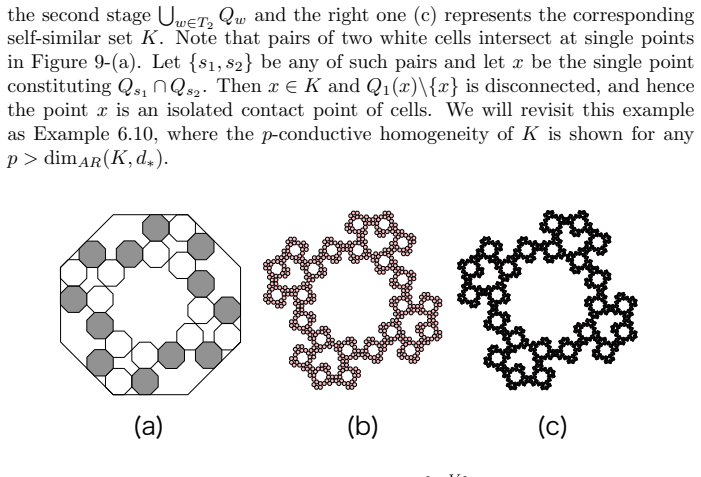
- domain assumption No isolated contact point of cells holds for the systems covered by Theorems 6.11, 10.2, and 13.9.
- ad hoc to paper For J=5, a folding map always exists, attributed to [15], a private communication by K. Sasaya.
Cite this review
Pith. "Pith review of Conductive homogeneity of locally symmetric polygon-based self-similar sets." pith.science (2026). https://pith.science/paper/NYHANMD2
@misc{pith2026250523057,
  author       = {Pith},
  title        = {Pith review of: Conductive homogeneity of locally symmetric polygon-based self-similar sets},
  year         = {2026},
  howpublished = {\url{https://pith.science/paper/NYHANMD2}},
  note         = {Machine review of arXiv:2505.23057}
}
read the original abstract
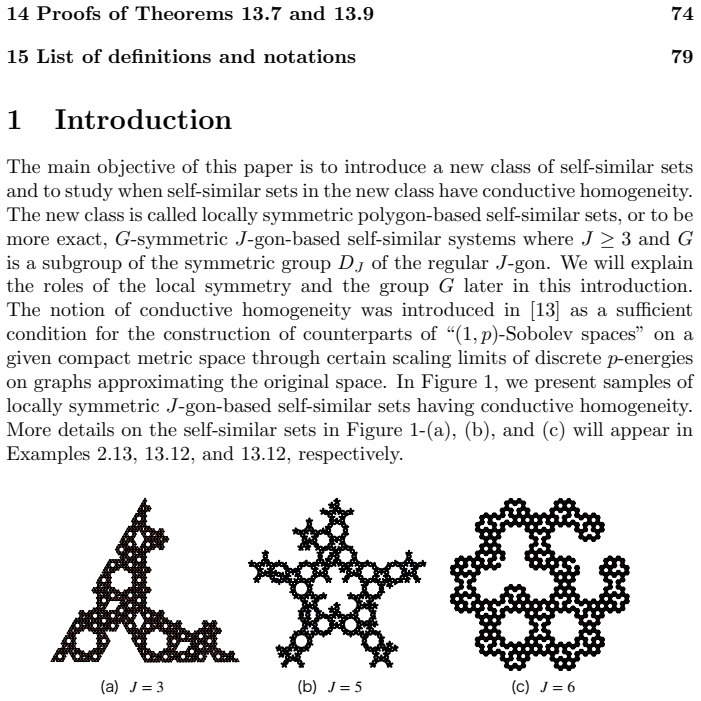
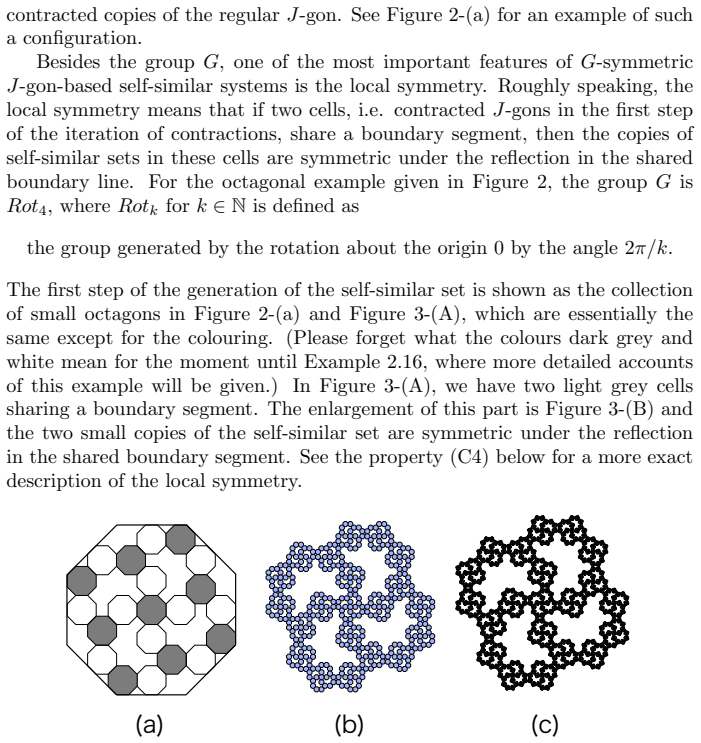
We provide a rich family of self-similar sets, called locally symmetric polygon-based self-similar sets, as examples of metric spaces having conductive homogeneity, which was introduced as a sufficient condition for the construction of counterparts of "Sobolev spaces" on compact metric spaces. In particular, our results imply the existence of "Brownian motions" on our family of self-similar sets at the same time. Unlike the known examples like the Sierpinski carpet by Barlow-Bass, unconstrained carpet by Cao and Qiu and the Octa-carpet by Andrews, our examples may have no global symmetries, i.e. the group of isometries is trivial.
Figures

Figures from the paper (16 more)






Reference graph
Works this paper leans on
- [15]
-
[13]
,Conductive homogeneity of compact metric spaces and construction ofp-energy, Mem. European Math. Soc.5(2023)
work page 2023
-
[1]
M. T. Barlow and R. F. Bass,The construction of Brownian motion on the Sierpinski carpet, Ann. Inst. Henri Poincar´ e25(1989), 225–257
work page 1989
- [2]
- [3]
- [4]
-
[5]
Cheeger,Differentiability of Lipschitz functions on metric measure spaces, Geom
J. Cheeger,Differentiability of Lipschitz functions on metric measure spaces, Geom. Funct. Anal.3(1999), 428–517
work page 1999
-
[6]
Haj lasz,Sobolev spaces on an arbitrary metric spaces, Pontential Anal- ysis5(1996), 403–415
P. Haj lasz,Sobolev spaces on an arbitrary metric spaces, Pontential Anal- ysis5(1996), 403–415. 82
work page 1996
Show all 16 references
-
[7]
Heinonen, P
J. Heinonen, P. Koskela, N. Shanmugalingam, and J. Tyson,Sobolev Spaces on Metric Measure Spaces - An Approach Based on Upper Gradients, New Mathematical Monographs, Cambridge University Press, 2015
2015
-
[8]
U. A. Andrews IV,Existence of diffusions on 4N-carpets, Doctoral Disser- tation, University of Connecticut, 2017
2017
-
[9]
Kajino and M
N. Kajino and M. Murugan,On the conformal walk dimension II: Non- attainment for some Sierpi´ nski carpets, in preparation
-
[10]
Math.231(2023), 263–405
,On the conformal walk dimension: Quasisymmetric uniformization for symmetric diffusions, Invent. Math.231(2023), 263–405
2023
-
[11]
Kigami,Analysis on Fractals, Cambridge Tracts in Math
J. Kigami,Analysis on Fractals, Cambridge Tracts in Math. vol. 143, Cam- bridge University Press, 2001
2001
-
[12]
,Geometry and Analysis of Metric Spaces via Weighted Partitions, Lecture Notes in Math. vol. 2265, Springer, 2020
2020
-
[14]
Ota,Conductive homogeneity of self-similar sets; a new class of exam- ples, Doctoral Dissertation, Kyoto University, 2025
Y. Ota,Conductive homogeneity of self-similar sets; a new class of exam- ples, Doctoral Dissertation, Kyoto University, 2025
2025
-
[16]
Shanmugalingam,Newtonian spaces: an extension of Sobolev spaces to metric measure spaces, Rev
N. Shanmugalingam,Newtonian spaces: an extension of Sobolev spaces to metric measure spaces, Rev. Mat. Iberoamer.16(2000), 243–279. 83
2000
Reviewed August 7, 2026 · model on record in the stance chip above.
Discussion (0). Sign in to comment.