REVIEW 5 major objections 7 minor 31 references
Bi-Residual Neural Network based Synchronous Motor Electrical Faults Diagnosis: Intra-link Layer Design for High-frequency Features
T0 review · 5 major / 7 minor · reviewed 2026-08-07 · deepseek-v4-flash
Pith's one-line read A shallow residual network with intra-layer shortcuts extracts high-frequency fault features from low-resolution noisy signals without adding parameters, and edges out ResNet18 on synchronous-motor data.
desk verdict A plausible, incremental fault-diagnosis architecture whose central accuracy claims rest on an unstated train/test split choice and no error bars; worth a careful referee but not ready as reported. read the letter →
The pith
A machine-rendered reading of the paper's core claim, the machinery that carries it, and where it could break.
The reading
What carries the argument
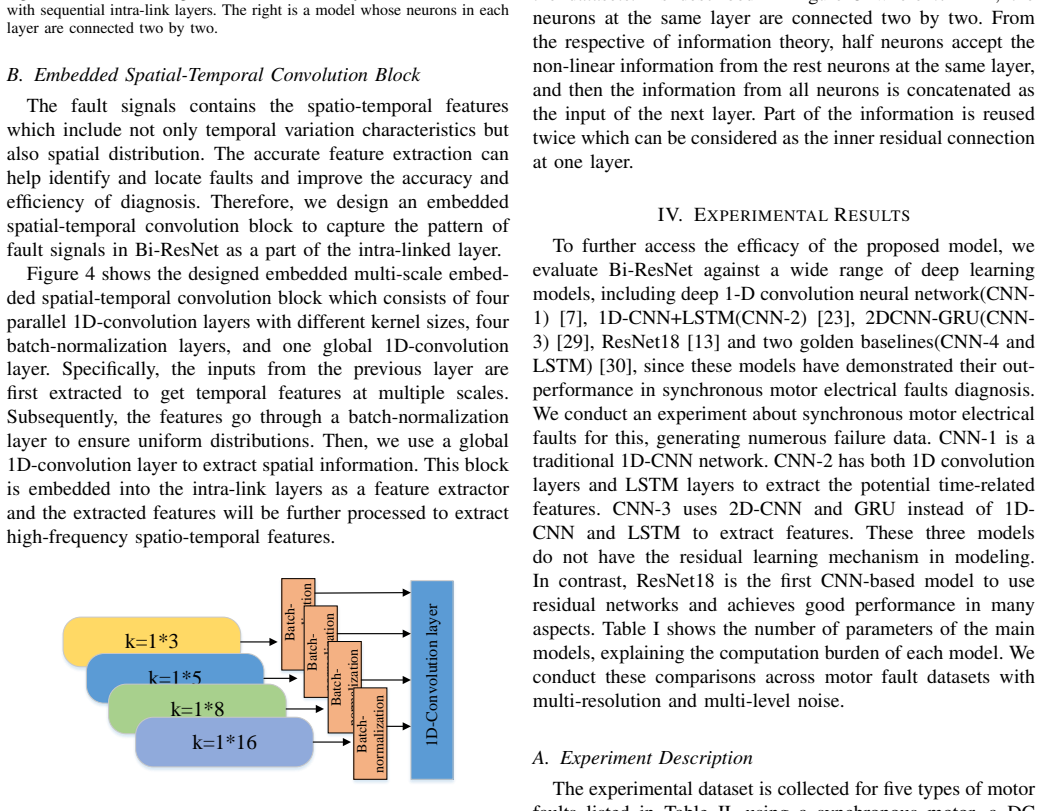
The load-bearing mechanism is the intra-linked layer: within one network layer, one neuron's pre-activation receives the previous layer's output plus the activated output of a neighboring neuron in the same layer, so the layer reuses its own information through a same-layer shortcut. With $m$ neurons in a layer and a hyperparameter $n$ controlling how many such connections exist, no new weights are introduced, only data paths, which the paper calls the network's height and a built-in sub-signal extractor. The second piece is the embedded spatial-temporal convolution block, four parallel 1D convolutions with kernel sizes 3, 5, 8 and 16 followed by a global 1D convolution, supplying multi-receptive-field temporal features for the intra-links. The name Bi-ResNet refers to this double residual structure: outer residual blocks between layers plus inner residual connections within a layer.
What would settle it
Hold out entire one-second fault events rather than individual time samples when constructing the 0.8:0.1:0.1 split, and repeat each model run across at least five random seeds. If Bi-ResNet's 94.15% versus 93.87% edge over ResNet18 at SNR -5 collapses within seed-to-seed variation, the claimed parameter-free high-frequency advantage is not established; inspecting whether any single event contributes both training and test samples would confirm whether temporal leakage is present.
Extended reading notes
Core claim
The central discovery is that residual shortcuts need not run only between layers; placing shortcuts between neurons in the same layer, termed intra-links, turns a shallow network into a built-in high-frequency extractor at zero additional parameter cost. Bi-ResNet combines these intra-links with an embedded spatial-temporal convolution block, made of parallel 1D convolution kernels of sizes 3, 5, 8 and 16 followed by a global 1D convolution, inside residual blocks. On the authors' synchronous-motor fault dataset, the resulting network, with about 1.05 million parameters, tracks or beats ResNet18, which has about 11.2 million parameters, and the gap grows when data are downsampled and white noise is added. Occlusion experiments show Bi-ResNet concentrating its attention on the fault-onset region where ResNet18 spreads attention over normal signal, supporting the claim that intra-links locate high-frequency fault components rather than merely improving classification.
Load-bearing premise
The load-bearing premise is that the 0.8:0.1:0.1 data split separates independent motor-fault events; if instead it cuts each one-second event's 10,000 time samples between training and test, temporally correlated samples leak across the split and inflate every reported accuracy, shrinking the true margin that Bi-ResNet's architecture actually earns.
Editorial extensions
If this is right
- On 10 ms sampled noisy data, Bi-ResNet holds 99.14% test accuracy while the best non-residual CNN sits at 96.86%, so coarse sampling hurts models without residual shortcuts more than it hurts Bi-ResNet.
- Across SNR levels from -5 to 5 dB, Bi-ResNet ranks first in every condition; at SNR -5 it reaches 94.15% versus 93.87% for ResNet18 and about 92.34% for the best non-residual CNN.
- Grafting intra-links onto CNN-1, CNN-2 and CNN-3 raises their accuracy by 0.46 to 1.97 percentage points at SNR -1 with 10 ms sampling, so the mechanism is portable across architectures.
- Ablation shows accuracy improves as the intra-link count rises from $n=0$ to $n=2$ and then declines by $n=4$, indicating a trade-off between the number of intra-links and input signal complexity.
- Because intra-links add no weights, the paper attributes the gains to architecture rather than model capacity, which is the core reason shallow networks can approach deep-network performance.
Reading between the lines
- Editorial inference: if intra-links act as a frequency prior, Bi-ResNet's margin over ResNet18 should be largest for fault classes with abrupt, localized transients such as opened phases and short circuits, and smallest for slow-drift faults; this can be tested class by class on the same dataset.
- Editorial inference: the reported single-run accuracies carry no error bars, so the decisive comparison is whether the SNR -5 gap of 0.28 percentage points survives multiple random seeds and an experiment-level split; such a test would support the parameter-free high-frequency claim far more strongly than the current tables.
- Editorial inference: the same intra-link construction should transfer to other one-dimensional industrial signals such as vibration, acoustic emission, or partial-discharge waveforms, where high-frequency burst features matter, but the paper only demonstrates motor current and voltage.
Editorial analysis
A structured set of objections, weighed in public.
Referee Report
Summary. The paper proposes Bi-ResNet, a residual network with intra-layer shortcut connections (intra-links) and a multi-scale spatial-temporal convolution block, for synchronous motor electrical fault diagnosis. The central claim is that intra-links act as a parameter-free high-frequency feature extractor, enabling a shallow network to match or exceed a deep ResNet18 on noisy, low-resolution fault data. Experiments compare six models across sample times (1-20 ms) and SNR levels (-5 to 5 dB) on a motor fault dataset, plus ablation studies varying the intra-link count n and the presence of the spatial-temporal block. Reported results show Bi-ResNet achieving the highest test accuracy in most settings, e.g., 94.15% vs 93.87% for ResNet18 at SNR -5 (Table V).
Significance. If the central claims hold, the parameter-free intra-link design would be an interesting contribution for resource-constrained fault diagnosis, and the systematic evaluation across multiple resolutions and SNR levels is a strength. The paper provides a real-life dataset, multiple baselines, and ablation experiments, and the intra-link idea is simple and potentially extensible. However, the significance is currently limited by the absence of statistical rigor (no error bars, confidence intervals, or multiple-seed runs), an unspecified data-split granularity that creates a temporal-leakage risk, and a high-frequency mechanism that is asserted rather than directly measured. The reported margins over ResNet18 are often small (e.g., 0.28 percentage points at SNR -5), which makes the comparative ranking vulnerable to implementation and evaluation details.
major comments (5)
- [Section IV.B, Section IV.A] The dataset split is stated only as a 0.8:0.1:0.1 ratio (Section IV.B), with no indication of whether the split is performed at the experiment level (one-second events) or at the sample/window level. Section IV.A states that each experiment contains 10,000 samples from the same one-second fault event. If the split is sample- or window-level, highly correlated or overlapping segments from the same event appear in both training and test sets, inflating all reported accuracies and potentially erasing the small margins over ResNet18 (e.g., 94.15% vs 93.87% at SNR -5 in Table V). No error bars, confidence intervals, or multiple-seed runs are reported anywhere in the paper, so the comparative ranking cannot be distinguished from split-induced leakage or random seed variation. This issue is load-bearing because the paper's central empirical claim is precisely this ranking.
- [Section IV.D.1, Table V] The text states that 'Bi-ResNet takes the lead by the largest margin, i.e., surpassing the second place ResNet18 by over 1% and the third place by about 3%'. However, Table V shows that at SNR -5 the margin over ResNet18 is 0.28 percentage points (94.15% vs 93.87%), and margins over 1% occur only at SNR -3 and -1. The claim as written overstates the advantage in the most challenging condition, which is exactly the condition the paper emphasizes.
- [Section IV.C, Section IV.D.2, Section IV.E.2] The paper repeatedly states that intra-links are a 'built-in high-frequency extractor' (Abstract, Section I, Section III.A) and that residual learning captures high-frequency components, but no frequency-domain analysis is provided to support this claim. The occlusion experiment (Fig. 8) demonstrates feature localization, not frequency extraction, and the ablation in Table IX shows only a 0.07 percentage point difference (99.14% vs 99.07%) when the spatial-temporal block is removed, which is within likely noise. To substantiate the central mechanism, the authors should measure the frequency content of learned features (e.g., via spectral analysis of feature maps or input-output sensitivity) and compare intra-link variants against a baseline with matched capacity.
- [Section III.A, Eq. (4)] Eq. (4) defines the intra-link pre-activation g_j^i as depending on g_{j+1}^i, creating a sequential chain within a layer. The paper does not specify how this chain is computed in the forward pass (e.g., order, boundary handling) or how gradients flow through this recurrence during backpropagation. In addition, the described mode n=1 ('neurons connected two by two') does not match the chain structure in the left panel of Figure 3, which appears to show a full sequential mode. This ambiguity prevents reproduction of the architecture and makes it unclear whether the reported improvements are due to the intra-link connectivity itself or to implementation details.
- [Section IV.E.1, Table VIII] The text claims that 'with the increase of n, the test accuracy also increases in all models', but Table VIII shows non-monotonic behavior: e.g., CNN-2 peaks at n=2 (96.94%) and drops to 96.14% at n=4, and Bi-ResNet peaks at n=2 (99.32%) before declining to 98.89% at n=4. The subsequent explanation that 'the potential computing power is dispersed into useless high-frequency component extraction' is post-hoc and not supported by any measurement. The asserted trade-off between intra-link number n and input data complexity is not established by the data presented.
minor comments (7)
- [Global] There are several typos and wording issues: 'PRMOF' in the Table I caption, 'SRNs' in the Table V caption, 'bath-normalization' in the Figure 5 description, 'access' instead of 'assess' in the opening of Section IV, and 'trade-off trade-off' in the Conclusion.
- [Section IV.A] The paper states that each experiment contains 10,000 samples and 10 features, but it does not describe how these samples are formed into input examples (window length, stride, normalization, and whether windows overlap). This information is essential for reproducibility and for interpreting the leakage risk.
- [Table I] Table I lists only CNN-1, CNN-2, CNN-3, Bi-ResNet, and ResNet18; the two baselines CNN-4 and LSTM are omitted. Their parameter counts should be included, or the table caption should explain why they are absent.
- [Table III] The notation 'Bi-residual block (*2)' appears four times with filter sizes 32, 64, 128, and 256. Please clarify whether each stage contains two repeated blocks, and specify the number of intra-links (n) used in each stage.
- [Abstract and Section IV] The paper counts 'five advanced CNN-based models and two baselines', but the model list includes CNN-4, which is also a CNN baseline. The taxonomy of advanced models versus baselines is confusing and should be clarified.
- [Section III.B] The 'spatial-temporal' block is implemented with 1D convolutions; the term 'spatial' is not defined. Please clarify how the spatial dimension is represented (e.g., treating feature channels as spatial locations).
- [Section IV.B] The paper motivates the work by resource-constrained environments, but it does not report training/inference time or FLOPs for the compared models. Adding a computational-cost comparison would strengthen the practical claims.
Circularity Check
No circular reduction: Bi-ResNet is evaluated against independent baselines, and the self-citation to dataset [30] is not load-bearing.
full rationale
The paper's central claims are architectural and empirical: Bi-ResNet introduces intra-linked layers and an embedded spatial-temporal convolution block, and its effectiveness is asserted through comparisons with ResNet18, plain CNNs, CNN-LSTM/GRU hybrids, and LSTM baselines. None of the reported accuracies are derived from the architecture's definition; the intra-link layer is a concrete structural modification (neurons at the same layer connected by shortcuts), not a fitted parameter renamed as a prediction. The 'high-frequency extractor' language is an interpretive label for the residual/shortcut mechanism, not a quantity defined so that the outcome is true by construction. The only self-citation is to the public synchronous-motor fault dataset and reference classifiers [30]; this is used as an experimental resource and baseline source, not as a uniqueness theorem or as the justification for the proposed architecture. Even if the unspecified train/validation/test split granularity or small accuracy margins raise validity concerns, those are experimental-design questions, not circularity: the model's output is not encoded in the input definitions or in a self-citation chain. Therefore the derivation chain is self-contained against external benchmarks, and no load-bearing circular step is exhibited.
Assumptions & free parameters
free parameters (1)
- intra-link number n =
1 (used for deployment); 2 is best in ablation
assumptions (3)
- domain assumption Residual learning is equivalent to learning high-frequency components in the input signal.
- ad hoc to paper Intra-layer shortcuts (Eq. 4) act as a built-in high-frequency extractor without adding parameters.
- domain assumption The train/test split yields independent and identically distributed samples.
Cite this review
Pith. "Pith review of Bi-Residual Neural Network based Synchronous Motor Electrical Faults Diagnosis: Intra-link Layer Design for High-frequency Features." pith.science (2026). https://pith.science/paper/JJSLZSGE
@misc{pith2026250523097,
  author       = {Pith},
  title        = {Pith review of: Bi-Residual Neural Network based Synchronous Motor Electrical Faults Diagnosis: Intra-link Layer Design for High-frequency Features},
  year         = {2026},
  howpublished = {\url{https://pith.science/paper/JJSLZSGE}},
  note         = {Machine review of arXiv:2505.23097}
}
read the original abstract
In practical resource-constrained environments, efficiently extracting the potential high-frequency fault-critical information is an inherent problem. To overcome this problem, this work suggests leveraging a bi-residual neural network named Bi-ResNet to extract the inner spatial-temporal high-frequency features using embedded spatial-temporal convolution blocks and intra-link layers. It can be considered as embedding a high-frequency extractor into networks without adding any parameters, helping shallow networks achieve the performance of deep networks. In our experiments, five advanced CNN-based neural networks and two baselines across a real-life dataset are utilized for synchronous motor electrical fault diagnosis to demonstrate the effectiveness of Bi-ResNet including one analytical, comparative, and ablation experiments. The corresponding experiments show: 1) The Bi-ResNet can perform better on low-resolution noisy data. 2) The proposed intra-links can help high-frequency components extraction and location from raw data. 3) There is a trade-off between intra-link number and input data complexity.
Figures


Figures from the paper (5 more)


Reference graph
Works this paper leans on
-
[24]
G. Chen, P. Peng, L. Ma, J. Li, L. Du, and Y . Tian, “Amplitude-phase recombination: Rethinking robustness of convolutional neural networks in frequency domain,” inProceedings of the IEEE/CVF International Conference on Computer Vision, 2021, pp. 458–467
work page 2021
-
[1]
E. A. Bhuiyan, M. M. A. Akhand, S. K. Das, M. F. Ali, Z. Tasneem, M. R. Islam, D. Saha, F. R. Badal, M. H. Ahamed, and S. Moyeen, “A survey on fault diagnosis and fault tolerant methodologies for permanent magnet synchronous machines,”International Journal of Automation and Computing, vol. 17, pp. 763–787, 2020
work page 2020
-
[2]
Motor fault diagnostics based on current signatures: A review,
G. Niu, X. Dong, and Y . Chen, “Motor fault diagnostics based on current signatures: A review,”IEEE Transactions on Instrumentation and Measurement, vol. 72, pp. 1–19, 2023
work page 2023
-
[3]
C. Gao, B. Gao, X. Xu, J. Si, and Y . Hu, “Automatic demagnetization fault location of direct-drive permanent magnet synchronous motor using knowledge graph,”IEEE Transactions on Instrumentation and Measurement, vol. 73, pp. 1–12, 2024
work page 2024
-
[4]
M. Jim ´enez-Guarneros, C. Morales-Perez, and J. d. J. Rangel- Magdaleno, “Diagnostic of combined mechanical and electrical faults in asd-powered induction motor using modwt and a lightweight 1-d cnn,”IEEE Transactions on Industrial Informatics, vol. 18, no. 7, pp. 4688–4697, 2022
work page 2022
-
[5]
A. Mohammad-Alikhani, B. Nahid-Mobarakeh, and M.-F. Hsieh, “One- dimensional lstm-regulated deep residual network for data-driven fault detection in electric machines,”IEEE Transactions on Industrial Elec- tronics, vol. 71, no. 3, pp. 3083–3092, 2024
work page 2024
-
[6]
Data-driven early fault diagnostic methodology of permanent magnet synchronous motor,
B. Cai, K. Hao, Z. Wang, C. Yang, X. Kong, Z. Liu, R. Ji, and Y . Liu, “Data-driven early fault diagnostic methodology of permanent magnet synchronous motor,”Expert Systems with Applications, vol. 177, p. 115000, 2021
work page 2021
-
[7]
J. Guo, Q. He, and F. Gu, “Dnocnet: A novel end-to-end network for induction motor drive systems fault diagnosis under speed fluctuation condition,”IEEE Transactions on Industrial Informatics, vol. 20, no. 6, pp. 8284–8293, 2024
work page 2024
Show all 31 references
-
[8]
Fault diagnosis in a permanent magnet syn- chronous motor using deep learning,
P. Quseiri Darbandeh, “Fault diagnosis in a permanent magnet syn- chronous motor using deep learning,” Ph.D. dissertation, Helmut- Schmidt-Universit¨at/Universit¨at der Bundeswehr Hamburg, 2024
2024
-
[9]
Custom phase space reconstruction image-driven fault diagnosis for pmsm under few-labeled samples,
J. Xie, X. Zhang, D. Luo, G. Qin, and F. Huang, “Custom phase space reconstruction image-driven fault diagnosis for pmsm under few-labeled samples,”IEEE Transactions on Power Electronics, vol. 39, no. 2, pp. 2731–2740, 2024
2024
-
[10]
Auto-encoding variational bayes,
D. P. Kingma and M. Welling, “Auto-encoding variational bayes,”
-
[11]
Demagnetization fault diagnosis of permanent magnet synchronous motors using magnetic leakage signals,
F. Huang, X. Zhang, G. Qin, J. Xie, J. Peng, S. Huang, Z. Long, and Y . Tang, “Demagnetization fault diagnosis of permanent magnet synchronous motors using magnetic leakage signals,”IEEE Transactions on Industrial Informatics, vol. 19, no. 4, pp. 6105–6116, 2023
2023
-
[12]
A comprehensive inter- turn fault severity diagnosis method for permanent magnet synchronous motors based on transformer neural networks,
F. Parvin, J. Faiz, Y . Qi, A. Kalhor, and B. Akin, “A comprehensive inter- turn fault severity diagnosis method for permanent magnet synchronous motors based on transformer neural networks,”IEEE Transactions on Industrial Informatics, vol. 19, no. 11, pp. 10 923–10 933, 2023
2023
-
[13]
Deep residual learning for image recognition,
K. He, X. Zhang, S. Ren, and J. Sun, “Deep residual learning for image recognition,” inProceedings of the IEEE conference on computer vision and pattern recognition, 2016, pp. 770–778
2016
-
[14]
Learning strict identity mappings in deep residual networks,
X. Yu, Z. Yu, and S. Ramalingam, “Learning strict identity mappings in deep residual networks,” inProceedings of the IEEE Conference on Computer Vision and Pattern Recognition (CVPR), June 2018
2018
-
[15]
On residual networks learning a perturbation from identity,
M. Hauser, “On residual networks learning a perturbation from identity,” 2019. [Online]. Available: https://arxiv.org/abs/1902.04106
2019 arXiv
-
[16]
Stochastic training of residual networks: a differential equation viewpoint,
Q. Sun, Y . Tao, and Q. Du, “Stochastic training of residual networks: a differential equation viewpoint,”ArXiv, vol. abs/1812.00174, 2018. [Online]. Available: https://api.semanticscholar.org/CorpusID:54439624
2018 arXiv
-
[17]
Do residual neural networks discretize neural ordinary differential equations?
M. Sander, P. Ablin, and G. Peyr ´e, “Do residual neural networks discretize neural ordinary differential equations?” inAdvances in Neural Information Processing Systems, S. Koyejo, S. Mohamed, A. Agarwal, D. Belgrave, K. Cho, and A. Oh, Eds., vol. 35. Curran Associates, Inc.,...
2022
-
[18]
Generalization bounds for neural ordinary differential equations and deep residual networks,
P. Marion, “Generalization bounds for neural ordinary differential equations and deep residual networks,” inAdvances in Neural Information Processing Systems, A. Oh, T. Naumann, A. Globerson, K. Saenko, M. Hardt, and S. Levine, Eds., vol. 36. Curran Associates, Inc., 2023, pp....
2023
-
[19]
High frequency residual learning for multi-scale image classification,
B. Cheng, R. Xiao, J. Wang, T. Huang, and L. Zhang, “High frequency residual learning for multi-scale image classification,”arXiv preprint arXiv:1905.02649, 2019
1905 arXiv
-
[20]
Residual frequency content awareness approach for image super resolution,
Inderjeet and J. S. Sahambi, “Residual frequency content awareness approach for image super resolution,” in2024 National Conference on Communications (NCC), 2024, pp. 1–6
2024
-
[21]
Hfgn: High- frequency residual feature guided network for fast mri reconstruction,
F. Fang, L. Hu, J. Liu, Q. Yi, T. Zeng, and G. Zhang, “Hfgn: High- frequency residual feature guided network for fast mri reconstruction,” Pattern Recognition, vol. 156, p. 110801, 2024
2024
-
[22]
The potentiality of integrating model-based residuals and machine-learning classifiers: An induction motor fault diagnosis case,
W. Purbowaskito, C.-y. Lan, and K. Fuh, “The potentiality of integrating model-based residuals and machine-learning classifiers: An induction motor fault diagnosis case,”IEEE Transactions on Industrial Informat- ics, vol. 20, no. 2, pp. 2822–2832, 2024
2024
-
[23]
An efficient approach based on a novel 1d-lbp for the detection of bearing failures with a hybrid deep learning method,
Y . Kaya, M. Kuncan, E. Akcan, and K. Kaplan, “An efficient approach based on a novel 1d-lbp for the detection of bearing failures with a hybrid deep learning method,”Applied Soft Computing, vol. 155, p. 111438, 2024
2024
-
[25]
Shift-invariant pattern recognition neural network and its optical architecture,
W. Zhang, J. Tanida, K. Itoh, and Y . Ichioka, “Shift-invariant pattern recognition neural network and its optical architecture,” inProceedings of annual conference of the Japan Society of Applied Physics, vol. 564. Montreal, CA, 1988
1988
-
[26]
G ´eron,Hands-on machine learning with Scikit-Learn, Keras, and TensorFlow
A. G ´eron,Hands-on machine learning with Scikit-Learn, Keras, and TensorFlow. ” O’Reilly Media, Inc.”, 2022
2022
-
[27]
Understand- ing batch normalization,
N. Bjorck, C. P. Gomes, B. Selman, and K. Q. Weinberger, “Understand- ing batch normalization,”Advances in neural information processing systems, vol. 31, 2018
2018
-
[28]
Multiscale kernel based residual convolutional neural network for motor fault diagnosis under nonstationary conditions,
R. Liu, F. Wang, B. Yang, and S. J. Qin, “Multiscale kernel based residual convolutional neural network for motor fault diagnosis under nonstationary conditions,”IEEE Transactions on Industrial Informatics, vol. 16, no. 6, pp. 3797–3806, 2020
2020
-
[29]
Fault diagnosis of asynchronous motors based on 2dcnn-gru network optimization,
Z. Li, P. Wang, and X. Li, “Fault diagnosis of asynchronous motors based on 2dcnn-gru network optimization,” in2023 CAA Symposium on Fault Detection, Supervision and Safety for Technical Processes (SAFEPROCESS). IEEE, 2023, pp. 1–6
2023
-
[30]
A public data-set for synchronous motor electrical faults diagnosis with cnn and lstm reference classifiers,
Z. Sun, R. Machlev, Q. Wang, J. Belikov, Y . Levron, and D. Baimel, “A public data-set for synchronous motor electrical faults diagnosis with cnn and lstm reference classifiers,”Energy and AI, vol. 14, p. 100274, 2023
2023
-
[2022]
Available: https://arxiv.org/abs/1312.6114
[Online]. Available: https://arxiv.org/abs/1312.6114
Reviewed August 7, 2026 · model on record in the stance chip above.
Discussion (0). Sign in to comment.