REVIEW 3 major objections 5 minor 58 references
A parallel algorithm for the computation of the Jones polynomial
T0 review · 3 major / 5 minor · reviewed 2026-08-07 · deepseek-v4-flash
Pith's one-line read A parallel algorithm computes the exact Jones polynomial by subdividing diagrams into linkoid pieces and gluing their states with a closed-form formula, cutting time exponentially with processor count.
desk verdict The subdivision-and-gluing formalism is real, but the exponential speedup claim rests on an unproven strand-count assumption; worth a demanding review, not immediate acceptance. read the letter →
The pith
A machine-rendered reading of the paper's core claim, the machinery that carries it, and where it could break.
The reading
What carries the argument
The load-bearing object is the linkoid, an open-arc diagram with free endpoints, together with its state permutations. Each smoothing of a piece's crossings produces a state consisting of circles and open strands that pair up endpoints; that pairing is the state permutation $\tau_S$. Grouping all states with the same permutation collapses the exponentially many bracket states of a piece into at most $C_c$ classes. Reassembly is carried out through the gluing permutation $\sigma$ and the segment-cycle count $|E/\langle \prod_i \tau_{S_i}, \sigma\rangle|$, which expresses how many closed loops are formed when the pieces' endpoint pairings are composed with the gluing that rebuilds the original knot. The parallel algorithm alternates between evaluating pieces and performing Cartesian products of permutation classes, with the classes merged at each level.
What would settle it
Take a family of $n$-crossing diagrams whose underlying planar graphs are rectangular grids, recursively bisect each into $2^m$ pieces using the minimum-bisection routine, and count the maximum number of boundary strands per piece for $m=1,2,3,\dots$; if that number stays $\Theta(\sqrt{n})$ rather than dropping toward $n/2^{m+1}$, then the Catalan-number bound on per-piece states and the claimed recombination cost are invalid for that family, and the quoted exponential speedup in the processor count would not hold.
Extended reading notes
Core claim
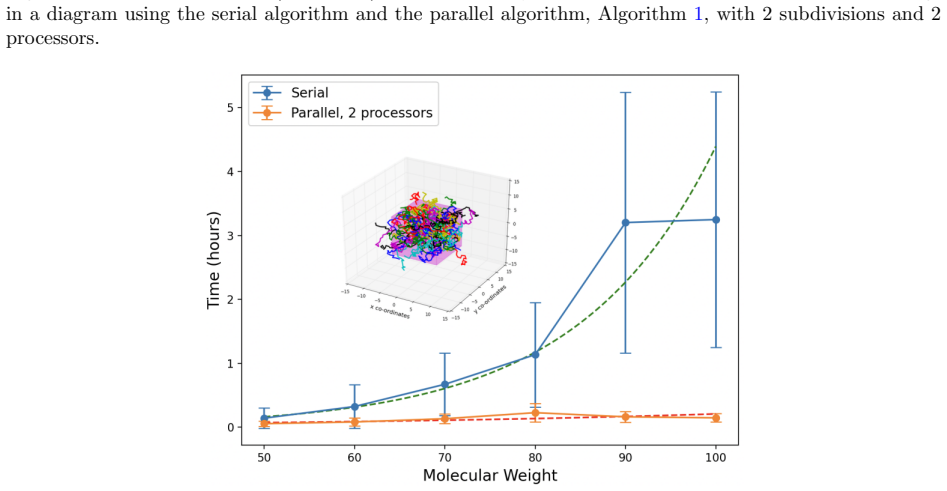
The paper's central claim is that the exact Jones polynomial of any knot, link, knotoid, linkoid, or collection of open curves can be computed by a divide-and-conquer scheme. A diagram $L$ with $n$ crossings is cut into $2^m$ linkoid pieces $L_i$; each piece's Kauffman bracket state sum is evaluated in parallel, and states that share the same pairing of endpoints (the same state permutation $\tau_{S_i}$) are collected into one class with a combined polynomial coefficient. The pieces are then glued back together in $m$ parallel rounds. The gluing is governed by Theorem 3.1's closed formula, in which the bracket polynomial of the whole diagram is a sum over tuples of piece states of $\prod_i A^{\alpha(S_i)} d^{|S_i|} d^{|E/\langle \prod_i \tau_{S_i}, \sigma\rangle|-1}$, where $\sigma$ is the gluing permutation and the last factor counts how many segment cycles the state endpoints form under the combined permutations. Because the number of distinct state permutations per piece is bounded by the Catalan number $C_c=\frac{1}{c+1}\binom{2c}{c}$, the per-piece work is roughly $2^{n/2^m}$, and the claimed total time is $O(2^{n/2^m+1}) + O(2^{n/\sqrt{2^m}-m})$ (or, with cutwidth-optimal subdivision, approximately $O(2^{n/2^m+1})+O(2^{C\sqrt{32n}-m})$ with $C=6\sqrt2+5\sqrt3$). The paper presents this as, to the authors' knowledge, the first parallel algorithm for exact Jones polynomial computation, and the abstract states that it reduces computational time by an exponential factor depending on the number of processors.
Load-bearing premise
The argument relies on the unproved assertion, labeled 'without loss of generality' in the proof of Theorem 3.2, that a diagram can be split into $2^m$ pieces with at most about $n/2^{m+1}$ strands crossing each piece's boundary; if some diagrams force $\Omega(\sqrt{n})$ boundary strands per piece no matter how finely they are split, the recombination step will be much slower than claimed.
Editorial extensions
If this is right
- With $p=2^m$ processors, the per-processor time drops from $O(2^n)$ to roughly $O(2^{n/p})$, so knots and link diagrams with far more crossings become computationally accessible than with the serial state-sum expansion.
- The same algorithm handles open curves and linkoids, so the Jones polynomial can be used as an entanglement measure for polymer melts, proteins, and other filamentous data with free ends, not just closed knots.
- The reassembly formula expresses the Jones polynomial of a glued diagram as a linear combination of Jones polynomials of the virtual spectrum of any single linkoid piece, which ties the complexity of a knot to the complexity of its constituent pieces.
- In special cases, such as when a piece is a disjoint union of knotoids or its virtual spectrum contains only trivial links, the whole invariant reduces to the Jones polynomial of the complementary piece with a modified closure.
- The subdivision, state-grouping, and parallel reassembly template is transferable to other state-sum invariants, and the paper explicitly points to the Arrow polynomial and Khovanov homology.
Reading between the lines
- If recursive bisection cannot keep the number of boundary strands small on worst-case diagrams, the recombination term could dominate and the benefit of extra processors might saturate; the paper's proof assumes without demonstration that the required subdivision exists.
- The same grouping-by-state-permutation idea could be applied to other invariants whose skein or state-sum expansion has a gluing formula, such as HOMFLY-PT or the Arrow polynomial; the paper suggests the extension but does not develop those algorithms.
- For open-curve data, where the Jones polynomial is an average over projections, the parallel algorithm makes per-projection computation cheap enough that one could empirically study the full distribution of the invariant across projections, not just its mean.
Editorial analysis
A structured set of objections, weighed in public.
Referee Report
Summary. The paper proposes a parallel divide-and-conquer algorithm for the exact computation of the Jones polynomial of knots, links, knotoids, linkoids, and collections of open curves in 3-space. The method subdivides a diagram into 2^m linkoid pieces, computes the bracket state sum on each piece in parallel, groups states by the induced endpoint permutations, and recombines the grouped states through a gluing permutation. The main theoretical claim is Theorem 3.2, which states a time complexity of O(2^{n/2^m + 1}) + O(2^{n/\sqrt{2^m} - m}) on 2^m processors, with cutwidth- and treewidth-based variants in Corollaries 3.1 and 3.2. The paper also reports numerical experiments on knot diagrams and on linear polymer melts, and it makes an implementation available on GitHub.
Significance. If the complexity claims were correct, this would be a significant contribution to computational knot theory, since the Jones polynomial is #P-hard and existing exact algorithms are exponential in the number of crossings. The state-sum regrouping identity in Theorem 3.1 is a correct and potentially useful reformulation of the bracket polynomial in terms of linkoid pieces, and the availability of an open-source implementation with experiments on open curves is a practical strength. However, the central exponential-speedup claim depends on an unjustified and internally contradicted assumption about the number of strands in subdivided pieces; as a result, the main theoretical result is not established by the manuscript.
major comments (3)
- [§3, proof of Theorem 3.2, paragraph before Eq. (10)] The 'Without loss of generality' reduction to a 2^{m/2} × 2^{m/2} grid with each piece having c strands is not a WLOG statement; it imposes a strong structural assumption on the subdivision. More seriously, the subsequent assertion c ≤ n/2^{m+1} is not proven and is contradicted by the paper's own Lemma 8.1, which states that a loopless linkoid piece with x crossings has x+1 strands. Braid-like tangles, which occur as pieces of arbitrary diagrams, have c ≈ x = n/2^m, not c ≤ n/2^{m+1}. Since Eq. (11) obtains the recombination term O(2^{n/\sqrt{2^m} - m}) precisely by substituting c = n/2^{m+1}, the exponential speedup claimed in Theorem 3.2 is unsupported.
- [Corollary 3.1 and proof, Eq. (12)] The inference that each subdivided piece L_i has C√(n/2^{m-5}) boundary points and C√(n/2^{m-3}) strands does not follow from the cited global cutwidth bound C√n for the whole diagram. Cutwidth bounds for the entire graph do not imply that a piece surviving m recursive bisections has cutwidth O(√(n/2^m)); a recursive separator construction can leave a piece with Θ(√n) boundary vertices regardless of m, because the top-level separator is inherited by all descendant pieces. Consequently the recombination term in Eq. (12), and the analogous term in Eq. (13), are not justified. This is a second independent gap in the complexity analysis.
- [Theorem 3.2 and Corollaries 3.1–3.2, overall complexity claim] Even apart from the strand-count bound, the relationship between the stated complexity and the claimed parallel speedup is not made precise. In Theorem 3.2 the second term O(2^{n/\sqrt{2^m} - m}) dominates the first term for every m ≥ 1, while in Corollary 3.1 the second term O(2^{C√(32n) - m}) is independent of m except for the additive -m factor in the exponent. The abstract's statement that the algorithm 'enables the reduction of the computational time by an exponential factor depending on the number of processors' is therefore ambiguous and should be reconciled with the dominant terms in Eqs. (11) and (12).
minor comments (5)
- [Introduction, §3, and Theorem 3.2] The notation for the second complexity term is inconsistent: the introduction writes O(2^{n√p - log p}) while Theorem 3.2 and Eq. (11) use O(2^{n/√(2^m) - m}); these are very different expressions and should be fixed.
- [§3, first paragraph and §4] The text refers to 'Theorem 4.1' when stating the closed-form expression for the Jones polynomial in terms of subdivided pieces; the correct reference is Theorem 3.1. The same misnumbering appears in Section 4.
- [Lemma 8.1] The statement of Lemma 8.1 should explicitly state the hypotheses under which the strand count is x+1, since the proof assumes a connected path-like structure with no disjoint components and no loops; these conditions are not satisfied by arbitrary linkoid pieces.
- [Algorithm 1, Step 1] The wording 'for i = 1 to m in parallel do' is misleading because the m levels of subdivision are sequential; only the pieces within one level are processed in parallel. The pseudocode should distinguish sequential levels from parallel loops.
- [References and typos] There are several small typographical issues, including 'Natoinal' in the acknowledgment and 'of of' in the introduction; reference [41] is cited as 'arXiv preprint, 2025' without an arXiv identifier.
Circularity Check
No circularity: the parallel state-sum formula is derived from the bracket definition, and the complexity estimates are analytic, not fitted or self-referential.
full rationale
The central derivation, Theorem 3.1, expresses the bracket polynomial of a glued linkoid diagram as a sum over products of constituent linkoid state contributions, with the segment-cycle factor |E/⟨∏τS_i,σ⟩| taken directly from Definition 2.4 and equation (7). This is an algebraic regrouping of the state-sum expansion, not a restatement of the desired output, so the main formula is self-contained. The complexity bound in Theorem 3.2 is an analytic estimate based on a stated partition of the diagram into 2^m pieces and a Catalan-number bound on distinct state permutations; it does not fit any parameter to the target result. Corollary 3.1 imports a known cutwidth bound from external sources ([21, 26]) and substitutes a per-piece strand count; whether that substitution is justified is a correctness or rigor concern, not circularity, because the cited bound does not include the paper's claimed speedup. The linkoid formalism and virtual spectrum from the authors' prior work ([6, 8]) is foundational but is independent, parameter-free mathematical theory with stated definitions and does not assume the Jones polynomial result being derived. There are no fitted parameters renamed as predictions, no load-bearing self-citation chain, and no known result merely relabeled. The unsupported 'without loss of generality' claim about per-piece strand counts is a potential gap in the proof of the complexity theorem, but it is not the kind of definitional or self-referential reduction that constitutes circularity under the stated rules.
Assumptions & free parameters
assumptions (4)
- domain assumption The Jones polynomial of linkoids and open curves, defined in [6,8], is a well-defined invariant under the relevant Reidemeister moves.
- standard math The number of distinct state permutations of a c-tangle is bounded by the c-th Catalan number.
- standard math A 4-valent planar graph on n vertices has a layout with cutwidth at most C*sqrt(n), and recursive planar bisection gives pieces with boundary size O(sqrt(n/2^m)).
- ad hoc to paper Any link diagram can be subdivided into 2^m pieces with at most n/2^(m+1) strands per piece, with endpoints uniformly distributed across boundaries.
Cite this review
Pith. "Pith review of A parallel algorithm for the computation of the Jones polynomial." pith.science (2026). https://pith.science/paper/BA226H25
@misc{pith2026250523101,
  author       = {Pith},
  title        = {Pith review of: A parallel algorithm for the computation of the Jones polynomial},
  year         = {2026},
  howpublished = {\url{https://pith.science/paper/BA226H25}},
  note         = {Machine review of arXiv:2505.23101}
}
read the original abstract
Knots, links and entangled filaments appear in many physical systems of interest in biology and engineering. Classifying knots and measuring entanglement is of interest both for advancing knot theory, as well as for analyzing large data that become available through experiments or Artificial Intelligence. In this context, the efficient computation of topological invariants and other metrics of entanglement becomes an urgent issue. The computation of common measures of topological complexity, such as the Jones polynomial, is #P-hard and of exponential time on the number of crossings in a knot(oid) (link(oid)) diagram. In this paper, we introduce the first parallel algorithm for the exact computation of the Jones polynomial for (collections of) both open and closed simple curves in 3-space. This algorithm enables the reduction of the computational time by an exponential factor depending on the number of processors. We demonstrate the advantage of this algorithm by applying it to knots, as well as to systems of linear polymers in a melt obtained from molecular dynamics simulations. The method is general and could be applied to other invariants and measures of complexity.
Figures


Figures from the paper (1 more)
Reference graph
Works this paper leans on
-
[1]
The Knot Book: An elementary introduction to the mathematical theory of knots
Colin Conrad Adams. The Knot Book: An elementary introduction to the mathematical theory of knots . American Mathematical Society, 2004
work page 2004
-
[2]
The BQP-hardness of approximating the Jones polynomial
Dorit Aharonov and Itai Arad. The BQP-hardness of approximating the Jones polynomial. New Journal of Physics , 13(3):035019, Mar 2011
work page 2011
-
[3]
A polynomial quantum algorithm for approximating the Jones polynomial
Dorit Aharonov, Vaughan Jones, and Zeph Landau. A polynomial quantum algorithm for approximating the Jones polynomial. In Proceedings of the Thirty-Eighth Annual ACM Symposium on Theory of Computing, page 427–436, New York, NY, USA, 2006. Association for Computing Machinery
work page 2006
-
[4]
J. Arsuaga, M. Vazquez, P. McGuirk, S. Trigueros, D. W. Sumners, and J. Roca. DNA knots reveal a chiral organization of DNA in phage capsids. The Proceedings of the National Academy of Sciences (USA), 102:9165–9169, 2005
work page 2005
-
[5]
Fast Khovanov homology computations
Dror Bar-Natan. Fast Khovanov homology computations. Journal of Knot Theory and Its Ramifications, 16(03):243–255, 2007
2007
-
[6]
K. Barkataki and E. Panagiotou. The Jones polynomial of collections of open curves in 3-space. Pro- ceedings of the Royal Society A: Mathematical, Physical and Engineering Sciences , vol. 478, no. 2267, 2022
work page 2022
-
[7]
K. Barkataki and E. Panagiotou. Parallel Jones polynomial computational package, 2025
work page 2025
-
[8]
Kauffman, and Eleni Panagiotou
Kasturi Barkataki, Louis H. Kauffman, and Eleni Panagiotou. The virtual spectrum of linkoids and open curves in 3-space. Journal of Knot Theory and Its Ramifications , 30(03), 2024
work page 2024
Show all 58 references
-
[9]
The Jones polynomial in systems with periodic boundary conditions
Kasturi Barkataki and Eleni Panagiotou. The Jones polynomial in systems with periodic boundary conditions. Journal of Physics A: Mathematical and Theoretical , 57(15):155202, 2024
2024
-
[10]
Topological gelation of reconnecting polymers
Andrea Bonato, Davide Marenduzzo, Davide Michieletto, and Enzo Orlandini. Topological gelation of reconnecting polymers. Proceedings of the National Academy of Sciences , 119(44):e2207728119, 2022
2022
-
[11]
Benjamin A. Burton. The HOMFLY-PT Polynomial is Fixed-Parameter Tractable. In Bettina Speck- mann and Csaba D. T´ oth, editors,34th International Symposium on Computational Geometry (SoCG 2018), volume 99 of Leibniz International Proceedings in Informatics (LIPIcs) , pages 18:...
2018
-
[12]
Burton, Ryan Budney, William Pettersson, et al
Benjamin A. Burton, Ryan Budney, William Pettersson, et al. Regina: Software for low-dimensional topology, 1999–2023
1999
-
[13]
Knot probabilities in random diagrams
Jason Cantarella, Harrison Chapman, and Matt Mastin. Knot probabilities in random diagrams. Journal of Physics A: Mathematical and Theoretical , 49(40):405001, 2016
2016
-
[14]
Open and closed random walks with fixed edgelengths in Rd
Jason Cantarella, Kyle Chapman, Philipp Reiter, and Clayton Shonkwiler. Open and closed random walks with fixed edgelengths in Rd. Journal of Physics A: Mathematical and Theoretical , 51(43):434002, 2018. 17
2018
-
[15]
‘Mind blowing’: quantum computer untangles the mathematics of knots
Davide Castelvecchi. ‘Mind blowing’: quantum computer untangles the mathematics of knots. Nature, 2025
2025
-
[16]
Mean unknotting times of random knots and embeddings
Yao-ban Chan, Aleksander L Owczarek, Andrew Rechnitzer, and Gordon Slade. Mean unknotting times of random knots and embeddings. Journal of Statistical Mechanics: Theory and Experiment , 2007(05):P05004, 2007
2007
-
[17]
The Book of Numbers
John H Conway and Richard Guy. The Book of Numbers . Springer Science & Business Media, 1998
1998
-
[18]
Parameterized algorithms
Marek Cygan, Fedor V Fomin, Lukasz Kowalik, Daniel Lokshtanov, D´ aniel Marx, Marcin Pilipczuk, Micha l Pilipczuk, and Saket Saurabh. Parameterized algorithms. Springer, 5(4), 2015
2015
-
[19]
Y. Diao. The knotting of equilateral polygons in R3. Journal of Knot Theory and Its Ramifications , 4:189–96, 1995
1995
-
[20]
Jones polynomial of knots formed by repeated tangle replacement operations
Y Diao, C Ernst, and U Ziegler. Jones polynomial of knots formed by repeated tangle replacement operations. Topology and its Applications, 156(13):2226–2239, 2009
2009
-
[21]
Crossing numbers and cutwidths
Hristo Djidjev and Imrich Vrt’o. Crossing numbers and cutwidths. Journal of Graph Algorithms and Applications, 7(3):245–251, 2003
2003
-
[22]
H. A. Dye and L. H. Kauffman. Virtual crossing number and the arrow polynomial. Journal of Knot Theory and Its Ramifications , 18(10):1335–1357, 2009
2009
-
[23]
S. F. Edwards, H. Takano, and E. M. Terentjev. Dynamic mechanical response of polymer networks. J. Chem. Phys. , 113:5531, 2000
2000
-
[24]
Efficient computation of the kauffman bracket
Lauren Ellenberg, Gabriella Newman, Stephen Sawin, and Jonathan Shi. Efficient computation of the kauffman bracket. Journal of Knot Theory and Its Ramifications , 23(05):1450026, 2014
2014
-
[25]
A polylogarithmic approximation of the minimum bisection
Uriel Feige and Robert Krauthgamer. A polylogarithmic approximation of the minimum bisection. SIAM Journal on Computing , 31(4):1090–1118, 2002
2002
-
[26]
Planar separators and the euclidean norm
Hillel Gazit and Gary L Miller. Planar separators and the euclidean norm. In International Symposium on Algorithms, pages 338–347. Springer, 1990
1990
-
[27]
G¨ ug¨ umcu and L
N. G¨ ug¨ umcu and L. H. Kauffman. New invariants of knotoids. European Journal of Combinatorics , 65:186–229, 2017
2017
-
[28]
G¨ ug¨ umc¨ u and L
N. G¨ ug¨ umc¨ u and L. H. Kauffman. Parity, virtual closure and minimality of knotoids.Journal of Knot Theory and Its Ramifications , 30(11):2150076, 2021
2021
-
[29]
G¨ ug¨ umcu and S
N. G¨ ug¨ umcu and S. Lambropoulou. Knotoids, braidoids and applications.Symmetry, 9:315, 2017
2017
-
[30]
Hagberg, Daniel A
Aric A. Hagberg, Daniel A. Schult, and Pieter J. Swart. Exploring network structure, dynamics, and function using NetworkX. In Ga¨ el Varoquaux, Travis Vaught, and Jarrod Millman, editors,Proceedings of the 7th Python in Science Conference , pages 11 – 15, Pasadena, CA USA, 2008
2008
-
[31]
E. J. Hanse van Rensburg, D. W. Sumners, E. Wasserman, and S. G. Whittington. Entanglement complexity of self-avoiding walks. J. Phys. A: Math. Gen. , 25:6557, 1992
1992
-
[32]
A fast algorithm for computing Jones polynomials of Montesinos links
Masao Hara, Masahiko Murakami, Seiichi Tani, and Makoto Yamamoto. A fast algorithm for computing Jones polynomials of Montesinos links. Scientiae Mathematicae Japonicae, 69(1):1–26, 2009
2009
-
[33]
On the computational complexity of the Jones and Tutte polynomials
Fran¸ cois Jaeger, Dirk L Vertigan, and Dominic JA Welsh. On the computational complexity of the Jones and Tutte polynomials. In Mathematical Proceedings of the Cambridge Philosophical Society , volume 108, pages 35–53. Cambridge University Press, 1990. 18
1990
-
[34]
On computing Kauffman bracket polynomial of Montesinos links
Xian’An Jin and Fuji Zhang. On computing Kauffman bracket polynomial of Montesinos links. Journal of Knot Theory and Its Ramifications , 19(08):1001–1023, 2010
2010
-
[35]
V.F.R. Jones. A polynomial invariant of knots via von Neumann algebras. Bulletin of the American Mathematical Society, 12:103–112, 1985
1985
-
[36]
L. H. Kauffman. State models and the Jones polynomial. Topology, 26:395–407, 1987
1987
-
[37]
Hard unknots and collapsing tangles
Louis H Kauffman and Sofia Lambropoulou. Hard unknots and collapsing tangles. Introductory lectures on knot theory, Ser. Knots Everything , 46:187–247, 2012
2012
-
[38]
An efficient heuristic procedure for partitioning graphs
Brian W Kernighan and Shen Lin. An efficient heuristic procedure for partitioning graphs. The Bell system technical journal , 49(2):291–307, 1970
1970
-
[39]
A categorification of the Jones polynomial
Mikhail Khovanov. A categorification of the Jones polynomial. Duke Math. J. , 101(3):359–426, 2000
2000
-
[40]
Treewidth: computations and approximations
Ton Kloks. Treewidth: computations and approximations . Springer, 1994
1994
-
[41]
Less quantum, more advantage: An end-to-end quantum algorithm for the jones polynomial
Tuomas Laakkonen, Enrico Rinaldi, Chris N Self, Eli Chertkov, Matthew DeCross, David Hayes, Brian Neyenhuis, Marcello Benedetti, and Konstantinos Meichanetzidis. Less quantum, more advantage: An end-to-end quantum algorithm for the jones polynomial. arXiv preprint, 2025
2025
-
[42]
A separator theorem for planar graphs
Richard J Lipton and Robert Endre Tarjan. A separator theorem for planar graphs. SIAM Journal on Applied Mathematics, 36(2):177–189, 1979
1979
-
[43]
Y. Liu, M. O’Keeffe, M. Treacy, and O. Yaghi. The geometry of periodic knots, polycatenanes and weaving from a chemical perspective: a library for reticular chemistry. Chemical Society Reviews , 47:4642–4664, 2018
2018
-
[44]
Coloured Tutte polynomials and Kauffman brackets for graphs of bounded tree width
Johann A Makowsky. Coloured Tutte polynomials and Kauffman brackets for graphs of bounded tree width. Discrete Applied Mathematics , 145(2):276–290, 2005
2005
-
[45]
Manouras, S
M. Manouras, S. Lambropoulou, and L. H. Kauffman. Finite type invariants for knotoids. European Journal of Combinatorics , 98:103402, dec 2021
2021
-
[46]
Micheletti, D
C. Micheletti, D. Marenduzzo, and E. Orlandini. Polymers with spatial or topological constraints: theoretical and computational results. Physics Reports, 504:1–73, 2011
2011
-
[47]
Computing the Jones polynomial on bipartite graphs
John Mighton. Computing the Jones polynomial on bipartite graphs. Journal of Knot Theory and Its Ramifications, 10(05):703–710, 2001
2001
-
[48]
Calculating the 2-variable polynomial for knots presented as closed braids
Hugh R Morton and HB Short. Calculating the 2-variable polynomial for knots presented as closed braids. Journal of Algorithms , 11(1):117–131, 1990
1990
-
[49]
Fast algorithms for computing Jones polynomials of certain links
Masahiko Murakami, Masao Hara, Makoto Yamamoto, and Seiichi Tani. Fast algorithms for computing Jones polynomials of certain links. Theoretical computer science, 374(1-3):1–24, 2007
2007
-
[50]
Panagiotou and L
E. Panagiotou and L. H. Kauffman. Knot polynomials of open and closed curves. Proceedings of the Royal Society A: Mathematical, Physical and Engineering Sciences , 476:20200124, 2020
2020
-
[51]
Panagiotou, M
E. Panagiotou, M. Kr¨ oger, and K. C. Millett. Writhe and mutual entanglement combine to give the entanglement length. Phys. Rev. E , 88:062604, 2013
2013
-
[52]
Panagiotou, K
E. Panagiotou, K. C. Millett, and P. J. Atzberger. Topological methods for polymeric materials: char- acterizing the relationship between polymer entanglement and viscoelasticity. Polymers, 11:11030437, 2019
2019
-
[53]
Qin and S
J. Qin and S. T. Milner. Counting polymer knots to find the entanglement length. Soft Matter, 7:10676– 93, 2011. 19
2011
-
[54]
Geometric learning of knot topology
Joseph Lahoud Sleiman, Filippo Conforto, Yair Augusto Gutierrez Fosado, and Davide Michieletto. Geometric learning of knot topology. Soft Matter , 20(1):71–78, 2024
2024
-
[55]
J. I. Sulkowska, E. J. Rawdon, K. C. Millett, J. N. Onuchic, and A. Stasiak. Conservation of complex knotting and slipknotting in patterns in proteins. Proc. Natl. Acad. Sci. , 109:E1715, 2012
2012
-
[56]
V. Turaev. Knotoids. Osaka Journal of Mathematics , 49:195–223, 2012
2012
-
[57]
Computation of the Jones polynomials for pretzel links
T Utsumi. Computation of the Jones polynomials for pretzel links. IPSJ SIG Tech. Rep. , 85:43–48, 2002
2002
-
[58]
On the universality of knot probability ratios
EJ Janse Van Rensburg and A Rechnitzer. On the universality of knot probability ratios. Journal of Physics A: Mathematical and Theoretical , 44(16):162002, 2011. 20
2011
Reviewed August 7, 2026 · model on record in the stance chip above.
Discussion (0). Sign in to comment.