REVIEW 4 major objections 4 minor 31 references
Interturn Fault Detection in IPMSMs: Two Adaptive Observer-based Solutions
T0 review · 4 major / 4 minor · reviewed 2026-08-07 · deepseek-v4-flash
Pith's one-line read A change of variables turns the faulty motor's current equations into a known linear system, so the short-circuit current amplitude is measured directly — exponentially fast with one observer, in finite time with a second.
desk verdict Clever transformation makes known-parameter fault detection work nicely, but the adaptive extension is unsupported as written. read the letter →
The pith
A machine-rendered reading of the paper's core claim, the machinery that carries it, and where it could break.
The reading
What carries the argument
The load-bearing object is the auxiliary state $i_{\alpha\beta}$ of equation (2): the measured $dq$ current plus a fault-dependent correction proportional to $(2\eta/3)\,i_f$ rotated by the rotor angle $\theta$. It converts the fault-detection problem from estimating an unknown disturbance into simulating a known linear time-varying system, whose mismatch with the measured current is exactly the fault amplitude. The finite-time variant is carried by the GPEBO mechanism: the observer error obeys the same LTV dynamics, so it equals $\Phi(t)\Theta$ with $\Phi$ the state-transition matrix and $\Theta$ the unknown initial error; after filtering with $F(p) = \lambda/(p+\lambda)$, the fault equations become the linear regression $y = \Psi^\top\Theta$, and a least-squares estimator with forgetting factor reconstructs $\Theta$ at exactly the interval-excitation time $T_c$. The adaptive extension is carried by the LS+DREM estimator applied to the nonlinear, monotonizable regression $Y = \xi^\top G(\mu)$ derived for isotropic motors.
What would settle it
Run the simulation of Proposition 3 with initial rotor position $\theta_0 = 0$ or $\theta_0 = \pi$: the derivation of the nonlinear regression (19) divides by $\eta_1 = \sin\theta_0$, so the LS+DREM estimates of $R_s$ and $L$ will not converge, contradicting the claim that convergence holds for all initial conditions. Separately, record $\Psi(t)$ during a run of Proposition 2 and compute $\int_0^{T_c}\Psi(s)\Psi^\top(s)\,ds$; if no $T_c$ and $\kappa > 0$ satisfy the interval-excitation inequality (15), the finite-time identity (16) will not hold at the claimed time.
Extended reading notes
Core claim
The central discovery is the change of variables in Lemma 1: define $i_{\alpha\beta} = [i_d + (2\eta/3)\cos\theta\, i_f,\; i_q - (2\eta/3)\sin\theta\, i_f]^\top$. The faulty motor's $dq$ equations, which contain the unknown fault voltages $e_d, e_q$, transform under this definition into the linear time-varying system $Q \,di_{\alpha\beta}/dt = A(t)i_{\alpha\beta} + b(t)$ with $A(t)$ and $b(t)$ entirely known — the fault terms are absorbed into the transformation rather than treated as disturbances. Because $|i_{\alpha\beta} - i_{dq}| = (2\eta/3)|i_f|$, any reconstruction of $i_{\alpha\beta}$ yields the short-circuit current amplitude directly. Proposition 1 proves that a copy of the LTV system achieves this exponentially fast with rate $\rho = R_s\min\{1/L_q, 1/L_d\}$. Proposition 2 proves that the same reconstruction holds in finite time: writing the observer error as $\varepsilon_{\alpha\beta}(t) = \Phi(t)\Theta$ with $\Theta$ an unknown constant, filtering the signals through $F(p) = \lambda/(p+\lambda)$, and estimating $\Theta$ with a least-squares estimator under an interval-excitation condition gives $|\hat i_{\alpha\beta} - i_{dq}| = (2\eta/3)|i_f|$ for all $t \ge T_c$. Proposition 3 extends the design to the adaptive case for isotropic motors, estimating $R_s$ and $L$ during the fault through a monotonizable nonlinear regression equation solved with the LS+DREM estimator.
Load-bearing premise
The adaptive estimator divides by $\sin\theta_0$, the sine of the initial rotor angle, so the parameter estimates and the adaptive observers built on them silently fail when the initial rotor position is a multiple of $\pi$; and the finite-time observer converges only if the filtered regressor satisfies an interval-excitation condition that the paper assumes but does not verify for the operating point it simulates.
Editorial extensions
If this is right
- The fault severity factor $(2\eta/3)|i_f(t)|$ becomes an explicit output of the observers, replacing the indirect disturbance or noise reconstructions used by high-gain and Kalman-filter designs.
- The linear observer detects the fault exponentially fast with no tuning freedom; its convergence rate $\rho = R_s\min\{1/L_q, 1/L_d\}$ is fixed by the motor, which may be too slow in practice.
- The GPEBO variant achieves finite convergence in exactly the interval-excitation time window $T_c$, independent of motor parameters, while staying robust to additive noise and able to track time-varying parameters thanks to its forgetting factor.
- For isotropic PMSMs the adaptive versions estimate $R_s$ and $L$ online during the fault — the only reported estimation scheme for the faulty motor — so the observers remain implementable when the motor parameters are uncertain.
Reading between the lines
- If the interval-excitation condition is generic for PI-controlled drives — suggested by the simulations but not proven there — the same construction transfers to other rotating machines such as induction motors or wound-field synchronous machines, whose fault models share a skew-symmetric LTV structure.
- A testable modification suggested by the derivation: re-parameterize the regression so that the division is by $\max\{|\sin\theta_0|, |\cos\theta_0|\}$ instead of $\sin\theta_0$; removing that division would eliminate the known failure mode of the adaptive scheme.
- Because the fault amplitude is an explicit observer output, the design could feed a fixed-threshold alarm; the estimator's claimed noise robustness would then make false-alarm and missed-detection rates a testable function of the gain $\gamma$ and the forgetting factor.
Editorial analysis
A structured set of objections, weighed in public.
Referee Report
Summary. The paper presents two observers for detecting inter-turn short-circuit faults (ITSCFs) in PMSMs by reconstructing an auxiliary state iαβ whose distance from the measured currents equals a scaled amplitude of the fault current. The first observer is a simple linear copy of the auxiliary dynamics and converges exponentially with a rate determined by the motor parameters. The second uses the generalized parameter estimation based observer (GPEBO) technique: it represents the observer error as Φ(t)Θ, filters the dynamics to obtain a linear regression in the constant vector Θ, and applies a least-squares estimator with forgetting factor to achieve finite-time convergence under an interval excitation assumption. For isotropic PMSMs, the authors derive a nonlinear regression for the resistance and inductance and propose an LS+DREM estimator to render the observers adaptive. Simulation results compare the two known-parameter observers on an isotropic PMSM with an ITSCF.
Significance. The known-parameter part is a clean and potentially useful contribution: Lemma 1's change of variables turns the faulty model into a known linear time-varying system, Proposition 1's Lyapunov analysis is straightforward, and the GPEBO derivation leading to the linear regression equation (14) is internally consistent. The explicit reconstruction of the fault current amplitude, rather than indirect information, is a genuine advantage over high-gain and Kalman-filter approaches. However, the adaptive extension advertised in the title and abstract is not supported as printed: Proposition 3 divides by sin θ0 without excluding singular initial angles, and the monotonicity proof in Appendix D is erroneous. These issues are repairable, but they currently prevent the paper from fully substantiating the adaptive claims.
major comments (4)
- [V, Eq. (19)] The derivation of the nonlinear regression (19) divides by η1 = sin θ0 without any assumption excluding θ0 ∈ πZ. Since θ0 is the initial rotor position, a fixed physical quantity determined by the motor at the start of estimation, the adaptive estimator is undefined for θ0 = 0 or π. The convergence claim in Proposition 3 therefore fails for these initial conditions, and the paper should either add an explicit regularity assumption or show how the singularity can be removed by a coordinate transformation.
- [Appendix D] The claim that P = [I3 03×2] yields P∇G(μ) = I3 is false. For G(μ) as defined in Section V, ∇G(μ) has rows [1,0,0], [μ3,0,μ1], [0,1,0], [0,μ3,μ2], [0,0,1], so P∇G(μ) equals [[1,0,0],[μ3,0,μ1],[0,1,0]], not I3, and its symmetrization is indefinite. Hence the strong-monotonicity condition required for the convergence theorem of Proposition 5 is not established. The result appears repairable by choosing P as the selector of rows 1, 3, and 5 of the Jacobian, but the printed proof does not support Proposition 3, P2.
- [IV, Proposition 2, F3] The finite-time convergence claim relies on the interval excitation condition (15) for the regressor Ψ(t). The paper does not verify this condition for the operating point used in the Section VI simulations, nor does it state conditions on speed, load, or fault severity under which (15) holds. As a result, the simulated finite-time convergence of the GPEBO is not rigorously connected to the theory. The authors should either verify the IE condition numerically for the simulated trajectory or provide sufficient conditions in terms of the motor operating regime.
- [VI and Abstract] The title and abstract advertise 'adaptive observer-based solutions', but the adaptive version based on Proposition 3 is neither simulated nor experimentally validated: the simulations in Section VI use known values of Rs and L, and the concluding remarks list implementation of the adaptive versions as future research. Since Proposition 3 is the only support for the adaptive claim and is not exercised in the paper, the presentation should either include adaptive simulations or explicitly limit the claims to the known-parameter observers.
minor comments (4)
- [II-A, Eq. (1b)] Equation (1b) contains a typo: the coefficient of diq/dt should be 1/Lq, not 1/Ld; otherwise it is inconsistent with the matrix Q = diag{Ld, Lq} used in Lemma 1 and Proposition 1.
- [VI] The abbreviation 'OLO' used in Figs. 2 and 3 is not defined; it presumably stands for 'open-loop observer', which should be stated either in the text or in the caption.
- [Appendix C] The finite-convergence-time property of the standard LS estimator is attributed to the submitted manuscript [21]; since this reference is not yet available, the authors should either give a self-contained proof or cite a published source for this result.
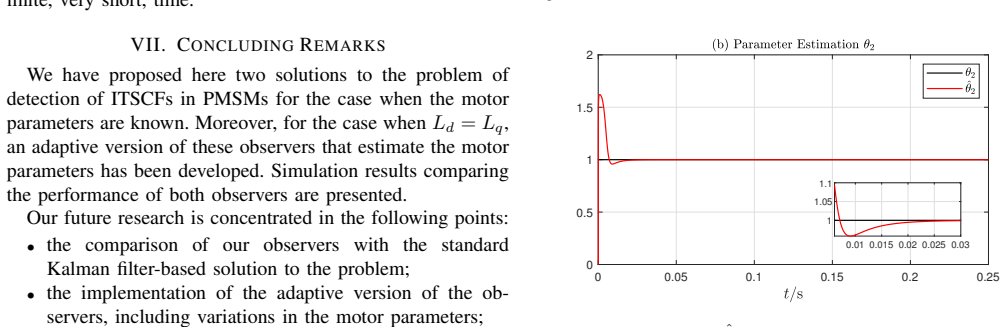
- [VI] Figs. 5 and 6 show the GPEBO parameter Θ(t) converging, but they do not show the estimates of Rs and L from Proposition 3; the simulation section would benefit from clarifying that the adaptive parameter estimator is not exercised in the presented results.
Circularity Check
No circular reduction found: the fault-detection observers are derived in-paper from the fault model, and the self-cited GPEBO/DREM/FCT lemmas are supporting mathematical tools, not inputs that make the conclusion equal to its assumptions.
full rationale
The central detection chain is self-contained. Lemma 1 defines the change of variables iαβ (Eq. 2) and derives Q diαβ/dt = A iαβ + b (Eq. 3) directly from the faulty PMSM equations; Proposition 1 gives a complete Lyapunov proof of exponential convergence with no use of fault data. Proposition 2 derives the linear regression y = Ψ^T Θ (Eqs. 10, 14) in the text from (1), (2) and (13), and Θ is the observer initial-error vector, not a fitted fault quantity; the fault indicator 2η/3 |if| is obtained from the converged state via (4), so it is not an input to the estimator. The adaptive regression (19) is likewise obtained from the model, with the overparameterized map G(µ) explicitly stated. The paper does lean on the authors' earlier GPEBO [18], LS+DREM [20], and the submitted finite-convergence-time note [21] for general parameter-estimator facts, but these are external mathematical lemmas about LS estimators and are also attributed to [25] and [20]; they are not equivalent to the ITSCF detection conclusion, so the self-citation is not a circular reduction. Two non-circular weaknesses are worth flagging: Proposition 3 divides by η1 = sin θ0 to form (19), so the adaptive observer is undefined for initial rotor angles that are multiples of π, and the Appendix D claim that P∇G(µ) = I3 for P = [I3 0] is arithmetically false as printed—the Jacobian has rows [1,0,0], [μ3,0,μ1], [0,1,0], whose symmetrization is indefinite. These are correctness and assumption gaps, not cases where a prediction equals its input by construction. The paper also states in Section VII that the adaptive version has not been implemented or experimentally validated, consistent with a limited but non-circular contribution.
Assumptions & free parameters
free parameters (2)
- Observer and estimator tuning gains in Section VI =
lambda=100, gamma=1, chi0=4, k=15, f11=1, f12=1/5, f21=1/4, f22=1/3, G=diag(6.25e5, 6.25e12)
- mu3 = eta2/eta1 = cot(theta0) =
Unknown; estimated online by LS+DREM in Proposition 3
assumptions (6)
- domain assumption The faulty PMSM is exactly described by the dq model (1) with constant parameters and a single short-circuit current if in phase A.
- domain assumption The electrical rotor position theta, speed omega, voltages vdq, and currents idq are measured or available with negligible noise.
- domain assumption The regressor Psi(t) in (10) satisfies the interval excitation condition (15).
- ad hoc to paper The NLRE map G is monotonizable with an appropriate matrix P.
- ad hoc to paper sin(theta0) is nonzero for the parameter estimator.
- standard math The finite-convergence-time least-squares result in Proposition 4 is correct as stated in [21], [25].
Cite this review
Pith. "Pith review of Interturn Fault Detection in IPMSMs: Two Adaptive Observer-based Solutions." pith.science (2026). https://pith.science/paper/DPKUIXNZ
@misc{pith2026250523125,
  author       = {Pith},
  title        = {Pith review of: Interturn Fault Detection in IPMSMs: Two Adaptive Observer-based Solutions},
  year         = {2026},
  howpublished = {\url{https://pith.science/paper/DPKUIXNZ}},
  note         = {Machine review of arXiv:2505.23125}
}
read the original abstract
In this paper we address the problem of online detection of inter-turn short-circuit faults (ITSCFs) that occur in permanent magnet synchronous motors (PMSMs). We propose two solutions to this problem: (i) a very simple linear observer and (ii) a generalized parameter estimation based observer, that incorporates a high performance estimator -- with both observers detecting the short-circuit current and the fault intensity. Although the first solution guarantees the detection of the fault exponentially fast, the rate of convergence is fully determined by the motor parameters that, in some cases, may be too slow. The second observer, on the other hand, ensures finite convergence time under the weakest assumption of interval excitation. To make the observers adaptive, we develop a parameter estimator that, in the case of isotropic PMSMs, estimates on-line (exponentially fast) the resistance and inductance of the motor. It should be underscored that, in contrast with existing observers (including the widely popular Kalman filter) that provide indirect information of the fault current, our observers provide explicit one -- namely the amplitude of the fault current. The performance of both observers, in their linear and generalized parameter estimation-based versions, is illustrated with realistic simulation studies.
Figures


Figures from the paper (2 more)

Reference graph
Works this paper leans on
-
[21]
R. Ortega, J. G. Romero, S. Aranovskiy and G. Tao, “Standard LS parameter estimators ensure finite convergence time for linear regression equations under an interval excitation assumption”, Automatica, (submit- ted), 2025
work page 2025
-
[1]
A brushless permanent magnet machine with integrated differential
K. Atallah and J. Wang, “A brushless permanent magnet machine with integrated differential”, IEEE Trans. Magn. , vol. 47, no. 10, pp. 4246– 4249, 2011
work page 2011
-
[2]
Detection of external rotor PMSM inter-turn short circuit fault using extended Kalman filter
A. Belkhadir, R. Pusca, R. Romary, D. Belkhayat, and Y . Zidani, “Detection of external rotor PMSM inter-turn short circuit fault using extended Kalman filter”, in 2023 IEEE 14th International Symposium on Diagnostics for Electrical Machines, Power Electronics and Drives (SDEMPED), pp. 491–497, 2023
work page 2023
-
[3]
On line interturn short-circuit fault diagnosis and nonlinear control of PMSM
S. Bouslimani, S. Drid, L. Chrifi-Alaoui, and L. Delahoche, “On line interturn short-circuit fault diagnosis and nonlinear control of PMSM”, in 19th International Multi-Conference on Systems, Signals & Devices (SSD), pp. 1139-1143, May, 2022
work page 2022
-
[4]
Inter-turn short circuit fault diagnosis of PMSM
X. Chen, P. Qin, Y . Chen, J. Zhao, W. Li, Y . Mao and T. Zhao, “Inter-turn short circuit fault diagnosis of PMSM”, Electronics, vol. 11, no. 1576, 2022
work page 2022
-
[5]
Robust adaptive sensorless control for permanent-magnet synchronous motors
J. Choi, K. Nam, A. Bobtsov, A. Pyrkin, and R. Ortega, “Robust adaptive sensorless control for permanent-magnet synchronous motors”, IEEE Trans. Power Electron., vol. 32, no. 5, pp. 3989-3997, 2016
work page 2016
-
[6]
Dissipativity of nonlinear systems of differential equations
B. P. Demidovich, “Dissipativity of nonlinear systems of differential equations”, in Vestnik Moscow State University, Ser. Mat. Mekh., Part I-6, (1961) pp. 19-27; Part II-1, (1962), pp. 3-8, (in Russian)
work page 1961
-
[7]
B. Du, S. Wu, S. Han, and S. Cui, “Interturn fault diagnosis strategy for interior permanent-magnet synchronous motor of electric vehicles based on digital signal processor”, IEEE Trans. Ind. Electron. , vol. 63, no. 3, pp. 1694-1706, 2016
work page 2016
Show all 31 references
-
[8]
Interturn Short-Circuit Fault Diagnosis of PMSM for Small Hydropower
L. Fang, X. Zhang, S. Huang, J. Xie, Z. Long and F. Huang, “Interturn Short-Circuit Fault Diagnosis of PMSM for Small Hydropower”, in 2021 IEEE 4th International Electrical and Energy Conference (CIEEC) , pp. 1-5, 2021
2021
-
[9]
Fliess and C
M. Fliess and C. Join, Model-free control and intelligent PID controllers: towards a possible trivialization of nonlinear control?, in 15th IFAC Symp. System Identif., Saint-Malo, France, 2009
2009
-
[10]
Fliess and C Join, Model-free control, Int
M. Fliess and C Join, Model-free control, Int. J. of Control, vol. 86, no. 12, pp. 2228-2252, 2013
2013
-
[11]
Goodwin and K
G. Goodwin and K. Sin, Adaptive Filtering Prediction and Control , Prentice-Hall, 1984
1984
-
[12]
A note on fixed-and discrete-time estimation via the DREM method
M. Korotina, S. Aranovskiy, R. Ushirobira, D. Efimov and J. Wang, “A note on fixed-and discrete-time estimation via the DREM method”, IEEE Trans. Autom. Control, vol. 69, no. 7, pp. 4793-4797, 2024
2024
-
[13]
Richness and excitation on an interval—with application to continuous-time adaptive control
G. Kreisselmeier and G. Rietze-Augst, “Richness and excitation on an interval—with application to continuous-time adaptive control”, IEEE Trans. Autom. Control, vol. 35, no. 2, pp. 165-171, 1990
1990
-
[14]
A computationally efficient design technique for electric-vehicle traction machines
P. Lazari, J. Wang, and L. Chen, “A computationally efficient design technique for electric-vehicle traction machines”, IEEE Trans. Ind Appl. , vol. 50, no. 5, pp. 3203–3213, 2014
2014
-
[15]
Interturn short-circuit fault diagnosis in PMSM with partitioned stator windings
M. Mazzoletti, G. Bossio and C. De Angelo, “Interturn short-circuit fault diagnosis in PMSM with partitioned stator windings”, IET Elect. Power Appl., vol. 14, no. 12, pp. 2301-2311, 2020
2020
-
[16]
Nam, AC Motor Control and Electric Vehicle Applications , CRC Press, 2010
K. Nam, AC Motor Control and Electric Vehicle Applications , CRC Press, 2010
2010
-
[17]
On modified parameter estimators for identification and adaptive control: a unified framework and some new schemes
R. Ortega, V . Nikiforov and D. Gerasimov, “On modified parameter estimators for identification and adaptive control: a unified framework and some new schemes”, Annu. Rev. Control, vol. 50, pp. 278-293, 2020
2020
-
[18]
Generalized parameter estimation-based observers: Application to power systems and chemical-biological reactors
R. Ortega, A. Bobtsov, N. Nikolayev, J. Schiffer and D. Dochain, “Generalized parameter estimation-based observers: Application to power systems and chemical-biological reactors”, Automatica, vol. 129, pp. 109635, 2021
2021
-
[19]
Parameter identification with finite-convergence time alertness preservation
R. Ortega, A. Bobtsov and N. Nikolayev, “Parameter identification with finite-convergence time alertness preservation”, IEEE Contr. Syst. Lett ., vol. 6, pp. 205-210, 2022
2022
-
[20]
A new least squares parameter estimator for nonlinear regression equations with relaxed excitation conditions and forgetting factor
R. Ortega, J. G. Romero and S. Aranovskiy, “A new least squares parameter estimator for nonlinear regression equations with relaxed excitation conditions and forgetting factor”, Syst. Control Lett., vol. 169, pp. 105377, 2022
2022
-
[22]
Rao and H
C. Rao and H. Toutenburg, H, Linear Models: Least Squares and Alternatives, Springer Series in Statistics (3rd ed.). Berlin, Springer, 2008
2008
-
[23]
Sastry, M
S. Sastry, M. Bodson, Adaptive Control: Stability, Convergence and Robustness, Prentice-Hall, New Jersey, 1989
1989
-
[24]
J.-J. E. Slotine and W. Li, Applied Nonlinear Control , Prentice-Hall, New Jersey, USA, 1991
1991
-
[25]
Tao, Adaptive Control Design and Analysis , vol
G. Tao, Adaptive Control Design and Analysis , vol. 37, John Wiley & Sons, New Jersey, 2003
2003
-
[26]
A BL-Homogeneous observe for ITSCF detection in PMSMS
O. Texis, E. Zurita and J. Schiffer, “A BL-Homogeneous observe for ITSCF detection in PMSMS”, in 2024 IEEE Conference on Control Technology and Applications (CCTA), Newcastle upon Tyne, UK, August 21-23, 2024
2024
-
[27]
Identifiability implies robust, globally exponentially convergent on-line parameter esti- mation: Application to model reference adaptive control
L. Wang, R. Ortega, A. Bobtsov, J. G. Romero and B. Yi, “Identifiability implies robust, globally exponentially convergent on-line parameter esti- mation: Application to model reference adaptive control”, Int. J. Control, vol. 97, no. 9, pp. 1967-1983, 2023
1967
-
[28]
Inter-turn short circuit faults in permanent magnet synchronous machines: an extended review and comprehensive analysis
M. Zafarani, E. Bostanci, Y . Qi, T. Goktas, and B. Akin, “Inter-turn short circuit faults in permanent magnet synchronous machines: an extended review and comprehensive analysis”, IEEE J. Emerg. Sel. Topics Power Electron., vol. 6, no. 4, pp. 2173-2191, 2018
2018
-
[29]
Fault diagnosis of inter- turn short circuit of permanent magnet synchronous motor based on voltage residual vector
Z. Zhang, Z. Yin, D. Yuan, and M. Yuan, “Fault diagnosis of inter- turn short circuit of permanent magnet synchronous motor based on voltage residual vector”, in 2022 IEEE International Power Electronics and Application Conference and Exposition (PEAC) , pp. 617–621, 2022
2022
-
[30]
Inter-turn short circuit fault detection of a novel PMSM with fault tolerance
L. Zhao, Y . Bai, X. Wang, and P. Zhao, “Inter-turn short circuit fault detection of a novel PMSM with fault tolerance”, in International Conference on Power and Renewable Energy , pp. 209-213, 2023
2023
-
[31]
Online interturn short circuits fault monitoring for permanent magnet synchronous machines
Y . Zuo, A. Darabi, C. Lai, and K. L. V . Iyer, “Online interturn short circuits fault monitoring for permanent magnet synchronous machines”, in IECON 2022–48th Annual Conference of the IEEE Industrial Electronics Society, pp. 1–6, 2022
2022
Reviewed August 7, 2026 · model on record in the stance chip above.
Discussion (0). Sign in to comment.