REVIEW 3 major objections 6 minor 2 cited by
$\eta_c\eta_c$ and $J/\psi J/\psi$ scatterings from lattice QCD
T0 review · 3 major / 6 minor · reviewed 2026-08-07 · deepseek-v4-flash
Pith's one-line read The paper claims lattice QCD produces a $J^{PC}=2^{++}$ resonance in $J/\psi J/\psi$ scattering at $(6544(10),\,552(34))$ MeV, matching the fully-charmed $X(6600)$/$X(6400)$ structures seen by ATLAS and CMS.
desk verdict Serious lattice calculation with a plausible but model-dependent 2++ resonance claim; the pole parameters should be read with caution. read the letter →
The pith
A machine-rendered reading of the paper's core claim, the machinery that carries it, and where it could break.
The reading
What carries the argument
The engine of the argument is the standard finite-volume method: two-meson correlation functions are computed with the distillation method on two lattice volumes at each pion mass, energy levels are extracted by solving a generalized eigenvalue problem, and L\"uscher's quantization condition assigns each energy level a scattering phase shift $k\cot\delta_0(k)$. For the $^5S_2$ channel these phase shifts cannot be described by an effective-range expansion, but the inverse of $\sqrt{s}\,/\,(k\cot\delta_0)$ is visibly linear in $s$, so the paper parametrizes the $K$-matrix as $K(s)=as+b$ and finds the resonance pole by solving $1-i\rho(s)K(s)=0$ with $\rho(s)=k/\sqrt{s}$; the zero of $K(s)$ at $\sqrt{s_0}\approx6.45$ GeV is a Castillejo--Dalitz--Dyson zero of the amplitude. The dynamics that explains why channels differ is quark rearrangement with one-gluon exchange: the Wick-contraction diagram in which the two mesons exchange quarks dominates over the direct gluonic exchange, and Fierz rearrangement fixes its sign, repulsive for $\eta_c\eta_c$ ($0^{++}$) and attractive for $J/\psi J/\psi$ ($0^{++}$), with the spin structure of the $^5S_2$ state flipping the relative strength to about $-2$ as the lattice data confirm.
What would settle it
A lattice calculation at the physical pion mass on larger volumes, or one that includes the $J/\psi\psi(2S)$ channel in the quantization condition, would settle it: if the $2^{++}$ pole moves outside roughly $6.54\pm0.05$ GeV in mass or $0.55\pm0.10$ GeV in width, the claimed match to $X(6600)$ fails. Independently, extracting the $X(6600)$ pole from a coupled-channel fit to the ATLAS and CMS four-muon spectra would provide an experimental cross-check at the same precision as the lattice pole.
Extended reading notes
Core claim
Reported most strongly is the observation of a $2^{++}$ resonance in the $^5S_2$ $J/\psi J/\psi$ scattering channel, determined from the pole of a single-channel scattering amplitude fitted to finite-volume energy levels through L\"uscher's quantization condition. Its pole parameters are $(m_R,\Gamma_R)=(6544(10),552(34))$ MeV at $m_\pi\approx420$ MeV and $(6539(13),546(57))$ MeV at $m_\pi\approx250$ MeV, indistinguishable between the two pion masses, and compatible with the parameters of the fully-charmed broad structure $X(6600)$ (or $X(6400)$) reported by ATLAS and CMS. Because the CMS angular distribution analysis of the four-muon final state favors $2^{++}$ and disfavors $0^{++}$ at the 95% confidence level, the paper takes this agreement as evidence that the experimental structures carry these quantum numbers. Alongside the resonance, the $^1S_0$ $J/\psi J/\psi$ amplitude has a positive scattering length and a pole on the second sheet below threshold by 28(10) MeV at $m_\pi=420$ MeV and 38(20) MeV at $m_\pi=250$ MeV, a likely virtual state that may be connected with $X(6200)$.
Load-bearing premise
The claim rests on treating $^5S_2$ $J/\psi J/\psi$ scattering as a single elastic channel up to 6.6 GeV; because the resonance is so wide ($\Gamma_R\approx550$ MeV), a large part of its tail lies above that energy, where $J/\psi\psi(2S)$ and other channels open and the two-body unitarity built into the fit no longer holds.
Editorial extensions
If this is right
- The structures $X(6600)$ and $X(6400)$ seen by ATLAS and CMS can be identified with a genuine $2^{++}$ resonance in $J/\psi J/\psi$ scattering, supporting the CMS angular-analysis preference for $2^{++}$ over $0^{++}$.
- The near-threshold $X(6200)$, if it exists, is a $0^{++}$ virtual state 20--40 MeV below the $J/\psi J/\psi$ threshold rather than a bound state, and the $^5S_2$ channel's repulsion rules out a $2^{++}$ assignment for it.
- Di-charmonium scattering parameters at the two pion masses agree within errors, so the interactions and the resonance are expected to persist essentially unchanged at the physical pion mass.
- The quark-rearrangement plus one-gluon-exchange mechanism predicts repulsive $\chi_{c0}\chi_{c0}$ interactions and attractive $h_ch_c$ and $\chi_{c1}\chi_{c1}$ interactions, checkable in future lattice calculations.
- The zero of the amplitude at $\sqrt{s_0}\approx6.45$ GeV coincides with the phenomenological mass of the lowest $2^{++}$ fully-charmed tetraquark, giving the Castillejo--Dalitz--Dyson zero a concrete physical interpretation.
Reading between the lines
- Because the resonance's width is about 550 MeV, a large fraction of its spectral weight lies above 6.6 GeV where $J/\psi\psi(2S)$ and higher channels open; I would expect a coupled-channel re-analysis to move the pole, and the cleanest tests are a lattice calculation that includes those channels explicitly and an experimental pole extraction from the full spectra.
- If the identification with $X(6600)$ is correct, the pole position from an interference-aware fit to the ATLAS and CMS data should converge near $(6.54\pm0.02)-i(0.27\pm0.04)$ GeV; current published mass-and-width comparisons are too blunt to confirm or refute it.
- The claimed pion-mass insensitivity makes a concrete prediction: the same $2^{++}$ pole should appear at essentially the same position in $\eta_b\eta_b$ and $\Upsilon\Upsilon$ scattering, testable with current bottom-quark lattice ensembles.
- A virtual state, unlike a bound state, produces only a threshold enhancement rather than a peak in the invariant-mass spectrum, so the $X(6200)$ interpretation could be tested by fitting the $J/\psi J/\psi$ threshold region in LHCb data with the virtual-state line shape.
Editorial analysis
A structured set of objections, weighed in public.
Referee Report
Summary. This manuscript presents an Nf = 2 lattice QCD study of ηcηc and J/ψJ/ψ scattering in the J^PC = 0^{++} and 2^{++} channels, using anisotropic ensembles at mπ ≈ 420 and 250 MeV, two volumes per pion mass, and the distillation method. From the correlation-weight matrices and GEVP analyses with restricted operator sets, the authors conclude that the ηcηc and J/ψJ/ψ channels are nearly decoupled and apply single-channel Lüscher analysis. For the 0^{++} channels they find repulsive ηcηc scattering (a0 ≈ −0.12 fm) and attractive 1S0 J/ψJ/ψ scattering (a0 ≈ +0.2 fm), with a likely virtual state 20–40 MeV below the J/ψJ/ψ threshold. For the 2^{++} channel they find repulsive near-threshold 5S2 J/ψJ/ψ scattering (a0 ≈ −0.16 fm) and, via a two-parameter K-matrix K(s) = as + b fitted below 6.6 GeV and continued to the second sheet, a broad resonance pole with (mR, ΓR) = (6544(10), 552(34)) MeV (mπ ≈ 420 MeV) and (6539(13), 546(57)) MeV (mπ ≈ 250 MeV), which they identify as compatible with the X(6600)/X(6400) structures seen by ATLAS and CMS. The dynamics are interpreted through quark rearrangement plus one-gluon exchange, including a predicted −2 relative strength between the 5S2 and 1S0 channels that is reproduced by the lattice correlation functions.
Significance. If the resonance claim survives a systematic-uncertainty treatment, the paper would provide a first direct lattice-QCD determination of the 2^{++} fully-charmed tetraquark candidate in the J/ψJ/ψ channel, supporting the 2^{++} assignment that CMS favors experimentally. Genuine strengths include: two volumes and two pion masses with consistent results; a careful energy-level analysis with GEVP orthogonality checks, two independent fitting methods, and NV-dependence studies used to exclude untrustworthy levels; explicit reporting of the LHS-smearing energy ceiling; agreement with the independent scattering lengths of Ref. [46]; and a parameter-free internal signature, the OGE prediction of a −2 ratio of quark-rearrangement strengths in the 5S2 and 1S0 channels (Eq. (61), Fig. 22), which the data reproduce. The mπ-insensitivity of the di-charmonium interactions is also notable.
major comments (3)
- [Section III.B, Table IV] The central quantitative claim carries only statistical errors, but the paper itself demonstrates model dependence far larger than those errors. The three sum-of-poles fits of Eq. (39) (initial g0 = 10, 20, 40 GeV) give (mR, ΓR) = (6449(21), 761(42)), (6495(12), 681(32)), and (6524(11), 617(35)) MeV, whereas the preferred linear ansatz Eq. (40) gives (6543(10), 548(34)) MeV; the spread is roughly 95 MeV in mass and 210 MeV in width, an order of magnitude above the quoted errors of 10 and 34 MeV. The linear form is justified by parameter economy, but the χ²/d.o.f. values in Fig. 16 do not discriminate: at mπ = 420 MeV (250 MeV) the pole fit with g0 = 10 gives 0.49 (0.19) versus 0.91 (0.40) for the linear fit. A systematic uncertainty reflecting the K-matrix ansatz choice, or a softened claim (a pole in the range ≈ 6.45–6.54 GeV with ΓR ≈ 0.55–0.76 GeV), must be adopted before the abstract's precision statement 'compatible with the parameters of X(6600)' is supported.
- [Sections II.B and III.B] The inelastic-channel truncation is stated but not quantified, and it is quantitatively relevant for a pole of this width. The study includes only ηcηc and J/ψJ/ψ below 6.6 GeV, excluding J/ψψ(2S) (threshold ≈ 6.77 GeV). For the quoted pole, a Breit-Wigner spectral function with mR = 6.543 GeV and ΓR = 0.548 GeV has roughly 28% of its weight above that threshold, and the pole's distance in the complex s-plane to the J/ψψ(2S) branch point (≈ 4.8 GeV²) is comparable to its distance to the elastic threshold (≈ 5.8 GeV²). The single-channel K-matrix in Eq. (46) has no branch cut for the omitted channel, so the analytic continuation that defines the pole is performed over a region where the amplitude's analytic structure is incomplete. The J/ψψ(2S) coupling is OZI-allowed and unconstrained by the fitted levels. Without an exploratory estimate of the shift this channel can induce in (mR, ΓR) (e.g., a two-channel fit or a Flatté-type sensitivity check), the quantitative compatibility with X(6600) asserted in the abstract and Sec. IV.C is not established; the paper deserves credit for stating the restriction explicitly in Sec. II.B, but a limitation statement is not a substitute for a systematic estimate.
- [Abstract and Section III.B, Fig. 19] The wording 'we observe a 2++ resonance' overstates what the constrained data show. Within the fitted window the phase shift δ0(s) rises from negative values, crosses zero at the CDD zero √s0 ≈ 6.45 GeV (Eq. (40)), and reaches only about π/4 by 6.6 GeV; it does not cross π/2 in the directly constrained region. The resonance is thus a second-sheet pole obtained from extrapolated K-matrix parameters, not a feature unambiguously visible in the finite-volume spectrum, and its interplay with the nearby CDD zero correlates the pole parameters with the functional form. In light of the two preceding comments, the abstract and the concluding compatibility statements should be reworded to something like 'a broad 2++ pole in the extrapolated single-channel amplitude, consistent within the stated systematic uncertainties with X(6600) or X(6400)'.
minor comments (6)
- [Abstract / Sections III.A and V] The virtual-state pole position is quoted inconsistently across the paper: the abstract says '20–40 MeV', Sec. III.A gives 28(10) MeV (M420) and 38(20) MeV (M250), and Sec. V says '20–30 MeV'; these values should be harmonized.
- [Throughout] There are numerous typos and infelicities: 'a formalism is developped' (Sec. I); 'we construction the OM M operators' (Sec. II.B); 'this this diagram' and 'eneregy' (Sec. II.C); 'Notable, the value' (Sec. III.B); and incomplete reference metadata (Ref. [45] lacks a title, and Ref. [29] lacks the publication year).
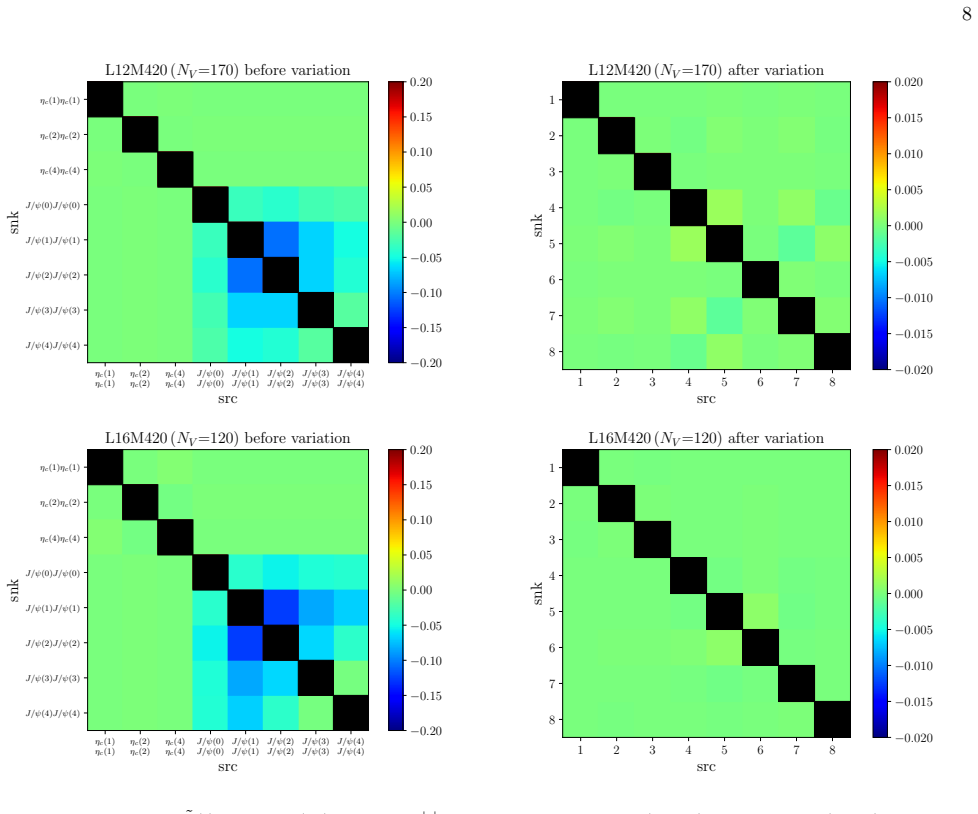
- [Section V] The statement that the 1D2 ηcηc scattering 'decouples completely' from the 5S2 J/ψJ/ψ scattering is too strong given that Fig. 8 shows small residual off-diagonal weights (the text itself notes 'a tiny deviation from the unit matrix' for L12M420); the claim should be qualified as decoupling within the present statistical precision.
- [Section III.B, Eq. (48) and Table IV] The normalization of Γ(J/ψJ/ψ) in Eq. (48), including the 1/2 symmetry factor for identical particles, is only alluded to ('has been considered implicitly'), and the narrow-width approximation is explicitly unsuitable for ΓR ≈ 550 MeV; the Br(J/ψJ/ψ) values in Table IV should be clearly labeled as an approximate internal consistency check, with the convention stated explicitly so the reader can reproduce the 65–75% numbers.
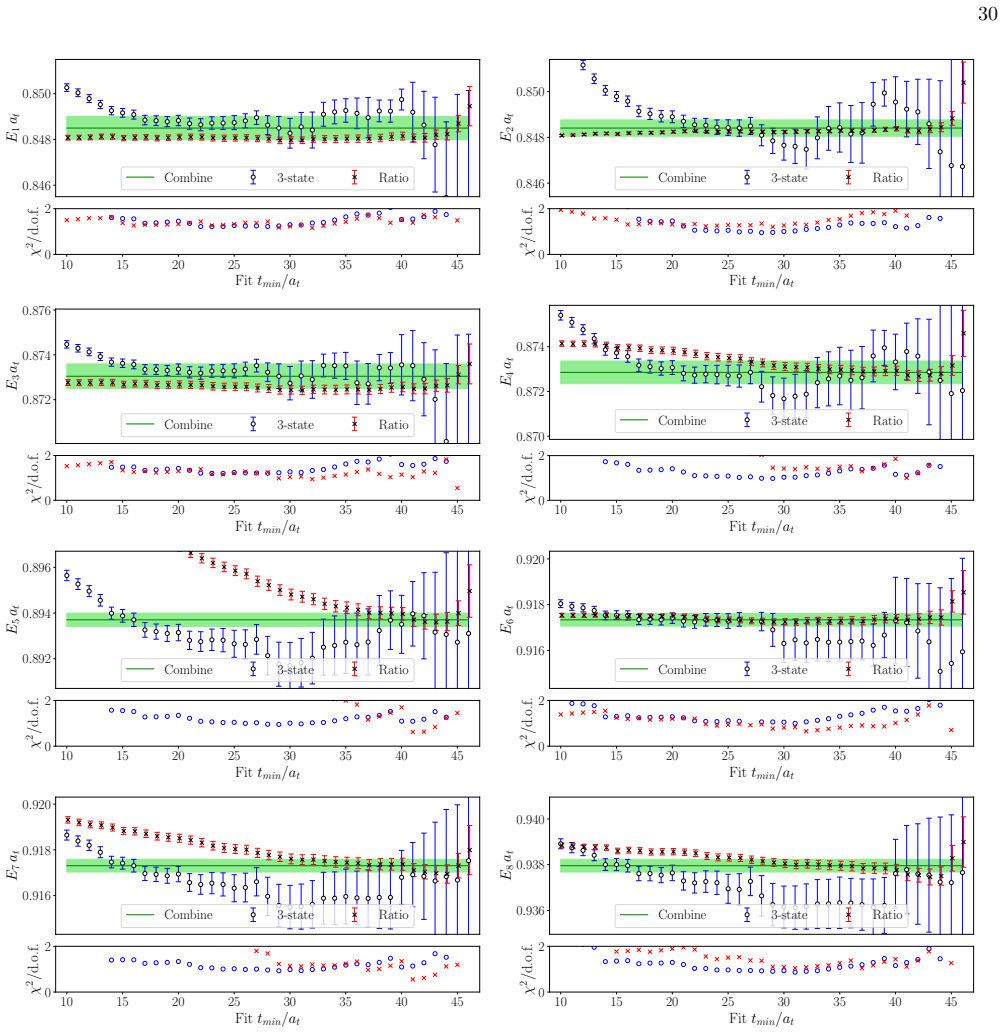
- [Section II.G, Tables II and III] The correspondence between the bold-face energy levels in Tables II and III and the actual inputs to the ERE/K-matrix fits is distributed across Sec. II.G and the captions of Figs. 15 and 18; a compact summary listing, for each ensemble and channel, which {En} enter each fit would improve reproducibility.
- [Section IV.C, Fig. 23] Figure 23 compares the experimental pole estimates with only the linear-fit poles; given the ansatz spread documented in Table IV, the figure should show the full pole-position range or an uncertainty band to provide an honest visual comparison with the ATLAS/CMS determinations.
Circularity Check
No load-bearing circularity: the resonance and virtual-state poles are standard analytic continuations of amplitudes fitted to lattice energy levels, with model dependence explicitly quantified; self-citations are methodological only.
full rationale
The paper's central claims are obtained by a standard, self-contained chain: finite-volume energies are extracted via GEVP fits (Sec. II.F), converted to phase shifts through Lüscher's quantization condition (Eq. (31)), and the phase shifts are parametrized by ERE or K-matrix forms (Eqs. (33), (39), (40)) whose parameters are fitted to those lattice-derived points. The quoted 0++ virtual-state and 2++ resonance poles are then solutions of the pole equations (36) and (46), i.e., analytic continuations of the fitted amplitude; they are not prescribed inputs. The paper explicitly reports the model dependence of the 2++ pole (Table IV: (m_R, Gamma_R) moves from (6.449, 0.761) to (6.524, 0.617) GeV under alternative pole-form K(s), with the linear fit giving (6.543, 0.548) GeV), which is a systematic uncertainty rather than a circular definition. The linear K(s)=as+b ansatz is selected because the inverse phase-shift data are nearly linear, and the alternative form is tested. The self-citations (Refs. [39], [54], [59]) are methodological (ensemble setup, ratio-method fitting strategy, QUDA interface) and do not supply the physical result. No equation is defined in terms of the quantity it purports to predict, and no fitted parameter is renamed as an independent prediction.
Assumptions & free parameters
free parameters (6)
- a0, 1S0 eta_c eta_c scattering length =
-0.117(19) fm (M420), -0.120(26) fm (M250)
- r0, 1S0 eta_c eta_c effective range =
-1.30(20) fm (M420), -1.63(40) fm (M250)
- a0, 1S0 J/psi J/psi scattering length =
0.25(7) fm (M420), 0.20(8) fm (M250)
- r0, 1S0 J/psi J/psi effective range =
2.31(33) fm (M420), 2.14(41) fm (M250)
- a, K-matrix slope for 5S2 J/psi J/psi =
1.45(12) GeV^-2 (M420), 1.48(20) GeV^-2 (M250)
- b, K-matrix intercept for 5S2 J/psi J/psi =
-60.4(4.9) (M420), -61.6(8.4) (M250)
assumptions (7)
- standard math Lüscher's quantization condition maps finite-volume energy levels to infinite-volume scattering amplitudes.
- domain assumption Charm-quark annihilation diagrams are negligible due to OZI suppression, and chi_c0 decouples from the di-charmonium operator set.
- domain assumption eta_c eta_c and J/psi J/psi channels decouple, so single-channel Lüscher analysis is valid.
- domain assumption Inelastic channels such as J/psi psi(2S) and J/psi psi(3770) can be neglected below the 6.6 to 6.7 GeV cutoff.
- domain assumption The LHS subspace truncation at NV=170 or 120 is sufficiently converged for the energy levels used.
- ad hoc to paper The K-matrix of the 5S2 channel is well approximated by K(s)=a s+b over the fit range.
- ad hoc to paper One-gluon exchange plus Fierz rearrangement explains the signs of the interactions and the observed -2 ratio.
invented entities (2)
-
2++ resonance R2++ in 5S2 J/psi J/psi scattering
independent evidence
-
0++ virtual state near the J/psi J/psi threshold
independent evidence
Cite this review
Pith. "Pith review of $\eta_c\eta_c$ and $J/\psi J/\psi$ scatterings from lattice QCD." pith.science (2026). https://pith.science/paper/WX7CKRLG
@misc{pith2026250523220,
  author       = {Pith},
  title        = {Pith review of: $\eta_c\eta_c$ and $J/\psi J/\psi$ scatterings from lattice QCD},
  year         = {2026},
  howpublished = {\url{https://pith.science/paper/WX7CKRLG}},
  note         = {Machine review of arXiv:2505.23220}
}
abstract
We investigate the $J^{PC}=(0,2)^{++}$ $\eta_c \eta_c$ and $J/\psi J/\psi$ scatterings in $N_f=2$ lattice QCD at two pion masses $m_\pi\approx 420$\,MeV and 250\,MeV. The quark field smearing scheme used in the distillation method strongly suppresses high-momentum states, thereby limiting the maximum accessible center-of-mass energy in this study to approximately 6.6\,GeV. Given the observed near-decoupling of the $\eta_c\eta_c$ and $J/\psi J/\psi$ channels, we analyze their scattering properties using the single-channel L\"{u}scher's method. In $0^{++}$ channels, $\eta_c\eta_c$ and $J/\psi J/\psi$ have repulsive and attractive interactions, respectively, which are dominated by the quark exchange effects with the Fierz rearrangement determining the interaction characteristic. A likely $0^{++}$ virtual state is observed below the threshold by 20-40\,MeV in the ${}^1S_0$ $J/\psi J/\psi$ scattering and may have connection with $X(6200)$. In $2^{++}$ channels, the near-threshold interaction for the ${}^5S_2$ $J/\psi J/\psi$ scattering is repulsive. The di-charmonium interactions are found to be insensitive to $m_\pi$ and can be consistently understood in terms of quark rearrangement effects combined with a one-gluon-exchange mechanism, both of which are supported by our lattice QCD results. Most importantly, we observe a $2^{++}$ resonance in the ${}^5S_2$ $J/\psi J/\psi$ scattering, whose properties are $(m_R,\Gamma_R)=\big(6544(10),552(34)\big)$\,MeV for $m_\pi\approx 420$\,MeV and $\big(6539(13),546(57)\big)$\,MeV for $m_\pi\approx 250$\,MeV, which are compatible with the parameters of the fully-charmed broad structure $X(6600)$ (or $X(6400)$) reported by ATLAS and CMS.
Figures


Figures from the paper (25 more)





Forward citations
Cited by 2 Pith papers
-
Tensor Resonance in $J/\psi J/\psi$ Scattering from Lattice QCD
A lattice QCD computation predicts a 2++ J/psi J/psi resonance with mass 6.54 GeV and width 0.54 GeV, identified with the X(6600) structure.
-
Next-to-leading order QCD corrections to electromagnetic production and decay of fully charm tetraquarks
The first NLO QCD corrections to fully charm tetraquark → γγ decay are given, with photon-fusion production cross sections predicted.
Reference graph
Works this paper leans on
-
[46]
Umeda, A Constant contribution in meson correlators at finite temperature, Phys
T. Umeda, A Constant contribution in meson correlators at finite temperature, Phys. Rev. D 75, 094502 (2007), arXiv:hep-lat/0701005
arXiv 2007
-
[1]
R. Aaij et al. (LHCb), Observation of structure in the J/ψ -pair mass spectrum, Sci. Bull. 65, 1983 (2020), arXiv:2006.16957 [hep-ex]
arXiv 2020
-
[2]
(61) This relation explains decently our observation in Fig
Let HOGE be the effective Hamiltonian for OGE, then one can easily get the relation rOGE = ⟨2MS|HOGE|2MS⟩ ⟨00|HOGE|00⟩ ≈ −2. (61) This relation explains decently our observation in Fig. 22, where the Q(t) components of the 2 ++ correlation func- tion and that of 0++ have a ratio which is approximately −2 in the small t region and deviates slowly from −2 d...
work page 2023
-
[3]
A. Hayrapetyan et al. (CMS), New Structures in the J/ψ J/ψ Mass Spectrum in Proton-Proton Collisions at s = 13 TeV, Phys. Rev. Lett. 132, 111901 (2024), arXiv:2306.07164 [hep-ex]
arXiv 2024
- [4]
-
[5]
Observation of a family of all-charm tetraquark candi- dates at the LHC (2025)
2025
-
[6]
X. Wang and K. Yi, New Structures in theJ/ψ J/ψMass Spectrum at CMS, in 22nd Conference on Flavor Physics and CP Violation(2024) arXiv:2408.04722 [hep-ex]
arXiv 2024
- [7]
Show all 61 references
-
[8]
Spin and symmetry properties of all-charm tetraquarks (2025)
2025
-
[9]
Liu, F.-X
M.-S. Liu, F.-X. Liu, X.-H. Zhong, and Q. Zhao, Fully heavy tetraquark states and their evidences in LHC observations, Phys. Rev. D 109, 076017 (2024), arXiv:2006.11952 [hep-ph]
2024 arXiv
-
[10]
Guo and J
Z.-H. Guo and J. A. Oller, Insights into the inner struc- tures of the fully charmed tetraquark state X(6900), Phys. Rev. D 103, 034024 (2021), arXiv:2011.00978 [hep- ph]
2021 arXiv
-
[11]
Maiani, J/ψ-pair resonance by LHCb: a new revolu- tion?, Sci
L. Maiani, J/ψ-pair resonance by LHCb: a new revolu- tion?, Sci. Bull. 65, 1949 (2020), arXiv:2008.01637 [hep- ph]
2020 arXiv
-
[12]
H.-X. Chen, W. Chen, X. Liu, and S.-L. Zhu, Strong decays of fully-charm tetraquarks into di-charmonia, Sci. Bull. 65, 1994 (2020), arXiv:2006.16027 [hep-ph]
2020 arXiv
-
[13]
Kuang, Q
S.-Q. Kuang, Q. Zhou, D. Guo, Q.-H. Yang, and L.-Y. Dai, Study of X(6900) with unitarized coupled channel scattering amplitudes, Eur. Phys. J. C 83, 383 (2023), arXiv:2302.03968 [hep-ph]
2023 arXiv
-
[14]
Chao and S.-L
K.-T. Chao and S.-L. Zhu, The possible tetraquark states cc¯c¯c observed by the LHCb experiment, Sci. Bull. 65, 1952 (2020), arXiv:2008.07670 [hep-ph]
2020 arXiv
-
[15]
Liu, M.-S
F.-X. Liu, M.-S. Liu, X.-H. Zhong, and Q. Zhao, Higher mass spectra of the fully-charmed and fully- bottom tetraquarks, Phys. Rev. D 104, 116029 (2021), arXiv:2110.09052 [hep-ph]
2021 arXiv
-
[16]
P. Niu, Z. Zhang, Q. Wang, and M.-L. Du, The third peak structure in the double J/ψ spectrum, Sci. Bull. 68, 800 (2023), arXiv:2212.06535 [hep-ph]
2023 arXiv
-
[17]
Gong, M.-C
C. Gong, M.-C. Du, Q. Zhao, X.-H. Zhong, and B. Zhou, Nature of X(6900) and its production mech- anism at LHCb, Phys. Lett. B 824, 136794 (2022), arXiv:2011.11374 [hep-ph]
2022 arXiv
-
[18]
X.-K. Dong, V. Baru, F.-K. Guo, C. Hanhart, A. Nefediev, and B.-S. Zou, Is the existence of a J/ ψJ/ψ bound state plausible?, Sci. Bull. 66, 2462 (2021), arXiv:2107.03946 [hep-ph]
2021 arXiv
-
[19]
Huang, R
Q. Huang, R. Chen, J. He, and X. Liu, Discovering a Novel Dynamics Mechanism for Charmonium Scattering (2024), arXiv:2407.16316 [hep-ph]
2024 arXiv
-
[20]
X.-K. Dong, V. Baru, F.-K. Guo, C. Hanhart, and A. Nefediev, Coupled-Channel Interpretation of the LHCb Double- J/ψ Spectrum and Hints of a New State Near the J/ψJ/ψ Threshold, Phys. Rev. Lett. 126, 132001 (2021), [Erratum: Phys.Rev.Lett. 127, 119901 (2021)], arXiv:2009.07795 [hep-ph]
2021 arXiv
-
[21]
H.-X. Chen, W. Chen, X. Liu, Y.-R. Liu, and S.-L. Zhu, An updated review of the new hadron states, Rept. Prog. Phys. 86, 026201 (2023), arXiv:2204.02649 [hep-ph]
2023 arXiv
-
[22]
Zhang and F.-K
Z.-H. Zhang and F.-K. Guo, Classification of Coupled-Channel Near-Threshold Structures (2024), arXiv:2407.10620 [hep-ph]
2024 arXiv
-
[23]
Chao, The (cc) - ( ¯ cc) (Diquark - Anti-Diquark) States in e+e− Annihilation, Z
K.-T. Chao, The (cc) - ( ¯ cc) (Diquark - Anti-Diquark) States in e+e− Annihilation, Z. Phys. C 7, 317 (1981)
1981
-
[24]
Iwasaki, A Possible Model for New Resonances- Exotics and Hidden Charm, Prog
Y. Iwasaki, A Possible Model for New Resonances- Exotics and Hidden Charm, Prog. Theor. Phys. 54, 492 (1975)
1975
-
[25]
Li and K.-F
B.-A. Li and K.-F. Liu, J/ψ Pair Production in Hadronic Collisions, Phys. Rev. D 29, 426 (1984)
1984
-
[26]
J. P. Ader, J. M. Richard, and P. Taxil, DO NARROW HEA VY MULTI - QUARK STATES EXIST?, Phys. Rev. D 25, 2370 (1982)
1982
-
[27]
A. M. Badalian, B. L. Ioffe, and A. V. Smilga, FOUR QUARK STATES IN THE HEA VY QUARK SYSTEM, Nucl. Phys. B 281, 85 (1987)
1987
-
[28]
Heller and J
L. Heller and J. A. Tjon, On Bound States of Heavy Q2 ¯Q2 Systems, Phys. Rev. D 32, 755 (1985)
1985
-
[29]
Belov, A
I. Belov, A. Giachino, and E. Santopinto, Fully charmed tetraquark production at the LHC experiments, JHEP 01, 093, arXiv:2409.12070 [hep-ph]
-
[30]
Chen, H.-X
W. Chen, H.-X. Chen, X. Liu, T. G. Steele, and S.-L. Zhu, Hunting for exotic doubly hidden-charm/bottom tetraquark states, Phys. Lett. B 773, 247 (2017), arXiv:1605.01647 [hep-ph]
2017 arXiv
-
[31]
L¨ uscher, Two-particle states on a torus and their re- lation to the scattering matrix, Nucl
M. L¨ uscher, Two-particle states on a torus and their re- lation to the scattering matrix, Nucl. Phys. B 354, 531 (1991)
1991
-
[32]
L¨ uscher, Volume dependence of the energy spectrum in massive quantum field theories
M. L¨ uscher, Volume dependence of the energy spectrum in massive quantum field theories. II. Scattering states, Commun. Math. Phys. 105, 153 (1986)
1986
-
[33]
Peardon, J
M. Peardon, J. Bulava, J. Foley, C. Morningstar, J. Dudek, R. G. Edwards, B. Joo, H.-W. Lin, D. G. Richards, and K. J. Juge (Hadron Spectrum), Novel quark-field creation operator construction for hadronic physics in lattice QCD, Phys. Rev. D 80, 054506 (2009), 25 arXiv:0905.21...
2009 arXiv
-
[34]
L¨ uscher, Signatures of unstable particles in finite vol- ume, Nucl
M. L¨ uscher, Signatures of unstable particles in finite vol- ume, Nucl. Phys. B 364, 237 (1991)
1991
-
[35]
Chen et al., Glueball spectrum and matrix elements on anisotropic lattices, Phys
Y. Chen et al., Glueball spectrum and matrix elements on anisotropic lattices, Phys. Rev. D 73, 014516 (2006), arXiv:hep-lat/0510074
2006 arXiv
-
[36]
C. J. Morningstar and M. J. Peardon, Efficient glueball simulations on anisotropic lattices, Phys. Rev. D56, 4043 (1997), arXiv:hep-lat/9704011
1997 arXiv
-
[37]
Su, L.-m
S.-q. Su, L.-m. Liu, X. Li, and C. Liu, A Numerical study of improved quark actions on anisotropic lattices, Int. J. Mod. Phys. A 21, 1015 (2006), arXiv:hep-lat/0412034
2006 arXiv
-
[38]
Zhang and C
J.-h. Zhang and C. Liu, Tuning the tadpole improved clover Wilson action on coarse anisotropic lattices, Mod. Phys. Lett. A 16, 1841 (2001), arXiv:hep-lat/0107005
2001 arXiv
-
[39]
H. Li, C. Shi, Y. Chen, M. Gong, J. Liang, Z. Liu, and W. Sun, X(3872) Relevant D ¯D∗ Scattering in Nf = 2 Lattice QCD (2024), arXiv:2402.14541 [hep-lat]
2024 arXiv
-
[40]
Meng et al
G.-Z. Meng et al. (CLQCD), Low-energy D∗+ ¯D0 1 scat- tering and the resonancelike structure Z + (4430), Phys. Rev. D 80, 034503 (2009), arXiv:0905.0752 [hep-lat]
2009 arXiv
-
[41]
Bors´ anyi, S
S. Bors´ anyi, S. D¨ urr, Z. Fodor, C. Hoelbling, S. D. Katz, S. Krieg, T. Kurth, L. Lellouch, T. Lippert, and C. McNeile (BMW), High-precision scale setting in lat- tice QCD, JHEP 09, 010, arXiv:1203.4469 [hep-lat]
-
[42]
L¨ uscher, Properties and uses of the Wilson flow in lattice QCD, JHEP 08, 071, [Erratum: JHEP 03, 092 (2014)], arXiv:1006.4518 [hep-lat]
M. L¨ uscher, Properties and uses of the Wilson flow in lattice QCD, JHEP 08, 071, [Erratum: JHEP 03, 092 (2014)], arXiv:1006.4518 [hep-lat]
2014 arXiv
-
[43]
Von Hippel and C
F. Von Hippel and C. Quigg, Centrifugal-barrier effects in resonance partial decay widths, shapes, and production amplitudes, Phys. Rev. D 5, 624 (1972)
1972
-
[44]
G. K. C. Cheung, C. E. Thomas, J. J. Dudek, and R. G. Edwards (Hadron Spectrum), Tetraquark operators in lattice QCD and exotic flavour states in the charm sector, JHEP 11, 033, arXiv:1709.01417 [hep-lat]
-
[45]
X. Feng, K. Jansen, and D. B. Renner, Phys. Lett. B 684, 268 (2010), arXiv:0909.3255 [hep-lat]
2010 arXiv
-
[47]
Castillejo, R
L. Castillejo, R. H. Dalitz, and F. J. Dyson, Low’s scat- tering equation for the charged and neutral scalar theo- ries, Phys. Rev. 101, 453 (1956)
1956
-
[48]
Y. Meng, C. Liu, X.-Y. Tuo, H. Yan, and Z. Zhang, Lat- tice calculation of the ηcηc and J/ψJ/ψ s-wave scattering length (2024), arXiv:2411.11533 [hep-lat]
2024 arXiv
-
[49]
M. I. Krivoruchenko, Remarks on the origin of Castillejo- Dalitz-Dyson poles, Phys. Rev. C 82, 018201 (2010), arXiv:1001.1659 [nucl-th]
2010 arXiv
-
[50]
F. J. Dyson, Meaning of the solutions of Low’s scattering equation, Phys. Rev. 106, 157 (1957)
1957
-
[51]
L¨ u, D.-Y
Q.-F. L¨ u, D.-Y. Chen, and Y.-B. Dong, Masses of fully heavy tetraquarks QQ ¯Q ¯Q in an extended rela- tivized quark model, Eur. Phys. J. C 80, 871 (2020), arXiv:2006.14445 [hep-ph]
2020 arXiv
-
[52]
Li, F.-K
Y. Li, F.-K. Guo, J.-Y. Pang, and J.-J. Wu, Generaliza- tion of Weinberg’s compositeness relations, Phys. Rev. D 105, L071502 (2022), arXiv:2110.02766 [hep-ph]
2022 arXiv
-
[53]
Gong, M.-C
C. Gong, M.-C. Du, and Q. Zhao, Pseudoscalar charmonium pair interactions via the Pomeron ex- change mechanism, Phys. Rev. D 106, 054011 (2022), arXiv:2206.13867 [hep-ph]
2022 arXiv
-
[54]
G.-J. Wang, L. Meng, M. Oka, and S.-L. Zhu, Higher fully charmed tetraquarks: Radial excitations and P-wave states, Phys. Rev. D 104, 036016 (2021), arXiv:2105.13109 [hep-ph]
2021 arXiv
-
[55]
Y.-L. Song, Y. Zhang, V. Baru, F.-K. Guo, C. Hanhart, and A. Nefediev, Toward a precision determination of the X(6200) parameters from data, Phys. Rev. D 111, 034038 (2025), arXiv:2411.12062 [hep-ph]
2025 arXiv
-
[56]
S. Chen, C. Shi, Y. Chen, M. Gong, Z. Liu, W. Sun, and R. Zhang, Tcc+(3875) relevant DD∗ scattering from Nf=2 lattice QCD, Phys. Lett. B 833, 137391 (2022), arXiv:2206.06185 [hep-lat]
2022 arXiv
-
[57]
M. A. Clark, R. Babich, K. Barros, R. C. Brower, and C. Rebbi, Solving Lattice QCD systems of equations us- ing mixed precision solvers on GPUs, Comput. Phys. Commun. 181, 1517 (2010), arXiv:0911.3191 [hep-lat]
2010 arXiv
-
[58]
R. G. Edwards and B. Joo (SciDAC, LHPC, UKQCD), The Chroma software system for lattice QCD, Nucl. Phys. B Proc. Suppl. 140, 832 (2005), arXiv:hep- lat/0409003
2005
-
[59]
Jiang, C
X. Jiang, C. Shi, Y. Chen, M. Gong, and Y.-B. Yang, Use quda for lattice qcd calculation with python (2024), arXiv:2411.08461 [hep-lat]. Appendix A: Energy level determination 26 0.828 0.830 0.832 E1at Combine 3-state Ratio 10 20 30 40 50 60 Fittmin/at 0 2χ2/d.o.f. 0.844 0.846...
2024 arXiv
-
[60]
Babich, M
R. Babich, M. A. Clark, B. Joo, G. Shi, R. C. Brower, and S. Gottlieb (QUDA), Scaling lattice QCD beyond 100 GPUs, in International Conference for High Per- formance Computing, Networking, Storage and Analysis (2011) arXiv:1109.2935 [hep-lat]
2011 arXiv
-
[101]
The Chroma software system [56], QUDA li- brary [57, 58], and PyQUDA package [59] are acknowl- edged. The computations were performed on the HPC clusters at the Institute of High Energy Physics (Bei- jing), China Spallation Neutron Source (Dongguan), and the ORISE computing en...
Reviewed August 7, 2026 · model on record in the stance chip above.
Discussion (0). Sign in to comment.