REVIEW 4 major objections 4 minor 1 cited by
The Chemical Clock of High-mass Star-forming Regions: N2H+/CCS
T0 review · 4 major / 4 minor · reviewed 2026-08-07 · deepseek-v4-flash
Pith's one-line read A ratio of two interstellar molecules, N2H+ to CCS, rises steadily as high-mass star-forming regions evolve, making it a usable chemical clock for these objects.
desk verdict A genuinely new UC HII sample shows a N2H+/CCS stage trend, but the 'reliable clock' claim depends on an unverified Trot assumption and unpublished comparison data. read the letter →
The pith
A machine-rendered reading of the paper's core claim, the machinery that carries it, and where it could break.
The reading
What carries the argument
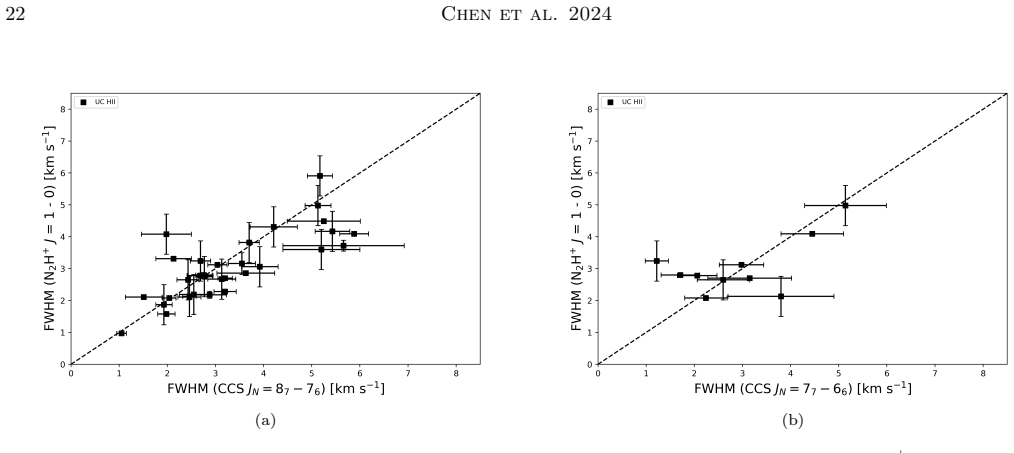
The load-bearing object is the ratio of column densities $N(\mathrm{N_2H^+})/N(\mathrm{CCS})$. N2H+ (diazenylium) and CCS (dicarbon sulfide) are both observed in the $J=1-0$ and $J_N=8_7-7_6$/$7_7-6_6$ rotational lines, and the ratio is built from LTE estimates of their column densities. The chemical rationale is that CCS forms early from carbon ions and atoms, while N2H+ forms later from N2, whose production is slow; hence the ratio should track chemical age. The same ratio is computed from a grid of gas-grain chemical models, and the observed average values at each stage are matched to model timescales to fix density, temperature, and chemical age.
What would settle it
Re-observe the 23 single-line CCS sources in the second CCS transition at 90.686 GHz and derive individual rotational temperatures; if the revised N(N2H+)/N(CCS) values drop into the protostellar-core range, the monotonic clock fails. A complementary check would measure the ratio in a sample whose evolutionary stage is independently known from outflow or maser activity.
Extended reading notes
Core claim
The central discovery proposed is that N(N2H+)/N(CCS) grows monotonically as high-mass star-forming regions evolve from starless cores to protostellar cores to ultracompact H II regions. The growth is driven mainly by N2H+ column density increasing across the stages while the CCS column density stays roughly flat, so the ratio acts as a chemical age indicator rather than merely a density tracer. The paper supports this with a gas-grain chemical model in which N2H+ builds up later because it forms from N2, whose production is slow in cold clouds, while CCS is an early carbon-chain molecule that does not keep growing. The authors therefore propose the ratio as a reliable chemical clock of high-mass star-forming regions.
Load-bearing premise
For 23 of the 33 ultracompact H II regions with CCS detections, the CCS column density is computed using a single rotational temperature of 11.93 K averaged from the other ten sources, so if those regions are warmer the ratios at the oldest stage could shift downward.
Editorial extensions
If this is right
- The ratio provides an evolutionary ordering for high-mass star-forming regions without needing an independent distance or age estimate.
- Sources that are hard to classify by morphology alone can be assigned to the starless-core, protostellar-core, or ultracompact-H II-region stage by comparing their ratio to the average values 23.6, 71.6, and 129.9.
- The best-fit gas-grain models indicate a total chemical age of roughly 86,000 years from starless core to ultracompact H II region, consistent with independent estimates of the high-mass star formation timescale.
- Because the rise is driven mainly by N2H+ rather than CCS, surveys that detect N2H+ but not CCS should tend to pick out the oldest, most evolved sources.
Reading between the lines
- A testable extension is to compare the ratio with independent age tracers such as outflows, masers, or infrared luminosity in the same sources; overlap between tracers would test whether the ratio really measures age rather than local temperature or density.
- The model's simplified uniform physical structure means the quoted chemical ages are order-of-magnitude estimates; spatially resolved chemical modeling of individual cores could sharpen the clock.
- The same N2H+/CCS strategy could be tried in lower-mass star-forming regions or in extragalactic sources, where carbon-chain chemistry may differ, to see whether the monotonic rise is universal.
Editorial analysis
A structured set of objections, weighed in public.
Referee Report
Summary. The paper reports IRAM 30 m observations of N2H+ J=1-0, CCS JN=87-76 and 77-66 toward 88 ultracompact H II regions (UC HIIs), detecting N2H+ in 87 sources and CCS 87-76 in 33 sources, with 10 of 82 targeted sources detected in CCS 77-66. The authors derive optical depths, excitation/rotational temperatures, and column densities, then combine their UC HII measurements with archival data for high-mass starless cores (HMSCs) and high-mass protostellar cores (HMPOs) to show that the column density ratio N(N2H+)/N(CCS) increases from HMSCs (average 23.6) to HMPOs (71.6) to UC HIIs (129.9), supported by K-S and t-tests. A gas-grain chemical model is used to interpret the ratio as an evolutionary clock, yielding best-fit physical parameters and ages for each stage. The paper concludes that N(N2H+)/N(CCS) is a reliable chemical evolutionary indicator for high-mass star-forming regions.
Significance. If the empirical trend is robust, the ratio provides a practical age-ordering tracer for high-mass star-forming regions, complementing existing chemical clocks such as HC3N/N2H+. The paper's strengths include a large, homogeneously observed UC HII sample, explicit error bars, statistical testing, a public modeling code (GGCHEMPY), and a check for distance-dependent beam bias within the UC HII sample. The main concerns are that the CCS column density for the majority of UC HII detections relies on an assumed rotational temperature, part of the comparison sample comes from an unpublished companion paper, and the three evolutionary stages were observed with different telescopes and beam sizes. These issues affect the load-bearing claim that the ratio cleanly separates the three stages and can serve as a reliable clock.
major comments (4)
- [4.1, Table 5] For 23 of the 33 UC HII sources with CCS 87-76 detections, the CCS column density is computed from a single line using the mean rotational temperature of the 10 two-line detections, Trot = 11.93 ± 5.72 K. The derived N(CCS) is highly sensitive to Trot through Eq. (7): at Trot = 5 K, which is within the measured range (4.88-24.65 K), N(CCS) is about 4.3 times larger than at 11.93 K, lowering N(N2H+)/N(CCS) by the same factor. The 23 single-line sources are exactly those without a detected 77-66 line, which is the signature of lower excitation temperature, so the assumed value likely biases the UC HII ratio upward. Since Table 6 shows that the HMPO-UC HII separation (71.60 vs 129.93) is the key discriminator, this systematic uncertainty could erase the claimed evolutionary trend. The authors should present a sensitivity test (e.g., recomputing all single-line CCS column densities at Trot = 5 K and repeating the K-S and t-tests) or restrict the cross-stage comparison to the 10 sources with measured Trot to demonstrate that the ordering survives.
- [4.1, beam matching] The comparison samples include eight HMSC and seven HMPO sources from 'Chen et al. 2025 (in prep.)' observed with the ARO 12 m telescope; these data are not available in the manuscript, in an appendix, or in a public archive. The physical parameters listed in Table 5 for these sources cannot be independently verified, and the K-S/t-test results in Table 6 include these unpublished points. The authors should either make the line intensities and spectra available as supplementary material or repeat the statistical analysis without these sources to show that the monotonic trend is not driven solely by the unpublished subset.
- [4.2, Eq. (8)] The three evolutionary stages are observed with different telescopes and beam sizes: IRAM 30 m (~27''), Nobeyama 45 m (~17''), and ARO 12 m (~66''). The statement in Section 4.1 that beam dilution effects are 'non-significant' assumes that N2H+ and CCS have identical spatial distributions within the beam. However, Section 3.3.2 itself notes that CCS emission is clumpy and distributed differently from N2H+, and the distance test in Figure 5 is applied only to the UC HII sample and does not control for cross-sample beam differences. If the two tracers have different effective source sizes, the observed ratio becomes beam-dependent, and the stage-to-stage comparison could be biased. The authors should quantify this effect, for instance by convolving all data to a common angular resolution or by modeling beam-filling corrections for each tracer and showing that the ratio ordering between the three stages remains unchanged.
- [4.2, Table 8] The gas-grain chemical model is presented as support for the clock, but the model parameters (density, temperature, and chemical age) are optimized for each stage using Eq. (8) to match the observed column densities of N2H+ and CCS, and the initial abundances for later stages are taken from the best-fit model of the preceding stage. The increasing modeled ratio in Figure 8 is therefore partly a consequence of the fitting procedure rather than an independent prediction of the model. The text should be revised to describe the model as a consistency check that can reproduce the trend with plausible parameters, not as independent confirmation that the ratio is a reliable clock. The best-fit ages in Table 8 should be presented with this caveat clearly stated.
minor comments (4)
- [Summary vs Section 4.2] There is an inconsistency in the total chemical age: Section 5 (item 4) states 83,913 years, while the three best-fit timescales in Table 8 sum to 19,179 + 32,990 + 34,286 = 86,455 years. Please reconcile these numbers.
- [Appendix C, Eq. (C1)] Equation (C1) appears to be typeset incorrectly: the summation notation 'nX i=2' is garbled and the limits are not legible. Please correct the equation so that the shell-averaging procedure is clear.
- [Throughout] The manuscript contains numerous typographical spacing errors, particularly in molecular formulas (e.g., 'N 2H+' instead of 'N2H+') and table headers (e.g., 'T able' instead of 'Table'). These should be corrected in the final version.
- [Section 3.3.2] The sentence 'For those six sources without observed in CCS (JN = 77−66) line' should be rephrased, for example as 'For the six sources that were not observed in the CCS JN = 77−66 line.'
Circularity Check
Observed N2H+/CCS stage trend is independent, but the chemical-model 'support' is fitted to the same column densities and is a consistency check, not an independent prediction.
-
fitted input called prediction
[Section 4.2, Eq. (8), Table 8, Figure 8]
"the agreement at each time step between the modeled column density Ni(t) and the observed column density Nobs,i(t) is quantified by the confidence level κi(t)... An iterative search was then performed to find the maximum total κ(t) value, representing the best-fit evolutionary time under the best-fit model. ... The modeled results show a similar trend with our measured results, i.e., increasing ratio of N(N2H+)/N(CCS) from HMSC, HMPO to UC HII stages. This support the reliability of N(N2H+)/N(CCS) as a chemical clock."
The best-fit density, temperature, and age for each evolutionary stage are chosen by maximizing agreement between modeled Ni(t) and observed Nobs,i(t) for N2H+ and CCS. The subsequent model curve of N(N2H+)/N(CCS) versus evolution age is therefore matched to the observed abundances (and hence the observed ratio) at the fitted stage ages; the 'similar trend' in Figure 8 is a property of the fitting, not an independent model prediction. The model provides a self-consistency check, but it cannot independently confirm the clock because the quantity it is said to predict is the same one used as the fitting target.
full rationale
The observed N(N2H+)/N(CCS) trend across HMSC, HMPO, and UC HII samples is built from independent line measurements (this paper's IRAM data plus Fontani et al. and Taniguchi et al.), so the central empirical claim is not circular. The fixed Trot=11.93 K adoption for 23 UC HII single-line sources is a robustness concern, not a definitional circularity. The main circular element is in Section 4.2: the gas-grain model is presented as supporting the clock, but its best-fit density, temperature, and age per stage are optimized against the observed N2H+ and CCS column densities, and the modeled ratio-versus-age curve is then compared with the same observed averages. This is a self-consistency check and not an independent prediction; it should not be cited as independent model support. The 'Chen et al. 2025, in prep.' self-citation supplies some HMSC/HMPO data points, but the stage trend does not depend on those data alone, so it is not load-bearing. Overall, the empirical clock claim has independent content, but the model corroboration is partially circular.
Assumptions & free parameters
free parameters (11)
- CCS rotational temperature (Trot) for single-line sources =
11.93 K (average of 10 two-line detections)
- Chemical age of HMSC stage =
19,179 yr
- Chemical age of HMPO stage =
32,990 yr
- Chemical age of UC HII stage =
34,286 yr
- Best-fit gas density for HMSC =
7.78e5 cm^-3
- Best-fit gas density for HMPO =
4.50e5 cm^-3
- Best-fit gas density for UC HII =
4.30e5 cm^-3
- Best-fit temperature for HMSC =
24.5 K
- Best-fit temperature for HMPO =
103.7 K
- Best-fit temperature for UC HII =
110.5 K
- Line-of-sight thickness for model column density =
1 pc
assumptions (6)
- domain assumption CCS emission is optically thin and in LTE, allowing the rotational diagram method
- domain assumption N2H+ hyperfine components share equal excitation temperature and line width
- domain assumption Semenov et al. (2010) gas-grain reaction network accurately describes high-mass star-forming region chemistry
- domain assumption Initial elemental abundances from Gerner et al. (2014) are appropriate for HMSC, HMPO, and UC HII stages
- domain assumption The three samples (HMSC, HMPO, UC HII) represent an evolutionary sequence with similar initial conditions
- domain assumption Fixed cosmic-ray ionization rate, visual extinction, and gas-to-dust ratio (5e-17 s^-1, 10 mag, 100)
Cite this review
Pith. "Pith review of The Chemical Clock of High-mass Star-forming Regions: N2H+/CCS." pith.science (2026). https://pith.science/paper/TT7KUY5T
@misc{pith2026250523221,
  author       = {Pith},
  title        = {Pith review of: The Chemical Clock of High-mass Star-forming Regions: N2H+/CCS},
  year         = {2026},
  howpublished = {\url{https://pith.science/paper/TT7KUY5T}},
  note         = {Machine review of arXiv:2505.23221}
}
read the original abstract
Using the IRAM 30 m telescope, we presented observations of N2H+ J = 1-0, CCS JN = 87-76 and 77-66 lines toward a large sample of ultracompact HII regions (UC HIIs). Among our 88 UC HIIs, 87 and 33 sources were detected in the N2H+ J = 1-0 and CCS JN = 87-76 lines, respectively. For the CCS 77-66 transition, we detected emission in 10 out of 82 targeted sources, all of which also exhibited emission in the CCS JN = 87-76 line. Physical parameters are derived for our detections, including the optical depth and excitation temperature of N2H+, the rotational temperature of CCS and the column density. Combining our results and previous observation results in different stages of high-mass star-forming regions (HMSFRs), we found that the column density ratio N(N2H+)/N(CCS) increases from high-mass starless cores (HMSCs) through high-mass protostellar cores (HMPOs) to UC HIIs. This implies that N(N2H+)/N(CCS) can trace the evolution process of HMSFRs. It was supported by our gas-grain chemical model, which shows that N(N2H+)/N(CCS) increases with the evolution age of HMSFRs. The temperature, density and chemical age were also constrained from our best-fit model at each stage. Thus, we propose N(N2H+)/N(CCS) as a reliable chemical clock of HMSFRs.
Figures


Figures from the paper (7 more)


Forward citations
Cited by 1 Pith paper
-
Chemistry of Dark Molecular Clouds
A comprehensive review arguing that the chemically rich cores TMC-1 CP and L1544 are representative molecular-cloud laboratories, and that complex organic molecule production is largely insensitive to metallicity.
Reference graph
Works this paper leans on
-
[1]
, " * write output.state after.block = add.period write newline
ENTRY address archivePrefix author booktitle chapter doi edition editor eprint howpublished institution journal key month number organization pages publisher school series title misctitle type volume year version url label extra.label sort.label short.list INTEGERS output.state before.all mid.sentence after.sentence after.block FUNCTION init.state.consts ...
-
[2]
write newline
" write newline "" before.all 'output.state := FUNCTION format.url url empty "" new.block "" url * "" * if FUNCTION format.eprint eprint empty "" archivePrefix empty "" archivePrefix "arXiv" = new.block " " eprint * " " * new.block " " eprint * " " * if if if FUNCTION format.doi doi empty "" " " doi * " " * if FUNCTION format.pid doi empty eprint empty ur...
-
[3]
bh<Etխӫ
thebibliography [1] 20pt to REFERENCES 6pt =0pt -12pt 10pt plus 3pt =0pt =0pt =1pt plus 1pt =0pt =0pt -12pt =13pt plus 1pt =20pt =13pt plus 1pt \@M =10000 =-1.0em =0pt =0pt 0pt =0pt =1.0em @enumiv\@empty 10000 10000 `\.\@m \@noitemerr \@latex@warning Empty `thebibliography' environment \@ifnextchar \@reference \@latexerr Missing key on reference command E...
2021
-
[4]
2015, , 807, 120, 10.1088/0004-637X/807/2/120
Aikawa , Y., Furuya , K., Nomura , H., & Qi , C. 2015, , 807, 120, 10.1088/0004-637X/807/2/120
-
[5]
2003, , 593, 906, 10.1086/376616
Aikawa , Y., Ohashi , N., & Herbst , E. 2003, , 593, 906, 10.1086/376616
doi:10.1086/376616 2003
-
[6]
2001, , 552, 639, 10.1086/320551
Aikawa , Y., Ohashi , N., Inutsuka , S.-i., Herbst , E., & Takakuwa , S. 2001, , 552, 639, 10.1086/320551
doi:10.1086/320551 2001
-
[7]
Beuther , H., Churchwell , E. B., McKee , C. F., & Tan , J. C. 2007, in Protostars and Planets V, ed. B. Reipurth , D. Jewitt , & K. Keil , 165, 10.48550/arXiv.astro-ph/0602012
-
[8]
2010, , 518, L78, 10.1051/0004-6361/201014532
Beuther , H., Henning , T., Linz , H., et al. 2010, , 518, L78, 10.1051/0004-6361/201014532
Show all 123 references
-
[9]
M., et al
Beuther , H., Schilke , P., Menten , K. M., et al. 2002, , 566, 945, 10.1086/338334
2002 doi
-
[10]
2012, , 20, 56, 10.1007/s00159-012-0056-x
Caselli , P., & Ceccarelli , C. 2012, , 20, 56, 10.1007/s00159-012-0056-x
2012 doi
- [11]
-
[12]
T., et al
Cesaroni , R., Pestalozzi , M., Beltr \'a n , M. T., et al. 2015, , 579, A71, 10.1051/0004-6361/201525953
2015 doi
-
[13]
L., Zhang , J
Chen , J. L., Zhang , J. S., Henkel , C., et al. 2021, , 257, 39, 10.3847/1538-4365/ac205a
2021 doi
- [14]
-
[15]
2002, , 40, 27, 10.1146/annurev.astro.40.060401.093845
Churchwell , E. 2002, , 40, 27, 10.1146/annurev.astro.40.060401.093845
2002
-
[16]
T., Cesaroni , R., & Moscadelli , L
Codella , C., Lorenzani , A., Gallego , A. T., Cesaroni , R., & Moscadelli , L. 2004, , 417, 615, 10.1051/0004-6361:20035608
2004 doi
-
[17]
S., Schuller , F., et al
Csengeri , T., Urquhart , J. S., Schuller , F., et al. 2014, , 565, A75, 10.1051/0004-6361/201322434
2014 doi
-
[18]
O., Thompson , M
Djordjevic , J. O., Thompson , M. A., Urquhart , J. S., & Forbrich , J. 2019, , 487, 1057, 10.1093/mnras/stz1262
2019 doi
-
[19]
K., Rosolowsky , E., Evans , Neal J., I., Cyganowski , C., & Urquhart , J
Dunham , M. K., Rosolowsky , E., Evans , Neal J., I., Cyganowski , C., & Urquhart , J. S. 2011, , 741, 110, 10.1088/0004-637X/741/2/110
2011 doi
-
[20]
E., Williams , R
Dyson , J. E., Williams , R. J. R., & Redman , M. P. 1995, , 277, 700, 10.1093/mnras/277.2.700
1995 doi
-
[21]
A., Rodr \' guez , L
Dzib , S. A., Rodr \' guez , L. F., Medina , S. N. X., et al. 2014, , 567, L5, 10.1051/0004-6361/201423855
2014 doi
-
[22]
Ellingsen , S. P. 2006, , 638, 241, 10.1086/498673
2006 doi
-
[23]
2021, , 73, 467, 10.1093/pasj/psab012
Feng , H., Wang , J., Li , S., et al. 2021, , 73, 467, 10.1093/pasj/psab012
2021 doi
-
[24]
2023, , 680, A58, 10.1051/0004-6361/202347565
Fontani , F., Roueff , E., Colzi , L., & Caselli , P. 2023, , 680, A58, 10.1051/0004-6361/202347565
2023 doi
-
[25]
2011, , 529, L7, 10.1051/0004-6361/201116631
Fontani , F., Palau , A., Caselli , P., et al. 2011, , 529, L7, 10.1051/0004-6361/201116631
2011 doi
-
[26]
T., Wakelam , V., & Herbst , E
Garrod , R. T., Wakelam , V., & Herbst , E. 2007, , 467, 1103, 10.1051/0004-6361:20066704
2007 doi
-
[27]
2022, Research in Astronomy and Astrophysics, 22, 015004, 10.1088/1674-4527/ac321e
Ge , J. 2022, Research in Astronomy and Astrophysics, 22, 015004, 10.1088/1674-4527/ac321e
2022 doi
-
[28]
2014, , 563, A97, 10.1051/0004-6361/201322541
Gerner , T., Beuther , H., Semenov , D., et al. 2014, , 563, A97, 10.1051/0004-6361/201322541
2014 doi
-
[29]
L., Beuther , H., et al
Gerner , T., Shirley , Y. L., Beuther , H., et al. 2015, , 579, A80, 10.1051/0004-6361/201423989
2015 doi
-
[30]
H., Helfand , D
Giveon , U., Becker , R. H., Helfand , D. J., & White , R. L. 2005 a , , 129, 348, 10.1086/426360
2005 doi
- [31]
- [32]
-
[33]
Grave , J. M. C., & Kumar , M. S. N. 2009, , 498, 147, 10.1051/0004-6361/200810902
2009 doi
-
[34]
2000, in Astronomical Society of the Pacific Conference Series, Vol
Guilloteau , S., & Lucas , R. 2000, in Astronomical Society of the Pacific Conference Series, Vol. 217, Imaging at Radio through Submillimeter Wavelengths, ed. J. G. Mangum & S. J. E. Radford , 299
2000
-
[35]
E., Guzm \'a n , V
Guzm \'a n , A. E., Guzm \'a n , V. V., Garay , G., Bronfman , L., & Hechenleitner , F. 2018, , 236, 45, 10.3847/1538-4365/aac01d
2018 doi
-
[36]
H., Zhou , J
Han , X. H., Zhou , J. J., Wang , J. Z., et al. 2015, , 576, A131, 10.1051/0004-6361/201423791
2015 doi
- [37]
-
[38]
I., Herbst , E., & Leung , C
Hasegawa , T. I., Herbst , E., & Leung , C. M. 1992, , 82, 167, 10.1086/191713
1992 doi
-
[39]
E., Harada , N., & Herbst , E
Hassel , G. E., Harada , N., & Herbst , E. 2011, , 743, 182, 10.1088/0004-637X/743/2/182
2011 doi
-
[40]
E., Herbst , E., & Garrod , R
Hassel , G. E., Herbst , E., & Garrod , R. T. 2008, , 681, 1385, 10.1086/588185
2008 doi
-
[41]
A., Millar , T
Hatchell , J., Thompson , M. A., Millar , T. J., & MacDonald , G. H. 1998, , 133, 29, 10.1051/aas:1998309
1998 doi
-
[42]
N., Pinte , C., et al
Hill , T., Longmore , S. N., Pinte , C., et al. 2010, , 402, 2682, 10.1111/j.1365-2966.2009.16101.x
2010
-
[43]
G., Purcell , C
Hoare , M. G., Purcell , C. R., Churchwell , E. B., et al. 2012, , 124, 939, 10.1086/668058
2012 doi
-
[44]
M., Foster , J
Hoq , S., Jackson , J. M., Foster , J. B., et al. 2013, , 777, 157, 10.1088/0004-637X/777/2/157
2013 doi
-
[45]
S., et al
Hsieh , T.-H., Takami , M., Connelley , M. S., et al. 2021, , 912, 108, 10.3847/1538-4357/abee88
2021 doi
-
[46]
M., Wu , Y., et al
Hu , B., Menten , K. M., Wu , Y., et al. 2016, , 833, 18, 10.3847/0004-637X/833/1/18
2016 doi
-
[47]
G., Burton , M., et al
Irabor , T., Hoare , M. G., Burton , M., et al. 2023, , 520, 1073, 10.1093/mnras/stad005
2023 doi
-
[48]
I., Caselli , P., et al
Jim \'e nez-Serra , I., Vasyunin , A. I., Caselli , P., et al. 2016, , 830, L6, 10.3847/2041-8205/830/1/L6
2016 doi
-
[49]
2015, , 219, 2, 10.1088/0067-0049/219/1/2
Jin , M., Lee , J.-E., & Kim , K.-T. 2015, , 219, 2, 10.1088/0067-0049/219/1/2
2015 doi
-
[50]
K., Belloche , A., & Garrod , R
J rgensen , J. K., Belloche , A., & Garrod , R. T. 2020, , 58, 727, 10.1146/annurev-astro-032620-021927
2020 doi
-
[51]
E., Hoare , M
Kalcheva , I. E., Hoare , M. G., Urquhart , J. S., et al. 2018, , 615, A103, 10.1051/0004-6361/201832734
2018 doi
-
[52]
C., & Evans , N
Kennicutt , R. C., & Evans , N. J. 2012, , 50, 531, 10.1146/annurev-astro-081811-125610
2012 doi
-
[53]
D., Lal , D
Khan , S., Pandian , J. D., Lal , D. V., et al. 2022, , 664, A140, 10.1051/0004-6361/202140914
2022 doi
-
[54]
R., Bate , M
Krumholz , M. R., Bate , M. R., Arce , H. G., et al. 2014, in Protostars and Planets VI, ed. H. Beuther , R. S. Klessen , C. P. Dullemond , & T. Henning , 243--266, 10.2458/azu_uapress_9780816531240-ch011
2014 doi
-
[55]
Kuiper , T. B. H., Langer , W. D., & Velusamy , T. 1996, , 468, 761, 10.1086/177732
1996 doi
-
[56]
J., Bergin , E
Lada , C. J., Bergin , E. A., Alves , J. F., & Huard , T. L. 2003, , 586, 286, 10.1086/367610
2003 doi
-
[57]
H., Herbst , E., Pineau des Forets , G., Roueff , E., & Le Bourlot , J
Lee , H. H., Herbst , E., Pineau des Forets , G., Roueff , E., & Le Bourlot , J. 1996, , 311, 690
1996
-
[58]
A., Henkel , C., Reimers , D., & Wang , M
Levshakov , S. A., Henkel , C., Reimers , D., & Wang , M. 2014, , 567, A78, 10.1051/0004-6361/201423732
2014 doi
-
[59]
2016, Research in Astronomy and Astrophysics, 16, 47, 10.1088/1674-4527/16/3/047
Li , H.-K., Zhang , J.-S., Liu , Z.-W., et al. 2016, Research in Astronomy and Astrophysics, 16, 47, 10.1088/1674-4527/16/3/047
2016 doi
-
[60]
C., Wu , Y., Zhang , C., et al
Liu , X. C., Wu , Y., Zhang , C., et al. 2019, , 622, A32, 10.1051/0004-6361/201834411
2019 doi
-
[61]
Lu , X., Mills , E. A. C., Ginsburg , A., et al. 2019, , 244, 35, 10.3847/1538-4365/ab4258
2019 doi
- [62]
-
[63]
Martins , M. A. P. 1996, General Relativity and Gravitation, 28, 1309, 10.1007/BF02109523
1996 doi
-
[64]
F., & Ostriker , E
McKee , C. F., & Ostriker , E. C. 2007, , 45, 565, 10.1146/annurev.astro.45.051806.110602
2007 arXiv
- [65]
-
[66]
2018, , 56, 41, 10.1146/annurev-astro-091916-055235
Motte , F., Bontemps , S., & Louvet , F. 2018, , 56, 41, 10.1146/annurev-astro-091916-055235
2018 doi
-
[67]
J., & Charnley , S
Mumma , M. J., & Charnley , S. B. 2011, , 49, 471, 10.1146/annurev-astro-081309-130811
2011 doi
-
[68]
I., & Bergin , E
\"O berg , K. I., & Bergin , E. A. 2021, , 893, 1, 10.1016/j.physrep.2020.09.004
2021 doi
-
[69]
2014, , 66, 119, 10.1093/pasj/psu116
Ohashi , S., Tatematsu , K., Choi , M., et al. 2014, , 66, 119, 10.1093/pasj/psu116
2014 doi
-
[70]
M., et al
Palau , A., Estalella , R., Girart , J. M., et al. 2007, , 465, 219, 10.1051/0004-6361:20065936
2007 doi
-
[71]
L., Urquhart , J
Patel , A. L., Urquhart , J. S., Yang , A. Y., et al. 2023, , 524, 4384, 10.1093/mnras/stad2143
2023 doi
-
[72]
D., Egan , M
Price , S. D., Egan , M. P., Carey , S. J., Mizuno , D. R., & Kuchar , T. A. 2001, , 121, 2819, 10.1086/320404
2001 doi
-
[73]
R., Longmore , S
Purcell , C. R., Longmore , S. N., Burton , M. G., et al. 2009, , 394, 323, 10.1111/j.1365-2966.2008.14283.x
2009
-
[74]
R., Hoare , M
Purcell , C. R., Hoare , M. G., Cotton , W. D., et al. 2013, , 205, 1, 10.1088/0067-0049/205/1/1
2013 doi
-
[75]
M., Jackson , J
Rathborne , J. M., Jackson , J. M., & Simon , R. 2006, , 641, 389, 10.1086/500423
2006 doi
-
[76]
J., Menten , K
Reid , M. J., Menten , K. M., Brunthaler , A., et al. 2014, , 783, 130, 10.1088/0004-637X/783/2/130
2014 doi
- [77]
-
[78]
2007, , 663, 1174, 10.1086/518595
Sakai , N., Ikeda , M., Morita , M., et al. 2007, , 663, 1174, 10.1086/518595
2007 doi
-
[79]
2010, , 714, 1658, 10.1088/0004-637X/714/2/1658
Sakai , T., Sakai , N., Hirota , T., & Yamamoto , S. 2010, , 714, 1658, 10.1088/0004-637X/714/2/1658
2010 doi
-
[80]
M., Foster , J
Sanhueza , P., Jackson , J. M., Foster , J. B., et al. 2012, , 756, 60, 10.1088/0004-637X/756/1/60
2012 doi
-
[81]
2013, , 773, 123, 10.1088/0004-637X/773/2/123
---. 2013, , 773, 123, 10.1088/0004-637X/773/2/123
2013 doi
-
[82]
M., Contreras , Y., et al
Schuller , F., Menten , K. M., Contreras , Y., et al. 2009, , 504, 415, 10.1051/0004-6361/200811568
2009 doi
-
[83]
2010, , 522, A42, 10.1051/0004-6361/201015149
Semenov , D., Hersant , F., Wakelam , V., et al. 2010, , 522, A42, 10.1051/0004-6361/201015149
2010 doi
-
[84]
2015, , 578, A55, 10.1051/0004-6361/201424364
Sipil \"a , O., Caselli , P., & Harju , J. 2015, , 578, A55, 10.1051/0004-6361/201424364
2015 doi
-
[85]
2022, , 258, 19, 10.3847/1538-4365/ac348e
Song , S.-M., Chen , X., Shen , Z.-Q., et al. 2022, , 258, 19, 10.3847/1538-4365/ac348e
2022 doi
-
[86]
K., Beuther , H., Saito , M., Wyrowski , F., & Schilke , P
Sridharan , T. K., Beuther , H., Saito , M., Wyrowski , F., & Schilke , P. 2005, , 634, L57, 10.1086/498644
2005 doi
-
[87]
K., Beuther , H., Schilke , P., Menten , K
Sridharan , T. K., Beuther , H., Schilke , P., Menten , K. M., & Wyrowski , F. 2002, , 566, 931, 10.1086/338332
2002 doi
-
[88]
E., Shirley , Y
Svoboda , B. E., Shirley , Y. L., Battersby , C., et al. 2016, , 822, 59, 10.3847/0004-637X/822/2/59
2016 doi
-
[89]
C., Beltr \'a n , M
Tan , J. C., Beltr \'a n , M. T., Caselli , P., et al. 2014, in Protostars and Planets VI, ed. H. Beuther , R. S. Klessen , C. P. Dullemond , & T. Henning , 149--172, 10.2458/azu_uapress_9780816531240-ch007
2014 doi
-
[90]
D., Henkel , C., Wyrowski , F., et al
Tang , X. D., Henkel , C., Wyrowski , F., et al. 2018, , 611, A6, 10.1051/0004-6361/201732168
2018 doi
-
[91]
K., & Minamidani , T
Taniguchi , K., Saito , M., Sridharan , T. K., & Minamidani , T. 2019, , 872, 154, 10.3847/1538-4357/ab001e
2019 doi
-
[92]
2010, , 62, 1473, 10.1093/pasj/62.6.1473
Tatematsu , K., Hirota , T., Kandori , R., & Umemoto , T. 2010, , 62, 1473, 10.1093/pasj/62.6.1473
2010 doi
-
[93]
2017, , 228, 12, 10.3847/1538-4365/228/2/12
Tatematsu , K., Liu , T., Ohashi , S., et al. 2017, , 228, 12, 10.3847/1538-4365/228/2/12
2017 doi
-
[94]
A., Hatchell , J., Walsh , A
Thompson , M. A., Hatchell , J., Walsh , A. J., MacDonald , G. H., & Millar , T. J. 2006, , 453, 1003, 10.1051/0004-6361:20054383
2006 doi
-
[96]
S., Busfield , A
Urquhart , J. S., Busfield , A. L., Hoare , M. G., et al. 2007, , 461, 11, 10.1051/0004-6361:20065837
2007 doi
-
[97]
S., Hoare , M
Urquhart , J. S., Hoare , M. G., Purcell , C. R., et al. 2009, , 501, 539, 10.1051/0004-6361/200912108
2009 doi
-
[98]
S., Morgan , L
Urquhart , J. S., Morgan , L. K., Figura , C. C., et al. 2011, , 418, 1689, 10.1111/j.1365-2966.2011.19594.x
2011
-
[99]
S., Thompson , M
Urquhart , J. S., Thompson , M. A., Moore , T. J. T., et al. 2013, , 435, 400, 10.1093/mnras/stt1310
2013 doi
-
[100]
S., Wells , M
Urquhart , J. S., Wells , M. R. A., Pillai , T., et al. 2022, , 510, 3389, 10.1093/mnras/stab3511
2022 doi
-
[101]
van Dishoeck , E. F. 2018, IAU Symposium, 332, 3, 10.1017/S1743921317011528
2018 doi
-
[102]
Vastel , C., Spaans , M., Ceccarelli , C., Tielens , A. G. G. M., & Caux , E. 2001, , 376, 1064, 10.1051/0004-6361:20011032
2001 doi
-
[103]
2011, , 527, A88, 10.1051/0004-6361/201014974
Vasyunina , T., Linz , H., Henning , T., et al. 2011, , 527, A88, 10.1051/0004-6361/201014974
2011 doi
-
[104]
I., Herbst , E., & Linz , H
Vasyunina , T., Vasyunin , A. I., Herbst , E., & Linz , H. 2012, , 751, 105, 10.1088/0004-637X/751/2/105
2012 doi
-
[105]
2004, , 422, 159, 10.1051/0004-6361:20047186
Wakelam , V., Caselli , P., Ceccarelli , C., Herbst , E., & Castets , A. 2004, , 422, 159, 10.1051/0004-6361:20047186
2004 doi
-
[106]
2019, , 622, A185, 10.1051/0004-6361/201834276
Wang , Y., Chang , Q., & Wang , H. 2019, , 622, A185, 10.1051/0004-6361/201834276
2019 doi
-
[107]
2021, , 648, A72, 10.1051/0004-6361/202140411
Wang , Y., Du , F., Semenov , D., Wang , H., & Li , J. 2021, , 648, A72, 10.1051/0004-6361/202140411
2021 doi
- [108]
-
[109]
X., Zhang , J
Wang , Y. X., Zhang , J. S., Yu , H. Z., et al. 2023, , 264, 48, 10.3847/1538-4365/acafe6
2023 doi
-
[110]
P., Bhattal , A
Whitworth , A. P., Bhattal , A. S., Chapman , S. J., Disney , M. J., & Turner , J. A. 1994, , 268, 291, 10.1093/mnras/268.1.291
1994 doi
-
[111]
Wood , D. O. S., & Churchwell , E. 1989, , 69, 831, 10.1086/191329
1989 doi
-
[112]
A., Li , D., et al
Xie , J., Fuller , G. A., Li , D., et al. 2021, Science China Physics, Mechanics, and Astronomy, 64, 279511, 10.1007/s11433-021-1695-0
2021 doi
-
[113]
2017, Introduction to Astrochemistry: Chemical Evolution from Interstellar Clouds to Star and Planet Formation , 10.1007/978-4-431-54171-4
Yamamoto , S. 2017, Introduction to Astrochemistry: Chemical Evolution from Interstellar Clouds to Star and Planet Formation , 10.1007/978-4-431-54171-4
2017 doi
-
[114]
T., Zhang , J
Yan , Y. T., Zhang , J. S., Henkel , C., et al. 2019, , 877, 154, 10.3847/1538-4357/ab17d6
2019 doi
-
[115]
T., Henkel , C., Kobayashi , C., et al
Yan , Y. T., Henkel , C., Kobayashi , C., et al. 2023, , 670, A98, 10.1051/0004-6361/202244584
2023 doi
- [116]
-
[117]
Z., Zhang , J
Yu , H. Z., Zhang , J. S., Henkel , C., et al. 2020, , 899, 145, 10.3847/1538-4357/aba8f1
2020 doi
-
[118]
2015, , 451, 2507, 10.1093/mnras/stv1058
Yu , N., & Wang , J.-J. 2015, , 451, 2507, 10.1093/mnras/stv1058
2015 doi
-
[119]
P., et al
Yuan , J., Wu , Y., Ellingsen , S. P., et al. 2017, , 231, 11, 10.3847/1538-4365/aa7204
2017 doi
-
[120]
S., Sun , L
Zhang , J. S., Sun , L. L., Riquelme , D., et al. 2015, , 219, 28, 10.1088/0067-0049/219/2/28
2015 doi
-
[121]
S., Liu , W., Yan , Y
Zhang , J. S., Liu , W., Yan , Y. T., et al. 2020, , 249, 6, 10.3847/1538-4365/ab9112
2020 doi
-
[122]
Y., Zhang , J
Zhao , J. Y., Zhang , J. S., Wang , Y. X., et al. 2023, , 266, 29, 10.3847/1538-4365/acc323
2023 doi
-
[123]
Zinnecker , H., & Yorke , H. W. 2007, , 45, 481, 10.1146/annurev.astro.44.051905.092549
2007 arXiv
-
[124]
P., Zhang , J
Zou , Y. P., Zhang , J. S., Henkel , C., et al. 2023, , 268, 56, 10.3847/1538-4365/acee6b
2023 doi
Reviewed August 7, 2026 · model on record in the stance chip above.
Discussion (0). Sign in to comment.