REVIEW 2 major objections 4 minor 26 references
Is spreadsheet syntax better than numeric indexing for cell selection?
T0 review · 2 major / 4 minor · reviewed 2026-08-07 · deepseek-v4-flash
Pith's one-line read Spreadsheet-style cell references beat numeric indexing in a 93-person experiment.
desk verdict A careful crossover experiment with a real confound: the authors' own DSL got five course exercises while Pandas was self-taught, so the causal claim is weaker than the p-values suggest. read the letter →
The pith
A machine-rendered reading of the paper's core claim, the machinery that carries it, and where it could break.
The reading
What carries the argument
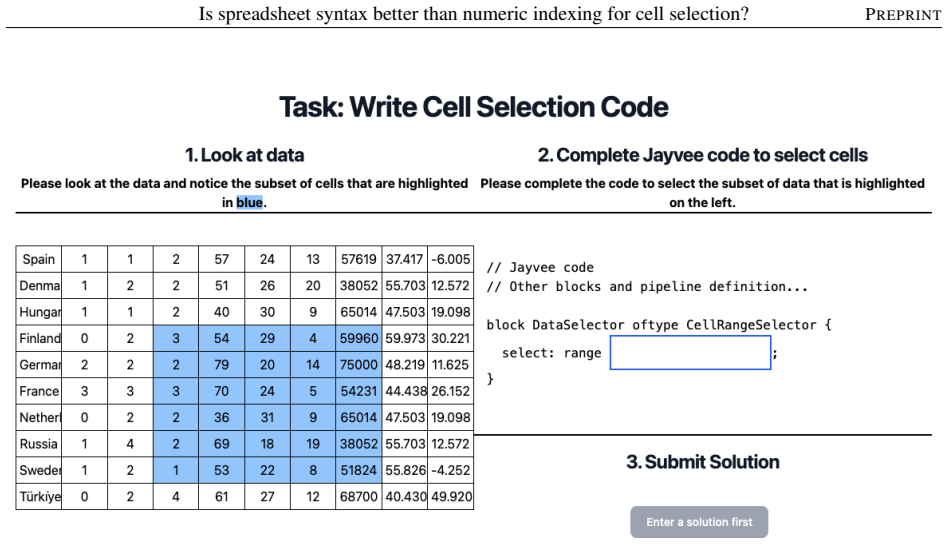
The machinery is the contrast between two cell-address notations in otherwise matched tasks: numeric indexing (e.g., df.iloc[6:10, 0:3], zero-based, rows and columns distinguished only by position) and spreadsheet-style references (e.g., A1:B10, columns as letters, rows as one-based numbers, with * meaning the last row or column). The experiment carries the argument through a crossover design that cancels individual differences: every participant did both treatments on four comprehension and four creation tasks, with an untracked pseudocode warm-up task and randomly assigned AB/BA sequences to limit carryover. Outcomes were measured programmatically—time to submission and Jaccard-index correctness between the highlighted cells and the selected set—and analyzed with paired nonparametric tests because the distributions were non-normal.
What would settle it
Re-run the experiment as a between-subjects design with a pre-test of each participant's skill in each syntax, or include self-reported prior hours with spreadsheets and with pandas as a covariate; if the spreadsheet advantage drops below statistical significance, the effect is explained by differential practice rather than by the syntax itself.
Extended reading notes
Core claim
The central claim is that for selecting cells from unstructured two-dimensional data, spreadsheet-style syntax reduces errors and saves time relative to numeric indexing, at least for users whose mental model of tables comes from spreadsheet software. Of the four measured outcomes, three favored spreadsheet syntax: reading comprehension correctness, code-creation correctness, and code-creation speed; reading speed showed no statistically significant difference (p≈0.147). The design was a crossover experiment: each participant used both syntaxes on parallel tasks, correctness was scored with the Jaccard index between selected and target cells, and times were measured from task start to submission. The authors explain the advantage through the two mental models: numeric indexing provides no syntactic distinction between rows and columns and forces users to remember zero-based, end-exclusive ranges, whereas spreadsheet syntax labels each dimension differently and matches the visual labels people already know from spreadsheet programs.
Load-bearing premise
The experiment assumes participants were roughly equally practiced in both syntaxes; there was no baseline measure of prior proficiency, so the measured advantage could partly be a training artifact if the spreadsheet-style DSL received more course time than pandas.
Editorial extensions
If this is right
- Language designers for data engineering should treat spreadsheet-style cell selection as a serious option when the target users are not professional programmers.
- Fewer cell-selection errors in pipeline code should lead to fewer bugs in downstream datasets, since wrong subsets propagate into cleaning and transformation steps.
- The large speed advantage in code writing suggests the syntax lowers the technical barrier for subject-matter experts to contribute directly to data pipelines.
- The paper's own discussion notes the advantage may shrink on very wide tables, where multi-letter column references like AA make spreadsheet syntax longer.
- Improved comprehension of cell selection code should let practitioners verify and trust existing scripts more confidently before modifying them.
Reading between the lines
- If the mechanism is familiarity rather than notation per se, the same effect should appear for any DSL that reuses an audience's existing notation—date formats, units, or field names—which would make the result a general design principle, not a spreadsheet-specific finding.
- A direct extension would test spreadsheet syntax against named-column selection and against direct visual manipulation; either might outperform both text syntaxes on realistic dirty data.
- The speed gap may partly reflect that pandas offers many ways to select cells, so participants spent time verifying which syntax was allowed; a study with autocomplete or a single-documented API variant could separate intuitiveness from syntactic simplicity.
- The authors expect the results not to generalize to professional programmers; a replication with industry data engineers with strong programming backgrounds would map where the syntax advantage ends.
Editorial analysis
A structured set of objections, weighed in public.
Referee Report
Summary. The paper reports a controlled crossover experiment with 93 students comparing spreadsheet-style cell-range syntax (in the authors' Jayvee DSL) with numeric iloc indexing in Pandas/Python for reading and writing cell-selection code. It finds a statistically significant improvement in code-creation time (p≈4.8e-13) and correctness (p≈3e-6) and a smaller improvement in comprehension correctness (p≈0.019), with no significant difference in comprehension speed. The authors conclude that spreadsheet-style syntax is a promising alternative for data engineering tools aimed at practitioners without a software engineering background.
Significance. If the effect is causal, the result is practically relevant and provides a useful data point for DSL design in data engineering. The experiment has notable strengths: a crossover design with random assignment, two distinct real-world datasets, two task types, automated measurement and scoring, nonparametric paired tests, effect sizes (CLES and RBC), outlier checks, a public data release on Zenodo, and a detailed description of the instrument that enables replication. The large code-creation effects are likely robust. However, the reading-correctness effect is small and fragile, and the differential training between treatments is a serious confound that has not been addressed. These issues affect the strength of the paper's central causal claim.
major comments (2)
- [§3.7, §3.3] The instrumentation section (3.7) states that participants were introduced to the DSL in two lectures and completed five exercises with it, whereas Pandas/Python was used mainly in a self-directed project, with only some participants having prior knowledge (§3.5). No baseline measure of proficiency in either syntax is reported. Because the paper's central claim is causal ('spreadsheet syntax is better'), the large code-creation advantages (Table 5, p≈4.8e-13 for time, CLES≈0.84) could be an artifact of differential practice with the authors' own DSL rather than a property of spreadsheet-style selection. This is a load-bearing threat that the current §6.1 discussion of dual role does not control for. I ask the authors to either provide additional evidence ruling out a practice effect (e.g., using task-order or event-log analyses, or a subgroup with comparable prior exposure) or to substantially temper the causal conclusions to refer to the DSL as taught in this course.
- [§4.1, Table 4] The reading-correctness result H1b has p≈0.019 with CLES≈0.54. With four hypotheses tested (H1a, H1b, H2a, H2b), a Bonferroni correction would set the threshold at 0.0125, so this finding would not survive correction. The abstract's statement that 'when reading code, participants make less mistakes using spreadsheet-style syntax' is therefore too strong without a multiple-comparison correction or an explicit exploratory label. Please either apply a correction (e.g., Bonferroni or FDR) and adjust the conclusions, or clearly mark H1b as a tentative finding requiring replication.
minor comments (4)
- [§3.7] There is a typo: 'I preparation for the experiment' should be 'In preparation for the experiment'.
- [Abstract, §1] 'make less mistakes' should be 'make fewer mistakes'; consider also noting that the comprehension-speed result (H1a) was not significant, to avoid overstating the reading benefits in the abstract.
- [Tables 4 and 5] Use a consistent format for p-values (e.g., 4.78e-13, 3.0e-6) and for H2b report the exact p-value; also specify how many outliers were removed for each hypothesis.
- [§3.9] The sentence 'The more rigid structure of the DSL leads to slightly lower correctness values for code creation in the spreadsheet syntax for rare edge cases' is unclear; please specify which edge cases are meant and how often they occurred.
Circularity Check
No circular derivation: the syntax-comparison conclusion is based on direct experimental measurements, not on a fitted parameter, a uniqueness theorem, or a definitional identity. The only self-involvement is the authors' own Jayvee DSL serving as one treatment arm, which is disclosed and is a validity threat rather than a circular reduction.
full rationale
The paper's central claim — that spreadsheet-style syntax improves program-comprehension correctness and code-creation speed and correctness versus numeric indexing — rests on a within-subjects controlled experiment that measures task time and Jaccard-index correctness directly (§3.4, §3.6, §3.9, §4). No parameter is fitted to a subset of the data and then relabeled as a prediction; the Wilcoxon signed-rank tests and CLES/RBC effect sizes are computed from the raw measurements and are not derived from the hypotheses they test. The two treatment syntaxes are not defined in terms of the outcome: spreadsheet syntax is operationalized as A1:B2-style column-character/one-indexed-row references and numeric syntax as Python/Pandas iloc, with surrounding code supplied to participants (§3.6). No uniqueness theorem or ansatz is imported from prior work. The only material self-citation is [5], the authors' own open-source Jayvee DSL, which implements the spreadsheet treatment and appears in the background discussion; it does not by itself justify the empirical conclusion, and the authors explicitly disclose their dual role as DSL creators in §6.1. The most serious concern is the training asymmetry reported in §3.7 (two introduction lectures plus five course exercises with the DSL, versus a largely self-directed Python/Pandas project with no baseline proficiency measurement): the large code-creation advantages could reflect differential practice rather than syntax per se. That is a threat to conclusion/internal validity, not circularity, because the conclusion does not reduce to its inputs by construction — the paper even disclaims causal interpretation in §7 ('we can not draw clear causal explanations from them'). The study is self-contained against its own measured data, so the circularity score is low despite the self-involvement.
Assumptions & free parameters
assumptions (4)
- domain assumption Master's students in data science and AI are a valid proxy for data practitioners without a professional programming background.
- domain assumption Participants had comparable prior training and familiarity with both syntaxes.
- domain assumption There are no differential carryover effects between treatment periods in the crossover design.
- domain assumption The Jaccard index of selected cells is an adequate operationalization of correctness.
Cite this review
Pith. "Pith review of Is spreadsheet syntax better than numeric indexing for cell selection?." pith.science (2026). https://pith.science/paper/V6RYBISQ
@misc{pith2026250523296,
  author       = {Pith},
  title        = {Pith review of: Is spreadsheet syntax better than numeric indexing for cell selection?},
  year         = {2026},
  howpublished = {\url{https://pith.science/paper/V6RYBISQ}},
  note         = {Machine review of arXiv:2505.23296}
}
read the original abstract
Selecting a subset of cells is a common task in data engineering, for example, to remove errors or select only specific parts of a table. Multiple approaches to express this selection exist. One option is numeric indexing, commonly found in general programming languages, where a tuple of numbers identifies the cell. Alternatively, the separate dimensions can be referred to using different enumeration schemes like "A1" for the first cell, commonly found in software such as spreadsheet systems. In a large-scale controlled experiment with student participants as proxy for data practitioners, we compare the two options with respect to speed and correctness of reading and writing code. The results show that, when reading code, participants make less mistakes using spreadsheet-style syntax. Additionally, when writing code, they make fewer mistakes and are faster when using spreadsheet syntax compared to numeric syntax. From this, a domain-specific syntax, such as spreadsheet syntax for data engineering, appears to be a promising alternative to explore in future tools to support practitioners without a software engineering background.
Figures


Figures from the paper (3 more)


Reference graph
Works this paper leans on
-
[1]
The TAME project: towards improvement-oriented software environments
V R Basili and H D Rombach. The TAME project: towards improvement-oriented software environments. IEEE Transactions on Software Engineering, 14(6):758–773, June 1988
work page 1988
-
[2]
Benefits and barriers of user evaluation in software engineering research
Raymond P L Buse, Caitlin Sadowski, and Westley Weimer. Benefits and barriers of user evaluation in software engineering research. In Proceedings of the 2011 ACM international conference on Object oriented programming systems languages and applications , New York, NY , USA, October 2011. ACM
work page 2011
-
[3]
Davide Falessi, Natalia Juristo, Claes Wohlin, Burak Turhan, Jürgen Münch, Andreas Jedlitschka, and Markku Oivo. Empirical software engineering experts on the use of students and professionals in experiments.Empirical Software Engineering, 23(1):452–489, February 2018
work page 2018
-
[4]
A systematic analysis of problems in open collaborative data engineering.Trans
Philip Heltweg and Dirk Riehle. A systematic analysis of problems in open collaborative data engineering.Trans. Soc. Comput., 6(3-4):1–30, December 2023
work page 2023
-
[5]
Philip Heltweg, Georg-Daniel Schwarz, Riehle Dirk, and Quast Felix. An empirical study on the effects of jayvee, a domain-specific language for data engineering, on understanding data pipeline architectures. Software: Practice & Experience, 2025
work page 2025
-
[6]
Comparing three notations for defining scenario-based model tests: A controlled experiment
Bernhard Hoisl, Stefan Sobernig, and Mark Strembeck. Comparing three notations for defining scenario-based model tests: A controlled experiment. In 2014 9th International Conference on the Quality of Information and Communications Technology, pages 180–189. IEEE, September 2014
work page 2014
-
[7]
Florian Häser, Michael Felderer, and Ruth Breu. Is business domain language support beneficial for creating test case specifications: A controlled experiment. Information and software technology, 79:52–62, November 2016
work page 2016
-
[8]
Étude comparative de la distribution florale dans une portion des alpes et des jura
P Jaccard. Étude comparative de la distribution florale dans une portion des alpes et des jura. Bull Soc V audoise Sci Nat, 37:547–579, 1901
work page 1901
Show all 26 references
-
[9]
Reporting guidelines for controlled experiments in software engineering
A Jedlitschka and D Pfahl. Reporting guidelines for controlled experiments in software engineering. In 2005 International Symposium on Empirical Software Engineering, 2005. , page 10 pp. Ieee, 2005
2005
-
[10]
Effectiveness and efficiency of a domain-specific language for high- performance marine ecosystem simulation: a controlled experiment
Arne N Johanson and Wilhelm Hasselbring. Effectiveness and efficiency of a domain-specific language for high- performance marine ecosystem simulation: a controlled experiment. Empirical Software Engineering, 22:2206– 2236, 2017
2017
-
[11]
The simple difference formula: An approach to teaching nonparametric correlation
Dave S Kerby. The simple difference formula: An approach to teaching nonparametric correlation. Comprehen- sive psychology, 3:11.IT.3.1, January 2014
2014
-
[12]
Robust statistical methods for empirical software engineering.Empirical Software Engineering, 22(2):579–630, April 2017
Barbara Kitchenham, Lech Madeyski, David Budgen, Jacky Keung, Pearl Brereton, Stuart Charters, Shirley Gibbs, and Amnart Pohthong. Robust statistical methods for empirical software engineering.Empirical Software Engineering, 22(2):579–630, April 2017
2017
-
[13]
Readability of domain-specific languages: A controlled experiment comparing (declarative) inference rules with (imperative) java source code in programming language design
Kai Klanten, Stefan Hanenberg, Stefan Gries, and V olker Gruhn. Readability of domain-specific languages: A controlled experiment comparing (declarative) inference rules with (imperative) java source code in programming language design. In Proceedings of the 19th International...
2024
-
[14]
A practical guide to controlled experiments of software engineering tools with human participants
Amy J Ko, Thomas D LaToza, and Margaret M Burnett. A practical guide to controlled experiments of software engineering tools with human participants. Empirical Software Engineering, 20(1):110–141, February 2015
2015
-
[15]
Comparing general-purpose domain specific languages: empirical study
T Kosar, N Oliveira, M Mernik, M João, M Pereira, M Repinåek, D Cruz, and P Rangel Henriques. Comparing general-purpose domain specific languages: empirical study. Computer Science Information Systems , 2010
2010
-
[16]
Program comprehension of domain-specific and general-purpose languages: replication of a family of experiments using integrated development environ- ments
Tomaž Kosar, Sašo Gaberc, Jeffrey C Carver, and Marjan Mernik. Program comprehension of domain-specific and general-purpose languages: replication of a family of experiments using integrated development environ- ments. Empirical Software Engineering, 23(5):2734–2763, October 2...
2018
-
[17]
Program comprehension of domain-specific and general- purpose languages: comparison using a family of experiments
Tomaž Kosar, Marjan Mernik, and Jeffrey C Carver. Program comprehension of domain-specific and general- purpose languages: comparison using a family of experiments. Empirical software engineering , 17:276–304, 2012
2012
-
[18]
A common language effect size statistic.Psychological bulletin, 111(2):361– 365, March 1992
Kenneth O McGraw and S P Wong. A common language effect size statistic.Psychological bulletin, 111(2):361– 365, March 1992
1992
-
[19]
An analysis of variance test for normality (complete samples)
S S Shapiro and M B Wilk. An analysis of variance test for normality (complete samples). Biometrika, 52(3/4):591–611, 1965
1965
-
[20]
Hints for reviewing empirical work in software engineering
W F Tichy. Hints for reviewing empirical work in software engineering. Empirical Software Engineering , 5(4):309–312, 2000
2000
-
[21]
Pingouin: statistics in python
Raphael Vallat. Pingouin: statistics in python. The Journal of Open Source Software , 3(31):1026, November 2018
2018
-
[22]
A critique and improvement of the CL common language effect size statis- tics of McGraw and wong
András Vargha and Harold D Delaney. A critique and improvement of the CL common language effect size statis- tics of McGraw and wong. Journal of educational and behavioral statistics: a quarterly publication sponsored by the American Educational Research Association and the Am...
2000
-
[23]
Crossover designs in software engineering experiments: Benefits and perils
Sira Vegas, Cecilia Apa, and Natalia Juristo. Crossover designs in software engineering experiments: Benefits and perils. IEEE Transactions on Software Engineering, 42(2):120–135, February 2016
2016
-
[24]
Individual comparisons by ranking methods
Frank Wilcoxon. Individual comparisons by ranking methods. Biometrics bulletin, 1(6):80, December 1945
1945
-
[25]
Experimen- tation in Software Engineering
Claes Wohlin, Per Runeson, Martin Höst, Magnus C Ohlsson, Björn Regnell, and Anders Wesslén. Experimen- tation in Software Engineering. Springer Science + Business Media, 2012
2012
-
[26]
40 years of designing code comprehension experiments: A systematic mapping study
Marvin Wyrich, Justus Bogner, and Stefan Wagner. 40 years of designing code comprehension experiments: A systematic mapping study. ACM Comput. Surv., October 2023. 18
2023
Reviewed August 7, 2026 · model on record in the stance chip above.
Discussion (0). Sign in to comment.