REVIEW 3 major objections 5 minor 81 references
Orientation dynamics of a spheroid in the simple shear flow of a weakly elastic fluid
T0 review · 3 major / 5 minor · reviewed 2026-08-07 · deepseek-v4-flash
Pith's one-line read Weak elasticity turns closed Jeffery orbits into four regimes of spheroid orientation.
desk verdict A careful, mostly convincing analytical derivation of the small-De spheroid phase diagram, but the unresolved Sharma & Koch discrepancy in the slender-fiber limit is a real correctness risk, not a footnote. read the letter →
The pith
A machine-rendered reading of the paper's core claim, the machinery that carries it, and where it could break.
The reading
What carries the argument
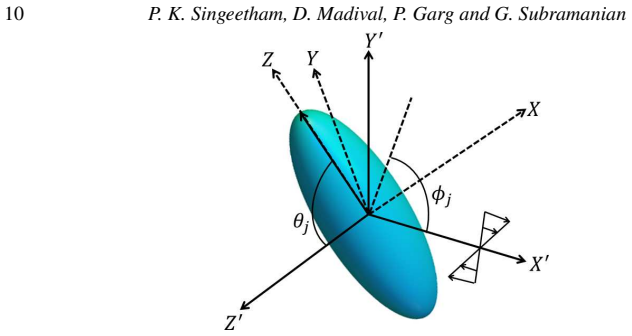
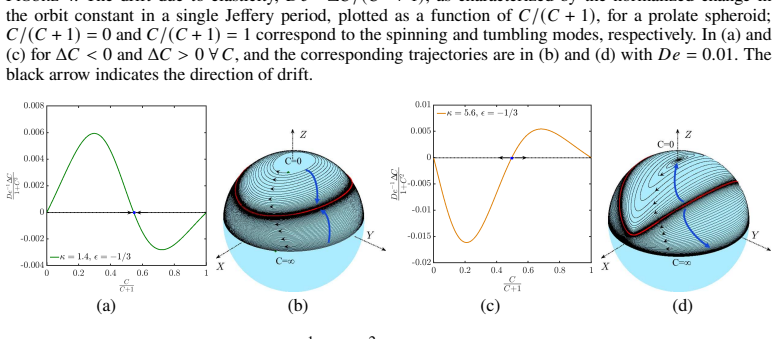
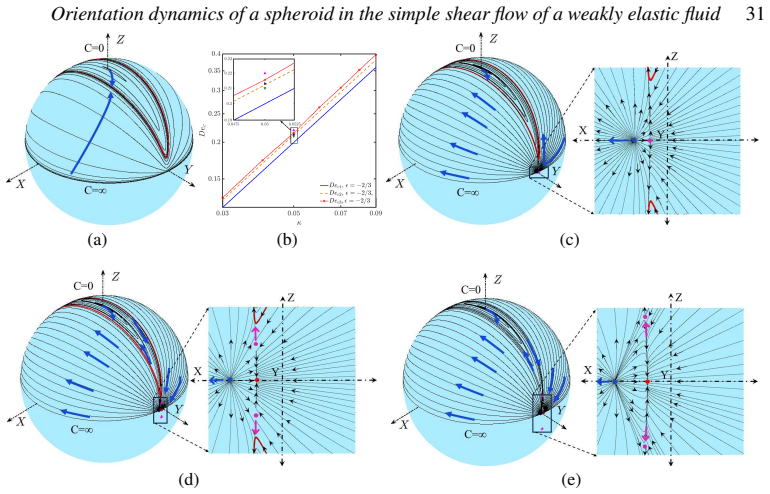
The central object is the orbit-averaged drift ΔC(C; κ, ε): the change in the Jeffery orbit constant over one rotation period, computed from the O(De) angular velocity by a multiple-scales (fast/slow time) expansion. The angular velocity is first written in an invariant quadratic form with four aspect-ratio functions β_i(κ, ε), which are evaluated in closed form in spheroidal coordinates using the reciprocal theorem and vector spheroidal harmonics; the fluid rheology enters only through the single parameter ε of the second-order fluid. The sign and zero-crossings of ΔC/(C²+1) as a function of C/(C+1) select one of four regimes, and the near-sphere, slender-fiber, and flat-disk asymptotes of ΔC supply the bifurcation loci on the κ-ε plane. For rotation arrest, the aligned-phase equation for a slender prolate spheroid gives the threshold De_c(κ), while for a thin oblate spheroid two further thresholds mark a saddle-node tri-furcation cascade that ends in stable flow-gradient-plane arrested states.
What would settle it
Integrate the full orientation equations for a prolate spheroid with κ=20 and ε=-0.6: the paper predicts rotation arrest only above De_c≈0.422 and predicts that arrested states in the flow-gradient plane are unstable, so any off-plane perturbation leads to a spiralling approach to the vorticity axis. Observing permanent arrest for De<0.422, or stable arrest for De>0.422 without the initially monotonic then spiralling transient, would falsify the threshold (4.2) and the stability analysis.
Extended reading notes
Core claim
For a neutrally buoyant spheroid of any aspect ratio in simple shear of a second-order fluid, weak elasticity breaks the closed Jeffery-orbit topology and produces an O(De) drift in the orbit constant C. The orbit-averaged drift ΔC(C; κ, ε) plotted against C/(C+1) has four possible shapes: always negative (spiralling to the spinning mode, Regime 1), always positive (spiralling to tumbling, Regime 2), a negative-slope zero crossing (stable kayaking limit cycle, Regime 3), or a positive-slope zero crossing (unstable limit cycle separating basins of spinning and tumbling, Regime 4). On the κ-ε plane these regimes are organized by bifurcation loci that asymptote to ε=-1/2 and ε=-1 in the slender-fiber limit, to ε=-1/3 in the flat-disk limit, and that intersect the sphere line at ε=-3/8, enclosing an island of Regime 3 near the prolate side. In the polymeric range ε∈[-0.7,-0.5], prolate spheroids of every aspect ratio drift to spinning; oblate spheroids drift to tumbling for κ > κ_c(ε), with κ_c increasing from 0.2 to 0.454 as ε varies from -0.7 to -0.5, and to a stable kayaking mode for κ < κ_c(ε). For slender prolate and thin oblate spheroids the drift picture breaks down and rotation about the vorticity axis is arrested above De_c(κ): an O(1/κ) threshold for prolate spheroids whose arrested states are unstable to off-plane perturbations, and for oblate spheroids a primary saddle-node at De_c1=12κ/(1+6ε), followed by secondary and tertiary bifurcations that create stable rotation-arrested states in the flow-gradient plane.
Load-bearing premise
The entire regime map assumes that the viscoelastic drift is always much slower than one Jeffery rotation, a separation that fails for extreme aspect ratios, so the phase diagram is only valid for De values that shrink toward zero as the spheroid becomes very slender or very flat.
Editorial extensions
If this is right
- In the polymeric range ε∈[-0.7,-0.5], a dilute suspension of rod-like spheroids should acquire a vorticity-aligned orientation distribution at long times, independent of initial orientation.
- Disk-like spheroids should switch from flow-gradient-plane tumbling to a kayaking limit cycle when their aspect ratio drops below κ_c(ε), with κ_c increasing from 0.2 to 0.454 as ε goes from -0.7 to -0.5.
- Slender fibers should exhibit rotation arrest in the flow-gradient plane above De_c = O(1/κ) with arrested states that are unstable to off-plane perturbations, whereas thin disks should show a narrow Deborah-number window where stable arrested states coexist with the kayaking limit cycle before the limit cycle is destroyed.
- The O(De) angular-velocity formula, with its closed-form aspect-ratio functions, can serve as the input for computing the leading-order elastic rheology and shear-induced migration of dilute spheroid suspensions.
- Because the drift coefficients scale linearly with (1+2ε) in the slender limit, Boger fluids near ε=-0.5 should display a logarithmically smaller drift, making the predicted regimes hardest to observe there.
Reading between the lines
- If the sign of ΔC is read from the closed-form functions, the regime boundaries at ε=-1/2 and ε=-1/3 suggest that for fluids near these parameter values the leading-order drift changes sign in a vanishingly small neighborhood of the sphere or of the flat-disk limit; finite-De corrections may then dominate and shift or destroy the predicted regime transitions.
- The paper's conclusion that no stable flow-vorticity-plane equilibria exist at small De implies that the stationary orientations seen in experiments and finite-De simulations of prolate spheroids require fluid-memory effects beyond the second-order fluid; a testable extension would be to see whether such equilibria vanish as De→0 in an ε=-0.6 fluid.
- Combining the tabulated viscoelastic β_i with the known inertial shape functions would yield an inertio-elastic regime diagram, since the two contributions are additive at small Re and De—a natural extension that the paper notes is planned for future work.
- The predicted oblate cascade with three closely spaced thresholds (for example 0.2, 0.212, and 0.215 for κ=0.05 and ε=-2/3) means that modest uncertainty in either De or κ could move a disk between qualitatively different long-time states; experiments will need precise control of both to test the phase diagram.
Editorial analysis
A structured set of objections, weighed in public.
Referee Report
Summary. The paper analyzes the orientation dynamics of a neutrally buoyant spheroid of arbitrary aspect ratio in simple shear flow of a weakly elastic second-order fluid, working to first order in the Deborah number. Using a reciprocal theorem formulation with vector spheroidal harmonics, the authors derive closed-form expressions for the O(De) correction to the angular velocity, then use a multiple-scales analysis to reduce the dynamics to a slow drift of the Jeffery orbit constant C. The drift curves are organized into four regimes on the κ–ε plane: stable spinning, stable tumbling, stable kayaking, and unstable kayaking. For the polymeric range ε∈[−0.7,−0.5], the paper claims that prolate spheroids always drift to the spinning mode, while oblate spheroids drift to tumbling for κ>κ_c(ε) and to a stable kayaking mode for κ<κ_c(ε). It also analyzes rotation arrest for extreme aspect ratios, deriving thresholds De_c∼1/κ for slender prolate spheroids and De_c∼κ for thin oblate spheroids, with secondary and tertiary bifurcations on the oblate side. Appendix B provides an independent Fourier-space slender-body derivation that reproduces the large-κ limit up to a factor of 4 compared with Leal (1975).
Significance. If correct, this is a substantial contribution: it gives a parameter-free, closed-form description of the leading viscoelastic correction to spheroid rotation across the full aspect-ratio range, identifies a stable kayaking mode for oblate spheroids in the polymeric range, and predicts arrest scalings that connect to earlier experiments and computations. The paper's strengths include a systematic reciprocal-theorem derivation, closed-form aspect-ratio functions in Appendix A, an independent slender-body check in Appendix B, and qualitative agreement with D'Avino et al. (2014) and with the early experiments of Gauthier and Bartram. The main risk is the slender-prolate corner, where the paper itself concedes an unresolved disagreement with Sharma & Koch (2023); because the abstract's 'prolate always drifts to spinning' claim covers that corner, this is a load-bearing issue rather than a peripheral discrepancy.
major comments (3)
- [§5 and Appendix B] The central claim that a prolate spheroid of any aspect ratio drifts to the spinning mode in the polymeric range is not settled in the slender-fiber limit. In §5 the authors state that Sharma & Koch (2023), in the limit c*De→0, found a stable limit cycle near the vorticity axis, that this disagrees with both Leal (1975) and the present results, and that 'the reasons for this discrepancy are not clear at the moment.' The independent derivation in Appendix B uses only the leading-order line distribution of Stokeslets (Eqs. B4–B7) and explicitly neglects the O(κ^-2) higher-order singularities that Sharma & Koch identify as controlling the long near-aligned phase. The spheroidal-harmonic expansion in §2.2 formally contains those singularities, but the paper never shows explicitly that its large-κ limit reproduces or refutes Sharma & Koch's aligned-phase torque balance. To support the 'always' claim, the authors should either retain the higher-order singularities in the large-κ reduction and show the sign of the drift near the flow-gradient plane, or explicitly restrict the claim to aspect ratios below the range where the Sharma–Koch mechanism operates.
- [§3 and §3.3, Figure 8] The global regime classification in Figure 8 is an asymptotic statement, not a fixed-De phase map. As the authors correctly note at the start of §3 and in §3.3, the time-scale separation underlying the multiple-scales reduction breaks down for slender prolate and thin oblate spheroids near their aligned phases, so De must be taken increasingly small as κ→∞ (De≪1/κ) or κ→0 (De≪κ). For any fixed experimental De in the extreme-aspect-ratio limits, rotation arrest and the secondary bifurcations of §4 intervene before the drift picture applies. This caveat appears in the text but is absent from the abstract and from the Figure 8 caption, where the four regimes are presented on the κ–ε plane without the De constraint. The paper should carry this qualification into the abstract and figure so that readers do not interpret the diagram as a fixed-De prediction.
- [§4, Eq. (4.1)–(4.2)] The prolate rotation-arrest threshold De_c(κ) is derived from the aligned-phase equation (4.1), which is truncated at leading order in κ^-1. The paper is appropriately cautious in Figure 10 by drawing the moderate-κ portions as dashed, but it does not give a quantitative criterion for where the asymptotic expression is reliable. Since the paper uses κ=20 as a representative case (Figure 11) and compares with computations for κ up to 16, an estimate of the neglected O(κ^-2) terms in (4.1) is needed to justify the precision implied by the quoted threshold values, especially near the turning-around region of the dashed curves where the prediction is acknowledged to be unphysical.
minor comments (5)
- [Abstract and §5] The phrase 'our results are exact' in §5 should be qualified: the results are exact within the second-order-fluid truncation and the regular O(De) expansion for a spheroid, whereas Appendix B itself is a leading-logarithmic slender-body calculation. As written, the sentence invites confusion between the spheroidal-harmonic calculation and the asymptotic slender-body check.
- [§2.3, after Eq. (2.42)] The list of relations between the β_i and the trigonometric coefficients appears to contain a notational slip, with one relation seemingly repeated. Please check that all coefficients are defined consistently, since the subsequent drift plots depend on these definitions.
- [§3.3 and Figures 6–7] The insets in Figures 6(b) and 6(f) show that the convergence to the slender-fiber asymptote is logarithmic and that the exact curves visibly differ even at κ=10^4. This is consistent with the text, but in the figure captions it would help to state explicitly that the plotted asymptote is the leading-logarithmic result from Appendix B, not the full large-κ limit of the exact expressions.
- [Appendix B, Eq. (B1)] The reciprocal-theorem prefactor in (B1) is stated for a slender fiber with the Oseen-Burgers tensor, but the derivation would be easier to follow if the paper stated explicitly that the longitudinal force profile is that of a slender spheroid, R(x1)=κ^-1√(1−x1^2), before quoting I1=2lnκ/3.
- [Throughout] There are numerous typographical artifacts in the rendered text (e.g., stray 'u1D' glyphs and inconsistent spacing in equations). A careful proofread of the final manuscript is needed before publication.
Circularity Check
No significant circularity: the O(De) angular velocity and orbital drift are derived from the reciprocal theorem and vector spheroidal harmonics, with prior same-group Stokesian fields used as published parameter-free inputs rather than as fits to the paper's own predictions.
full rationale
The paper's central derivation is self-contained against its own equations. The O(De) angular velocity follows from the generalized reciprocal theorem in Eq. (2.16), with the disturbance fields evaluated from Stokesian spheroidal-harmonic solutions quoted from Dabade et al. (2016); those are published, parameter-free analytical inputs that do not themselves contain the viscoelastic drift prediction. The orbit-constant drift is then obtained independently via a multiple-scales average in Eq. (3.6), and the closed-form aspect-ratio functions are tabulated in Appendix A. The slender-fiber limit is checked by an independent Fourier-space slender-body calculation in Appendix B, which reproduces Leal (1975) up to a factor of four and matches the large-aspect-ratio limit of the main expressions. No free parameter is fitted to the target predictions, and the regime diagram in Figure 8 is organized by the computed sign and zero crossings of the drift rather than imposed by construction. The acknowledged discrepancy with Sharma & Koch (2023) in Section 5 (“the reasons for this discrepancy are not clear at the moment”) is a correctness and validation risk, not a circularity: the paper does not redefine Sharma & Koch's result as its own prediction, and the disagreement leaves the central derivation unchanged. Self-citations of the authors' prior work are used only for standard Stokesian building blocks and are not load-bearing circular justification.
Assumptions & free parameters
assumptions (5)
- domain assumption The suspending fluid is modeled as a second-order fluid, so viscoelasticity is captured by the O(De) stress terms (2.5)-(2.6) with material parameter epsilon.
- domain assumption The disturbance velocity and pressure fields in the O(De) integrals can be replaced by their Stokesian (De = 0) approximations.
- standard math The structure of the O(De) angular velocity is exactly the four-function invariant form (2.40).
- domain assumption The multiple-scales reduction in Eq. (3.6) is valid because Jeffery rotation is fast compared with viscoelastic drift.
- domain assumption Polymer solutions correspond to epsilon in [-0.7, -0.5].
Cite this review
Pith. "Pith review of Orientation dynamics of a spheroid in the simple shear flow of a weakly elastic fluid." pith.science (2026). https://pith.science/paper/MSCKIMCL
@misc{pith2026250523361,
  author       = {Pith},
  title        = {Pith review of: Orientation dynamics of a spheroid in the simple shear flow of a weakly elastic fluid},
  year         = {2026},
  howpublished = {\url{https://pith.science/paper/MSCKIMCL}},
  note         = {Machine review of arXiv:2505.23361}
}
abstract
We investigate the orientation dynamics of a neutrally buoyant spheroid, of an arbitrary aspect ratio ($\kappa$), freely rotating in a weakly viscoelastic fluid undergoing simple shear flow. Weak elasticity is characterized by a small but finite Deborah number ($De$), and the suspending fluid rheology is therefore modeled as a second-order fluid, with the constitutive equation involving a material parameter $\epsilon$ related to the ratio of the first and second normal stress differences; polymer solutions correspond to $\epsilon\in[-0.7,-0.5]$. Employing a reciprocal theorem formulation, along with expressions for the relevant disturbance fields in terms of vector spheroidal harmonics, we obtain the spheroid angular velocity to $O(De)$. In the Newtonian limit, a spheroid rotates along Jeffery orbits parametrized by an orbit constant $C$, although this closed-trajectory topology is structurally unstable, being susceptible to weak perturbations. For $De$ well below a threshold, $De_c(\kappa)$, weak viscoelasticity transforms the closed-trajectory topology into a tightly spiralling one. A multiple-scales analysis is used to interpret the resulting orientation dynamics in terms of an $O(De)$ orbital drift. The drift in orbit constant over a Jeffery period $\Delta C$, when plotted as a function of $C$, identifies four different orientation dynamics regimes on the $\kappa-\epsilon$ plane. For $\epsilon$ in the polymeric range, prolate spheroids always drift towards the spinning mode. Oblate spheroids drift towards the tumbling mode for $\kappa > \kappa_c(\epsilon)$, but towards an intermediate kayaking mode for $\kappa < \kappa_c(\epsilon)$. The rotation of spheroids of extreme aspect ratios, either slender prolate spheroids ($\kappa \gg 1$) or thin oblate ones ($\kappa \ll 1$), about the vorticity axis, is arrested for $De \geq De_c(\kappa)$
Figures


Figures from the paper (13 more)





Reference graph
Works this paper leans on
-
[1]
, " * write output.state after.block = add.period write newline
ENTRY address author booktitle chapter edition editor howpublished institution journal key month note number organization pages publisher school series title type volume year eprint label extra.label sort.label short.list INTEGERS output.state before.all mid.sentence after.sentence after.block FUNCTION init.state.consts #0 'before.all := #1 'mid.sentence ...
-
[2]
write newline
" write newline "" before.all 'output.state := FUNCTION n.dashify 't := "" t empty not t #1 #1 substring "-" = t #1 #2 substring "--" = not "--" * t #2 global.max substring 't := t #1 #1 substring "-" = "-" * t #2 global.max substring 't := while if t #1 #1 substring * t #2 global.max substring 't := if while FUNCTION word.in bbl.in capitalize " " * FUNCT...
-
[3]
Abtahi, S. A. & Elfring, G. J. 2019 Jeffery orbits in shear-thinning fluids . Phys. Fluids 31 (10)
work page 2019
-
[4]
Anand, P. & Subramanian, G. 2023 Inertial migration of a neutrally buoyant spheroid in plane poiseuille flow . J. Fluid Mech. 974 , A39
work page 2023
-
[5]
Anczurowski, E. & Mason, S. G. 1968 Particle motions in sheared suspensions. xxiv. rotation of rigid spheroids and cylinders . Trans. Soc. Rheol. 12 (2), 209--215
work page 1968
-
[6]
Arratia, P. E. 2022 Life in complex fluids: Swimming in polymers . Phys. Rev. Fluids 7 (11), 110515
work page 2022
-
[7]
Banerjee, M. R. & Subramanian, G. 2021 An anisotropic particle in a simple shear flow: an instance of chaotic scattering . J. Fluid Mech. 913
work page 2021
-
[8]
Bartram, E. , Goldsmith, H. L. & Mason, S. G. 1975 Particle motions in non-newtonian media: Iii. further observations in elasticoviscous fluids . Rheol. Acta 14 , 776--782
work page 1975
Show all 81 references
-
[9]
Batchelor, G. K. 1970 Slender-body theory for particles of arbitrary cross-section in stokes flow . J. Fluid Mech. 44 (3), 419--440
1970
-
[10]
Bender, C. M. & Orszag, S. A. 1999 Advanced mathematical methods for scientists and engineers I: Asymptotic methods and perturbation theory\/ . Springer Science & Business Media
1999
-
[11]
Beris, A. N. , Horner, J. S. , Jariwala, S. , Armstrong, M. J. & Wagner, N. J. 2021 Recent advances in blood rheology: a review . Soft Matter 17 (47), 10591--10613
2021
-
[12]
Bird, R. B. , Armstrong, R. C. & Hassager, O. 1987 Dynamics of polymeric liquids. Vol. 1: Fluid mechanics\/ . John Wiley and Sons Inc., New York
1987
-
[13]
, Abisset-Chavanne, E
Borzacchiello, D. , Abisset-Chavanne, E. , Chinesta, F. & Keunings, R. 2016 Orientation kinematics of short fibres in a second-order viscoelastic fluid . Rheol. Acta 55 , 397--409
2016
-
[14]
Bretherton, F. P. 1962 The motion of rigid particles in a shear flow at low reynolds number . J. Fluid Mech. 14 (2), 284--304
1962
-
[15]
1976 a\/ The behavior of a sphere in non-homogeneous flows of a viscoelastic fluid
Brunn, P. 1976 a\/ The behavior of a sphere in non-homogeneous flows of a viscoelastic fluid . Rheol. Acta 15 (11-12), 589--611
1976
-
[16]
1976 b\/ The slow motion of a sphere in a second-order fluid
Brunn, P. 1976 b\/ The slow motion of a sphere in a second-order fluid . Rheol. Acta 15 (3-4), 163--171
1976
-
[17]
1977 The slow motion of a rigid particle in a second-order fluid
Brunn, P. 1977 The slow motion of a rigid particle in a second-order fluid . J. Fluid Mech. 82 (3), 529--547
1977
-
[18]
Caro, C. G. , Pedley, T. J. , Schroter, R. C. , Parker, K. H. & Seed, W. A. 2012 The mechanics of the circulation\/ . Cambridge University Press
2012
-
[19]
Cho, H. R. , Iribarne, J. V. & Richards, W. G. 1981 On the orientation of ice crystals in a cumulonimbus cloud . J. Atmos. Sci. 38 (5), 1111--1114
1981
-
[20]
& Cohen, C
Chung, B. & Cohen, C. 1987 Orientation and rheology of rodlike particles with strong brownian diffusion in a second-order fluid under simple shear flow . J. Nonnewton. Fluid Mech. 25 (3), 289--312
1987
-
[21]
, Chung, B
Cohen, C. , Chung, B. & Stasiak, W. 1987 Orientation and rheology of rodlike particles with weak brownian diffusion in a second-order fluid under simple shear flow . Rheol. Acta 26 , 217--232
1987
-
[22]
Cox, R. G. 1970 The motion of long slender bodies in a viscous fluid part 1. general theory . J. Fluid Mech. 44 (4), 791--810
1970
-
[23]
2009 Orientation dynamics of anisotropic particles in viscoelastic fluids
Dabade, V. 2009 Orientation dynamics of anisotropic particles in viscoelastic fluids. Master's thesis, Jawaharlal Nehru Centre for Advanced Scientific Research
2009
-
[24]
, Marath, N
Dabade, V. , Marath, N. K. & Subramanian, G. 2015 Effects of inertia and viscoelasticity on sedimenting anisotropic particles . J. Fluid Mech. 778 , 133--188
2015
-
[25]
, Marath, N
Dabade, V. , Marath, N. K. & Subramanian, G. 2016 The effect of inertia on the orientation dynamics of anisotropic particles in simple shear flow . J. Fluid Mech. 791 , 631--703
2016
-
[26]
, Greco, F
D'Avino, G. , Greco, F. & Maffettone, P. L. 2017 Particle migration due to viscoelasticity of the suspending liquid and its relevance in microfluidic devices . Annu. Rev. Fluid Mech. 49 (1), 341--360
2017
-
[27]
, Hulsen, M
D'Avino, G. , Hulsen, M. A. , Greco, F. & Maffettone, P. L. 2014 Bistability and metabistability scenario in the dynamics of an ellipsoidal particle in a sheared viscoelastic fluid . Phys. Rev. E 89 (4), 043006
2014
-
[28]
, Hulsen, M
D’Avino, G. , Hulsen, M. A. , Greco, F. & Maffettone, P. L. 2019 Numerical simulations on the dynamics of a spheroid in a viscoelastic liquid in a wide-slit microchannel . J. Nonnewton. Fluid Mech. 263 , 33--41
2019
-
[29]
, Hulsen, M
D’Avino, G. , Hulsen, M. A. , Snijkers, F. , Vermant, J. , Greco, F. & Maffettone, P. L. 2008 Rotation of a sphere in a viscoelastic liquid subjected to shear flow. part i: Simulation results . J. Rheol. 52 (6), 1331--1346
2008
-
[30]
& Maffettone, P
D’Avino, G. & Maffettone, P. L. 2015 Particle dynamics in viscoelastic liquids . J. Nonnewton. Fluid Mech. 215 , 80--104
2015
-
[31]
Garrett, T. J. , Gerber, H. , Baumgardner, D. G. , Twohy, C. H. & Weinstock, E. M. 2003 Small, highly reflective ice crystals in low-latitude cirrus . Geophys. Res. Lett. 30 (21)
2003
-
[32]
, Goldsmith, H
Gauthier, F. , Goldsmith, H. L. & Mason, S. G. 1971 Particle motions in non-newtonian media: I: Couette flow . Rheol. Acta 10 , 344--364
1971
-
[33]
Gunes, D. Z. , Scirocco, R. , Mewis, J. & Vermant, J. 2008 Flow-induced orientation of non-spherical particles: Effect of aspect ratio and medium rheology . J. Nonnewton. Fluid Mech. 155 (1-2), 39--50
2008
-
[34]
Harlen, O. G. & Koch, D. L. 1993 Simple shear flow of a suspension of fibres in a dilute polymer solution at high deborah number . J. Fluid Mech. 252 , 187--207
1993
-
[35]
Harris, J. B. & Pittman, J. F. T. 1975 Equivalent ellipsoidal axis ratios of slender rod-like particles . J. Coll. Interface Sci. 50 (2), 280--282
1975
-
[36]
Harrison, G. M. , Remmelgas, J. & Leal, L. G. 1998 The dynamics of ultradilute polymer solutions in transient flow: Comparison of dumbbell-based theory and experiment . Phys. Fluids 42 , 1039--1058
1998
-
[37]
Hogan, R. J. , Tian, L. , Brown, P. R. A. , Westbrook, C. D. , Heymsfield, A. J. & Eastment, J. D. 2012 Radar scattering from ice aggregates using the horizontally aligned oblate spheroid approximation . J. Appl. Meteorol. Climatol. 51 (3), 655--671
2012
-
[38]
Housiadas, K. D. & Tanner, R. I. 2011 The angular velocity of a freely rotating sphere in a weakly viscoelastic matrix fluid . Phys. Fluids 23 (5), 051702
2011
-
[39]
Hwang, W. R. , Hulsen, M. A. & Meijer, H. E. H. 2004 Direct simulations of particle suspensions in a viscoelastic fluid in sliding bi-periodic frames . J. Nonnewton. Fluid Mech. 121 (1), 15--33
2004
-
[40]
, Cohen, C
Iso, Y. , Cohen, C. & Koch, D. L. 1996b Orientation in simple shear flow of semi-dilute fiber suspensions 2. highly elastic fluids . J. Nonnewton. Fluid Mech. 62 (2-3), 135--153
-
[41]
, Koch, D
Iso, Y. , Koch, D. L. & Cohen, C. 1996a Orientation in simple shear flow of semi-dilute fiber suspensions 1. weakly elastic fluids . J. Nonnewton. Fluid Mech. 62 (2-3), 115--134
-
[42]
Jeffery, G. B. 1922 The motion of ellipsoidal particles immersed in a viscous fluid . Proc. R. Soc. Lond. Ser. A-Contain. Pap. Math. Phys. Character 102 (715), 161--179
1922
-
[43]
Johnson, S. J. , Salem, A. J. & Fuller, G. G. 1990 Dynamics of colloidal particles in sheared, non-newtonian fluids . J. Nonnewton. Fluid Mech. 34 (1), 89--121
1990
-
[44]
& Mason, S
Karnis, A. & Mason, S. G. 1966 Particle motions in sheared suspensions. xix. viscoelastic media . Trans Soc. Rheol. 11 , 571--592
1966
-
[45]
& Karrila, S
Kim, S. & Karrila, S. J. 1991 M icrohydrodynamics: P rinciples and S elected A pplications\/ . Buttertworth-Heineman
1991
-
[46]
Klett, J. D. 1995 Orientation model for particles in turbulence . J. Atmos. Sci. 52 (12), 2276--2285
1995
-
[47]
, Hallworth, M
Koyaguchi, T. , Hallworth, M. A. , Huppert, H. E. & Sparks, R. S. J. 1990 Sedimentation of particles from a convecting fluid . Nature 343 (6257), 447--450
1990
-
[48]
1995 Addition theorems of partial vector solutions of the lame equation in a spheroidal basis
Kushch, V. 1995 Addition theorems of partial vector solutions of the lame equation in a spheroidal basis . Int. J. Appl. Mech. 31 (2)
1995
-
[49]
1997 Microstresses and effective elastic moduli of a solid reinforced by periodically distributed spheroidal particles
Kushch, V. 1997 Microstresses and effective elastic moduli of a solid reinforced by periodically distributed spheroidal particles . Int. J. Solids Struct. 34 (11), 1353--1366
1997
-
[50]
1998 Elastic equilibrium of a medium containing a finite number of arbitrarily oriented spheroidal inclusions
Kushch, V. 1998 Elastic equilibrium of a medium containing a finite number of arbitrarily oriented spheroidal inclusions . Int. J. Solids Struct. 35 (12), 1187--1198
1998
-
[51]
& Sangani, A
Kushch, V. & Sangani, A. S. 2000 Stress intensity factor and effective stiffness of a solid containing aligned penny-shaped cracks . Int. J. Solids Struct. 37 (44), 6555--6570
2000
-
[52]
& Sevostianov, I
Kushch, V. & Sevostianov, I. 2004 Effective elastic properties of the particulate composite with transversely isotropic phases . Int. J. Solids Struct. 41 (3-4), 885--906
2004
-
[53]
Leal, L. G. 1975 The slow motion of slender rod-like particles in a second-order fluid . J. Fluid Mech. 69 (2), 305--337
1975
-
[54]
Li, Y. , Xu, C. & Zhao, L. 2023 Rotational dynamics of a neutrally buoyant prolate spheroid in viscoelastic shear flows at finite reynolds numbers . J. Fluid Mech. 958 , A20
2023
-
[55]
Li, Y. , Xu, C. & Zhao, L. 2024 Oscillation migration of a neutrally buoyant oblate spheroid in the elasto-inertial duct flow . J. Fluid Mech. 997 , A57
2024
-
[56]
& Lin, J
Li, Z. & Lin, J. 2022 On the some issues of particle motion in the flow of viscoelastic fluids . Acta Mech. Sin. 38 (3), 321467
2022
-
[57]
, Peery, J
Lin, C. , Peery, J. H. & Schowalter, W. R. 1970 Simple shear flow round a rigid sphere: inertial effects and suspension rheology . J. Fluid Mech. 44 (1), 1--17
1970
-
[58]
& Huo, L
Lin, J. & Huo, L. 2015 A review of research on nanoparticulate flow undergoing coagulation . Acta Mech. Sin. 31 , 292--302
2015
-
[59]
, Tang, S
Lv, H. , Tang, S. & Zhou, W. 2011 Direct numerical simulation of particle migration in a simple shear flow . Chin. Phys. Lett. 28 (8), 084708
2011
-
[60]
Marath, N. K. , Dwivedi, R. & Subramanian, G. 2017 An orientational order transition in a sheared suspension of anisotropic particles . J. Fluid Mech. 811 , R3
2017
-
[61]
Marath, N. K. & Subramanian, G. 2017 The effect of inertia on the time period of rotation of an anisotropic particle in simple shear flow . J. Fluid Mech. 830 , 165--210
2017
-
[62]
Marath, N. K. & Subramanian, G. 2018 The inertial orientation dynamics of anisotropic particles in planar linear flows . J. Fluid Mech. 844 , 357--402
2018
-
[63]
Mikulencak, D. R. & Morris, J. F. 2004 Stationary shear flow around fixed and free bodies at finite reynolds number . J. Fluid Mech. 520 , 215--242
2004
-
[64]
& Fan, X
Phan-Thien, N. & Fan, X. 2002 Viscoelastic mobility problem using a boundary element method . J. Nonnewton. Fluid Mech. 105 (2-3), 131--152
2002
-
[65]
, Barkstrom, B
Ramanathan, V. , Barkstrom, B. R. & Harrison, E. F. 1989 Climate and the earth's radiation budget . Physics Today 42 (5), 22--32
1989
-
[66]
Schwindinger, K. R. 1999 Particle dynamics and aggregation of crystals in a magma chamber with application to kilauea iki olivines . J. Volcanol. Geotherm. Res. 88 (4), 209--238
1999
-
[67]
& Koch, D
Sharma, A. & Koch, D. L. 2023 Rotation of a fibre in simple shear flow of a dilute polymer solution . J. Fluid Mech. 976 , A9
2023
-
[68]
, D’Avino, G
Snijkers, F. , D’Avino, G. , Maffettone, P. L. , Greco, F. , Hulsen, M. & Vermant, J. 2009 Rotation of a sphere in a viscoelastic liquid subjected to shear flow. part ii. experimental results . J. Rheol. 53 (2), 459--480
2009
-
[69]
, D’Avino, G
Snijkers, F. , D’Avino, G. , Maffettone, P. L. , Greco, F. , Hulsen, M. A. & Vermant, J. 2011 Effect of viscoelasticity on the rotation of a sphere in shear flow . J. Nonnewton. Fluid Mech. 166 (7-8), 363--372
2011
-
[70]
Spagnolie, S. E. & Underhill, P. T. 2023 Swimming in complex fluids . Annu. Rev. Condens. Matter Phys. 14 (1), 381--415
2023
-
[71]
& Brady, J
Subramanian, G. & Brady, J. F. 2004 Multiple scales analysis of the fokker--planck equation for simple shear flow . Phys. A Stat. Mech. Appl. 334 (3-4), 343--384
2004
-
[72]
& Koch, D
Subramanian, G. & Koch, D. L. 2005 Inertial effects on fibre motion in simple shear flow . J. Fluid Mech. 535 , 383--414
2005
-
[73]
& Koch, D
Subramanian, G. & Koch, D. L. 2006 The stress in a dilute suspension of spheres suspended in a second-order fluid subject to a linear velocity field . J. Nonnewton. Fluid Mech. 138 (2-3), 87--97
2006
-
[74]
& Koch, D
Subramanian, G. & Koch, D. L. 2007 Heat transfer from a neutrally buoyant sphere in a second-order fluid . J. non-Newt. Fluid Mech. 144 (1), 49--57
2007
-
[75]
& Marath, N
Subramanian, G. & Marath, N. K. 2022 Rheology of dilute inertial suspensions . In Recent Advances in Rheology: Theory, Biorheology, Suspension and Interfacial Rheology\/ (ed. D. K. Daniel & R. Arun ) , chap. 9, pp. 1--30 . AIP Publishing, Melville, NewYork
2022
-
[76]
& Narsimhan, V
Tai, C. & Narsimhan, V. 2022 Experimental and theoretical studies of cross-stream migration of non-spherical particles in a quadratic flow of a viscoelastic fluid . Soft Matter 18 (24), 4613--4624
2022
-
[77]
, Wang, S
Tai, C. , Wang, S. & Narsimhan, V. 2020 a\/ Cross-stream migration of non-spherical particles in a second-order fluid--theories of particle dynamics in arbitrary quadratic flows . J. Fluid Mech. 895 , A6
2020
-
[78]
, Wang, S
Tai, C. , Wang, S. & Narsimhan, V. 2020 b\/ Cross-stream migration of nonspherical particles in second-order fluid flows: Effect of flow profiles . AIChE J. 66 (12), e17076
2020
-
[79]
, Tai, C
Wang, S. , Tai, C. & Narsimhan, V. 2020 Dynamics of spheroids in an unbound quadratic flow of a general second-order fluid . Phys. Fluids 32 (11)
2020
-
[80]
Wang, Y. , Yu, Z. & Lin, J. 2019 Numerical simulations of the motion of ellipsoids in planar couette flow of giesekus viscoelastic fluids . Microfluid. Nanofluidics 23 , 1--16
2019
-
[81]
, Phan-Thien, N
Ye, T. , Phan-Thien, N. & Lim, C. T. 2016 Particle-based simulations of red blood cells—a review . J. Biomech. 49 (11), 2255--2266
2016
Reviewed August 7, 2026 · model on record in the stance chip above.
Discussion (0). Sign in to comment.