REVIEW 4 major objections 5 minor 15 references
Particle exchange Monte Carlo methods for eigenfunction and related nonlinear problems
T0 review · 4 major / 5 minor · reviewed 2026-08-07 · deepseek-v4-flash
Pith's one-line read Particle-exchange Monte Carlo estimates eigenvalues and eigenfunctions of nonlinear problems by coupling a forward diffusion to its time-reversed dual, with a swap rule that preserves the joint eigenfunction law.
desk verdict A genuinely new forward/backward swap construction with a clean formal core; the practical algorithm is a plausible but unproven extrapolation, so treat it as a strong conditional. read the letter →
The pith
A machine-rendered reading of the paper's core claim, the machinery that carries it, and where it could break.
The reading
What carries the argument
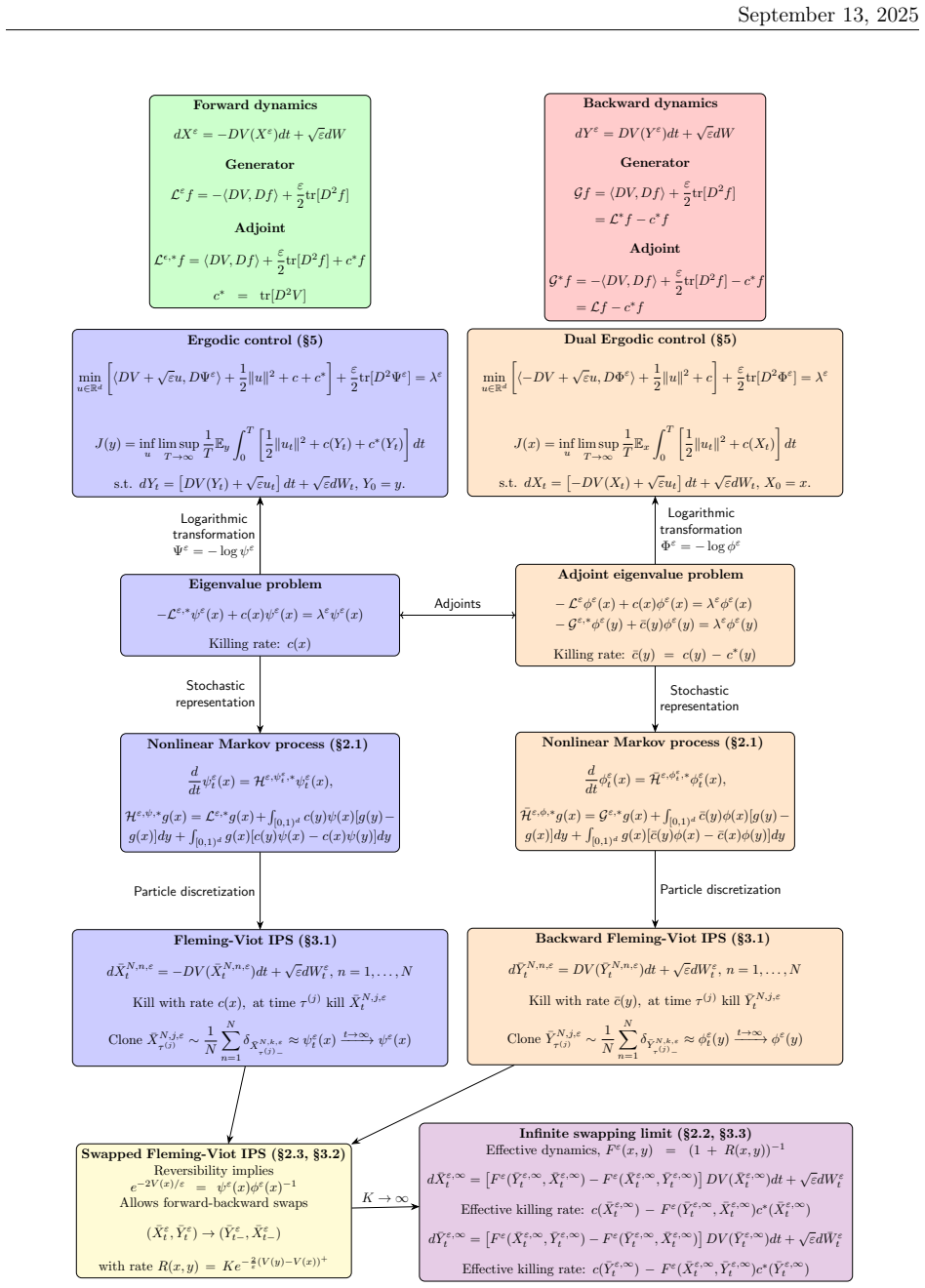
The central object is the forward/backward pair of nonlinear Markov processes: the forward process $\bar X^\epsilon$ follows the drift $-DV$, is killed at rate $c$, and is reborn according to its own current law, while the backward process $\bar Y^\epsilon$ follows the time-reversed drift $DV$, is killed at rate $\bar c=c-c^*$, and is reborn according to its own law. The identity $\psi_\epsilon(x)=e^{-2V(x)/\epsilon}\phi_\epsilon(x)$ turns the unknown eigenfunctions into the known drift potential $V$, yielding the Metropolis swap rate $r(x,y)=e^{-(1/\epsilon)(2V(y)-2V(x))^+}$ that preserves the product stationary law. The infinite-swapping limit replaces the random location swaps with dynamics in which forward and backward drifts are mixed by the weight $F^\epsilon(x,y)$, and the Fleming-Viot particle system with pure-jump (Kushner-type) discretization turns this into an implementable algorithm.
What would settle it
Simulate Algorithm 6 on the periodic double-well example with $N$ large and $\epsilon$ small and measure the transition rate between the two basins: the implied-potential claim predicts the rate should become essentially independent of the barrier height $e^{-\Delta V/\epsilon}$ as $N\to\infty$, whereas unswapped Langevin dynamics keep the Arrhenius dependence; in the same run, compare the histogram and eigenvalue estimate against a high-resolution finite-difference solution, since uncontrolled finite-$N$ bias would show up as a persistent mismatch as $N$ grows.
Extended reading notes
Core claim
The paper claims that parallel-tempering-style particle exchange is possible for nonlinear eigenfunction problems, provided the exchange couples each forward process to its time-reversed dual rather than to a higher-temperature copy. With the rate $r(x,y)=e^{-(1/\epsilon)(2V(y)-2V(x))^+}$, the joint law $\psi_\epsilon(x)\phi_\epsilon(y)$ remains the dominant eigenfunction of the swapped generator (Lemma 2.5), so the eigenvalue $\lambda_\epsilon$ and both eigenfunctions can be recovered from long-run samples. In the infinite swapping limit the random swaps become a convex combination of forward and backward dynamics with weight $F^\epsilon(x,y)$, and the implied potential $-\epsilon\log[\psi_\epsilon(x)\phi_\epsilon(y)+\psi_\epsilon(y)\phi_\epsilon(x)]$ has no barrier between equal-height local minima in the nonlinear Markov model. The paper further claims that a Fleming-Viot approximation with $N$ particles per direction makes the construction simulable, and that the resulting algorithm approximates the target quasistationary distribution more accurately than a standard Fleming-Viot system in the reported examples.
Load-bearing premise
The practical algorithm assumes the Fleming-Viot particle system converges to the nonlinear Markov process and that the infinite-swapping limit is valid in this nonlinear setting, but the paper does not prove either convergence and leaves the finite-particle bias as an open question.
Editorial extensions
If this is right
- The eigenvalue $\lambda_\epsilon$ can be estimated directly as the long-run killing/cloning rate of the swapped particle system, and $\psi_\epsilon,\phi_\epsilon$ can be estimated from the weighted empirical measure, without knowing the eigenvalue in advance.
- The swap rule is implementable from the drift of the diffusion alone, so no prior knowledge of the eigenfunctions is needed to run the algorithm.
- For Gibbs-type problems (eigenvalue zero), the infinite-swapping effective potential is approximately $\min\{V(x),V(y)\}$, which removes barriers between equal-height minima and gives exponentially faster communication between metastable states in the nonlinear model.
- The same construction applies to quasistationary distributions and to ergodic stochastic control, where the sampled score functions yield the optimal feedback control $\sqrt{\epsilon}D\log\phi_\epsilon$ and the optimal cost $\lambda_\epsilon$.
- The method extends beyond diffusions to countable and finite-state jump Markov processes, since the forward/backward pairing and swap rule do not rely on a continuous state space.
Reading between the lines
- One extension the paper leaves implicit is using the forward/backward swap construction as a proposal or control variate inside existing replica-exchange samplers, which could combine the barrier removal with variance-reduction techniques.
- If the finite-$N$ herding observed in Example 6.1 is mitigated by coupling several temperatures of forward/backward pairs, the method could attack high-dimensional multimodal sampling where conventional parallel tempering slows down exponentially in the inverse temperature.
- A natural testable extension is to use the INS Fleming-Viot weighted samples as training data for score-based generative models to estimate controls in high-dimensional ergodic control problems, going beyond the one-dimensional validation shown here.
Editorial analysis
A structured set of objections, weighed in public.
Referee Report
Summary. The paper introduces a particle exchange Monte Carlo method for eigenfunction problems of the form -L^{ε,*} ψε + c ψε = λε ψε, where the eigenvalue is unknown, in contrast to classical parallel tempering for Gibbs measures. The construction couples a forward nonlinear Markov process (NLMP) with a time-reversed backward NLMP, and derives a Metropolis-type swap rule with rate r(x,y)=exp(-(1/ε)(2V(y)-2V(x))^+) that preserves the joint stationary law ψε(x)φε(y). The authors then pass to an infinite-swapping limit, introduce an 'implied potential' that removes barriers between equal-height minima, approximate the NLMPs by Fleming-Viot particle systems, and discretize the diffusions by pure jump Markov chains. Numerical experiments address multimodal sampling and a quasistationary distribution problem, and a section on ergodic control connects the sampled eigenfunctions to optimal feedback controls via score matching.
Significance. The paper's core conceptual contribution is significant: it extends the parallel-tempering/infinite-swapping framework from linear problems with known eigenvalue to nonlinear eigenfunction problems, and it identifies a forward/backward pair as the correct structure for a reversible swap rule. The derivation of the relation ψε = e^{-2V/ε} φε and the verification in Lemma 2.5 that the swap operator annihilates ψε(x)φε(y) are clean and self-contained, and the swap rate depends only on the known potential V, not on fitted parameters. The paper also provides reproducible code and a detailed pseudocode for the proposed algorithm. The main weakness is that the chain of justifications connecting the provable Lemma 2.5 to the implemented Algorithm 6 contains explicit, acknowledged gaps: the infinite-swapping limit is asserted by analogy, the Fleming-Viot approximation is stated without proof, and the finite-N bias is left as an open question. These gaps do not invalidate the central construction, but they do mean the practical algorithm's output is not yet guaranteed to approximate the target eigenfunction.
major comments (4)
- [§3.3 and Algorithm 6] The finite-N bias of the Fleming-Viot approximation is load-bearing for the practical algorithm, and it is explicitly left open. The estimator (3.1) is said to be asymptotically unbiased 'if the stationary distribution of each of the particles were exactly ψε(x)φε(y)', but the preceding sentence acknowledges that there is a finite-N bias that vanishes as N→∞, with only a formal large-deviations heuristic for exponential decay. Since Algorithm 6 simulates exactly this finite-N system, the weighted empirical measure produced by the algorithm has an uncontrolled error when used to estimate λε and integrals against ψε. This is an acknowledged limitation, not a demonstrated inconsistency, but it needs to be addressed—by a consistency proof, a rate bound, or at least a systematic numerical convergence study—before the algorithmic claims can be considered established.
- [§2.3] The infinite-swapping limit is asserted rather than proved. The text states that 'a weak convergence analysis justifying the construction of the limit derived below can be given using arguments analogous to those of [3]', but no theorem is stated for the nonlinear setting, and the limiting SDEs and killing rates for (X̄^{ε,∞}, Ȳ^{ε,∞}) are derived formally. The stationary density hε(x,y) = (1/2)[ψε(x)φε(y)+ψε(y)φε(x)] and the weighting by Fε are computed, but the convergence of the prelimit processes—and especially the nonlinear killing/resampling terms—requires a separate argument because the generators here depend on the current density. This step is central: it is the justification for replacing the finite-K swapping process by the INS process used in Algorithm 6.
- [§3.1] The convergence of the Fleming-Viot particle system to the NLMP is asserted without proof: 'As N→∞, this pair of random processes converges in distribution to (X̄ε_t, ψε_t(x)dx)' is stated directly after the construction, with no theorem, proof, or reference for this specific nonlinear diffusion with killing and rebirth. This is the first approximation step linking the implementable algorithm to the idealized NLMP, and it is a prerequisite for the subsequent finite-N bias discussion. A precise statement under the paper's standing assumptions, or a reference that covers this case, should be supplied.
- [§4.1 and Example 6.2] The randomized pure jump grid used in Example 6.2 is not verified against the local consistency condition (4.1). The grid size h is drawn i.i.d. from U(0.05,0.15) in the example, but (4.1) is stated as a uniform condition in the limit h→0, and no argument is given that a random, fixed-range h satisfies the required consistency in any averaged sense. Moreover, the experiments do not send h to 0, so the discretization error in the reported eigenvalue and QSD estimates is uncontrolled. This matters because the pure jump approximation is not merely a numerical convenience; it is the actual dynamics being simulated, and the INS algorithm's correctness inherits the accuracy of this approximation.
minor comments (5)
- [Appendix B, Algorithm 6] In the pseudocode, line 38 (the else branch when i′ ≥ N) sets {y(j)_m} ← p1 and {x(j)_m} ← p1; the second assignment should almost certainly be {x(j)_m} ← p2, otherwise both arrays are assigned the same particle set and the forward/backward pairing is destroyed. Please correct this typo.
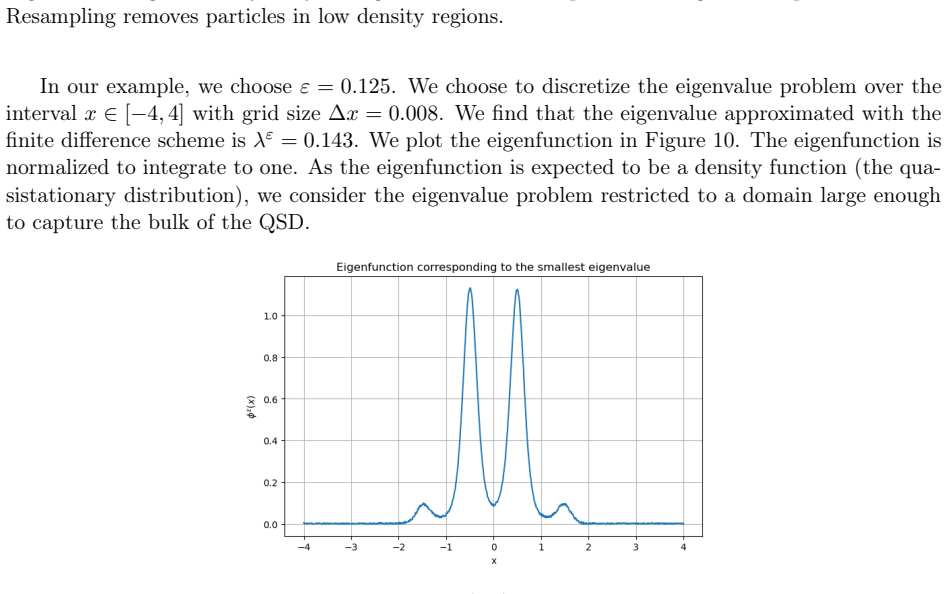
- [§6.2] The eigenvalue comparison with the finite-difference approximation reports a single value λε = 0.143 and a cumulative MSE plot, but does not provide confidence intervals or a systematic study of the estimators' dependence on N, h, and T. Since the theoretical convergence rates are open, such a numerical study would substantially strengthen the empirical claims.
- [§2.4 and Figures 5–7] The phenomenon of 'herding' is described qualitatively and illustrated, but no quantitative measure (e.g., a mixing statistic, effective sample size, or time to coverage of the state space) is given. A quantitative definition would make the claims about improved communication easier to evaluate.
- [§4.1] The discussion of the randomized grid says that rates and vectors 'could depend on time and even be random in a suitable way, so long as (4.1) holds,' but the paper does not specify what 'suitable' means when h is random with a distribution that does not concentrate at 0. Please clarify the intended asymptotic regime.
- [Throughout] There are several typographical slips, including 'Specifially' in §2.3 and the duplicated 'the the' in the acknowledgments. These should be corrected in revision.
Circularity Check
No significant circularity: the swap invariant is proven from the eigenfunction equations, and the Fleming-Viot and infinite-swapping gaps are acknowledged correctness risks, not circular reductions.
full rationale
The derivation chain is self-contained at its core. Theorem 2.2 supplies the principal eigenpairs; a direct algebra check in Section 2.1 establishes the relation ψε(x) = e^{-2V(x)/ε} φε(x) from the two eigenvalue equations, and Lemma 2.5 verifies by explicit computation that the Metropolis swap rate r(x,y) = e^{-(1/ε)(2V(y)-2V(x))^+} leaves ψε(x)φε(y) invariant. The infinite-swapping limit's stationary density is also verified directly in Section 2.3, and the algorithm's swap and kill/clone rates are expressed only in terms of the known potential V and killing rate c, never in terms of the unknown eigenfunctions. No parameter is fitted to the target: Section 6.2 validates the method against an independent finite-difference solution of the eigenvalue problem rather than tuning the algorithm to that solution. The paper's main caveats are the unproven Fleming-Viot convergence and finite-N bias (Section 3.3: 'whether or not this can be made rigorous is an interesting open question') and the infinite-swapping optimality/limit justification by analogy to prior work (Section 7.4: 'go beyond the theory developed in [3]'). These are honestly flagged correctness gaps, not attempts to smuggle the conclusion into the assumptions. The self-citations that appear, chiefly [1] and [3], are used either for an external published theorem on ergodic control or for a heuristic explicitly acknowledged as open in the present nonlinear setting; the central swap-invariance lemma is proven, so no equation in the paper reduces to its own input.
Assumptions & free parameters
free parameters (3)
- Discretization scale h =
0.1 in QSD example; h ~ U(0.05, 0.15) in Example 6.2
- Particle count N =
5, 20, 50
- Simulation horizon T and burn-in =
T=100, burn-in 10 seconds
assumptions (7)
- standard math There exists a principal eigenvalue λε and positive eigenfunctions ψε, φε for the periodic diffusion generator with killing, including the Green's function expansion (Theorem 2.2).
- standard math The quasistationary distribution is characterized by the eigenfunction equation (Theorem 2.4).
- domain assumption The Fleming-Viot N-particle system converges in distribution to the nonlinear Markov process as N → ∞.
- ad hoc to paper The infinite swapping limit with dynamics swapping converges to the stated effective SDE, with the fast switching variable spending fraction F(x,y) in each state.
- ad hoc to paper Finite-N bias of the Fleming-Viot infinite swapping estimator decays exponentially in N.
- ad hoc to paper Randomized grid sizes h satisfy the uniform local consistency condition (4.1).
- domain assumption The killing rates c and ar{c} = c - c* are non-negative in the stochastic representation, with negative regions handled by cloning-then-killing.
invented entities (1)
-
Infinite swapping forward/backward process (X̄^{ε,∞}, Ȳ^{ε,∞})
independent evidence
Cite this review
Pith. "Pith review of Particle exchange Monte Carlo methods for eigenfunction and related nonlinear problems." pith.science (2026). https://pith.science/paper/SLCSXS5G
@misc{pith2026250523456,
  author       = {Pith},
  title        = {Pith review of: Particle exchange Monte Carlo methods for eigenfunction and related nonlinear problems},
  year         = {2026},
  howpublished = {\url{https://pith.science/paper/SLCSXS5G}},
  note         = {Machine review of arXiv:2505.23456}
}
read the original abstract
We introduce and develop a novel particle exchange Monte Carlo method. Whereas existing methods apply to eigenfunction problems where the eigenvalue is known (e.g., integrals with respect to a Gibbs measure, which can be interpreted as corresponding to eigenvalue zero), here the focus is on problems where the eigenvalue is not known a priori. To obtain an appropriate particle exchange rule we must consider a pair of processes, with one evolving forward in time and the other backward. Applications to eigenfunction problems corresponding to quasistationary distributions and ergodic stochastic control are discussed.
Figures


Figures from the paper (10 more)




Reference graph
Works this paper leans on
- [3]
-
[1]
A. Budhiraja, P. Dupuis, P. Nyquist, and G.-J. Wu. Quasistationary distributions and ergodic control problems.Stoch. Proc. App., 145:143–164, 2022
work page 2022
-
[2]
Du.Order structure and topological methods in nonlinear partial differential equations: Vol
Y. Du.Order structure and topological methods in nonlinear partial differential equations: Vol. 1: Maximum principles and applications, volume 2. World Scientific, 2006
work page 2006
-
[4]
P. Dupuis and G.-J. Wu. Analysis and optimization of certain parallel monte carlo methods in the low temperature limit.SIAM J. Multiscale Model. and Simul., 20:220–249, 2022
work page 2022
-
[5]
C.J. Geyer. Markov chain Monte Carlo maximum likelihood. In Computing Science and Statistics: Proceedings of the 23rd Symposium on the Interface, pages 156–163, New York,
-
[6]
T. E. Harris.The Theory of Branching Processes. Springer Berlin, Heidelberg, 1963
work page 1963
-
[7]
D. Ingerman K. Burdzy, R. Holyst and P. March. Configurational transition in a Fleming- Viot-type model and probabilistic interpretation of Laplacian eigenfunctions. J. Phys. A, 29:2633–2642, 1996
work page 1996
-
[8]
V.N. Kolokoltsov. Nonlinear Markov processes and kinetic equations. Cambridge University Press, 2010
work page 2010
Show all 15 references
-
[9]
H. J. Kushner.Probability Methods for Approximations in Stochastic Control and for Elliptic Equations. Academic Press, New York, 1977
1977
-
[10]
H. J. Kushner and P. Dupuis.Numerical Methods for Stochastic Control Problems in Contin- uous Time. Springer-Verlag, New York, 2001. Revised Second Edition
2001
-
[11]
Plattner, J.D
N. Plattner, J.D. Doll, P. Dupuis, H. Wang, Y. Liu, and J.E. Gubernatis. An infinite swapping approach to the rare-event sampling problem.J. of Chemical Physics, 135:134111, 2011
2011
-
[12]
Swendsen and J.S
R.H. Swendsen and J.S. Wang. Replica Monte Carlo simulation of spin glasses.Phys. Rev. Lett., 57:2607–2609, 1986
1986
-
[13]
Sznitman
A.S. Sznitman. Topics in propagation of chaos, volume 1464, pages 167–251. Springer, Berlin, 1991
1991
-
[14]
General approximation method for the distribution of Markov processes conditioned not to be killed.ESAIM: PS, 18:441–467, 2014
Villemonais, Denis. General approximation method for the distribution of Markov processes conditioned not to be killed.ESAIM: PS, 18:441–467, 2014. 38
2014
-
[1991]
American Statistical Association
Reviewed August 7, 2026 · model on record in the stance chip above.
Discussion (0). Sign in to comment.