REVIEW 4 major objections 5 minor 50 references
Importance of pressure-dependent electronic interactions and magnetic order on pressure-driven insulator-metal transitions in MnO and NiO
T0 review · 4 major / 5 minor · reviewed 2026-08-07 · deepseek-v4-flash
Pith's one-line read Pressure-dependent electron interactions and magnetic-order destabilization, not simple gap closure, explain NiO's 240 GPa metallization.
desk verdict The paper's new qualitative result—NiO's AFM order destabilizing under pressure-dependent interactions—is plausible, but the claimed resolution of the 240 GPa mystery depends on a paramagnetic state that is never computed, and the DSCC model is underdocumented. read the letter →
The pith
A machine-rendered reading of the paper's core claim, the machinery that carries it, and where it could break.
The reading
What carries the argument
The engine of the calculation is the doubly-screened Coulomb correction (DSCC), whose model dielectric function $\varepsilon(q) = 1 + \{(\varepsilon_\infty - 1)^{-1} + (q/\lambda_{\mathrm{TF}})^2\}^{-1}$ converts pressure-dependent screening into interaction matrix elements $U_{ijkl}$ and into the hybrid exchange-mixing parameter $\alpha = \varepsilon_\infty^{-1}$. The paper feeds these into DFT+U and the screened hybrid functional HSE03, and tracks the enthalpy difference between antiferromagnetic and ferromagnetic states to locate magnetic instabilities. The decisive move is letting $\alpha$ shrink with pressure: that is what brings NiO's gap trend into line with experiment and what makes the antiferromagnetic order lose stability.
What would settle it
A decisive test is a magnetic-order measurement of NiO across 200 to 300 GPa. If nuclear forward scattering or a high-pressure magnetic hyperfine probe finds antiferromagnetic order intact at and above 240 GPa, the paper's magnetic-order-driven metallization claim is falsified; if a magnetic transition appears at 240 GPa, it is confirmed. An independent first-principles calculation of $\varepsilon_\infty(P)$ that disagrees strongly with the DSCC values would also undercut the pressure-dependent parameter chain.
Extended reading notes
Core claim
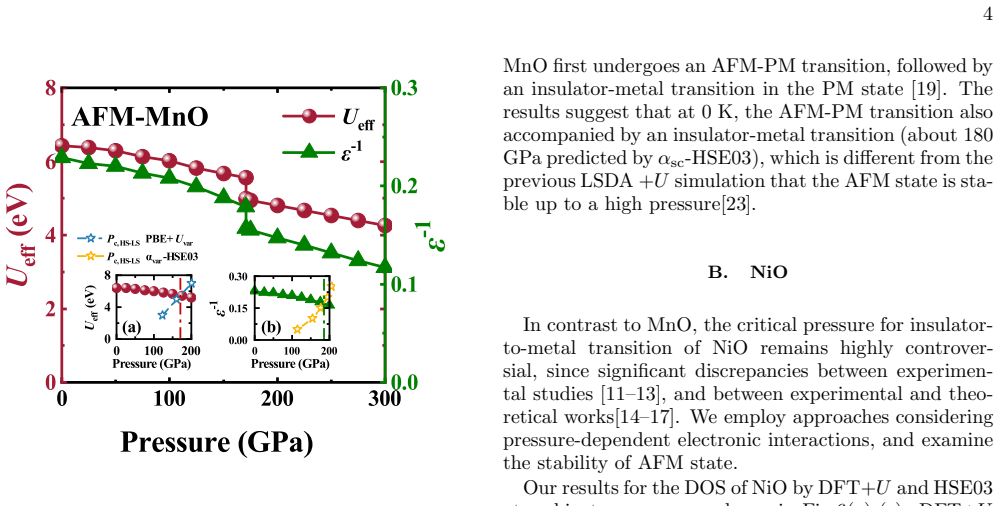
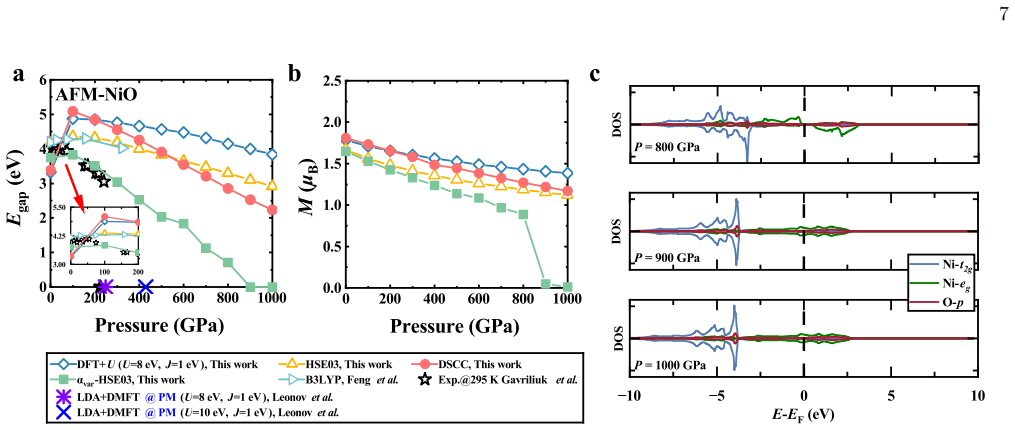
In the paper's own terms, NiO does not metallize by the closing of a single-particle gap in a frozen antiferromagnetic state. Instead, as pressure rises, screening strengthens and the effective on-site Coulomb interaction $U_{\mathrm{eff}} = U - J$ together with the inverse dielectric constant $\varepsilon_\infty^{-1}$ fall; the hybrid mixing parameter $\alpha = \varepsilon_\infty^{-1}$ therefore falls as well. With these pressure-dependent parameters, the antiferromagnetic band gap of NiO tracks experiment up to 240 GPa, while fixed-parameter DFT+U and hybrid-functionals keep an antiferromagnetic insulator up to about 900 GPa. The antiferromagnetic state itself becomes unstable as interactions weaken, and the paper argues that the experimentally observed metallization near 240 GPa is plausibly tied to this pressure-induced magnetic-order change rather than to conventional Mott gap closure. For MnO the same scheme gives an insulator-metal transition near 185 GPa, close to room-temperature extrapolation, and an antiferromagnetic instability near 171 GPa.
Load-bearing premise
The load-bearing premise is that the doubly-screened Coulomb model of Eq. (3) accurately describes how electronic screening changes with pressure in MnO and NiO, even though the paper does not specify how the two model parameters are computed.
Editorial extensions
If this is right
- Fixed-parameter DFT+U and HSE03 predict that NiO remains an antiferromagnetic insulator up to about 900 GPa, whereas the pressure-dependent DSCC/alpha-scaled HSE03 calculation reproduces the measured gap trend below 240 GPa, so gap closure in the antiferromagnetic state cannot be the operative transition mechanism.
- The antiferromagnetic state of NiO becomes unstable as electronic interactions weaken with pressure, with the AFM-FM enthalpy crossover estimated near 836 GPa; before that crossover, an AFM-to-paramagnetic transition may occur and may itself drive metallization.
- For MnO, the alpha-scaled hybrid calculation yields an insulator-metal transition near 185 GPa and an antiferromagnetic instability near 171 GPa, in line with room-temperature extrapolations, whereas fixed-parameter DFT+U and HSE03 do not metallize within 300 GPa.
- Non-local exchange is essential at high pressure: DFT+DSCC within the on-site correction framework still fails to metallize MnO, while the hybrid functional with the same pressure-dependent screening succeeds, showing that pressure effects and non-local Fock exchange act together.
- Pressure-dependent electronic interaction parameters should be included alongside magnetic ordering when predicting insulator-metal transitions of correlated transition-metal oxides under compression.
Reading between the lines
- The author leaves implicit that if screening weakens interactions with pressure, any ground-state method using fixed U or fixed exchange-mixing will tend to overestimate the stability of insulating magnetic states in compressed correlated oxides, making the NiO discrepancy a generic symptom rather than a special case.
- A direct paramagnetic-state calculation, which the paper does not perform, would probably place NiO's insulator-metal transition closer to the experimental 240 GPa than the AFM-only estimate of about 900 GPa, because the PM state metallizes earlier in the paper's own picture.
- The DSCC screening parameters could be tested independently by computing $\varepsilon_\infty(P)$ with finite-field or linear-response methods at a handful of pressures; agreement would anchor the whole parameter chain, while disagreement would leave the proposed mechanism unsupported.
- The same mechanism may apply to other antiferromagnetic Mott insulators, where pressure-dependent screening and magnetic destabilization should be checked before attributing metallization to band-gap closure or spin-state collapse alone.
Editorial analysis
A structured set of objections, weighed in public.
Referee Report
Summary. The manuscript studies pressure-driven insulator-metal transitions in MnO and NiO using DFT+U and HSE03 hybrid-functional calculations in which the Hubbard U, Hund's coupling J, and the Hartree-Fock mixing parameter alpha are made pressure-dependent through the authors' doubly-screened Coulomb correction (DSCC) scheme. For MnO, the pressure-dependent alpha_sc-HSE03 approach yields metallization associated with a high-spin to low-spin transition at about 185 GPa, closer to the experimentally extrapolated range than fixed-parameter calculations. For NiO, the band gap in the AFM state closes only near 900 GPa, while the enthalpy difference between AFM and FM order suggests an AFM-FM instability near 836 GPa for alpha_sc-HSE03. The authors argue that a pressure-induced magnetic-order change, likely an AFM-PM transition that they do not compute, may explain the experimentally observed metallization near 240 GPa. The paper explicitly acknowledges that structural distortions, the B1-B8 transition in MnO, temperature, and paramagnetic states are not treated.
Significance. If the central claim holds, the work would substantially advance the understanding of why static single-determinant calculations overestimate the insulator-metal transition pressure in NiO: pressure-dependent screening softens the electronic interactions, and magnetic-order destabilization could provide a mechanism for metallization well before the AFM band gap closes. The paper has clear strengths: it gives a systematic comparison of fixed- versus pressure-dependent parameters across two materials, it reports explicit parameter trends, it identifies a specific qualitative mechanism (magnetic-order change) that is experimentally testable, and it candidly lists its main limitations in the Methods and Summary sections. However, the load-bearing NiO conclusion rests on an uncomputed AFM-PM transition, and the DSCC model that generates all pressure-dependent parameters is underdocumented. The significance is therefore conditional on closing those gaps.
major comments (4)
- [§II.B, Fig. 9 and Summary] The central NiO explanation relies on an inferred magnetic-order transition that is not computed. The only magnetic-stability calculation is the AFM-FM enthalpy difference (Fig. 9), whose alpha_sc-HSE03 crossing is at about 836 GPa, more than three times the experimental 240 GPa transition and far above the 280 GPa up to which nuclear forward scattering finds AFM order [13]. The text bridges this gap by stating that 'before this, the AFM-PM transition may have occurred' and that the IMT occurs earlier in the PM state. Since the Methods section explicitly states that only AFM and FM orderings are considered and PM simulations are left for future work, the AFM-FM enthalpy difference does not constrain the AFM-PM enthalpy difference, particularly for a frustrated type-II fcc antiferromagnet. The proposed mechanism for the 240 GPa transition is therefore not established by the presented data; a PM-state calculation (or another quantitative argument) is needed.
- [§IV, Eq. (3)] The DSCC model dielectric function, Eq. (3), is the source of all pressure-dependent U, J, and alpha values, yet it is not documented in sufficient detail. The paper does not state how epsilon_inf and lambda_TF are obtained, what values they take for MnO and NiO at ambient and high pressure, what reference introduces the DSCC method, or how the screening parameters were validated. Because every pressure-dependent result in Figs. 3, 4, 7, 8, and 9 is derived from this model, the reader cannot assess whether the central qualitative trends are robust or an artifact of the screening parametrization. Please provide the derivation, the parameter values, and a benchmark against independent screening calculations or experimental dielectric data.
- [§IV, Methods and Computational Details; §II.A] The MnO validation is performed while neglecting the B1-to-B8 structural transition that experiments place near 90 GPa, essentially at the observed insulator-metal transition pressure. The Methods section states that the distorted B1 (NaCl) structure is retained throughout, while the experimental IMT at 90-105 GPa is accompanied by or occurs near this structural transformation. The alpha_sc-HSE03 metallization is found at 185 GPa, but it is unclear whether this is a property of the B1 structure or an artefact of ignoring the B8 phase. The authors acknowledge the approximation, but given that MnO is used as a method validation, the effect of the B1-B8 transition on the predicted metallization pressure should be quantified or at least discussed in more depth.
- [§II.B, Fig. 8(a)] The band-gap comparison for NiO would be strengthened by clarifying what experimental data are plotted in Fig. 8(a). The text says the trend and magnitude of alpha_sc-HSE03 'agree well with experimental measurement of band gap below 240 GPa,' but the reader cannot tell whether the experimental points are from Gavriliuk et al. [24] or another source, which pressures are included, and how the experimental gap was extracted. This is important because the agreement below 240 GPa is one of the main quantitative supports for the pressure-dependent screening scheme.
minor comments (5)
- [Title and Abstract] There are typographical errors, including 'interaction s' in the title and 'Mno' in §II.A; the paper should be carefully proofread.
- [§IV, Eq. (5) and notation] The notation is confusing: HSE03 is used both for the standard fixed alpha=0.25 functional and for HSE hybrids with alpha=0.05, 0.10, 0.15, and 0.25. Please introduce a clearer naming scheme for the fixed-alpha variants.
- [§II.B, Fig. 9] The sentence 'Our results indicate that, as electronic interactions weaken with increasing pressure, the AFM state will no longer be stable at least 836 GPa' should read 'at pressures above 836 GPa' or 'at approximately 836 GPa'; the current wording is ambiguous.
- [§II.A, Fig. 4(c)] The density-of-states panel shows pressures from 175 to 200 GPa, but the text states that the band gap vanishes at 185 GPa; please indicate the metallization pressure directly on the panel or in the caption to avoid confusion.
- [References] The DSCC method is described as 'recently developed' but no reference is provided for it; a citation or a short appendix describing the method and its prior applications is needed.
Circularity Check
Pressure-dependent 'predictions' rely on a load-bearing self-cited DSCC ansatz (α=ε∞^-1), but external band-gap benchmarks keep the central claim from reducing to its inputs.
-
self citation load bearing
[Section IV, Method and Computational Details (Eq. (3), Eq.]
"In this work, we obtained α also from DSCC calculations, α = ε−1∞, from the perspective of many-body perturbation theory[39] ... we utilized DSCC approach to evaluated interaction matrix elements for 3 d-electrons. In DSCC approach, the doubly screened model dielectric function ε(q) is used to determines the screened Coulomb potential vsc: ε(q) = 1 + {(ε∞ − 1)−1 + (q/λTF)^2}^−1."
The central quantitative input for all α_sc-HSE03 results—MnO's insulator-metal transition near 185 GPa, NiO's AFM destabilization near 836 GPa, and the invoked AFM-PM mechanism—is the pressure-dependent α set equal to ε∞^-1 from the DSCC dielectric model, the same model that also provides U and J. The paper labels DSCC as 'our developed' and gives only Ref. [39], a review co-authored by corresponding author Y.-C. Wang, for the α=ε∞^-1 identification; no derivation or independent reference for the DSCC model itself is provided. Thus the pressure dependence of the interactions is imported from the authors' own framework, and the subsequent electronic-structure predictions do not independently test that framework.
full rationale
No step was found in which a target prediction is identical by construction to a fitted parameter: the DSCC-derived U, J, and α are computed from the stated dielectric model rather than fitted to the reported transition pressures, and the MnO and NiO band-gap trends are checked against external experiments. The main circularity concern is the self-cited DSCC relation α=ε∞^-1, which is load-bearing for every pressure-dependent result but justified only by Ref. [39] (with overlapping authorship) and by the label 'our developed.' This raises the score to 4 under the rubric: some self-citation, but the central claim still has independent content. The paper's NiO magnetic-order explanation is also under-supported: the only magnetic-stability calculation is AFM vs FM (Fig. 9), with the AFM-FM crossing at about 836 GPa, while the paper bridges the 240 GPa experimental transition by stating 'Before this, the AFM-PM transition may have occurred' and by asserting that the IMT occurs earlier in the PM state. The Methods section explicitly says 'We only focus on AFM and FM orderings,' and the Summary says 'Future research can further take these factors into account and conduct simulations on the total energy and electronic structure of the paramagnetic state.' That is an evidentiary gap rather than circularity, so it does not by itself raise the circularity score.
Assumptions & free parameters
free parameters (2)
- ε∞ and λ_TF in DSCC model
- Fixed U and J for DFT+U baselines =
U=8 eV, J=1 eV (NiO); U=5.5 eV, J=1 eV (MnO)
assumptions (4)
- ad hoc to paper The doubly-screened model dielectric function, Eq. (3), with parameters ε∞ and λ_TF, captures the pressure-dependent screening in MnO and NiO across the studied pressure range.
- domain assumption The hybrid functional mixing parameter α is set equal to ε∞^{-1} (a many-body perturbation theory relation).
- domain assumption Structural distortions (rhombohedral) and the B1-B8 phase transition in MnO do not qualitatively affect the band gap and magnetic stability conclusions.
- domain assumption Static 0 K treatment with only AFM and FM orderings, and no paramagnetic state, suffices to assess the magnetic stability relevant to experiment.
Cite this review
Pith. "Pith review of Importance of pressure-dependent electronic interactions and magnetic order on pressure-driven insulator-metal transitions in MnO and NiO." pith.science (2026). https://pith.science/paper/CHTKUSIZ
@misc{pith2026250523466,
  author       = {Pith},
  title        = {Pith review of: Importance of pressure-dependent electronic interactions and magnetic order on pressure-driven insulator-metal transitions in MnO and NiO},
  year         = {2026},
  howpublished = {\url{https://pith.science/paper/CHTKUSIZ}},
  note         = {Machine review of arXiv:2505.23466}
}
abstract
The pressure-driven insulator-metal transition is a crucial topic in condensed matter physics. However, even for the prototypical strongly correlated system, NiO, the critical pressure for transition remains debated. In this work, we evaluated the electronic interactions over a wide range of pressures based on our developed doubly-screened Coulomb correction method and investigated the effects of pressure-dependent electronic interactions and their interplay with magnetic order on the transition. As a validation of the method, we also performed calculations on MnO. The results show that the hybrid functional combined with pressure-dependent screening parameters reasonably describes the insulator-metal transition in MnO. The insulating band gap of antiferromagnetic (AFM) NiO also match well with experiments in both trend and value, which is better than the method using fixed parameters. Further calculations considering magnetic order indicate that as the electronic interactions weaken under pressure, the AFM state of NiO will no longer be stable, a phenomenon that was not observed in previous works. In addition, the results show that, compared with DFT+$U$ within the on-site Coulomb correction framework, the hybrid functional provides a more accurate description of the properties of MnO and NiO at high pressures, highlighting the key role of non-local effects. Our work provides a possible explanation for the long-standing discrepancies in NiO and offers guidance for the development of first-principles methods for correlated electron systems under pressure.
Figures


Figures from the paper (6 more)



Reference graph
Works this paper leans on
-
[13]
In terms of theoretical calculations, Archer et al
showed that NiO still maintains AFM order up to 280 GPa, but in conflict with the observation of the insulator- metal transition around 240 GPa. In terms of theoretical calculations, Archer et al. [32] showed that both LDA and PBE calculations have demonstrated a trend of de- creasing N´ eel temperature with increasing pressure. Re- cent DFT+DMFT simulatio...
-
[24]
D. Kasinathan, K. Koepernik, and W. E. Pickett. Pressure-driven magnetic moment collapse in the ground state of MnO. New Journal of Physics , 9:235, 2007
work page 2007
-
[1]
N. F. Mott and R. Peierls. Discussion of the paper by de Boer and Verwey. Proc. Phys. Soc. London, Ser. A , 49:72, 1937
work page 1937
-
[2]
J. H. de Boer and E. J. W. Verwey. Semi-conductors 9 with partially and with completely filled 3 d-lattice bands. Proc. Phys. Soc. London, Ser. A , 49:59, 1937
work page 1937
-
[3]
N. F. Mott. Metal-Insulator Transitions . Taylor and Francis, London, 1990
work page 1990
- [4]
-
[5]
Y. Zhou, J. Guo, S. Cai, J. Zhao, G. Gu, C. Lin, H. Yan, C. Huang, C. Yang, S. Long, Y. Gong, Y. Li, X. Li, Q. Wu, J. Hu, X. Zhou, T. Xiang, and L. Sun. Quan- tum phase transition from superconducting to insulating- like state in a pressurized cuprate superconductor. Nat. Phys., 18:406–410, 2022
work page 2022
-
[6]
Y. Ji, X. Wang, X. Li, W. Tang, X. Li, X. Wang, F. Li, L. Li, and Q. Zhou. Unveiling a novel insulator-to-metal transition in La 2NiO4: Challenging high-temperature su- perconductivity claimed for single-layer lanthanum nick- elates. Chin. Phys. Lett. , 41:097402, 2024
work page 2024
Show all 50 references
-
[7]
A. J. Browne, E. J. Pace, G. Garbarino, and J. P. At- tfield. Structural study of the pressure-induced metal- insulator transition in LiV 2O4. Phys. Rev. Mater. , 4:015002, 2020
2020
-
[8]
Y. Xu, Y. Sheng, and Y. Yang. Mechanism of the insulator-to-metal transition and superconductivity in the spin liquid candidate NaYbSe 2 under pressure. npj Quantum Mater. , 7:21, 2022
2022
-
[9]
Greenberg, I
E. Greenberg, I. Leonov, S. Layek, Z. Konopkova, M. P. Pasternak, L. Dubrovinsky, R. Jeanloz, I. A. Abrikosov, and G. K. Rozenberg. Pressure-induced site-selective Mott insulator-metal transition in Fe 2O3. Phys. Rev. X , 8:031059, 2018
2018
-
[10]
Z. Shao, X. Cao, H. Luo, and P. Jin. Recent progress in the phase-transition mechanism and modulation of vana- dium dioxide materials. NPG Asia Mater. , 10:581–605, 2018
2018
-
[11]
A. G. Gavriliuk, I. A. Trojan, and V. V. Struzhkin. Insulator-metal transition in highly compressed NiO. Phys. Rev. Lett. , 109:086402, 2012
2012
-
[12]
A. G. Gavriliuk, V. V. Struzhkin, A. G. Ivanova, V. B. Prakapenka, A. A. Mironovich, S. N. Aksenov, I. A. Troyan, and W. Morgenroth. The first-order structural transition in NiO at high pressure. Commun. Phys., 6:23, 2023
2023
-
[14]
Potapkin, L
V. Potapkin, L. Dubrovinsky, I. Sergueev, M. Ekholm, I. Kantor, D. Bessas, E. Bykova, V. Prakapenka, R. P. Hermann, R. R¨ uffer, V. Cerantola, H. J. M. J¨ onsson, W. Olovsson, S. Mankovsky, H. Ebert, and I. A. Abrikosov. Magnetic interactions in NiO at ultrahigh pressure. Phys....
2016
-
[15]
Feng and N.-M
X.-B. Feng and N.-M. Harrison. Metal-insulator and magnetic transition of NiO at high pressures. Phys. Rev. B, 69:035114, 2004
2004
-
[16]
Leonov, L
I. Leonov, L. Pourovskii, A. Georges, and I. A. Abrikoso v. Magnetic collapse and the behavior of transition metal oxides at high pressure. Phys. Rev. B , 94:155135, 2016
2016
-
[17]
Leonov, A
I. Leonov, A. O. Shorikov, V. I. Anisimov, and I. A. Abrikosov. Emergence of quantum critical charge and spin-state fluctuations near the pressure-induced Mott transition in MnO, FeO, CoO, and NiO. Phys. Rev. B , 101:245144, 2020
2020
-
[18]
G. M. Gaifutdinov and I. V. Leonov. Electronic correla- tions and long-range magnetic ordering in NiO tuned by pressure. Phys. Rev. B , 110:235103, 2024
2024
-
[19]
J. R. Patterson, C. M. Aracne, D. D. Jackson, V. Malba, S. T. Weir, P. A. Baker, and Y. K. Vohra. Pressure- induced metallization of the Mott insulator MnO. Phys. Rev. B , 69:220101, 2004
2004
-
[20]
C. S. Yoo, B. Maddox, J.-H. P. Klepeis, V. Iota, W. Evans, A. McMahan, M. Y. Hu, P. Chow, M. So- mayazulu, D. H¨ ausermann, R. T. Scalettar, and W. E. Pickett. First-order isostructural Mott transition in highly compressed MnO. Phys. Rev. Lett. , 94:115502, 2005
2005
-
[21]
J.-P. Rueff, A. Mattila, J. Badro, G. Vank´ o, and A. Shukla. Electronic properties of transition-metal ox- ides under high pressure revealed by X-ray emission spec- troscopy. J. Phys. Condens. Matter , 17:S717, 2005
2005
-
[22]
Kuneˇ s, A
J. Kuneˇ s, A. Lukoyanov, V. Anisimov, R. T. Scalettar, and W. E. Pickett. Collapse of magnetic moment drives the Mott transition in MnO. Nat. Mater. , 7:198–202, 2008
2008
-
[23]
Kasinathan, J
D. Kasinathan, J. Kuneˇ s, K. Koepernik, C. V. Diaconu, R. L. Martin, I. D. Prodan, G. E. Scuseria, N. Spaldin, L. Petit, T. C. Schulthess, and W. E. Pickett. Mott tran- sition of MnO under pressure: A comparison of correlated band theories. Phys. Rev. B , 74:195110, 2006
2006
-
[25]
A. G. Gavriliuk, V. V. Struzhkin, I. S. Lyubutin, S. G. Ovchinnikov, M. Y. Hu, and P. Chow. Another mecha- nism for the insulator-metal transition observed in Mott insulators. Phys. Rev. B , 77:155112, 2008
2008
-
[26]
Z. Zhao, K. Bao, D. Duan, F. Tian, B. Liu, and T. Cui. Effects of magnetic ordering and electron correlations on the stability of fen. RSC Adv. , 5:31270–31274, 2015
2015
-
[27]
van Elp, R
J. van Elp, R. H. Potze, H. Eskes, R. Berger, and G. A. Sawatzky. Electronic structure of MnO. Phys. Rev. B , 44:1530–1537, 1991
1991
-
[28]
Zaanen, G
J. Zaanen, G. A. Sawatzky, and J. W. Allen. Band gaps and electronic structure of transition-metal compounds. Phys. Rev. Lett. , 55:418–421, 1985
1985
-
[29]
Mandal, K
S. Mandal, K. Haule, K. M. Rabe, and D. Vanderbilt. In- fluence of magnetic ordering on the spectral properties of binary transition metal oxides. Phys. Rev. B , 100:245109, 2019
2019
-
[30]
Jind ˇ rich Kolorenˇ c and Lubos Mitas.B1-to-B8 structural phase transition in MnO under pressure: Comparison of all-electron and pseudopotential approaches. Phys. Rev. B, 75:235118, 2007
2007
-
[31]
J. Li, C. Zheng, E. Zhao, J. Mao, Y. Cheng, H. Liu, Z. Hu, and T. Ling. Ferromagnetic ordering corre- lated strong metal–oxygen hybridization for superior oxy- gen reduction reaction activity. Proc. Natl. Acad. Sci. , 120:e2307901120, 2023
2023
-
[32]
Werner and A
P. Werner and A. J. Millis. High-spin to low-spin and orbital polarization transitions in multiorbital Mott sys - tems. Phys. Rev. Lett. , 99:126405, 2007
2007
-
[33]
Archer, C
T. Archer, C. D. Pemmaraju, S. Sanvito, C. Franchini, J. He, A. Filippetti, P. Delugas, D. Puggioni, V. Fioren- tini, R. Tiwari, and P. Majumdar. Exchange interac- tions and magnetic phases of transition metal oxides: Benchmarking advanced ab-initio methods. Phys. Rev. B, 84:1...
2011
-
[34]
G. A. Sawatzky and J. W. Allen. Magnitude and origin of the band gap in NiO. Phys. Rev. Lett. , 53:2339–2342, 1984
1984
-
[35]
A. B. Shick, A. I. Liechtenstein, and W. E. Pickett. Implementation of the LDA+ U method using the full- 10 potential linearized augmented plane-wave basis. Phys. Rev. B , 60:10763, 1999
1999
-
[36]
Bengone, M
O. Bengone, M. Alouani, P. Bl¨ ochl, and J. Hugel. Im- plementation of the projector augmented-wave LDA+ U method: Application to the electronic structure of NiO. Phys. Rev. B , 62:16392, 2000
2000
-
[37]
Amadon, F
B. Amadon, F. Jollet, and M. Torrent. γ and β cerium: LDA+U calculations of ground-state parameters. Phys. Rev. B , 77:155104, 2008
2008
-
[38]
J. P. Perdew, M. Ernzerhof, and K. Burke. Rationale for mixing exact exchange with density functional approxi- mations. J. Chem. Phys. , 105:9982–9985, 1996
1996
-
[39]
A. D. Becke. Density-functional thermochemistry. IV. A new dynamical correlation functional and implications for exact-exchange mixing. J. Chem. Phys. , 104:1040– 1046, 1996
1996
-
[40]
Zhang, Z.-H
M.-Y. Zhang, Z.-H. Cui, Y.-C. Wang, and H. Jiang. Hybrid functionals with system-dependent parameters: Conceptual foundations and methodological develop- ments. WIRES Comput. Mol. Sci. , 10:e1476, 2020
2020
-
[41]
J. Heyd, G. E. Scuseria, and M. Ernzerhof. Hybrid func- tionals based on a screened coulomb potential. J. Chem. Phys., 118:8207–8215, 2003
2003
-
[42]
Kresse and J
G. Kresse and J. Furthmiiller. Efficiency of ab-initio total energy calculations for metals and semiconductors using a plane-wave basis set. Comp. Mater. Sci. , 6:15–50, 1996
1996
-
[43]
Kresse and D
G. Kresse and D. Joubert. From ultrasoft pseudopoten- tials to the projector augmented-wave method. Phys. Rev. B , 59:1758–1775, 1999
1999
-
[44]
P. E. Bl¨ ochl. Projector augmented-wave method. Phys. Rev. B , 50:17953–17979, 1994
1994
-
[45]
J. Fang, X. Gao, and H. Song. Implementation of the projector augmented-wave method: The use of atomic datasets in the standard PA W-XML format. Commun. Comput. Phys. , 26:1196–1223, 2019
2019
-
[46]
Trimarchi, Z
G. Trimarchi, Z. Wang, and A. Zunger. Polymorphous band structure model of gapping in the antiferromagnetic and paramagnetic phases of the Mott insulators MnO, FeO, CoO, and NiO. Phys. Rev. B , 97:035107, 2018
2018
-
[47]
J. P. Perdew, K. Burke, and M. Ernzerhof. Generalized gradient approximation made simple. Phys. Rev. Lett. , 77:3865–3868, 1996
1996
-
[48]
Zhang, Y
T. Zhang, Y. Wang, J. Xian, S. Wang, J. Fang, S. Duan, X. Gao, H. Song, and H. Liu. Effect of the projector aug- mented wave potentials on the simulation of thermody- namic properties of vanadium. Matter Radiat. Extrem. , 6:068401, 2021
2021
-
[49]
Monkhorst and J
H. Monkhorst and J. Pack. Special points for Brillouin- zone integrations. Phys. Rev. B , 13:5188, 1976
1976
-
[50]
V. I. Anisimov, I. V. Solovyev, M. A. Korotin, M. T. Czy˙ zyk, and G. A. Sawatzky. Density-functional theory and NiO photoemission spectra. Phys. Rev. B , 48:16929–16934, 1993
1993
Reviewed August 7, 2026 · model on record in the stance chip above.
Discussion (0). Sign in to comment.