REVIEW 3 major objections 4 minor 12 references
The four-gluon and ghost-gluon vertices in the Landau gauge from lattice simulations
T0 review · 3 major / 4 minor · reviewed 2026-08-07 · deepseek-v4-flash
Pith's one-line read The paper claims that in collinear kinematics the four-gluon vertex has a form factor $F^{(2)}$ that grows toward the infrared while $F^{(0)}$ stays constant, and that the soft-gluon ghost-gluon form factor agrees with earlier lattice and…
desk verdict A modest but honest lattice proceedings update on two Yang-Mills vertices; the main worry is an imprecise kinematic condition that could let disconnected diagrams in, and it should be tightened before the results are used as a reference. read the letter →
The pith
A machine-rendered reading of the paper's core claim, the machinery that carries it, and where it could break.
The reading
What carries the argument
The load-bearing mechanism is the kinematic simplification of collinear momenta: when $p_i \propto p_j$, the full four-gluon Green function receives contributions only from the one-particle-irreducible four-gluon vertex, so no subtraction of three-gluon or disconnected diagrams is required, and the tensor basis collapses to the three operators $\tilde\Gamma^{(0)}$, $\tilde\Gamma^{(1)}$, $\tilde\Gamma^{(2)}$ of Eq. (1), whose amputated form factors $F^{(i)}$ are measured. For the ghost-gluon vertex, the mechanism is Landau-gauge orthogonality of the gluon propagator, which removes the $H_2$ form factor and leaves a single scalar $H_1$, extracted by Lorentz-color contraction and evaluated with both the lattice vertex $\Gamma^{\mathrm{Lat}}_\mu$ and the continuum vertex $\Gamma^{\mathrm{Cont}}_\mu$ to monitor discretization effects.
What would settle it
Measuring the four-gluon form factors on a finer lattice spacing (for example $\beta = 6.4$) and with external momenta that are only nearly collinear would settle it: if the infrared rise of $F^{(2)}$ disappears or depends sharply on the small deviation from collinearity, the reported behavior is an artifact of the kinematic assumption or of discretization rather than a property of the vertex.
Extended reading notes
Core claim
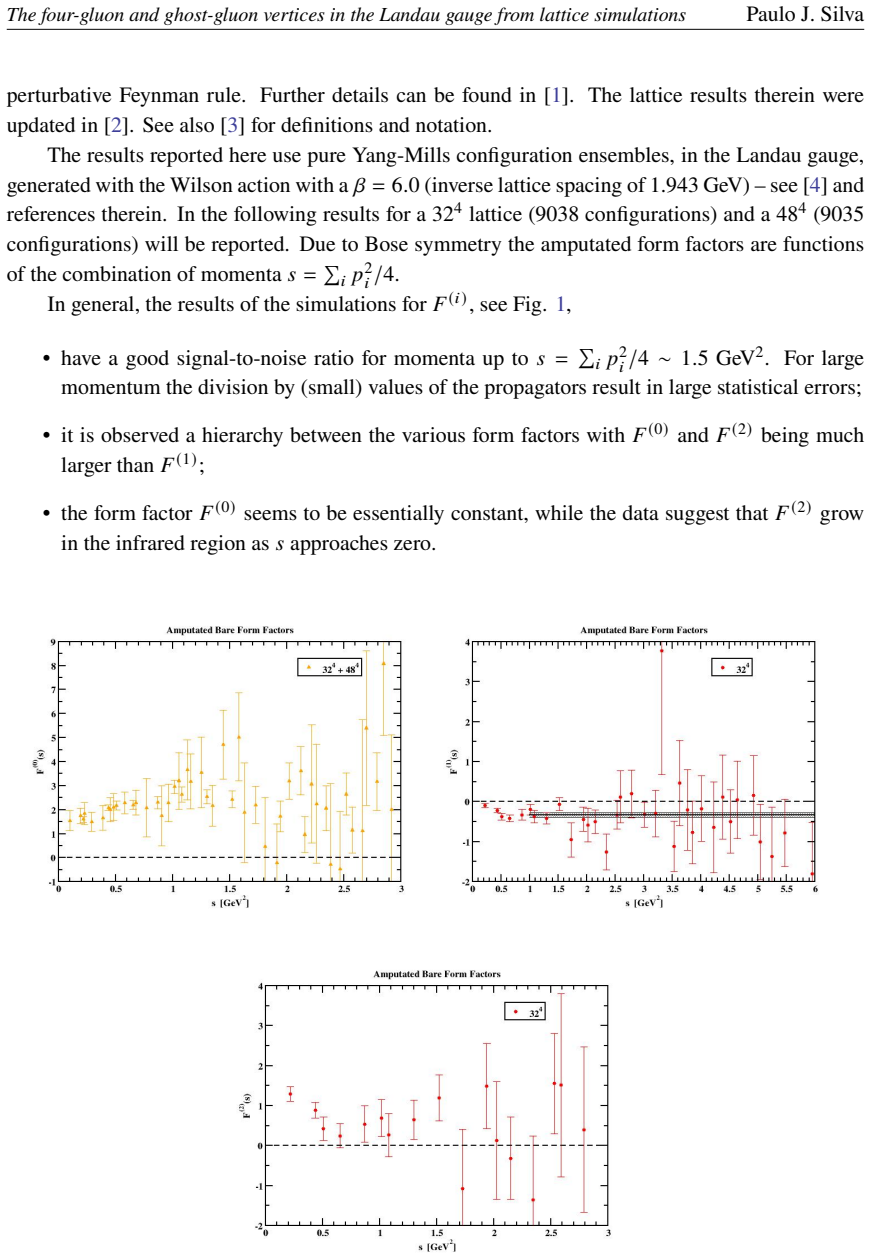
The paper's central claim is that the infrared behavior of the four-gluon vertex can be measured reliably in the collinear kinematics where all external momenta are proportional, and that in this regime the amputated form factors show a clear hierarchy $F^{(0)}, F^{(2)} \gg F^{(1)}$, with $F^{(0)}$ essentially constant and $F^{(2)}$ increasing as $s = \sum_i p_i^2/4$ approaches zero. For the one-particle-irreducible ghost-gluon vertex in the soft-gluon limit (gluon momentum taken to zero), the claim is that $H_1$ computed with the lattice and continuum versions of the tensor structure agree up to roughly 3 GeV, indicating that finite-size effects are under control, and that the result is consistent with previous lattice determinations. The authors present these as ongoing calculations with large statistical ensembles but a single lattice spacing, so they do not claim a continuum-limit determination.
Load-bearing premise
The central measurement assumes that when the four external momenta are all parallel, the full four-gluon correlation function receives contributions only from the genuine four-gluon vertex, so no subtraction of three-gluon or disconnected pieces is needed.
Editorial extensions
If this is right
- If $F^{(2)}$ indeed grows toward the infrared, the four-gluon vertex has a nontrivial momentum dependence that any functional or perturbative description of Yang-Mills dynamics in the deep infrared must reproduce.
- The hierarchy $F^{(0)}, F^{(2)} \gg F^{(1)}$ implies that the $\tilde\Gamma^{(0)}$ and $\tilde\Gamma^{(2)}$ tensor structures dominate collinear kinematics, simplifying the modelling of this vertex in continuum functional approaches.
- The agreement of the lattice $H_1$ with previous lattice and continuum determinations supports the standard soft-gluon truncations used in studies of ghost and gluon propagators.
- For momenta up to about 3 GeV, the ghost-gluon vertex shows no significant finite-size effects on these ensembles, validating the volume strategy for future analyses.
- Larger ensembles and additional lattice spacings are required to firm up the size of the infrared rise of $F^{(2)}$ and to control the $k \gtrsim 3$ GeV region for the ghost-gluon vertex.
Reading between the lines
- A direct extension the authors leave implicit: if $F^{(2)}$ keeps rising toward zero momentum, the four-gluon vertex may become as important as the three-gluon vertex in the infrared dynamics of Yang-Mills theory, a possibility that continuum functional studies could test by feeding in the measured lattice form factors.
- The collinear kinematic trick could be stress-tested on the same ensembles by measuring a slightly non-collinear momentum configuration and checking that the extracted form factors do not drift, which would probe the assumption that only the one-particle-irreducible four-gluon diagram contributes.
- A run at a finer lattice spacing with the same physical volume would allow a first continuum extrapolation of $F^{(2)}$'s infrared growth; if the rise persists, it is a genuine nonperturbative signal rather than a discretization artefact.
Editorial analysis
A structured set of objections, weighed in public.
Referee Report
Summary. The manuscript reports lattice determinations of two Landau-gauge Yang-Mills vertices: the four-gluon vertex in collinear kinematics and the ghost-gluon vertex in the soft-gluon limit. The four-gluon form factors F^(0), F^(1), F^(2) are extracted from amputated Green functions on 32^4 and 48^4 ensembles at beta=6.0, with the claims that F^(0) is essentially constant and F^(2) grows in the infrared. The ghost-gluon form factor H1 is computed with both lattice and continuum tensor structures and the two are reported to agree up to about 3 GeV, with agreement with previous lattice results. The paper is a short proceedings contribution that explicitly states that no continuum limit is attempted.
Significance. If the reported qualitative behaviors survive a complete analysis, the results are a useful cross-check for continuum functional methods and for the understanding of confining correlation functions: an IR-enhanced F^(2) is a nontrivial signature of the four-gluon vertex, and a soft-ghost-gluon vertex consistent with earlier determinations constrains truncation schemes. The paper's explicit strengths are the large statistics (~9000 configurations for the four-gluon vertex for each volume; thousands for the ghost-gluon vertex) and the direct comparison with independent continuum calculations [9,10] and previous lattice data [8]. The manuscript is honest about the lack of a continuum limit, but the kinematic justification of the four-gluon extraction and the finite-size argument need to be tightened before the central claims can be considered established.
major comments (3)
- [Sec. 1, four-gluon kinematics] The condition 'p_i ∝ p_j and p_i ≠ p_j' does not exclude p_i = -p_j, and for a tuple such as (p, 2p, -p, -2p) the disconnected diagrams do not vanish; after amputation they can project onto the F^(i) basis. The text defers the required no-opposite-pair condition to Ref. [1] and does not specify the momentum tuples used for Fig. 1. If opposite pairs are present, the reported infrared growth of F^(2) would mix 1PI four-gluon physics with two-point contributions. Please state the exact momentum sets used and either prove or cite a proof that all disconnected contributions vanish for those sets.
- [Sec. 3, ghost-gluon finite-size conclusion] The agreement between H1 obtained with the lattice and continuum tensor structures is a check of discretization/improvement effects, not of finite-volume effects; it does not by itself support the sentence that 'finite size effects are under control'. The comparison of 32^4 and 48^4 data, or a direct reference to a dedicated volume study, would be the appropriate check. The paper should either provide this comparison or qualify the statement.
- [Figs. 1-2 and Secs. 1,3] The central qualitative claims — F^(0) constant, F^(2) infrared growth, and agreement of H1 with previous results — are supported only by figures and verbal statements. No numerical table, fit, or explicit statistical error is given. A short table of representative values with errors, or a fit parametrization, is needed to make the claims checkable, particularly for the infrared behavior of F^(2), which is the paper's main new result.
minor comments (4)
- [Sec. 3] The text contains a typo: 'Oure result' should read 'Our result' or 'Our results'.
- [Sec. 1, Eq. (1)] The notation 'eΓ' is not defined; if it denotes the amputated vertex or a particular tensor basis, please state this explicitly.
- [Sec. 2] The formula for H1 is written with all Lorentz and color indices omitted; please spell out the contraction or give the explicit expression with indices.
- [Abstract/Sec. 3] The abstract describes the computations as being 'addressed', while Sec. 3 says the calculations are 'on-going'; the wording should be harmonized.
Circularity Check
No significant circularity: the paper is a direct lattice measurement with no fitted parameters or back-substitution.
full rationale
The paper reports lattice extractions of the collinear four-gluon form factors and the soft-gluon ghost-gluon vertex. The four-gluon F^(i) are obtained by amputating the measured full Green function and contracting with the three tensor structures of Eq. (1); the ghost-gluon H1 is read directly from the Lorentz-color contraction in Sec. 2. Neither quantity is fitted to data nor derived from the same quantity by construction. The kinematic statement that only the one-particle-irreducible four-gluon diagram contributes for proportional momenta is a diagrammatic fact whose derivation is delegated to [1]; even though [1] shares authors, this is a methodological citation, not a claim that the present data reproduce the cited paper's output. The qualitative conclusions (F^(0) roughly constant, F^(2) infrared growth) follow from the plots of raw amputated form factors, and the ghost-gluon result is compared against independent continuum and lattice determinations [8-10]. The possible subtlety concerning opposite momenta (p_i = -p_j) would be a correctness/systematics issue about whether the kinematic condition excludes disconnected diagrams, not a circularity, since it does not make the output equal the input. No equation in the paper reduces to a prior result by construction, and no fitted parameter is renamed as a prediction.
Assumptions & free parameters
assumptions (4)
- domain assumption The Wilson action ensembles at beta = 6.0 have inverse lattice spacing a^{-1} = 1.943 GeV and represent pure SU(3) Yang-Mills in the Landau gauge.
- domain assumption For collinear external momenta, only the one-particle-irreducible four-gluon diagram contributes to the full four-point Green function, so the amputated correlator directly gives the 1PI form factors.
- domain assumption In the Landau gauge, the H2 form factor of the ghost-gluon vertex decouples due to gluon propagator transversality, and H1 can be isolated with the given Lorentz-color contraction using lattice or continuum tree-level vertices.
- domain assumption Finite-size effects for the four-gluon and ghost-gluon vertices are small for these ensembles, inferred from prior gluon propagator studies.
Cite this review
Pith. "Pith review of The four-gluon and ghost-gluon vertices in the Landau gauge from lattice simulations." pith.science (2026). https://pith.science/paper/QIHCLYIB
@misc{pith2026250523476,
  author       = {Pith},
  title        = {Pith review of: The four-gluon and ghost-gluon vertices in the Landau gauge from lattice simulations},
  year         = {2026},
  howpublished = {\url{https://pith.science/paper/QIHCLYIB}},
  note         = {Machine review of arXiv:2505.23476}
}
abstract
The computation of the four-gluon and ghost-gluon vertices in the Landau gauge using high statistical lattice ensembles for $32^4$ and $48^4$ volumes is addressed. For the four-gluon vertex, our previous results for the collinear kinematics are updated allowing to get a better coverage of the IR region. Furthermore, the one-particle irreducible ghost-gluon Green function in the soft gluon limit is computed covering, with precision, a large momentum region.
Figures

Reference graph
Works this paper leans on
-
[1]
Four-gluon vertex from lattice QCD,
M. Colaço, O. Oliveira and P. J. Silva, “Four-gluon vertex from lattice QCD,” Phys. Rev. D 109, 074502 (2024)
work page 2024
-
[8]
M. Muller-Preussker, A. Sternbeck, A. Schiller, and I. L. Bogolubsky, Landau gauge gluon and ghost propagators from lattice QCD, Braz. J. Phys. 37, 193 (2007)
work page 2007
-
[2]
The four-gluon vertex from lattice QCD
O. Oliveira, M. Colaço and P. J. Silva, “The four-gluon vertex from lattice QCD,” PoS LATTICE2024, 391 (2025) doi:10.22323/1.466.0391 [arXiv:2501.17650 [hep-lat]]
work page Pith review arXiv 2025
-
[3]
Gribov copies, lattice QCD and the gluon propagator,
P. J. Silva , O. Oliveira, “Gribov copies, lattice QCD and the gluon propagator,” Nucl. Phys. B690, 177-198 (2004)
work page 2004
-
[4]
A.G.Duarte,O.OliveiraandP.J.Silva,“LatticeGluonandGhostPropagators,andtheStrong CouplinginPureSU(3)Yang-MillsTheory: FiniteLatticeSpacingandVolumeEffects,”Phys. Rev. D94, 014502 (2016)
work page 2016
-
[5]
High statistical computation of the Landau gauge ghost-gluon vertex
N.Brito,O.OliveiraandP.J.Silva,“HighstatisticalcomputationoftheLandaugaugeghost- gluonvertex,”PoSLATTICE2024,469(2025)doi:10.22323/1.466.0469[arXiv:2411.17280 [hep-lat]]
work page Pith review arXiv 2025
-
[6]
A. Cucchieri , A. Maas, and T. Mendes, Three-point vertices in Landau-gauge Yang-Mills theory, Phys. Rev. D 77, 094510 (2008)
work page 2008
-
[7]
Maas, Constraining the gauge-fixed Lagrangian in minimal Landau gauge, SciPost Phys
A. Maas, Constraining the gauge-fixed Lagrangian in minimal Landau gauge, SciPost Phys. 8, 071 (2020)
work page 2020
Show all 12 references
-
[9]
Four-gluonvertexincollinearkinematics,
A.C.Aguilaratal.,“Four-gluonvertexincollinearkinematics,”Eur.Phys.J.C84,no.7,676 (2024)
2024
-
[10]
Barrioset al., Phys
N. Barrioset al., Phys. Rev. D109, L091502 (2024)
2024
-
[11]
The lattice Landau gauge gluon propagator: lattice spacing andvolumedependence,
O. Oliveira and P. J. Silva, “The lattice Landau gauge gluon propagator: lattice spacing andvolumedependence,”Phys.Rev.D86,114513(2012)doi:10.1103/PhysRevD.86.114513 [arXiv:1207.3029 [hep-lat]]
2012 arXiv
-
[12]
A. C. Aguilar, F. De Soto, M. N. Ferreira, J. Papavassiliou, F. Pinto-Gómez, J. Rodríguez-Quintero and L. R. Santos, Phys. Lett. B858, 139065 (2024) doi:10.1016/j.physletb.2024.139065 [arXiv:2408.06135 [hep-ph]]. 6
2024
Reviewed August 7, 2026 · model on record in the stance chip above.
Discussion (0). Sign in to comment.