REVIEW 3 major objections 4 minor 65 references
Hermitian modular forms and algebraic modular forms on $SO(6)$
T0 review · 3 major / 4 minor · reviewed 2026-08-07 · deepseek-v4-flash
Pith's one-line read Cuspidal Hermitian eigenforms not from Miyawaki lifts correspond to SO(6) eigenforms not from Yoshida lifts, preserving the degree-six zeta function.
desk verdict A credible, carefully evidenced conjecture relating Hermitian modular forms to SO(6) algebraic modular forms; the L-function normalization gap is real but repairable, and the dimension evidence is strong. read the letter →
The pith
A machine-rendered reading of the paper's core claim, the machinery that carries it, and where it could break.
The reading
What carries the argument
The central object is the genus L_K of positive-definite even rank-six lattices whose discriminant form is (O'_K/O_K, -N_{K/Q}), the same discriminant form as the norm lattice of the ring of integers of K; locally it is H oplus H oplus O_K(-1) at every prime. Algebraic modular forms of weight nu are represented by homogeneous harmonic polynomials of degree nu on the finite set of classes in this genus, and the weight shift nu = k-4 is the mechanism that makes dimensions match. On the Hermitian side, the key computational objects are the Hecke operators and the degree-six Euler factors; on the algebraic side, the Satake transform supplies the standard L-function. The Atkin–Lehner involutions provide the characters that select the spinor-norm-one part, and the theta map connects algebraic forms to vector-valued modular forms, conjecturally realizing the Maass lift.
What would settle it
Compute the Euler factor at a good prime for a single predicted pair, for instance the weight-40 Hermitian eigenform for K=Q($\sqrt$(-3)) and the weight-36 algebraic eigenform on the corresponding genus; if the two degree-six polynomials in $p^{{-s}}$ do not coincide under the paper's stated normalization, then Conjecture 9(i) is false.
Extended reading notes
Core claim
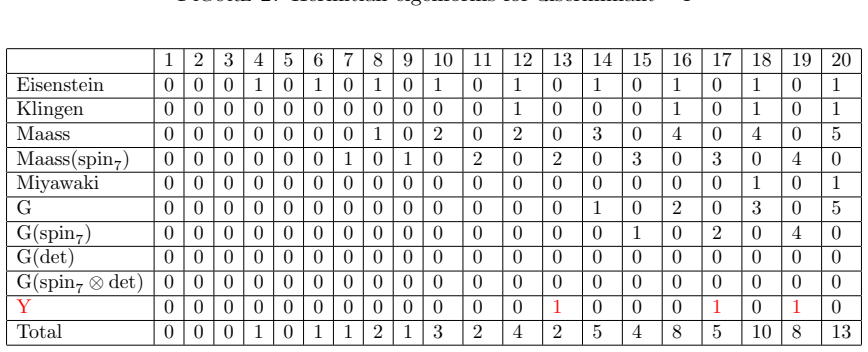
The central claim is Conjecture 9: for an imaginary quadratic field K and the genus L_K of even rank-six lattices with discriminant form (O'_K/O_K, -N_{K/Q}), there is a one-to-one correspondence between cuspidal Hermitian eigenforms F in S_k(Gamma_K) that are not Miyawaki lifts and nonconstant algebraic eigenforms G in M_nu(Spin(L_K)), with nu = k-4, that are not Yoshida lifts. The correspondence should satisfy (i) L(F;s)=L(G;s) up to Euler factors at primes dividing Delta_K, where the left side is the degree-six zeta function and the right side the standard L-function of the algebraic eigenform; (ii) the spinor character of G is the product of spin_p over exactly those primes for which the Atkin–Lehner involution W_p acts on F by -1; and (iii) F lies in the Sugano Maass space exactly when G is not in the kernel of the theta map. The paper's evidence is dimensional and computational: the mass of the genus gives the same asymptotic growth as the Hermitian dimension formula, and for discriminants -3, -4, -7, -8, -11 the full generating series of dimensions match after subtracting Eisenstein, Klingen, and Miyawaki lifts on the Hermitian side and constants and Yoshida lifts on the algebraic side.
Load-bearing premise
The load-bearing premise is that the algebraic normalization of the Satake-transform L-factors on the SO(6) side agrees exactly with the classical normalization of the degree-six zeta function on the Hermitian side; if the two normalizations differ by a power of p or a sign, the matching Euler factors would be normalization artifacts rather than evidence for the correspondence.
Editorial extensions
If this is right
- Non-Miyawaki cuspidal Hermitian eigenforms and non-Yoshida SO(6) eigenforms are two descriptions of the same set of Hecke eigensystems, with the weight shifted by four.
- For the five discriminants where both dimension series are known, the comparison is exact after subtracting Eisenstein, Klingen, and Miyawaki lifts on the Hermitian side and constants and Yoshida lifts on the algebraic side.
- The spinor character of the algebraic form encodes exactly which Atkin–Lehner involutions act by -1 on the Hermitian form, so the maximal discrete extension corresponds to the trivial spin character.
- The Sugano Maass space coincides with the image of the theta map, so a positive solution of the Eichler basis problem for rank-six lattices would prove the Maass-space part of the conjecture.
- Yoshida lifts account for algebraic eigenforms with no Hermitian counterpart, explaining the surplus in dimensions for discriminants such as -91 and -104.
Reading between the lines
- If the conjecture is right, the Hecke eigensystems of level-one Hermitian cusp forms can be computed from finite-dimensional spaces of harmonic polynomials in six variables, bypassing expensive Fourier-coefficient computations on the tube domain.
- The weight shift and the matching of spinor characters to Atkin–Lehner signs suggest an explicit theta-correspondence between SU(2,2) and Spin(6); proving it would extend the proved Sp(2) paramodular analogue to this setting.
- The apparent Yoshida lifts from Hilbert modular forms and CM forms of weight three suggest a broader family of algebraic eigenforms without Hermitian counterparts; comparing M_0(Spin(L_K)) with weight-four Jacobi forms for larger discriminants would test this directly.
- A natural next step is to verify the L-function equality for the one known weight-40 pair over Q(sqrt(-3)) at several primes, since the paper supplies the dimension match and explicit checks mainly for lift cases.
Editorial analysis
A structured set of objections, weighed in public.
Referee Report
Summary. The paper states a conjectural correspondence between cuspidal Hermitian modular forms of degree two for the full group Γ_K and algebraic modular forms for the compact group SO(6) associated to the genus L_K of rank-six lattices with discriminant form of K. The main conjecture, Conjecture 9, asserts a one-to-one correspondence between non-Miyawaki Hermitian eigenforms of weight k and non-Yoshida algebraic eigenforms of weight k−4, with matching degree-six zeta functions, matching spinor characters and Atkin–Lehner signs, and an identification between the Sugano Maass space and the image of the theta map. The paper supplies evidence in several forms: asymptotic dimension main terms derived from independent volume and mass formulas, exact dimension equalities after subtracting Eisenstein, Klingen, Miyawaki, and Yoshida contributions for discriminants −3, −4, −7, −8, and −11 (Theorem 17), explicit Euler-factor coincidences in Examples 7 and 8, extensive tables of eigenform decompositions in Appendix B, low-weight comparisons in Appendix C, and a new dimension formula for Q(√−2) proved in Appendix A.
Significance. If the conjectural correspondence is correct, it provides a concrete and computationally accessible instance of Langlands functoriality between SU(2,2) and its compact inner form SO(6), with precise relations between classical Hermitian modular forms, algebraic modular forms, L-functions, and theta lifts. The paper is careful to present the correspondence as a conjecture rather than a theorem, and the evidence is substantial: the dimension main terms come from independent volume and Minkowski–Siegel mass formulas, the Hilbert series are either prior theorems or a new derivation, and the comparisons involve no fitted parameters. The authors also make their SageMath code and supporting data available, which adds reproducibility. The main weakness is that the L-function equality in Conjecture 9(i) relies on an unproved modification of Murphy's Satake transform formula, and the Miyawaki L-function formula is likewise stated without proof; these points are load-bearing for the Euler-factor evidence.
major comments (3)
- [3.3] The algebraic normalization of Murphy's Satake transform is stated but not derived. The text says only that "We have to modify Murphy's result slightly to get the algebraic normalization of the L-function," and the displayed Euler factors contain p-powers such as p^{ν+1}, p^{2ν+3}, and p^{6ν+12}. Since Conjecture 9(i) asserts equality between the Hermitian degree-six zeta function and this standard L-function, and since the Euler-factor matches in Examples 7 and 8 and in Appendix C are computed using this unverified normalization, an error of even one p-power or a sign would make those matches normalization artifacts rather than evidence. A derivation of the modification, or an independent check (for example, by comparing with a known transfer or by recomputing a local Satake transform in a degenerate case), is needed before the Euler-factor comparisons can support the conjecture.
- [2.4] The formula L(F_{f,g}; s) = ζ_K(s−k+2) L(f⊗g; s) for the degree-six L-function of a Miyawaki lift is not proved in the paper. The text states that "from numerical examples it is clear" and "presumably this can be derived from the work of [7]". This formula is used to identify Miyawaki lifts in the Hecke eigenvalue computations of Appendix B and to split the spaces into Miyawaki and non-Miyawaki parts. Since the phrase "not Miyawaki" is a standing assumption in Conjecture 9 and in the interpretation of the tables, the formula should either be proved or stated explicitly as a separate conjecture, with a discussion of how the tabulated decompositions would be affected if it failed.
- [4] The Yoshida lifts Y_{f,g,h} are introduced only through their conjectured standard L-function L(f⊗g; s)L(h; s−ν−1); no construction or independent characterization is proposed. Consequently, the Euler-factor coincidences in Examples 7 and 8, while striking, are matches against a conjectural defining property rather than against an independently constructed lift. The paper should state this limitation explicitly, since Theorem 17 subtracts the Yoshida generating series to obtain exact dimension equalities, and the interpretation of that equality as evidence for Conjecture 5 depends on the eventual existence of such lifts.
minor comments (4)
- [Theorem 17] In the statement of Theorem 17, the character in dim S3(Γ0(|∆K|), χk) should be χ_K, not χk.
- [Remark 4] Remark 4 assumes the five denominator degrees a1,...,a5 are coprime, but for Δ = −8 the degrees are 2, 6, 8, 10, 12, which are not coprime; the partial-fraction argument as written does not directly apply in that case, although the conclusion may still be correct.
- [Appendix C] The table in Appendix C mixes headings "−∆" and "−D" for the same quantity; the notation should be unified.
- [3.1] The notation for the spin-character eigenspaces is not completely consistent: Mν(Spin(LK)) is used both for the full space defined via U0(L) and, in Section 6.1, for the sum ∑_d dim Mν(LK, spind); this dual use should be clarified.
Circularity Check
No significant circularity: the main evidence is an independent dimension comparison via volume, mass, and Hilbert-series computations; the unproved Murphy normalization in Section 3.3 is a correctness gap, not a circular reduction.
full rationale
The paper's central derivation chain is not circular. The dimension evidence is self-contained: Proposition 12 computes the mass of the genus L_D from the Minkowski–Siegel formula and local densities, yielding the Bernoulli number B_{3,chi_K} with no fitted constants; Proposition 13 compares this with the volume-based asymptotic (2.2) for Hermitian modular forms, which comes from an independent fundamental-domain volume. Theorem 17 is an exact generating-function identity for the five small discriminants, using Hilbert series from Theorem 3 (prior theorems by Dern–Krieg, Nagaoka, Aoki, Williams) and the new Jacobi-form derivation in Appendix A, together with Molien-series computations of algebraic modular forms. No parameter is adjusted to force the equality. The Euler-factor coincidences in Examples 7 and 8 and Appendix C do depend on the assertion in Section 3.3, 'We have to modify Murphy's result slightly to get the algebraic normalization of the L-function', and that modification is not derived; but this is an unverified external input, not a circularity, because the paper does not define the algebraic L-function to be equal to the Hermitian degree-six zeta function. The equality is instead posed as the content of Conjecture 9(i), and the examples are presented as experimental checks. Similarly, the statement in Section 2.4 that the Miyawaki degree-six L-function 'presumably can be derived from the work of [7]' is an admitted missing proof, not a circular definition. The self-citations to prior work of the authors (e.g., Williams [60], Wang–Williams [56], [57]) are used as published, independently stated theorems about Hermitian modular forms or Jacobi forms, and they do not assume the correspondence being conjectured. Therefore the paper has no significant circularity, though it does carry unproved normalization assumptions that affect the strength of the L-function evidence.
Assumptions & free parameters
assumptions (7)
- domain assumption Langlands philosophy predicts a Hecke-equivariant correspondence between automorphic forms on G and G' whenever G ⊗ C is isomorphic to G' ⊗ C.
- standard math Nikulin's classification: a genus of even integral lattices is determined by signature and discriminant form.
- standard math Minkowski-Siegel mass formula and Kitaoka's local density formulas for even lattices.
- standard math Known complete dimension formulas and Hilbert series for Hermitian modular forms for discriminants -3, -4, -7, -11.
- standard math Every leading Fourier-Jacobi coefficient built from weak Jacobi forms as described extends to a holomorphic Hermitian modular form, the Norm 2-condition of [57].
- ad hoc to paper The degree-six L-function of a Miyawaki lift is ζ_K(s - k + 2) L(f ⊗ g; s).
- domain assumption Murphy's Satake-transform L-factors for SO(6) remain valid after the paper's algebraic normalization modification, and coincide with the Hina-Sugano-Gritsenko Hermitian L-function.
invented entities (1)
-
Yoshida lifts Y_{f,g,h} on SO(L_D)
independent evidence
Cite this review
Pith. "Pith review of Hermitian modular forms and algebraic modular forms on $SO(6)$." pith.science (2026). https://pith.science/paper/3PBJSIXO
@misc{pith2026250523497,
  author       = {Pith},
  title        = {Pith review of: Hermitian modular forms and algebraic modular forms on $SO(6)$},
  year         = {2026},
  howpublished = {\url{https://pith.science/paper/3PBJSIXO}},
  note         = {Machine review of arXiv:2505.23497}
}
abstract
We state conjectures that relate Hermitian modular forms of degree two and algebraic modular forms for the compact group $SO(6)$. We provide evidence for these conjectures in the form of dimension formulas and explicit computations of eigenforms.
Figures


Figures from the paper (3 more)


Reference graph
Works this paper leans on
-
[7]
On the Miyawaki lifts of Hermitian modular forms
Hiraku Atobe and Hisashi Kojima. On the Miyawaki lifts of Hermitian modular forms. J. Number Theory, 185:281–318, 2018. ISSN 0022-314X
work page 2018
-
[1]
URL https://github.com/btw-47/Algebraic-and-Hermitian-modular-forms
Supporting data. URL https://github.com/btw-47/Algebraic-and-Hermitian-modular-forms
-
[2]
Hecke operators on Jacobi forms of lattice index and the relation to elliptic modular forms
Ali Ajouz. Hecke operators on Jacobi forms of lattice index and the relation to elliptic modular forms. Dissertation (adviser N. Skoruppa), 2015. URLhttps://dspace.ub.uni-siegen.de/entities/ publication/ffc31054-bbde-42af-bf74-5ac965d515d8
work page 2015
-
[3]
H. Aoki. The graded ring of Hermitian modular forms of degree 2. Abh. Math. Sem. Univ. Hamburg , 72:21–34, 2002
work page 2002
-
[4]
T. Arakawa, T. Ibukiyama, and M. Kaneko. Bernoulli numbers and zeta functions . Springer Verlag, 2014
work page 2014
-
[5]
On certain Dirichlet series associated with Hilbert modular forms and Rankin’s method
Tetsuya Asai. On certain Dirichlet series associated with Hilbert modular forms and Rankin’s method. Math. Ann., 226(1):81–94, 1977
work page 1977
-
[6]
Definite orthogonal modular forms: computations, excursions, and discoveries
Eran Assaf, Dan Fretwell, Colin Ingalls, Adam Logan, Spencer Secord, and John Voight. Definite orthogonal modular forms: computations, excursions, and discoveries. Res. Number Theory, 8(4):Paper No. 70, 32, 2022
work page 2022
-
[8]
On Borcherds products associated with lattices of prime discriminant
Jan Hendrik Bruinier and Michael Bundschuh. On Borcherds products associated with lattices of prime discriminant. Ramanujan J., 7(1-3):49–61, 2003. Rankin Memorial Issues
work page 2003
Show all 65 references
-
[9]
J. W. S. Cassels. Rational quadratic forms (Dover books on Mathematics) . Dover, 2008
2008
-
[10]
Hermitesche Modulformen zweiten Grades
Tobias Dern. Hermitesche Modulformen zweiten Grades. Dissertation (advisers A. Krieg, N.-P. Sko- ruppa), R WTH Aachen, 2001. URL http://publications.rwth-aachen.de/record/95377/files/ Dern_Tobias.pdf
2001
-
[11]
Graded rings of Hermitian modular forms of degree 2
Tobias Dern and Aloys Krieg. Graded rings of Hermitian modular forms of degree 2. Manuscripta Math., 110(2):251–272, 2003
2003
-
[12]
The graded ring of Hermitian modular forms of degree 2 over Q(√−2)
Tobias Dern and Aloys Krieg. The graded ring of Hermitian modular forms of degree 2 over Q(√−2). J. Number Theory , 107(2):241–265, 2004
2004
-
[13]
Dummigan, A
N. Dummigan, A. Pacetti, G. Rama, and G. Tornar ´ ıa. Quinary forms and paramodular forms. Math. Comp., 93(348), 2024
2024
-
[14]
¨Uber die Darstellbarkeit von Modulformen durch Thetareihen
Martin Eichler. ¨Uber die Darstellbarkeit von Modulformen durch Thetareihen. J. Number Theory, 195: 156–171, 1955
1955
-
[15]
The theory of Jacobi forms , volume 55 of Progress in Mathematics
Martin Eichler and Don Zagier. The theory of Jacobi forms , volume 55 of Progress in Mathematics . Birkh¨ auser Boston, Inc., Boston, MA, 1985
1985
-
[16]
Dimensionsformeln f¨ ur R¨ aume von hermiteschen Spitzenformen vom Grad 2
Andreas Freh. Dimensionsformeln f¨ ur R¨ aume von hermiteschen Spitzenformen vom Grad 2. Dissertation (adviser A. Krieg), R WTH Aachen University, 2017. URL https://publications.rwth-aachen.de/ record/706670/files/706670.pdf
2017
-
[17]
Lattice methods for algebraic modular forms on classical groups
Matthew Greenberg and John Voight. Lattice methods for algebraic modular forms on classical groups. In Computations with modular forms, volume 6 of Contrib. Math. Comput. Sci., pages 147–179. Springer, Cham, 2014
2014
-
[18]
Gritsenko, K
V. Gritsenko, K. Hulek, and G. K. Sankaran. The Hirzebruch-Mumford volume for the orthogonal group and applications. Doc. Math., 12:215–241, 2007
2007
-
[19]
V. A. Gritsenko. The zeta function of degree six for Hermitian modular forms of genus 2. Zap. Nauchn. Sem. Leningrad. Otdel. Mat. Inst. Steklov. (LOMI) , 154(Anal. Teor. Chisel i Teor. Funktsi ˘ ı. 7):46–66, 176–177, 1986
1986
-
[20]
V. A. Gritsenko. Jacobi functions and Euler products for Hermitian modular forms. Zap. Nauchn. Sem. Leningrad. Otdel. Mat. Inst. Steklov. (LOMI) , 183(Modul. Funktsii i Kvadrat. Formy. 1):77–123, 165–166, 167–168, 1990
1990
-
[21]
Benedict H. Gross. Algebraic modular forms. Israel J. Math. , 113:61–93, 1999
1999
-
[22]
On Brandt matrices associated with the positive definite quaternion Hermitian forms
Ki-ichiro Hashimoto. On Brandt matrices associated with the positive definite quaternion Hermitian forms. J. Fac. Sci. Univ. Tokyo Sect. IA , 27:227–245, 1980
1980
-
[23]
On Hecke theory for Hermitian modular forms
Adrian Hauffe-Waschb¨ usch and Aloys Krieg. On Hecke theory for Hermitian modular forms. InModular forms and related topics in number theory , volume 340 of Springer Proc. Math. Stat. , pages 73–88. Springer, Singapore, 2020. 32
2020
-
[24]
Haverkamp
Klaus K. Haverkamp. Hermitian Jacobi forms. Results Math., 29(1-2):78–89, 1996
1996
-
[25]
Orthogonal modular forms: an application to a conjecture of Birch, algorithms and computations
Jeffery Hein. Orthogonal modular forms: an application to a conjecture of Birch, algorithms and computations. Dissertation (adviser J. Voight), 2016. URL https://www.proquest.com/docview/ 1811951906/
2016
-
[26]
On the local Hecke series of some classical groups over p-adic fields
Tatsuo Hina and Takashi Sugano. On the local Hecke series of some classical groups over p-adic fields. J. Math. Soc. Japan , 35(1):133–152, 1983
1983
-
[27]
On relations of dimensions of automorphic forms of Sp(2 , R) and its compact twist Sp(2)
Tomoyoshi Ibukiyama. On relations of dimensions of automorphic forms of Sp(2 , R) and its compact twist Sp(2). I. In Automorphic forms and number theory (Sendai, 1983) , volume 7 of Adv. Stud. Pure Math., pages 7–30. North-Holland, Amsterdam, 1985
1983
-
[28]
A remark on the Hermitian modular forms
Tomoyoshi Ibukiyama. A remark on the Hermitian modular forms. Osaka University Research Reports Math., 99-19, 1999
1999
-
[29]
Parmodular forms and compact twist
Tomoyoshi Ibukiyama. Parmodular forms and compact twist. In Automorphic Forms on GSp(4), Proceedings of 9-th Autumn workshop 2006., pages 37–48. Osaka City University, 2007. URL http: //www.math.sci.osaka-u.ac.jp/~ibukiyam/en/pdf/hn4_4.pdf
2006
-
[30]
Dimension formulas of paramodular forms of squarefree level and comparison with inner twist
Tomoyoshi Ibukiyama and Hidetaka Kitayama. Dimension formulas of paramodular forms of squarefree level and comparison with inner twist. J. Math. Soc. Japan , 69(2):597–671, 2017. ISSN 0025-5645. doi: 10.2969/jmsj/06920597. URL https://doi.org/10.2969/jmsj/06920597
2017
-
[31]
On zeta functions associated to symmetric matrices I: An explicit form of zeta functions
Tomoyoshi Ibukiyama and Hiroshi Saito. On zeta functions associated to symmetric matrices I: An explicit form of zeta functions. Amer. J. Math. , 117:1097–1155, 1995
1995
-
[32]
On certain arithmetical Dirichlet series
Yasutaka Ihara. On certain arithmetical Dirichlet series. J. Math. Soc. Japan , 16:214–225, 1964
1964
-
[33]
On the lifting of Hermitian modular forms
Tamotsu Ikeda. On the lifting of Hermitian modular forms. Compos. Math., 144(5):1107–1154, 2008. ISSN 0010-437X
2008
-
[34]
Langlands
Herv´ e Jacquet and Robert P. Langlands. Automorphic forms on GL(2), volume 114 of Lecture Notes in Mathematics . Springer, Berlin-New York, 1970
1970
-
[35]
Arithmetic of quadratic forms , volume 106 of Cambridge Tracts Math
Yoshiyuki Kitaoka. Arithmetic of quadratic forms , volume 106 of Cambridge Tracts Math. Cambridge Univ. Press, 1993
1993
-
[36]
A note on Hecke eigenvalues of Hermitian Siegel Eisenstein series
Krzysztof Klosin. A note on Hecke eigenvalues of Hermitian Siegel Eisenstein series. Ramanujan J., 35 (2):287–298, 2014
2014
-
[37]
Quadratische Formen
Martin Kneser. Quadratische Formen . Springer-Verlag, Berlin, 2002. ISBN 3-540-64650-7. doi: 10. 1007/978-3-642-56380-5. URL https://doi.org/10.1007/978-3-642-56380-5 . Revised and edited in collaboration with Rudolf Scharlau
2002 doi
-
[38]
Krieg, M
A. Krieg, M. Raum, and A. Wernz. The maximal discrete extension of the Hermitian modular group. Doc. Math., 26:1871–1888, 2021
2021
-
[39]
The Maaß spaces on the Hermitian half-space of degree 2
Aloys Krieg. The Maaß spaces on the Hermitian half-space of degree 2. Math. Ann. , 289(4):663–681, 1991
1991
-
[40]
M. L. Mehta. Basic sets of invariant polynomials for finite reflection groups. Comm. Algebra, 16(5): 1083–1098, 1988
1988
-
[41]
M¨ uller
Manuel K.-H. M¨ uller. The basis problem for modular forms for the Weil representation. arXiv:2407.01205, 2024
2024 arXiv
-
[42]
Algebraic modular forms on definite groups
Daniel Kim Murphy. Algebraic modular forms on definite groups. Dissertation (adviser A. Venkatesh),
-
[43]
A note on the structure of the ring of symmetric Hermitian modular forms of degree 2 over the Gaussian field
Shoyu Nagaoka. A note on the structure of the ring of symmetric Hermitian modular forms of degree 2 over the Gaussian field. J. Math. Soc. Japan , 48(3):525–549, 1996
1996
-
[44]
V. V. Nikulin. Integer symmetric bilinear forms and some of their geometric applications. Izv. Akad. Nauk SSSR Ser. Mat. , 43(1):111–177, 238, 1979
1979
-
[45]
Computation of Eisenstein series associated with discriminant forms
Sebastian Opitz. Computation of Eisenstein series associated with discriminant forms. Dissertation (adviser J.H. Bruinier), TU Darmstadt, 2018. URL https://tuprints.ulb.tu-darmstadt.de/8261/ 1/20181203_Dissertation_Sebastian_Opitz.pdf
2018
-
[46]
Plesken and B
W. Plesken and B. Souvignier. Computing isometries of lattices. J. Symbolic Comput., 24(3-4):327–334, 1997
1997
-
[47]
Computation of paramodular forms
Gustavo Rama and Gonzalo Tornar ´ ıa. Computation of paramodular forms. InANTS XIV—Proceedings of the Fourteenth Algorithmic Number Theory Symposium , volume 4 of Open Book Ser., pages 353–370. 33 Math. Sci. Publ., Berkeley, CA, 2020
2020
-
[48]
Global liftings between inner forms of GSp(4).J
Mirko R¨ osner and Rainer Weissauer. Global liftings between inner forms of GSp(4).J. Number Theory, 263:79–138, 2024. ISSN 0022-314X,1096-1658. doi: 10.1016/j.jnt.2024.04.010. URL https://doi.org/ 10.1016/j.jnt.2024.04.010
2024 doi
-
[49]
Twisted component sums of vector-valued modular forms
Markus Schwagenscheidt and Brandon Williams. Twisted component sums of vector-valued modular forms. Abh. Math. Semin. Univ. Hambg. , 89(2):151–168, 2019
2019
-
[50]
On zeta functions of quaternion algebras
Hideo Shimizu. On zeta functions of quaternion algebras. Ann. of Math.(2) , 81:166–193, 1965
1965
-
[51]
Euler products and Eisenstein series , volume 93 of CBMS Regional Conference Series in Mathematics
Goro Shimura. Euler products and Eisenstein series , volume 93 of CBMS Regional Conference Series in Mathematics . Published for the Conference Board of the Mathematical Sciences, Washington, DC; by the American Mathematical Society, Providence, RI, 1997
1997
-
[52]
On Maass space of SU(2,2) (in Japanese)
Takashi Sugano. On Maass space of SU(2,2) (in Japanese). Suriken Kokyuroku, RIMS, Kyoto, 546:1–16,
-
[53]
Jacobi forms and the theta lifting
Takashi Sugano. Jacobi forms and the theta lifting. Comment. Math. Univ. St. Paul. , 44(1):1–58, 1995. URL https://rikkyo.repo.nii.ac.jp/records/9951
1995
-
[54]
The Brandt module of ternary quadratic lattices
Gonzalo Tornaria. The Brandt module of ternary quadratic lattices. Dissertation (adviser F. Rodriguez- Villegas), 2005. URL https://www.cmat.edu.uy/~tornaria/pub/tornaria_thesis.pdf
2005
-
[55]
A geometric Jacquet-Langlands correspondence for paramodular Siegel threefolds
Pol van Hoften. A geometric Jacquet-Langlands correspondence for paramodular Siegel threefolds. Math. Z. , 299:2029–2061, 2021
2021
-
[56]
On weak Jacobi forms of rank two
Haowu Wang and Brandon Williams. On weak Jacobi forms of rank two. J. Algebra, 634:722–754, 2023
2023
-
[57]
Modular forms with poles on hyperplane arrangements
Haowu Wang and Brandon Williams. Modular forms with poles on hyperplane arrangements. Algebr. Geom., 11(4):506–568, 2024. ISSN 2313-1691
2024
-
[58]
On Hermitian modular groups and modular forms
Annalena Wernz. On Hermitian modular groups and modular forms. Dissertation (adviser A. Krieg),
-
[59]
Hermitian theta series and Maaß spaces under the action of the maximal discrete extension of the Hermitian modular group
Annalena Wernz. Hermitian theta series and Maaß spaces under the action of the maximal discrete extension of the Hermitian modular group. Results Math., 75(4):Paper No. 163, 10, 2020
2020
-
[60]
Two graded rings of Hermitian modular forms
Brandon Williams. Two graded rings of Hermitian modular forms. Abh. Math. Semin. Univ. Hambg. , 91(2):257–285, 2021
2021
-
[61]
Miyawaki
Brandon Williams. Weilrep. Accessed February 14, 2025. URL https://github.com/btw-47/weilrep. Appendix A. The dimension formula forQ(√−2) A set of generators for the graded ring of Hermitian modular forms over Q(√−2) was computed by Dern and Krieg [12], but they do not give a ...
2025
-
[65]
and the CM form of weight 3 and level 8); as for the other form, which has trivial spin character, one can use Borcherds products to show that there is a Hermitian cusp form, not belonging to the Maass space, of weight 4 for the field Q(√−136). Department of Mathematics, Gradu...
-
[1985]
URL https://www.kurims.kyoto-u.ac.jp/~kyodo/kokyuroku/contents/pdf/0546-01.pdf
-
[2013]
URL https://stacks.stanford.edu/file/druid:pv404zw1184/thesis.pdftk-augmented. pdf
-
[2019]
URL https://www.mathematik.rwth-aachen.de/go/id/ckus/lidx/1/file/764825
Reviewed August 7, 2026 · model on record in the stance chip above.
Discussion (0). Sign in to comment.